REVIEW 4 major objections 4 minor 40 references
Topological Learning Prediction of Virus-like Particle Stoichiometry and Stability
T0 review · 4 major / 4 minor · reviewed 2026-08-06 · deepseek-v4-flash
Pith's one-line read Persistent Laplacian spectra of capsid asymmetric units classify VLP stoichiometry with AUC 0.94 and order VLP stability as 180-mer > 60-mer > 420-mer > 240-mer.
desk verdict The VLP706 numbers are not trustworthy—the asymmetric-unit features can read the label from atom counts—but the dataset and the VLP200 result are worth a careful look. read the letter →
The pith
A machine-rendered reading of the paper's core claim, the machinery that carries it, and where it could break.
The reading
What carries the argument
The machinery is the persistent Laplacian of a filtered simplicial complex, an operator $L^{s,t}_p = \partial^{s,t}_{p+1}(\partial^{s,t}_{p+1})^* + (\partial_p)^*\partial_p$ whose zero-eigenvalue part reproduces persistent homology while its nonzero eigenvalues add geometric information. Each VLP is reduced to its asymmetric unit; six element-specific atom sets (C$\alpha$, N, O, and their pairwise unions) are turned into distance-based and $\alpha$ complexes; harmonic and non-harmonic persistent Laplacian spectra are binned and summarized into a 1044-dimensional feature vector; and gradient-boosted trees perform classification. A separate sequence-perturbation analysis replaces structure features with embeddings from a pretrained protein language model to test stability.
What would settle it
Train the same gradient-boosted classifier using only the number of chains, or total atom count, in each extracted asymmetric unit and compare cross-validated AUC on VLP706; if that trivial size feature matches the reported 0.956 AUC, the persistent Laplacian is not the deciding signal. A second check is to keep the unit sizes fixed while randomly rotating or scrambling atomic coordinates and see whether accuracy collapses, which would confirm that real geometry matters.
Extended reading notes
Core claim
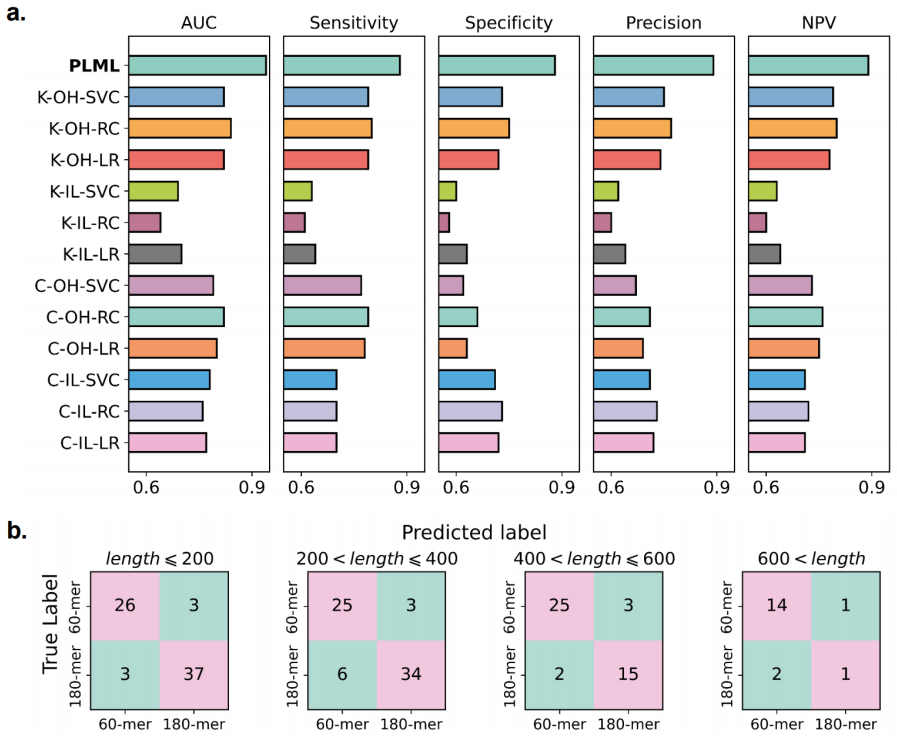
On the paper's own terms, the central claim is that persistent Laplacian spectra encode enough structural information about an icosahedral capsid's asymmetric unit to classify its stoichiometry across triangulation numbers T = 1, 3, 4, and 7. On the VLP200 dataset the model reports AUC 0.94, sensitivity 0.88, specificity 0.88, precision 0.89, and NPV 0.89, each above the best prior method. On the new VLP706 dataset it reports a 4-class accuracy of 0.858 and macro-averaged AUC of 0.956, with binary accuracies of 0.983 (60 vs 180), 0.993 (60 vs 240), and 0.925 (180 vs 240). The paper further claims that random insertion and deletion of up to 50% of residues, measured through a sequence-based model's accuracy drop, shows 180-mers retain accuracy up to about 35% perturbation, 60-mers and 420-mers up to about 10%, and 240-mers only about 5%, leading to the conclusion that 60- and 180-mers are more stable and better suited as platforms for vaccine and therapeutic display.
Load-bearing premise
The load-bearing premise is that the features generated from each capsid's asymmetric unit reflect structure rather than particle size, so the classifier is not simply learning the label from how many protein chains or atoms the unit contains.
Editorial extensions
If this is right
- Stoichiometry labels for icosahedral VLPs can be assigned from structure alone, so new capsid designs can be checked computationally before experimental assembly.
- The VLP706 collection extends stoichiometry benchmarks beyond the two-class setting, giving the field a four-class testbed with 60-, 180-, 240-, and 420-mers.
- If persistent Laplacian features are the cause of the edge, structural geometry carries prediction signal that sequence-only models miss.
- The stability ranking 180-mer > 60-mer > 420-mer > 240-mer gives a concrete selection rule for choosing VLP scaffolds to carry antigens or therapeutic payloads.
Reading between the lines
- Beyond the paper: the method's reliance on asymmetric units means its real test is whether it can predict stoichiometry for capsids that break exact icosahedral symmetry or for pseudo-T-number assemblies; those cases are not in the current datasets.
- Beyond the paper: the stability ordering is measured by a sequence model's classification accuracy, not by physical assembly assays; mutating residues that disrupt interfaces could show a different order, and an experimental assembly screen on a few 180- vs 240-mer pairs would settle it.
- Beyond the paper: because the T-number labels are defined by chain count, a control that removes all geometry, such as randomizing atomic coordinates while preserving counts, would show whether the topological features are doing the work or the label is leaking through the asymmetric unit's size.
- Beyond the paper: if the method transfers, symmetric protein nanocages and other self-assembling particles with discrete subunit numbers are natural next targets for the same persistent Laplacian pipeline.
Editorial analysis
A structured set of objections, weighed in public.
Referee Report
Summary. The paper introduces a persistent Laplacian-based machine learning (PLML) model for predicting virus-like particle (VLP) stoichiometry from structural features, and a sequence-perturbation analysis intended to evaluate VLP stability. The model is evaluated on the existing VLP200 dataset, where it reportedly outperforms published baselines (AUC 0.94 vs 0.84), and on a newly curated VLP706 dataset with four stoichiometry classes (60-, 180-, 240-, 420-mers), where it reports an accuracy of 0.858 and a macro-averaged AUC of 0.956. Based on classifier accuracy on sequences with random insertions/deletions, the authors conclude that 60-mer and 180-mer VLPs are more stable than 240-mer and 420-mer VLPs.
Significance. The proposed use of persistent Laplacian spectra (both harmonic and non-harmonic) is methodologically interesting, and the authors make their code and the new VLP706 dataset publicly available. The VLP200 result, if robust, would provide a fast computational screen for VLP stoichiometry. However, the VLP706 evaluation appears to be compromised by label leakage: the input features are derived from icosahedral asymmetric units whose chain count is directly proportional to the stoichiometry label. The stability analysis is also not a biophysical measure of stability but rather a classifier-accuracy curve under sequence perturbation. These issues currently undermine the paper's central claims, although the VLP200 contribution is potentially salvageable with additional controls.
major comments (4)
- [Section 2.2.1 and Section 4.2] The VLP706 dataset is constructed by selecting PDB assemblies with exactly 60, 180, 240, or 420 chains under icosahedral symmetry (Section 2.2.1), and Section 4.2 states that all topological features are computed from 'atoms within the asymmetric unit.' In standard icosahedral capsid geometry, the asymmetric unit contains T copies of the capsid protein, where T equals 1, 3, 4, and 7 for 60-, 180-, 240-, and 420-mers, respectively. Consequently, any feature that depends on atom count or the number of chain copies—such as the number of 0-D harmonic eigenvalues, eigenvalue sums and counts, and Alpha-complex barcode counts—is an approximately monotone function of the stoichiometry label. A gradient-boosting tree can achieve the reported VLP706 accuracy by reading feature scale alone, without learning any biological pattern. The paper does not define how the asymmetric unit was extracted, nor does it normalize features by T or provide a control using only size-based features. This invalidates the VLP706 classification results as evidence of generalization and also undermines the stability analysis that relies on the VLP706-trained model.
- [Section 2.3 and Figure 3] The stability claim ('60-mers and 180-mers exhibit greater stability than 240-mers and 420-mers') is derived from the accuracy of a sequence classifier (SeqGBT) on sequences with random insertions and deletions. Classifier accuracy under input perturbation is not a biophysical measure of VLP structural stability; it reflects the classifier's decision boundary and the geometry of ESM-2 embeddings. The 85%-of-baseline threshold is arbitrary, the non-monotonic 180-mer curve is unexplained, and no calibration against experimental stability data (e.g., thermal or chemical denaturation, assembly/disassembly assays) is provided. Moreover, SeqGBT is trained on the full VLP706 dataset and then evaluated on perturbed copies of the same training data, so the baseline accuracy is likely inflated by memorization rather than representing true generalization. This section should be removed or completely redesigned using held-out data and a validated stability metric.
- [Table 2 and Section 2.2.4] Table 2 reports VLP706 results without standard deviations or significance tests, despite the VLP200 table (Table 1) including mean ± standard deviation. The 4-class AUC is macro-averaged one-vs-rest, which is sensitive to the severe class imbalance (47 samples for the 420-mer class). More importantly, there is no control experiment that would detect label leakage, such as training a model on the raw atom count or chain count alone and comparing performance. Reporting such a control is essential to support the claim that the topological features, rather than trivial size cues, drive the predictions. Without these controls, the VLP706 performance numbers are not interpretable.
- [Section 2.2.3 and Section 4] For VLP200, the features are generated from AlphaFold2 monomer structures, and the label leakage affecting VLP706 is avoided because the input is a single chain. However, many features, such as the number of atoms and the number of 0-D harmonic eigenvalues, are proportional to sequence length. The paper reports performance stratified by sequence-length groups (Figure 2b) but does not report the class distribution within each length group or the correlation between sequence length and stoichiometry label. To rule out a trivial length cue, the authors should either normalize features by the number of residues/atoms or report the confusion matrices and class balance per length group. Without this, the VLP200 result, while promising, is not yet conclusive.
minor comments (4)
- [Section 2.3] The sentence 'The coat proteins of Qβ virions may show high versatility and can have diverse forms of [1]' is incomplete; it should be rephrased to finish the thought.
- [Section 4] There is a typo 'datsets' in the first paragraph; it should be 'datasets.' Also, 'up tp 35%' in Section 2.3 should be 'up to 35%.'
- [References] Reference [8] concerns multi-gene expression stoichiometry in mammalian cells, not capsid protein stoichiometry in VLPs; it does not support the statement in the Introduction about VLP stoichiometry determining assembly and immunogenicity.
- [Figure 1 and Section 4.2] The term 'asymmetric unit' is used without definition. The authors should specify whether it is the icosahedral asymmetric unit of the biological assembly or the crystallographic asymmetric unit, and describe how it was extracted from the PDB entries.
Circularity Check
VLP706 stoichiometry prediction reduces to reading T from the asymmetric-unit atom count; VLP200 comparison is independent.
-
self definitional
[Section 2.2.1 (dataset construction), Section 4.2 (persistent-Laplacian vectorization), Figure 1 caption]
"Specifically, we set the 'Full Text' field to 'virus-like particle', select the number of protein instances (chains) per assembly as 60, 180, 240, and 420 for 60-mer, 180-mer, 240-mer, and 420-mer respectively under the 'Assembly Features' section of 'Structure Attributes', and specify the 'Symmetry Type' as icosahedral. ... Given the large size of typical VLP structures, we restrict our analysis to atoms within the asymmetric unit to reduce computational cost."
The paper itself invokes Caspar-Klug theory: 'a T-number corresponds to 60T protein subunits.' For icosahedral particles, the asymmetric unit contains T copies of the capsid protein, so for VLP706 (T=1,3,4,7 for 60-, 180-, 240-, and 420-mers) the number of atoms in the asymmetric unit is T times the atoms per subunit, a linear function of the stoichiometry label. The PLML features include 0-D harmonic bin counts (connected components, i.e., atoms at small filtration), non-zero eigenvalue counts and sums, and Alpha-complex barcode counts, all monotone in atom count. A gradient-boosted tree can reach the reported ACC 0.858 and AUC 0.956 by thresholding feature scale rather than learning any independent structural pattern.
full rationale
The VLP200 evaluation is not circular: AlphaFold2 monomer structures are generated from sequences, and the 60/180 label is not present in a single-chain input, so the reported AUC 0.94 is an independent empirical result. The circularity is concentrated in VLP706. The dataset is selected by exact assembly chain count (60/180/240/420), and features are restricted to the 'asymmetric unit.' Under the standard icosahedral-ASU meaning used by the paper's own CK-theory framing, that unit contains T copies, making atom-count-sensitive persistent-Laplacian features nearly proportional to the label. Because the paper provides no normalization by T and no alternative extraction protocol, the VLP706 generalization claim is largely forced by construction. The stability analysis defines stability as classifier accuracy under perturbation (85% of baseline ACC), which is a model-robustness proxy rather than a circular derivation; it is not scored here as a circular step. Overall, the central VLP706 prediction is a self-definitional label-leak pattern, while the VLP200 comparison and the mathematical persistent-Laplacian formalism retain independent content.
Assumptions & free parameters
free parameters (2)
- Stability threshold =
0.85 of baseline accuracy
- Filtration range for Vietoris-Rips =
0 to 10 Angstrom, step 0.5
assumptions (3)
- standard math Persistent Laplacian nullity equals persistent Betti number
- domain assumption AlphaFold2/ColabFold structures are accurate enough for topological feature extraction
- ad hoc to paper Classifier accuracy under sequence perturbation is a valid proxy for VLP structural stability
Cite this review
Pith. "Pith review of Topological Learning Prediction of Virus-like Particle Stoichiometry and Stability." pith.science (2026). https://pith.science/paper/R43TXZIE
@misc{pith2026250721417,
  author       = {Pith},
  title        = {Pith review of: Topological Learning Prediction of Virus-like Particle Stoichiometry and Stability},
  year         = {2026},
  howpublished = {\url{https://pith.science/paper/R43TXZIE}},
  note         = {Machine review of arXiv:2507.21417}
}
read the original abstract
Understanding the stoichiometry and associated stability of virus-like particles (VLPs) is crucial for optimizing their assembly efficiency and immunogenic properties, which are essential for advancing biotechnology, vaccine design, and drug delivery. However, current experimental methods for determining VLP stoichiometry are labor-intensive, and time consuming. Machine learning approaches have hardly been applied to the study of VLPs. To address this challenge, we introduce a novel persistent Laplacian-based machine learning (PLML) mode that leverages both harmonic and non-harmonic spectra to capture intricate topological and geometric features of VLP structures. This approach achieves superior performance on the VLP200 dataset compared to existing methods. To further assess robustness and generalizability, we collected a new dataset, VLP706, containing 706 VLP samples with expanded stoichiometry diversity. Our PLML model maintains strong predictive accuracy on VLP706. Additionally, through random sequence perturbative mutation analysis, we found that 60-mers and 180-mers exhibit greater stability than 240-mers and 420-mers.
Figures


Figures from the paper (1 more)

Reference graph
Works this paper leans on
-
[1]
Structural assembly of q β virion and its diverse forms of virus-like particles
Jeng-Yih Chang, Karl V Gorzelnik, Jirapat Thongchol, and Junjie Zhang. Structural assembly of q β virion and its diverse forms of virus-like particles. Viruses, 14(2):225, 2022
work page 2022
-
[2]
Virus-like particles: flexible platforms for vaccine development
Bryce Chackerian. Virus-like particles: flexible platforms for vaccine development. Ex- pert review of vaccines , 6(3):381–390, 2007
work page 2007
-
[3]
Natasha Kushnir, Stephen J Streatfield, and Vidadi Yusibov. Virus-like particles as a highly efficient vaccine platform: diversity of targets and production systems and advances in clinical development. Vaccine, 31(1):58–83, 2012. 17
work page 2012
-
[4]
Virus-like particles in vaccine development
Ant´ onio Rold˜ ao, Maria Candida M Mellado, Leda R Castilho, Manuel JT Carrondo, and Paula M Alves. Virus-like particles in vaccine development. Expert review of vaccines , 9(10):1149–1176, 2010
work page 2010
-
[5]
Human hepatitis b vaccine from recom- binant yeast
William J McAleer, Eugene B Buynak, Robert Z Maigetter, D Eugene Wampler, William J Miller, and Maurice R Hilleman. Human hepatitis b vaccine from recom- binant yeast. Nature, 307(5947):178–180, 1984
work page 1984
-
[6]
Janine T Bryan, Barry Buckland, Jennifer Hammond, and Kathrin U Jansen. Preven- tion of cervical cancer: journey to develop the first human papillomavirus virus-like particle vaccine and the next generation vaccine. Current opinion in chemical biology , 32:34–47, 2016
work page 2016
-
[7]
Peter Pushko, Paul Pumpens, and Elmars Grens. Development of virus-like particle technology from small highly symmetric to large complex virus-like particle structures. Intervirology, 56(3):141–165, 2013
work page 2013
-
[8]
Chenrui Qin, Yanhui Xiang, Jie Liu, Ruilin Zhang, Ziming Liu, Tingting Li, Zhi Sun, Xiaoyi Ouyang, Yeqing Zong, Haoqian M Zhang, et al. Precise programming of multi- gene expression stoichiometry in mammalian cells by a modular and programmable transcriptional system. Nature communications, 14(1):1500, 2023
work page 2023
Show all 40 references
-
[9]
Modern analytical ultracentrifugation in protein science: a tutorial review
Jacob Lebowitz, Marc S Lewis, and Peter Schuck. Modern analytical ultracentrifugation in protein science: a tutorial review. Protein science, 11(9):2067–2079, 2002
2002
-
[10]
Light-scattering-based analysis of biomolecular interactions
Daniel Some. Light-scattering-based analysis of biomolecular interactions. Biophysical reviews, 5(2):147–158, 2013
2013
-
[11]
Quantitative mass imaging of single biological macromolecules
Gavin Young, Nikolas Hundt, Daniel Cole, Adam Fineberg, Joanna Andrecka, Andrew Tyler, Anna Olerinyova, Ayla Ansari, Erik G Marklund, Miranda P Collier, et al. Quantitative mass imaging of single biological macromolecules. Science, 360(6387): 423–427, 2018
2018
-
[12]
Classifying the stoichiometry of virus- like particles with interpretable machine learning
Jiayang Zhang, Xianyuan Liu, Wei Wu, Sina Tabakhi, Wenrui Fan, Shuo Zhou, Kang Lan Tee, Tuck Seng Wong, and Haiping Lu. Classifying the stoichiometry of virus- like particles with interpretable machine learning. arXiv preprint arXiv:2502.12049 , 2025
2025 arXiv
-
[13]
The protein data bank
Helen M Berman, John Westbrook, Zukang Feng, Gary Gilliland, Talapady N Bhat, Helge Weissig, Ilya N Shindyalov, and Philip E Bourne. The protein data bank. Nucleic acids research, 28(1):235–242, 2000
2000
-
[14]
Physical principles in the construction of regular viruses
Donald LD Caspar and Aaron Klug. Physical principles in the construction of regular viruses. In Cold Spring Harbor symposia on quantitative biology , volume 27, pages 1–24. Cold Spring Harbor Laboratory Press, 1962. 18
1962
-
[15]
Topology and data
Gunnar Carlsson. Topology and data. Bulletin of the American Mathematical Society , 46(2):255–308, 2009
2009
-
[16]
A topological approach for protein classification
Zixuan Cang, Lin Mu, Kedi Wu, Kristopher Opron, Kelin Xia, and Guo-Wei Wei. A topological approach for protein classification. Computational and Mathematical Bio- physics, 3(1), 2015
2015
-
[17]
Topologynet: Topology based deep convolutional and multi-task neural networks for biomolecular property predictions
Zixuan Cang and Guo-Wei Wei. Topologynet: Topology based deep convolutional and multi-task neural networks for biomolecular property predictions. PLoS computational biology, 13(7):e1005690, 2017
2017
-
[18]
Position: Topological deep learning is the new frontier for relational learning
Theodore Papamarkou, Tolga Birdal, Michael M Bronstein, Gunnar E Carlsson, Justin Curry, Yue Gao, Mustafa Hajij, Roland Kwitt, Pietro Lio, Paolo Di Lorenzo, et al. Position: Topological deep learning is the new frontier for relational learning. In Forty- first International Co...
2024
-
[19]
Mathematical deep learning for pose and binding affinity prediction and ranking in d3r grand challenges
Duc Duy Nguyen, Zixuan Cang, Kedi Wu, Menglun Wang, Yin Cao, and Guo-Wei Wei. Mathematical deep learning for pose and binding affinity prediction and ranking in d3r grand challenges. Journal of computer-aided molecular design , 33:71–82, 2019
2019
-
[20]
Mathdl: mathematical deep learning for d3r grand challenge 4
Duc Duy Nguyen, Kaifu Gao, Menglun Wang, and Guo-Wei Wei. Mathdl: mathematical deep learning for d3r grand challenge 4. Journal of computer-aided molecular design , 34:131–147, 2020
2020
-
[21]
Persistent spectral graph.International journal for numerical methods in biomedical engineering , 36(9):e3376, 2020
Rui Wang, Duc Duy Nguyen, and Guo-Wei Wei. Persistent spectral graph.International journal for numerical methods in biomedical engineering , 36(9):e3376, 2020
2020
-
[22]
Persistent spectral theory-guided protein engineering
Yuchi Qiu and Guo-Wei Wei. Persistent spectral theory-guided protein engineering. Nature computational science, 3(2):149–163, 2023
2023
-
[23]
Persistent laplacian projected omicron ba
Jiahui Chen, Yuchi Qiu, Rui Wang, and Guo-Wei Wei. Persistent laplacian projected omicron ba. 4 and ba. 5 to become new dominating variants. Computers in Biology and Medicine, 151:106262, 2022
2022
-
[24]
Persistent topological Laplacians–a Survey.Mathematics, 13(2):208, 2025
Xiaoqi Wei and Guo-Wei Wei. Persistent topological Laplacians–a Survey.Mathematics, 13(2):208, 2025
2025
-
[25]
Topological data analysis and topological deep learning beyond persistent homology – a review
Zhe Su, Xiang Liu, Layal Bou Hamdan, Vaslieios Maroulas, Jie Wu, Gunnar Carlsson, and Guo-Wei Wei. Topological data analysis and topological deep learning beyond persistent homology – a review. arXiv preprint arXiv:2507.19504 , 2025
2025 arXiv
-
[26]
Greedy function approximation: a gradient boosting machine
Jerome H Friedman. Greedy function approximation: a gradient boosting machine. Annals of statistics , pages 1189–1232, 2001. 19
2001
-
[27]
Direct stimulation of t lymphocytes by immunosomes: virus-like particles deco- rated with t cell receptor/cd3 ligands plus costimulatory molecules
Sophia V Derdak, Hans J Kueng, Victoria M Leb, Alina Neunkirchner, Klaus G Schmetterer, Edith Bielek, Otto Majdic, Walter Knapp, Brian Seed, and Winfried F Pickl. Direct stimulation of t lymphocytes by immunosomes: virus-like particles deco- rated with t cell receptor/cd3 liga...
2006
-
[28]
Reengineering viruses and virus-like particles through chemical functionalization strategies
Mark Thomas Smith, Anna K Hawes, and Bradley Charles Bundy. Reengineering viruses and virus-like particles through chemical functionalization strategies. Current opinion in biotechnology , 24(4):620–626, 2013
2013
-
[29]
Evolutionary-scale pre- diction of atomic-level protein structure with a language model
Zeming Lin, Halil Akin, Roshan Rao, Brian Hie, Zhongkai Zhu, Wenting Lu, Nikita Smetanin, Robert Verkuil, Ori Kabeli, Yaniv Shmueli, et al. Evolutionary-scale pre- diction of atomic-level protein structure with a language model. Science, 379(6637): 1123–1130, 2023
2023
-
[30]
Inducing long lasting b cell and t cell immunity against multiple variants of sars-cov-2 through mutant bacteriophage q β—receptor binding domain conjugate
Zibin Tan, Canchai Yang, Po-han Lin, Sherif Ramadan, Weizhun Yang, Zahra Rashidi, Shuyao Lang, Fatemeh Shafieichaharberoud, Jia Gao, Xingling Pan, et al. Inducing long lasting b cell and t cell immunity against multiple variants of sars-cov-2 through mutant bacteriophage q β—r...
2024
-
[31]
Evaluation of alphafold 3’s protein–protein complexes for predicting binding free energy changes upon mutation
JunJie Wee and Guo-Wei Wei. Evaluation of alphafold 3’s protein–protein complexes for predicting binding free energy changes upon mutation. Journal of Chemical Information and Modeling, 64(16):6676–6683, 2024
2024
-
[32]
Colabfold: making protein folding accessible to all
Milot Mirdita, Konstantin Sch¨ utze, Yoshitaka Moriwaki, Lim Heo, Sergey Ovchinnikov, and Martin Steinegger. Colabfold: making protein folding accessible to all. Nature methods, 19(6):679–682, 2022
2022
-
[33]
Highly accurate protein structure prediction with AlphaFold
John Jumper, Richard Evans, Alexander Pritzel, Tim Green, Michael Figurnov, Olaf Ronneberger, Kathryn Tunyasuvunakool, Russ Bates, Augustin ˇZ ´ ıdek, Anna Potapenko, Alex Bridgland, Clemens Meyer, Simon A A Kohl, Andrew J Ballard, Andrew Cowie, Bernardino Romera-Paredes, Stan...
2021
-
[34]
Integration of element specific persistent homology and machine learning for protein-ligand binding affinity prediction
Zixuan Cang and Guo-Wei Wei. Integration of element specific persistent homology and machine learning for protein-ligand binding affinity prediction. International journal for numerical methods in biomedical engineering , 34(2):e2914, 2018. 20
2018
-
[35]
¨Uber den h¨ oheren zusammenhang kompakter r¨ aume und eine klasse von zusammenhangstreuen abbildungen
Leopold Vietoris. ¨Uber den h¨ oheren zusammenhang kompakter r¨ aume und eine klasse von zusammenhangstreuen abbildungen. Mathematische Annalen, 97(1):454–472, 1927
1927
-
[36]
Alpha shapes-a survey
Herbert Edelsbrunner. Alpha shapes-a survey. In Tessellations in the sciences: Virtues, techniques and applications of geometric tilings . 2011
2011
-
[37]
The gudhi library: Simplicial complexes and persistent homology
Cl´ ement Maria, Jean-Daniel Boissonnat, Marc Glisse, and Mariette Yvinec. The gudhi library: Simplicial complexes and persistent homology. In Mathematical Software–ICMS 2014: 4th International Congress, Seoul, South Korea, August 5-9, 2014. Proceedings 4, pages 167–174. Sprin...
2014
-
[38]
scipy/scipy: Scipy 1.15
Ralf Gommers, Pauli Virtanen, Matt Haberland, Evgeni Burovski, Tyler Reddy, Warren Weckesser, Travis E Oliphant, David Cournapeau, Andrew Nelson, Pamphile Roy, et al. scipy/scipy: Scipy 1.15. 0. Zenodo, 2024
2024
-
[39]
Scikit-learn: Machine learning in python
Fabian Pedregosa, Ga¨ el Varoquaux, Alexandre Gramfort, Vincent Michel, Bertrand Thirion, Olivier Grisel, Mathieu Blondel, Peter Prettenhofer, Ron Weiss, Vincent Dubourg, et al. Scikit-learn: Machine learning in python. the Journal of machine Learning research, 12:2825–2830, 2011
2011
-
[40]
An introduction to roc analysis
Tom Fawcett. An introduction to roc analysis. Pattern recognition letters, 27(8):861– 874, 2006. 21 Supplementary Information Persistent Laplacian of Simplicial Complexes In this section, we provide a brief overview of persistent Laplacians defined on simplicial complexes. We ...
2006
Reviewed August 6, 2026 · model on record in the stance chip above.
Discussion (0). Continue with ORCID to comment.