REVIEW 3 major objections 4 minor 62 references
Resilient Pattern Mining
T0 review · 3 major / 4 minor · reviewed 2026-08-07 · deepseek-v4-flash
Pith's one-line read Exact near-linear-time algorithm mines substrings that survive any k letter substitutions.
desk verdict New problem and clever algorithm, but the main theorem is unproven: Section 5's #-to-alphabet reduction has a real gap. read the letter →
The pith
A machine-rendered reading of the paper's core claim, the machinery that carries it, and where it could break.
The reading
What carries the argument
The load-bearing mechanism is the suffix tree of S—the compact trie of all suffixes of S—combined with three auxiliary structures: constant-time periodic extension queries to decide periodicity of any fragment; mergeable AVL trees that maintain, during a tree traversal, the sorted list of occurrence positions of the string at each node; and a run-index built in linear time, with runs grouped by Lyndon root (the lexicographically smallest rotation of the period block), from which the containing runs of a periodic substring are retrieved in O(log n + tau + k) time. Two combinatorial facts carry the counting: Lemma 1, that any three occurrences of an aperiodic substring cannot all overlap, and Lemma 2, that any position of S is contained in at most two runs sharing the same period. These facts bound how much damage a single letter substitution can do and justify the greedy destruction-counting algorithms AperiodicResilient and PeriodicResilient.
What would settle it
For a small string over a two-letter alphabet, compare the algorithm's output against a brute-force enumeration of all substitution sets: if any substring reported as (tau,k)-resilient ceases to be tau-frequent after some substitution using real letters, the Section 5 equivalence fails. For alphabets of size at least 4, instead take a periodic substring P and a set of '#' substitutions that destroy y occurrences of P, apply the constructs of Lemma 9 and Lemma 10, and check each resulting literal substitution for a newly created occurrence of P; one such occurrence refutes Lemma 11.
Extended reading notes
Core claim
The central discovery is that resilience to k substitutions is a counting property of occurrence sets, not a search over substitution scenarios. The paper proves (Theorem 3) that for |Sigma| >= 4 the (tau,k)-Resilient Pattern Mining problem is solvable in O(n log n) time and O(n) space. The argument splits every candidate substring into aperiodic or periodic: an aperiodic substring's occurrences overlap at most in pairs, so one substitution can destroy at most two of them and a greedy scan of the sorted occurrence list settles the question; a periodic substring's occurrences cluster inside runs, and because any position lies in at most two runs with the same period, the same greedy idea applies after clusters are retrieved. The full set of substrings is covered by a bottom-up suffix-tree traversal that checks only O(n log n/(tau+k)) candidates, one per suffix-tree edge near the cut. Finally, the paper claims that using a special letter outside the alphabet in the counting argument is equivalent to using true alphabet letters whenever the alphabet has at least four letters.
Load-bearing premise
The central assumption is that destroying occurrences of a substring with a special character outside the alphabet is always equivalent to doing so with real alphabet letters, a claim the paper proves only for alphabets of size at least four.
Editorial extensions
If this is right
- If Theorem 3 holds, then resilience to k substitutions is computable in the same asymptotic time as building a suffix tree, independent of the robustness budget k.
- For versioned datasets such as software libraries and Wikipedia pages, the (tau,k)-resilient substrings found in one version remain tau-frequent for thousands of later versions, while plain frequent substrings stop being frequent almost immediately.
- Clustering viral genomes by their resilient substrings reproduces the ground-truth taxonomy with NMI up to 1 and Rand Index up to 0.96, outperforming clustering by plain frequent substrings and by an established alignment-free method.
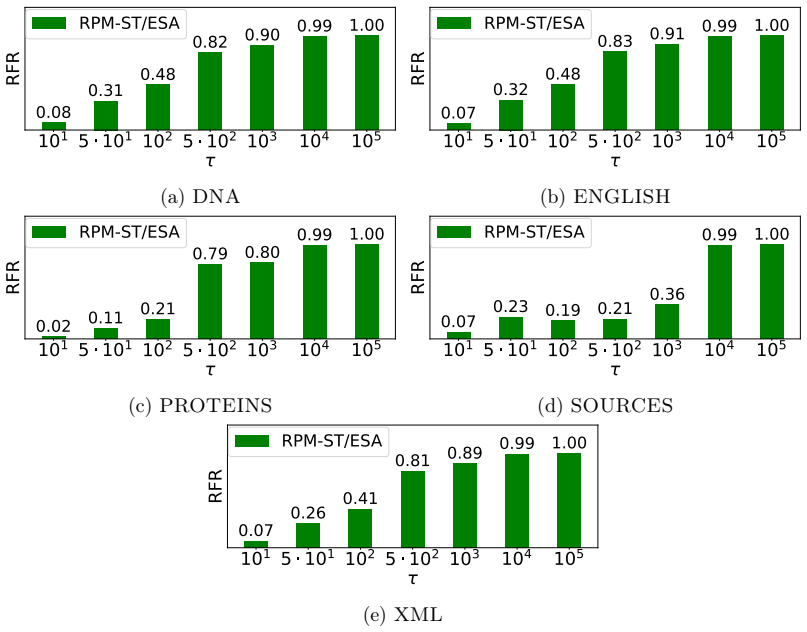
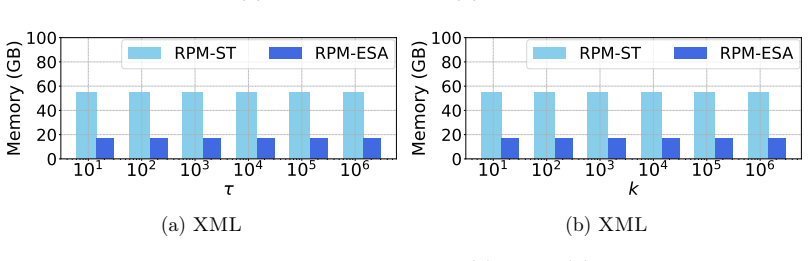
- On real strings of length about 2*10^8, the enhanced-suffix-array implementation runs in hundreds of seconds and linear memory, scales near-linearly with n, and does not slow down as tau or k grow.
Reading between the lines
- If the Section 5 equivalence could be extended to alphabets of size 2 and 3, the same algorithm would apply to binary strings and to the raw DNA alphabet without the |Sigma| >= 4 restriction; the paper leaves this as an open direction.
- The same run-based counting template may transfer to other local edit operations (insertions, deletions, or bounded-length block edits): what is needed is an analogue of Lemma 1/Lemma 2 bounding how many occurrences one edit can cover.
- A direct empirical falsifier is available for small n: enumerate all k-subsets of positions and all replacement letters, compute the true (tau,k)-resilient set by brute force, and compare it with the algorithm's output on random strings over alphabets of size 2, 3, and 4; any mismatch would isolate the failing lemma exactly.
Editorial analysis
A structured set of objections, weighed in public.
Referee Report
Summary. The paper defines the (τ,k)-Resilient Pattern Mining (RPM) problem: given a string S of length n and integers τ,k, return for each starting position the length of the longest prefix of the suffix that remains τ-frequent under any k letter substitutions. The authors give a DP-based baseline with O(n^3 k log n) time and O(n^2) space, and a claimed O(n log n)-time, O(n)-space algorithm based on suffix trees, runs, periodic extension queries, and counting arguments for aperiodic and periodic substrings. A central part is Section 5, which aims to show that destroying occurrences with a special symbol # outside the alphabet can be simulated by substitutions with alphabet letters whenever |Σ|≥4. The paper also reports experiments on large genomic, text, source-code, XML, and versioned datasets, plus a clustering case study.
Significance. If correct, the main theorem is significant: it shows that an exact resilience check over all k-letter substitutions can be performed in time independent of τ and k, which is a striking and practically useful result. The problem is natural, the compact representation via an OUTPUT array is sensible, and the experiments suggest that resilient substrings behave differently from frequent substrings and are useful in versioned-data and clustering applications. The strength of the paper, however, is conditional on the proof of the #-to-Σ reduction and on the correctness of the Phase 2 binary search; both currently have load-bearing gaps. The paper also deserves credit for including detailed proofs of the main combinatorial lemmas and for testing on real large-scale datasets.
major comments (3)
- [Section 5, Lemma 9 (Fact 2)] The proof of Fact 2 is incomplete. After deriving that a new occurrence at position y forces the substituted letter at x to equal T[x+(i-y)], the set of forbidden letters over all y∈[|U|,i) has size up to |X|-|P|, which can exceed σ-2. Thus the assertion that |Σ|≥4 guarantees two safe letters does not follow from the stated argument. Since Fact 2 supports Fact 3 and hence Lemma 9, and Lemma 9 is one of the four cases used in Lemma 11, the reduction from #-substitutions to alphabet substitutions is not established. This directly affects the exactness of Theorem 3 with respect to Definition 6.
- [Section 5, Lemma 8] The pigeonhole step in the proof of Lemma 8 is not justified. The text claims that because |V|<m we have 2|V|>m, but this implication is false (and the alternative reading 2^{|V|}>m also fails for small |V|). Without a valid counting argument, the existence of the string V′ that destroys the single overlapping occurrence is unproven, and this case is needed in Lemma 11.
- [Section 4.2 and proof of Theorem 3 (Lemma 15)] Lemma 15 asserts that occ_S(P)=occ_S(str(v)) for a prefix P of str(v), which is false in general. For example, in S=abababxabab, taking str(v)=ababab and P=abab gives occurrences of P at positions 0,2,7, while str(v) occurs only at position 0. Since AperiodicResilient and PeriodicResilient require the sorted occurrence list and run set of the queried substring P, Phase 2's binary search cannot simply reuse the occurrence data of str(v). As written, the algorithm may misclassify prefixes along cut edges, so both the correctness of the OUTPUT array and the claimed O(n log n) bound are not proven. The manuscript should specify how the SA intervals and occurrence lists of implicit loci are obtained and used during the binary search.
minor comments (4)
- [Section 5, Lemma 11 (final paragraph)] The final paragraph is incorrect as stated: replacing a letter at a position with a letter other than P[0] prevents occurrences starting at that exact position, not occurrences starting earlier. The proof can be repaired by deleting this paragraph, since the unused budget can be left unspent under d_H(S,S′)≤k, but the current wording is misleading.
- [General numbering] Lemma 7 appears twice (Section 4.3 and Section 5), and Lemma 15 is introduced only inside the proof of Theorem 3 without being listed in the paper's lemma sequence. The duplicate and out-of-order numbering should be fixed.
- [Section 7, Figure 12 captions] The text states that the comparison with RPM-DP uses a prefix of DNA with n=10,000, while the caption of Figure 12 says n=1000. This inconsistency should be corrected.
- [Section 4.2] There is a typo in 'preprosessing' in the preprocessing paragraph; please correct it.
Circularity Check
No circularity: the RPM derivation is self-contained and reduces to external combinatorial and data-structure results.
full rationale
The paper's central claim (Theorem 3) is derived from Definition 6 through a chain of new and external lemmas. No parameter is fitted to data and later reported as a prediction; the algorithm computes OUTPUT by counting destroyed occurrences, and the correctness argument ties those counts back to the definition via an interval-hitting theorem from Chrobak et al./Damaschke, runs, periodic-extension queries, priority search trees, and AVL merges. The paper explicitly flags the '#'-substitution convention as an assumption to be discharged and devotes Section 5 to showing that alphabet letters can replace '#', rather than silently equating the two. Even if Lemma 11's proof contains gaps, those are correctness risks for a particular bridge lemma, not a reduction of the theorem to its own input. The only self-citations appearing in the paper, e.g., [BCG+23] and [LZL+24], are used for motivation or experimental methodology and are not load-bearing for the main algorithm or its complexity bound. All load-bearing tools are external and independent of the target result. Therefore no specific circular step can be exhibited.
Assumptions & free parameters
assumptions (9)
- standard math Suffix tree construction in O(n) time over integer alphabets (Farach 1997).
- standard math Number of runs in a string is O(n) and all runs can be computed in O(n) time (Bannai et al. 2017; Ellert-Fischer 2021).
- standard math O(1)-time periodic-extension queries after O(n) preprocessing (Kociumaka et al. 2024, Theorem 2).
- standard math O(1)-time minimal rotation of a substring (Kociumaka 2016).
- standard math Priority search trees support 3-sided range reporting in O(log n + output) time (McCreight 1985).
- standard math AVL trees can be merged in O(log((n1+n2)/n1)) time (Brown-Tarjan 1979).
- standard math Interval scheduling DP computes the maximum number of intervals hit by k points in O(k f^2) time (Chrobak et al. 2021; Damaschke 2017).
- domain assumption Alphabet size satisfies |Sigma| >= 4.
- domain assumption Alphabet size sigma = n^{O(1)}.
Cite this review
Pith. "Pith review of Resilient Pattern Mining." pith.science (2026). https://pith.science/paper/R4TDYIHP
@misc{pith2026250604935,
  author       = {Pith},
  title        = {Pith review of: Resilient Pattern Mining},
  year         = {2026},
  howpublished = {\url{https://pith.science/paper/R4TDYIHP}},
  note         = {Machine review of arXiv:2506.04935}
}
abstract
Frequent pattern mining is a flagship problem in data mining. In its most basic form, it asks for the set of substrings of a given string $S$ of length $n$ that occur at least $\tau$ times in $S$, for some integer $\tau\in[1,n]$. We introduce a resilient version of this classic problem, which we term the $(\tau, k)$-Resilient Pattern Mining (RPM) problem. Given a string $S$ of length $n$ and two integers $\tau, k\in[1,n]$, RPM asks for the set of substrings of $S$ that occur at least $\tau$ times in $S$, even when the letters at any $k$ positions of $S$ are substituted by other letters. Unlike frequent substrings, resilient ones account for the fact that changes to string $S$ are often expensive to handle or are unknown. We propose an exact $\mathcal{O}(n\log n)$-time and $\mathcal{O}(n)$-space algorithm for RPM, which employs advanced data structures and combinatorial insights. We then present experiments on real large-scale datasets from different domains demonstrating that: (I) The notion of resilient substrings is useful in analyzing genomic data and is more powerful than that of frequent substrings, in scenarios where resilience is required, such as in the case of versioned datasets; (II) Our algorithm is several orders of magnitude faster and more space-efficient than a baseline algorithm that is based on dynamic programming; and (III) Clustering based on resilient substrings is effective.
Figures


Figures from the paper (10 more)





Reference graph
Works this paper leans on
-
[1]
Sara Ahmadian, MohammadHossein Bateni, Hossein Esfandiari, Silvio Lattanzi, Morteza Monemizadeh, and Ashkan Norouzi - Fard. Resilient k-clustering. In Proceedings of the 30th ACM SIGKDD Conference on Knowledge Discovery and Data Mining, KDD 2024 , pages 29--38. ACM , 2024. http://dx.doi.org/10.1145/3637528.3671888 doi:10.1145/3637528.3671888
arXiv 2024
-
[2]
Center-based clustering under perturbation stability
Pranjal Awasthi, Avrim Blum, and Or Sheffet. Center-based clustering under perturbation stability. Inf. Process. Lett. , 112(1-2):49--54, 2012. http://dx.doi.org/10.1016/J.IPL.2011.10.006 doi:10.1016/J.IPL.2011.10.006
-
[3]
Replacing suffix trees with enhanced suffix arrays
Mohamed Ibrahim Abouelhoda, Stefan Kurtz, and Enno Ohlebusch. Replacing suffix trees with enhanced suffix arrays. J. Discrete Algorithms , 2(1):53--86, 2004. URL: https://doi.org/10.1016/S1570-8667(03)00065-0, http://dx.doi.org/10.1016/S1570-8667(03)00065-0 doi:10.1016/S1570-8667(03)00065-0
-
[4]
Pissis, Giovanna Rosone, and Michelle Sweering
Giulia Bernardini, Huiping Chen, Alessio Conte, Roberto Grossi, Grigorios Loukides, Nadia Pisanti, Solon P. Pissis, Giovanna Rosone, and Michelle Sweering. Combinatorial algorithms for string sanitization. ACM Trans. Knowl. Discov. Data , 15(1):8:1--8:34, 2021. URL: https://doi.org/10.1145/3418683, http://dx.doi.org/10.1145/3418683 doi:10.1145/3418683
-
[5]
Big data: principles and paradigms
Rajkumar Buyya, Rodrigo N Calheiros, and Amir Vahid Dastjerdi. Big data: principles and paradigms . Morgan Kaufmann, 2016. URL: https://doi.org/10.1016/C2015-0-04136-3, http://dx.doi.org/10.1016/C2015-0-04136-3 doi:10.1016/C2015-0-04136-3
-
[6]
Pissis, Giulia Punzi, Leen Stougie, and Michelle Sweering
Giulia Bernardini, Alessio Conte, Garance Gourdel, Roberto Grossi, Grigorios Loukides, Nadia Pisanti, Solon P. Pissis, Giulia Punzi, Leen Stougie, and Michelle Sweering. Hide and mine in strings: Hardness, algorithms, and experiments. IEEE Trans. Knowl. Data Eng. , 35(6):5948--5963, 2023. URL: https://doi.org/10.1109/TKDE.2022.3158063, http://dx.doi.org/1...
arXiv 2023
-
[7]
Phoni: Streamed matching statistics with multi-genome references
Christina Boucher, Travis Gagie, I Tomohiro, Dominik K \"o ppl, Ben Langmead, Giovanni Manzini, Gonzalo Navarro, Alejandro Pacheco, and Massimiliano Rossi. Phoni: Streamed matching statistics with multi-genome references. In 2021 Data Compression Conference (DCC) , pages 193--202. IEEE, 2021. URL: https://doi.org/10.1109/DCC50243.2021.00027, http://dx.doi...
arXiv 2021
-
[8]
Hideo Bannai, Tomohiro I, Shunsuke Inenaga, Yuto Nakashima, Masayuki Takeda, and Kazuya Tsuruta. The "runs" theorem. SIAM J. Comput. , 46(5):1501--1514, 2017. URL: https://doi.org/10.1137/15M1011032, http://dx.doi.org/10.1137/15M1011032 doi:10.1137/15M1011032
Show all 62 references
-
[9]
Are stable instances easy? Comb
Yonatan Bilu and Nathan Linial. Are stable instances easy? Comb. Probab. Comput. , 21(5):643--660, 2012. URL: https://doi.org/10.1017/S0963548312000193, http://dx.doi.org/10.1017/S0963548312000193 doi:10.1017/S0963548312000193
2012 doi
-
[10]
Brown and Robert E
Mark R. Brown and Robert E. Tarjan. A fast merging algorithm. Journal of the ACM (JACM) , 26(2):211--226, April 1979. http://dx.doi.org/10.1145/322123.322127 doi:10.1145/322123.322127
1979
-
[11]
Perturbation resilient clustering for k-center and related problems via LP relaxations
Chandra Chekuri and Shalmoli Gupta. Perturbation resilient clustering for k-center and related problems via LP relaxations. In Approximation, Randomization, and Combinatorial Optimization. Algorithms and Techniques, APPROX/RANDOM 2018 , pages 9:1--9:16, 2018. http://dx.doi.org...
2018 doi
-
[12]
Golin, Tak Wah Lam, and Dorian Nogneng
Marek Chrobak, Mordecai J. Golin, Tak Wah Lam, and Dorian Nogneng. Scheduling with gaps: new models and algorithms. J. Sched. , 24(4):381--403, 2021. http://dx.doi.org/10.1007/S10951-021-00691-W doi:10.1007/S10951-021-00691-W
2021 doi
-
[13]
Algorithms on strings
Maxime Crochemore, Christophe Hancart, and Thierry Lecroq. Algorithms on strings . Cambridge University Press, 2007. http://dx.doi.org/10.1017/CBO9780511546853 doi:10.1017/CBO9780511546853
2007 doi
-
[14]
Iliopoulos, Marcin Kubica, Jakub Radoszewski, Wojciech Rytter, and Tomasz Walen
Maxime Crochemore, Costas S. Iliopoulos, Marcin Kubica, Jakub Radoszewski, Wojciech Rytter, and Tomasz Walen. Extracting powers and periods in a word from its runs structure. Theor. Comput. Sci. , 521:29--41, 2014. http://dx.doi.org/10.1016/J.TCS.2013.11.018 doi:10.1016/J.TCS....
2014 doi
-
[15]
Cormen, Charles E
Thomas H. Cormen, Charles E. Leiserson, Ronald L. Rivest, and Clifford Stein. Introduction to Algorithms, 3rd Edition . MIT Press, 2009
2009
-
[16]
Computational pan-genomics: status, promises and challenges
The Computational Pan - Genomics Consortium. Computational pan-genomics: status, promises and challenges. Briefings Bioinform. , 19(1):118--135, 2018. http://dx.doi.org/10.1093/BIB/BBW089 doi:10.1093/BIB/BBW089
2018 doi
-
[17]
Hiding messages in DNA microdots
Catherine Taylor Clelland, Viviana Risca, and Carter Bancroft. Hiding messages in DNA microdots. Nature , 399(6736):533--534, 1999. URL: https://doi.org/10.1038/21092, http://dx.doi.org/10.1038/21092 doi:10.1038/21092
1999 doi
-
[18]
Refined algorithms for hitting many intervals
Peter Damaschke. Refined algorithms for hitting many intervals. Inf. Process. Lett. , 118:117--122, 2017. http://dx.doi.org/10.1016/J.IPL.2016.11.001 doi:10.1016/J.IPL.2016.11.001
2017 doi
-
[19]
Cynthia Dwork, Frank McSherry, Kobbi Nissim, and Adam D. Smith. Calibrating noise to sensitivity in private data analysis. In Theory of Cryptography, Third Theory of Cryptography Conference, TCC 2006 , volume 3876 of Lecture Notes in Computer Science , pages 265--284. Springer...
2006 doi
-
[20]
Puglisi, and Andrew Turpin
Jasbir Dhaliwal, Simon J. Puglisi, and Andrew Turpin. Practical efficient string mining. IEEE Trans. Knowl. Data Eng. , 24(4):735--744, 2012. http://dx.doi.org/10.1109/TKDE.2010.242 doi:10.1109/TKDE.2010.242
2012 doi
-
[21]
Linear time runs over general ordered alphabets
Jonas Ellert and Johannes Fischer. Linear time runs over general ordered alphabets. In 48th International Colloquium on Automata, Languages, and Programming, ICALP 2021 , pages 63:1--63:16, 2021. http://dx.doi.org/10.4230/LIPICS.ICALP.2021.63 doi:10.4230/LIPICS.ICALP.2021.63
2021 doi
-
[22]
Evans, Andrew D
Patricia A. Evans, Andrew D. Smith, and Harold T. Wareham. On the complexity of finding common approximate substrings. Theor. Comput. Sci. , 306(1-3):407--430, 2003. URL: https://doi.org/10.1016/S0304-3975(03)00320-7, http://dx.doi.org/10.1016/S0304-3975(03)00320-7 doi:10.1016...
2003 doi
-
[23]
Optimal suffix tree construction with large alphabets
Martin Farach. Optimal suffix tree construction with large alphabets. In 38th Annual Symposium on Foundations of Computer Science, FOCS 1997 , pages 137--143, 1997. http://dx.doi.org/10.1109/SFCS.1997.646102 doi:10.1109/SFCS.1997.646102
1997
-
[24]
NCBI genome datasets, 2024
National Center for Biotechnology Information. NCBI genome datasets, 2024. URL: https://www.ncbi.nlm.nih.gov/datasets/genome/
2024
-
[25]
Fast frequent string mining using suffix arrays
Johannes Fischer, Volker Heun, and Stefan Kramer. Fast frequent string mining using suffix arrays. In Proceedings of the 5th IEEE International Conference on Data Mining ( ICDM 2005) , pages 609--612. IEEE Computer Society, 2005. http://dx.doi.org/10.1109/ICDM.2005.62 doi:10.1...
2005 doi
-
[26]
Optimal string mining under frequency constraints
Johannes Fischer, Volker Heun, and Stefan Kramer. Optimal string mining under frequency constraints. In Knowledge Discovery in Databases: PKDD 2006, 10th European Conference on Principles and Practice of Knowledge Discovery in Databases , pages 139--150. Springer, 2006. http:/...
2006 doi
-
[27]
Optimal dynamic strings
Pawe Gawrychowski, Adam Karczmarz, Tomasz Kociumaka, Jakub a cki, and Piotr Sankowski. Optimal dynamic strings. In Proceedings of the Twenty-Ninth Annual ACM-SIAM Symposium on Discrete Algorithms , SODA '18, page 1509–1528. Society for Industrial and Applied Mathematics, 2018....
2018 doi
-
[28]
Fully functional suffix trees and optimal text searching in bwt-runs bounded space
Travis Gagie, Gonzalo Navarro, and Nicola Prezza. Fully functional suffix trees and optimal text searching in bwt-runs bounded space. J. ACM , 67(1):2:1--2:54, 2020. http://dx.doi.org/10.1145/3375890 doi:10.1145/3375890
2020 doi
-
[29]
Finding near-duplicate web pages: a large-scale evaluation of algorithms
Monika Henzinger. Finding near-duplicate web pages: a large-scale evaluation of algorithms. In SIGIR 2006: Proceedings of the 29th Annual International ACM SIGIR Conference on Research and Development in Information Retrieval , pages 284--291. ACM , 2006. http://dx.doi.org/10....
2006
-
[30]
Data Mining: Concepts and Techniques, 3rd edition
Jiawei Han, Micheline Kamber, and Jian Pei. Data Mining: Concepts and Techniques, 3rd edition . Morgan Kaufmann, 2011. http://dx.doi.org/10.1016/C2009-0-61819-5 doi:10.1016/C2009-0-61819-5
2011 doi
-
[31]
Average sensitivity of decision tree learning
Satoshi Hara and Yuichi Yoshida. Average sensitivity of decision tree learning. In The Eleventh International Conference on Learning Representations, ICLR 2023, Kigali, Rwanda, May 1-5, 2023 . OpenReview.net, 2023. URL: https://openreview.net/forum?id=boik01yhssB
2023
-
[32]
Choudhuri, Enno Ohlebusch, Chris Schleiermacher, Jens Stoye, and Robert Giegerich
Stefan Kurtz, Jomuna V. Choudhuri, Enno Ohlebusch, Chris Schleiermacher, Jens Stoye, and Robert Giegerich. Reputer: the manifold applications of repeat analysis on a genomic scale. Nucleic Acids Research , 29(22):4633--4642, 11 2001. URL: https://doi.org/10.1093/nar/29.22.4633...
2001 doi
-
[33]
Cory Kapser and Michael W. Godfrey. Improved tool support for the investigation of duplication in software. In 21st IEEE International Conference on Software Maintenance (ICSM 2005) , pages 305--314. IEEE Computer Society, 2005. http://dx.doi.org/10.1109/ICSM.2005.52 doi:10.11...
2005 doi
-
[34]
Knuth, James H
Donald E. Knuth, James H. Morris Jr., and Vaughan R. Pratt. Fast pattern matching in strings. SIAM J. Comput. , 6(2):323--350, 1977. http://dx.doi.org/10.1137/0206024 doi:10.1137/0206024
1977 doi
-
[35]
Linear-time longest-common-prefix computation in suffix arrays and its applications
Toru Kasai, Gunho Lee, Hiroki Arimura, Setsuo Arikawa, and Kunsoo Park. Linear-time longest-common-prefix computation in suffix arrays and its applications. In Combinatorial Pattern Matching, 12th Annual Symposium, CPM 2001 , pages 181--192, 2001. http://dx.doi.org/10.1007/3-5...
2001 doi
-
[36]
Minimal suffix and rotation of a substring in optimal time
Tomasz Kociumaka. Minimal suffix and rotation of a substring in optimal time. In 27th Annual Symposium on Combinatorial Pattern Matching, CPM 2016 , pages 28:1--28:12, 2016. http://dx.doi.org/10.4230/LIPICS.CPM.2016.28 doi:10.4230/LIPICS.CPM.2016.28
2016 doi
-
[37]
Internal pattern matching queries in a text and applications
Tomasz Kociumaka, Jakub Radoszewski, Wojciech Rytter, and Tomasz Walen. Internal pattern matching queries in a text and applications. SIAM J. Comput. , 53(5):1524--1577, 2024. http://dx.doi.org/10.1137/23M1567618 doi:10.1137/23M1567618
2024 doi
-
[38]
Small fitness effect of mutations in highly conserved non-coding regions
Gregory V Kryukov, Steffen Schmidt, and Shamil Sunyaev. Small fitness effect of mutations in highly conserved non-coding regions. Human molecular genetics , 14(15):2221--2229, 2005. http://dx.doi.org/10.1093/hmg/ddi226 doi:10.1093/hmg/ddi226
2005 doi
-
[39]
Yongkun Li, Lily He, Rong Lucy He, and Stephen S.-T. Yau. A novel fast vector method for genetic sequence comparison. S ci R ep. , 22, 2017. http://dx.doi.org/10.1038/s41598-017-12493-2 doi:10.1038/s41598-017-12493-2
2017 doi
-
[40]
Efficient secure similarity computation on encrypted trajectory data
An Liu, Kai Zheng, Lu Li, Guanfeng Liu, Lei Zhao, and Xiaofang Zhou. Efficient secure similarity computation on encrypted trajectory data. In 31st IEEE International Conference on Data Engineering, ICDE 2015 , pages 66--77. IEEE Computer Society, 2015. http://dx.doi.org/10.110...
2015
-
[41]
Pissis, and Maria Matsangidou
Ling Li, Wiktor Zuba, Grigorios Loukides, Solon P. Pissis, and Maria Matsangidou. Scalable order-preserving pattern mining. In Elena Baralis, Kun Zhang, Ernesto Damiani, M \' e rouane Debbah, Panos Kalnis, and Xindong Wu, editors, IEEE International Conference on Data Mining, ...
2024
-
[42]
McCreight
Edward M. McCreight. Priority search trees. SIAM J. Comput. , 14(2):257--276, 1985. http://dx.doi.org/10.1137/0214021 doi:10.1137/0214021
1985 doi
-
[43]
Udi Manber and Eugene W. Myers. Suffix arrays: A new method for on-line string searches. SIAM J. Comput. , 22(5):935--948, 1993. http://dx.doi.org/10.1137/0222058 doi:10.1137/0222058
1993 doi
-
[44]
Indexing highly repetitive string collections, part i: Repetitiveness measures
Gonzalo Navarro. Indexing highly repetitive string collections, part i: Repetitiveness measures. ACM Comput. Surv. , 54(2), March 2021. URL: https://doi.org/10.1145/3434399, http://dx.doi.org/10.1145/3434399 doi:10.1145/3434399
2021 doi
-
[45]
Information theoretic measures for clusterings comparison: Variants, properties, normalization and correction for chance
Xuan Vinh Nguyen, Julien Epps, and James Bailey. Information theoretic measures for clusterings comparison: Variants, properties, normalization and correction for chance. J. Mach. Learn. Res. , 11:2837--2854, 2010. http://dx.doi.org/10.5555/1756006.1953024 doi:10.5555/1756006.1953024
2010
-
[46]
The pizza and chili corpus - texts
Pizza and Chili Corpus. The pizza and chili corpus - texts. https://pizzachili.dcc.uchile.cl/texts.html, 2024
2024
-
[47]
Carvalho, Laurent Marsan, and Marie - France Sagot
Nadia Pisanti, Alexandra M. Carvalho, Laurent Marsan, and Marie - France Sagot. RISOTTO: fast extraction of motifs with mismatches. In LATIN 2006: Theoretical Informatics, 7th Latin American Symposium , pages 757--768, 2006. http://dx.doi.org/10.1007/11682462\_69 doi:10.1007/1...
2006 doi
-
[48]
Towards efficient mining of proportional fault-tolerant frequent itemsets
Ardian Kristanto Poernomo and Vivekanand Gopalkrishnan. Towards efficient mining of proportional fault-tolerant frequent itemsets. In John F. Elder IV, Fran c oise Fogelman - Souli \' e , Peter A. Flach, and Mohammed Javeed Zaki, editors, Proceedings of the 15th ACM SIGKDD Int...
2009
-
[49]
Hudson, and Anna Di Rienzo
Molly Przeworski, Richard R. Hudson, and Anna Di Rienzo . Adjusting the focus on human variation. Trends in Genetics , 16(7):296--302, 2000. http://dx.doi.org/https://doi.org/10.1016/S0168-9525(00)02030-8 doi:https://doi.org/10.1016/S0168-9525(00)02030-8
-
[50]
Objective criteria for the evaluation of clustering methods
William M Rand. Objective criteria for the evaluation of clustering methods. Journal of the American Statistical association , 66(336):846--850, 1971. http://dx.doi.org/10.1080/01621459.1971.10482356 doi:10.1080/01621459.1971.10482356
1971
-
[51]
Comparison of five methods for finding conserved sequences in multiple alignments of gene regulatory regions
Nikola Stojanovic, Liliana Florea, Cathy Riemer, Deborah Gumucio, Jerry Slightom, Morris Goodman, Webb Miller, and Ross Hardison. Comparison of five methods for finding conserved sequences in multiple alignments of gene regulatory regions. Nucleic Acids Research , 27(19):3899-...
1999 doi
-
[52]
MACFP: maximal approximate consecutive frequent pattern mining under edit distance
Jingbo Shang, Jian Peng, and Jiawei Han. MACFP: maximal approximate consecutive frequent pattern mining under edit distance. In Proceedings of the 2016 SIAM International Conference on Data Mining , pages 558--566. SIAM , 2016. http://dx.doi.org/10.1137/1.9781611974348.63 doi:...
2016 doi
-
[53]
Groundhog day: near-duplicate detection on twitter
Ke Tao, Fabian Abel, Claudia Hauff, Geert - Jan Houben, and Ujwal Gadiraju. Groundhog day: near-duplicate detection on twitter. In 22nd International World Wide Web Conference, WWW '13 , pages 1273--1284. International World Wide Web Conferences Steering Committee / ACM , 2013...
2013
-
[54]
Repcorpus, 2024
RepCorpus Team. Repcorpus, 2024. URL: https://pizzachili.dcc.uchile.cl/repcorpus/real/
2024
-
[55]
Towards more robust and accurate sequential recommendation with cascade-guided adversarial training
Juntao Tan, Shelby Heinecke, Zhiwei Liu, Yongjun Chen, Yongfeng Zhang, and Huan Wang. Towards more robust and accurate sequential recommendation with cascade-guided adversarial training. In Proceedings of the 2024 SIAM International Conference on Data Mining, SDM 2024 , pages ...
2024 doi
-
[56]
The 100 000 genomes project: bringing whole genome sequencing to the nhs
Clare Turnbull, Richard H Scott, Ellen Thomas, Louise Jones, Nirupa Murugaesu, Freya Boardman Pretty, Dina Halai, Emma Baple, Clare Craig, Angela Hamblin, et al. The 100 000 genomes project: bringing whole genome sequencing to the nhs. Bmj , 361, 2018. http://dx.doi.org/10.113...
2018 doi
-
[57]
Susana Vinga and Jonas S. Almeida. Alignment-free sequence comparison-a review. Bioinform. , 19(4):513--523, 2003. http://dx.doi.org/10.1093/BIOINFORMATICS/BTG005 doi:10.1093/BIOINFORMATICS/BTG005
2003 doi
-
[58]
Average sensitivity of graph algorithms
Nithin Varma and Yuichi Yoshida. Average sensitivity of graph algorithms. SIAM J. Comput. , 52(4):1039--1081, 2023. http://dx.doi.org/10.1137/21M1399592 doi:10.1137/21M1399592
2023 doi
-
[59]
Opr-miner: Order-preserving rule mining for time series
Youxi Wu, Xiaoqian Zhao, Yan Li, Lei Guo, Xingquan Zhu, Philippe Fournier - Viger, and Xindong Wu. Opr-miner: Order-preserving rule mining for time series. IEEE Trans. Knowl. Data Eng. , 35(11):11722--11735, 2023. http://dx.doi.org/10.1109/TKDE.2022.3224963 doi:10.1109/TKDE.20...
2023
-
[60]
Average sensitivity of E uclidean k-clustering
Yuichi Yoshida and Shinji Ito. Average sensitivity of E uclidean k-clustering. In Advances in Neural Information Processing Systems 35: Annual Conference on Neural Information Processing Systems 2022, NeurIPS 2022 , 2022. URL: http://papers.nips.cc/paper\_files/paper/2022/hash...
2022
-
[61]
Sensitivity analysis of the maximum matching problem
Yuichi Yoshida and Samson Zhou. Sensitivity analysis of the maximum matching problem. In 12th Innovations in Theoretical Computer Science Conference, ITCS 2021 , pages 58:1--58:20, 2021. http://dx.doi.org/10.4230/LIPICS.ITCS.2021.58 doi:10.4230/LIPICS.ITCS.2021.58
2021 doi
-
[62]
Feida Zhu, Xifeng Yan, Jiawei Han, and Philip S. Yu. Efficient discovery of frequent approximate sequential patterns. In Proceedings of the 7th IEEE International Conference on Data Mining (ICDM 2007) , pages 751--756. IEEE Computer Society, 2007. http://dx.doi.org/10.1109/ICD...
2007 doi
Reviewed August 7, 2026 · model on record in the stance chip above.
Discussion (0). Sign in to comment.