Multiparameter Maximum Information States for Coherent Diffraction Measurements
Pith reviewed 2026-06-28 16:14 UTC · model grok-4.3
The pith
The scattering matrix allows maximization of the Fisher information matrix over input modes to achieve optimal multiparameter precision in coherent light measurements.
A machine-rendered reading of the paper's core claim, the machinery that carries it, and where it could break.
Core claim
Fisher information for coherent diffraction can be written in terms of the scattering matrix, and for multiple parameters this matrix can be optimized over the choice of input modes by maximizing scalar functions such as its trace or determinant, yielding input states that simultaneously improve precision for all parameters of interest while accounting for nuisance effects.
What carries the argument
The Fisher information matrix constructed from the scattering matrix of the optical system, which is maximized over input modes to define multiparameter maximum information states.
If this is right
- Multiple parameters can be estimated with higher joint precision by choosing input light patterns that maximize functions of the Fisher matrix.
- Nuisance parameters can be suppressed in the optimization without sacrificing precision on the parameters of interest.
- The approach applies to any linear scattering system where the scattering matrix is known.
- Photon-noise-limited measurements achieve the Cramér-Rao bound more closely with these optimized states.
Where Pith is reading between the lines
- If the scattering matrix can be measured or modeled accurately, this method could guide experimental design in complex media like biological tissue.
- Extending to dynamic systems might allow real-time adaptation of input modes for ongoing multiparameter tracking.
Load-bearing premise
The scattering matrix of the system is known and fixed, allowing computation of the Fisher information matrix for different inputs.
What would settle it
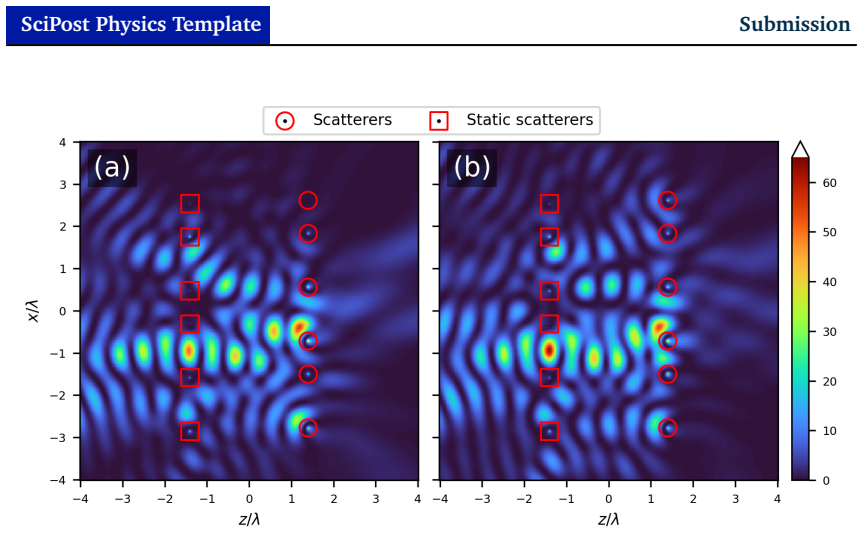
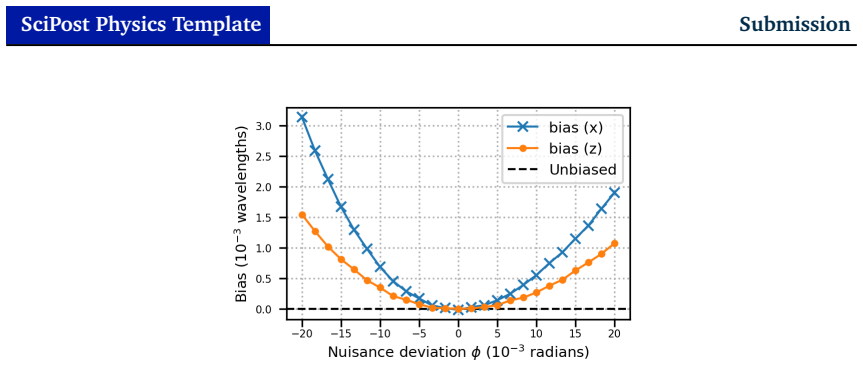
A numerical test in the 2D coupled dipole system where the variance of parameter estimates using the optimized input modes is compared to that using random modes, expecting lower variance for the optimized case.
Figures
read the original abstract
In metrology, Fisher information is an important metric that quantifies the precision that can be achieved in a measurement. For optical measurements using coherent light it has been shown that Fisher information can be expressed simply using the scattering matrix of the system. Fisher information can be maximized over the input modes to achieve maximum information states, which produce optimally precise estimates for a parameter when the system is limited by photon noise. Here, we extend this approach to multiparameter estimation, in which case Fisher information takes the form of a matrix. We consider several scalar functions of the Fisher matrix to optimize the precision in multiple parameters at the same time. We also consider strategies for dealing with nuisance parameters, which can degrade the achievable precision of other parameters but are not of interest to measure. We corroborate our findings numerically using a scattering system of 2D coupled dipoles.
Editorial analysis
A structured set of objections, weighed in public.
Referee Report
Summary. The manuscript extends single-parameter maximum information states to multiparameter estimation for coherent diffraction measurements. Fisher information is expressed as a matrix derived from the scattering matrix S; several scalar functions of this matrix are optimized over input modes to maximize simultaneous precision across multiple parameters, with additional strategies proposed for nuisance parameters. Numerical corroboration is provided via a 2D coupled-dipole scattering system.
Significance. If the algebraic extension holds, the work supplies a systematic route to input-mode optimization for multiparameter precision under photon-noise limits when S is known exactly. The numerical example verifies the matrix construction and scalar-function optimization under ideal conditions, which is a modest but useful check on the formalism.
major comments (2)
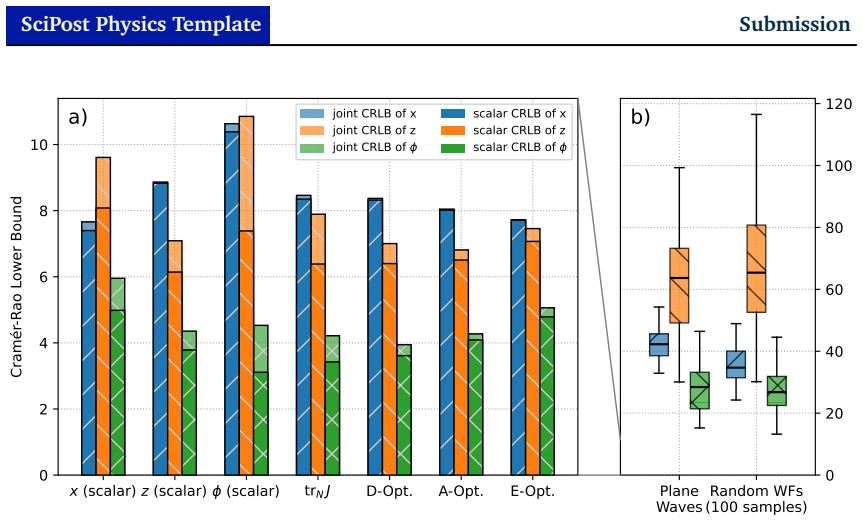
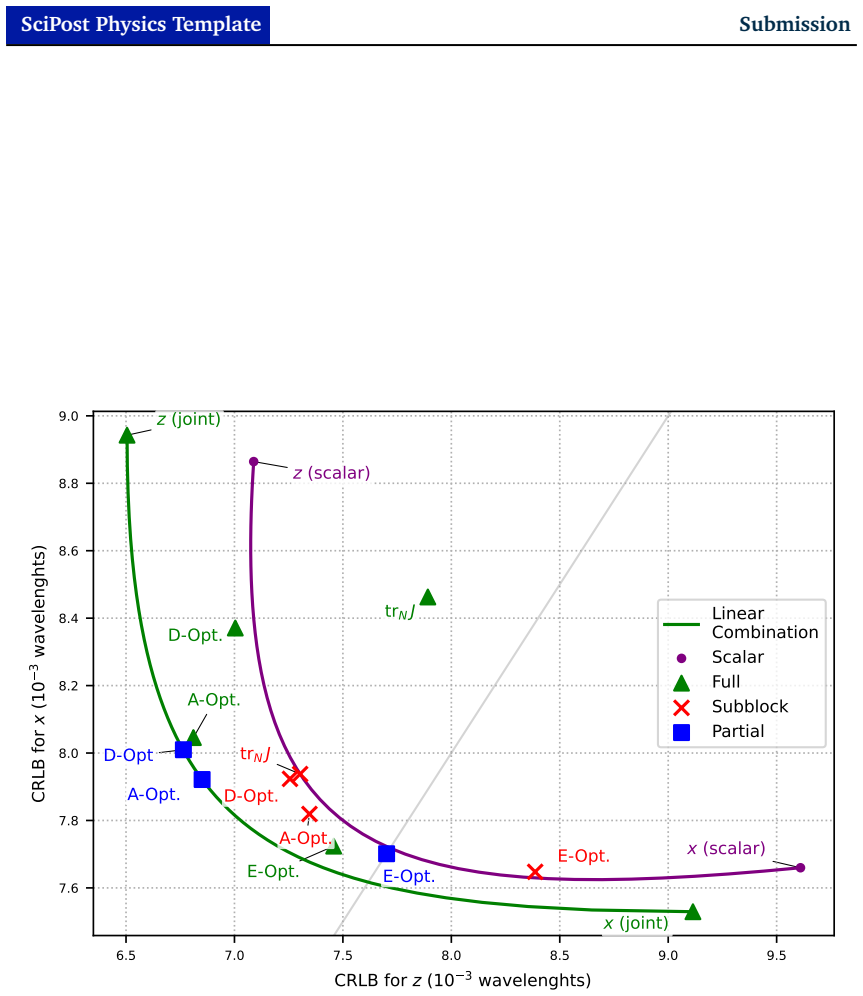
- [Abstract / numerical section] Abstract and numerical-results section: the stated numerical corroboration on 2D coupled dipoles supplies no error bars, exclusion criteria, or direct comparison showing that the chosen scalar functions of the Fisher matrix improve joint precision beyond single-parameter baselines; the central multiparameter claim therefore rests on unshown quantitative detail.
- [Numerical section] Numerical section: S is computed exactly from the model parameters with no added estimation noise, so the example confirms the algebra under perfect knowledge but does not test whether the reported precision gains survive when S itself must be recovered from finite noisy measurements—the assumption underlying practical use of the method.
minor comments (2)
- Define the scalar functions (trace, det, etc.) of the Fisher matrix with explicit equations in the main text rather than referring only to the single-parameter precursor.
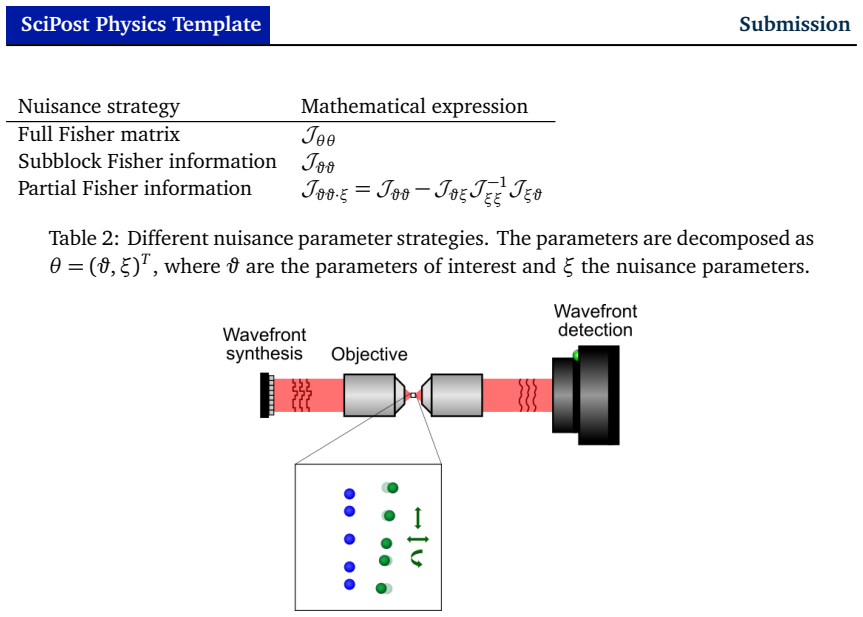
- Clarify the treatment of nuisance parameters: state whether they are marginalized, projected out, or optimized jointly, and indicate which scalar function is used in each case.
Simulated Author's Rebuttal
We thank the referee for their constructive comments and positive recommendation. We respond to each major comment below.
read point-by-point responses
-
Referee: [Abstract / numerical section] Abstract and numerical-results section: the stated numerical corroboration on 2D coupled dipoles supplies no error bars, exclusion criteria, or direct comparison showing that the chosen scalar functions of the Fisher matrix improve joint precision beyond single-parameter baselines; the central multiparameter claim therefore rests on unshown quantitative detail.
Authors: We agree that the numerical section can be strengthened by the addition of direct comparisons to single-parameter baselines and error bars from repeated realizations. In the revised manuscript we will include these quantitative comparisons to demonstrate the joint-precision improvements. revision: yes
-
Referee: [Numerical section] Numerical section: S is computed exactly from the model parameters with no added estimation noise, so the example confirms the algebra under perfect knowledge but does not test whether the reported precision gains survive when S itself must be recovered from finite noisy measurements—the assumption underlying practical use of the method.
Authors: The numerical example is presented to verify the algebraic construction and scalar-function optimization assuming exact knowledge of S, consistent with the scope of the manuscript. Extending the test to noisy recovery of S would require separate estimation procedures that lie outside the present work; we will add an explicit statement of this scope limitation in the revised text. revision: partial
Circularity Check
Minor self-citation to single-parameter result; multiparameter extension algebraically independent with no reduction by construction
full rationale
The paper states that 'it has been shown' Fisher information can be expressed using the scattering matrix for the single-parameter case, then extends this to the multiparameter Fisher matrix by considering scalar functions (trace, det, etc.) and nuisance-parameter strategies. This prior result is referenced but not load-bearing for the new claims, which derive directly from the matrix extension without fitting, self-definition, or ansatz smuggling. Numerical checks with 2D dipoles use the exact model S and verify the algebra under known S, without circular reduction. No steps match the enumerated circularity patterns; the derivation remains self-contained against external benchmarks.
Axiom & Free-Parameter Ledger
axioms (2)
- domain assumption Fisher information quantifies the precision achievable in a parameter estimate from noisy measurements
- domain assumption For coherent light the Fisher information can be expressed using the scattering matrix
Reference graph
Works this paper leans on
-
[1]
Nature Biotechnology , author =
Real-time denoising enables high-sensitivity fluorescence time-lapse imaging beyond the shot-noise limit , volume =. Nature Biotechnology , author =. 2023 , pages =. doi:10.1038/s41587-022-01450-8 , abstract =
-
[2]
Maximum information states for coherent scattering measurements , volume =. Nature Physics , author =. 2021 , pages =. doi:10.1038/s41567-020-01137-4 , language =
-
[3]
Physical Review Letters , author =
Optimal. Physical Review Letters , author =. 2021 , pages =. doi:10.1103/PhysRevLett.127.253902 , language =
-
[4]
Optimizing illumination for precise multi-parameter estimations in coherent diffractive imaging , volume =. Optics Letters , author =. 2021 , pages =. doi:10.1364/OL.411339 , abstract =
-
[5]
Radhakrishna , editor =
Rao, C. Radhakrishna , editor =. Information and the. Breakthroughs in. 1992 , doi =
1992
-
[6]
Journal of Statistical Planning and Inference , author =
Conditioning on ancillary statistics and loss of information in the presence of nuisance parameters , volume =. Journal of Statistical Planning and Inference , author =. 1989 , pages =. doi:10.1016/0378-3758(89)90001-3 , language =
-
[7]
The. Physical Review , author =. 1945 , pages =. doi:10.1103/PhysRev.67.107 , language =
-
[8]
Physical Review Letters , author =
Influence of the. Physical Review Letters , author =. 2020 , pages =. doi:10.1103/PhysRevLett.124.133903 , language =
-
[9]
Annals of the Institute of Statistical Mathematics , author =
On. Annals of the Institute of Statistical Mathematics , author =. 1994 , pages =. doi:10.1007/BF00773520 , language =
-
[10]
Astronomy & Astrophysics , author =
Likelihood,. Astronomy & Astrophysics , author =. 2012 , pages =. doi:10.1051/0004-6361/201219293 , urldate =
-
[11]
Borodin, V. V. and Minasian, G. R. , editor =. Statistical. Full. 1995 , doi =
1995
-
[12]
Journal of Guidance, Control, and Dynamics , author =
Sensor placement for on-orbit modal identification and correlation of large space structures , volume =. Journal of Guidance, Control, and Dynamics , author =. 1991 , pages =. doi:10.2514/3.20635 , language =
-
[13]
Journal of the Optical Society of America B , author =
How to find optimal quantum states for optical micromanipulation and metrology in complex scattering problems: tutorial , volume =. Journal of the Optical Society of America B , author =. 2024 , pages =. doi:10.1364/JOSAB.522649 , abstract =
-
[14]
A. Sensors , author =. 2025 , pages =. doi:10.3390/s25165013 , abstract =
-
[15]
Continuity equation for the flow of. Nature Physics , author =. 2024 , pages =. doi:10.1038/s41567-024-02519-8 , language =
-
[16]
Reviews of Modern Physics , author =
The. Reviews of Modern Physics , author =. 2021 , pages =. doi:10.1103/RevModPhys.93.045001 , language =
-
[17]
Physical Review Applied , author =
Information-. Physical Review Applied , author =. 2020 , pages =. doi:10.1103/PhysRevApplied.14.014026 , language =
-
[18]
, year =
Wei, X. , year =. New methods and applications of ptychography , url =
-
[19]
Nature Communications , author =
Information advantage in sensing revealed by. Nature Communications , author =. 2025 , pages =. doi:10.1038/s41467-025-66187-9 , abstract =
-
[20]
Nanometer. ACS Photonics , author =. 2024 , pages =. doi:10.1021/acsphotonics.4c01451 , language =
-
[21]
Physical Review Research , author =
Very high and very low. Physical Review Research , author =. 2025 , pages =. doi:10.1103/m4cm-545j , abstract =
-
[22]
Measuring optical transmission matrices by wavefront shaping , volume =. Optics Express , author =. 2015 , pages =. doi:10.1364/OE.23.010158 , language =
-
[23]
IEEE Communications Letters , author =
Multi-. IEEE Communications Letters , author =. 2018 , pages =. doi:10.1109/LCOMM.2018.2868663 , number =
-
[24]
Monthly Notices of the Royal Astronomical Society , author =
Generalised. Monthly Notices of the Royal Astronomical Society , author =. 2014 , note =. doi:10.1093/mnras/stu1866 , abstract =
-
[25]
Optimal experimental design:. Acta Numerica , author =. 2024 , note =. doi:10.1017/S0962492924000023 , abstract =
-
[26]
and Hüpfl, Jakob and MacDonald, Kevin F
Weimar, Maximilian and Zhou, Huanli and Neubacher, Luca and Grant, Thomas A. and Hüpfl, Jakob and MacDonald, Kevin F. and Rotter, Stefan and Zheludev, Nikolay I. , month = aug, year =. Controlling the. doi:10.48550/arXiv.2508.13640 , abstract =
-
[27]
, year =
Casella, George and Berger, Roger L. , year =. Statistical inference , isbn =
-
[28]
and Casella, George , year =
Lehmann, Erich L. and Casella, George , year =. Theory of point estimation , isbn =
-
[29]
Journal of Physics A: Mathematical and Theoretical , author =
Quantum state estimation with nuisance parameters , volume =. Journal of Physics A: Mathematical and Theoretical , author =. 2020 , note =. doi:10.1088/1751-8121/ab8b78 , abstract =
-
[30]
, year =
Kay, Steven M. , year =. Fundamentals of statistical signal processing. 1:
-
[31]
, year =
Van Trees, Harry L.. , year =. Detection, estimation, and linear modulation theory , isbn =
-
[32]
and Johnson, Charles R
Horn, Roger A. and Johnson, Charles R. , year =. Matrix analysis , isbn =
-
[33]
Kühmayer, Matthias , collaborator =. Optimal. 2022 , doi =
2022
-
[34]
Scattering invariant modes of light in complex media , volume =. Nature Photonics , author =. 2021 , pages =. doi:10.1038/s41566-021-00789-9 , language =
-
[35]
Physical Review Letters , author =
Focusing inside. Physical Review Letters , author =. 2017 , pages =. doi:10.1103/PhysRevLett.119.033903 , language =
-
[36]
Reviews of Modern Physics , author =
Light fields in complex media:. Reviews of Modern Physics , author =. 2017 , pages =. doi:10.1103/RevModPhys.89.015005 , language =
-
[37]
Guidestar-assisted wavefront-shaping methods for focusing light into biological tissue , volume =. Nature Photonics , author =. 2015 , pages =. doi:10.1038/nphoton.2015.140 , language =
-
[38]
Nature Reviews Physics , author =
Deep optical imaging within complex scattering media , volume =. Nature Reviews Physics , author =. 2020 , pages =. doi:10.1038/s42254-019-0143-2 , language =
-
[39]
Physical Review Applied , author =
Upper bounds on focusing light through multimode fibers , volume =. Physical Review Applied , author =. 2025 , pages =. doi:10.1103/64xd-3cbs , abstract =
-
[40]
Focusing coherent light through opaque strongly scattering media , volume =. Optics Letters , author =. 2007 , pages =. doi:10.1364/OL.32.002309 , language =
-
[41]
Revisiting Natural Gradient for Deep Networks
Pascanu, Razvan and Bengio, Yoshua , year =. Revisiting. doi:10.48550/ARXIV.1301.3584 , abstract =
work page internal anchor Pith review Pith/arXiv arXiv doi:10.48550/arxiv.1301.3584
-
[42]
Fisher. Physical Review X , author =. 2025 , pages =. doi:10.1103/kn3z-rmm8 , abstract =
-
[43]
IEEE Transactions on Signal Processing , author =
Cramér-. IEEE Transactions on Signal Processing , author =. 2022 , pages =. doi:10.1109/TSP.2022.3183853 , urldate =
-
[44]
Journal of Multivariate Analysis , author =
Information on parameters of interest decreases under transformations , volume =. Journal of Multivariate Analysis , author =. 2013 , pages =. doi:10.1016/j.jmva.2013.05.010 , language =
-
[45]
Measurements of channels and time delay of light in strongly scattering media: , shorttitle =
Bosch, Jeroen , month = jul, year =. Measurements of channels and time delay of light in strongly scattering media: , shorttitle =. doi:10.33540/41 , file =
-
[46]
Accurate
Pai, Pritam , month = apr, year =. Accurate
-
[47]
and Thomas, Joy A
Cover, Thomas M. and Thomas, Joy A. , month = sep, year =. Elements of
-
[48]
Physical Review Applied , author =
Fundamental. Physical Review Applied , author =. 2021 , pages =. doi:10.1103/PhysRevApplied.15.024047 , language =
-
[49]
Nonlinear
Miettinen, Kaisa , collaborator =. Nonlinear
-
[50]
Journal of Physics A: Mathematical and Theoretical , author =
Quantum. Journal of Physics A: Mathematical and Theoretical , author =. 2020 , pages =. doi:10.1088/1751-8121/ab5d4d , abstract =
-
[51]
Communications in Theoretical Physics , author =
Quantum. Communications in Theoretical Physics , author =. 2014 , pages =. doi:10.1088/0253-6102/61/1/08 , number =
-
[52]
, year =
Hall, Brian C. , year =. Lie
-
[53]
Lang, Oliver and Huemer, Mario , month = dec, year =. Best. doi:10.48550/arXiv.1612.04060 , abstract =
work page internal anchor Pith review Pith/arXiv arXiv doi:10.48550/arxiv.1612.04060
discussion (0)
Sign in with ORCID, Apple, or X to comment. Anyone can read and Pith papers without signing in.