Prediction for IMAP: Revealing the Role of the Solar Magnetic Field in the Heliotail
Pith reviewed 2026-06-26 01:23 UTC · model grok-4.3
The pith
Solar magnetic field collimates solar wind to form high-latitude ENA lobes in the heliotail above 10 keV.
A machine-rendered reading of the paper's core claim, the machinery that carries it, and where it could break.
Core claim
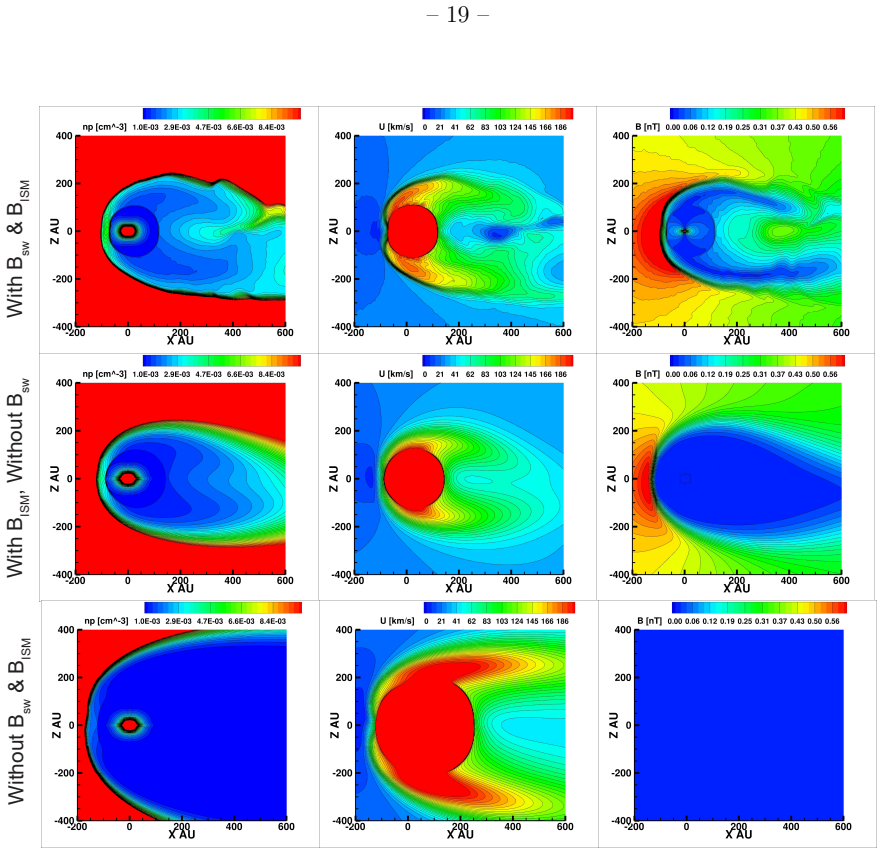
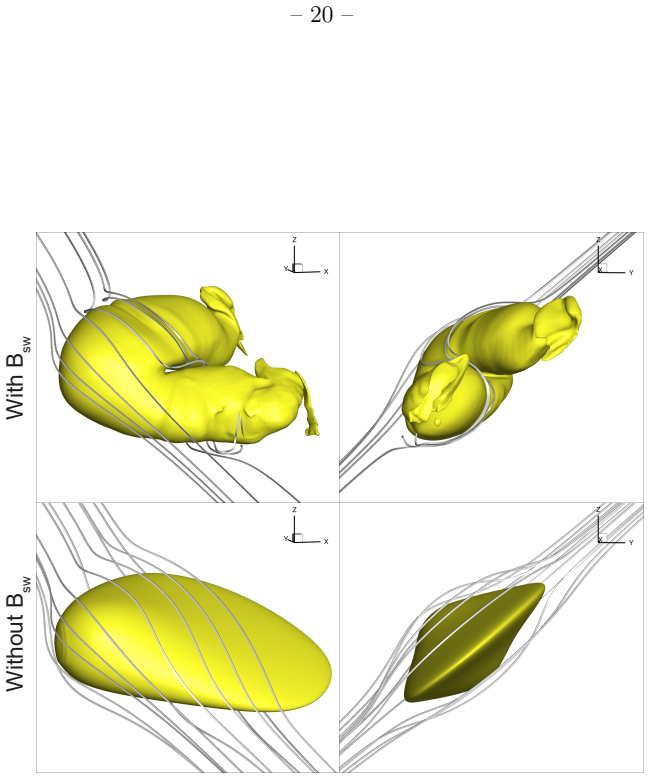
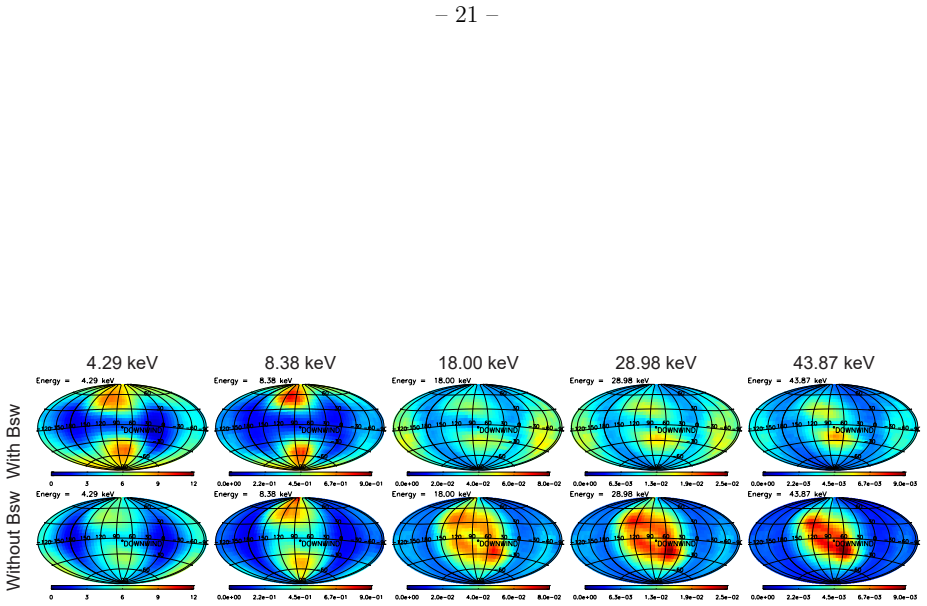
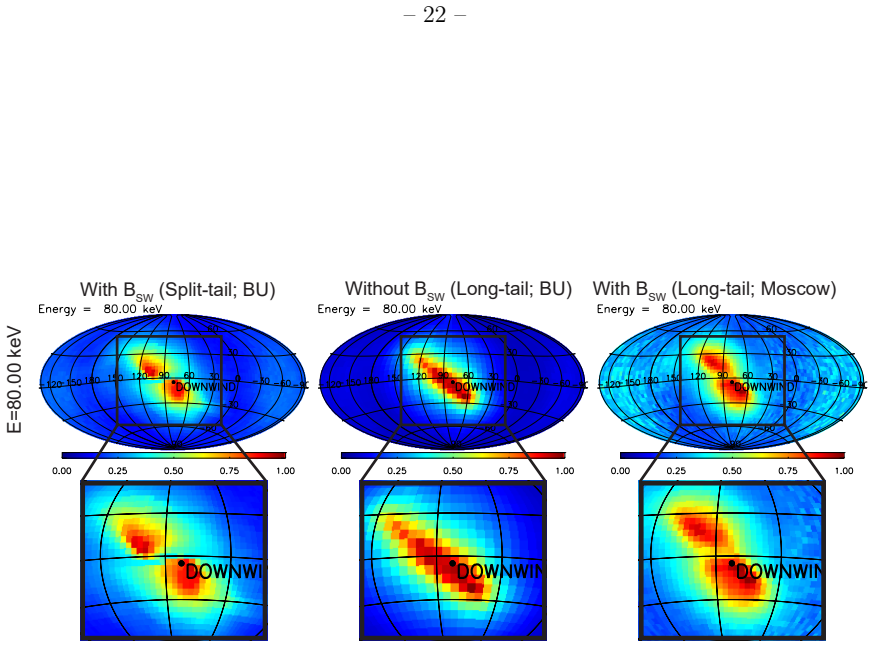
Comparison of MHD solutions with and without the solar magnetic field shows that the field collimates solar wind plasma in the heliosheath. This collimation organizes ENA emission into high-latitude tail lobes once energies exceed 10 keV; at 80 keV the split-tail structure produces an ENA enhancement of approximately a factor of 2 in the lobes relative to the equatorial region.
What carries the argument
MHD solutions computed with and without the solar magnetic field, isolating its collimation of solar wind plasma and the resulting ENA maps.
If this is right
- The fast/slow solar wind profile alone cannot organize ENA maps above 10 keV.
- Magnetic collimation produces a split-tail heliosphere with distinct high-latitude lobes.
- IMAP should detect the factor-of-two ENA enhancement at 80 keV if the field is active.
- ENA observations can constrain the shape of the deep heliotail.
Where Pith is reading between the lines
- Confirmation would imply that similar magnetic collimation operates in other stellar astrospheres.
- Models that add explicit charge-exchange cross sections could shift the energy threshold where collimation dominates.
- The same ENA signature might allow remote measurement of the solar magnetic field strength far from the Sun.
Load-bearing premise
The MHD runs isolate the collimation effect of the solar magnetic field from every other modeling choice or unmodeled process at high energies.
What would settle it
ENA maps at 80 keV from IMAP that show no intensity difference between high-latitude lobes and the low-latitude region would falsify the predicted collimation.
Figures
read the original abstract
The classic paradigm of the heliosphere considered the solar magnetic field as having a passive role in the heliosheath, yet recent work has suggested that the solar magnetic field plays an active role by collimating the solar wind plasma. Previous work has suggested that high-latitude lobes observed by IBEX-Hi energetic neutral atom (ENA) maps are solely due to the fast/slow solar wind profile, yet other works have found that the solar magnetic field may play a role in organizing the lobes as well. Here, using an MHD solution with and without the solar magnetic field, we find that the fast/slow wind profile largely dictates the ENA profile up to 10 keV. Beyond this energy, the collimation effects are more prominent and the fast/slow solar wind profile no longer organizes the maps. The collimation creates two high latitude lobes. At 80 keV, the split-tail heliosphere yields an enhancement of ENAs of the high-latitude tail lobes compared to the low-latitude region by a factor of $\sim$2, IMAP should be able to see whether the solar magnetic field collimates the solar wind, as well as probe the shape of the deep heliotail.
Editorial analysis
A structured set of objections, weighed in public.
Referee Report
Summary. The manuscript presents MHD simulations of the heliosphere comparing runs with and without the solar magnetic field. It claims that the fast/slow solar wind profile dominates ENA maps up to 10 keV, while above this energy magnetic collimation dominates, producing high-latitude tail lobes; at 80 keV the split-tail configuration yields an ENA enhancement in the high-latitude lobes by a factor of ~2 relative to the low-latitude region. This is offered as a testable prediction for IMAP to probe the role of the solar magnetic field in the deep heliotail.
Significance. If the comparison isolates the collimation effect, the work supplies a clear, energy-dependent, falsifiable prediction for IMAP that could resolve debates on the origin of IBEX high-latitude lobes. The use of two independent MHD runs without parameter fitting to the target observable avoids circularity and is a methodological strength.
major comments (2)
- [Abstract] Abstract: the central claim that the ~2 enhancement at 80 keV is due to collimation (rather than other flow changes) rests on the with/without-B comparison, yet the text provides no evidence that the two runs were normalized to identical mass flux, thermal pressure, or outer boundary conditions; removing B necessarily alters termination-shock geometry and heliosheath densities/velocities that enter the ENA source function via charge exchange.
- [Abstract] Abstract: the assertion that 'fast/slow wind profile largely dictates the ENA profile up to 10 keV' while 'collimation effects are more prominent' beyond this energy is load-bearing for the IMAP prediction, but no details are given on the ENA production model (charge-exchange cross sections, line-of-sight integration) or on grid resolution and boundary conditions that would allow assessment of whether the energy threshold is robust.
minor comments (1)
- The manuscript would benefit from a dedicated methods subsection describing the MHD code, grid, and boundary conditions used for both runs.
Simulated Author's Rebuttal
We thank the referee for the constructive comments and for recognizing the methodological strengths of our with/without-B comparison. We address each major comment below. Where the manuscript lacked sufficient detail on run normalization and ENA modeling, we have revised the text to provide the requested information and strengthen the presentation of the energy-dependent transition.
read point-by-point responses
-
Referee: [Abstract] Abstract: the central claim that the ~2 enhancement at 80 keV is due to collimation (rather than other flow changes) rests on the with/without-B comparison, yet the text provides no evidence that the two runs were normalized to identical mass flux, thermal pressure, or outer boundary conditions; removing B necessarily alters termination-shock geometry and heliosheath densities/velocities that enter the ENA source function via charge exchange.
Authors: The two MHD runs were constructed with identical solar-wind boundary conditions at 1 AU (same mass flux, thermal pressure, and velocity profiles) and the same outer-boundary conditions at 1000 AU; the sole difference is the inclusion or exclusion of the solar magnetic field. We acknowledge that the magnetic field still modifies termination-shock geometry and heliosheath properties, which is an inherent aspect of the physical comparison. To make this explicit, we have added a dedicated subsection in the Methods section that tabulates the boundary conditions, confirms the normalization, and quantifies the resulting differences in heliosheath density and velocity between the two runs. This revision clarifies that the ~2 enhancement at 80 keV arises from the additional collimation channel rather than from uncontrolled differences in the base flow. revision: yes
-
Referee: [Abstract] Abstract: the assertion that 'fast/slow wind profile largely dictates the ENA profile up to 10 keV' while 'collimation effects are more prominent' beyond this energy is load-bearing for the IMAP prediction, but no details are given on the ENA production model (charge-exchange cross sections, line-of-sight integration) or on grid resolution and boundary conditions that would allow assessment of whether the energy threshold is robust.
Authors: We agree that the robustness of the 10 keV transition requires explicit documentation. The ENA maps are generated from the MHD solutions using charge-exchange cross sections from Lindsay & Stebbings (2005), with line-of-sight integration performed through the heliosheath volume. The MHD grid resolution is 0.5 AU in the tail region. We have expanded the Methods section to include these parameters, the precise integration procedure, and a brief sensitivity test demonstrating that the energy threshold remains stable under ±20 % variations in cross-section values and moderate grid refinement. These additions allow readers to evaluate the claim that the fast/slow wind profile dominates below 10 keV while magnetic collimation becomes dominant above that energy. revision: yes
Circularity Check
No circularity; forward MHD comparison yields independent prediction
full rationale
The paper's central result is obtained by direct numerical comparison of ENA maps computed from two separate MHD solutions (with versus without solar magnetic field). This is a forward-modeling exercise whose output (the ~2x high-latitude enhancement at 80 keV) is not obtained by fitting any parameter to the target observable, nor by re-expressing an input quantity. No self-definitional equations, fitted-input predictions, or load-bearing self-citations appear in the derivation chain. The simulation difference is therefore self-contained and falsifiable against future IMAP data.
Axiom & Free-Parameter Ledger
axioms (1)
- standard math Standard MHD equations govern the large-scale plasma flow in the heliosphere
Reference graph
Works this paper leans on
-
[1]
Baranov, V. B., & Malama, Y. G. 1993, J. Geophys. Res., 98, 15 Chen, Y., T´ oth, G., Zhou, H., & Wang, X. 2023, Computer Physics Communications, 287, 108714. doi:10.1016/j.cpc.2023.108714 Chen, Y., T´ oth, G., Powell, E., et al. 2024, ApJ, 973,
-
[2]
doi:10.3847/1538-4357/ad6323 Dayeh, M. A., Zirnstein, E. J., Fuselier, S. A., et al. 2022, ApJS, 261,
-
[5]
doi:10.1038/s41550-017-0115 Drake, J. F., Swisdak, M., & Opher, M. 2015, ApJ, 808, L44. doi:10.1088/2041- 8205/808/2/L44 Funsten, H. O., Allegrini, F., Bochsler, P., et al. 2009, Space Sci. Rev., 146,
-
[6]
doi:10.1007/s11214-009-9504-y Giacalone, J., Nakanotani, M., Zank, G. P., et al. 2021, ApJ, 911,
-
[8]
doi:10.1134/1.1537379 Izmodenov, V. V., & Alexashov, D. B. 2015, ApJS, 220,
-
[9]
doi:10.1088/0067-0049/220/2/32 – 14 – Izmodenov, V. V. & Alexashov, D. B. 2020, A&A, 633, L12. doi:10.1051/0004- 6361/201937058 Katushkina, O. A., Izmodenov, V. V., Quemerais, E., et al. 2013, Journal of Geophysical Research (Space Physics), 118,
-
[10]
doi:10.1002/jgra.50303 Katushkina, O., Izmodenov, V., Koutroumpa, D., et al. 2019, Sol. Phys., 294,
-
[11]
doi:10.1007/s11207-018-1391-5 King, J. H. & Papitashvili, N. E. 2005, J. Geophys. Res., 110, A02104. doi:10.1029/2004JA010649 Kornbleuth, M., Opher, M., Michael, A. T., et al. 2020, ApJ, 895, L26. doi:10.3847/2041- 8213/ab922b Kornbleuth, M., Opher, M., Baliukin, I., et al. 2021, ApJ, 923,
-
[14]
doi:10.1126/science.1181079 – 15 – Lallement, R., Qu´ emerais, E., Bertaux, J. L., et al. 2005, Science, 307,
-
[15]
2010, Twelfth International Solar Wind Conference, 1216,
doi:10.1126/science.1107953 Lallement, R., Qu´ emerais, E., Koutroumpa, D., et al. 2010, Twelfth International Solar Wind Conference, 1216,
-
[16]
doi:10.1063/1.3395925 Malama, Y. G. 1991, Ap&SS, 176,
-
[17]
doi:10.1007/BF00643074 McComas, D. J., Barraclough, B. L., Funsten, H. O., et al. 2000, J. Geophys. Res., 105, 10419-10434. doi:10.1029/1999JA000383 McComas, D. J., Allegrini, F., Bochsler, P., et al. 2009, Space Sci. Rev., 146,
-
[18]
doi:10.1007/s11214-009-9499-4 McComas, D. J., Dayeh, M. A., Funsten, H. O., et al. 2013, ApJ, 771,
-
[20]
doi:10.1007/s11214-025-01224-z Michael, A. T., Opher, M., T´ oth, G., et al. 2022, ApJ, 924,
-
[23]
doi:10.1007/s11207-012-9993-9 Swaczyna, P., Bzowski, M., Dialynas, K., et al. 2024, ApJ, 969, L20. doi:10.3847/2041- 8213/ad5832 Tenishev, V., Shou, Y., Borovikov, D., Lee, Y., Fougere, N., Michael, A., & Combi, M., J. Geophys. Res. Space Phys., 126, e2020JA028242. doi:10.1029/2020JA028242 Tokumaru, M., Kojima, M., & Fujiki, K. 2012, J. Geophys. Res., 117...
-
[26]
Broderick, Abraham Loeb, and Ramesh Narayan
doi:10.1088/0004- 637X/708/2/1092 Zirnstein, E. J., Funsten, H. O., Heerikhuisen, J., et al. 2016, ApJ, 826,
-
[27]
2016 THE MYSTERIOUS CASE OF THE SOLAR ARGON ABUNDANCE NEAR SUNSPOTS IN FLARES
doi:10.3847/0004- 637X/826/1/58 – 17 – Zirnstein, E. J., Heerikhuisen, J., Funsten, H. O., et al. 2016a, ApJ, 818, L18. doi:10.3847/2041-8205/818/1/L18 Zirnstein, E. J., Dayeh, M. A., McComas, D. J., et al. 2020, ApJ, 897,
-
[28]
doi:10.3847/1538- 4357/ab9605 This manuscript was prepared with the AAS LATEX macros v5.2. – 18 – Energy [keV] With B SW Without BSW Split-tail Long-tail 4.29 3.27 1.45 8.38 4.83 1.98 18.00 1.53 1.20 28.98 1.43 1.08 43.87 1.21 0.95 80.00 1.95 0.90 Table 1: Ratios of ENA flux from the northern lobe to the downwind direction for cases with and without solar...
discussion (0)
Sign in with ORCID, Apple, or X to comment. Anyone can read and Pith papers without signing in.