REVIEW 4 major objections 5 minor 46 references
Online Item Cold-Start Recommendation with Popularity-Aware Meta-Learning
T0 review · 4 major / 5 minor · reviewed 2026-08-12 · deepseek-v4-flash
Pith's one-line read This paper claims that a popularity-aware meta-learning scheme, PAM, materially improves cold-start item recommendation in online streaming settings without needing to fine-tune each new item at serving time.
desk verdict A genuinely new and practical meta-learning idea for online item cold-start, with consistent large gains, but the evaluation's cold-start definition is too loose to support the strongest zero-history serving claim. read the letter →
The pith
A machine-rendered reading of the paper's core claim, the machinery that carries it, and where it could break.
The reading
What carries the argument
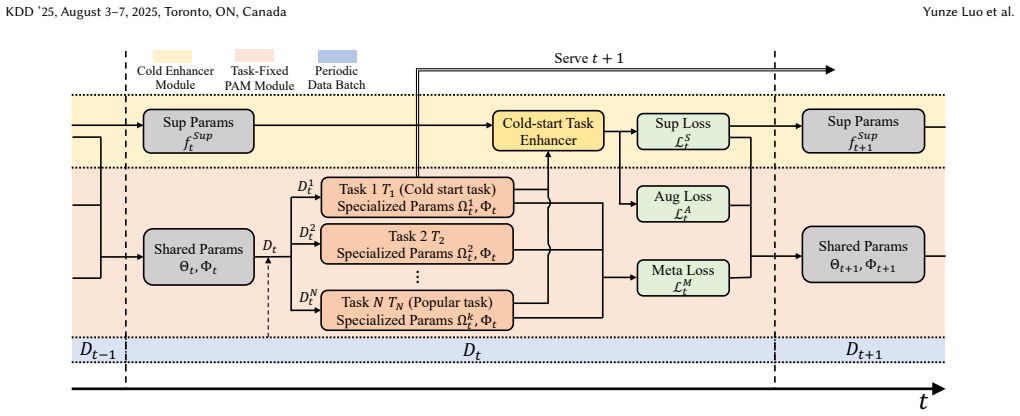
The load-bearing mechanism is the fixed popularity-task segmentation plus the cold-start embedding simulation. Popularity thresholds partition each streaming batch into N tasks; the same item always falls into the same task, so the task-fixed meta-learner can store specialized parameters $\Omega^n_t$ for each task and serve cold-start items at time $t+1$ using the cold-start task parameters computed from the previous period, eliminating online fine-tuning. The cold-start enhancer constructs simulated cold-start embeddings by concatenating stored behavior-based embeddings (ID and sequential embeddings) from the item's earlier cold period with current content-based embeddings (Eqs. 12-13), then uses them for data augmentation and for a self-supervised instructor loss that maps the cold-start representation toward the item's current ID embedding.
What would settle it
Train PAM with the cold-start enhancer disabled except for a probe: for items that enter the system with zero stored behavior embeddings, measure whether the enhancer-trained cold-start task parameters still improve ranking over the enhancer-free version; if the improvement disappears on items with no stored cold-period embeddings, the simulation does not transfer. Alternatively, compare the embedding distributions of simulated cold-start items and genuine first-appearance items, since a significant divergence would show the augmentation signal is off-distribution.
Extended reading notes
Core claim
The central discovery is that item popularity, usually treated as a nuisance bias in cold-start recommendation, can be used as the task definition for meta-learning in streaming settings. By partitioning each arriving batch by pre-defined popularity thresholds into a fixed set of tasks, and by running MAML-style local updates per task, the model learns cold-start task parameters that rely more on content-based features and popular-task parameters that rely more on behavior-based features. The cold-start enhancer then makes the scarce cold-start task trainable: it reconstructs a plausible cold-start embedding for a currently popular item by concatenating that item's stored behavior-based embeddings from its own earlier cold period with its current content-based embeddings, and uses these simulated samples both as augmented data and as targets for a self-supervised mapping that learns to turn cold-start representations into well-trained ID embeddings. The result, the paper reports, is consistent and large improvement on cold-start item ranking across MovieLens, Yelp, and Book, plus positive online A/B metrics, with no additional fine-tuning cost at serving.
Load-bearing premise
The enhancer assumes that simulated cold-start embeddings, built from stored behavior embeddings from an item's earlier cold period concatenated with its current content embeddings, still represent what a genuinely new item looks like at serving time, even though real new items have no stored behavior history at all.
Editorial extensions
If this is right
- Cold-start items in streaming recommenders can be ranked accurately without per-item fine-tuning, because task parameters are precomputed and stored each period.
- The approach transfers knowledge from popular items with abundant data to cold-start items with scarce data through two complementary routes: augmented simulated samples and self-supervised embedding instruction.
- The fixed task split also counters the long-tail bias, because popular data no longer dominates a single parameter update while the model still retains behavior information from popular items.
- PAM is model-agnostic, so the same training scheme can be applied on top of any dual-tower-style recommender, not just the specific network used in the experiments.
- If deployed, the expected practical effect is better discovery of new items, with higher show and like-through rates on cold-start items and no added serving latency.
Reading between the lines
- The simulation step implicitly assumes that an item's stored early behavior embeddings remain a valid proxy for a genuinely new item's embedding; a natural test is to compare PAM's gains on items whose cold-period embeddings were stored versus items appearing for the very first time with no stored history.
- The popularity-threshold task design could be extended to user cold-start or to a popularity-aware curriculum over time, since the same fixed-task logic applies to any long-tail partition of the data.
- Because the content-based embedding branch is agnostic to the source of content features, PAM may combine naturally with multimodal side information or graph-based item representations.
Signed reviews
Editorial analysis
A structured set of objections, weighed in public.
Referee Report
Summary. The paper proposes Popularity-Aware Meta-learning (PAM), an online training method for item cold-start recommendation. PAM divides streaming interaction data into fixed tasks according to item popularity thresholds, applies a MAML-style bi-level optimization to obtain task-specific parameters, and augments the cold-start task with a cold-start enhancer that simulates cold-start embeddings from stored historical behavior embeddings and content features, with data-augmentation and self-supervised losses. Experiments on MovieLens, Yelp, and Book report large gains over several online and meta-learning baselines, and an online A/B test reports improved show and engagement rates compared with periodical fine-tuning.
Significance. If the central claim holds, PAM offers a practical, model-agnostic way to improve recommendations for low-popularity items in streaming settings without per-item fine-tuning, which is a real operational concern. The paper has notable strengths: the code is released, the problem setting is clearly motivated, and the fixed task segmentation is a sensible way to reduce the overhead of per-item meta-learning. The reported gains are large and consistent across datasets, and the online A/B test, though brief, is a useful signal. However, the load-bearing claim that the method serves genuinely new cold-start items is not actually tested, because both the simulated training samples and the offline evaluation involve items that already have stored behavior-based embeddings. In addition, the baseline comparison places several methods at a systematic disadvantage, and the absence of repeated runs means the word 'significantly' is not supported by statistical evidence. The significance is therefore conditional on addressing these concerns.
major comments (4)
- [Sec. 4.3.1 and Sec. 5.1.3 (Eqs. 12-13, Table 2)] The evaluation protocol does not restrict the cold-start test set to items whose first appearance is in the test period; it includes all items below the popularity threshold in the next period, many of which have stored behavior-based embeddings from earlier periods. Because the simulated cold-start samples used in training also concatenate stored behavior-based embeddings from a previous cold period with current content embeddings, the reported gains may reflect the model's ability to exploit historical behavior embeddings of long-tail items rather than its ability to recommend genuinely new items with zero interaction history. The paper should report results separately for items with no prior interactions (first-exposure items) and, ideally, evaluate the enhancer directly on such items. Without this, the central claim in Sec. 4.4.2 that PAM handles cold-start serving without per-item fine-tuning is under-supported for the hardest case.
- [Sec. 5.1.2 and Sec. 5.2.1] SML, ASMG, and IMSR are described in the paper as relying on the efficacy of a pre-trained initialized model, yet Sec. 5.1.3 states that no pre-training scheme is used for any model. The authors themselves note this reliance in the discussion of Table 2. This protocol places those baselines at a systematic disadvantage, so the headline improvements over the 'optimal result in baseline' do not establish superiority over well-initialized versions. The authors should either pre-train all methods consistently, including PAM, or add a controlled comparison in which SML, ASMG, and IMSR start from the same pre-trained checkpoint.
- [Tables 2 and 3] The reported improvements are presented as 'significantly outperforms' with no error bars, standard deviations, or significance tests. Given that the largest claimed gains (e.g., +74.09% NDCG@5 on Yelp) are relative improvements over a single baseline run, the paper should report the mean and variance over multiple random seeds, with the data periods held fixed, and where possible paired significance tests against the strongest baseline. This is needed to support the strength of the comparison claim.
- [Sec. 4.3.3 and Sec. 4.4.2 (Eqs. 15-16)] The self-supervised instructor trains a mapping f_Sup from concatenated stored cold-period behavior embeddings plus current content embeddings to the item's popular-phase ID embedding. At serving time for a genuinely new item, there is no stored behavior embedding and the ID embedding is freshly initialized, so the conditions of the training distribution do not match the conditions at serving. The paper should either describe how new-item embeddings are initialized and how f_Sup and the cold-start task parameters are applied to zero-history items, or narrow the claim to items that already have sparse behavior histories. Without this, the statement that PAM serves cold-start items 'without requiring additional fine-tuning in online serving' overclaims.
minor comments (5)
- [Sec. 4.2.2 and Sec. 5.1.4] The symbol beta is used for the outer-loop learning rate in Eq. (10) and again in Sec. 5.1.4 for task weights ('weights of tasks beta are set to 2'), which conflicts with the notation established in the method section. Use lambda_n for task weights, as in Eq. (11).
- [Eqs. (11) and (16)] N denotes both the number of tasks in Eq. (11) and the embedding dimension in Eq. (16); rename one of them (e.g., d) to avoid ambiguity.
- [Sec. 4.3.1] The sentence after Eq. (13) states that the reconstructed embedding 'fully simulates a cold-start item embedding at current time'; given the domain-gap issue raised in the major comments, this should be softened to 'approximates', and the limitations of the simulation should be acknowledged.
- [Sec. 5.1.3] The evaluation description says negative samples number 'not less than 900' but does not specify whether the same user-item pairs can appear as positives in other rankings or how ties are broken; specify the exact candidate set and tie-breaking rule for reproducibility.
- [Throughout] Minor typos and wording errors include 'Popularity-Awared' in the Introduction (should be 'Popularity-Aware'), 'meaks' (should be 'makes'), 'LSLR [2] methods' in Sec. 4.2.2 (should be 'the LSLR method'), and 'We can also that' in Sec. 5.4 (should be 'We can also see that').
Circularity Check
The self-supervised instructor's target embedding is co-trained by the same loss it supervises, making part of the cold-start 'instruction' self-referential; the main benchmark results otherwise rest on held-out periods and external baselines.
-
self definitional
[Sec. 4.3.3 (Self-supervised Instructor), Eqs. (15)-(18); Sec. 4.4.1]
"For the simulated cold-start item embedding ˆ𝒆𝑖, we have the ID embedding of its popular state 𝒆ID∈ Φ𝑡, which has more information due to multiple updates. ... We use MSE loss to evaluate the similarity between output top embedding and true ID embedding: L𝑆𝑡 = 1/𝑁∥ ˆ𝒛ID, 𝒆ID∥2 2 ... the new parameter update method becomes: {Φ𝑡+1, Θ𝑡+1,𝑓 𝑆𝑢𝑝 𝑡+1}←{ Φ𝑡, Θ𝑡,𝑓 𝑆𝑢𝑝 𝑡 }− 𝛽∇{Φ𝑡,Θ𝑡,𝑓 𝑆𝑢𝑝 𝑡 }L𝑇𝑡 ."
The 'true ID embedding' 𝒆ID is not a fixed external target: it is part of the trainable embedding matrix Φ𝑡, and Eq. (18) updates Φ𝑡 with the gradient of the total loss L𝑇𝑡, which includes γ𝑆L𝑆𝑡. Hence the gradient of L𝑆𝑡 moves 𝒆ID toward the network output ˆ𝒛ID while simultaneously moving ˆ𝒛ID toward 𝒆ID; the MSE can be reduced by collapsing the target onto the prediction as much as by improving feature extraction. The claimed 'instruction' from 'well-learned embeddings of popular items' is therefore partly self-referential: the teacher is a student of the same loss. No stop-gradient or detached target is specified, so the PAM-S improvement (Sec. 5.3) may partly reflect this self-collapse rather than independent supervision.
full rationale
The paper's main meta-learning loss (Eq. 11) is computed on real interaction labels, and the offline experiments (Sec. 5.1.3) evaluate on held-out next-period data against external baselines (PF, s2Meta, IncCTR, SML, ASMG, MeLON, IMSR); no fitted constant is renamed as a prediction, so the central Table 2 improvements are not forced by construction. The task-fixed meta-learning and the data-augmentation component (Eq. 14) use real labels and retain independent content. The one load-bearing circular element is the self-supervised instructor (Sec. 4.3.3): its target embedding 𝒆ID is co-trained by the same loss it supervises, making the 'well-learned' teacher partly a projection of the student. The self-citations in Related Work ([4], [5], [29], [30]) are background and are not load-bearing. A separate validity concern, not a circularity, is that the offline 'cold-start' set is defined as the lowest 5% popularity (Sec. 5.1.4), which may include items with prior stored behavior embeddings rather than genuinely first-exposure items; this affects transfer to true cold-start serving but is not a by-construction reduction. Overall, the circularity is real but localized to one auxiliary training signal, so a moderate score is appropriate.
Assumptions & free parameters
free parameters (7)
- Popularity thresholds v_cold =
50 (MovieLens), 20 (Yelp), 15 (Book)
- Task weights lambda_n =
2.0 for cold-start task, 0.5 for others
- Loss weights gamma_M, gamma_S, gamma_A =
1, 3, 2
- Inner and outer learning rates alpha, beta =
0.001, 0.001
- Batch size =
1024
- InfoNCE temperature tau =
not stated
- Number of tasks N =
5 (1 cold + 4 popularity tiers)
assumptions (6)
- domain assumption Popularity (view count) is a sufficient signal for partitioning items into tasks that share transferable meta-knowledge.
- domain assumption Stored cold-period behavior embeddings of now-popular items, combined with current content embeddings, faithfully simulate true cold-start item embeddings.
- domain assumption Behavior-based and content-based item features can be separated and are differently useful for cold versus popular items.
- domain assumption InfoNCE with in-batch negatives is a valid surrogate for the recommendation ranking objective.
- standard math Gradient-based meta-learning (MAML) converges to useful task-specific parameters with one inner step.
- domain assumption The evaluation protocol, which uses all non-interacted users in the current batch as negatives for a cold-start item, yields an unbiased estimate of cold-start recommendation quality.
invented entities (2)
-
Simulated cold-start embedding
-
Self-supervised instructor mapping f_Sup
Cite this review
Pith. "Pith review of Online Item Cold-Start Recommendation with Popularity-Aware Meta-Learning." pith.science (2026). https://pith.science/paper/R5QVWSYW
@misc{pith2026241111225,
  author       = {Pith},
  title        = {Pith review of: Online Item Cold-Start Recommendation with Popularity-Aware Meta-Learning},
  year         = {2026},
  howpublished = {\url{https://pith.science/paper/R5QVWSYW}},
  note         = {Machine review of arXiv:2411.11225}
}
read the original abstract
With the rise of e-commerce and short videos, online recommender systems that can capture users' interests and update new items in real-time play an increasingly important role. In both online and offline recommendation systems, the cold-start problem caused by interaction sparsity has been impacting the effectiveness of recommendations for cold-start items. Many cold-start scheme based on fine-tuning or knowledge transferring shows excellent performance on offline recommendation. Yet, these schemes are infeasible for online recommendation on streaming data pipelines due to different training method, computational overhead and time constraints. Inspired by the above questions, we propose a model-agnostic recommendation algorithm called Popularity-Aware Meta-learning (PAM), to address the item cold-start problem under streaming data settings. PAM divides the incoming data into different meta-learning tasks by predefined item popularity thresholds. The model can distinguish and reweight behavior-related and content-related features in each task based on their different roles in different popularity levels, thus adapting to recommendations for cold-start samples. These task-fixing design significantly reduces additional computation and storage costs compared to offline methods. Furthermore, PAM also introduced data augmentation and an additional self-supervised loss specifically designed for low-popularity tasks, leveraging insights from high-popularity samples. This approach effectively mitigates the issue of inadequate supervision due to the scarcity of cold-start samples. Experimental results across multiple public datasets demonstrate the superiority of our approach over other baseline methods in addressing cold-start challenges in online streaming data scenarios.
Figures


Figures from the paper (1 more)

Reference graph
Works this paper leans on
-
[1]
Abien Fred Agfarap. 2019. Deep Learning using Rectified Linear Units (ReLU). arXiv:1803.08375 [cs.NE]
arXiv 2019
-
[2]
Antreas Antoniou, Harrison Edwards, and Amos Storkey. 2019. How to train your MAML. arXiv:1810.09502 [cs.LG]
arXiv 2019
-
[3]
Homanga Bharadhwaj. 2019. Meta-Learning for User Cold-Start Recommen- dation. In 2019 International Joint Conference on Neural Networks (IJCNN) . 1–8. https://doi.org/10.1109/IJCNN.2019.8852100
arXiv 2019
-
[4]
Gaode Chen, Ruina Sun, Yuezihan Jiang, Jiangxia Cao, Qi Zhang, Jingjian Lin, Han Li, Kun Gai, and Xinghua Zhang. 2024. A Multi-modal Modeling Framework for Cold-start Short-video Recommendation. In Proceedings of the 18th ACM Conference on Recommender Systems . 391–400
2024
-
[5]
Gaode Chen, Xinghua Zhang, Yijun Su, Yantong Lai, Ji Xiang, Junbo Zhang, and Yu Zheng. 2023. Win-win: a privacy-preserving federated framework for dual-target cross-domain recommendation. InProceedings of the AAAI Conference on Artificial Intelligence, Vol. 37. 4149–4156
2023
-
[6]
Robin Devooght, Nicolas Kourtellis, and Amin Mantrach. 2015. Dynamic Matrix Factorization with Priors on Unknown Values. arXiv:1507.06452 [stat.ML]
work page Pith review arXiv 2015
-
[7]
Manqing Dong, Feng Yuan, Lina Yao, Xiwei Xu, and Liming Zhu. 2020. MAMO: Memory-Augmented Meta-Optimization for Cold-start Recommendation. In Proceedings of the 26th ACM SIGKDD International Conference on Knowledge Discovery & Data Mining (Virtual Event, CA, USA) (KDD ’20). Association for Computing Machinery, New York, NY, USA, 688–697. https://doi.org/1...
arXiv 2020
-
[8]
Zhengxiao Du, Xiaowei Wang, Hongxia Yang, Jingren Zhou, and Jie Tang. 2019. Sequential Scenario-Specific Meta Learner for Online Recommendation. In Pro- ceedings of the 25th ACM SIGKDD International Conference on Knowledge Discovery & Data Mining (Anchorage, AK, USA) (KDD ’19). Association for Computing Machinery, New York, NY, USA, 2895–2904. https://doi...
doi:10.1145/3292500 2019
Show all 46 references
-
[9]
Chelsea Finn, Pieter Abbeel, and Sergey Levine. 2017. Model-Agnostic Meta- Learning for Fast Adaptation of Deep Networks. arXiv:1703.03400 [cs.LG]
2017 arXiv
-
[10]
Chongming Gao, Shijun Li, Yuan Zhang, Jiawei Chen, Biao Li, Wenqiang Lei, Peng Jiang, and Xiangnan He. 2022. KuaiRand: An Unbiased Sequential Rec- ommendation Dataset with Randomly Exposed Videos. In Proceedings of the 31st ACM International Conference on Information & Knowled...
2022
-
[11]
Maxwell Harper and Joseph A
F. Maxwell Harper and Joseph A. Konstan. 2015. The MovieLens Datasets: History and Context. ACM Trans. Interact. Intell. Syst. 5, 4, Article 19 (dec 2015), 19 pages. https://doi.org/10.1145/2827872
2015 doi
-
[12]
Yupeng Hou, Jiacheng Li, Zhankui He, An Yan, Xiusi Chen, and Julian McAuley
-
[13]
Po-Sen Huang, Xiaodong He, Jianfeng Gao, Li Deng, Alex Acero, and Larry Heck. 2013. Learning deep structured semantic models for web search using clickthrough data. In Proceedings of the 22nd ACM international conference on Information & Knowledge Management . 2333–2338
2013
-
[14]
SeongKu Kang, Junyoung Hwang, Dongha Lee, and Hwanjo Yu. 2019. Semi- Supervised Learning for Cross-Domain Recommendation to Cold-Start Users. In Proceedings of the 28th ACM International Conference on Information and Knowledge Management (Beijing, China) (CIKM ’19). Associatio...
2019 doi
-
[15]
Minseok Kim, Hwanjun Song, Yooju Shin, Dongmin Park, Kijung Shin, and Jae-Gil Lee. 2022. Meta-Learning for Online Update of Recommender Systems. arXiv:2203.10354 [cs.IR]
2022 arXiv
- [16]
-
[17]
Hoyeop Lee, Jinbae Im, Seongwon Jang, Hyunsouk Cho, and Sehee Chung. 2019. MeLU: Meta-Learned User Preference Estimator for Cold-Start Recommendation. In Proceedings of the 25th ACM SIGKDD International Conference on Knowledge Discovery & Data Mining (Anchorage, AK, USA) (KDD ...
2019
-
[18]
Yuanfu Lu, Yuan Fang, and Chuan Shi. 2020. Meta-learning on Heterogeneous Information Networks for Cold-start Recommendation. In Proceedings of the 26th ACM SIGKDD International Conference on Knowledge Discovery & Data Mining (Virtual Event, CA, USA) (KDD ’20). Association for...
2020
-
[19]
Haokai Ma, Zhuang Qi, Xinxin Dong, Xiangxian Li, Yuze Zheng, Xiangxu Meng, and Lei Meng. 2023. Cross-Modal Content Inference and Feature Enrichment for Cold-Start Recommendation. arXiv:2307.02761 [cs.IR]
2023 arXiv
-
[20]
Mohammmadmahdi Maheri, Reza Abdollahzadeh, Bardia Mohammadi, Mina Rafiei, Jafar Habibi, and Hamid R. Rabiee. 2023. ClusterSeq: Enhanc- ing Sequential Recommender Systems with Clustering based Meta-Learning. arXiv:2307.13766 [cs.IR]
2023 arXiv
-
[21]
Krishna Prasad Neupane, Ervine Zheng, Yu Kong, and Qi Yu. 2022. A Dy- namic Meta-Learning Model for Time-Sensitive Cold-Start Recommendations. arXiv:2204.00970 [cs.IR]
2022 arXiv
-
[22]
Xingyu Pan, Yushuo Chen, Changxin Tian, Zihan Lin, Jinpeng Wang, He Hu, and Wayne Xin Zhao. 2022. Multimodal Meta-Learning for Cold-Start Se- quential Recommendation. In Proceedings of the 31st ACM International Con- ference on Information & Knowledge Management (Atlanta, GA, ...
2022
-
[23]
Deepak Kumar Panda and Sanjog Ray. 2022. Approaches and algorithms to mitigate cold start problems in recommender systems: a systematic literature review. J. Intell. Inf. Syst. 59, 2 (oct 2022), 341–366. https://doi.org/10.1007/s10844- 022-00698-5
2022 doi
-
[24]
Haoyu Pang, Fausto Giunchiglia, Ximing Li, Renchu Guan, and Xiaoyue Feng
-
[25]
Danni Peng, Sinno Jialin Pan, Jie Zhang, and Anxiang Zeng. 2021. Learning an Adaptive Meta Model-Generator for Incrementally Updating Recommender Systems. In Proceedings of the 15th ACM Conference on Recommender Systems (Amsterdam, Netherlands) (RecSys ’21). Association for Co...
2021
-
[26]
Shameem A Puthiya Parambath and Sanjay Chawla. 2020. Simple and effective neural-free soft-cluster embeddings for item cold-start recommendations. Data Mining and Knowledge Discovery 34 (09 2020). https://doi.org/10.1007/s10618- 020-00708-6
2020 doi
-
[27]
Aniruddh Raghu, Maithra Raghu, Samy Bengio, and Oriol Vinyals. 2020. Rapid Learning or Feature Reuse? Towards Understanding the Effectiveness of MAML. In International Conference on Learning Representations . https://openreview.net/ forum?id=rkgMkCEtPB
2020
-
[28]
Chuan Shi, Binbin Hu, Wayne Xin Zhao, and Philip S. Yu. 2019. Heterogeneous Information Network Embedding for Recommendation.IEEE Trans. on Knowl. and Data Eng. 31, 2 (feb 2019), 357–370. https://doi.org/10.1109/TKDE.2018.2833443
2019
-
[29]
Zijian Song, Wenhan Zhang, Lifang Deng, Jiandong Zhang, Kaigui Bian, and Bin Cui. 2024. MultiLoRA: Multi-Directional Low Rank Adaptation for Multi-Domain Recommendation. In Proceedings of the 33rd ACM International Conference on Information and Knowledge Management . 2148–2157
2024
-
[30]
Zijian Song, Wenhan Zhang, Lifang Deng, Jiandong Zhang, Zhihua Wu, Kaigui Bian, and Bin Cui. 2024. Mitigating Negative Transfer in Cross-Domain Rec- ommendation via Knowledge Transferability Enhancement. In Proceedings of the 30th ACM SIGKDD Conference on Knowledge Discovery a...
2024
-
[32]
Aaron van den Oord, Yazhe Li, and Oriol Vinyals. 2019. Representation Learning with Contrastive Predictive Coding. arXiv:1807.03748 [cs.LG]
2019 arXiv
-
[33]
Manasi Vartak, Arvind Thiagarajan, Conrado Miranda, Jeshua Bratman, and Hugo Larochelle. 2017. A meta-learning perspective on cold-start recommendations for items. In Proceedings of the 31st International Conference on Neural Information Processing Systems (Long Beach, Califor...
2017
-
[34]
Maksims Volkovs, Guangwei Yu, and Tomi Poutanen. 2017. DropoutNet: Address- ing Cold Start in Recommender Systems. In Proceedings of the 31st International Conference on Neural Information Processing Systems (Long Beach, California, USA) (NIPS’17). Curran Associates Inc., Red ...
2017
-
[35]
Yichao Wang, Huifeng Guo, Ruiming Tang, Zhirong Liu, and Xiuqiang He. 2020. A Practical Incremental Method to Train Deep CTR Models. arXiv:2009.02147 [cs.IR]
2020 arXiv
-
[36]
Yining Wang, Liwei Wang, Yuanzhi Li, Di He, Tie-Yan Liu, and Wei Chen. 2013. A Theoretical Analysis of NDCG Type Ranking Measures. arXiv:1304.6480 [cs.LG]
2013 arXiv
-
[37]
Zhikai Wang and Yanyan Shen. 2023. Incremental Learning for Multi-Interest Sequential Recommendation. In 2023 IEEE 39th International Conference on Data Engineering (ICDE). 1071–1083. https://doi.org/10.1109/ICDE55515.2023.00087
2023
-
[38]
Zhenchao Wu and Xiao Zhou. 2023. M2EU: Meta Learning for Cold-start Recom- mendation via Enhancing User Preference Estimation. In Proceedings of the 46th International ACM SIGIR Conference on Research and Development in Information Retrieval (SIGIR ’23) . Association for Compu...
2023
-
[39]
Jiafeng Xia, Dongsheng Li, Hansu Gu, Jiahao Liu, Tun Lu, and Ning Gu. 2022. FIRE: Fast Incremental Recommendation with Graph Signal Processing. In Proceedings of the ACM Web Conference 2022 (Virtual Event, Lyon, France) (WWW ’22) . Association for Computing Machinery, New York...
2022
-
[40]
Ruobing Xie, Yalong Wang, Rui Wang, Yuanfu Lu, Yuanhang Zou, Feng Xia, and Leyu Lin. 2022. Long Short-Term Temporal Meta-learning in Online Rec- ommendation. In Proceedings of the Fifteenth ACM International Conference on Web Search and Data Mining (Virtual Event, AZ, USA) (WS...
2022
-
[41]
Chen Yang, Jin Chen, Qian Yu, Xiangdong Wu, Kui Ma, Zihao Zhao, Zhiwei Fang, Wenlong Chen, Chaosheng Fan, Jie He, Changping Peng, Zhangang Lin, and Jingping Shao. 2023. An Incremental Update Framework for Online Recom- menders with Data-Driven Prior. In Proceedings of the 32nd...
2023
-
[42]
Junliang Yu, Min Gao, Jundong Li, Hongzhi Yin, and Huan Liu. 2018. Adaptive Implicit Friends Identification over Heterogeneous Network for Social Recommen- dation. In Proceedings of the 27th ACM International Conference on Information and Knowledge Management (Torino, Italy)(C...
2018
-
[43]
Yang Zhang, Fuli Feng, Chenxu Wang, Xiangnan He, Meng Wang, Yan Li, and Yongdong Zhang. 2020. How to Retrain Recommender System? A Sequential Meta-Learning Method. In Proceedings of the 43rd International ACM SIGIR Con- ference on Research and Development in Information Retrie...
2020
-
[44]
Yujia Zheng, Siyi Liu, Zekun Li, and Shu Wu. 2020. Cold-start Sequential Recom- mendation via Meta Learner. arXiv:2012.05462 [cs.IR]
2020 arXiv
-
[45]
Yongchun Zhu, Ruobing Xie, Fuzhen Zhuang, Kaikai Ge, Ying Sun, Xu Zhang, Leyu Lin, and Juan Cao. 2021. Learning to Warm Up Cold Item Embeddings for Cold-start Recommendation with Meta Scaling and Shifting Networks. In Proceedings of the 44th International ACM SIGIR Conference ...
2021
-
[2022]
In Proceedings of the ACM Web Conference 2022 (Virtual Event, Lyon, France) (WWW ’22)
PNMTA: A Pretrained Network Modulation and Task Adaptation Approach for User Cold-Start Recommendation. In Proceedings of the ACM Web Conference 2022 (Virtual Event, Lyon, France) (WWW ’22). Association for Computing Ma- chinery, New York, NY, USA, 348–359. https://doi.org/10....
2022
-
[2024]
arXiv preprint arXiv:2403.03952 (2024)
Bridging Language and Items for Retrieval and Recommendation. arXiv preprint arXiv:2403.03952 (2024)
2024 arXiv
Reviewed August 12, 2026 · model on record in the stance chip above.
Discussion (0). Continue with ORCID to comment.