REVIEW 2 major objections 16 references
Invariants of the Colored Braid Groupoid
T0 review · 2 major / 0 minor · reviewed 2026-06-26 · grok-4.3
Pith's one-line read A groupoid built from Delaunay triangulations of moving points represents the colored braid groupoid and supplies matrix invariants.
desk verdict The paper sketches a Delaunay-triangulation model for colored braids but supplies no check that the induced maps respect the groupoid relations or define homomorphisms to GL(2n+1). read the letter →
The pith
A machine-rendered reading of the paper's core claim, the machinery that carries it, and where it could break.
The reading
What carries the argument
The groupoid G^4_{n+3} constructed from Delaunay triangulation states of a point dynamical system, which encodes the colored braids and maps to matrix groups.
What would settle it
Two colored braids that are distinct in ColB(n) but map to the same matrix under f_{n+3} or f'_{n+3}, or a set of generators whose images fail to satisfy the defining relations of the colored braid groupoid.
Extended reading notes
Core claim
The abstract groupoid G^4_{n+3} arising from the dynamical system of points whose states are Delaunay triangulations provides a representation of the colored braid groupoid ColB(n). The homomorphisms f_{n+3} to GL_{2n+1}(Q) and f'_{n+3} to GL_{2n+1}(C) yield invariants of this groupoid, and an algorithm is given for computing them.
Load-bearing premise
The dynamical system of points in the plane with states as Delaunay triangulations defines a groupoid that represents the colored braid groupoid ColB(n) and that the stated homomorphisms are well-defined.
Editorial extensions
If this is right
- The representation lets one associate matrices in GL_{2n+1}(Q) to elements of ColB(n).
- Similar matrices over the complex numbers are also obtained via the second homomorphism.
- An explicit algorithm computes these matrix invariants from the braid data.
- The construction works for any n by using the groupoid indexed by n+3.
Reading between the lines
- If the representation is faithful, the matrix values could serve as practical tests for equivalence of colored braids.
- The same state-space idea might be applied to other topological groupoids by replacing Delaunay triangulations with a different family of configurations.
- Software implementation of the algorithm would allow direct numerical checks on small values of n.
Editorial analysis
A structured set of objections, weighed in public.
Referee Report
Summary. The paper regards braids as dynamical systems whose states are Delaunay triangulations of n+3 points. It defines an abstract groupoid G^4_{n+3} that is claimed to represent the colored braid groupoid ColB(n), constructs homomorphisms f_{n+3} and f'_{n+3} from this groupoid into GL_{2n+1}(Q) and GL_{2n+1}(C), and describes an algorithm for computing the resulting invariants.
Significance. If the groupoid representation and the homomorphisms are valid, the work would supply a combinatorial, triangulation-based route to linear invariants of colored braids, potentially linking geometric dynamics with representation theory. The absence of any explicit verification of the key homomorphism property, however, prevents evaluation of whether this potential is realized.
major comments (2)
- [Abstract] Abstract: the central claim that G^4_{n+3} furnishes a representation of ColB(n) rests on the assertion that combinatorial changes in Delaunay triangulations induced by colored braid motions automatically satisfy the defining relations of ColB(n) (far-commutativity, braid relations, color preservation). No definition of the groupoid morphisms or any check that these relations are preserved is supplied.
- [Abstract] Abstract: the maps f_{n+3} and f'_{n+3} are asserted to be groupoid homomorphisms, yet no verification is given that they preserve composition (e.g., explicit matrix computation for the generators of ColB(3) or ColB(4) showing that the composite change equals the change for the composite braid). This step is load-bearing for the claim that the images yield invariants.
Simulated Author's Rebuttal
We thank the referee for the detailed report and the identification of points where the manuscript requires greater explicitness. We address each major comment below and will incorporate the requested verifications into a revised version.
read point-by-point responses
-
Referee: [Abstract] Abstract: the central claim that G^4_{n+3} furnishes a representation of ColB(n) rests on the assertion that combinatorial changes in Delaunay triangulations induced by colored braid motions automatically satisfy the defining relations of ColB(n) (far-commutativity, braid relations, color preservation). No definition of the groupoid morphisms or any check that these relations are preserved is supplied.
Authors: The referee is correct that the abstract asserts the representation without supplying the explicit definitions of the morphisms or direct checks that the relations hold. The construction in the paper defines the groupoid morphisms via the combinatorial flips and color-preserving moves on Delaunay triangulations that correspond to the generators of ColB(n); by design these moves are required to respect far-commutativity, the braid relations, and color preservation because they arise from continuous motions of the points. Nevertheless, to make the argument self-contained we will add a dedicated subsection that defines the morphisms explicitly and verifies the relations on the generators for small values of n. revision: yes
-
Referee: [Abstract] Abstract: the maps f_{n+3} and f'_{n+3} are asserted to be groupoid homomorphisms, yet no verification is given that they preserve composition (e.g., explicit matrix computation for the generators of ColB(3) or ColB(4) showing that the composite change equals the change for the composite braid). This step is load-bearing for the claim that the images yield invariants.
Authors: We agree that an explicit check that f_{n+3} and f'_{n+3} preserve composition is necessary to substantiate the claim that their images are invariants. The manuscript defines the linear maps via the action on the vector space associated with the triangulation and supplies an algorithm for their evaluation, but does not include the concrete matrix multiplications requested. In the revision we will insert explicit computations for the generators of ColB(3) and ColB(4), confirming that the matrix for a composite braid equals the product of the matrices for its factors. revision: yes
Circularity Check
No circularity: construction is independent of claimed representation
full rationale
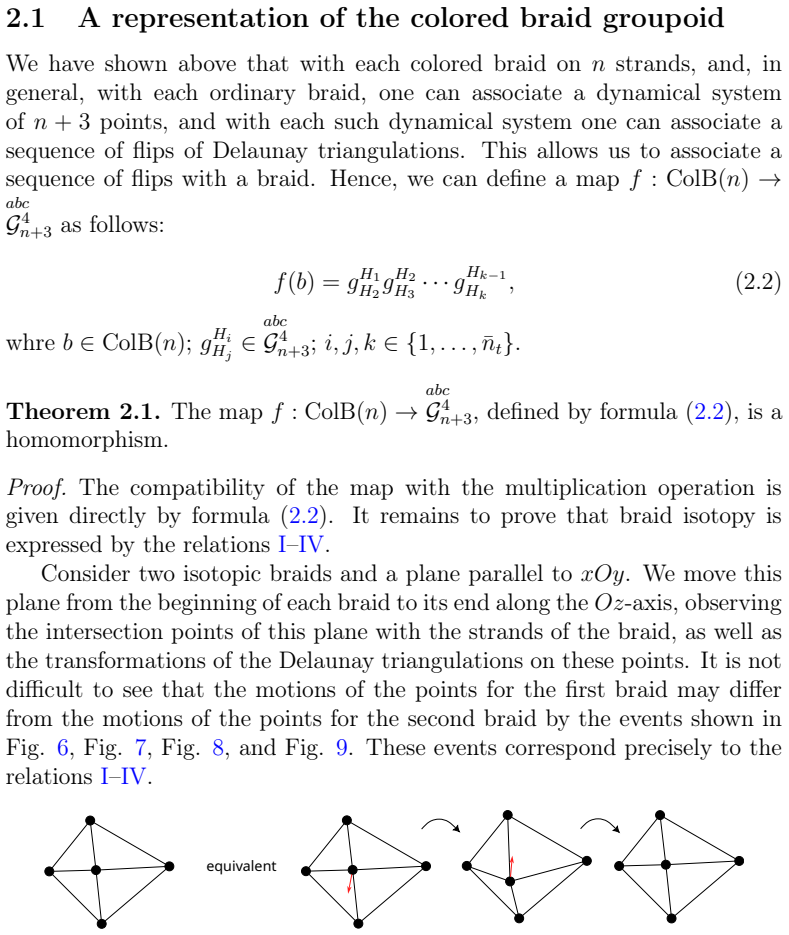
The paper defines states via Delaunay triangulations of n+3 points and morphisms via combinatorial changes under colored braid motions, then asserts that the resulting groupoid G^4_{n+3} represents ColB(n) and admits the stated homomorphisms to GL(2n+1). This is a direct construction whose validity rests on verifying that the induced maps satisfy ColB(n) relations; nothing in the abstract or described chain reduces the representation claim or the matrix invariants to a quantity defined in terms of themselves, a fitted parameter renamed as prediction, or a self-citation chain. The derivation is therefore self-contained and externally checkable against the braid groupoid axioms.
Assumptions & free parameters
Cite this review
Pith. "Pith review of Invariants of the Colored Braid Groupoid." pith.science (2026). https://pith.science/paper/R6LGMQJT
@misc{pith2026260620473,
  author       = {Pith},
  title        = {Pith review of: Invariants of the Colored Braid Groupoid},
  year         = {2026},
  howpublished = {\url{https://pith.science/paper/R6LGMQJT}},
  note         = {Machine review of arXiv:2606.20473}
}
abstract
In this paper, a braid is regarded as a dynamical system of points in the plane. The states of this dynamical system are given by Delaunay triangulations. This construction makes it possible to define an abstract groupoid $\overset{{abc}}{\mathcal{G}^{4}_{n+3}}$, which gives a representation of the colored braid groupoid $\text{ColB}(n)$. We define homomorphisms ${f}_{n+3}:\overset{{abc}}{\mathcal{G}^{4}_{n+3}} \rightarrow\text{GL}_{2n+1}(\mathbb{Q})$ and ${f}'_{n+3}:\overset{{abc}}{\mathcal{G}^{4}_{n+3}} \rightarrow\text{GL}_{2n+1}(\mathbb{C})$, and describe an algorithm for computing the resulting invariants.
Figures


Figures from the paper (10 more)




Reference graph
Works this paper leans on
-
[1]
Aurenhammer, R
F. Aurenhammer, R. Klein and D.-T. Lee,Voronoi Diagrams and De- launay Triangulations, World Scientific Publishing, 2013, 337 pp
2013
-
[6]
Manturov,Knot Theory, Second Edition, CRC Press, 2018, 580 pp
Vassily O. Manturov,Knot Theory, Second Edition, CRC Press, 2018, 580 pp
2018
-
[9]
I.E.Rohozhkin, Pentagonequations, Delaunaytriangulationsandpure braid group invariant,Journal of Knot Theory and Its Ramifications, 2025, 25 pp
2025
-
[10]
слипаться
T. Ohtsuki,Quantum Invariants: A Study of Knots, 3-Manifolds, and Their Sets, World Scientific Publishing, 2002, 508 pp. 30 Инварианты группоида цветных кос Илья Э. Рогожкин∗ 19 июня 2026 г. Аннотация В этой работе коса рассматривается как динамическая систе- ма точек на плоскости. Состояния динамической системы задают- ся триангуляциями Делоне. Такая кон...
2002
-
[11]
три точки соединены рёбрами, если внутри окружности, описанной около этих точек, нет других точек
-
[12]
Из определения триангуляции Делоне следует, что ее внешняя грань не всегда треугольная, поэтому триангуляция Делоне не всегда являет- ся триангуляцией в строгом понимании
нет ни одной четвёрки точек лежащих на одной окружности, такой, что описывающая их окружность не содержит внутри себя других точек. Из определения триангуляции Делоне следует, что ее внешняя грань не всегда треугольная, поэтому триангуляция Делоне не всегда являет- ся триангуляцией в строгом понимании. Будем называть триангуляцию Делонестрогой, если любая...
-
[13]
Aurenhammer, R
F. Aurenhammer, R. Klein and D.-T. Lee,Voronoi Diagrams and Delaunay Triangulations, World Scientific Publishing, 2013, 337 pp
2013
- [14]
Show all 16 references
-
[15]
I. G. Korepanov and N. M. Sadykov, Pentagon relations in direct sums and Grassmann algebras,SIGMA9(2013), 030, 16 pp
2013
-
[16]
Licata and V
J. Licata and V. V´ ertesi, Liftable braids and colored braid groupoid, preprint, 2025, arXiv:2508.05146v1 [math.GT]
2025
-
[17]
V. O. Manturov, Non-Reidemeister Knot Theory and Its Applications in Dynamical Systems, Geometry, and Topology, preprint, 2015, arXiv:1501.05208v1 [math.GT]
2015 arXiv
-
[18]
В. О. Мантуров,Теория узлов, Москва–Ижевск: Институт компью- терных исследований, 2005, 512 с
2005
-
[19]
Manturov, D
V. Manturov, D. Fedoseev, S. Kim and I. Nikonov,Invariants and Pictures, World Scientific Publishing, 2020, 388 pp
2020
-
[20]
V. O. Manturov and I. M. Nikonov, The groupsΓ 4 n, braids, and 3- manifolds, preprint, 2023, arXiv:2305.06316v1 [math.GT]
2023
-
[21]
I. E. Rohozhkin, Pentagon equations, Delaunay triangulations and pure braid group invariant,Journal of Knot Theory and Its Ramifications, 2025, 25 pp
2025
-
[22]
Ohtsuki,Quantum Invariants: A Study of Knots, 3-Manifolds, and Their Sets, World Scientific Publishing, 2002, 508 pp
T. Ohtsuki,Quantum Invariants: A Study of Knots, 3-Manifolds, and Their Sets, World Scientific Publishing, 2002, 508 pp. 31
2002
Reviewed June 26, 2026 · model on record in the stance chip above.
Discussion (0). Continue with ORCID to comment.