REVIEW 4 major objections 6 minor 9 references
Some new theorems on Pentagon and Pentagram
T0 review · 4 major / 6 minor · reviewed 2026-08-14 · deepseek-v4-flash
Pith's one-line read The paper presents a new concurrency theorem for arbitrary five points, together with collinearity results when the configuration is cyclic.
desk verdict Plausible new pentagon geometry claims, but no proofs at all—the central Theorem 4 is unproved and Theorems 5–8 lean on it, so this is a conjecture list, not an established paper. read the letter →
The pith
A machine-rendered reading of the paper's core claim, the machinery that carries it, and where it could break.
The reading
What carries the argument
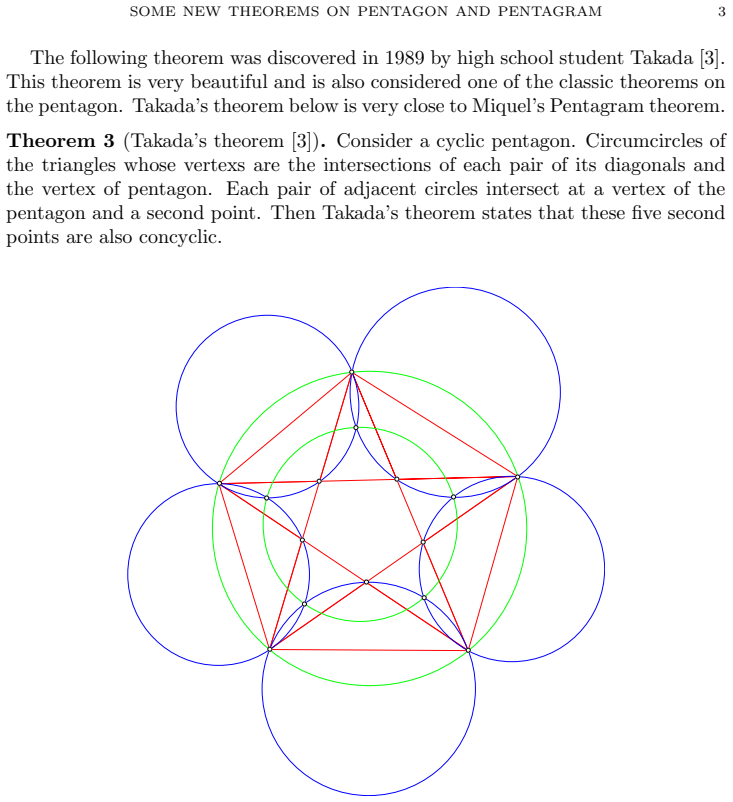
The carrying object is a two-level chain of circumcircles built from the pentagon's side and diagonal intersections: circles through triples of $A$'s and $B$'s, then circles through $C$'s and $B$'s, with $K_i$ and $L_i$ as their centers. Miquel's Pentagram Theorem — the classical result that the five second intersections of adjacent circumcircles of a pentagram are concyclic — is invoked to pass from cyclicity of the $B_i$ or $A_i$ to cyclicity of the $C_i$ on a second circle $(J)$, and Miquel's Five Circles Theorem is used in Theorem 8 to confirm the circle $(O)$ through the $K_i$. The concurrency point $X$ of the lines $K_iL_i$ is the point that ties the new construction to those classical circles; the paper claims $O$, $J$, and $X$ are collinear whenever the relevant Miquel hypotheses hold.
What would settle it
Choose five points in general position, for example with no three collinear and no two relevant lines parallel, compute the $B_i$, $C_i$, $K_i$, and $L_i$ as defined in Theorem 4 using exact rational arithmetic, and check whether the five lines $K_iL_i$ share a common intersection $X$; a single explicit counterexample would settle Theorem 4. Similarly, for Theorems 6 and 7, choose five points $A_i$ on a circle, compute all auxiliary points and test the collinearity of $O$, $J$, and $X$; one non-collinear computation would refute the claim.
Extended reading notes
Core claim
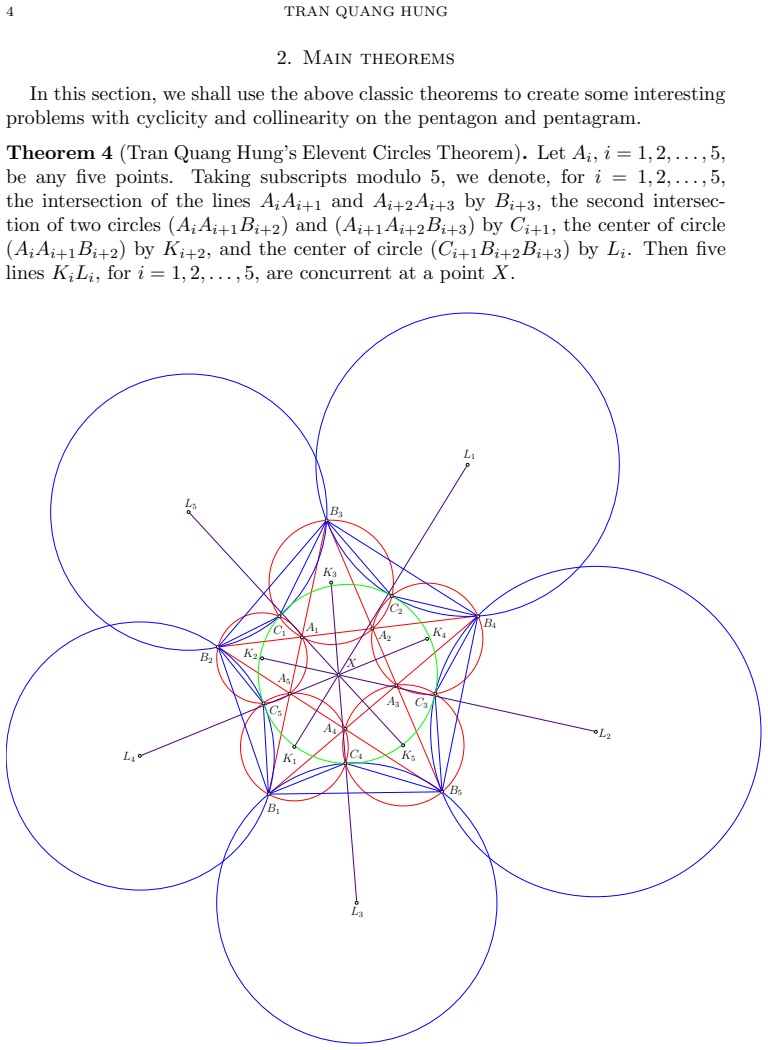
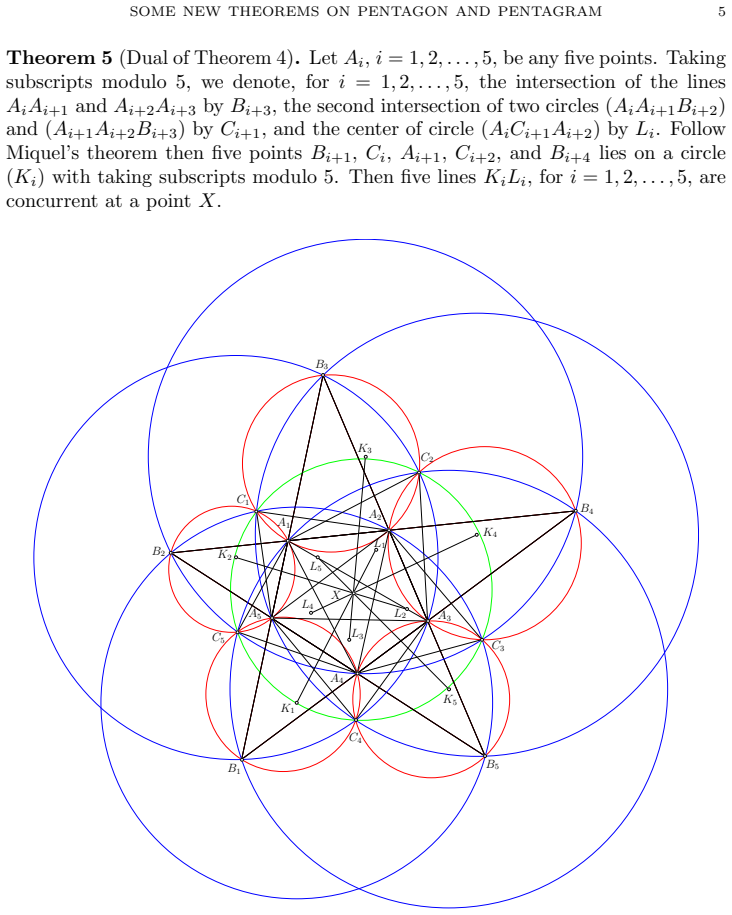
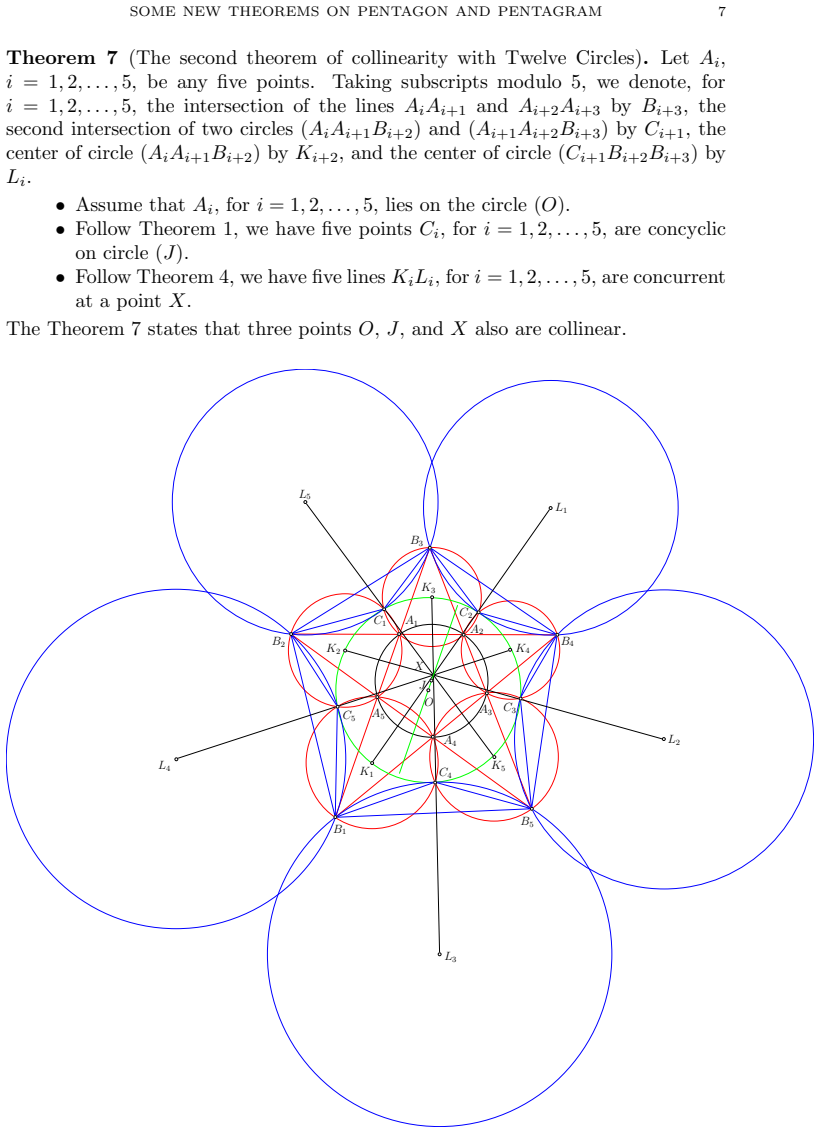
The central discovery, stated as Theorem 4 (the 'Eleven Circles' theorem), is a concurrency theorem for an arbitrary pentagon: with $A_1,\ldots,A_5$ any five points (indices modulo 5), define $B_{i+3}$ as the intersection of the lines $A_iA_{i+1}$ and $A_{i+2}A_{i+3}$; let $C_{i+1}$ be the second intersection of the circumcircles $(A_iA_{i+1}B_{i+2})$ and $(A_{i+1}A_{i+2}B_{i+3})$; let $K_{i+2}$ be the center of the first of these circles and $L_i$ the center of the circle $(C_{i+1}B_{i+2}B_{i+3})$. Then the five lines $K_iL_i$ are concurrent at a single point $X$. Theorem 5 gives a dual version with the roles of circles and centers changed, also concurrent at a point $X$. Theorems 6 and 7 assert that when the five $B_i$ (respectively the five $A_i$) lie on a circle $(O)$, the five $C_i$ lie on a circle $(J)$ by Miquel's Pentagram Theorem, and then $O$, $J$, and $X$ are collinear. Theorem 8 adds a second generation of the construction: if the centers $K_i$ themselves lie on a circle $(O)$, then with auxiliary points $D_i$ and $E_i$ defined analogously, each triple $K_i$, $L_i$, $E_i$ is collinear and $O$, $J$, $X$ are again collinear.
Load-bearing premise
The collinearity theorems rely on the assumption that the points $C_i$ really are concyclic on a circle $(J)$ via Miquel's Pentagram Theorem and that the lines $K_iL_i$ really are concurrent at $X$ via Theorem 4; the paper gives no argument verifying either application.
Editorial extensions
If this is right
- For any five points in general position, the construction yields a distinguished point $X$ where the five lines $K_iL_i$ meet; this is a new center associated to an arbitrary pentagon.
- If the five side-intersection points $B_i$ are concyclic, the center $O$ of that circle, the center $J$ of the Miquel circle through the $C_i$, and $X$ lie on one line.
- If the five original vertices $A_i$ are concyclic, the same collinearity of $O$, $J$, and $X$ holds.
- If the five centers $K_i$ are concyclic, the construction iterates and produces five collinear triples $K_i$, $L_i$, $E_i$ plus the collinearity $O$, $J$, $X$.
- By the author's remark, applying the dual theorem 5 yields three further collinearity theorems analogous to Theorems 6–8.
Reading between the lines
- Because Theorem 4 makes no cyclicity assumption, if it holds it is a purely projective or Euclidean theorem about arbitrary five-point sets; a coordinate proof or a radical-axis argument would likely reveal the underlying structure, and the paper does not supply one.
- The construction is invariant under cyclic relabeling, so $X$ and the collinearity lines probably have a natural interpretation under any symmetry of the pentagon, possibly connecting to known families of triangle and pentagon centers.
- The absence of proofs means the fastest check is numerical: evaluating the construction on randomly chosen rational coordinates would quickly show whether the concurrency and collinearity claims are true as stated.
- If the full concurrency of Theorem 4 fails for generic points, Theorems 6–8 could still hold under their cyclicity hypotheses, so the two families of claims should be tested separately.
Signed reviews
Editorial analysis
A structured set of objections, weighed in public.
Referee Report
Summary. The paper recalls three classical theorems on pentagons and pentagrams (Miquel's Pentagram Theorem, Miquel Five Circles Theorem, and Takada's Theorem) and then states five new results. Theorem 4 asserts that for arbitrary five points A_i, five constructed lines K_iL_i are concurrent at a point X; Theorem 5 is announced as its dual. Theorems 6, 7, and 8 assert collinearity of certain centers O, J, and X under additional cyclicity assumptions, and Theorem 8 adds collinearity of triples K_i, L_i, E_i. The paper contains definitions, figures, and statements but no proofs: each new theorem is justified only by phrases such as "Follow Theorem 4" or "Follow Theorem 1," and no derivation or citation is supplied for the central concurrency claim.
Significance. If the stated theorems were proved, they would constitute a collection of new and visually appealing results in classical Euclidean geometry, potentially of interest to researchers and olympiad-style problemists. The paper correctly recalls the three classical theorems, and the figures suggest that the configurations are carefully drawn. However, the manuscript establishes none of its new claims: Theorem 4 is the load-bearing result, and it is asserted without proof, without citation, and without any algebraic or numerical verification. Since Theorems 6, 7, and 8 all depend on Theorem 4, the main conclusions are unsupported as submitted. The paper also contains no machine-checked proofs, reproducible code, or parameter-free derivations that could substitute for a written argument.
major comments (4)
- [Section 2, Theorem 4] Theorem 4 is the central new result, yet it is stated with no proof. The text defines the points A_i, B_i, C_i, K_i, L_i and asserts that the five lines K_iL_i are concurrent at X, but gives neither a derivation, a citation to a known theorem that implies the concurrency, nor a computational verification. Because Theorems 6, 7, and 8 each obtain their point X solely by invoking "Follow Theorem 4," the existence and uniqueness of X are not established, and all subsequent collinearity statements involving X are ungrounded.
- [Section 2, Theorems 6 and 7] The applications of Miquel's Pentagram Theorem are not justified. In Theorem 6, after assuming the points B_i lie on a circle (O), the text simply states "Follow Theorem 1, we have five points C_i are concyclic on circle (J)." It is not demonstrated that the C_i defined in the construction are the five second intersection points of Miquel's theorem, nor that the configuration satisfies the hypotheses of Theorem 1. The same gap occurs in Theorem 7 with the assumption that the A_i lie on (O). Without this verification, the circle (J) is not established, and the collinearity O, J, X cannot be concluded.
- [Section 2, Theorem 8] Theorem 8 contains multiple unsupported applications of classical theorems. The step "Assume that K_i, for i = 1,...,5, lies on a circle, follow Theorem 2 this circle is also (O)" is unclear: Theorem 2 concerns five circles with concyclic centers, but the text does not verify that the circles (A_iA_{i+1}B_{i+2}) satisfy the required conditions or that the circle through the K_i is the same as the circle (O) obtained earlier. The subsequent definitions of D_i and E_i and the invocations of Theorems 1 and 4 are likewise not checked against their hypotheses. Thus both stated conclusions of Theorem 8 are unsupported.
- [Section 2, Theorem 5 and Remark] Theorem 5, announced as the dual of Theorem 4, is also stated without proof. The Remark then says that using Theorem 5 yields three further theorems analogous to Theorems 6, 7, and 8; since Theorem 5 is unproved, those analogues would inherit the same missing-proof gap. No argument is given for why the five points named in Theorem 5 lie on a circle (K_i), and the concurrency of the lines K_iL_i is simply asserted.
minor comments (6)
- [Throughout] The manuscript contains no proofs, no numbered equations, and no derivations; the figures are the only evidence offered for the new assertions.
- [Theorem 4 title] The title "Elevent Circles Theorem" contains a typo; it should be "Eleven Circles Theorem."
- [Keywords and Remark] There are several typographical errors: "Concylic" should be "Concyclic," "obatain" should be "obtain," and "the the theorems" should be "the theorems."
- [Theorem 3] The phrase "whose vertexs are the intersections" should be "whose vertices are the intersections."
- [References] References [4] through [9] are listed but are not cited in the body of the text; in particular, the self-citations [7], [8], and [9] are not referenced anywhere in the proof of the new results. The paper should either cite these sources in relevant places or remove them.
- [Theorem 8] The symbol (O) is used for both the circle through the C_i and the circle through the K_i, which is confusing; distinct notation for these two circles would improve clarity.
Circularity Check
No circular derivation: the paper's dependencies are unproved assertions and classical citations, not self-referential reductions.
full rationale
The paper consists of stated synthetic-geometry theorems with no accompanying proofs, so the derivation chain is not fully exhibited. Theorem 4 asserts the concurrency of the five lines K_iL_i at a point X, and Theorems 6, 7, and 8 each invoke that concurrency with the phrase 'Follow Theorem 4' before asserting the collinearity of O, J, and X. This is a dependency on an unproved statement in the same paper, but it is not a circularity: the collinearity conclusions are not used to define X, Theorem 4 is not defined in terms of the later theorems, and no parameter is fitted to the conclusions. The named classical theorems of Miquel and Takada are recalled from external sources and are not being presented as the paper's own derived results. The references include several prior items by the author, but these are not cited in the argument and do not carry the load of any proof. Thus no step reduces by construction to its own inputs; the central weakness is an omitted proof of the pivoting concurrency theorem, which is a proof gap rather than a circular derivation.
Assumptions & free parameters
assumptions (4)
- standard math Miquel's Pentagram Theorem is true and applicable to the constructed B_i and C_i points.
- standard math Miquel Five Circles Theorem is true and applicable to the K_i points in Theorem 8.
- ad hoc to paper Theorem 4 of this paper is true.
- ad hoc to paper Theorem 5 (Dual of Theorem 4) is true.
Cite this review
Pith. "Pith review of Some new theorems on Pentagon and Pentagram." pith.science (2026). https://pith.science/paper/R6SCO2P2
@misc{pith2026190800974,
  author       = {Pith},
  title        = {Pith review of: Some new theorems on Pentagon and Pentagram},
  year         = {2026},
  howpublished = {\url{https://pith.science/paper/R6SCO2P2}},
  note         = {Machine review of arXiv:1908.00974}
}
read the original abstract
We establish some new theorems on pentagon and pentagram.
Figures


Figures from the paper (5 more)


Reference graph
Works this paper leans on
-
[1]
F. V. Lamoen, Miquel’s Pentagram Theorem , from MathWorld–A Wolfram Web Resource , created by E. W. Weisstein, http://mathworld.wolfram.com/MiquelsPentagramTheorem. html
-
[2]
E. W. Weisstein, Miquel Five Circles Theorem , from MathWorld–A Wolfram Web Resource, http://mathworld.wolfram.com/MiquelFiveCirclesTheorem.html
-
[3]
Takada’s theorem in Japanese, https://www.nakanihon.co.jp/gijyutsu/Shimada/ Computationalgeometry/chapter040901.html 10 TRAN QUANG HUNG
-
[4]
T. O. Dao, Advanced Plane Geometry, message 1531, August 28, 2014
work page 2014
-
[5]
N. Dergiades, Dao’s theorem on six circumcenters associated with a cyclic hexagon , Forum Geom., 14 (2014) 243–246
work page 2014
-
[6]
T. Cohl, Radical center of Five circles , Forum AoPS., https://artofproblemsolving.com/ community/q2h1813119
-
[7]
Q. H. Tran (Nick name buratinogigle), Concurrent lines in bicentric hexagon , Forum AoPS., https://artofproblemsolving.com/community/c374081h1829746
-
[8]
Q. H. Tran (Nick name buratinogigle), Concurrent on cyclic pentagon , Forum AoPS., https: //artofproblemsolving.com/community/q3h561853
Show all 9 references
-
[9]
Q. H. Tran (Nick name buratinogigle), Concurrency on bicentric pentagon , Forum AoPS., https://artofproblemsolving.com/community/q3h482606 High school for Gifted students, Hanoi University of Science, Hanoi National Uni- versity, Hanoi, Vietnam. E-mail address : analgeomatica@...
Reviewed August 14, 2026 · model on record in the stance chip above.
Discussion (0). Continue with ORCID to comment.