REVIEW 3 major objections 5 minor 24 references
AfforDance: Personalized AR Dance Learning System with Visual Affordance
T0 review · 3 major / 5 minor · reviewed 2026-08-15 · deepseek-v4-flash
Pith's one-line read AfforDance turns any user-selected dance video into an AR lesson with body-matched visual cues.
desk verdict A clearly written workshop system proposal whose 'enhances learning' claim is not backed by any evaluation; the alignment step that everything depends on is 'confirmed' rather than measured. read the letter →
The pith
A machine-rendered reading of the paper's core claim, the machinery that carries it, and where it could break.
The reading
What carries the argument
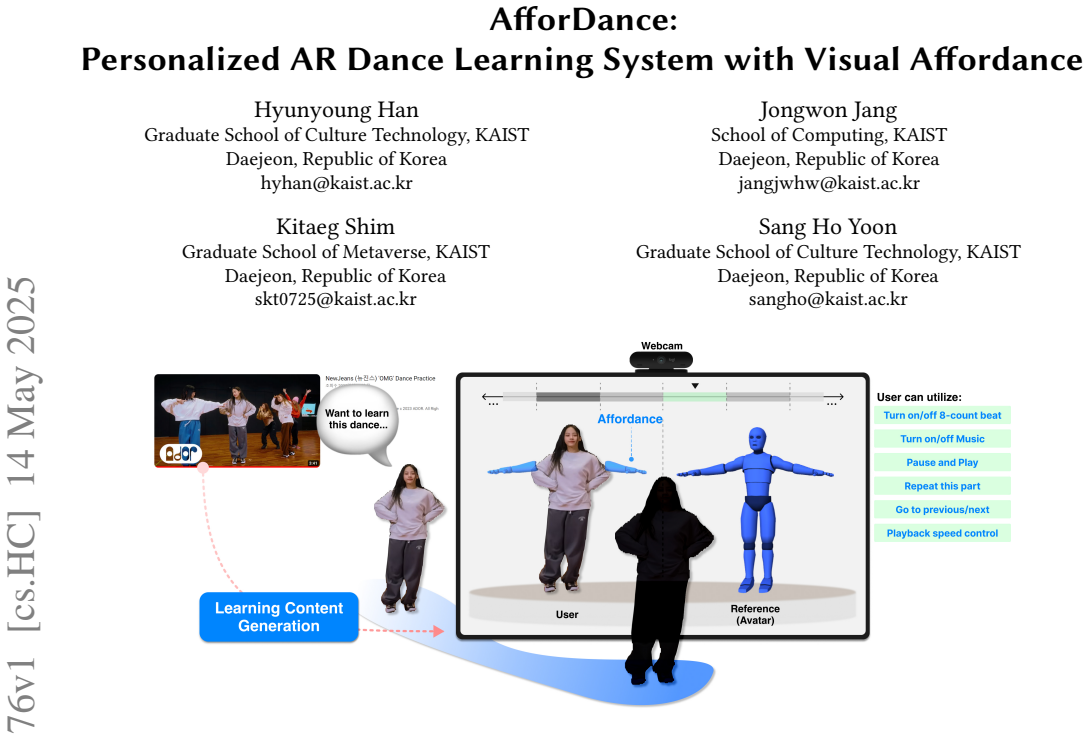
The load-bearing object is the visual affordance: an AR overlay, sized to the learner's body, that marks the hands and feet (with optional full-body display) so joint positions and movement ranges are explicit during practice. It is produced by separating vertex groups from the WHAM-generated avatar mesh in Blender and then normalized to the learner's webcam frame using real-time pose estimation from ThreeDPoseUnityBarracuda, performed once at startup rather than per frame. The reference avatar generated from the input video and the 8-count beat inserted into the audio complete the learning content. The affordance is what carries the learning argument: it turns an abstract video demonstration into spatially grounded cues on the learner's own body.
What would settle it
Record the learner's webcam view during a practice session and compare the projected positions of the affordance overlays against the tracked wrist and ankle positions frame by frame; if the average alignment error grows with movement speed or dance range, the one-time normalization is not sufficient. A controlled comparison of learners practicing an 8-count phrase with affordances versus with a plain mirrored video, measuring joint-angle error against the reference pose, would settle whether the cues improve learning.
Extended reading notes
Core claim
The central claim is that dance learning can be personalized end-to-end: a learner picks a video of a desired dance, and the system converts it into structured AR content rather than displaying the video alone. The conversion pipeline estimates 3D body pose from the 2D footage, renders a reference avatar, embeds a beat counted in 8-count phrases into the extracted audio, and generates affordances by separating the avatar mesh into hand and foot regions. The affordances are then normalized once to the learner's body size using real-time pose estimation from the webcam and displayed over the learner's mirror image beside the reference avatar. The authors hold that these visual cues communicate movement mechanics and range of motion directly, addressing the known difficulty of learning upper-lower body coordination and fast beat synchronization from traditional videos.
Load-bearing premise
The system's benefit rests on the untested assumption that the one-time body-size normalization aligns the visual cues with the learner's actual moving body accurately enough to guide, rather than mislead, their movements.
Editorial extensions
If this is right
- Users can learn a chosen choreography without waiting for instructor-made content, since any accessible dance video is converted automatically.
- Learners keep their eyes on the display and their own mirrored body at once, removing the device-switching interruption that self-learners reported.
- Hand and foot affordances target the joints that prior work found hardest to learn, giving a principled reason to expect faster mastery of those movements.
- Playback speed, repeat, and section navigation let learners slow difficult 8-count phrases, matching the pacing of a dance class without a teacher.
- Because guidance happens on a large display rather than a headset, the approach avoids the fatigue and disorientation associated with prolonged HMD use.
Reading between the lines
- If the one-time body-size normalization holds during fast, large-range dance motions, the same affordance pipeline could be applied to other motor-learning domains such as sports drills or rehabilitation exercises where joint trajectories matter.
- A natural extension the paper leaves implicit is making the affordances reactive: instead of a static overlay, cues could change color or intensity when the learner's tracked wrists and ankles deviate from the reference motion, turning the system from passive content into live feedback.
- The untested step is the accuracy of the normalization transform; a quantitative comparison of one-time versus per-frame alignment during dance movements would show whether the simplicity assumption costs accuracy.
- If the visual affordance claim is right, an isolated affordance-on versus affordance-off comparison in a user study should show measurable differences in joint-angle error, not just self-reported preference.
Signed reviews
Editorial analysis
A structured set of objections, weighed in public.
Referee Report
Summary. AfforDance is an AR-based dance learning system that converts a user-selected dance video into a structured learning experience. The pipeline extracts audio, adds an 8-count beat, generates a 3D reference avatar using the WHAM pose-estimation model, and renders real-time visual 'affordances' overlaid on the user's webcam view using ThreeDPoseUnityBarracuda for initial body-size normalization. Design goals are derived from a contextual inquiry with three participants. The paper presents the system architecture and interface but reports no user study, no quantitative evaluation, and no measured performance data. Section 4 acknowledges that user input is not effectively integrated beyond passive content delivery and identifies this as a key limitation.
Significance. The problem addressed is relevant: self-directed dance learning with AR overlays for large displays is a reasonable alternative to HMD-based approaches, and the use of WHAM for avatar generation is a sensible technical choice. The paper's strengths include a clear system pipeline, the grounding of design goals in a small contextual inquiry, and an honest statement of limitations. However, the central claim that the system 'enhances learning through visual affordances' is entirely unsupported by evidence; the paper is a system description without any empirical validation. The alignment mechanism, which is the enabling condition for the visual guidance, is described as a one-time normalization with no error measurement. If the result holds, the system could be a useful contribution to personalized dance education, but as presented the evidence is insufficient to support the learning claim.
major comments (3)
- [Section 3.2.2] The affordance alignment mechanism is load-bearing but unvalidated. The text states that 'normalization is performed initially rather than every frame' and that 'the transform is confirmed to ensure proper alignment,' without reporting any quantitative error metric. If the normalization is a fixed affine transform, any translation, rotation, or scale change of the user relative to the webcam during dancing will cause the affordances to drift off the corresponding body parts. If ThreeDPoseUnityBarracuda is used per-frame, the paper does not report its keypoint accuracy under dance-like motion with fast movements and self-occlusion. In either reading, the visual cues could misguide rather than guide the learner, undermining the abstract's claim that the system enhances learning through visual affordances. The authors should provide a quantitative evaluation of alignment error during representative dance motions, or describe a continuous re-normalization scheme.
- [Abstract and Section 4] The paper claims that AfforDance 'enhances learning through visual affordances,' but no user study or learning-outcome evaluation is reported. The only empirical input is a contextual inquiry with three participants that motivates design goals, not an assessment of the implemented system. Given that the central contribution is a claimed learning benefit, the absence of even a small pilot study (e.g., movement accuracy, completion time, or user-reported experience compared with a video-only baseline) leaves the main claim unsupported. Section 4's acknowledgment that 'user input can be effectively integrated into the learning process beyond passive content delivery' further weakens the adaptive-guidance aspect. The manuscript should either add a pilot evaluation or carefully scope its claims to system design and feasibility.
- [Section 3.1] The audio content generation and reference avatar generation are described but not validated. For audio, the procedure of adjusting BPM and zero-padding for alignment could introduce temporal misalignment between the beat and the dance video; no measure of synchronization accuracy is provided. For the avatar, WHAM is used to estimate 3D poses from 2D dance videos, but the paper does not address how pose-estimation errors under fast, complex choreography affect the quality of the reference avatar and the subsequent affordances. These pipeline stages are central to the learnability of the content, so some form of accuracy assessment or at least a qualitative example with error overlay would strengthen the contribution.
minor comments (5)
- [Section 2.2.1] The sentence 'It is hard to watch myself in the mirror and the device at the same time' is presented as a quote from P1 and P3, but it is unclear whether this is a direct quote or a paraphrase; please clarify or use quotation marks consistently.
- [Section 3.2.2] The statement 'the transform is confirmed to ensure proper alignment' is vague; specify whether this is visual inspection, manual calibration, or an automatic check.
- [Section 3.2.2] The use of 'PKL' and 'FBX' file formats may be unfamiliar to readers outside graphics; a one-sentence explanation would improve accessibility.
- [Figure 3] The caption of Figure 3 describes the three affordance display modes, but the text does not explain why a user would choose one mode over another; a brief rationale would help.
- [Section 4] The future direction paragraph is well-articulated, but the phrasing 'key limitation of this study is the insufficient discussion' undersells the issue; it is not only insufficient discussion but also an unvalidated system.
Circularity Check
No circularity: AfforDance is a system-integration paper whose components come from external models and user-input video, with no prediction or derived result that reduces to its own inputs.
full rationale
AfforDance makes no falsifiable quantitative prediction and derives no formal result; it is an AR dance-learning system built by composing independently published components (WHAM for 3D pose, ThreeDPoseUnityBarracuda for real-time pose estimation, pafy/moviepy/librosa for audio). The claimed contribution is a content-generation pipeline and interface, and every stated input—user-selected dance video, BPM, start/end times, webcam image—feeds directly into that pipeline without being repackaged as an output that was also an input. The design goals are traced to a three-participant contextual inquiry, not to tuning the system toward a predetermined outcome, and no fitted parameter is later relabeled as a prediction. The paper's main weakness, flagged by the skeptical reader, is that the affordance alignment in Section 3.2.2 is only 'confirmed' rather than quantitatively validated, and the system's learning benefit is asserted rather than measured; that is an empirical-validation gap, not circular reasoning. The authors' own Section 4 statement that user input is not effectively integrated beyond passive content delivery is a candid limitation, and it does not indicate that any claimed result is true by construction. None of the enumerated circularity patterns—self-definitional reasoning, fitted input called prediction, load-bearing self-citation, uniqueness imported from the authors, ansatz smuggled via citation, or renaming a known result—appears in the manuscript. The paper is self-contained as a systems description and should receive the honest non-finding score of 0.
Assumptions & free parameters
assumptions (4)
- domain assumption 8-count segmentation is an effective unit for learning dance choreography.
- domain assumption WHAM provides sufficiently accurate 3D body poses from 2D dance videos for reference avatar generation.
- domain assumption Real-time pose estimation from a single webcam is accurate enough for body-size normalization and affordance alignment.
- domain assumption Visual affordances on wrists and ankles improve dance learning.
Cite this review
Pith. "Pith review of AfforDance: Personalized AR Dance Learning System with Visual Affordance." pith.science (2026). https://pith.science/paper/RAEY5NB3
@misc{pith2026250509376,
  author       = {Pith},
  title        = {Pith review of: AfforDance: Personalized AR Dance Learning System with Visual Affordance},
  year         = {2026},
  howpublished = {\url{https://pith.science/paper/RAEY5NB3}},
  note         = {Machine review of arXiv:2505.09376}
}
read the original abstract
We propose AfforDance, an augmented reality (AR)-based dance learning system that generates personalized learning content and enhances learning through visual affordances. Our system converts user-selected dance videos into interactive learning experiences by integrating 3D reference avatars, audio synchronization, and adaptive visual cues that guide movement execution. This work contributes to personalized dance education by offering an adaptable, user-centered learning interface.
Figures


Reference graph
Works this paper leans on
-
[1]
Fraser Anderson, Tovi Grossman, Justin Matejka, and George Fitzmaurice. 2013. YouMove: enhancing movement training with an augmented reality mirror. In Proceedings of the 26th annual ACM symposium on User interface software and technology. 311–320
work page 2013
-
[2]
Audacity Team. [n. d.]. Audacity: Free, open source, cross-platform audio software. https://www.audacityteam.org/. Accessed: 2024-06-11
work page 2024
-
[3]
İremsu Baş, Demir Alp, Lara Ceren Ergenç, Andy Emre Koçak, and Sedat Yalçın
-
[4]
Hugh Beyer and Karen Holtzblatt. 1999. Contextual design. interactions 6, 1 (1999), 32–42
1999
-
[5]
Julien Blanchet, Megan E Hillis, Yeongji Lee, Qijia Shao, Xia Zhou, David JM Kraemer, and Devin Balkcom. 2023. LearnThatDance: Augmenting TikTok Dance Challenge Videos with an Interactive Practice Support System Powered by Au- tomatically Generated Lesson Plans. In Adjunct Proceedings of the 36th Annual ACM Symposium on User Interface Software and Technol...
work page 2023
-
[6]
Blender Foundation. [n. d.]. Blender - Open Source 3D Creation Suite. https: //www.blender.org/. Accessed: 2024-06-11
work page 2024
-
[7]
Jacky CP Chan, Howard Leung, Jeff KT Tang, and Taku Komura. 2010. A virtual reality dance training system using motion capture technology. IEEE transactions on learning technologies 4, 2 (2010), 187–195
work page 2010
-
[8]
Kuo-En Chang, Jia Zhang, Yang-Sheng Huang, Tzu-Chien Liu, and Yao-Ting Sung. 2020. Applying augmented reality in physical education on motor skills learning. Interactive Learning Environments 28, 6 (2020), 685–697
work page 2020
Show all 24 references
-
[9]
Karen Dearborn and Rachael Ross. 2006. Dance learning and the mirror: compar- ison study of dance phrase learning with and without mirrors. Journal of Dance Education 6, 4 (2006), 109–115
2006
-
[10]
digital standard. 2021. ThreeDPoseUnityBarracuda. https://github.com/digital- standard/ThreeDPoseUnityBarracuda
2021
-
[11]
Daniel L Eaves, Gavin Breslin, Paul Van Schaik, Emma Robinson, and Iain R Spears. 2011. The short-term effects of real-time virtual reality feedback on motor learning in dance. Presence: Teleoperators and Virtual Environments 20, 1 (2011), 62–77
2011
-
[12]
Inc Free Software Foundation. 2007. pafy. https://github.com/mps-youtube/pafy
2007
-
[13]
Javid Iqbal and Manjit Singh Sidhu. 2021. Augmented Reality-Based Dance Training System: A Study of Its Acceptance. In Design, Operation and Evaluation of Mobile Communications: Second International Conference, MOBILE 2021, Held as Part of the 23rd HCI International Conference...
2021
-
[14]
Muhammed Kocabas, Nikos Athanasiou, and Michael J. Black. 2020. VIBE: Video Inference for Human Body Pose and Shape Estimation. In The IEEE Conference on Computer Vision and Pattern Recognition (CVPR)
2020
-
[15]
Markus Laattala, Roosa Piitulainen, Nadia Ady, Monica Tamariz, and Perttu Hämäläinen. 2024. Anticipatory Movement Visualization for VR Dancing. In ACM SIGCHI Annual Conference on Human Factors in Computing Systems . ACM
2024
-
[16]
Markus Laattala, Roosa Piitulainen, Nadia M Ady, Monica Tamariz, and Perttu Hämäläinen. 2024. Wave: Anticipatory movement visualization for vr dancing. In Proceedings of the 2024 CHI Conference on Human Factors in Computing Systems . 1–9
2024
-
[17]
Brian McFee, Colin Raffel, Dawen Liang, Daniel PW Ellis, Matt McVicar, Eric Battenberg, and Oriol Nieto. 2015. librosa: Audio and music signal analysis in python. SciPy 2015 (2015), 18–24
2015
-
[18]
Soyong Shin, Juyong Kim, Eni Halilaj, and Michael J. Black. 2024. WHAM: Reconstructing World-grounded Humans with Accurate 3D Motion. arXiv:2312.07531 [cs.CV]
2024 arXiv
-
[19]
Unity Technologies. [n. d.]. Unity Real-Time Development Platform. https: //unity.com/. Accessed: 2024-06-11
2024
-
[20]
Yoko Usui, Katsumi Sato, and Shinichi Watabe. 2015. Learning Hawaiian hula dance by using tablet computer. InSIGGRAPH Asia 2015 Symposium on Education. 1–2
2015
-
[21]
Jiahao Wang, Yunhong Wang, Nina Weng, Tianrui Chai, Annan Li, Faxi Zhang, and Sansi Yu. 2022. Will you ever become popular? Learning to predict virality of dance clips. ACM Transactions on Multimedia Computing, Communications, and Applications (TOMM) 18, 2 (2022), 1–24
2022
-
[22]
Yufeng Wu, Gangyi Ding, Hongsong Li, Tong Xue, Di Jiao, Tianyu Huang, Longfei Zhang, Fuquan Zhang, and Lin Xu. 2019. VRAS: A virtual rehearsal assistant system for live performance. In Advances in Smart Vehicular Technology, Trans- portation, Communication and Applications: Pr...
2019
-
[23]
Zulko. 2023. moviepy. https://github.com/Zulko/moviepy
2023
-
[2023]
In International Conference on Human-Computer Interaction
AR Dance Learning App with a Feedback Feature Through Pose Estimation: DancÆR. In International Conference on Human-Computer Interaction . Springer, 198–204
Reviewed August 15, 2026 · model on record in the stance chip above.
Discussion (0). Continue with ORCID to comment.