Revisiting angle stability in power systems with grid-forming power converters
Pith reviewed 2026-05-20 04:44 UTC · model grok-4.3
The pith
Synchronism stability in power systems with machines and grid-forming converters depends only on slow voltage angle difference dynamics.
A machine-rendered reading of the paper's core claim, the machinery that carries it, and where it could break.
Core claim
This letter presents a comprehensive analysis showing that the stability phenomenon related to the ability of generators to remain in synchronism when subjected to small or large disturbances in power systems with both synchronous machines and grid-forming voltage source converters is fully characterised with the slow dynamics of the angle difference between the voltage sources connected to the power system, regardless of whether they are synchronous machines (with rotors) or GFM-VSCs. Therefore, we suggest using the term angle stability to refer to this phenomenon, while slow-interaction converter-driven stability should only include slow interactions of different nature involving power
What carries the argument
Slow dynamics of the angle difference between the voltage sources, serving as the unifying mechanism for describing synchronism stability independent of the source type.
If this is right
- Rotor-angle stability and the relevant part of converter-driven stability merge into one concept.
- Analysis of both small and large signal stability can use the same angle difference approach in mixed systems.
- The classification of stability phenomena in power systems needs updating to reflect this unification.
Where Pith is reading between the lines
- This could lead to simpler simulation models for stability studies in grids with increasing converter penetration.
- Design of converter controls might incorporate principles from classical machine stability analysis.
- It opens the way for parameter-free or reduced-order models focused on angle dynamics.
Load-bearing premise
The slow angle-difference dynamics by themselves are enough to characterize the full synchronism stability phenomenon in mixed machine-converter systems for all relevant disturbances.
What would settle it
A specific counterexample would be a mixed power system where synchronism is lost due to fast or converter-specific dynamics not reflected in the slow angle difference between voltage sources.
Figures

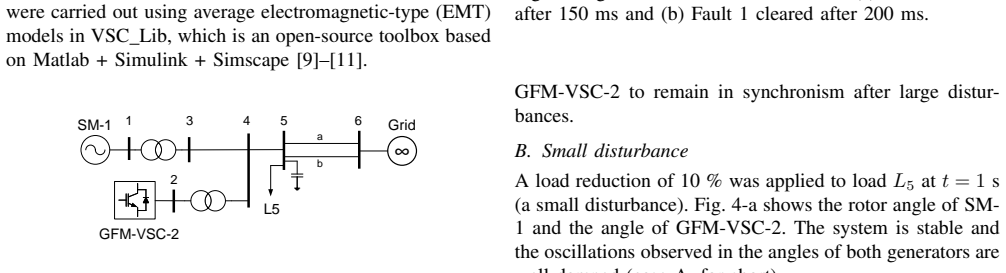

read the original abstract
This letter presents a comprehensive analysis of the stability phenomenon related to the ability of generators to remain in synchronism when subjected to small or large disturbances, in power systems with both synchronous machines and grid-forming voltage source converters (GFM-VSC). This phenomenon is associated with two stability classes in the IEEE/PES classification, namely, rotor-angle stability (when involving synchronous machines and slow-interaction converter-driven stability (when involving power converters). However, this work shows that this phenomenon is fully characterised with the slow dynamics of the angle difference between the voltage sources connected to the power system, regardless of whether they are synchronous machines (with rotors) or GFM-VSCs. Therefore, we suggest using the term angle stability to refer to this phenomenon, while slow-interaction converter-driven stability should only include slow interactions of different nature involving power converters.
Editorial analysis
A structured set of objections, weighed in public.
Referee Report
Summary. The letter re-characterizes synchronism stability (small- and large-disturbance) in mixed synchronous-machine and grid-forming VSC systems. It argues that the phenomenon previously split into rotor-angle stability and slow-interaction converter-driven stability is in fact fully captured by the slow dynamics of the voltage-source angle difference, irrespective of whether the sources are physical rotors or GFM-VSC equivalents, and therefore proposes to subsume both under the single term 'angle stability'.
Significance. If the reduction to pure angle-difference dynamics can be shown rigorously, the result would simplify stability classification and allow classical swing-equation tools to be applied directly to mixed SM-GFM systems. The work correctly identifies that converter controls can emulate inertial behavior, but the significance hinges on whether this equivalence holds without residual interaction terms across the full range of disturbances and control parameters.
major comments (2)
- [§III] §III (Modeling and Reduction): the central claim that GFM-VSC full-order dynamics (inner loops, droop/virtual inertia, filters) reduce to the slow angle-difference subsystem without affecting the stability boundary is asserted but not demonstrated. No singular-perturbation ordering, center-manifold analysis, or explicit algebraic elimination of fast states is provided for the mixed SM-converter case; the letter therefore leaves open the possibility that converter-specific time constants interact with the angle mode under certain parameter regimes.
- [§IV] §IV (Numerical Validation): the simulation cases illustrate angle-difference behavior but do not constitute a counter-example exclusion. Without an accompanying analytical reduction or a systematic parameter sweep that varies inner-loop bandwidths relative to the angle mode, it remains unclear whether the unification holds for all relevant small- and large-disturbance scenarios or only for the particular tuning shown.
minor comments (2)
- [Abstract] The abstract states that the phenomenon is 'fully characterised'; this phrasing should be softened to 'characterised to first order by' pending the missing reduction step.
- [Notation] Notation for the angle difference δ should explicitly distinguish between SM rotor angle and GFM-VSC virtual angle when both are present in the same system.
Simulated Author's Rebuttal
We thank the referee for the constructive feedback, which helps clarify the scope and limitations of our letter. We appreciate the acknowledgment of the potential to unify stability concepts under 'angle stability'. Below we respond point-by-point to the major comments, indicating where revisions will be made to improve clarity without altering the core claims.
read point-by-point responses
-
Referee: [§III] §III (Modeling and Reduction): the central claim that GFM-VSC full-order dynamics (inner loops, droop/virtual inertia, filters) reduce to the slow angle-difference subsystem without affecting the stability boundary is asserted but not demonstrated. No singular-perturbation ordering, center-manifold analysis, or explicit algebraic elimination of fast states is provided for the mixed SM-converter case; the letter therefore leaves open the possibility that converter-specific time constants interact with the angle mode under certain parameter regimes.
Authors: Section III derives the reduced model by separating the fast inner-loop and filter dynamics from the slow voltage-angle subsystem for both synchronous machines and GFM-VSCs, showing that the angle-difference dynamics govern synchronism stability. The reduction relies on standard time-scale separation assumptions common in power-system modeling, where converter controls are tuned to emulate inertial response without residual fast-state coupling to the angle mode. We agree that an explicit singular-perturbation ordering would strengthen the presentation and will add a concise paragraph in the revised manuscript discussing these assumptions and citing relevant reduction techniques, while noting that a full center-manifold analysis lies beyond the scope of this short letter. revision: partial
-
Referee: [§IV] §IV (Numerical Validation): the simulation cases illustrate angle-difference behavior but do not constitute a counter-example exclusion. Without an accompanying analytical reduction or a systematic parameter sweep that varies inner-loop bandwidths relative to the angle mode, it remains unclear whether the unification holds for all relevant small- and large-disturbance scenarios or only for the particular tuning shown.
Authors: The cases in Section IV demonstrate the angle-difference dynamics for both small-signal linearization and large-disturbance nonlinear behavior across mixed SM-GFM configurations, supporting the unification under representative tunings. We acknowledge that a systematic sweep over inner-loop bandwidths would provide additional reassurance. In the revision we will expand the discussion to explicitly state the bandwidth separation ratios used and add one supplementary simulation case with varied inner-loop gains, while emphasizing that the letter format precludes exhaustive sweeps. revision: partial
Circularity Check
No circularity: re-framing of stability classes rests on interpretive analysis rather than self-referential reduction
full rationale
The paper's core assertion—that synchronism stability (small and large disturbances) in mixed SM/GFM-VSC systems is fully characterised by the slow dynamics of the angle difference between voltage sources—is advanced as a re-characterisation of IEEE/PES stability classes rather than a derivation that reduces by construction to its own inputs. The abstract and available text present this as an observational unification without exhibiting fitted parameters, self-definitional equations, or load-bearing self-citations that would force the conclusion. No explicit reduction (e.g., via singular perturbation) is shown to be equivalent to an ansatz or prior result by the same authors; the claim remains open to external verification through full-order model analysis. This is the most common honest outcome for interpretive stability papers that do not embed their result inside a closed mathematical loop.
Axiom & Free-Parameter Ledger
axioms (1)
- domain assumption Synchronism stability after disturbances is governed by the slow dynamics of voltage angle differences between connected sources.
Reference graph
Works this paper leans on
-
[1]
Definition and classification of power system stability - revisited and extended,
N. Hatziargyriou, J. V . Milanovi ´c, C. Rahmann, V . Ajjarapu, C. Canizares, I. Erlich, D. Hill, I. Hiskens, I. Kamwa, B. Pal, P. Pourbeik, J. J. Sanchez-Gasca, A. Stankovi ´c, T. Van Cutsem, V . Vittal, and C. V ournas, “Definition and classification of power system stability - revisited and extended,”IEEE Transactions on Power Systems, vol. 36, no. 4, ...
work page 2021
-
[2]
P. Kundur, J. Paserba, V . Ajjarapu, G. Andersson, A. Bose, C. Canizares, N. Hatziargyriou, D. Hill, A. Stankovic, C. Taylor, T. Van Cutsem, and V . Vittal, “Definition and classification of power system stability IEEE/CIGRE joint task force on stability terms and definitions,”IEEE Transactions on Power Systems, vol. 19, no. 3, pp. 1387–1401, 2004
work page 2004
-
[3]
Impact of virtual synchronous machines on low-frequency oscillations in power systems,
M. Baruwa and M. Fazeli, “Impact of virtual synchronous machines on low-frequency oscillations in power systems,”IEEE Transactions on Power Systems, vol. 36, no. 3, pp. 1934–1946, 2021
work page 1934
-
[4]
D. Pan, X. Wang, F. Liu, and R. Shi, “Transient stability of voltage- source converters with grid-forming control: A design-oriented study,” IEEE Journal of Emerging and Selected Topics in Power Electronics, vol. 8, no. 2, pp. 1019–1033, 2020
work page 2020
-
[5]
Large Signal Synchronizing Instability of PLL-Based VSC Connected to Weak AC Grid,
Q. Hu, L. Fu, F. Ma, and F. Ji, “Large Signal Synchronizing Instability of PLL-Based VSC Connected to Weak AC Grid,”IEEE Transactions on Power Systems, vol. 34, no. 4, pp. 3220–3229, 2019
work page 2019
-
[6]
Suitable classification of power system stability phenomena,
M. Lindner, H. Abele, C. John, J. Lehner, K. Vennemann, T. Henning, R. Dimitrovski, N. Kl ¨otzl, H. Just, and R. Stornowski, “Suitable classification of power system stability phenomena,”CIGRE Science and Engineering, no. CSE 037, pp. 1 – 28, 2025
work page 2025
-
[7]
S. D’Arco, J. A. Suul, and O. B. Fosso, “A Virtual Synchronous Machine implementation for distributed control of power converters in SmartGrids,”Electric Power Systems Research, vol. 122, pp. 180– 197, 2015
work page 2015
-
[8]
R. E. ´Avila Mart´ınez, J. Renedo, L. Rouco, A. Garcia-Cerrada, and L. Sigrist, “A benchmark test system to assess angle stability in power systems with grid-forming power converters: Data,”Universidad Pontificia Comillas, vol. Working paper, no. IIT-25-372WP, Madrid, Spain, pp. 1 – 8, 2025
work page 2025
-
[9]
VSC lib: Grid forming models for Matlab/SimPowerSystem,
L2EP-LILLE, “VSC lib: Grid forming models for Matlab/SimPowerSystem,” vol. https://github.com/l2ep-epmlab/ (accessed 08-07-2020), 2020
work page 2020
-
[10]
T. Qoria, Q. Cossart, C. Li, X. Guillaud, F. Colas, F. Gruson, and X. Kestelyn, “WP3-Control and Operation of a Grid with 100% Converter-Based Devices. Deliverable 3.2: Local control and simula- tion tools for large transmission systems,” MIGRATE Project, Tech. Rep., 2018
work page 2018
-
[11]
T. Qoria, F. Gruson, F. Colas, G. Denis, T. Prevost, and X. Guillaud, “Inertia effect and load sharing capability of grid forming converters connected to a transmission grid,” inProc. 15th IET Int. Conf. on AC and DC power transmission (ACDC), Coventry, UK, 2019, pp. 1–6
work page 2019
-
[12]
Analysis of 0.1-Hz Var Oscillations in Solar Photovoltaic Power Plants,
L. Fan, Z. Miao, D. Piper, D. Ramasubramanian, L. Zhu, and P. Mitra, “Analysis of 0.1-Hz Var Oscillations in Solar Photovoltaic Power Plants,”IEEE Transactions on Sustainable Energy, vol. 14, no. 1, pp. 734 – 737, 2023
work page 2023
discussion (0)
Sign in with ORCID, Apple, or X to comment. Anyone can read and Pith papers without signing in.