REVIEW 4 minor 91 references
Search for a resonance in events with four top quarks decaying into two leptons and jets in proton-proton collisions
T0 review · 0 major / 4 minor · reviewed 2026-08-14 · deepseek-v4-flash
Pith's one-line read Four-top search finds no resonance and sets exclusion limits on a top-philic vector boson.
desk verdict A competent, honest null result that opens the two-lepton channel for four-top resonance searches; the central claim holds, with a disclosed but real caveat on the background normalisation that sets the exact mass reach. read the letter →
The pith
A machine-rendered reading of the paper's core claim, the machinery that carries it, and where it could break.
The reading
What carries the argument
The mass of the putative resonance is reconstructed as $m_{JJ}$, the invariant mass of the two leading variable-radius jets formed with the HOTVR algorithm, whose distance parameter shrinks as $R_{\text{eff}}=600\,\text{GeV}/p_T$ to follow collimated top-quark decays. A boosted decision tree tags whether each VR jet comes from a hadronically decaying top quark, and the background of misidentified top-tagged jets is estimated from data by transferring events with zero t-tagged VR jets into the two-tagged signal regions using simulation-derived transfer factors, with the overall normalisation corrected in Z-boson control regions. A simultaneous profile-likelihood fit of the $m_{JJ}$ templates in two signal regions and three dilepton channels yields the 95% confidence-level limits via the $CL_s$ criterion.
What would settle it
With the next $100\,\text{fb}^{-1}$ of 13.6 TeV data, count events in SR2b2T near $m_{JJ}\approx500$ GeV: a real 500 GeV resonance would show a growing peak, while a fluctuation would track the transfer-factor background. The transfer assumption itself can be checked by measuring the two-tag correlation in a same-flavour dilepton region outside the Z window and verifying that the control-region correction factor does not change by more than its uncertainty.
Extended reading notes
Core claim
On its own terms, the paper establishes a null result: the dijet invariant mass spectrum in the two-lepton, two-top-tagged signal regions is consistent with the standard-model background, with a background-only $p$-value of 0.21. The largest local deviation is a 2.1 standard deviation excess for a 500 GeV vector mediator with 4% width, with similar deviations of 2.0 and 2.4 standard deviations for scalar and pseudoscalar hypotheses. The paper therefore reports upper limits rather than evidence: for the $\Gamma_{Z'}/m_{Z'}=50\%$ benchmark, $Z'$ bosons are excluded up to 850 GeV, while the observed limits for 10 and 20% widths are weaker than expected and exclude no mediators. Scalar and pseudoscalar mediators are not excluded. These exclusions apply to the resonant $s$-channel contribution only; non-$s$-channel diagrams and interference with standard-model four-top production are not included, as the paper explicitly states.
Load-bearing premise
The background estimate assumes that the residual mismodelling of the correlation between the two top-tagging probabilities, measured in Z-boson control regions and applied as a normalisation correction, is the same in the signal regions; if that correlation differs there, the background yield could shift by about 20% and change the mass reach.
Editorial extensions
If this is right
- The benchmark top-philic vector mediator with 50% relative width is excluded below 850 GeV, extending the mass reach of earlier four-top searches.
- Scalar and pseudoscalar mediators are not excluded, so those interpretations remain viable targets for future searches.
- Variable-radius jets extend sensitivity below 1 TeV mediator mass, a region where fixed-radius top tagging was inefficient.
- The analysis provides the first four-top resonance limits that include 13.6 TeV data, combining 138 fb${}^{-1}$ at 13 TeV with 35 fb${}^{-1}$ at 13.6 TeV.
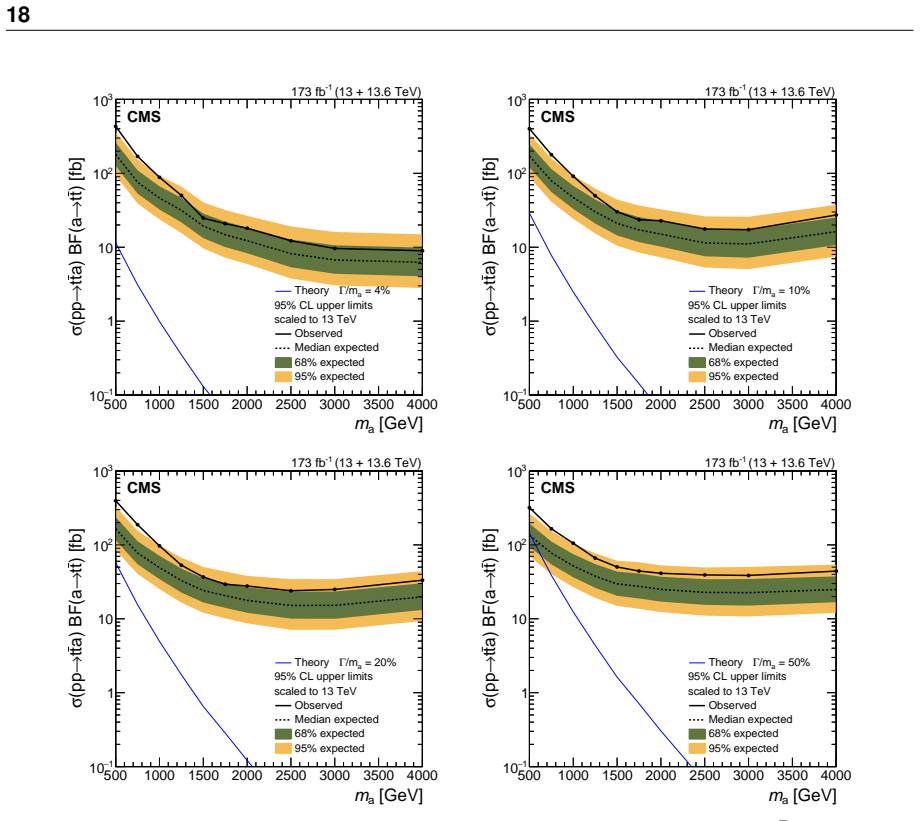
- The ALP reinterpretation sets new upper limits on $c_t/f_A$ in the mass range around 500 GeV to 4 TeV, complementing tt-resonance and missing-transverse-momentum searches.
Reading between the lines
- If the mild 2.1σ excess near 500 GeV is real, additional 13.6 TeV data should produce a growing narrow peak in $m_{JJ}$; if it is a fluctuation, the spectrum should continue to follow the transfer-factor background.
- Because the shown exclusions omit interference with standard-model four-top production, a full top-philic model could be more or less constrained than the benchmark limits suggest, particularly for broad mediators.
- The same two-lepton plus VR-jet topology could be combined with single-lepton four-top searches, and applied to other resonances such as heavy Higgs bosons, to improve overall coverage of top-philic scenarios.
- A direct measurement of the correlation between the two top-tagging decisions in a dedicated control region would test the background-transfer assumption and could shrink the roughly 20% normalisation uncertainty that currently dominates the background systematics.
Editorial analysis
A structured set of objections, weighed in public.
Referee Report
Summary. This paper reports a search for a heavy resonance produced in association with a top-quark pair and decaying to a top-quark pair, in final states with two opposite-sign leptons and jets, using 138 fb^-1 of 13 TeV and 35 fb^-1 of 13.6 TeV CMS data. The resonance mass is reconstructed from the two leading variable-radius jets, and a boosted decision tree is used to identify hadronically decaying top quarks. The dominant background from misidentified top-tagged jets is estimated from data by transferring zero-tagged events in transfer regions to two-tagged signal regions using simulation-derived transfer factors, with normalisation corrections obtained from Z-boson control regions. A simultaneous profile-likelihood fit to the dijet invariant mass finds no significant excess (background-only p-value 0.21), and 95% CL upper limits are set on ttZ', ttphi, and tta production cross sections for mediator masses from 500 GeV to 4 TeV and relative widths from 4% to 50%. For the vector benchmark with 50% relative width, observed exclusion reaches 850 GeV, compared with 1000 GeV expected. Local significances of 2.1-2.4 standard deviations are observed for the 500 GeV signal hypotheses and are attributed to statistical fluctuations.
Significance. If the result holds, this is the first dedicated two-lepton four-top-resonance search and it extends sensitivity below 1 TeV using variable-radius jets; it also provides a new reinterpretation of the results in terms of axion-like particles. The paper's strengths include a data-driven background estimate with dedicated transfer and control regions, a profile-likelihood fitting procedure with CLs limits, a documented treatment of systematic uncertainties including a dedicated 20% flavour-composition uncertainty, and a public HEPData record. The central null result is robust. The main caveat, explicitly acknowledged in Section 5, is that the normalisation corrections measured in the Z+jets-dominated CR2J region are transferred to the b-enriched signal regions under an assumption about the similarity of top-tagging correlation mismodelling; the paper states this assumption and assigns a dedicated 20% uncertainty, so I do not regard this as undermining the central claim that no significant excess is observed. The exact mass reach of the exclusions is conditional on this modelling assumption, but that is a standard feature of searches of this type.
minor comments (4)
- [Section 4.4 / Table 1] The region names SR1b2T and SR2b2T are initially easy to misread; although Table 1 defines n_b and n_t, a one-line clarification in the text that 'b2T' denotes the b-jet multiplicity plus the requirement of at least two t-tagged VR jets would improve readability.
- [Section 5] The correction factors for the e±mu∓ channel are set to the geometric mean of the e+e- and mu+mu- factors, but no validation of this approximation is shown; a sentence describing the systematic uncertainty assigned to this choice, or a closure check in the e±mu∓ control region, would make the procedure more complete.
- [Section 5 / Figure 4] The goodness-of-fit of the constant functions in Figure 4 is reported only as chi2/ndf ≲ 1; quoting the individual chi2/ndf values would be more quantitative and would help readers assess the quality of the normalisation corrections.
- [Figure 6] The legend entry 'Theory 95% CL upper limits' in Figure 6 appears to conflate the theoretical cross-section curve with the 95% CL limit curves; please relabel the theory line and the limit curves separately to avoid confusion.
Circularity Check
No significant circularity: the signal-region background is estimated from orthogonal transfer and Z-boson control regions, not from a fit to the signal region, so the null result and limits are not self-referential.
full rationale
The central claim (no significant excess; 95% CL limits on ttZ', ttphi, and tta cross sections) is derived from a simultaneous maximum-likelihood fit to the SR m_JJ templates. The dominant background is not obtained by fitting the SR itself: Section 5 estimates it from zero-tagged TR data using simulation-derived transfer factors, with genuine-hadronic-top events subtracted and a normalisation correction measured in the Z-mass-window CR2J regions. CR2J and the SRs are disjoint (CR2J selects 80 < m_ll < 101 GeV and does not require b-tagged AK4 jets, while the SRs veto that window and require at least one or two b-tagged jets), so the correction factors are not fit to the same data they are used to predict. The paper's explicit caveat that the correction-factor transfer 'assumes that the residual mismodelling of the correlation between the two t-tagging probabilities is sufficiently similar in the CRs and SRs' is a modelling assumption, not a circular reduction; Section 6 assigns a dedicated about 20% normalisation uncertainty for the b-quark-composition difference. No fitted parameter is renamed as a prediction, no uniqueness claim is imported from author self-citation, and the signal samples and transfer factors use standard external generators and calibrations. The observed excess (84 events vs 61.5 expected pre-fit) is reported and the limits are weakened accordingly, indicating that the analysis does not force agreement by construction.
Assumptions & free parameters
assumptions (5)
- domain assumption Transfer factors computed in simulation can map events with zero t-tagged VR jets to events with two t-tagged VR jets.
- domain assumption The residual mismodelling of the correlation between the two t-tagging probabilities is sufficiently similar in the control regions and the signal regions.
- domain assumption Signal simulation restricted to s-channel tt+X production with no interference with SM four-top production is adequate for the benchmark interpretation.
- standard math Asymptotic formulae for the profile-likelihood test statistic are valid for the CLs limits.
- domain assumption Simulated samples describe the detector response and jet substructure after data-derived scale factors.
Cite this review
Pith. "Pith review of Search for a resonance in events with four top quarks decaying into two leptons and jets in proton-proton collisions." pith.science (2026). https://pith.science/paper/RBNB5FAN
@misc{pith2026260810148,
  author       = {Pith},
  title        = {Pith review of: Search for a resonance in events with four top quarks decaying into two leptons and jets in proton-proton collisions},
  year         = {2026},
  howpublished = {\url{https://pith.science/paper/RBNB5FAN}},
  note         = {Machine review of arXiv:2608.10148}
}
abstract
A search for a heavy resonance in events containing four top quarks is presented and interpreted in models featuring a new vector, scalar, or pseudoscalar boson that interacts exclusively with top quarks. Proton-proton collision data collected by the CMS experiment at the CERN LHC at centre-of-mass energies of 13 and 13.6 TeV are analysed, corresponding to integrated luminosities of 138 and 35 fb$^{-1}$, respectively. Events with two leptons (electrons or muons) and jets are selected. The mass of the heavy resonance is reconstructed from a pair of jets that are formed using a variable-radius jet clustering algorithm. A machine-learning approach is used to identify whether these jets originate from top quarks that decay fully hadronically. The dominant background from misidentified jets is estimated from data as a function of the dijet invariant mass. No significant excess is observed in data. Upper limits at 95% confidence level are set on the resonance production cross section for resonance masses between 500 GeV and 4 TeV, and relative widths ranging from 4 to 50%. In the vector-mediator benchmark, resonances with 50% relative width are excluded up to masses of 850 GeV, with an expected exclusion limit of 1000 GeV. This is the first dedicated search for these models in the two lepton channel.
Figures


Figures from the paper (7 more)



Reference graph
Works this paper leans on
-
[1]
Observation of four-top-quark production in the multilepton final state with the ATLAS detector
ATLAS Collaboration, “Observation of four-top-quark production in the multilepton final state with the ATLAS detector”,Eur. Phys. J. C83(2023) 496, doi:10.1140/epjc/s10052-023-11573-0,arXiv:2303.15061. [Erratum: doi:10.1140/epjc/s10052-024-12458-6]
arXiv 2023
-
[2]
Observation of four top quark production in proton-proton collisions at √s=13 TeV
CMS Collaboration, “Observation of four top quark production in proton-proton collisions at √s=13 TeV”,Phys. Lett. B847(2023) 138290, doi:10.1016/j.physletb.2023.138290,arXiv:2305.13439
arXiv 2023
- [3]
-
[4]
Particle dark matter: Evidence, candidates and constraints
G. Bertone, D. Hooper, and J. Silk, “Particle dark matter: Evidence, candidates and constraints”,Phys. Rept.405(2005) 279,doi:10.1016/j.physrep.2004.08.031, arXiv:hep-ph/0404175
arXiv 2005
-
[5]
A direct empirical proof of the existence of dark matter
D. Clowe et al., “A direct empirical proof of the existence of dark matter”,Astrophys. J. Lett.648(2006) L109,doi:10.1086/508162,arXiv:astro-ph/0608407
arXiv 2006
-
[6]
Dynamics of spontaneous symmetry breaking in the Weinberg-Salam theory
L. Susskind, “Dynamics of spontaneous symmetry breaking in the Weinberg-Salam theory”,Phys. Rev. D20(1979) 2619,doi:10.1103/PhysRevD.20.2619
-
[7]
Evidence for four-top quark production in proton-proton collisions at √s=13 TeV
CMS Collaboration, “Evidence for four-top quark production in proton-proton collisions at √s=13 TeV”,Phys. Lett. B844(2023) 138076, doi:10.1016/j.physletb.2023.138076,arXiv:2303.03864
-
[8]
ATLAS Collaboration, “Measurement of the t tt t production cross section in pp collisions at √s=13 TeV with the ATLAS detector”,JHEP11(2021) 118, doi:10.1007/JHEP11(2021)118,arXiv:2106.11683. 22
arXiv 2021
Show all 91 references
-
[9]
Model-independent production of a top-philic resonance at the LHC
N. Greiner et al., “Model-independent production of a top-philic resonance at the LHC”, JHEP04(2015) 029,doi:10.1007/JHEP04(2015)029,arXiv:1410.6099
2015 arXiv
-
[10]
Probing TeV scale top-philic resonances with boosted top-tagging at the high luminosity LHC
J. H. Kim, K. Kong, S. J. Lee, and G. Mohlabeng, “Probing TeV scale top-philic resonances with boosted top-tagging at the high luminosity LHC”,Phys. Rev. D94(2016) 035023, doi:10.1103/PhysRevD.94.035023,arXiv:1604.07421
2016 arXiv
-
[11]
Theory and phenomenology of two-Higgs-doublet models
G. C. Branco et al., “Theory and phenomenology of two-Higgs-doublet models”,Phys. Rept.516(2012) 1,doi:10.1016/j.physrep.2012.02.002,arXiv:1106.0034
2012 arXiv
-
[12]
A theory of spontaneousTviolation
T. D. Lee, “A theory of spontaneousTviolation”,Phys. Rev. D8(1973) 1226, doi:10.1103/PhysRevD.8.1226
1973 doi
-
[13]
CP conservation in the presence of pseudoparticles
R. D. Peccei and H. R. Quinn, “CP conservation in the presence of pseudoparticles”, Phys. Rev. Lett.38(1977) 1440,doi:10.1103/PhysRevLett.38.1440
1977 doi
-
[14]
Constraints imposed by CP conservation in the presence of pseudoparticles
R. D. Peccei and H. R. Quinn, “Constraints imposed by CP conservation in the presence of pseudoparticles”,Phys. Rev. D16(1977) 1791,doi:10.1103/PhysRevD.16.1791
1977 doi
-
[15]
Problem of strongPandTinvariance in the presence of instantons
F. Wilczek, “Problem of strongPandTinvariance in the presence of instantons”,Phys. Rev. Lett.40(1978) 279,doi:10.1103/PhysRevLett.40.279
1978 doi
-
[16]
Top-philic ALP phenomenology at the LHC: The elusive mass-window
S. Blasi et al., “Top-philic ALP phenomenology at the LHC: The elusive mass-window”, JHEP06(2024) 077,doi:10.1007/JHEP06(2024)077,arXiv:2311.16048
2024 arXiv
-
[17]
Novel collider and dark matter phenomenology of a top-philic Z′
P . Cox, A. D. Medina, T. S. Ray, and A. Spray, “Novel collider and dark matter phenomenology of a top-philic Z′”,JHEP06(2016) 110, doi:10.1007/JHEP06(2016)110,arXiv:1512.00471
2016 arXiv
-
[18]
LHC Dark Matter Working Group: Next-generation spin-0 dark matter models
LHC Dark Matter Working Group Collaboration, “LHC Dark Matter Working Group: Next-generation spin-0 dark matter models”,Phys. Dark Univ.27(2020) 100351, doi:10.1016/j.dark.2019.100351,arXiv:1810.09420
2020
-
[19]
Axion-like particles as mediators for dark matter: Beyond freeze-out
A. Bharucha, F. Br ¨ummer, N. Desai, and S. Mutzel, “Axion-like particles as mediators for dark matter: Beyond freeze-out”,JHEP02(2023) 141, doi:10.1007/JHEP02(2023)141,arXiv:2209.03932
2023 arXiv
-
[20]
Search for t t resonances in fully hadronic final states in pp collisions at √s=13 TeV with the ATLAS detector
ATLAS Collaboration, “Search for t t resonances in fully hadronic final states in pp collisions at √s=13 TeV with the ATLAS detector”,JHEP10(2020) 061, doi:10.1007/JHEP10(2020)061,arXiv:2005.05138
2020 arXiv
-
[21]
Search for heavy neutral Higgs bosons decaying into a top quark pair in 140 fb−1 of proton-proton collision data at √s=13 TeV with the ATLAS detector
ATLAS Collaboration, “Search for heavy neutral Higgs bosons decaying into a top quark pair in 140 fb−1 of proton-proton collision data at √s=13 TeV with the ATLAS detector”, JHEP08(2024) 013,doi:10.1007/JHEP08(2024)013,arXiv:2404.18986
2024 arXiv
-
[22]
Search for heavy pseudoscalar and scalar bosons decaying to a top quark pair in proton–proton collisions at √s=13 TeV
CMS Collaboration, “Search for heavy pseudoscalar and scalar bosons decaying to a top quark pair in proton–proton collisions at √s=13 TeV”,Rept. Prog. Phys.88(2025) 127801,doi:10.1088/1361-6633/ae2207,arXiv:2507.05119
2025
-
[23]
Search for new particles decaying into top quark-antiquark pairs in proton-proton collisions at √s= 13 TeV
CMS Collaboration, “Search for new particles decaying into top quark-antiquark pairs in proton-proton collisions at √s= 13 TeV”, 2026.arXiv:2603.23454. Submitted to JHEP
2026
-
[24]
Search for dark matter produced in association with one or two top quarks in proton-proton collisions at √s=13 TeV
CMS Collaboration, “Search for dark matter produced in association with one or two top quarks in proton-proton collisions at √s=13 TeV”,JHEP08(2025) 085, doi:10.1007/JHEP08(2025)085,arXiv:2505.05300. References 23
2025 arXiv
-
[25]
Search for top-philic heavy resonances in pp collisions at√s=13 TeV with the ATLAS detector
ATLAS Collaboration, “Search for top-philic heavy resonances in pp collisions at√s=13 TeV with the ATLAS detector”,Eur. Phys. J. C84(2024) 157, doi:10.1140/epjc/s10052-023-12318-9,arXiv:2304.01678
2024 arXiv
-
[26]
Search for a top-philic Z ′ boson decaying into a tt pair in a final state with jets and an electron or muon in proton-proton collisions at √s=13 TeV
CMS Collaboration, “Search for a top-philic Z ′ boson decaying into a tt pair in a final state with jets and an electron or muon in proton-proton collisions at √s=13 TeV”, 2026. arXiv:2608.01251. Submitted to JHEP
2026 arXiv
-
[27]
A new tagger for hadronically decaying heavy particles at the LHC
T. Lapsien, R. Kogler, and J. Haller, “A new tagger for hadronically decaying heavy particles at the LHC”,Eur. Phys. J. C76(2016) 600, doi:10.1140/epjc/s10052-016-4443-8,arXiv:1606.04961
2016 arXiv
-
[28]
Identification of heavy, energetic, hadronically decaying particles using machine-learning techniques
CMS Collaboration, “Identification of heavy, energetic, hadronically decaying particles using machine-learning techniques”,JINST15(2020) P06005, doi:10.1088/1748-0221/15/06/P06005,arXiv:2004.08262
2020 arXiv
-
[29]
HEPData record for this analysis, 2026.doi:10.17182/hepdata.170073
2026 doi
-
[30]
The CMS experiment at the CERN LHC
CMS Collaboration, “The CMS experiment at the CERN LHC”,JINST3(2008) S08004, doi:10.1088/1748-0221/3/08/S08004
2008 doi
-
[31]
Development of the CMS detector for the CERN LHC Run 3
CMS Collaboration, “Development of the CMS detector for the CERN LHC Run 3”, JINST19(2024) P05064,doi:10.1088/1748-0221/19/05/P05064
2024 doi
-
[32]
Performance of the CMS Level-1 trigger in proton-proton collisions at √s=13 TeV
CMS Collaboration, “Performance of the CMS Level-1 trigger in proton-proton collisions at √s=13 TeV”,JINST15(2020) P10017, doi:10.1088/1748-0221/15/10/P10017,arXiv:2006.10165
2020 arXiv
-
[33]
The CMS trigger system
CMS Collaboration, “The CMS trigger system”,JINST12(2017) P01020, doi:10.1088/1748-0221/12/01/P01020,arXiv:1609.02366
2017 arXiv
-
[34]
Performance of the CMS high-level trigger during LHC Run 2
CMS Collaboration, “Performance of the CMS high-level trigger during LHC Run 2”, JINST19(2024) P11021,doi:10.1088/1748-0221/19/11/P11021, arXiv:2410.17038
2024 arXiv
-
[35]
Electron and photon reconstruction and identification with the CMS experiment at the CERN LHC
CMS Collaboration, “Electron and photon reconstruction and identification with the CMS experiment at the CERN LHC”,JINST16(2021) P05014, doi:10.1088/1748-0221/16/05/P05014,arXiv:2012.06888
2021 arXiv
-
[36]
Performance of the CMS muon detector and muon reconstruction with proton-proton collisions at √s=13 TeV
CMS Collaboration, “Performance of the CMS muon detector and muon reconstruction with proton-proton collisions at √s=13 TeV”,JINST13(2018) P06015, doi:10.1088/1748-0221/13/06/P06015,arXiv:1804.04528
2018 arXiv
-
[37]
Description and performance of track and primary-vertex reconstruction with the CMS tracker
CMS Collaboration, “Description and performance of track and primary-vertex reconstruction with the CMS tracker”,JINST9(2014) P10009, doi:10.1088/1748-0221/9/10/P10009,arXiv:1405.6569
2014 arXiv
-
[38]
Particle-flow reconstruction and global event description with the CMS detector
CMS Collaboration, “Particle-flow reconstruction and global event description with the CMS detector”,JINST12(2017) P10003,doi:10.1088/1748-0221/12/10/P10003, arXiv:1706.04965
2017 arXiv
-
[39]
The anti-kT jet clustering algorithm
M. Cacciari, G. P . Salam, and G. Soyez, “The anti-kT jet clustering algorithm”,JHEP04 (2008) 063,doi:10.1088/1126-6708/2008/04/063,arXiv:0802.1189. 24
2008 arXiv
-
[40]
FastJet user manual
M. Cacciari, G. P . Salam, and G. Soyez, “FastJet user manual”,Eur. Phys. J. C72(2012) 1896,doi:10.1140/epjc/s10052-012-1896-2,arXiv:1111.6097
2012 arXiv
-
[41]
Jet energy scale and resolution in the CMS experiment in pp collisions at 8 TeV
CMS Collaboration, “Jet energy scale and resolution in the CMS experiment in pp collisions at 8 TeV”,JINST12(2017) P02014, doi:10.1088/1748-0221/12/02/P02014,arXiv:1607.03663
2017 arXiv
-
[42]
Pileup mitigation at CMS in 13 TeV data
CMS Collaboration, “Pileup mitigation at CMS in 13 TeV data”,JINST15(2020) P09018, doi:10.1088/1748-0221/15/09/p09018,arXiv:2003.00503
2020 arXiv
-
[43]
Pileup per particle identification
D. Bertolini, P . Harris, M. Low, and N. Tran, “Pileup per particle identification”,JHEP10 (2014) 059,doi:10.1007/JHEP10(2014)059,arXiv:1407.6013
2014 arXiv
-
[44]
Jet algorithms performance in 13 TeV data
CMS Collaboration, “Jet algorithms performance in 13 TeV data”, Physics Analysis Summary CMS-PAS-JME-16-003, 2017
2017
-
[45]
Performance of missing transverse momentum reconstruction in proton-proton collisions at √s=13 TeV using the CMS detector
CMS Collaboration, “Performance of missing transverse momentum reconstruction in proton-proton collisions at √s=13 TeV using the CMS detector”,JINST14(2019) P07004,doi:10.1088/1748-0221/14/07/P07004,arXiv:1903.06078
2019 arXiv
-
[46]
Technical proposal for the Phase-II upgrade of the Compact Muon Solenoid
CMS Collaboration, “Technical proposal for the Phase-II upgrade of the Compact Muon Solenoid”, CMS Technical Proposal CERN-LHCC-2015-010, CMS-TDR-15-02, 2015
2015
-
[47]
The automated computation of tree-level and next-to-leading order differential cross sections, and their matching to parton shower simulations
J. Alwall et al., “The automated computation of tree-level and next-to-leading order differential cross sections, and their matching to parton shower simulations”,JHEP07 (2014) 079,doi:10.1007/JHEP07(2014)079,arXiv:1405.0301
2014 arXiv
-
[48]
A framework for Higgs characterisation
P . Artoisenet et al., “A framework for Higgs characterisation”,JHEP11(2013) 043, doi:10.1007/JHEP11(2013)043,arXiv:1306.6464
2013 arXiv
-
[49]
A new method for combining NLO QCD with shower Monte Carlo algorithms
P . Nason, “A new method for combining NLO QCD with shower Monte Carlo algorithms”,JHEP11(2004) 040,doi:10.1088/1126-6708/2004/11/040, arXiv:hep-ph/0409146
2004 arXiv
-
[50]
Matching NLO QCD computations with parton shower simulations: The POWHEG method
S. Frixione, P . Nason, and C. Oleari, “Matching NLO QCD computations with parton shower simulations: The POWHEG method”,JHEP11(2007) 070, doi:10.1088/1126-6708/2007/11/070,arXiv:0709.2092
2007 arXiv
-
[51]
A general framework for implementing NLO calculations in shower Monte Carlo programs: The POWHEG BOX
S. Alioli, P . Nason, C. Oleari, and E. Re, “A general framework for implementing NLO calculations in shower Monte Carlo programs: The POWHEG BOX”,JHEP06(2010) 043,doi:10.1007/JHEP06(2010)043,arXiv:1002.2581
2010 arXiv
-
[52]
Single-top Wt-channel production matched with parton showers using the POWHEG method
E. Re, “Single-top Wt-channel production matched with parton showers using the POWHEG method”,Eur. Phys. J. C71(2011) 1547, doi:10.1140/epjc/s10052-011-1547-z,arXiv:1009.2450
2011 arXiv
-
[53]
A positive-weight next-to-leading-order Monte Carlo for heavy flavour hadroproduction
S. Frixione, P . Nason, and G. Ridolfi, “A positive-weight next-to-leading-order Monte Carlo for heavy flavour hadroproduction”,JHEP09(2007) 126, doi:10.1088/1126-6708/2007/09/126,arXiv:0707.3088
2007 arXiv
-
[54]
Higgs boson production in association with top quarks in the POWHEG BOX
H. B. Hartanto, B. Jager, L. Reina, and D. Wackeroth, “Higgs boson production in association with top quarks in the POWHEG BOX”,Phys. Rev. D91(2015) 094003, doi:10.1103/PhysRevD.91.094003,arXiv:1501.04498. References 25
2015 arXiv
-
[55]
Comparative study of various algorithms for the merging of parton showers and matrix elements in hadronic collisions
J. Alwall et al., “Comparative study of various algorithms for the merging of parton showers and matrix elements in hadronic collisions”,Eur. Phys. J. C53(2008) 473, doi:10.1140/epjc/s10052-007-0490-5,arXiv:0706.2569
2008 arXiv
-
[56]
QCD radiation in the production of heavy colored particles at the LHC
J. Alwall, S. de Visscher, and F. Maltoni, “QCD radiation in the production of heavy colored particles at the LHC”,JHEP02(2009) 017, doi:10.1088/1126-6708/2009/02/017,arXiv:0810.5350
2009 arXiv
-
[57]
Top++: A program for the calculation of the top-pair cross-section at hadron colliders
M. Czakon and A. Mitov, “Top++: A program for the calculation of the top-pair cross-section at hadron colliders”,Comput. Phys. Commun.185(2014) 2930, doi:10.1016/j.cpc.2014.06.021,arXiv:1112.5675
2014 arXiv
-
[58]
Single-top-quark production in thet-channel at NNLO
J. Campbell, T. Neumann, and Z. Sullivan, “Single-top-quark production in thet-channel at NNLO”,JHEP02(2021) 040,doi:10.1007/JHEP02(2021)040, arXiv:2012.01574
2021 arXiv
-
[59]
Large NLO corrections in t tW ± and ttt t hadroproduction from supposedly subleading EW contributions
R. Frederix, D. Pagani, and M. Zaro, “Large NLO corrections in t tW ± and ttt t hadroproduction from supposedly subleading EW contributions”,JHEP02(2018) 031, doi:10.1007/JHEP02(2018)031,arXiv:1711.02116
2018 arXiv
-
[60]
Threshold resummation for the production of four top quarks at the LHC
M. van Beekveld, A. Kulesza, and L. M. Valero, “Threshold resummation for the production of four top quarks at the LHC”,Phys. Rev. Lett.131(2023) 211901, doi:10.1103/PhysRevLett.131.211901,arXiv:2212.03259
2023 arXiv
-
[61]
Parton distributions from high-precision collider data
NNPDF Collaboration, “Parton distributions from high-precision collider data”,Eur. Phys. J. C77(2017) 663,doi:10.1140/epjc/s10052-017-5199-5, arXiv:1706.00428
2017 arXiv
-
[62]
An introduction to PYTHIA 8.2
T. Sj ¨ostrand et al., “An introduction to PYTHIA 8.2”,Comput. Phys. Commun.191(2015) 159,doi:10.1016/j.cpc.2015.01.024,arXiv:1410.3012
2015 arXiv
-
[63]
Extraction and validation of a new set of CMS PYTHIA8 tunes from underlying-event measurements
CMS Collaboration, “Extraction and validation of a new set of CMS PYTHIA8 tunes from underlying-event measurements”,Eur. Phys. J. C80(2020) 4, doi:10.1140/epjc/s10052-019-7499-4,arXiv:1903.12179
2020 arXiv
-
[64]
GEANT4—a simulation toolkit
GEANT4 Collaboration, “GEANT4—a simulation toolkit”,Nucl. Instrum. Meth. A506 (2003) 250,doi:10.1016/S0168-9002(03)01368-8
2003 doi
-
[65]
Performance of the pile up jet identification in CMS for Run 2
CMS Collaboration, “Performance of the pile up jet identification in CMS for Run 2”, CMS Performance Note CMS-DP-2020-020, 2020
2020
-
[66]
Jet flavour classification using DeepJet
E. Bols et al., “Jet flavour classification using DeepJet”,JINST15(2020) P12012, doi:10.1088/1748-0221/15/12/P12012,arXiv:2008.10519
2020 arXiv
-
[67]
Identification of heavy-flavour jets with the CMS detector in pp collisions at 13 TeV
CMS Collaboration, “Identification of heavy-flavour jets with the CMS detector in pp collisions at 13 TeV”,JINST13(2018) P05011, doi:10.1088/1748-0221/13/05/P05011,arXiv:1712.07158
2018 arXiv
-
[68]
Boosted top quarks and jet structure
S. Sch ¨atzel, “Boosted top quarks and jet structure”,Eur. Phys. J. C75(2015) 415, doi:10.1140/epjc/s10052-015-3636-x,arXiv:1403.5176
2015 arXiv
-
[69]
Jet substructure at the Large Hadron Collider: A review of recent advances in theory and machine learning
A. J. Larkoski, I. Moult, and B. Nachman, “Jet substructure at the Large Hadron Collider: A review of recent advances in theory and machine learning”,Phys. Rep.841(2020) 1, doi:10.1016/j.physrep.2019.11.001,arXiv:1709.04464. 26
2020 arXiv
-
[70]
Jet substructure at the Large Hadron Collider: Experimental review
R. Kogler et al., “Jet substructure at the Large Hadron Collider: Experimental review”, Rev. Mod. Phys.91(2019) 045003,doi:10.1103/RevModPhys.91.045003, arXiv:1803.06991
2019 arXiv
-
[71]
Advances in jet substructure at the LHC: Algorithms, measurements and searches for new physical phenomena
R. Kogler, “Advances in jet substructure at the LHC: Algorithms, measurements and searches for new physical phenomena”, volume 284 ofSpringer T racts Mod. Phys. Springer, 2021.doi:10.1007/978-3-030-72858-8, ISBN 978-3-030-72857-1, 978-3-030-72858-8
2021 doi
-
[72]
Better jet clustering algorithms
Y. L. Dokshitzer, G. D. Leder, S. Moretti, and B. R. Webber, “Better jet clustering algorithms”,JHEP08(1997) 001,doi:10.1088/1126-6708/1997/08/001, arXiv:hep-ph/9707323
1997 arXiv
-
[73]
Hadronization corrections to jet cross-sections in deep inelastic scattering
M. Wobisch and T. Wengler, “Hadronization corrections to jet cross-sections in deep inelastic scattering”, inWorkshop on Monte Carlo Generators for HERA Physics, p. 270. 1998.arXiv:hep-ph/9907280
1998 arXiv
-
[74]
Vetoed jet clustering: The mass-jump algorithm
M. Stoll, “Vetoed jet clustering: The mass-jump algorithm”,JHEP04(2015) 111, doi:10.1007/JHEP04(2015)111,arXiv:1410.4637
2015 arXiv
-
[75]
Identifying boosted objects with N-subjettiness
J. Thaler and K. Van Tilburg, “Identifying boosted objects with N-subjettiness”,JHEP03 (2011) 015,doi:10.1007/JHEP03(2011)015,arXiv:1011.2268
2011 arXiv
-
[76]
Measurement of the inelastic proton-proton cross section at√s=13 TeV
CMS Collaboration, “Measurement of the inelastic proton-proton cross section at√s=13 TeV”,JHEP07(2018) 161,doi:10.1007/JHEP07(2018)161, arXiv:1802.02613
2018 arXiv
-
[77]
Precision luminosity measurement in proton-proton collisions at√s=13 TeV in 2015 and 2016 at CMS
CMS Collaboration, “Precision luminosity measurement in proton-proton collisions at√s=13 TeV in 2015 and 2016 at CMS”,Eur. Phys. J. C81(2021) 800, doi:10.1140/epjc/s10052-021-09538-2,arXiv:2104.01927
2021 arXiv
-
[78]
Precision luminosity measurement in proton-proton collisions at√s=13 TeV with the CMS detector
CMS Collaboration, “Precision luminosity measurement in proton-proton collisions at√s=13 TeV with the CMS detector”, Physics Analysis Summary CMS-PAS-LUM-20-001, 2025
2025
-
[79]
Luminosity measurement in proton-proton collisions at 13.6 TeV in 2022 at CMS
CMS Collaboration, “Luminosity measurement in proton-proton collisions at 13.6 TeV in 2022 at CMS”, Physics Analysis Summary CMS-PAS-LUM-22-001, 2024
2022
-
[80]
The SysCalc code: A tool to derive theoretical systematic uncertainties
A. Kalogeropoulos and J. Alwall, “The SysCalc code: A tool to derive theoretical systematic uncertainties”, 2018.arXiv:1801.08401
2018 arXiv
-
[81]
PDF4LHC recommendations for LHC Run II
J. Butterworth et al., “PDF4LHC recommendations for LHC Run II”,J. Phys. G43(2016) 023001,doi:10.1088/0954-3899/43/2/023001,arXiv:1510.03865
2016 arXiv
-
[82]
Fitting using finite Monte Carlo samples
R. J. Barlow and C. Beeston, “Fitting using finite Monte Carlo samples”,Comput. Phys. Commun.77(1993) 219,doi:10.1016/0010-4655(93)90005-W
1993 doi
-
[83]
Procedure for the LHC Higgs boson search combination in summer 2011
ATLAS and CMS Collaborations, and LHC Higgs Combination Group, “Procedure for the LHC Higgs boson search combination in summer 2011”, Technical Report CMS-NOTE-2011-005, ATL-PHYS-PUB-2011-11, 2011
2011
-
[84]
Confidence level computation for combining searches with small statistics
T. Junk, “Confidence level computation for combining searches with small statistics”, Nucl. Instr. Meth. A434(1999) 435,doi:10.1016/S0168-9002(99)00498-2, arXiv:hep-ex/9902006. References 27
1999 arXiv
-
[85]
Presentation of search results: The CL s technique
A. L. Read, “Presentation of search results: The CL s technique”,J. Phys. G28(2002) 2693, doi:10.1088/0954-3899/28/10/313
2002 doi
-
[86]
Asymptotic formulae for likelihood-based tests of new physics
G. Cowan, K. Cranmer, E. Gross, and O. Vitells, “Asymptotic formulae for likelihood-based tests of new physics”,Eur. Phys. J. C71(2011) 1554, doi:10.1140/epjc/s10052-011-1554-0,arXiv:1007.1727. [Erratum: doi:10.1140/epjc/s10052-013-2501-z]
2011 arXiv
-
[87]
The CMS statistical analysis and combination tool: COMBINE
CMS Collaboration, “The CMS statistical analysis and combination tool: COMBINE”, Comput. Softw. Big Sci.8(2024) 19,doi:10.1007/s41781-024-00121-4, arXiv:2404.06614
2024 arXiv
-
[88]
On the coupling of axion-like particles to the top quark
F. Esser, M. Madigan, V . Sanz, and M. Ubiali, “On the coupling of axion-like particles to the top quark”,JHEP09(2023) 063,doi:10.1007/JHEP09(2023)063, arXiv:2303.17634
2023 arXiv
-
[89]
Top-quark pair production near threshold at LHC
Y. Kiyo et al., “Top-quark pair production near threshold at LHC”,Eur. Phys. J. C60 (2009) 375,doi:10.1140/epjc/s10052-009-0892-7,arXiv:0812.0919
2009 arXiv
-
[90]
Signatures of toponium formation in LHC Run 2 data
B. Fuks, K. Hagiwara, K. Ma, and Y.-J. Zheng, “Signatures of toponium formation in LHC Run 2 data”,Phys. Rev. D104(2021) 034023,doi:10.1103/PhysRevD.104.034023, arXiv:2102.11281
2021 arXiv
-
[91]
ALP-ine quests at the LHC: Hunting axion-like particles via peaks and dips in tt production
A. Anuar et al., “ALP-ine quests at the LHC: Hunting axion-like particles via peaks and dips in tt production”,JHEP12(2024) 197,doi:10.1007/JHEP12(2024)197, arXiv:2404.19014. 28 29 A The CMS Collaboration Yerevan Physics Institute, Yerevan, Armenia A. Gevorgyan , A. Hayrapetya...
2024 arXiv
Reviewed August 14, 2026 · model on record in the stance chip above.
Discussion (0). Continue with ORCID to comment.