REVIEW 2 major objections 5 minor 71 references
Analysis of Premixed Flame Kernel/Turbulence Interactions under Engine Conditions based on DNS Data
T0 review · 2 major / 5 minor · reviewed 2026-08-14 · deepseek-v4-flash
Pith's one-line read Small premixed flame kernels are deformed by turbulent eddies larger than the flame itself, which flips the curvature distribution toward positive values early in growth.
desk verdict Solid DNS study with a genuinely new observation about early flame kernels, but the central claim rests on only two realizations from one turbulence field. read the letter →
The pith
A machine-rendered reading of the paper's core claim, the machinery that carries it, and where it could break.
The reading
What carries the argument
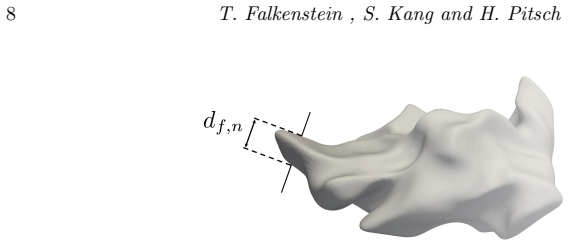
The load-bearing tool is the mean curvature transport equation for a propagating scalar iso-surface, written as $\frac{D_T\kappa}{D_T t} = \kappa a_n - 2S_{ij}\frac{\partial n_j}{\partial x_i} - \left[\frac{\partial^2 u_j}{\partial x_i^2}n_j - \frac{\partial^2 u_n}{\partial x_n^2}\right]$, with the total velocity split into flow and flame-propagation parts so that strain, bending, and propagation effects can be separated. The curvature variance and skewness of surface-weighted PDFs, the normalized burned-region thickness $d_{f,n}/D_v$ for topology change, and a low-pass box filter of width $\Delta = 0.5\,\ell_t$ applied to the velocity field are the supporting diagnostics; the filter shows that flame normal vectors align with the most compressive principal strain of the large scales rather than of the full field.
What would settle it
Run a set of small-kernel simulations with the same $D_0/\ell_t$ ignited at many locations in one turbulent field and in several independent fields, then measure the surface-weighted curvature skewness near $t = 0.25\,\tau_t$; if a substantial fraction of kernels do not show positive skewness, or if the skewness does not track alignment with large-scale compressive strain, the claimed inverse skewness would be a realization artifact.
Extended reading notes
Core claim
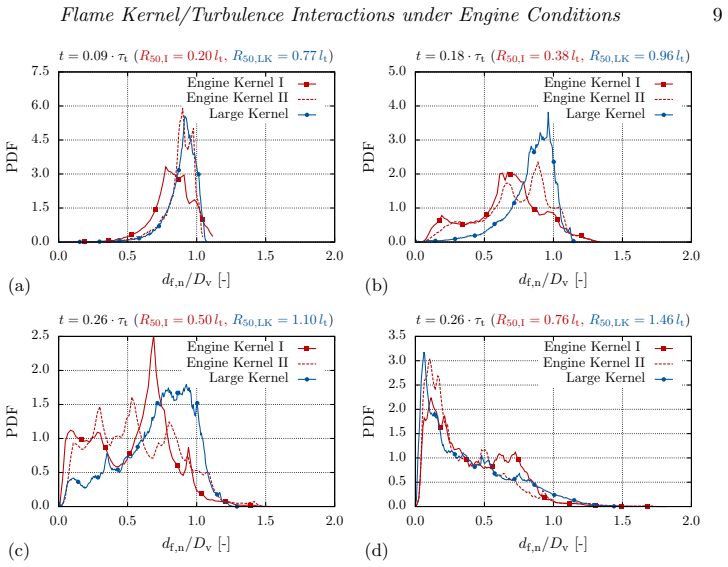
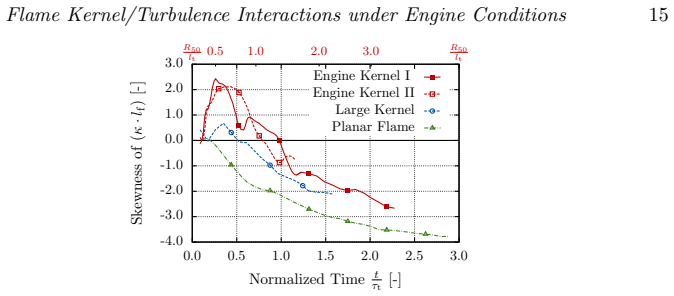
The central claim is that early flame kernel/turbulence interaction under engine conditions is governed by large-scale flow structures: a small kernel ($D_0/\ell_t = 0.3$) is subject to strong compressive strain from turbulent eddies at least as large as the flame radius, which distorts the initially spherical topology into flattened, thin regions while the kernel remains a single coherent flame surface. Analysis of the mean curvature balance attributes this to two mechanisms: tangential strain amplifies the initially large positive curvature intrinsic to a small burned pocket, while bending by second derivatives of the velocity field creates negatively curved regions that flame propagation then sharpens into cusps. The resulting picture is that the curvature PDF of small kernels is positively skewed for $t \lesssim 1.0\,\tau_t$, the mirror image of the negative skewness of developed turbulent flames, and that this signature is strongly realization-dependent, varying markedly between two kernels ignited in the same turbulent field.
Load-bearing premise
The engine-relevant conclusions rest on only two kernel runs, both started in different spots of the same single decaying isotropic turbulent flow, so the observed distortion and positive curvature skewness could be peculiar to that one turbulent realization rather than characteristic of small kernels in general.
Editorial extensions
If this is right
- The early kernel's wrinkling is not bounded by an upper cutoff at the kernel diameter; flow scales larger than the kernel can dominate its deformation, so models built on the high-wavenumber-only assumption miss a leading effect.
- Run-to-run variation in early curvature variance is identified as a mechanism connecting local flow conditions to flame area growth; the subsequent decay of this excess variance causes a plateau in net flame area production.
- The sign of curvature skewness can serve as a phase marker: positive skewness identifies the kernel-dominated early phase, while the eventual return to negative skewness marks the transition to developed turbulent flame behavior.
- In LES-based engine simulations, the kernel shape must be resolved while the flame diameter is smaller than the integral scale, for example by temporary mesh refinement up to about $t \approx 0.5\,\tau_t$, or the large-scale distortion cannot be reproduced.
- For modeling tests, a DNS database of several kernel realizations computed to about $t = 1.0\,\tau_t$ is sufficient to capture the stochastic range of early kernel behavior.
Reading between the lines
- A natural stress test would be to ignite $D_0/\ell_t = 0.3$ kernels at many locations in the same and in several independent turbulent fields; the paper's mechanism predicts that positive early skewness should occur preferentially where the kernel sits in strong large-scale compressive strain, turning a two-realization observation into a probabilistic statement.
- Because the positive-curvature tail is generated by tangential straining of already positively curved flame, fuels with Lewis number above unity would be expected to show a stronger local burning-rate or quenching response at those curved nibs; the paper mentions this as future work, so the specific prediction of amplified stretch sensitivity follows from its mechanism.
- If the flame-area plateau caused by the decay of excess curvature variance is generic, then the timing of ignition relative to the passage of large strain-bearing eddies becomes a candidate control variable for cycle-to-cycle variations, testable by phase-locked experiments or by LES with resolved kernels.
Signed reviews
Editorial analysis
A structured set of objections, weighed in public.
Referee Report
Summary. The manuscript analyzes DNS data of three premixed flame configurations with different ratios of initial flame diameter to integral length scale (D0/lt = 0.3 for two engine-kernel realizations, 2.0 for a large kernel, and infinity for a planar flame) under engine-relevant thermodynamic conditions with detailed chemistry. The central claims are that small flame kernels are distorted by large-scale compressive strain from eddies at least as large as the flame radius, that this distortion causes temporary excessive curvature variance and a positively skewed curvature PDF (opposite to developed turbulent flames), and that two distinct mechanisms—tangential strain amplification of initially positive curvature and velocity-field bending followed by propagation-driven cusp sharpening—produce these effects. The curvature budget analysis is used to connect these mechanisms to flame area evolution through Eq. (1.11), and a low-pass-filtered strain alignment analysis in Section 5 provides evidence for the large-scale origin of the strain.
Significance. If the conclusions hold, the paper challenges the commonly used assumption that early flame kernel growth is governed only by turbulent scales smaller than the kernel size (Herweg & Maly 1992; Echekki et al. 1994). The identification of large-scale strain as a driver of early kernel distortion and of the resulting positive curvature skewness is a new and physically interesting result with direct relevance to modeling spark-ignition engine cycle-to-cycle variations. Strengths of the work include the use of three-dimensional DNS with detailed chemistry under engine conditions, the deployment of a recent curvature transport formulation (Dopazo et al. 2018) that is carefully reformulated in Appendix A, and the explicit validation of the approximations in Eqs. (1.9)-(1.10) against supplementary material. The paper also provides falsifiable predictions: the direction of curvature skewness in early small kernels and the scale-dependent alignment of flame normals with compressive strain. However, the statistical support for the genericity of these claims is limited, as discussed in the major comments.
major comments (2)
- [Section 5 (concluding paragraph) and Section 2.1] The central claim that 'the small flame kernel is subject to strong compressive strain caused by turbulent eddies that are at least as large as the flame radius' is presented as a generic property of small kernels (D0/lt << 1), but it rests on exactly two realizations ignited at two locations in the same single decaying homogeneous isotropic turbulence field. The manuscript itself admits in Section 7 that 'only two flame realizations were considered.' Since D0/lt = 0.3 means the kernel initially spans only a small fraction of an integral scale, each realization samples only a handful of large-scale strain configurations; the observed distortion, excessive curvature variance, and positive skewness could be peculiar to the specific strain fields at those ignition sites rather than intrinsic to the small-kernel configuration. The paper does not report the separation of the ignition locations or the decorrelation of the strain histories experienced by the two kernels, so the effective sample size may be smaller than two. The supplementary note that the effect is 'not just an artifact' is based on local regions of the other flames, not on an independent ensemble of small-kernel cases. This under-sampling directly affects the generality of the main physical conclusion and requires either additional independent realizations or a significant tempering of the claims to a case-study level.
- [Section 5, low-pass filter analysis] The attribution of the alignment to 'eddies at least as large as the flame radius' is based on a single filter scale, Delta = 0.5 lt, chosen to match the kernel radius at t = 0.25 tau_t. The paper does not show sensitivity of the alignment PDFs to the filter scale, nor does it compare against a smaller filter scale that would exclude scales larger than the kernel. Without such a test, the conclusion that the governing scales are specifically the large scales (rather than a range of scales around the kernel size) is not fully demonstrated. This is load-bearing because the central claim distinguishes the present mechanism from the conventional picture of scale-dependent wrinkling; the authors could address it by repeating the alignment analysis with a few different filter widths on the existing data.
minor comments (5)
- [Abstract and Section 4.3] The phrase 'inversely skewed' is used to mean the opposite sign of the skewness observed in developed flames; consider using 'positively skewed' or 'oppositely skewed' consistently, since 'inversely skewed' is not standard terminology.
- [Equation (1.11)] The central moments mu_kappa and sigma^2_kappa are introduced without an explicit definition; please define them as the surface-weighted mean and variance of curvature, e.g., mu_kappa = <kappa>_s and sigma^2_kappa = <kappa^2>_s - mu_kappa^2.
- [References] The reference list appears to duplicate the entry for Shepherd et al. 2002: entries '2002a' and '2002b' cite the same article with identical volume and pages; one should be removed or corrected.
- [Figures 4 and 5] The upper x-axes indicating the size of Engine Kernel I are not explained in the captions; please add a sentence describing that these axes show the normalized median radius R50/lt for Engine Kernel I at the corresponding times.
- [Section 2.2] The statement that the integral length scale is 'approximately 2.5 times smaller than in a practical engine' is a useful caveat, but it would be clearer to state explicitly whether this affects the scale-separation argument (e.g., the ratio D0/lt is still representative of engine conditions).
Circularity Check
No significant circularity: the paper's central claims rest on direct DNS diagnostics and an externally sourced curvature transport equation, not on fitting or self-referential derivation.
full rationale
The paper's central claims—large-scale compressive strain distorting small flame kernels and positive curvature skewness during early kernel growth—are obtained by post-processing DNS fields from the authors' prior database, but the inference is not assumed in the inputs. The curvature transport equation (4.5) is adopted from Dopazo et al. (2018), an external source, and is used to decompose observed curvature changes into straining, bending, and propagation terms. The planar flame and large-kernel cases are independent reference configurations, and the small-kernel conclusions rest on comparisons of PDFs and conditional statistics, not on fitted parameters or on a result whose definition presupposes the conclusion. The one self-reference—Falkenstein et al. (2019)—supplies the simulation data and the previously reported flame-area plateau; using one's own DNS data as input is normal, and the plateau explanation via (1.11) is a consistency check rather than a circular derivation. The acknowledged limitation that only two engine-kernel realizations were considered is a statistical-generalizability concern, not a circularity concern, and the paper explicitly flags it in the conclusions.
Assumptions & free parameters
free parameters (2)
- Initial flame diameter ratio D0/lt =
0.3 (engine kernel), 2.0 (large kernel), infinity (planar)
- Low-pass filter size Delta =
0.5*lt
assumptions (6)
- standard math Curvature transport equation as derived by Dopazo et al. (2018) (Eq. 38 or A-1) is correct
- domain assumption DNS data adequately resolves flame-turbulence interaction
- domain assumption Unity Lewis number for all species
- ad hoc to paper Ignition heat source model is representative of spark ignition
- domain assumption The approximations in Eqs. 1.9 and 1.10 are valid
- domain assumption Surface-weighted curvature statistics from temperature iso-surfaces characterize flame front geometry
Cite this review
Pith. "Pith review of Analysis of Premixed Flame Kernel/Turbulence Interactions under Engine Conditions based on DNS Data." pith.science (2026). https://pith.science/paper/RBTDZBB3
@misc{pith2026190809176,
  author       = {Pith},
  title        = {Pith review of: Analysis of Premixed Flame Kernel/Turbulence Interactions under Engine Conditions based on DNS Data},
  year         = {2026},
  howpublished = {\url{https://pith.science/paper/RBTDZBB3}},
  note         = {Machine review of arXiv:1908.09176}
}
read the original abstract
Although the evolution of premixed flames in turbulence has been frequently studied, it is not well understood how small flames interact with large-scale turbulent flow motion. Since this question is of practical importance for the occurrence of cycle-to-cycle variations in spark ignition engines, the objective of the present work is to fundamentally differentiate early flame kernel development from well-established turbulent flame configurations. For this purpose, a DNS database consisting of three flames propagating in homogeneous isotropic turbulence (Falkenstein et al., Combust. Flame, 2019) is considered. The flames feature different ratios of the initially laminar flame diameter to the integral length scale. To quantify flame kernel development, the time evolution of flame topology and flame front geometry are analysed in detail. It is shown that some realizations of the early flame kernel are substantially influenced by high compressive strain caused by large-scale turbulent flow motion with characteristic length scales greater than the flame kernel size. As a result, the initial spherical kernel topology may become highly distorted, which is reflected in the stochastic occurrence of excessive curvature variance. Two mechanisms of curvature production resulting from early flame kernel/turbulence interactions are identified by analysis of the mean curvature balance equation. Further, it is shown that the curvature distribution of small flame kernels becomes strongly skewed towards positive curvatures, which is contrary to developed turbulent flames. Hence, the transition of ignition kernels to self-sustaining turbulent flames is very different in nature compared with the development of a statistically planar flame brush.
Figures

Figures from the paper (6 more)




Reference graph
Works this paper leans on
-
[1]
, " * write output.state after.block = add.period write newline
ENTRY address author booktitle chapter edition editor howpublished institution journal key month note number organization pages publisher school series title type volume year eprint label extra.label sort.label short.list INTEGERS output.state before.all mid.sentence after.sentence after.block FUNCTION init.state.consts #0 'before.all := #1 'mid.sentence ...
-
[2]
write newline
" write newline "" before.all 'output.state := FUNCTION n.dashify 't := "" t empty not t #1 #1 substring "-" = t #1 #2 substring "--" = not "--" * t #2 global.max substring 't := t #1 #1 substring "-" = "-" * t #2 global.max substring 't := while if t #1 #1 substring * t #2 global.max substring 't := if while FUNCTION word.in bbl.in capitalize " " * FUNCT...
-
[3]
Abdel-Gayed, R. G. , Al-Khishali, K. J. & Bradley, D. 1984 Turbulent burning velocities and flame straining in explosions . Proceedings of the Royal Society of London. Series A, Mathematical and Physical Sciences 391 (1801), 393--414
work page 1984
-
[4]
Akindele, O. , Bradley, D. , Mak, P. & McMahon, M. 1982 Spark ignition of turbulent gases . Combustion and Flame 47 , 129 -- 155
work page 1982
-
[5]
Aleiferis, P. , Taylor, A. , Ishii, K. & Urata, Y. 2004 The nature of early flame development in a lean-burn stratified-charge spark-ignition engine . Combustion and Flame 136 (3), 283 -- 302
work page 2004
-
[6]
Alqallaf, A. , Klein, M. & Chakraborty, N. 2019 Effects of L ewis number on the evolution of curvature in spherically expanding turbulent premixed flames . Fluids 4 (1), 12
work page 2019
-
[7]
Ashurst, W. T. , Kerstein, A. R. , Kerr, R. M. & Gibson, C. H. 1987 Alignment of vorticity and scalar gradient with strain rate in simulated N avier- S tokes turbulence . The Physics of Fluids 30 (8), 2343--2353
work page 1987
-
[8]
Batchelor, G. K. 1959 Small-scale variation of convected quantities like temperature in turbulent fluid part 1. general discussion and the case of small conductivity . Journal of Fluid Mechanics 5 (1), 113--133
work page 1959
Show all 71 references
-
[9]
u ger, C. , Dreizler, A. & B \
Bode, J. , Schorr, J. , Kr \"u ger, C. , Dreizler, A. & B \"o hm, B. 2017 Influence of three-dimensional in-cylinder flows on cycle-to-cycle variations in a fired stratified DISI engine measured by time-resolved dual-plane PIV . Proceedings of the Combustion Institute 36 (3), ...
2017
-
[10]
, Veynante, D
Boger, M. , Veynante, D. , Boughanem, H. & Trouv \'e , A. 1998 Direct numerical simulation analysis of flame surface density concept for large eddy simulation of turbulent premixed combustion . Symposium (International) on Combustion 27 (1), 917 -- 925
1998
-
[11]
, Lawes, M
Bradley, D. , Lawes, M. , Scott, M. & Mushi, E. 1994 Afterburning in spherical premixed turbulent explosions . Combustion and Flame 99 (3), 581 -- 590
1994
-
[12]
& Lung, F.-K
Bradley, D. & Lung, F.-K. 1987 Spark ignition and the early stages of turbulent flame propagation . Combustion and Flame 69 (1), 71 -- 93
1987
-
[13]
, Bittner, N
Buschbeck, M. , Bittner, N. , Halfmann, T. & Arndt, S. 2012 Dependence of combustion dynamics in a gasoline engine upon the in-cylinder flow field, determined by high-speed PIV . Experiments in Fluids 53 (6), 1701--1712
2012
-
[14]
Buxton, O. R. H. , Laizet, S. & Ganapathisubramani, B. 2011 The interaction between strain-rate and rotation in shear flow turbulence from inertial range to dissipative length scales . Physics of Fluids 23 (6), 061704
2011
-
[15]
Candel, S. M. & Poinsot, T. J. 1990 Flame stretch and the balance equation for the flame area . Combustion Science and Technology 70 (1--3), 1--15
1990
-
[16]
, Fiorina, B
Castela, M. , Fiorina, B. , Coussement, A. , Gicquel, O. , Darabiha, N. & Laux, C. O. 2016 Modelling the impact of non-equilibrium discharges on reactive mixtures for simulations of plasma-assisted ignition in turbulent flows . Combustion and Flame 166 , 133 -- 147
2016
-
[17]
& Swaminathan, N
Chakraborty, N. & Swaminathan, N. 2007 Influence of the D amk \"o hler number on turbulence-scalar interaction in premixed flames. I . P hysical insight . Physics of Fluids 19 (4), 045103
2007
-
[18]
, Dopazo, C
Cifuentes, L. , Dopazo, C. , Sandeep, A. , Chakraborty, N. & Kempf, A. 2018 Analysis of flame curvature evolution in a turbulent premixed bluff body burner . Physics of Fluids 30 (9), 095101
2018
-
[19]
& Truffin, K
Colin, O. & Truffin, K. 2011 A spark ignition model for large eddy simulation based on an FSD transport equation ( ISSIM - LES ) . Proceedings of the Combustion Institute 33 (2), 3097 -- 3104
2011
-
[20]
, Lamioni, R
Creta, F. , Lamioni, R. , Lapenna, P. E. & Troiani, G. 2016 Interplay of D arrieus- L andau instability and weak turbulence in premixed flame propagation . Physical Review E 94 , 053102
2016
-
[21]
1940 Der E influss der T urbulenz auf die F lammengeschwindigkeit in G asgemischen
Damk \"o hler, G. 1940 Der E influss der T urbulenz auf die F lammengeschwindigkeit in G asgemischen . Zeitschrift für Elektrochemie und angewandte physikalische Chemie 46 (11), 601--626
1940
-
[22]
, Martin, J
Dopazo, C. , Martin, J. , Cifuentes, L. & Hierro, J. 2018 Strain, rotation and curvature of non-material propagating iso-scalar surfaces in homogeneous turbulence . Flow, Turbulence and Combustion 101 (1), 1--32
2018
-
[23]
& Chen, J
Echekki, T. & Chen, J. 1999 Analysis of the contribution of curvature to premixed flame propagation . Combustion and Flame 118 , 308--311
1999
-
[24]
& Kolera-Gokula, H
Echekki, T. & Kolera-Gokula, H. 2007 A regime diagram for premixed flame kernel-vortex interactions . Physics of Fluids 19 (4), 043604
2007
-
[25]
, Poinsot, T
Echekki, T. , Poinsot, T. , Baritaud, T. & Trouv \'e , A. 1994 Modeling and simulation of turbulent flame kernel evolution . Tech. Rep.\/ 41525. Institut Fran c ais du P \'e trole
1994
-
[26]
, Kang, S
Falkenstein, T. , Kang, S. , Cai, L. , Bode, M. & Pitsch, H. 2019 DNS study of the global heat release rate during early flame kernel development under engine conditions . Submitted to Combustion and Flame , arXiv:arXiv: http://arxiv.org/abs/1908.07556
2019 arXiv
-
[27]
Fansler, T. D. & Wagner, R. M. 2015 Cyclic dispersion in engine combustion -- introduction by the special issue editors . International Journal of Engine Research 16 (3), 255--259
2015
-
[28]
, Hult, J
Gashi, S. , Hult, J. , Jenkins, K. W. , Chakraborty, N. , Cant, S. & Kaminski, C. F. 2005 Curvature and wrinkling of premixed flame kernels—comparisons of oh plif and dns data . Proceedings of the Combustion Institute 30 (1), 809 -- 817
2005
-
[29]
, Sheppard, C
Haq, M. , Sheppard, C. , Woolley, R. , Greenhalgh, D. & Lockett, R. 2002 Wrinkling and curvature of laminar and turbulent premixed flames . Combustion and Flame 131 (1), 1 -- 15
2002
-
[30]
2016 Scale-resolving simulations in engine combustion process design based on a systematic approach for model development
Hasse, C. 2016 Scale-resolving simulations in engine combustion process design based on a systematic approach for model development . International Journal of Engine Research 17 (1), 44--62
2016
-
[31]
& Ghandhi, J
Heim, D. & Ghandhi, J. 2011 A detailed study of in-cylinder flow and turbulence using PIV . SAE International Journal of Engines 4 (1), 1642--1668
2011
-
[32]
& Maly, R
Herweg, R. & Maly, R. R. 1992 A fundamental model for flame kernel formation in S. I. engines. In International Fuels & Lubricants Meeting & Exposition\/ . SAE International
1992
-
[33]
, Chakraborty, N
Hesse, H. , Chakraborty, N. & Mastorakos, E. 2009 The effects of the lewis number of the fuel on the displacement speed of edge flames in igniting turbulent mixing layers . Proceedings of the Combustion Institute 32 (1), 1399 -- 1407
2009
-
[34]
1994 Combustion and its modeling in spark-ignition engines
Heywood, J. 1994 Combustion and its modeling in spark-ignition engines. In Proceedings of the Third International Symposium on Diagnostics and Modeling of Combustion in Internal Combustion Engines (COMODIA), Yokohama, Japan, July 11 -- 14\/ , pp. 1--15
1994
-
[35]
Hirschfelder, J. O. , Curtiss, C. F. & Bird, R. B. 1954 Molecular theory of gases and liquids\/ . John Wiley and Sons, New York
1954
-
[36]
, Sasaki, K
Jung, D. , Sasaki, K. & Iida, N. 2017 Effects of increased spark discharge energy and enhanced in-cylinder turbulence level on lean limits and cycle-to-cycle variations of combustion for SI engine operation . Applied Energy 205 , 1467 -- 1477
2017
-
[37]
, Denniston, D
Karlovitz, B. , Denniston, D. W. & Wells, F. E. 1951 Investigation of turbulent flames . The Journal of Chemical Physics 19 (5), 541--547
1951
-
[38]
Kim, S. H. & Pitsch, H. 2007 Scalar gradient and small-scale structure in turbulent premixed combustion . Physics of Fluids 19 (11), 115104
2007
-
[39]
, Attili, A
Luca, S. , Attili, A. , Schiavo, E. L. , Creta, F. & Bisetti, F. 2019 On the statistics of flame stretch in turbulent premixed jet flames in the thin reaction zone regime at varying reynolds number . Proceedings of the Combustion Institute 37 (2), 2451 -- 2459
2019
-
[40]
& Poinsot, T
Meneveau, C. & Poinsot, T. 1991 Stretching and quenching of flamelets in premixed turbulent combustion . Combustion and Flame 86 (4), 311 -- 332
1991
-
[41]
1998 Low- M ach-number asymptotics of the N avier- S tokes equations
M \"u ller, B. 1998 Low- M ach-number asymptotics of the N avier- S tokes equations . Journal of Engineering Mathematics 34 (1), 97--109
1998
-
[42]
1992 A spectral closure for premixed turbulent combustion in the flamelet regime
Peters, N. 1992 A spectral closure for premixed turbulent combustion in the flamelet regime . Journal of Fluid Mechanics 242 , 611--629
1992
-
[43]
1999 The turbulent burning velocity for large-scale and small-scale turbulence
Peters, N. 1999 The turbulent burning velocity for large-scale and small-scale turbulence . Journal of Fluid Mechanics 384 , 107--132
1999
-
[44]
, Reuss, D
Peterson, B. , Reuss, D. L. & Sick, V. 2011 High-speed imaging analysis of misfires in a spray-guided direct injection engine . Proceedings of the Combustion Institute 33 (2), 3089 -- 3096
2011
-
[45]
, Reuss, D
Peterson, B. , Reuss, D. L. & Sick, V. 2014 On the ignition and flame development in a spray-guided direct-injection spark-ignition engine . Combustion and Flame 161 (1), 240 -- 255
2014
-
[46]
& Peters, N
Pitsch, H. & Peters, N. 1996 Numerical and asymtotic studies of the structure of premixed iso-octane flames . Symposium (International) on Combustion 26 (1), 763 -- 771
1996
-
[47]
& Oran, E
Poludnenko, A. & Oran, E. 2011 The interaction of high-speed turbulence with flames: Turbulent flame speed . Combustion and Flame 158 (2), 301 -- 326
2011
-
[48]
Pope , S. B. 1988 The evolution of surfaces in turbulence . International Journal of Engineering Science 26 , 445--469
1988
-
[49]
& Abraham, J
Reddy, H. & Abraham, J. 2013 Influence of turbulence-kernel interactions on flame development in lean methane/air mixtures under natural gas-fueled engine conditions . Fuel 103 , 1090--1105
2013
-
[50]
, Colin, O
Richard, S. , Colin, O. , Vermorel, O. , Benkenida, A. , Angelberger, C. & Veynante, D. 2007 Towards large eddy simulation of combustion in spark ignition engines . Proceedings of the Combustion Institute 31 (2), 3059 -- 3066
2007
-
[51]
Rutland, C. J. 2011 Large-eddy simulations for internal combustion engines -- a review . International Journal of Engine Research 12 (5), 421--451
2011
-
[52]
, Reuss, D
Schiffmann, P. , Reuss, D. L. & Sick, V. 2018 Empirical investigation of spark-ignited flame-initiation cycle-to-cycle variability in a homogeneous charge reciprocating engine . International Journal of Engine Research 19 (5), 491--508
2018
-
[53]
& Grover, J
Scurlock, A. & Grover, J. 1953 Propagation of turbulent flames . Symposium (International) on Combustion 4 (1), 645 -- 658
1953
-
[54]
& Ashurst, W
Shepherd, I. & Ashurst, W. 1992 Flame front geometry in premixed turbulent flames . Symposium (International) on Combustion 24 (1), 485 -- 491
1992
-
[55]
, Cheng, R
Shepherd, I. , Cheng, R. , Plessing, T. , Kortschik, C. & Peters, N. 2002 a\/ Premixed flame front structure in intense turbulence . Proceedings of the Combustion Institute 29 (2), 1833 -- 1840
2002
-
[56]
, Cheng, R
Shepherd, I. , Cheng, R. , Plessing, T. , Kortschik, C. & Peters, N. 2002 b\/ Premixed flame front structure in intense turbulence . Proceedings of the Combustion Institute 29 (2), 1833 -- 1840
2002
-
[57]
, Domingo, P
Subramanian, V. , Domingo, P. & Vervisch, L. 2009 Turbulent flame spreading mechanisms after spark ignition . AIP Conference Proceedings 1190 (1), 68--89
2009
-
[58]
2005 Three-dimensional direct simulations and structure of expanding turbulent methane flames
Th \'e venin, D. 2005 Three-dimensional direct simulations and structure of expanding turbulent methane flames . Proceedings of the Combustion Institute 30 (1), 629 -- 637
2005
-
[59]
, Gicquel, O
Th \'e venin, D. , Gicquel, O. , Charentenay, J. D. , Hilbert, R. & Veynante, D. 2002 Two- versus three-dimensional direct simulations of turbulent methane flame kernels using realistic chemistry . Proceedings of the Combustion Institute 29 (2), 2031 -- 2039
2002
-
[60]
Uranakara, H. A. , Chaudhuri, S. & Lakshmisha, K. 2017 On the extinction of igniting kernels in near-isotropic turbulence . Proceedings of the Combustion Institute 36 (2), 1793 -- 1800
2017
-
[61]
, Echekki, T
Vasudeo, N. , Echekki, T. , Day, M. S. & Bell, J. B. 2010 The regime diagram for premixed flame kernel-vortex interactions -- revisited . Physics of Fluids 22 (4), 043602
2010
-
[62]
, Hawkes, E
Wang, H. , Hawkes, E. R. , Chen, J. H. , Zhou, B. , Li, Z. & Ald \'e n, M. 2017 a\/ Direct numerical simulations of a high K arlovitz number laboratory premixed jet flame -- an analysis of flame stretch and flame thickening . Journal of Fluid Mechanics 815 , 511--536
2017
-
[63]
, Liu, H
Wang, Z. , Liu, H. & Reitz, R. D. 2017 b\/ Knocking combustion in spark-ignition engines . Progress in Energy and Combustion Science 61 , 78 -- 112
2017
-
[64]
& Peters, N
Wenzel, H. & Peters, N. 2000 Direct numerical simulation and modeling of kinematic restoration, dissipation and gas expansion effects of premixed flames in homogeneous turbulence . Combustion Science and Technology 158 (1), 273--297
2000
-
[65]
Young, M. B. 1981 Cyclic dispersion in the homogeneous-charge spark-ignition engine -- a literature survey . SAE Transactions 90 , 49--73
1981
-
[66]
Zel'dovich, Y. B. 1966 An effect which stabilizes the curved front of a laminar flame . Journal of Applied Mechanics and Technical Physics 7 (1), 68--69
1966
-
[67]
, Keum, S
Zeng, W. , Keum, S. , Kuo, T.-W. & Sick, V. 2019 Role of large scale flow features on cycle-to-cycle variations of spark-ignited flame-initiation and its transition to turbulent combustion . Proceedings of the Combustion Institute 37 (4), 4945 -- 4953
2019
-
[68]
, " * write output.state after.block = add.period write newline
ENTRY address author booktitle chapter edition editor howpublished institution journal key month note number organization pages publisher school series title type volume year eprint label extra.label sort.label short.list INTEGERS output.state before.all mid.sentence after.sen...
-
[69]
@esa (Ref
\@ifclassloaded aguplus natbib The aguplus class already includes natbib coding, so you should not add it explicitly Type <Return> for now, but then later remove the command natbib from the document \@ifclassloaded nlinproc natbib The nlinproc class already includes natbib cod...
-
[70]
@stdbsttrue NAT@ctr \@lbibitem[ NAT@ctr ] \@lbibitem[#1]#2 \@extra@b@citeb \@ifundefined br@#2\@extra@b@citeb \@namedef br@#2 \@nameuse br@#2\@extra@b@citeb \@ifundefined b@#2\@extra@b@citeb @num @parse #2 [ @natanchorstart #2\@extra@b@citeb \@biblabel @num @natanchorend] @ifc...
-
[71]
@open @close @open @close and [1] URL: #1 \@ifundefined chapter * \@mkboth \@ifundefined NAT@sectionbib * \@mkboth * \@mkboth\@gobbletwo \@ifclassloaded amsart * \@ifclassloaded amsbook * \@ifundefined bib@heading @heading NAT@ctr thebibliography [1] @ \@biblabel NAT@ctr \@bib...
1996
Reviewed August 14, 2026 · model on record in the stance chip above.
Discussion (0). Continue with ORCID to comment.