REVIEW 3 major objections 4 minor 1 cited by
Modelling the selection of galaxy groups with end to end simulations
T0 review · 3 major / 4 minor · reviewed 2026-08-07 · deepseek-v4-flash
Pith's one-line read The X-GAP galaxy-group selection is now quantified: a flux-driven detection probability, 50% completeness at 450 km/s, and 93% purity in the parent sample.
desk verdict First end-to-end selection function for the X-GAP parent sample, delivered with a robust conditional fit and a useful sigma_v-M calibration, but the headline 450 km/s completeness claim is stress-tested more weakly than the paper's own admitted LX model offset. read the letter →
The pith
A machine-rendered reading of the paper's core claim, the machinery that carries it, and where it could break.
The reading
What carries the argument
The load-bearing machinery is a normalising-flow neural network (a generative model that learns a complex distribution from a chain of invertible transformations) trained on TNG300 hydrodynamical clusters plus HIFLUGCS and SPT cluster data to predict self-similar emission measure profiles and X-ray temperatures from halo mass and redshift. These profiles, together with an AGN model and real RASS background maps, are turned into X-ray photons with the SIXTE simulator; a wavelet detector finds extended sources and a friends-of-friends algorithm on the UchuuSDSS galaxy mock finds optical groups; a three-way match connects both detections to the input dark matter haloes. The matched versus unmatched haloes give the detection ratio from which the selection function is fitted.
What would settle it
Reduce all mock group luminosities by a factor of two — the offset acknowledged in Appendix A — and rerun the end-to-end detection; if the fitted 50% completeness velocity dispersion shifts noticeably from 450 km/s, the claimed selection function is not robust to the known luminosity bias. Empirically, a complete spectroscopic census of every ROSAT extended source in the X-GAP sky area would give the observed completeness curve to compare directly with the mock prediction.
Extended reading notes
Core claim
The central claim of this paper is that the X-GAP selection function — the probability that a galaxy group of given X-ray flux $F_X$, redshift $z$, and velocity dispersion $\sigma_{v,T}$ enters the sample — can be written as a single logistic curve, $P_{\rm det}(F_X,z,\sigma_{v,T}) = (1 + \exp[-\alpha_{F_x}(\log_{10} F_X - F_{X,0}) - \alpha_{\sigma_v}\,\log_{10}\sigma_{v,T} + \alpha_z\,\log_{10} z])^{-1}$, with parameters fitted to an end-to-end mock that reproduces the observed $L_X$--$\sigma_v$ distribution of the real AXES parent sample. The fit says the selection is dominated by X-ray flux, with weaker dependences on velocity dispersion and redshift; in the X-GAP redshift range $0.02<z<0.06$ the 50% completeness lies at $\sigma_{v,T}\simeq450$ km/s, and the X-ray match raises purity to 93% in the parent sample. The paper also claims a calibrated velocity dispersion--halo mass relation with a slope and normalisation consistent with the literature and an intrinsic scatter of about 0.06 dex, and that measurement scatter, not intrinsic scatter, dominates the observed velocity dispersion distribution in an SDSS-like setup.
Load-bearing premise
The result rests on the trained network's X-ray luminosities being correct on average; the paper reports that the model overpredicts $L_X$ by about a factor of two near $10^{13}\,M_\odot$ relative to a stacking analysis, yet the robustness test rescales luminosities by only 10%.
Editorial extensions
If this is right
- X-GAP is effectively flux-limited: detection probability is mainly a function of 0.5--2 keV flux, so undetected systems are mostly faint ones rather than low-mass ones at fixed flux.
- Any comparison of X-GAP thermodynamic properties or gas fractions to hydrodynamical simulations must weight each mock group by Eq. 15 (or the 6-arcmin-aperture version), otherwise the comparison is biased toward bright systems.
- Velocity dispersion measurements are reliable only for rich systems: accuracy within 10% requires about 20 recovered members, and groups with fewer than 10 members are biased by more than 20%.
- The X-ray follow-up acts as a cleaning step: purity reaches 90% already at 280 km/s with the X-ray match, compared to 600 km/s for the optical FoF catalogue alone.
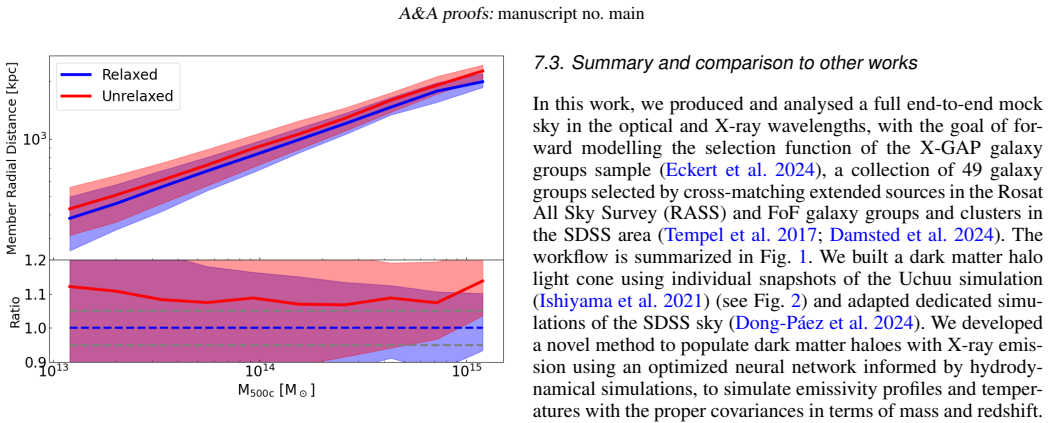
- The velocity dispersion--mass relation is recovered unbiasedly only when measurement scatter is modelled separately; intrinsic scatter is about 0.06--0.07 dex and measurement scatter about 0.10 dex in an SDSS-like survey.
Reading between the lines
- Because the selection function is expressed in observed quantities (flux, redshift, velocity dispersion) rather than halo mass, it should transfer to other RASS+SDSS selected group samples without re-simulating baryons; the ratio definition also absorbs part of the X-ray modelling uncertainty.
- The 20-member accuracy threshold is a strong statement about galaxy population rather than halo mass: a massive cluster that is poor in observed members will still give a biased velocity dispersion, so mass calibration priors should depend on richness, not just mass.
- The same pipeline, re-run with eROSITA exposure and background instead of RASS, would produce a direct comparison selection function; the paper's comparison with eRASS1 suggests the 50% flux limit would drop roughly fivefold.
Editorial analysis
A structured set of objections, weighed in public.
Referee Report
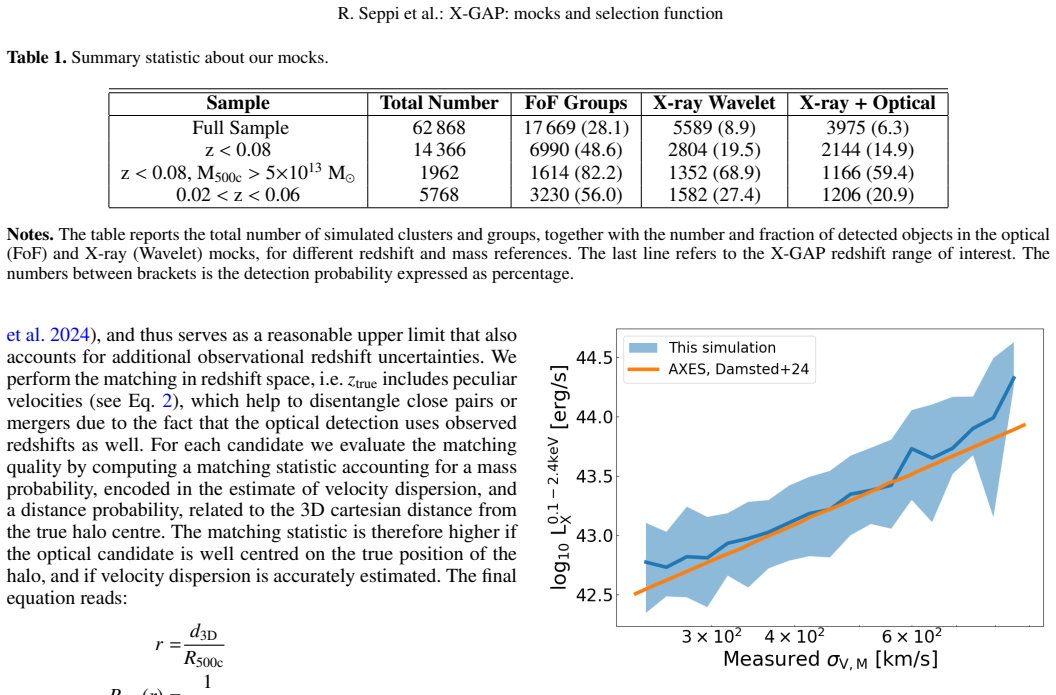
Summary. This paper constructs an end-to-end forward model of the joint X-ray and optical selection of the X-GAP galaxy-group sample. Starting from the Uchuu dark-matter light cone, the authors assign X-ray emissivity profiles and temperatures with a normalising-flow network trained on TNG300 plus HIFLUGCS/SPT data, add a phenomenological AGN population, generate events with SIXTE using real ROSAT background maps, and run the wavelet and FoF detection schemes of Damsted et al. (2024) and Tempel et al. (2017). The mock is validated against the real AXES sample in the L_X-sigma_v plane (Fig. 6). The authors then fit the detection probability with the sigmoid model of Eq. (15), report 50% completeness at sigma_v about 450 km/s in the X-GAP redshift range, estimate 93% purity after X-ray matching, and calibrate the velocity dispersion-halo mass relation separating intrinsic and measurement scatter.
Significance. If the central result is robust, this is a valuable framework for using X-GAP as a benchmark for hydrodynamical simulations. The selection function is expressed in terms of observables, the purity estimate of 93% is directly actionable, and the sigma_v-M calibration with separate intrinsic and measurement scatter is useful for forward-modelling. The paper's strengths include the end-to-end nature of the pipeline, the use of public high-resolution simulations and standard public tools, a direct comparison to the real AXES sample (Fig. 6), and a formal goodness-of-fit check (chi2_r = 0.97) for the selection-function model. The main threat to the headline numbers is the acknowledged factor-of-two overprediction of L_X near 10^13 M_sun relative to eROSITA stacking results, which is tested only with a much smaller 10% luminosity rescale.
major comments (3)
- [Sect. 3.4 and Appendix A] The robustness test applied to the acknowledged factor-of-two overprediction of L_X near 10^13 M_sun is too weak. The text reduces input luminosities by only 10% (0.04 dex), roughly seven times smaller than the 0.3 dex discrepancy quoted against Zhang et al. (2024). Because the headline 50%-completeness threshold at sigma_v = 450 km/s is obtained after marginalizing over the mock flux distribution at fixed sigma_v (right-hand panel of Fig. 10), a parent L_X-M relation that is biased high by 0.3 dex will populate high-flux bins with low-mass haloes and bias the marginalized completeness upward, with the parameters alpha_sigma_v and F_X,0 of Eq. (15) absorbing part of the bias. The Appendix A statement that the selection function is 'not affected by this particular prescription' holds for the conditional detection probability at fixed flux, not for the marginalized completeness as a function of sigma_v. Please rerun the end-to-end pipeline with a factor-of-two (0.3 dex) luminosity rescaling, or provide a semi-analytic propagation of the L_X-M uncertainty into Eq. (15) and into the quoted 450 km/s completeness threshold.
- [Sect. 4.3 and Fig. 6] The validation against the real AXES sample in Fig. 6 is performed after applying the X-ray plus optical selection, which preferentially retains high-L_X objects at fixed velocity dispersion (Appendix C, Fig. C.1). This makes the agreement mostly sensitive to the L_X-sigma_v correlation and to the detection pipeline, and only weakly constraining for the absolute L_X-M normalization near the flux limit, where the factor-two tension with the eROSITA stacking result resides. Please show the same comparison for an unbiased parent population, or quantify what fraction of the 0.3 dex offset in L_X at M around 10^13 M_sun survives the selection and could be hidden by Fig. 6.
- [Sect. 5.2 and Eq. (15)] The selection function in Eq. (15) is written in terms of the true velocity dispersion sigma_v,T, which is not directly observable, while the abstract quotes the 450 km/s 50%-completeness threshold without this qualifier. Given that Fig. 13 shows measured velocity dispersions are biased low by more than 20% for groups with fewer than 10 members, an observer who applies Eq. (15) to measured sigma_v will obtain incorrect completeness estimates. The paper should state explicitly that Eq. (15) is for forward-modelling true sigma_v, and should either provide the corresponding fit in terms of measured sigma_v,M or show how the measurement-scatter model of Section 6 converts between the two.
minor comments (4)
- [Abstract] The abstract states that 'the 50% completeness is reached at a velocity dispersion of 450 km/s' without specifying that this refers to the true (simulation) velocity dispersion, for the X-ray plus optical selected sample, in the redshift range 0.02 < z < 0.06; please add these qualifiers.
- [Eq. (1)] In Eq. (1), 'DEC = theta - 90' mixes radians and degrees if theta is computed with arccos in the standard convention; please clarify the units and the conversion to degrees.
- [Eq. (17)] The last line of Eq. (17) writes P(sigma_v,M | M, z, theta) as a product that includes the detection-probability factor P(I | sigma_v,T, z), but the left-hand side is not explicitly conditioned on detection; please define the selected-sample likelihood and its normalization.
- [Fig. 9 caption] The caption refers to green and violet contours for the base model and the six-arcminute aperture model, but the color coding is not obvious from the printed figure; please make the colors unambiguous or add panel labels.
Circularity Check
No significant circularity: the selection function is an empirical fit to mock completeness validated against external data; the acknowledged LX-model caveat is a calibration risk rather than a circular step.
full rationale
The paper's central results do not reduce to their inputs by construction. The selection function in Eq. 15 is fitted to the mock completeness ratio defined in Eq. 14, which is a forward-modelled quantity computed from simulated X-ray and optical detections; it is not a parameter hidden inside the definition of the input. The headline 50% completeness at 450 km/s and the 93% purity estimate are outputs of this forward model, and the purity estimate in Eq. 16 explicitly weights the simulated purity by the observed AXES velocity-dispersion distribution, providing an external anchor. The mock is validated against independent data in Fig. 6 (AXES LX-sigma_v relation), Fig. 4 (LX-M and TX-M relations compared to multiple observational samples), and Fig. 11 (sigma_v-M relation compared to Munari et al. 2013 and Ferragamo et al. 2022). The self-citations present, such as Seppi et al. (2022) for the X-ray matching scheme and Seppi et al. (2024) for an eRASS1 comparison, are methodological or comparative and are not load-bearing for the main claim. Appendix A honestly discloses that the TNG-based luminosity model overpredicts LX by about a factor of two near 10^13 Msun, and the 10% rescale robustness test is a sensitivity check rather than a circular validation; the possibility that the marginalized 450 km/s completeness is sensitive to the LX-M normalization is a calibration uncertainty, not a derivation that assumes its own conclusion. Overall, the derivation chain is self-contained and externally benchmarked, so no circular step can be exhibited.
Assumptions & free parameters
free parameters (8)
- Base selection function parameters (alpha_Fx, F_X,0, alpha_sigma_v, alpha_z) =
4.78, -11.03, 0.83, 1.73
- 6-arcmin aperture selection function parameters =
4.76, -10.84, 1.01, 2.19
- Velocity dispersion-halo mass normalisation A =
1145.1 +/- 3.9 km/s (M200c, full sample)
- Velocity dispersion-halo mass slope alpha =
0.330 +/- 0.001 (M200c)
- Intrinsic scatter of true sigma_v at fixed mass =
0.073 +/- 0.001 dex (full sample); 0.057 dex for X-ray selected
- Measurement scatter between measured and true sigma_v =
0.102 +/- 0.001 dex (optical); 0.106 +/- 0.002 (optical+X-ray)
- Detection probability sigmoid in Eq. 17 =
slope 6.4 (optical), 10.8 (opt+X); normalisation 2.64 and 2.68
- Assumed log-normal scatter in optical-to-halo matching =
0.08 dex
assumptions (7)
- domain assumption TNG300 hydrodynamical simulation provides realistic X-ray emissivity and temperature profiles for galaxy groups and clusters
- domain assumption The normalizing flow transfers TNG profiles to Uchuu halos with correct covariances in mass and redshift
- domain assumption UchuuSDSS mock reproduces SDSS galaxy positions, magnitudes, and redshifts needed for FoF group finding
- domain assumption Comparat et al. (2019) AGN model and RASS background maps describe the X-ray sky seen by ROSAT
- domain assumption Wavelet detection on mock images and FoF with Tempel et al. (2017) linking reproduce the real AXES/X-GAP detection
- domain assumption Measured velocity dispersion follows a log-normal distribution around the true value
- standard math Poisson statistics for photon counts and background
Cite this review
Pith. "Pith review of Modelling the selection of galaxy groups with end to end simulations." pith.science (2026). https://pith.science/paper/RCUV6TVN
@misc{pith2026250604757,
  author       = {Pith},
  title        = {Pith review of: Modelling the selection of galaxy groups with end to end simulations},
  year         = {2026},
  howpublished = {\url{https://pith.science/paper/RCUV6TVN}},
  note         = {Machine review of arXiv:2506.04757}
}
read the original abstract
Feedback from supernovae and AGN shapes galaxy formation and evolution, yet its impact remains unclear. Galaxy groups offer a crucial probe, as their binding energy is comparable to that available from their central AGN. The XMM-Newton Group AGN Project (X-GAP) is a sample of 49 groups selected in X-ray (ROSAT) and optical (SDSS) bands, providing a benchmark for hydrodynamical simulations. In sight of such a comparison, understanding selection effects is essential. We aim to model the selection function of X-GAP by forward modelling the detection process in the X-ray and optical bands. Using the Uchuu simulation, we build a halo light cone, predict X-ray group properties with a neural network trained on hydro simulations, and assign galaxies matching observed properties. We compare the selected sample to the parent population. Our method provides a sample that matches the observed distribution of X-ray luminosity and velocity dispersion. The 50% completeness is reached at a velocity dispersion of 450 km/s in the X-GAP redshift range. The selection is driven by X-ray flux, with secondary dependence on velocity dispersion and redshift. We estimate a 93% purity level in the X-GAP parent sample. We calibrate the velocity dispersion-halo mass relation. We find a normalisation and slope in agreement with the literature, and an intrinsic scatter of about 0.06 dex. The measured velocity dispersion is accurate within 10% only for rich systems with more than about 20 members, while the velocity dispersion for groups with less than 10 members is biased at more than 20%. The X-ray follow-up refines the optical selection, enhancing purity but reducing completeness. In an SDSS-like setup, velocity dispersion measurement errors dominate over intrinsic scatter. Our selection model will enable the comparisons of thermodynamic properties and gas fractions between X-GAP groups and hydro simulations.
Figures


Figures from the paper (13 more)




Forward citations
Cited by 1 Pith paper
-
AXES-SDSS: Solving the puzzle of X-ray emission of optical galaxy groups via a modified Hausdorff distance
A modified Hausdorff distance between X-ray contours and optical galaxy positions identifies matches with 90% purity and reveals X-ray emission in over half of nearby low-velocity-dispersion groups.
Reference graph
Works this paper leans on
-
[1]
, " * write output.state after.block = add.period write newline
ENTRY address archiveprefix author booktitle chapter edition editor howpublished institution eprint journal key month note number organization pages publisher school series title type volume year label extra.label sort.label short.list INTEGERS output.state before.all mid.sentence after.sentence after.block FUNCTION init.state.consts #0 'before.all := #1 ...
-
[2]
write newline
" write newline "" before.all 'output.state := FUNCTION n.dashify 't := "" t empty not t #1 #1 substring "-" = t #1 #2 substring "--" = not "--" * t #2 global.max substring 't := t #1 #1 substring "-" = "-" * t #2 global.max substring 't := while if t #1 #1 substring * t #2 global.max substring 't := if while FUNCTION word.in bbl.in " " * FUNCTION format....
-
[3]
2015, TensorFlow : Large-Scale Machine Learning on Heterogeneous Systems, software available from tensorflow.org
Abadi, M., Agarwal, A., Barham, P., et al. 2015, TensorFlow : Large-Scale Machine Learning on Heterogeneous Systems, software available from tensorflow.org
2015
-
[4]
Abell , G. O. 1958, , 3, 211
1958
-
[5]
2018, , 620, A5
Adami , C., Giles , P., Koulouridis , E., et al. 2018, , 620, A5
2018
-
[6]
L., Georgakakis , A., et al
Aird , J., Coil , A. L., Georgakakis , A., et al. 2015, , 451, 1892
2015
-
[7]
E., Gaspari , M., White , S
Anderson , M. E., Gaspari , M., White , S. D. M., Wang , W., & Dai , X. 2015, , 449, 3806
2015
-
[8]
F., Margon , B., Voges , W., et al
Anderson , S. F., Margon , B., Voges , W., et al. 2007, , 133, 313
2007
Show all 214 references
-
[9]
Arnaud , K. A. 1996, in Astronomical Society of the Pacific Conference Series, Vol. 101, Astronomical Data Analysis Software and Systems V, ed. G. H. Jacoby & J. Barnes , 17
1996
-
[10]
Arnaud , M., Aghanim , N., & Neumann , D. M. 2002, , 389, 1
2002
-
[11]
2024, , 691, A301
Artis , E., Ghirardini , V., Bulbul , E., et al. 2024, , 691, A301
2024
-
[12]
J., & Scott , P
Asplund , M., Grevesse , N., Sauval , A. J., & Scott , P. 2009, , 47, 481
2009
-
[13]
P., Tollerud , E
Astropy Collaboration , Robitaille , T. P., Tollerud , E. J., et al. 2013, , 558, A33
2013
-
[14]
E., Bulbul , E., Clerc , N., et al
Bahar , Y. E., Bulbul , E., Clerc , N., et al. 2022, , 661, A7
2022
-
[15]
E., Bulbul , E., Ghirardini , V., et al
Bahar , Y. E., Bulbul , E., Ghirardini , V., et al. 2024, , 691, A188
2024
-
[16]
2023, , 674, A179
Bartalucci , I., Molendi , S., Rasia , E., et al. 2023, , 674, A179
2023
-
[17]
C., Flynn , K., & Gebhardt , K
Beers , T. C., Flynn , K., & Gebhardt , K. 1990, , 100, 32
1990
-
[18]
2013, , 762, 109
Behroozi , P., Wechsler , R., & Wu , H.-Y. 2013, , 762, 109
2013
-
[19]
H., Hearin , A
Behroozi , P., Wechsler , R. H., Hearin , A. P., & Conroy , C. 2019, , 488, 3143
2019
-
[20]
B., Allen , S
Benyas , M., Pfeifer , J., Mantz , A. B., Allen , S. W., & Darragh-Ford , E. 2024, , 969, 58
2024
-
[21]
& Arnouts , S
Bertin , E. & Arnouts , S. 1996, , 117, 393
1996
-
[22]
2013, , 428, 1395
Biffi , V., Dolag , K., & B \"o hringer , H. 2013, , 428, 1395
2013
-
[23]
2012, , 420, 3545
Biffi , V., Dolag , K., B \"o hringer , H., & Lemson , G. 2012, , 420, 3545
2012
-
[24]
R., Nulsen , P
B \^ rzan , L., McNamara , B. R., Nulsen , P. E. J., Carilli , C. L., & Wise , M. W. 2008, , 686, 859
2008
-
[25]
R., Bershady , M
Blanton , M. R., Bershady , M. A., Abolfathi , B., et al. 2017, , 154, 28
2017
-
[26]
P., Schrabback , T., et al
Bocquet , S., Dietrich , J. P., Schrabback , T., et al. 2019, , 878, 55
2019
-
[27]
2025, , 111, 063533
Bocquet , S., Grandis , S., Krause , E., et al. 2025, , 111, 063533
2025
-
[28]
Boese , F. G. 2000, , 141, 507
2000
-
[29]
P., et al
B \"o hringer , H., Voges , W., Huchra , J. P., et al. 2000, , 129, 435
2000
-
[30]
2016, , 588, A70
Boissay , R., Ricci , C., & Paltani , S. 2016, , 588, A70
2016
-
[31]
J., Tr \"u mper , J., et al
Boller , T., Freyberg , M. J., Tr \"u mper , J., et al. 2016, , 588, A103
2016
-
[32]
Booth , C. M. & Schaye , J. 2009, , 398, 53
2009
-
[33]
Bourne , M. A. & Yang , H.-Y. K. 2023, Galaxies, 11, 73
2023
-
[34]
2016, Statistics and Computing, 26, 383
Buchner , J. 2016, Statistics and Computing, 26, 383
2016
-
[35]
2019, , 131, 108005
Buchner , J. 2019, , 131, 108005
2019
-
[36]
2021, The Journal of Open Source Software, 6, 3001
Buchner , J. 2021, The Journal of Open Source Software, 6, 3001
2021
-
[37]
N., Mohr , J
Bulbul , E., Chiu , I. N., Mohr , J. J., et al. 2019, , 871, 50
2019
-
[38]
2024, , 685, A106
Bulbul , E., Liu , A., Kluge , M., et al. 2024, , 685, A106
2024
-
[39]
2023, , 945, 152
Cerini , G., Cappelluti , N., & Natarajan , P. 2023, , 945, 152
2023
-
[40]
N., Ghirardini , V., Liu , A., et al
Chiu , I. N., Ghirardini , V., Liu , A., et al. 2022, , 661, A11
2022
-
[41]
2024, , 687, A238
Clerc , N., Comparat , J., Seppi , R., et al. 2024, , 687, A238
2024
-
[42]
E., Ridl , J., et al
Clerc , N., Ramos-Ceja , M. E., Ridl , J., et al. 2018, , 617, A92
2018
-
[43]
2020, The Open Journal of Astrophysics, 3, 13
Comparat , J., Eckert , D., Finoguenov , A., et al. 2020, The Open Journal of Astrophysics, 3, 13
2020
-
[44]
2019, , 487, 2005
Comparat , J., Merloni , A., Salvato , M., et al. 2019, , 487, 2005
2019
-
[45]
F., Kalmbach , J
Crenshaw , J. F., Kalmbach , J. B., Gagliano , A., et al. 2024, , 168, 80
2024
-
[46]
2024, , 690, A52
Damsted , S., Finoguenov , A., Lietzen , H., et al. 2024, , 690, A52
2024
-
[47]
2019, , 630, A66
Dauser , T., Falkner , S., Lorenz , M., et al. 2019, , 630, A66
2019
-
[48]
2019, , 486, 2827
Dav \'e , R., Angl \'e s-Alc \'a zar , D., Narayanan , D., et al. 2019, , 486, 2827
2019
-
[49]
2021, , 504, 5383
De Luca , F., De Petris , M., Yepes , G., et al. 2021, , 504, 5383
2021
-
[50]
2016, , 463, 1797
Dolag , K., Komatsu , E., & Sunyaev , R. 2016, , 463, 1797
2016
-
[51]
A., Smith , A., Szewciw , A
Dong-P \'a ez , C. A., Smith , A., Szewciw , A. O., et al. 2024, , 528, 7236
2024
-
[52]
2016, , 463, 3948
Dubois , Y., Peirani , S., Pichon , C., et al. 2016, , 463, 3948
2016
-
[53]
C., & Henry , J
Ebeling , H., Edge , A. C., & Henry , J. P. 2001, , 553, 668
2001
-
[54]
2016, , 592, A12
Eckert , D., Ettori , S., Coupon , J., et al. 2016, , 592, A12
2016
-
[55]
Eckert , D., Gaspari , M., Gastaldello , F., Le Brun , A. M. C., & O'Sullivan , E. 2021, Universe, 7, 142
2021
-
[56]
2024, Galaxies, 12, 24
Eckert , D., Gastaldello , F., O'Sullivan , E., et al. 2024, Galaxies, 12, 24
2024
-
[57]
2011, , 526, A79
Eckert , D., Molendi , S., & Paltani , S. 2011, , 526, A79
2011
-
[58]
2012, , 541, A57
Eckert , D., Vazza , F., Ettori , S., et al. 2012, , 541, A57
2012
-
[59]
Egger , R. J. & Aschenbach , B. 1995, , 294, L25
1995
-
[60]
Fabian , A. C. 2012, , 50, 455
2012
-
[61]
2010, , 406, 2267
Fakhouri , O., Ma , C.-P., & Boylan-Kolchin , M. 2010, , 406, 2267
2010
-
[62]
& Diemand , J
Faltenbacher , A. & Diemand , J. 2006, , 369, 1698
2006
-
[63]
2022, in European Physical Journal Web of Conferences, Vol
Ferragamo , A., De Petris , M., Yepes , G., et al. 2022, in European Physical Journal Web of Conferences, Vol. 257, mm Universe @ NIKA2 - Observing the mm Universe with the NIKA2 Camera, 00018
2022
-
[64]
Finoguenov , A., Jones , C., B \"o hringer , H., & Ponman , T. J. 2002, , 578, 74
2002
-
[65]
2020, , 638, A114
Finoguenov , A., Rykoff , E., Clerc , N., et al. 2020, , 638, A114
2020
-
[66]
Foster , A. R. & Heuer , K. 2020, Atoms, 8, 49
2020
-
[67]
Garcia , A. M. 1993, , 100, 47
1993
-
[68]
A., Temi , P., et al
Gastaldello , F., Buote , D. A., Temi , P., et al. 2009, , 693, 43
2009
-
[69]
2021, Universe, 7, 208
Gastaldello , F., Simionescu , A., Mernier , F., et al. 2021, Universe, 7, 208
2021
-
[70]
Geller , M. J. & Huchra , J. P. 1983, , 52, 61
1983
-
[71]
2017, , 471, 1976
Georgakakis , A., Aird , J., Schulze , A., et al. 2017, , 471, 1976
2017
-
[72]
2019, , 487, 275
Georgakakis , A., Comparat , J., Merloni , A., et al. 2019, , 487, 275
2019
-
[73]
2015, arXiv e-prints, arXiv:1502.03509
Germain , M., Gregor , K., Murray , I., & Larochelle , H. 2015, arXiv e-prints, arXiv:1502.03509
2015 arXiv
-
[74]
E., Bulbul , E., et al
Ghirardini , V., Bahar , Y. E., Bulbul , E., et al. 2022, , 661, A12
2022
-
[75]
2024, , 689, A298
Ghirardini , V., Bulbul , E., Artis , E., et al. 2024, , 689, A298
2024
-
[76]
2019, , 621, A41
Ghirardini , V., Eckert , D., Ettori , S., et al. 2019, , 621, A41
2019
-
[77]
Gitti , M., Brighenti , F., & McNamara , B. R. 2012, Advances in Astronomy, 2012, 950641
2012
-
[78]
Gladders , M. D. & Yee , H. K. C. 2000, , 120, 2148
2000
-
[79]
J., Pouget-Abadie , J., Mirza , M., et al
Goodfellow , I. J., Pouget-Abadie , J., Mirza , M., et al. 2014, arXiv e-prints, arXiv:1406.2661
2014 arXiv
-
[80]
G., et al
Gozaliasl , G., Finoguenov , A., Khosroshahi , H. G., et al. 2020, , 635, A36
2020
-
[81]
G., et al
Gozaliasl , G., Finoguenov , A., Khosroshahi , H. G., et al. 2014, , 566, A140
2014
-
[82]
2019, , 483, 3545
Gozaliasl , G., Finoguenov , A., Tanaka , M., et al. 2019, , 483, 3545
2019
-
[83]
M., Ting, Y.-S., & Kamdar, H
Green, G. M., Ting, Y.-S., & Kamdar, H. 2023, The Astrophysical Journal, 942, 26
2023
-
[84]
& Melchior , P
Hahn , C. & Melchior , P. 2022, , 938, 11
2022
-
[85]
A., Puchwein , E., Shen , S., & Sijacki , D
Henden , N. A., Puchwein , E., Shen , S., & Sijacki , D. 2018, , 479, 5385
2018
-
[86]
2016, , 594, A116
HI4PI Collaboration , Ben Bekhti , N., Fl \"o er , L., et al. 2016, , 594, A116
2016
-
[87]
2022, in Handbook of X-ray and Gamma-ray Astrophysics, ed
Hlavacek-Larrondo , J., Li , Y., & Churazov , E. 2022, in Handbook of X-ray and Gamma-ray Astrophysics, ed. C. Bambi & A. Sangangelo , 5
2022
-
[88]
u cket , J. P., & Gottl \
Hoeft , M., M \"u cket , J. P., & Gottl \"o ber , S. 2004, , 602, 162
2004
-
[89]
Huchra , J. P. & Geller , M. J. 1982, , 257, 423
1982
-
[90]
2020, , 499, 4768
Ider Chitham , J., Comparat , J., Finoguenov , A., et al. 2020, , 499, 4768
2020
-
[91]
A., et al
Ishiyama , T., Prada , F., Klypin , A. A., et al. 2021, , 506, 4210
2021
-
[92]
J., & Finoguenov , A
Johnson , R., Ponman , T. J., & Finoguenov , A. 2009, , 395, 1287
2009
-
[93]
2019, , 628, A43
K \"a fer , F., Finoguenov , A., Eckert , D., et al. 2019, , 628, A43
2019
-
[94]
& Haehnelt , M
Kauffmann , G. & Haehnelt , M. 2000, , 311, 576
2000
-
[95]
Khalil , H., Finoguenov , A., Tempel , E., & Mamon , G. A. 2024, , 690, A212
2024
-
[96]
Kingma , D. P. & Welling , M. 2013, arXiv e-prints, arXiv:1312.6114
2013 arXiv
-
[97]
2024, , 688, A210
Kluge , M., Comparat , J., Liu , A., et al. 2024, , 688, A210
2024
-
[98]
2016, , 457, 4340
Klypin , A., Yepes , G., Gottl \"o ber , S., Prada , F., & He , S. 2016, , 457, 4340
2016
-
[99]
R., Muldrew , S
Knebe , A., Knollmann , S. R., Muldrew , S. I., et al. 2011, , 415, 2293
2011
-
[100]
R., Lux , H., et al
Knebe , A., Pearce , F. R., Lux , H., et al. 2013, , 435, 1618
2013
-
[101]
Kobyzev , I., Prince , S. J. D., & Brubaker , M. A. 2019, arXiv e-prints, arXiv:1908.09257
2019 arXiv
-
[102]
2019, , 489, 2488
Kolokythas , K., O'Sullivan , E., Intema , H., et al. 2019, , 489, 2488
2019
-
[103]
2018, , 481, 1550
Kolokythas , K., O'Sullivan , E., Raychaudhury , S., et al. 2018, , 481, 1550
2018
-
[104]
& Ho , L
Kormendy , J. & Ho , L. C. 2013, , 51, 511
2013
-
[105]
2024, , 682, A132
Krippendorf , S., Baron Perez , N., Bulbul , E., et al. 2024, , 682, A132
2024
-
[106]
S., Kraan-Korteweg , R
Lambert , T. S., Kraan-Korteweg , R. C., Jarrett , T. H., & Macri , L. M. 2020, , 497, 2954
2020
-
[107]
Le Brun , A. M. C., McCarthy , I. G., Schaye , J., & Ponman , T. J. 2014, , 441, 1270
2014
-
[108]
2023, arXiv e-prints, arXiv:2309.16958
Li , J., Melchior , P., Hahn , C., & Huang , S. 2023, arXiv e-prints, arXiv:2309.16958
2023 arXiv
-
[109]
2016, , 455, 3020
Licitra , R., Mei , S., Raichoor , A., Erben , T., & Hildebrandt , H. 2016, , 455, 3020
2016
-
[110]
2022 a , , 661, A2
Liu , A., Bulbul , E., Ghirardini , V., et al. 2022 a , , 661, A2
2022
-
[111]
2022 b , , 661, A27
Liu , T., Merloni , A., Comparat , J., et al. 2022 b , , 661, A27
2022
-
[112]
2019, , 484, 3376
Liu , W., Sun , M., Nulsen , P., et al. 2019, , 484, 3376
2019
-
[113]
Lovisari , L., Ettori , S., Gaspari , M., & Giles , P. A. 2021, Universe, 7, 139
2021
-
[114]
H., & Schellenberger , G
Lovisari , L., Reiprich , T. H., & Schellenberger , G. 2015, , 573, A118
2015
-
[115]
2020, , 892, 102
Lovisari , L., Schellenberger , G., Sereno , M., et al. 2020, , 892, 102
2020
-
[116]
1998, , 115, 2285
Magorrian , J., Tremaine , S., Richstone , D., et al. 1998, , 115, 2285
1998
-
[117]
A., Biviano , A., & Bou \'e , G
Mamon , G. A., Biviano , A., & Bou \'e , G. 2013, , 429, 3079
2013
-
[118]
A., Biviano , A., & Murante , G
Mamon , G. A., Biviano , A., & Murante , G. 2010, , 520, A30
2010
-
[119]
B., Allen , S
Mantz , A. B., Allen , S. W., Morris , R. G., et al. 2016, , 463, 3582
2016
-
[120]
2025, , 694, A207
Marini , I., Popesso , P., Dolag , K., et al. 2025, , 694, A207
2025
-
[121]
2024, , 689, A7
Marini , I., Popesso , P., Lamer , G., et al. 2024, , 689, A7
2024
-
[122]
2004, , 354, 10
Mazzotta , P., Rasia , E., Moscardini , L., & Tormen , G. 2004, , 354, 10
2004
-
[123]
G., Schaye , J., Bird , S., & Le Brun , A
McCarthy , I. G., Schaye , J., Bird , S., & Le Brun , A. M. C. 2017, , 465, 2936
2017
-
[124]
McNamara , B. R. & Nulsen , P. E. J. 2007, , 45, 117
2007
-
[125]
2012, arXiv e-prints, arXiv:1209.3114
Merloni , A., Predehl , P., Becker , W., et al. 2012, arXiv e-prints, arXiv:1209.3114
2012 arXiv
-
[126]
S., et al
Mernier , F., de Plaa , J., Kaastra , J. S., et al. 2017, , 603, A80
2017
-
[127]
Mo , H. J. & White , S. D. M. 2002, , 336, 112
2002
-
[128]
P., Naab , T., & White , S
Moster , B. P., Naab , T., & White , S. D. M. 2013, , 428, 3121
2013
-
[129]
Mu \ n oz-Cuartas , J. C. & M \"u ller , V. 2012, , 423, 1583
2012
-
[130]
2013, , 430, 2638
Munari , E., Biviano , A., Borgani , S., Murante , G., & Fabjan , D. 2013, , 430, 2638
2013
-
[131]
M., George , I
Nandra , K., O'Neill , P. M., George , I. M., & Reeves , J. N. 2007, , 382, 194
2007
-
[132]
F., Frenk , C
Navarro , J. F., Frenk , C. S., & White , S. D. M. 1996, , 462, 563
1996
-
[133]
2019, Computational Astrophysics and Cosmology, 6, 2
Nelson , D., Springel , V., Pillepich , A., et al. 2019, Computational Astrophysics and Cosmology, 6, 2
2019
-
[134]
F., Gao , L., Bett , P., et al
Neto , A. F., Gao , L., Bett , P., et al. 2007, , 381, 1450
2007
-
[135]
Neumann , D. M. & Arnaud , M. 1999, , 348, 711
1999
-
[136]
2019, , 876, 82
Ntampaka , M., ZuHone , J., Eisenstein , D., et al. 2019, , 876, 82
2019
-
[137]
A., Pearce , F
Old , L., Skibba , R. A., Pearce , F. R., et al. 2014, , 441, 1513
2014
-
[138]
A., et al
Old , L., Wojtak , R., Mamon , G. A., et al. 2015, , 449, 1897
2015
-
[139]
R., et al
Onions , J., Knebe , A., Pearce , F. R., et al. 2012, , 423, 1200
2012
-
[140]
D., Babul , A., Bah \'e , Y., Butsky , I
Oppenheimer , B. D., Babul , A., Bah \'e , Y., Butsky , I. S., & McCarthy , I. G. 2021, Universe, 7, 209
2021
-
[141]
& Nagai , D
Osato , K. & Nagai , D. 2023, , 519, 2069
2023
-
[142]
2018, , 618, A126
O'Sullivan , E., Combes , F., Salom \'e , P., et al. 2018, , 618, A126
2018
-
[143]
J., Kolokythas , K., et al
O'Sullivan , E., Ponman , T. J., Kolokythas , K., et al. 2017, , 472, 1482
2017
-
[144]
2020, , 72, 1
Ota , N., Mitsuishi , I., Babazaki , Y., et al. 2020, , 72, 1
2020
-
[145]
B., et al
Pacaud , F., Pierre , M., Melin , J. B., et al. 2018, , 620, A10
2018
-
[146]
2006, , 372, 578
Pacaud , F., Pierre , M., Refregier , A., et al. 2006, , 372, 578
2006
-
[147]
M., Assef , R
Padovani , P., Alexander , D. M., Assef , R. J., et al. 2017, , 25, 2
2017
-
[148]
2019, arXiv e-prints, arXiv:1912.02762
Papamakarios , G., Nalisnick , E., Jimenez Rezende , D., Mohamed , S., & Lakshminarayanan , B. 2019, arXiv e-prints, arXiv:1912.02762
2019 arXiv
-
[149]
G., Hippmann , H., et al
Pfeffermann , E., Briel , U. G., Hippmann , H., et al. 1986, in Society of Photo-Optical Instrumentation Engineers (SPIE) Conference Series, Vol. 733, Society of Photo-Optical Instrumentation Engineers (SPIE) Conference Series, 519--532
1986
-
[150]
2016, , 592, A1
Pierre , M., Pacaud , F., Adami , C., et al. 2016, , 592, A1
2016
-
[151]
2018, , 473, 4077
Pillepich , A., Springel , V., Nelson , D., et al. 2018, , 473, 4077
2018
-
[152]
2020, , 641, A6
Planck Collaboration , Aghanim , N., Akrami , Y., et al. 2020, , 641, A6
2020
-
[153]
J., Cannon , D
Ponman , T. J., Cannon , D. B., & Navarro , J. F. 1999, , 397, 135
1999
-
[154]
J., Sanderson , A
Ponman , T. J., Sanderson , A. J. R., & Finoguenov , A. 2003, , 343, 331
2003
-
[155]
2024, arXiv e-prints, arXiv:2411.16546
Popesso , P., Marini , I., Dolag , K., et al. 2024, arXiv e-prints, arXiv:2411.16546
2024
-
[156]
A., Cuesta , A
Prada , F., Klypin , A. A., Cuesta , A. J., Betancort-Rijo , J. E., & Primack , J. 2012, , 423, 3018
2012
-
[157]
W., Croston , J
Pratt , G. W., Croston , J. H., Arnaud , M., & B \"o hringer , H. 2009, , 498, 361
2009
-
[158]
2021, , 647, A1
Predehl , P., Andritschke , R., Arefiev , V., et al. 2021, , 647, A1
2021
-
[159]
A., Becker , W., et al
Predehl , P., Sunyaev , R. A., Becker , W., et al. 2020, , 588, 227
2020
-
[160]
W., Nulsen , P
Randall , S. W., Nulsen , P. E. J., Jones , C., et al. 2015, , 805, 112
2015
-
[161]
T., Borgani , S., et al
Rasia , E., Lau , E. T., Borgani , S., et al. 2014, , 791, 96
2014
-
[162]
2005, , 618, L1
Rasia , E., Mazzotta , P., Borgani , S., et al. 2005, , 618, L1
2005
-
[163]
Reiprich , T. H. & B \"o hringer , H. 2002, , 567, 716
2002
-
[164]
J., et al
Ricci , C., Trakhtenbrot , B., Koss , M. J., et al. 2017, , 233, 17
2017
-
[165]
W., Boubert , D., et al
Rix , H.-W., Hogg , D. W., Boubert , D., et al. 2021, , 162, 142
2021
-
[166]
Robotham , A. S. G., Norberg , P., Driver , S. P., et al. 2011, , 416, 2640
2011
-
[167]
2002, , 40, 539
Rosati , P., Borgani , S., & Norman , C. 2002, , 40, 539
2002
-
[168]
C., Torrey , P., Villaescusa-Navarro , F., et al
Rose , J. C., Torrey , P., Villaescusa-Navarro , F., et al. 2025, , 982, 68
2025
-
[169]
S., Rozo , E., Busha , M
Rykoff , E. S., Rozo , E., Busha , M. T., et al. 2014, , 785, 104
2014
-
[170]
W., & Davis , B
Sahu , N., Graham , A. W., & Davis , B. L. 2019, , 876, 155
2019
-
[171]
C., Janowiecki , S., et al
Salim , S., Lee , J. C., Janowiecki , S., et al. 2016, , 227, 2
2016
-
[172]
Sanders , J. S. 2023, arXiv e-prints, arXiv:2301.12791
2023 arXiv
-
[173]
S., Fabian , A
Sanders , J. S., Fabian , A. C., Russell , H. R., & Walker , S. A. 2018, , 474, 1065
2018
-
[174]
J., Bazin , G., & Dolag , K
Saro , A., Mohr , J. J., Bazin , G., & Dolag , K. 2013, , 772, 47
2013
-
[175]
A., Bower , R
Schaye , J., Crain , R. A., Bower , R. G., et al. 2015, , 446, 521
2015
-
[176]
2023, , 526, 4978
Schaye , J., Kugel , R., Schaller , M., et al. 2023, , 526, 4978
2023
-
[177]
& Reiprich , T
Schellenberger , G. & Reiprich , T. H. 2017, , 469, 3738
2017
-
[178]
2022, , 665, A78
Seppi , R., Comparat , J., Bulbul , E., et al. 2022, , 665, A78
2022
-
[179]
2024, , 686, A196
Seppi , R., Comparat , J., Ghirardini , V., et al. 2024, , 686, A196
2024
-
[180]
2021, , 652, A155
Seppi , R., Comparat , J., Nandra , K., et al. 2021, , 652, A155
2021
-
[181]
2023, , 671, A57
Seppi , R., Comparat , J., Nandra , K., et al. 2023, , 671, A57
2023
-
[182]
2019, , 632, A54
Sereno , M., Ettori , S., Eckert , D., et al. 2019, , 632, A54
2019
-
[183]
D., Nagai , D., Bhattacharya , S., & Lau , E
Shaw , L. D., Nagai , D., Bhattacharya , S., & Lau , E. T. 2010, , 725, 1452
2010
-
[184]
2025, , 697, A22
Shreeram , S., Comparat , J., Merloni , A., et al. 2025, , 697, A22
2025
-
[185]
& Rees , M
Silk , J. & Rees , M. J. 1998, , 331, L1
1998
-
[186]
K., Brickhouse , N
Smith , R. K., Brickhouse , N. S., Liedahl , D. A., & Raymond , J. C. 2001, , 556, L91
2001
-
[187]
L., Egger , R., Freyberg , M
Snowden , S. L., Egger , R., Freyberg , M. J., et al. 1997, , 485, 125
1997
-
[188]
& Hernquist , L
Springel , V. & Hernquist , L. 2003, , 339, 289
2003
-
[189]
Springel , V., White , S. D. M., Jenkins , A., et al. 2005, , 435, 629
2005
-
[190]
M., Donahue , M., et al
Sun , M., Voit , G. M., Donahue , M., et al. 2009, , 693, 1142
2009
-
[191]
Sutherland , R. S. & Dopita , M. A. 1993, , 88, 253
1993
-
[192]
2018, , 618, A81
Tempel , E., Kruuse , M., Kipper , R., et al. 2018, , 618, A81
2018
-
[193]
Tempel , E., Tago , E., & Liivam \"a gi , L. J. 2012, , 540, A106
2012
-
[194]
Tempel , E., Tuvikene , T., Kipper , R., & Libeskind , N. I. 2017, , 602, A100
2017
-
[195]
V., Klypin , A., et al
Tinker , J., Kravtsov , A. V., Klypin , A., et al. 2008, , 688, 709
2008
-
[196]
Tinker , J. L. 2021, , 923, 154
2021
-
[197]
2007, , 463, 853
Trevese , D., Castellano , M., Fontana , A., & Giallongo , E. 2007, , 463, 853
2007
-
[198]
1982, Advances in Space Research, 2, 241
Truemper , J. 1982, Advances in Space Research, 2, 241
1982
-
[199]
C., & Varoquaux , G
van der Walt , S., Colbert , S. C., & Varoquaux , G. 2011, Computing in Science and Engineering, 13, 22
2011
-
[200]
R., Forman , W., et al
Vikhlinin , A., McNamara , B. R., Forman , W., et al. 1998, , 502, 558
1998
-
[201]
2014, , 444, 1518
Vogelsberger , M., Genel , S., Springel , V., et al. 2014, , 444, 1518
2014
-
[202]
1999, , 349, 389
Voges , W., Aschenbach , B., Boller , T., et al. 1999, , 349, 389
1999
-
[203]
2000, , 7432, 3
Voges , W., Aschenbach , B., Boller , T., et al. 2000, , 7432, 3
2000
-
[204]
Waddell , S. G. H., Nandra , K., Buchner , J., et al. 2024, , 690, A132
2024
-
[205]
L., Han , J
Wen , Z. L., Han , J. L., & Liu , F. S. 2012, , 199, 34
2012
-
[206]
E., Hegland , B., et al
Wetzell , V., Jeltema , T. E., Hegland , B., et al. 2022, , 514, 4696
2022
-
[207]
Willingale , R., Hands , A. D. P., Warwick , R. S., Snowden , S. L., & Burrows , D. N. 2003, , 343, 995
2003
-
[208]
& okas , E
Wojtak , R. & okas , E. L. 2010, , 408, 2442
2010
-
[209]
J., van den Bosch , F
Yang , X., Mo , H. J., van den Bosch , F. C., & Jing , Y. P. 2005, , 356, 1293
2005
-
[210]
1997, , 479, 184
Yaqoob , T. 1997, , 479, 184
1997
-
[211]
2018, , 480, 987
Zandanel , F., Fornasa , M., Prada , F., et al. 2018, , 480, 987
2018
-
[212]
2024, , 690, A268
Zhang , Y., Comparat , J., Ponti , G., et al. 2024, , 690, A268
2024
-
[213]
A., Kunz , M
ZuHone , J. A., Kunz , M. W., Markevitch , M., Stone , J. M., & Biffi , V. 2015, , 798, 90
2015
-
[214]
1963, Catalogue of galaxies and of clusters of galaxies, Vol
Zwicky , F., Herzog , E., & Wild , P. 1963, Catalogue of galaxies and of clusters of galaxies, Vol. 2
1963
Reviewed August 7, 2026 · model on record in the stance chip above.
Discussion (0). Continue with ORCID to comment.