REVIEW 4 major objections 5 minor 1 cited by
A precise detection method for transient micro short-circuit faults of lithium-ion batteries through signal processing
T0 review · 4 major / 5 minor · reviewed 2026-08-07 · deepseek-v4-flash
Pith's one-line read Voltage–current wavelet coherence can catch transient micro short-circuit faults in lithium-ion batteries that voltage alone hides.
desk verdict A plausible wavelet-coherence fault detector with a real validation gap: no threshold, single cell, window-relative normalization, so the '30 mV within seconds' claim is not yet established. read the letter →
The pith
A machine-rendered reading of the paper's core claim, the machinery that carries it, and where it could break.
The reading
What carries the argument
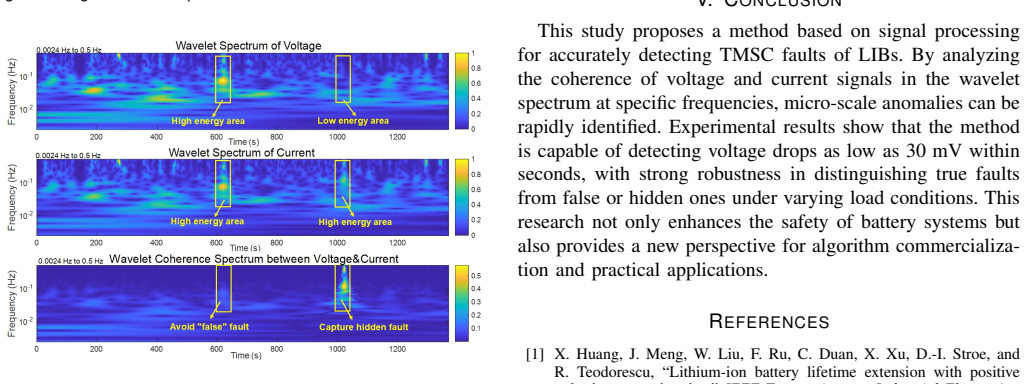
The central object is the wavelet coherence matrix $W^\psi_{co}(t,\lambda) = \bigl||\hat W^\psi_{text{voltage}}(t,\lambda)| - |\hat W^\psi_{text{current}}(t,\lambda)|\bigr|$, computed from the Morlet continuous wavelet transforms of voltage and current over a sliding window of length $T = 1370$ s under 1 Hz sampling. The matrix is normalized element-wise and then examined at a selected high-frequency band, using 0.1 Hz as the demarcation between high and low coherence; a localized decrease in coherence in that band indicates a probable TMSC fault. This coherence comparison is what separates load-induced voltage fluctuations from true fault signatures, because both current and voltage move together under normal loads but only voltage carries the fault's abnormal high-frequency component.
What would settle it
Run a healthy cell under a load profile whose high-frequency current variations are not mirrored in voltage, such as a rapid pulse train at 0.2–0.4 Hz, and apply the same coherence analysis; if the coherence matrix shows fault-like high-energy regions in the absence of any short circuit, the method cannot separate that load pattern from a true TMSC.
Extended reading notes
Core claim
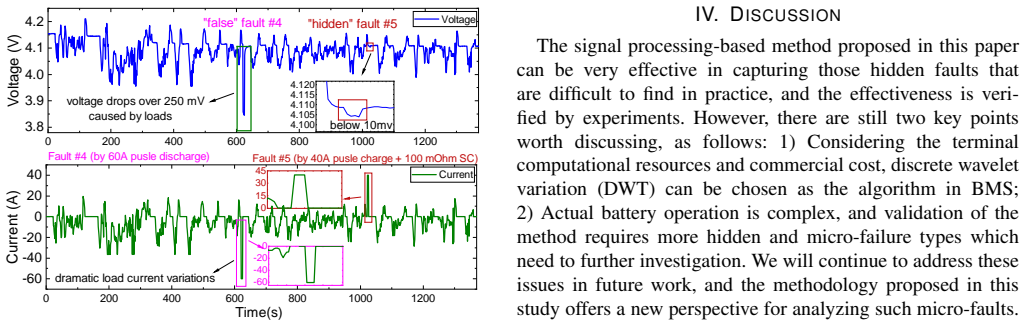
The central claim is that TMSC faults are spectrally localized abnormalities: they add high-frequency energy to the voltage signal that does not appear in the current signal, so the magnitude difference of the normalized CWT coefficients of voltage and current forms localized high-energy regions in the coherence matrix. In experiments, three externally triggered TMSC faults (voltage drops of about 20–40 mV) produced distinct low-coherence peaks around 0.26 Hz, a 60 A pulse discharge that mimicked a load shock did not produce a false alarm because voltage and current remained coherent, and a hidden fault combining a 100 mΩ short circuit with a 40 A charge pulse (voltage drop below 10 mV) was still detected. The method is presented as a precise, model-free, signal-processing alternative to voltage-only diagnostics and machine-learning approaches.
Load-bearing premise
The method assumes that during normal operation the high-frequency parts of voltage and current stay in step, so that a short-circuit's voltage-only wiggle is the only thing that breaks their coherence; if ordinary loads can also break that coherence in the same frequency band, the detector would either miss faults or raise false alarms.
Editorial extensions
If this is right
- At a 1 Hz sampling rate, the fault signature appears as high-energy regions in the 0.1–0.5 Hz band, so a detector can flag a TMSC within a few seconds of its onset.
- A 60 A pulse discharge that mimics a load shock does not produce a false alarm, because voltage and current remain coherent under that disturbance.
- A short circuit as small as a 100 mΩ resistor can be detected even when a 40 A charge pulse masks the voltage drop, because the incoherence between voltage and current remains visible.
- Changing the sampling frequency shifts the high-frequency band that must be monitored, so the method can be adapted to different acquisition settings.
Reading between the lines
- The coherence-loss signature may generalize to other battery fault types that produce voltage-only spectral anomalies, such as early internal short circuits or connection intermittency, though the paper only tests TMSC cases.
- The paper notes that discrete wavelet transform (DWT) could replace CWT for lower computational cost; an editorial extension is that a DWT-based coherence statistic could be evaluated for real-time BMS deployment with modest memory and computation.
- The 0.1 Hz demarcation and the choice of a 1370 s window are tuned to the specific cell and FUDS profile; applying the method to different cells or load profiles would likely require recalibrating the frequency threshold rather than using it as a universal constant.
Editorial analysis
A structured set of objections, weighed in public.
Referee Report
Summary. This letter proposes a fault-detection method for transient micro-short-circuit (TMSC) faults in lithium-ion batteries. Voltage and current are transformed with the continuous wavelet transform, normalized globally over a 1370-s FUDS window, and a "coherence" matrix is computed as the absolute difference of normalized magnitudes. The method flags time-frequency regions where coherence in the 0.1-0.5 Hz band drops. Experiments on one 38.2 Ah cell with externally injected faults report detection of 20-40 mV voltage drops and robustness against a 60-A pulse load and a simultaneous short-circuit-plus-charge "hidden" fault.
Significance. The failure mode is practically relevant, and a model-free, BMS-compatible detector would be valuable. The paper's strengths are the external fault injection with known ground truth, the clear qualitative visualization of low-coherence regions, and the attempt to address false and hidden faults. However, the quantitative claims rest on a single cell, a single experiment, and a visually assessed statistic; without a decision threshold, baseline comparison, or error analysis, the stated sensitivity and robustness are not established. The significance is therefore conditional on further validation.
major comments (4)
- [Section II-B, Eq. (4)] The global min-max normalization denominator is dominated by the low-frequency trend of the window, so the coherence statistic's scale depends on the window's SOC swing and load profile. A fixed 30-mV fault will produce different statistic values in different operating conditions. The paper does not specify a decision threshold or false-alarm measure; Section II-B only states that a coherence decrease "indicates a possible fault," and Fig. 7 is assessed visually. Please report a threshold selection procedure, ROC/detection-delay analysis, and sensitivity to window length and low-frequency content.
- [Section III-A, Table I] The test matrix is a single cell and a single experiment (two FUDS cycles), with no repetitions or error bars. The table lists a 500-mΩ short-circuit resistor for faults #1-#3 while the text says 1 Ω, leaving the actual fault amplitude ambiguous. The claimed "detecting 30 mV within seconds" therefore describes this recording, not algorithm behavior; multiple cells, repeated fault injections, and a baseline comparison (e.g., voltage-drop threshold, sample entropy) are needed.
- [Section II-B, Eq. (5)] The "coherence" is an absolute difference of normalized wavelet magnitudes, not a standard coherence measure (e.g., magnitude-squared coherence). The premise that normal dynamic loads keep this difference small in 0.1-0.5 Hz is supported only by one 60-A pulse at one state of charge. Please provide a theoretical or empirical characterization of the normal-case distribution under a wider range of current profiles, SOCs, and temperatures.
- [Section II-B and Fig. 7] The demarcation frequency f_s = 0.1 Hz and the analysis peak at 0.26 Hz are selected by inspecting the same normal and fault recordings. This creates a risk of overfitting; please justify these values by independent criteria (e.g., pre-specified based on physical time constants) or cross-validate on held-out data.
minor comments (5)
- [Abstract] "con-sistency" is a typo; "Result demonstrates" should agree in number.
- [Section II-A] "non-smooth signals" should read "non-stationary signals"; also, "the CWT of origin x(t)" should be "of original x(t)".
- [Fig. 4] The axes and the text "0 .010 .10.000.010.020.03" are garbled; please regenerate the figure with clear axis labels and colorbar.
- [Section III-B] The phrase "two FUDS cycles" is inconsistent with the time axis in Fig. 6, which reaches 1200 s (one cycle); clarify whether the second cycle is the same or a separate experiment.
- [Section IV] "discrete wavelet variation" should be "discrete wavelet transform".
Circularity Check
No significant circularity: the detection method is validated against externally injected faults, and its central claim does not reduce to its own definitions or fitted parameters.
full rationale
The paper proposes a CWT-based coherence statistic and validates it on FUDS experiments with externally triggered TMSC faults, false faults, and hidden faults. The fault labels are not constructed from the detector's output; they are injected via external resistors and current pulses (Table I), so the central claim does not reduce to its inputs by construction. The detection rule is not a tautology of the fault definition: a TMSC is defined by a 20-30 mV, 1-2 s voltage drop (Sec. I), while detection is based on a low-coherence region at 0.1-0.5 Hz (Sec. II-B); the link between these is an empirical assumption, not an equation forced by the method itself. The manuscript selects fs=0.1 Hz by inspecting the same normal and faulty traces (Figs. 3-4), which is post-hoc threshold selection and a robustness concern, but it is not circular because the claimed 30 mV sensitivity is measured from independent fault injections (Fig. 6) rather than fitted or derived from the detector's definition. There are no load-bearing self-citations or imported uniqueness theorems; reference [11] is unrelated prior work on impedance deep learning and is not used to justify the method's premise. The absence of a decision threshold and the window-relative normalization in Eq. (4) are validity limitations, not circularity. Hence the circularity score is 0.
Assumptions & free parameters
free parameters (3)
- Demarcation frequency f_s = 0.1 Hz =
0.1 Hz
- Analysis peak frequency 0.26 Hz =
0.26 Hz
- Coherence decision threshold =
not specified
assumptions (6)
- standard math The mother wavelet must be admissible, with 0 < integral of omega^-1 times the squared Fourier magnitude < infinity.
- domain assumption The Morlet wavelet optimizes the product of time and frequency resolution.
- domain assumption Under normal dynamic operation, voltage and current CWT spectra have high coherence in the high-frequency band.
- ad hoc to paper TMSC faults are essentially abnormal high-frequency components in the voltage signal.
- standard math Shannon sampling theorem limits the usable spectrum to 0.0024-0.5 Hz at 1 Hz sampling.
- domain assumption External resistor short-circuits and pulse currents reproduce real TMSC and load-disturbance signatures.
Cite this review
Pith. "Pith review of A precise detection method for transient micro short-circuit faults of lithium-ion batteries through signal processing." pith.science (2026). https://pith.science/paper/RCXLAAF6
@misc{pith2026250514283,
  author       = {Pith},
  title        = {Pith review of: A precise detection method for transient micro short-circuit faults of lithium-ion batteries through signal processing},
  year         = {2026},
  howpublished = {\url{https://pith.science/paper/RCXLAAF6}},
  note         = {Machine review of arXiv:2505.14283}
}
read the original abstract
A specific failure mode designated as transient micro-short circuit (TMSC) has been identified in practical battery systems, exhibiting subtle and latent characteristics with measurable voltage deviations. To further improve the safe use of lithium-ion batteries (LIBs), this letter introduces a novel method for the precise detection of this TMSC faults within LIBs. The method applies the continuous wavelet transform (CWT) to voltage and current signals, followed by the identification of micro-scale anomalies through the analysis of the coherence in the wavelet spectrum at specific frequency. Through designed fault experiments, the effec-tiveness of this method has been verified. Result demon-strates that it can effectively capture micro-faults with a voltage drop as low as 30 mV within just a few seconds. Furthermore, the proposed method is inherently highly robust and is able to effectively detect false faults and hidden faults under varying current loads, which highlights the superiority of this method.
Figures


Figures from the paper (4 more)


Forward citations
Cited by 1 Pith paper
-
OmniEval: A Benchmark for Evaluating Omni-modal Models with Visual, Auditory, and Textual Inputs
OmniEval releases a Chinese-English, audio-visual-text benchmark with fine-grained temporal grounding questions, and reports that today's omni-modal models score low and depend mainly on textual cues.
Reference graph
Works this paper leans on
-
[1]
Lithium-ion battery lifetime extension with positive pulsed current charging,
X. Huang, J. Meng, W. Liu, F. Ru, C. Duan, X. Xu, D.-I. Stroe, and R. Teodorescu, “Lithium-ion battery lifetime extension with positive pulsed current charging,” IEEE Transactions on Industrial Electronics , vol. 71, DOI 10.1109/TIE.2023.3250850, no. 1, pp. 484–492, 2024
-
[2]
Review of lithium-ion battery fault features, diagnosis methods, and diagnosis procedures,
J. Zhao, M. Liu, B. Zhang, X. Wang, D. Liu, J. Wang, P. Bai, C. Liu, Y . Sun, and Y . Zhu, “Review of lithium-ion battery fault features, diagnosis methods, and diagnosis procedures,” IEEE Internet of Things Journal, vol. 11, DOI 10.1109/JIOT.2023.3324322, no. 11, pp. 18 936– 18 950, 2024
-
[3]
W. Gao, X. Li, M. Ma, Y . Fu, J. Jiang, and C. Mi, “Case study of an electric vehicle battery thermal runaway and online internal short- circuit detection,” IEEE Transactions on Power Electronics , vol. 36, DOI 10.1109/TPEL.2020.3013191, no. 3, pp. 2452–2455, 2021
-
[4]
An online multifault diagnosis scheme for battery packs based on voltage enve- lope relationship,
Q. Yang, H. Ma, J. Sun, Y . Kang, D. Duan, and P. Ju, “An online multifault diagnosis scheme for battery packs based on voltage enve- lope relationship,” IEEE Transactions on Transportation Electrification, vol. 9, DOI 10.1109/TTE.2022.3172663, no. 1, pp. 1008–1020, 2023
-
[5]
X. Li, X. Gao, Z. Zhang, Q. Chen, and Z. Wang, “Fault diagnosis and detection for battery system in real-world electric vehicles based on long-term feature outlier analysis,” IEEE Transactions on Transportation Electrification, vol. 10, DOI 10.1109/TTE.2023.3288394, no. 1, pp. 1668–1679, 2024
-
[6]
X. Gu, J. Li, K. Liu, Y . Zhu, X. Tao, and Y . Shang, “A precise minor- fault diagnosis method for lithium-ion batteries based on phase plane sample entropy,” IEEE Transactions on Industrial Electronics , vol. 71, DOI 10.1109/TIE.2023.3319717, no. 8, pp. 8853–8861, 2024
-
[7]
Spatiotemporal entropy for abnormality detection and localization of li-ion battery packs,
P. Wei and H.-X. Li, “Spatiotemporal entropy for abnormality detection and localization of li-ion battery packs,” IEEE Transactions on Indus- trial Electronics, vol. 70, DOI 10.1109/TIE.2023.3234128, no. 12, pp. 12 851–12 859, 2023
arXiv 2023
-
[8]
Disturbance-immune and aging-robust internal short circuit diagnostic for lithium-ion battery,
J. Hu, H. He, Z. Wei, and Y . Li, “Disturbance-immune and aging-robust internal short circuit diagnostic for lithium-ion battery,” IEEE Transac- tions on Industrial Electronics, vol. 69, DOI 10.1109/TIE.2021.3063968, no. 2, pp. 1988–1999, 2022
Show all 13 references
-
[9]
Fault diagnosis of lithium-ion battery pack based on hybrid system and dual extended kalman filter algorithm,
T. Lin, Z. Chen, C. Zheng, D. Huang, and S. Zhou, “Fault diagnosis of lithium-ion battery pack based on hybrid system and dual extended kalman filter algorithm,” IEEE Transactions on Transportation Electrifi- cation, vol. 7, DOI 10.1109/TTE.2020.3006064, no. 1, pp. 26–36, 2021
-
[10]
Adaptive internal short-circuit fault detection for lithium-ion batteries of electric vehicles,
X. Zhang, W. Yang, L. Yan, M. B. Kaleem, and W. Liu, “Adaptive internal short-circuit fault detection for lithium-ion batteries of electric vehicles,” Journal of Energy Storage , vol. 84, DOI https://doi.org/10.1016/j.est.2024.110874, p. 110874, 2024. [Online]. Available: http...
-
[11]
Internal short circuit early detection of lithium-ion batteries from impedance spectroscopy using deep learning,
B. Cui, H. Wang, R. Li, L. Xiang, J. Du, H. Zhao, S. Li, X. Zhao, G. Yin, X. Cheng, Y . Ma, H. Huo, P. Zuo, and C. Du, “Internal short circuit early detection of lithium-ion batteries from impedance spectroscopy using deep learning,” Journal of Power Sources, vol. 563, DOI htt...
-
[12]
A novel battery abnormality detection method using interpretable autoencoder,
X. Zhang, P. Liu, N. Lin, Z. Zhang, and Z. Wang, “A novel battery abnormality detection method using interpretable autoencoder,” Applied Energy, vol. 330, DOI https://doi.org/10.1016/j.apenergy.2022.120312, p. 120312, 2023. [Online]. Available: https://www.sciencedirect.com/ s...
2022
-
[13]
Convolutional neural network-based false battery data detection and classification for battery energy storage systems,
H.-J. Lee, K.-T. Kim, J.-H. Park, G. Bere, J. J. Ochoa, and T. Kim, “Convolutional neural network-based false battery data detection and classification for battery energy storage systems,” IEEE Transactions on Energy Conversion, vol. 36, DOI 10.1109/TEC.2021.3061493, no. 4, pp...
Reviewed August 7, 2026 · model on record in the stance chip above.
Discussion (0). Continue with ORCID to comment.