REVIEW 4 major objections 7 minor 28 references
Motor Imagery Teleoperation of a Mobile Robot Using a Low-Cost Brain-Computer Interface for Multi-Day Validation
T0 review · 4 major / 7 minor · reviewed 2026-08-11 · deepseek-v4-flash
Pith's one-line read Low-cost 16-channel EEG headset plus a per-user fine-tuned deep network decodes four imagined commands across three days, reaching 75% validation accuracy and 62% real-world robot control accuracy.
desk verdict A useful multi-day BCI teleoperation demo whose headline efficiency claim only holds for returning users, not cold starts. read the letter →
The pith
A machine-rendered reading of the paper's core claim, the machinery that carries it, and where it could break.
The reading
What carries the argument
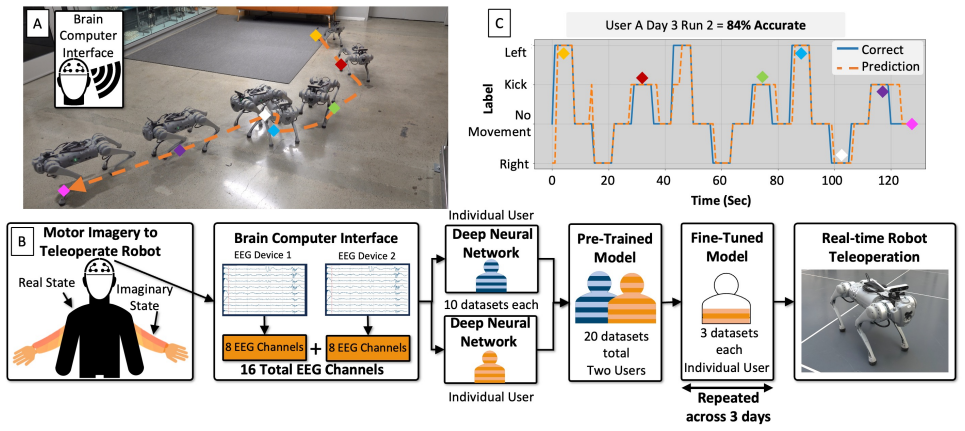
The load-bearing mechanism is the ATCNet architecture (an Attention-based Temporal Convolutional Network) modified to work with a sliding-window input. The network takes 7-second EEG segments from 16 channels, with 6-second overlap between consecutive inputs, and emits a command every second. The fine-tuning procedure freezes the central attention and temporal-convolutional layers and retrains only the initial convolutional block and the final linear layer for each user on each new day, using three short datasets rather than the ten used at day zero. This per-user, per-day updating is what the paper credits for coping with day-to-day EEG variability and for cutting training burden by 70%.
What would settle it
Run the same fine-tuning pipeline on a user whose data were never used to pre-train the network, and compare their day-one validation accuracy to the reported 75% average. If a new user cannot reach comparable accuracy with only three datasets (about 38 minutes of collection), the claim that the method reduces training data for everyday users collapses.
Extended reading notes
Core claim
The paper's central claim is that practical, multi-day motor-imagery brain-computer interface control of a real mobile robot is achievable with a low-cost, 16-channel EEG system and a fine-tuned deep neural network. The authors report that after an initial large data collection, fine-tuning only the early convolutional and final linear layers of a pre-trained network for each user and day—using about 70% less data—yields an average validation accuracy of 75% over three days and an average 62% accuracy when the decoded commands actually drive the quadruped robot. The system decodes four classes of imagined movement (right hand, left hand, kicking, and no movement) in continuous, real-time streams via a sliding window that updates commands once per second, without any hand-crafted feature extraction.
Load-bearing premise
The 70% training-data reduction is demonstrated only for users whose earlier day-0 data were already included in the pre-trained model, so the benefit for a completely new user is assumed rather than shown.
Editorial extensions
If this is right
- Multi-day motor-imagery teleoperation of a real mobile robot is feasible with a consumer-grade EEG headset, not just with high-density laboratory systems.
- Per-user, per-day fine-tuning can replace large day-zero data collections on subsequent days, cutting calibration time and user fatigue.
- The reported 75% validation accuracy across three days indicates that day-to-day EEG variability can be managed by retraining a small subset of network layers.
- The 62% real-world command accuracy, measured while the robot is actually moving, provides a quantitative benchmark that future MI-BCI robot studies can reproduce and compare.
- Removing hand-crafted feature extraction simplifies the pipeline enough that other robotics groups could deploy a similar system with off-the-shelf EEG hardware.
Reading between the lines
- The 70% training-data reduction is only validated for users who already contributed to the pre-trained model; a genuinely new user would still need a full day-0 dataset. A natural extension is to pre-train on a held-out user pool and test a completely unseen user.
- The real-world accuracy metric is averaged over all commands, and the 'no movement' class is more frequent; a per-class breakdown would reveal whether mistakes are systematic (for instance, left/right confusions) and where shared autonomy could compensate.
- The approach could likely be transferred to other low-cost EEG hardware and other imagined actions, but robustness across days probably depends on the user's individual motor-imagery ability; participants with strong prior skills (piano players) performed best, hinting that adaptive feedback might help weaker users.
- A shared-control layer that rejects low-confidence classifications could raise effective control accuracy above the reported 62% without additional EEG data collection.
Signed reviews
Editorial analysis
A structured set of objections, weighed in public.
Referee Report
Summary. The manuscript reports a three-day, four-user study of motor-imagery (MI) teleoperation of a quadruped robot using a low-cost 16-channel EEG system. The authors build a pre-trained ATCNet-style deep neural network on ten datasets per pair of users, then fine-tune it for each user on each new day using only three datasets, claiming a 70% reduction in training-data requirements. They report 75% average validation accuracy and 62% average real-world robot-command accuracy over the three days, and they frame the work as a practical step toward accessible, multi-day MI-BCI robot control. The paper also proposes a standardized accuracy metric for real-world robot control and compares its setup with prior MI-BCI robot studies.
Significance. If the main claim is valid, the paper would be a useful empirical contribution: multi-day validation of an MI-BCI on a real mobile robot is uncommon in the literature, the use of a low-cost open-source EEG device addresses an accessibility gap, and the proposed real-robot command-accuracy metric is a sensible step toward comparability across studies. The strengths of the paper are its realistic setting (real robot, real control room, repeated days) and its explicit reporting of both offline validation and online robot-control accuracy. However, the load-bearing claim that fine-tuning reduces training data by 70% is not actually tested for a user absent from the pre-training set, and the evaluation lacks baselines and statistical support. These issues make the practical generalization of the reported numbers uncertain, so the manuscript needs substantial additional evidence before its central claims can be accepted.
major comments (4)
- [III-G and III-H] The number of pre-training epochs is reported inconsistently: Section III-G states "We trained the pre-trained model with a large dataset in Day 0 and used 200 epochs," while Section III-H states "we trained a generalized pre-trained model with 500 epoch." This discrepancy must be resolved, because the fine-tuning results in Table III may depend on the pre-training schedule. Please state the exact protocol and, ideally, report sensitivity to the epoch count.
- [III-H and Fig. 1B] The central data-reduction claim is not tested for a genuinely new user. As described in Section III-H, "to create the fine-tuned model for User A, we started with the pre-trained model (trained on data from Users A and B)" and the same is true for each user. Thus the 70% reduction applies only to users whose Day-0 data already contributed to the pre-trained model. No leave-one-user-out evaluation, no cold-start user, and no experiment fine-tuning from a model pre-trained on other users only is reported. The abstract and conclusion generalize the data-reduction and fatigue-reduction benefits to new users, but that generalization is currently unsupported. Please add a held-out-user experiment or clearly restrict the claims to the returning-user setting.
- [IV-B, Table III] No baseline comparison is provided. The paper does not compare the fine-tuned model against (a) training ATCNet from scratch on the same three datasets, (b) fine-tuning from a model pre-trained on other users' data only, or (c) a classical approach such as CSP+LDA on the same data. Without such baselines, the reported 75% validation accuracy cannot be attributed to the fine-tuning strategy rather than to the smaller dataset or day-specific variability. An ablation of this kind is essential for the paper's main contribution.
- [IV-B, Table III] The statistical evidence is thin for the strength of the claims. There are only four users, and User B consistently performs much worse than the others (validation 58-62%, robot control 40-57%). No confidence intervals, significance tests, or confusion matrices are reported, and the paper does not report per-class accuracies despite the four-class problem with a 25% chance level. The phrase "high accuracy" in Section IV-B is therefore not supported across the user population. At a minimum, the authors should report per-class results, the distribution of accuracies across sessions, and an uncertainty measure.
minor comments (7)
- [III-G] The text refers to "ACTNet" once; this appears to be a typo for "ATCNet." Please check all model-name spellings.
- [III-C] The text says users received "no extensive user practice" but then states users were given "approximately 5 minutes to practice real and imaginary movements." These statements should be reconciled so the reader knows exactly what practice was provided.
- [III-I, Eq. (3)] Equation (3) defines accuracy as the average of per-class true-positive rates. This is a balanced accuracy measure only when all class priors are equal in the test set; in the robot-control setting, the paper notes that class N has more samples. Please state this explicitly and report per-class values so the reader can see whether the reported accuracy is driven by one class.
- [IV-A] The sentence "The average accuracy of each user included 55%, 53%, 51% and 70%" is awkwardly worded and should be rewritten for clarity; Table II conveys the same information more clearly.
- [IV-C and Fig. 6] The selection of "best, median and least accurate runs" should be defined explicitly (e.g., median of what distribution, over how many runs) so that Fig. 6 is not open to cherry-picking concerns.
- [Table I] The row for "Our Approach" contains the entries "78 57 0.65 75 62" with no column headers or explanations, making the table difficult to interpret. Please reformat this row so each number corresponds to a clearly labeled column.
- [References] Reference [15] lists the first author as "C. Geeling, A. Yujin et al." which appears malformed; please correct the author list and verify all reference metadata.
Circularity Check
The 70% data-reduction claim is partly circular: each user's 'pre-trained' model is trained on that same user's data, so the reduction is a same-user warm-start rather than a transfer-learning result.
-
self definitional
[Section III-G (Deep Neural Network Model), final paragraph; Fig. 1 caption]
"For example, to create the fine-tuned model for User A, we started with the pre-trained model (trained on data from Users A and B) and then optimized it using User A's data for each day. ... Each user's fine-tuned model was developed by further training the pre-trained model that included their data."
The model labeled 'pre-trained' is not user-independent: for User A it is trained on Users A and B, meaning it includes the very user who is later fine-tuned. The paper's headline contribution (A), 'reducing dataset size by 70% while maintaining 75% average accuracy,' counts only the 3 fine-tuning datasets as training data and omits the 10 day-0 datasets from the same user that were needed to build the pre-trained model. The 70% figure (3 vs 10 datasets) is therefore an accounting artifact: the user's own EEG data enter through both pretraining and fine-tuning. No leave-one-user-out or cold-start condition is reported, so the data-reduction benefit is not established for a new user; it reduces by construction to same-user initialization rather than to cross-user transfer.
full rationale
The core empirical results (75% validation accuracy and 62% real-world robot control accuracy) are genuine measurements on held-out same-day sessions and are not forced by the model definition. The paper is not built on a self-citation chain, and no uniqueness theorem or ansatz is smuggled in via the authors' prior work. The one load-bearing circularity concern is the construction of the 'pre-trained' model: it explicitly includes the target user's day-0 data before that user is fine-tuned, so the claimed 70% reduction in training data is partially self-definitional. This is a partial circularity in the headline contribution (A), not in the measured accuracies; hence the moderate score. A corrected evaluation would need a held-out user not present in the pretraining set, or an ablation from scratch or from other-user pretraining, to support the transfer and data-reduction claims for new users.
Assumptions & free parameters
free parameters (5)
- Pre-training epoch count =
Reported as 200 (Sec. III-G) and 500 (Sec. III-H), inconsistent
- Fine-tuning dataset size =
3 sessions (38 min) per day
- Feature dimension d =
16
- First sliding window exclusion =
Excluded for each MI task
- Fine-tuning epochs =
15
assumptions (4)
- domain assumption The 7-second input window captures stable, decodable motor-imagery EEG patterns for all four classes across days.
- domain assumption The DNN architecture ATCNet, with the stated hyperparameters, is an appropriate decoder for these EEG signals.
- domain assumption Balanced per-class accuracy on held-out sessions is a valid proxy for real-world robot command accuracy.
- ad hoc to paper The pre-trained model trained on users A and B can serve as a valid starting point for fine-tuning the same users on later days, and similarly for C and D.
Cite this review
Pith. "Pith review of Motor Imagery Teleoperation of a Mobile Robot Using a Low-Cost Brain-Computer Interface for Multi-Day Validation." pith.science (2026). https://pith.science/paper/RE2IUK7B
@misc{pith2026241208971,
  author       = {Pith},
  title        = {Pith review of: Motor Imagery Teleoperation of a Mobile Robot Using a Low-Cost Brain-Computer Interface for Multi-Day Validation},
  year         = {2026},
  howpublished = {\url{https://pith.science/paper/RE2IUK7B}},
  note         = {Machine review of arXiv:2412.08971}
}
abstract
Brain-computer interfaces (BCI) have the potential to provide transformative control in prosthetics, assistive technologies (wheelchairs), robotics, and human-computer interfaces. While Motor Imagery (MI) offers an intuitive approach to BCI control, its practical implementation is often limited by the requirement for expensive devices, extensive training data, and complex algorithms, leading to user fatigue and reduced accessibility. In this paper, we demonstrate that effective MI-BCI control of a mobile robot in real-world settings can be achieved using a fine-tuned Deep Neural Network (DNN) with a sliding window, eliminating the need for complex feature extractions for real-time robot control. The fine-tuning process optimizes the convolutional and attention layers of the DNN to adapt to each user's daily MI data streams, reducing training data by 70% and minimizing user fatigue from extended data collection. Using a low-cost (~$3k), 16-channel, non-invasive, open-source electroencephalogram (EEG) device, four users teleoperated a quadruped robot over three days. The system achieved 78% accuracy on a single-day validation dataset and maintained a 75% validation accuracy over three days without extensive retraining from day-to-day. For real-world robot command classification, we achieved an average of 62% accuracy. By providing empirical evidence that MI-BCI systems can maintain performance over multiple days with reduced training data to DNN and a low-cost EEG device, our work enhances the practicality and accessibility of BCI technology. This advancement makes BCI applications more feasible for real-world scenarios, particularly in controlling robotic systems.
Figures


Figures from the paper (3 more)


Reference graph
Works this paper leans on
-
[1]
A brain-computer interface that evokes tactile sensations improves robotic arm control,
S. N. Flesher et al. , “A brain-computer interface that evokes tactile sensations improves robotic arm control,” Science, vol. 372, no. 6544, pp. 831–836, 2021
work page 2021
-
[2]
S. R. Soekadar et al. , “Hybrid eeg/eog-based brain/neural hand exoskeleton restores fully independent daily living activities after quadriplegia,” Sci. Robotics, vol. 1, no. 1, p. eaag3296, 2016
work page 2016
-
[3]
Correcting robot mistakes in real time using eeg signals,
A. F. Salazar-Gomez et al. , “Correcting robot mistakes in real time using eeg signals,” in 2017 IEEE Int. Conf. Robot. and Autom. (ICRA), 2017, pp. 6570–6577
work page 2017
-
[4]
Robust predictive control for eeg-based brain–robot teleoperation,
H. Li et al. , “Robust predictive control for eeg-based brain–robot teleoperation,” IEEE Trans. Intell Transp. Syst. , pp. 1–11, 2024
work page 2024
-
[5]
Lessons learned: Symbiotic autonomous robot ecosystem for nuclear environments,
D. Mitchell et al. , “Lessons learned: Symbiotic autonomous robot ecosystem for nuclear environments,” IET Cyber-Syst. Robot. , vol. 5, no. 4, p. e12103, 2023
work page 2023
-
[6]
——, “Symbiotic system of systems design for safe and resilient autonomous robotics in offshore wind farms,” IEEE Access , vol. 9, pp. 141 421–141 452, 2021
work page 2021
-
[8]
Brain–robot interface-based navigation control of a mobile robot in corridor environments,
Y . Liu et al. , “Brain–robot interface-based navigation control of a mobile robot in corridor environments,” IEEE Trans. Syst. Man Cybern.: Syst., vol. 50, no. 8, pp. 3047–3058, 2020
work page 2020
-
[9]
Plug-and-play control of a brain–computer interface through neural map stabilization,
D. B. Silversmith et al. , “Plug-and-play control of a brain–computer interface through neural map stabilization,” Nat. Biotechnol., vol. 39, no. 3, pp. 326–335, Mar 2021
work page 2021
Show all 28 references
-
[10]
Neurograsp: Real-time eeg classification of high- level motor imagery tasks using a dual-stage deep learning frame- work,
J.-H. Cho et al. , “Neurograsp: Real-time eeg classification of high- level motor imagery tasks using a dual-stage deep learning frame- work,” IEEE Trans. Cybern., vol. 52, no. 12, pp. 13 279–13 292, 2022
2022
-
[11]
Noninvasive brain–machine interfaces for robotic devices,
L. Tonin and J. d. R. Mill ´an, “Noninvasive brain–machine interfaces for robotic devices,” Annual Review of Control, Robotics, and Au- tonomous Systems, vol. 4, no. V olume 4, 2021, pp. 191–214, 2021
2021
-
[12]
Progress in brain computer interface: Challenges and opportunities,
S. Saha et al., “Progress in brain computer interface: Challenges and opportunities,” Front. syst. neurosci., vol. 15, 2021
2021
-
[13]
Brain-computer interface robotics for hand rehabilitation after stroke: a systematic review,
P. D. E. Baniqued et al., “Brain-computer interface robotics for hand rehabilitation after stroke: a systematic review,” J. Neuroeng. Rehabil., vol. 18, no. 1, p. 15, Jan 2021
2021
-
[14]
Deep learning for eeg motor imagery classification based on multi-layer cnns feature fusion,
S. U. Amin et al., “Deep learning for eeg motor imagery classification based on multi-layer cnns feature fusion,”Future Gener. Comput. Syst., vol. 101, pp. 542–554, 2019
2019
-
[15]
Generalizability under sensor failure: Tokenization + transformers enable more robust latent spaces,
C. Geeling, A. Yujin et al. , “Generalizability under sensor failure: Tokenization + transformers enable more robust latent spaces,” arXiv, 2024
2024
-
[16]
Neuroengineering challenges of fusing robotics and neuroscience,
G. Cheng et al., “Neuroengineering challenges of fusing robotics and neuroscience,” Sci. Robotics, vol. 5, no. 49, p. eabd1911, 2020
2020
-
[17]
Electroencephalography (EEG) technology applications and available devices,
M. Soufineyestani et al., “Electroencephalography (EEG) technology applications and available devices,” Appl. Sci., vol. 10, no. 21, 2020
2020
-
[18]
Continuous shared control of a mobile robot with brain–computer interface and autonomous navigation for daily assis- tance,
B. Xu et al. , “Continuous shared control of a mobile robot with brain–computer interface and autonomous navigation for daily assis- tance,” Comput. Struct. Biotechnol. J. , vol. 22, pp. 3–16, 2023
2023
-
[19]
Towards independence: A bci telepresence robot for people with severe motor disabilities,
R. Leeb et al., “Towards independence: A bci telepresence robot for people with severe motor disabilities,” Proceedings of the IEEE , vol. 103, no. 6, pp. 969–982, 2015
2015
-
[20]
A survey on robots controlled by motor imagery brain-computer interfaces,
J. Zhang and M. Wang, “A survey on robots controlled by motor imagery brain-computer interfaces,” Cognit. Robot., vol. 1, pp. 12–24, 2021
2021
-
[21]
Motor-imagery eeg-based bcis in wheelchair move- ment and control: A systematic literature review,
A. Palumbo et al., “Motor-imagery eeg-based bcis in wheelchair move- ment and control: A systematic literature review,” Sensors, vol. 21, no. 18, 2021
2021
-
[22]
NOIR: Neural signal operated intelligent robots for everyday activities,
R. Zhang et al., “NOIR: Neural signal operated intelligent robots for everyday activities,” arXiv, 2023
2023
-
[23]
Motor imagery based continuous teleoperation robot control with tactile feedback,
B. Xu et al. , “Motor imagery based continuous teleoperation robot control with tactile feedback,” Electronics, vol. 9, no. 1, 2020
2020
-
[24]
An assistive shared control architecture for a robotic arm using EEG-based BCI with motor imagery,
G. Gillini et al., “An assistive shared control architecture for a robotic arm using EEG-based BCI with motor imagery,” in IEEE/RSJ Int. Conf, Intelli. Robot. Syst. , 2021, pp. 4132–4137
2021
-
[25]
Optimizing motor imagery parameters for robotic arm control by brain-computer interface,
U. Hayta et al. , “Optimizing motor imagery parameters for robotic arm control by brain-computer interface,” Brain Sci. , vol. 12, no. 7, 2022
2022
-
[26]
Toward brain-actuated humanoid robots: Asyn- chronous direct control using an eeg-based bci,
Y . Chae et al. , “Toward brain-actuated humanoid robots: Asyn- chronous direct control using an eeg-based bci,” IEEE Trans. on Robot., vol. 28, no. 5, pp. 1131–1144, 2012
2012
-
[27]
Asynchronous motor imagery bci and lidar- based shared control system for intuitive wheelchair navigation,
J. W. Choi et al. , “Asynchronous motor imagery bci and lidar- based shared control system for intuitive wheelchair navigation,” IEEE Sensors J., vol. 23, no. 14, pp. 16 252–16 263, 2023
2023
-
[28]
Physics-informed attention temporal convolutional network for EEG-based motor imagery classification,
H. Altaheri et al., “Physics-informed attention temporal convolutional network for EEG-based motor imagery classification,” IEEE Trans. Ind. Informat., vol. 19, no. 2, pp. 2249–2258, 2023
2023
-
[29]
Generalized neural decoders for transfer learning across participants and recording modalities,
S. Peterson et al., “Generalized neural decoders for transfer learning across participants and recording modalities,” J. Neural Eng., vol. 18, 2021
2021
Reviewed August 11, 2026 · model on record in the stance chip above.
Discussion (0). Continue with ORCID to comment.