Sequential and Generative Models for Vehicular Distributed MIMO Channel Prediction
Pith reviewed 2026-06-25 19:28 UTC · model grok-4.3
The pith
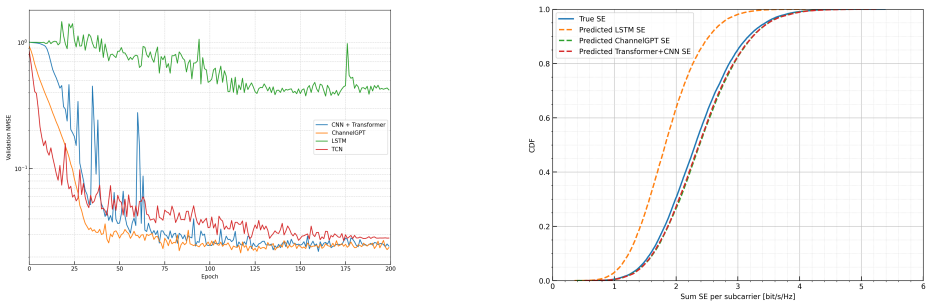
ChannelGPT predicts vehicular MIMO channels with 94% lower NMSE than LSTM and produces spectral efficiency nearly identical to real measurements.
A machine-rendered reading of the paper's core claim, the machinery that carries it, and where it could break.
Core claim
Using measured urban channels from the MaMIMOSA campaign, ChannelGPT achieves over 94% NMSE reduction versus LSTM, cuts FLOPs by 28% and latency by 39% versus the CNN-Transformer, and yields spectral efficiency distributions nearly indistinguishable from those obtained with real CSI for vehicular distributed MIMO.
What carries the argument
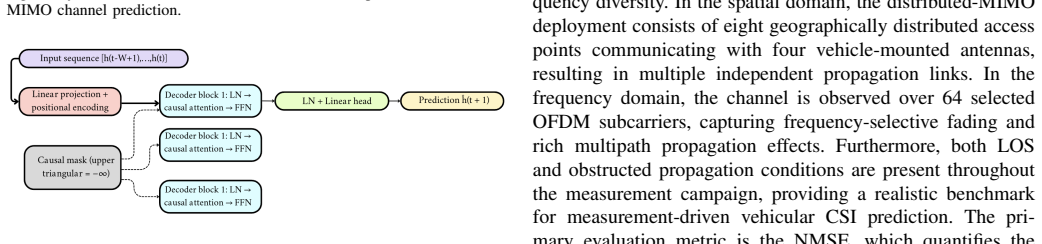
ChannelGPT, a generative model trained to forecast multi-horizon CSI while preserving spatiotemporal dynamics and non-stationarity of measured vehicular channels.
If this is right
- Accurate multi-horizon prediction allows system-level spectral efficiency evaluation without needing continuous real-time CSI acquisition.
- Generative models maintain the non-stationary statistics of vehicular channels better than recurrent or convolutional alternatives across different forecasting horizons.
- Lower computational cost of the best predictor makes real-time channel forecasting feasible inside moving vehicles.
- Predicted channels that match real SE distributions can substitute for measured CSI in performance studies of distributed MIMO vehicular networks.
Where Pith is reading between the lines
- The same generative approach might extend to predicting channels in mixed indoor-outdoor or highway scenarios if the training data include those statistics.
- Integration with beamforming or resource allocation algorithms could test whether the prediction accuracy translates into end-to-end throughput gains.
- If the model generalizes, it could reduce pilot overhead in standards for high-mobility 6G links.
Load-bearing premise
The channels collected in one urban measurement campaign capture the essential dynamics that appear in other vehicular environments.
What would settle it
Retraining the models on channel data from a second independent measurement campaign in a different city and checking whether the 94% NMSE gain and SE match still hold.
Figures



read the original abstract
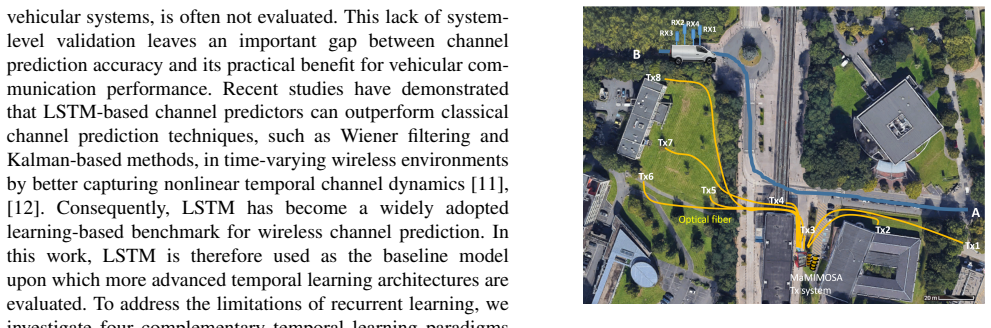
Vehicular communication is a key 6G use case requiring reliable and high-capacity connectivity under fast mobility and highly time-varying propagation conditions. However, large-scale vehicular channel estimation is costly and limited, impacting system-level performance of vehicular communications, and realistic channel prediction models are needed. This paper proposes a vehicular channel prediction framework based on real measured urban channels collected through a dedicated measurement campaign using the MaMIMOSA channel sounder. The framework enables the training and systematic benchmarking of sequential and generative models for both single-step and multi-horizon vehicular channel state information (CSI) prediction to assess prediction robustness across different forecasting horizons, including LSTM, TCN, a CNN-enhanced Transformer, and ChannelGPT, with the goal of accurately predicting channel evolution while preserving spatiotemporal dynamics and non-stationarity. In addition, a system-level evaluation framework is introduced to assess the impact of channel prediction on the performance of vehicular distributed MIMO communications. Using predicted channels, spectral efficiency (SE) is evaluated against true CSI. Results show that ChannelGPT achieves over 94% normalized mean squared error (NMSE) reduction compared to LSTM and significant improvements over other baselines, while reducing FLOPs by 28% and inference latency by 39% relative to the CNN + Transformer. Moreover, ChannelGPT-predicted channels yield SE distributions nearly indistinguishable from those obtained with real measurements, demonstrating its effectiveness for reliable performance evaluation in high-mobility 6G vehicular networks.
Editorial analysis
A structured set of objections, weighed in public.
Referee Report
Summary. The manuscript proposes a vehicular CSI prediction framework trained and benchmarked on urban channels from the MaMIMOSA measurement campaign. It evaluates LSTM, TCN, CNN+Transformer, and a new generative model (ChannelGPT) for single-step and multi-horizon prediction, then assesses the downstream impact of predicted channels on spectral efficiency in a distributed MIMO setting. The central empirical claims are a >94% NMSE reduction versus LSTM, 28% fewer FLOPs and 39% lower latency versus CNN+Transformer, and SE distributions from ChannelGPT predictions that are nearly indistinguishable from those obtained with measured CSI.
Significance. If the reported gains hold under broader testing, the work supplies a concrete, measurement-driven benchmark for generative channel predictors in high-mobility scenarios and demonstrates a useful system-level link between prediction fidelity and achievable SE. The use of real MaMIMOSA data rather than purely synthetic channels is a strength.
major comments (2)
- [Abstract and §5 (Results)] The headline performance claims (94% NMSE reduction, SE distributions nearly indistinguishable from real CSI) rest on a single urban measurement campaign. No cross-campaign hold-out, different mobility patterns, or synthetic channels with altered statistics are reported, which directly underpins the claim that the models enable reliable performance evaluation in high-mobility 6G vehicular networks.
- [Abstract and §4–5] The abstract and results sections state quantitative improvements without accompanying details on the number of Monte-Carlo trials, error bars, statistical significance tests, or data-exclusion rules. This absence makes it impossible to judge whether the reported margins are robust or sensitive to particular train/test splits within the MaMIMOSA dataset.
minor comments (1)
- [§3] Notation for the multi-horizon prediction loss and the precise definition of the generative sampling procedure should be clarified with an equation or pseudocode block.
Simulated Author's Rebuttal
We thank the referee for the detailed review and constructive feedback on our manuscript. We address the two major comments point-by-point below. We agree that enhancing the statistical reporting and discussing the scope of the evaluation will improve the paper, and we will make revisions accordingly.
read point-by-point responses
-
Referee: [Abstract and §5 (Results)] The headline performance claims (94% NMSE reduction, SE distributions nearly indistinguishable from real CSI) rest on a single urban measurement campaign. No cross-campaign hold-out, different mobility patterns, or synthetic channels with altered statistics are reported, which directly underpins the claim that the models enable reliable performance evaluation in high-mobility 6G vehicular networks.
Authors: We acknowledge the referee's concern regarding the reliance on a single measurement campaign. The MaMIMOSA dataset provides extensive real-world urban vehicular channel measurements under high-mobility conditions, which is a key strength as noted in the significance section. However, we agree that demonstrating robustness across additional datasets would further support the claims. Since our current work focuses on this comprehensive campaign, we will revise the manuscript to include a more explicit discussion of this limitation and the potential for future cross-campaign validation in the conclusions and abstract. No new experiments are added at this stage. revision: partial
-
Referee: [Abstract and §4–5] The abstract and results sections state quantitative improvements without accompanying details on the number of Monte-Carlo trials, error bars, statistical significance tests, or data-exclusion rules. This absence makes it impossible to judge whether the reported margins are robust or sensitive to particular train/test splits within the MaMIMOSA dataset.
Authors: We thank the referee for pointing this out. We will revise the manuscript to include the number of Monte-Carlo trials performed, error bars on the reported metrics, clarification of data exclusion rules, and any statistical significance tests conducted. These details will be added to Section 5 and referenced in the abstract. revision: yes
Circularity Check
No circularity; empirical benchmarking on external measurements
full rationale
The paper trains and evaluates sequential/generative models (LSTM, TCN, CNN+Transformer, ChannelGPT) on channels collected via the independent MaMIMOSA measurement campaign, then reports NMSE reductions and SE distributions versus real CSI and baselines. No derivation, uniqueness theorem, ansatz, or parameter fit is invoked whose output is definitionally identical to its input; all performance numbers are obtained by standard train/test splits and system-level simulation on held-out measured data. The central claims therefore rest on external data rather than self-referential construction.
Axiom & Free-Parameter Ledger
Reference graph
Works this paper leans on
-
[1]
A vision of 6g vehicular networks: Challenges and opportunities,
N. Saeedet al., “A vision of 6g vehicular networks: Challenges and opportunities,”IEEE TVT, vol. 70, no. 9, pp. 7619–7632, 2021
2021
-
[2]
Machine learning for v2x channel modeling and prediction: A survey,
H. Liu, S. Chen, B. Ai, and C. Han, “Machine learning for v2x channel modeling and prediction: A survey,”IEEE Communications Surveys & Tutorials, vol. 24, no. 2, pp. 1234–1260, 2022
2022
-
[3]
6g-enabled vehicular communication: Require- ments, technologies, and challenges,
K. Muhammadet al., “6g-enabled vehicular communication: Require- ments, technologies, and challenges,”IEEE Communications Surveys & Tutorials, vol. 24, no. 3, pp. 1597–1646, 2022
2022
-
[4]
DeepMIMO: A Generic Deep Learning Dataset for Millimeter Wave and Massive MIMO Applications,
M. Alrabeiah and A. Alkhateeb, “DeepMIMO: A Generic Deep Learning Dataset for Millimeter Wave and Massive MIMO Applications,” inProc. IEEE ICC, 2019
2019
-
[5]
Measurement of the v2i channel in cell-free vehicular networks with the distributed mamimosa channel sounder,
E. P. Simon, P. Laly, J. Farah, E. Tanghe, W. Joseph, and D. Gaillot, “Measurement of the v2i channel in cell-free vehicular networks with the distributed mamimosa channel sounder,” inEuCAP, 2023, pp. 1–5
2023
-
[6]
Deep learning–based channel prediction for vehicle-to-vehicle communications,
X. Gao, Y . Liu, H. Xiao, and D. Yang, “Deep learning–based channel prediction for vehicle-to-vehicle communications,”IEEE Transactions on V ehicular Technology, vol. 70, no. 6, pp. 5184–5196, 2021
2021
-
[7]
Recurrent neural networks for prediction of v2x channels in highway scenarios,
E. Onwubolu, S. S. Pietro, and R. A. Stirling-Gallacher, “Recurrent neural networks for prediction of v2x channels in highway scenarios,” IEEE Access, vol. 8, pp. 210 365–210 377, 2020
2020
-
[8]
Transformer-based channel estimation for v2x communications,
W. Feng, J. Xu, Y . Liang, and S. Sun, “Transformer-based channel estimation for v2x communications,” inProc. IEEE ICC, 2022
2022
-
[9]
Mobility-aware channel prediction for vehicular networks using graph neural networks,
T. He, X. Cheng, L. Yang, and Y . Li, “Mobility-aware channel prediction for vehicular networks using graph neural networks,”IEEE Transactions on Wireless Communications, vol. 21, no. 6, pp. 4514–4526, 2022
2022
-
[10]
Spatio-temporal deep learning for v2x channel prediction,
H. Jiang, M. Ma, and G. Gui, “Spatio-temporal deep learning for v2x channel prediction,”IEEE T-ITS, 2023
2023
-
[11]
Machine learning prediction of time-varying rayleigh channels,
S. Kibugi, D. T. M. Slock, and Y . Yuan, “Machine learning prediction of time-varying rayleigh channels,”arXiv:2103.06131, 2021
-
[12]
Massive mimo channel prediction: Machine learning versus kalman filtering,
J. Kim, J. Lee, and J. Choi, “Massive mimo channel prediction: Machine learning versus kalman filtering,” inICTC, 2020
2020
-
[13]
Long Short-Term Memory,
S. Hochreiter and J. Schmidhuber, “Long Short-Term Memory,”Neural Computation, vol. 9, no. 8, pp. 1735–1780, 1997
1997
-
[14]
An Empirical Evaluation of Generic Convolutional and Recurrent Networks for Sequence Modeling
S. Bai, J. Z. Kolter, and V . Koltun, “An Empirical Evaluation of Generic Convolutional and Recurrent Networks for Sequence Model- ing,”arXiv:1803.01271, 2018
work page internal anchor Pith review Pith/arXiv arXiv 2018
-
[15]
Local partial zero-forcing precoding for cell-free massive mimo,
G. Interdonato, M. Karlsson, E. Bj ¨ornson, and E. G. Larsson, “Local partial zero-forcing precoding for cell-free massive mimo,” arXiv:1909.01034, 2019
-
[16]
Massive mimo under multi- keyhole channels: Does the use-and-then-forget bounding technique work?
T. X. Doan, C. D. Ho, and H. Q. Ngo, “Massive mimo under multi- keyhole channels: Does the use-and-then-forget bounding technique work?”Physical Communication, vol. 47, p. 101384, 2021
2021
discussion (0)
Sign in with ORCID, Apple, or X to comment. Anyone can read and Pith papers without signing in.