REVIEW 3 major objections 4 minor 88 references
Low Angular Momentum Black Hole Accretion: First GRMHD Evidence of Standing Shocks
T0 review · 3 major / 4 minor · reviewed 2026-08-06 · deepseek-v4-flash
Pith's one-line read This paper claims that low-angular-momentum, weakly magnetized accretion onto a rotating black hole produces two quasi-steady standing shocks, the first time standing shocks have been reproduced in full GRMHD simulations.
desk verdict Plausible first GRMHD standing shocks, but the headline claim rides on 2.5D runs taken after MRI decayed, and the 3D validation skips the exact parameters used for the strongest shocks. read the letter →
The pith
A machine-rendered reading of the paper's core claim, the machinery that carries it, and where it could break.
The reading
What carries the argument
The central control parameter is the inclination parameter $\alpha$, which concentrates the Fishbone-Moncrief torus density toward the equatorial plane via rho proportional to exp[-($\alpha$ cos $\theta$)^2], combined with a reduced angular momentum fraction F = 0.4 and a weak poloidal magnetic field. These choices establish a pressure balance between centrifugal force (amplified by frame dragging near a spinning black hole) and the ram pressure of the infalling gas; when $\alpha$ is large this balance supports two standing shocks, at roughly 4-5 rg and 40-50 rg, with increasing spin pushing the outer shock outward.
What would settle it
Run a high-resolution 3D GRMHD simulation of the alpha = 50, a* = 0.94 case for at least 15,000 tg and check the equatorial radial profiles of pressure and radial velocity: if the two sharp jumps at about 4-5 rg and 40-50 rg do not form or do not persist over several thousand tg, the claim of standing shocks in GRMHD SANE low-angular-momentum flows would be contradicted.
Extended reading notes
Core claim
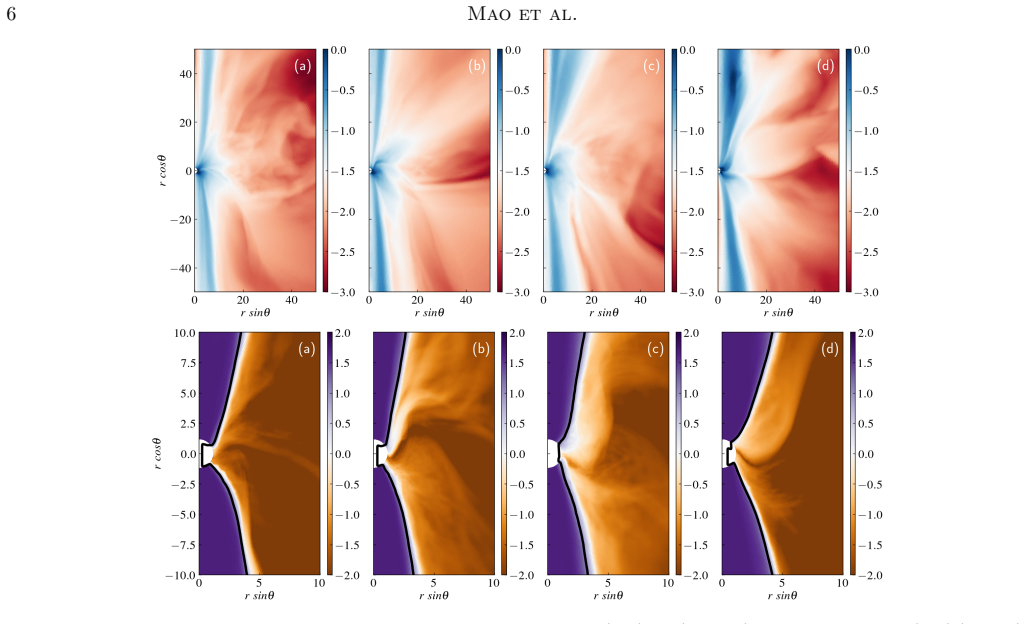
The authors report the first GRMHD evidence of standing shocks in low-angular-momentum accretion flows. In the weakly magnetized SANE regime, when the initial torus is confined near the equatorial plane (inclination parameter alpha = 50), two standing shocks form at r approximately 4-5 rg and r approximately 40-50 rg, and the outer shock shifts outward for higher black hole spin because frame dragging strengthens centrifugal support. The shock locations remain quasi-steady between 14,000 and 15,000 tg, and a 3D validation run at alpha = 10 shows a quasi-steady, gently oscillating shock at about 37 rg. This demonstrates that such structures are not limited to idealized hydrodynamics but arise naturally in turbulent, weakly magnetized GRMHD flows around a rotating black hole.
Load-bearing premise
The main results come from 2.5D axisymmetric simulations that the authors acknowledge cannot sustain MRI growth of magnetic fields after about 10,000 gravitational times, and the single 3D validation was run at the lower inclination parameter alpha = 10 rather than the alpha = 50 cases where the two-shock structure is strongest; if full 3D turbulence at high alpha destroys or prevents the shocks, the central claim fails.
Editorial extensions
If this is right
- Standing shocks are not artifacts of 1.5D idealized flows: they can persist in turbulent magnetized GRMHD simulations, so shock-based analytic models gain a firmer footing.
- The outer shock location depends on black hole spin through frame dragging, so measuring shock positions in observations could offer a spin diagnostic.
- The hot, dense post-shock region acts as a post-shock corona that can up-scatter soft photons, linking these simulations to the hard X-ray tails of black hole X-ray binaries.
- Quasi-steady radial oscillation of the shock front (seen in the 3D run) provides a plausible source of low-frequency quasi-periodic oscillations and flares such as those observed in Sgr A* and X-ray binaries.
- If confirmed in full 3D at high alpha, the shock structures give a concrete target for general relativistic radiative transfer calculations that would predict direct observational signatures.
Reading between the lines
- The 2.5D runs may underestimate how full 3D turbulence disrupts the shocks; a 3D run at alpha = 50 and high spin would be the decisive test of whether the strong two-shock structure survives.
- The finding suggests that earlier GRMHD studies that saw no standing shocks may have used initial conditions that were too close to Keplerian or insufficiently concentrated toward the equatorial plane, with alpha as the key control.
- If standing shocks require the weakly magnetized SANE regime, shock presence could serve as an observational discriminant between SANE and magnetically arrested (MAD) accretion states.
- The connection between shock radius and spin implies that correlated timing and spectral observations of quasi-periodic oscillations might be used to infer both the accretion geometry and the black hole spin in a single source.
Editorial analysis
A structured set of objections, weighed in public.
Referee Report
Summary. The paper presents 2.5D axisymmetric and one 3D GRMHD simulations, performed with BHAC, of low-angular-momentum accretion onto Kerr black holes. A sub-Keplerian parameter F=0.4 and an inclination parameter α (5, 10, 30, 50) are used, with black hole spins a*=0.8, 0.9, and 0.94. The central claim is that quasi-steady standing shocks form in the weakly magnetized SANE regime—specifically a two-shock structure around r≈4–5 rg and r≈40–50 rg for α=50—and that this is the first GRMHD demonstration of such standing shocks. The outer shock location is reported to move outward with increasing spin, and a 3D run at α=10 is presented as validation, showing an oscillating shock at r≈37±5 rg.
Significance. If the claim is correct, the paper would be a significant advance: it would show that standing shocks, previously obtained in idealized 1.5D/2D hydrodynamic and semi-analytic models, can survive in a genuinely multi-dimensional, magnetized GRMHD flow, with direct consequences for interpreting Sgr A* flares and QPOs in X-ray binaries. The paper has notable strengths: it uses the public BHAC code rather than a purpose-built solver, no free parameters are fitted to the claimed shock location, the SANE regime is checked via normalized magnetic flux, and the parameter study spans several spins and inclination parameters. The 3D validation, although limited, is an honest attempt to go beyond axisymmetry. However, the advertised strength of the claim currently exceeds what the presented diagnostics establish.
major comments (3)
- [Section 3 and Section 4] Section 3 states that after t≳10,000 tg the MRI cannot continuously grow the magnetic fields due to the 2D nature of the simulations, yet the shock analysis in Section 4 is time-averaged over t=12,000–15,000 tg and Figure 7 uses t=14,000–15,000 tg. This means the shocks are identified inside a window where the flow is explicitly described as having decaying MRI, so the repeated characterization of the flow as 'turbulent, weakly magnetized' in Section 4.1 is not supported for the analyzed epoch. Please provide turbulence diagnostics (e.g., Maxwell stress, magnetic energy evolution, α-viscosity parameter) over the averaging window, or identify the shocks in an earlier epoch where MRI is active, or explicitly restrict the claim to a quasi-steady but non-turbulent regime.
- [Section 5] The 3D validation is performed for α=10 at resolution 256×80×64, while the headline two-shock result is obtained in 2.5D for α=50 (and partially α=30) at an effective resolution of 1024×512. The α=10 3D run therefore does not validate the α=50 case, and the statement 'we expect to see a similar shock structure for higher values' is an extrapolation. To support the central claim, either run a 3D simulation with α=50 (even at reduced resolution), or provide a concrete physical argument, backed by diagnostics, for why the α=10 3D result transfers to α=50.
- [Section 4.1, Figure 6 and Figure 7] The identification of features as shocks rests entirely on visual discontinuities in the radial velocity and pressure along the equatorial plane at a single time (Figure 6) and in ten slices over 14,000–15,000 tg (Figure 7). No Rankine-Hugoniot jump conditions, Mach-number or magnetosonic-Mach-number checks, compression-ratio tests, or comparison with the sonic-point location are provided. Without such verification, the discontinuities could be, for example, centrifugal pressure-balance layers or numerical artifacts. Please add a quantitative shock test, at minimum an upstream Mach number greater than unity and consistency with the expected density/temperature jumps, and ideally a resolution study showing the jump sharpens or converges with resolution.
minor comments (4)
- [Throughout] The paper interchangeably uses '2D', '2.5D', and 'axisymmetric (2.5D)'; please define the terminology once and use it consistently, since 2.5D usually implies axisymmetry with phi derivatives retained, whereas 2D can be ambiguous.
- [Section 5 and Figure 9] The text says the 3D snapshots are at ts=8000, 9000, and 10,000, while the following paragraph describes t=10,000–12,000 tg and Figure 9 mentions t=10000 and 12000; the time ranges are inconsistent and should be reconciled.
- [Section 3 and Figure 3] The text uses a*=0.94, while Figure 3's caption and panels label a*=0.9375; please use one value throughout or explain the difference.
- [Section 4.1] There is a typo and spacing issue in 'aroundr = 40−50 rg' and the phrase 'by (Nakayama 1994)' should read 'by Nakayama (1994)'.
Circularity Check
No significant circularity: the standing-shock claim is a numerical output, not a refitted input.
full rationale
The paper's central claim is that standing shocks form in low-angular-momentum GRMHD accretion flows, identified from density, radial-velocity, and pressure profiles produced by the BHAC code (Porth et al. 2017; Olivares et al. 2019). No parameter is fitted to the shock location, and no equation defining the shock is constructed from the claimed result. The inclination parameter alpha and angular-momentum fraction F are chosen to select a regime motivated by earlier semi-analytic and hydrodynamic shock studies, but the shock itself emerges from the time integration of the GRMHD equations, so this is a genuine numerical test rather than a definitional identity. Self-citations to Dihingia and Mizuno (2024, 2025) are used for setup choices and for stating that the alpha = 0 case lacks shocks; these citations support the choice of initial conditions and provide context, but they do not by themselves force the alpha = 50 two-shock structure or the spin-dependent shock locations reported here. The most serious concern raised by the manuscript is internal validity, not circularity: Section 3 states that MRI cannot continuously grow magnetic fields after t greater than about 10,000 t_g due to the 2D nature of the simulations, while the time averaging in Section 4 covers 12,000-15,000 t_g, and the 3D validation is performed only for alpha = 10 at lower resolution. These are correctness and robustness issues about whether the flow is genuinely turbulent in the analyzed window and whether the alpha = 50 result survives in 3D; they do not amount to the derivation reducing to its inputs. Accordingly, no circular step can be exhibited, and the paper should not receive a circularity penalty.
Assumptions & free parameters
free parameters (3)
- sub-Keplerian fraction F =
0.40
- inclination parameter alpha =
5, 10, 30, 50 in 2.5D; 10 in 3D
- initial torus inner edge and density maximum =
rin=5 rg, rmax=18.5 rg
assumptions (4)
- domain assumption Ideal single-fluid GRMHD with adiabatic index Gamma=4/3 describes the accretion plasma.
- domain assumption Axisymmetric (2.5D) evolution is representative of 3D shock behavior for the main alpha=50 cases.
- domain assumption The modified sub-Keplerian Fishbone-Moncreif torus is a valid initial condition for quasi-steady low angular momentum accretion.
- domain assumption The flow remains in the SANE regime and magnetic pressure does not disrupt the shocks.
Cite this review
Pith. "Pith review of Low Angular Momentum Black Hole Accretion: First GRMHD Evidence of Standing Shocks." pith.science (2026). https://pith.science/paper/REWW5IP7
@misc{pith2026250722506,
  author       = {Pith},
  title        = {Pith review of: Low Angular Momentum Black Hole Accretion: First GRMHD Evidence of Standing Shocks},
  year         = {2026},
  howpublished = {\url{https://pith.science/paper/REWW5IP7}},
  note         = {Machine review of arXiv:2507.22506}
}
abstract
Understanding the dynamics of low angular momentum accretion flow around black holes (BHs) is essential for probing extreme plasma behavior in strong gravity, where shock formation can naturally produce variability signatures. In this paper, we perform general relativistic magnetohydrodynamic (GRMHD) simulations of low angular momentum accretion flows onto a BH with different BH spins to investigate the accretion dynamics near the central BH region. The simulation results show the standard and normal evolution (SANE) regime in all cases. In particular, we report the formation and persistence of standing shocks in low-angular-momentum accretion flows using multi (two and three)-dimensional GRMHD simulations for the first time. Previous studies did not detect such stable standing shock structures, making our findings a significant advancement in this field. The finding of shock dynamics can be further associated with some radiation features, such as flares observed in Sgr~A$^\ast$ and quasi-periodic oscillation (QPO) signals detected in some XRBs and AGNs.
Figures


Figures from the paper (6 more)


Reference graph
Works this paper leans on
-
[1]
Abramowicz, M. A., & Zurek, W. H. 1981, ApJ, 246, 314, doi: 10.1086/158924
doi:10.1086/158924 1981
-
[2]
2015, MNRAS, 453, 3414, doi: 10.1093/mnras/stv1874
Aktar, R., Das, S., & Nandi, A. 2015, MNRAS, 453, 3414, doi: 10.1093/mnras/stv1874
-
[3]
2017, MNRAS, 471, 4806, doi: 10.1093/mnras/stx1893
Aktar, R., Das, S., Nandi, A., & Sreehari, H. 2017, MNRAS, 471, 4806, doi: 10.1093/mnras/stx1893
-
[4]
2025, ApJ, 980, 251, doi: 10.3847/1538-4357/ada7f9
Alabarta, K., M´ endez, M., Garc ´ ıa, F., et al. 2025, ApJ, 980, 251, doi: 10.3847/1538-4357/ada7f9
-
[5]
Balbus, S. A., & Hawley, J. F. 1991, ApJ, 376, 214, doi: 10.1086/170270
doi:10.1086/170270 1991
-
[6]
Belloni, T. M. 2010, in Lecture Notes in Physics, Berlin Springer Verlag, ed. T. Belloni, Vol. 794, 53, doi: 10.1007/978-3-540-76937-8 3
-
[7]
Belloni, T. M., & Motta, S. E. 2016, Transient Black Hole Binaries, ed. C. Bambi, Vol. 440, 61, doi: 10.1007/978-3-662-52859-4 2
-
[8]
1952, MNRAS, 112, 195, doi: 10.1093/mnras/112.2.195
Bondi, H. 1952, MNRAS, 112, 195, doi: 10.1093/mnras/112.2.195
Show all 88 references
-
[9]
Chakrabarti, S. K. 1989a, ApJ, 347, 365, doi: 10.1086/168125 —. 1989b, PASJ, 41, 1145 —. 1989c, MNRAS, 240, 7, doi: 10.1093/mnras/240.1.7 —. 1996a, MNRAS, 283, 325, doi: 10.1093/mnras/283.1.325 —. 1996b, ApJ, 471, 237, doi: 10.1086/177965
-
[10]
K., Acharyya, K., & Molteni, D
Chakrabarti, S. K., Acharyya, K., & Molteni, D. 2004, A&A, 421, 1, doi: 10.1051/0004-6361:20034523
2004 doi
-
[11]
2016, MNRAS, 459, 3792, doi: 10.1093/mnras/stw876
Chattopadhyay, I., & Kumar, R. 2016, MNRAS, 459, 3792, doi: 10.1093/mnras/stw876
2016 doi
-
[12]
Chen, X., & Taam, R. E. 1993, ApJ, 412, 254, doi: 10.1086/172916
1993 doi
-
[13]
2007, MNRAS, 376, 1659, doi: 10.1111/j.1365-2966.2007.11501.x
Das, S. 2007, MNRAS, 376, 1659, doi: 10.1111/j.1365-2966.2007.11501.x
2007
-
[15]
Das, S., Chattopadhyay, I., & Chakrabarti, S. K. 2001a, ApJ, 557, 983, doi: 10.1086/321692
-
[16]
Das, S., Chattopadhyay, I., Nandi, A., & Chakrabarti, S. K. 2001b, A&A, 379, 683, doi: 10.1051/0004-6361:20011307
-
[17]
2014, Mon
Das, S., Chattopadhyay, I., Nandi, A., & Molteni, D. 2014, Mon. Not. Roy. Astron. Soc., 442, 251, doi: 10.1093/mnras/stu864
2014 doi
-
[18]
K., & Czerny, B
Das, T. K., & Czerny, B. 2012, NewA, 17, 254, doi: 10.1016/j.newast.2011.08.002
2012 doi
-
[19]
Debnath, S., Chattopadhyay, I., & Joshi, R. K. 2024, MNRAS, 528, 3964, doi: 10.1093/mnras/stae181
2024 doi
-
[20]
K., Das, S., Maity, D., & Chakrabarti, S
Dihingia, I. K., Das, S., Maity, D., & Chakrabarti, S. 2018a, PhRvD, 98, 083004, doi: 10.1103/PhysRevD.98.083004
-
[21]
K., Das, S., & Mandal, S
Dihingia, I. K., Das, S., & Mandal, S. 2018b, MNRAS, 475, 2164, doi: 10.1093/mnras/stx3269
-
[22]
K., Das, S., & Nandi, A
Dihingia, I. K., Das, S., & Nandi, A. 2019, Mon. Not. Roy. Astron. Soc., 484, 3209, doi: 10.1093/mnras/stz168
2019 doi
-
[23]
K., Das, S., Prabhakar, G., & Mandal, S
Dihingia, I. K., Das, S., Prabhakar, G., & Mandal, S. 2020a, MNRAS, 496, 3043, doi: 10.1093/mnras/staa1687
- [24]
-
[25]
K., Maity, D., Chakrabarti, S., & Das, S
Dihingia, I. K., Maity, D., Chakrabarti, S., & Das, S. 2020b, PhRvD, 102, 023012, doi: 10.1103/PhysRevD.102.023012
-
[26]
K., & Mizuno, Y
Dihingia, I. K., & Mizuno, Y. 2024, ApJ, 967, 4, doi: 10.3847/1538-4357/ad391a —. 2025, ApJL, 982, L21, doi: 10.3847/2041-8213/adbc6d
2024 doi
-
[27]
K., Vaidya, B., & Fendt, C
Dihingia, I. K., Vaidya, B., & Fendt, C. 2021, MNRAS, 505, 3596, doi: 10.1093/mnras/stab1512
2021 doi
-
[28]
2007, A&A Rv, 15, 1, doi: 10.1007/s00159-007-0006-1
Done, C., Gierli´ nski, M., & Kubota, A. 2007, A&A Rv, 15, 1, doi: 10.1007/s00159-007-0006-1
2007 doi
-
[29]
P., Belloni, T
Fender, R. P., Belloni, T. M., & Gallo, E. 2004, MNRAS, 355, 1105, doi: 10.1111/j.1365-2966.2004.08384.x
2004
- [30]
-
[31]
2002, ACCRETION DISCS IN ACTIVE GALACTIC NUCLEI (Cambridge University Press), 244266
Frank, J., King, A., & Raine, D. 2002, ACCRETION DISCS IN ACTIVE GALACTIC NUCLEI (Cambridge University Press), 244266
2002
-
[32]
1987, PASJ, 39, 309 Standing Shock in Low-Angular-Momentum Accretion 11
Fukue, J. 1987, PASJ, 39, 309 Standing Shock in Low-Angular-Momentum Accretion 11
1987
- [33]
-
[34]
K., Samanta, M
Giri, K., Chakrabarti, S. K., Samanta, M. M., & Ryu, D. 2010, MNRAS, 403, 516, doi: 10.1111/j.1365-2966.2009.16147.x
2010
-
[35]
2003, A&A, 409, 1, doi: 10.1051/0004-6361:20031080
Gu, W.-M., & Foglizzo, T. 2003, A&A, 409, 1, doi: 10.1051/0004-6361:20031080
2003 doi
-
[36]
W., Vasil, G
Hester, E. W., Vasil, G. M., & Wechselberger, M. 2022, MNRAS, 512, 5771, doi: 10.1093/mnras/stac731
2022 doi
-
[37]
Huang, J.-X., & Singh, C. B. 2025, Research in Astronomy and Astrophysics, 25, 025013, doi: 10.1088/1674-4527/ada2e8
2025 doi
-
[38]
2023, MNRAS, 525, 4515, doi: 10.1093/mnras/stad2481
Husain, N., Garg, A., Misra, R., & Sen, S. 2023, MNRAS, 525, 4515, doi: 10.1093/mnras/stad2481
2023 doi
-
[39]
R., & Motta, S
Ingram, A. R., & Motta, S. E. 2019, NewAR, 85, 101524, doi: 10.1016/j.newar.2020.101524
2019
-
[40]
2015, ApJ, 807, 108, doi: 10.1088/0004-637X/807/1/108
Iyer, N., Nandi, A., & Mandal, S. 2015, ApJ, 807, 108, doi: 10.1088/0004-637X/807/1/108
2015 doi
-
[41]
2024, JCAP, 2024, 075, doi: 10.1088/1475-7516/2024/07/075
Jana, C., & Das, S. 2024, JCAP, 2024, 075, doi: 10.1088/1475-7516/2024/07/075
2024 doi
-
[42]
2009, ApJ, 705, 1503, doi: 10.1088/0004-637X/705/2/1503
Janiuk, A., Sznajder, M., Mo´ scibrodzka, M., & Proga, D. 2009, ApJ, 705, 1503, doi: 10.1088/0004-637X/705/2/1503
2009 doi
-
[43]
Kaaz, N., Murguia-Berthier, A., Chatterjee, K., Liska, M. T. P., & Tchekhovskoy, A. 2023, ApJ, 950, 31, doi: 10.3847/1538-4357/acc7a1
2023 doi
-
[44]
K., Balsara, D
Kim, J., Garain, S. K., Balsara, D. S., & Chakrabarti, S. K. 2017, MNRAS, 472, 542, doi: 10.1093/mnras/stx1986
2017 doi
-
[45]
K., Chakrabarti, S
Kim, J., Garain, S. K., Chakrabarti, S. K., & Balsara, D. S. 2019, MNRAS, 482, 3636, doi: 10.1093/mnras/sty2953
2019 doi
-
[46]
M., Dai, L., & Tchekhovskoy, A
Kwan, T. M., Dai, L., & Tchekhovskoy, A. 2023, ApJL, 946, L42, doi: 10.3847/2041-8213/acc334
2023 doi
-
[47]
Lanzafame, G., Molteni, D., & Chakrabarti, S. K. 1998, MNRAS, 299, 799, doi: 10.1046/j.1365-8711.1998.01816.x
1998
-
[48]
S., Wolff, M
Le, T., Wood, K. S., Wolff, M. T., Becker, P. A., & Putney, J. 2016, ApJ, 819, 112, doi: 10.3847/0004-637X/819/2/112
2016 doi
-
[49]
Liang, E. P. T., & Thompson, K. A. 1980, ApJ, 240, 271, doi: 10.1086/158231
1980 doi
-
[50]
F., Yu, K
Lu, J. F., Yu, K. N., Yuan, F., & Young, E. C. M. 1997, A&A, 321, 665
1997
-
[52]
2024, ApJ, 971, 28, doi: 10.3847/1538-4357/ad55cb
Mitra, S., & Das, S. 2024, ApJ, 971, 28, doi: 10.3847/1538-4357/ad55cb
2024 doi
-
[53]
M., Mosallanezhad, A., Abbassi, S., & Das, S
Mitra, S., Ghoreyshi, S. M., Mosallanezhad, A., Abbassi, S., & Das, S. 2023, MNRAS, 523, 4431, doi: 10.1093/mnras/stad1682
2023 doi
-
[54]
Molteni, D., Lanzafame, G., & Chakrabarti, S. K. 1994, ApJ, 425, 161, doi: 10.1086/173972
1994 doi
-
[55]
Molteni, D., Ryu, D., & Chakrabarti, S. K. 1996a, ApJ, 470, 460, doi: 10.1086/177877
-
[56]
Molteni, D., Sponholz, H., & Chakrabarti, S. K. 1996b, ApJ, 457, 805, doi: 10.1086/176775
-
[57]
2020, MNRAS, 497, 2119, doi: 10.1093/mnras/staa2035
Mondal, S., & Basu, P. 2020, MNRAS, 497, 2119, doi: 10.1093/mnras/staa2035
2020 doi
-
[58]
2008, ApJ, 689, 391, doi: 10.1086/590325 —
Nagakura, H., & Yamada, S. 2008, ApJ, 689, 391, doi: 10.1086/590325 —. 2009, ApJ, 696, 2026, doi: 10.1088/0004-637X/696/2/2026
2008 doi
-
[59]
1992, MNRAS, 259, 259, doi: 10.1093/mnras/259.2.259 —
Nakayama, K. 1992, MNRAS, 259, 259, doi: 10.1093/mnras/259.2.259 —. 1993, PASJ, 45, 167 —. 1994, MNRAS, 270, 871, doi: 10.1093/mnras/270.4.871
1992 doi
-
[60]
Nandi, A., Debnath, D., Mandal, S., & Chakrabarti, S. K. 2012, A&A, 542, A56, doi: 10.1051/0004-6361/201117844
2012 doi
-
[61]
V., & Abramowicz, M
Narayan, R., Igumenshchev, I. V., & Abramowicz, M. A. 2003, PASJ, 55, L69, doi: 10.1093/pasj/55.6.L69
2003 doi
-
[63]
2014, MNRAS, 441, 2354, doi: 10.1093/mnras/stu738
Okuda, T. 2014, MNRAS, 441, 2354, doi: 10.1093/mnras/stu738
2014 doi
-
[64]
2015, MNRAS, 453, 147, doi: 10.1093/mnras/stv1626
Okuda, T., & Das, S. 2015, MNRAS, 453, 147, doi: 10.1093/mnras/stv1626
2015 doi
-
[66]
B., & Aktar, R
Okuda, T., Singh, C. B., & Aktar, R. 2022, MNRAS, 514, 5074, doi: 10.1093/mnras/stac1630
2022 doi
-
[67]
B., Das, S., et al
Okuda, T., Singh, C. B., Das, S., et al. 2019, PASJ, 71, 49, doi: 10.1093/pasj/psz021
2019 doi
-
[68]
2019, A&A, 629, A61, doi: 10.1051/0004-6361/201935559
Olivares, H., Porth, O., Davelaar, J., et al. 2019, A&A, 629, A61, doi: 10.1051/0004-6361/201935559
2019 doi
-
[69]
R., Mo´ scibrodzka, M
Olivares, H. R., Mo´ scibrodzka, M. A., & Porth, O. 2023, A&A, 678, A141, doi: 10.1051/0004-6361/202346010
2023 doi
-
[70]
2019, MNRAS, 487, 755, doi: 10.1093/mnras/stz1296
Palit, I., Janiuk, A., & Sukova, P. 2019, MNRAS, 487, 755, doi: 10.1093/mnras/stz1296
2019 doi
-
[71]
R., & Das, S
Patra, S., Majhi, B. R., & Das, S. 2022, Physics of the Dark Universe, 37, 101120, doi: 10.1016/j.dark.2022.101120 —. 2024, Journal of High Energy Astrophysics, 44, 371, doi: 10.1016/j.jheap.2024.10.012
2022
-
[72]
Popham, R., & Gammie, C. F. 1998, ApJ, 504, 419, doi: 10.1086/306054
1998 doi
-
[73]
Porth, O., Mizuno, Y., Younsi, Z., & Fromm, C. M. 2021, MNRAS, 502, 2023, doi: 10.1093/mnras/stab163
2021 doi
-
[74]
2017, Computational Astrophysics and Cosmology, 4, 1, doi: 10.1186/s40668-017-0020-2 12 Mao et al
Porth, O., Olivares, H., Mizuno, Y., et al. 2017, Computational Astrophysics and Cosmology, 4, 1, doi: 10.1186/s40668-017-0020-2 12 Mao et al
2017 doi
-
[75]
Proga, D., & Begelman, M. C. 2003, ApJ, 592, 767, doi: 10.1086/375773
2003 doi
-
[76]
A., & McClintock, J
Remillard, R. A., & McClintock, J. E. 2006, ARA&A, 44, 49, doi: 10.1146/annurev.astro.44.051905.092532
2006 arXiv
-
[77]
M., Quataert, E., & Stone, J
Ressler, S. M., Quataert, E., & Stone, J. M. 2018, MNRAS, 478, 3544, doi: 10.1093/mnras/sty1146
2018 doi
-
[78]
L., Ostriker, J
Ryu, D., Brown, G. L., Ostriker, J. P., & Loeb, A. 1995, ApJ, 452, 364, doi: 10.1086/176308
1995 doi
-
[79]
2018, MNRAS, 473, 2415, doi: 10.1093/mnras/stx2505
Sarkar, B., Das, S., & Mandal, S. 2018, MNRAS, 473, 2415, doi: 10.1093/mnras/stx2505
2018 doi
-
[80]
K., & Misra, R
Sarkar, B., Dihingia, I. K., & Misra, R. 2025, NewA, 118, 102377, doi: 10.1016/j.newast.2025.102377
2025
-
[81]
2023, MNRAS, 522, 3735, doi: 10.1093/mnras/stad1064
Sarkar, S., Singh, K., Chattopadhyay, I., & Laurent, P. 2023, MNRAS, 522, 3735, doi: 10.1093/mnras/stad1064
2023 doi
-
[82]
2022, JCAP, 2022, 048, doi: 10.1088/1475-7516/2022/08/048
Sen, G., Maity, D., & Das, S. 2022, JCAP, 2022, 048, doi: 10.1088/1475-7516/2022/08/048
2022 doi
-
[83]
I., & Sunyaev, R
Shakura, N. I., & Sunyaev, R. A. 1973, A&A, 24, 337
1973
-
[84]
B., & Chakrabarti, S
Singh, C. B., & Chakrabarti, S. K. 2012, MNRAS, 421, 1666, doi: 10.1111/j.1365-2966.2012.20426.x
2012
-
[85]
B., Okuda, T., & Aktar, R
Singh, C. B., Okuda, T., & Aktar, R. 2021, arXiv e-prints, arXiv:2101.05474. https://arxiv.org/abs/2101.05474
2021 arXiv
-
[86]
2024, Ap&SS, 369, 1, doi: 10.1007/s10509-023-04263-6 Sukov´ a, P., Charzy´ nski, S., & Janiuk, A
Singh, M., & Das, S. 2024, Ap&SS, 369, 1, doi: 10.1007/s10509-023-04263-6 Sukov´ a, P., Charzy´ nski, S., & Janiuk, A. 2017a, MNRAS, 472, 4327, doi: 10.1093/mnras/stx2254 —. 2017b, MNRAS, 472, 4327, doi: 10.1093/mnras/stx2254
2024 doi
-
[87]
2006, ApJ, 645, 1408, doi: 10.1086/500107
Tsuruta, S. 2006, ApJ, 645, 1408, doi: 10.1086/500107
2006 doi
-
[88]
2002, ApJ, 572, 950, doi: 10.1086/340380
Takahashi, M., Rilett, D., Fukumura, K., & Tsuruta, S. 2002, ApJ, 572, 950, doi: 10.1086/340380
2002 doi
-
[89]
Tchekhovskoy, A., Narayan, R., & McKinney, J. C. 2011, MNRAS, 418, L79, doi: 10.1111/j.1745-3933.2011.01147.x
2011
-
[90]
2024a, Physics of the Dark Universe, 44, 101429, doi: 10.1016/j.dark.2024.101429
Uniyal, A., Chakrabarti, S., & Das, S. 2024a, Physics of the Dark Universe, 44, 101429, doi: 10.1016/j.dark.2024.101429
2024
-
[91]
K., & Mizuno, Y
Uniyal, A., Dihingia, I. K., & Mizuno, Y. 2024b, ApJ, 970, 172, doi: 10.3847/1538-4357/ad5b5b
- [92]
Reviewed August 6, 2026 · model on record in the stance chip above.
Discussion (0). Continue with ORCID to comment.