REVIEW 3 major objections 1 minor 35 references
Accelerating Robot Path Planning via Connectivity-Preserving Region Proposal Network
T0 review · 3 major / 1 minor · reviewed 2026-06-29 · grok-4.3
Pith's one-line read The Connectivity-Preserving Region Proposal Network predicts compact and topologically connected candidate regions to compress the search space for robot path planning.
desk verdict CP-RPN targets connected regions with a homology loss but the reported speedups may depend on unmeasured fallback calls. read the letter →
The pith
A machine-rendered reading of the paper's core claim, the machinery that carries it, and where it could break.
The reading
What carries the argument
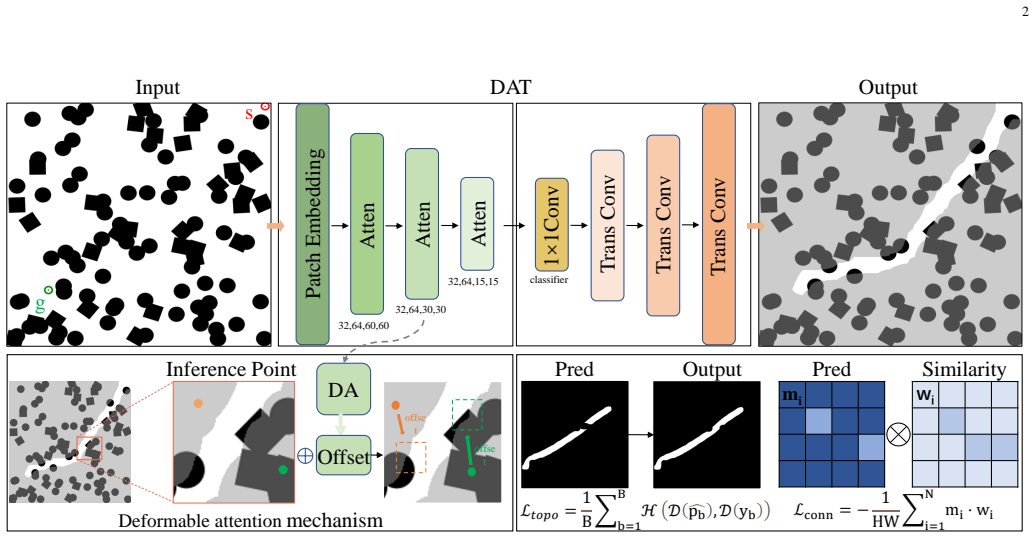
The Connectivity-Preserving Region Proposal Network (CP-RPN) uses a Deformable Attention Transformer for long-range dependencies and a composite loss with persistent homology to predict connected corridor-like regions that enable fast Voronoi path planning.
What would settle it
Running the system in a new environment and finding that the predicted region often excludes all paths from start to goal, forcing frequent use of the full A* fallback and increasing latency.
Extended reading notes
Core claim
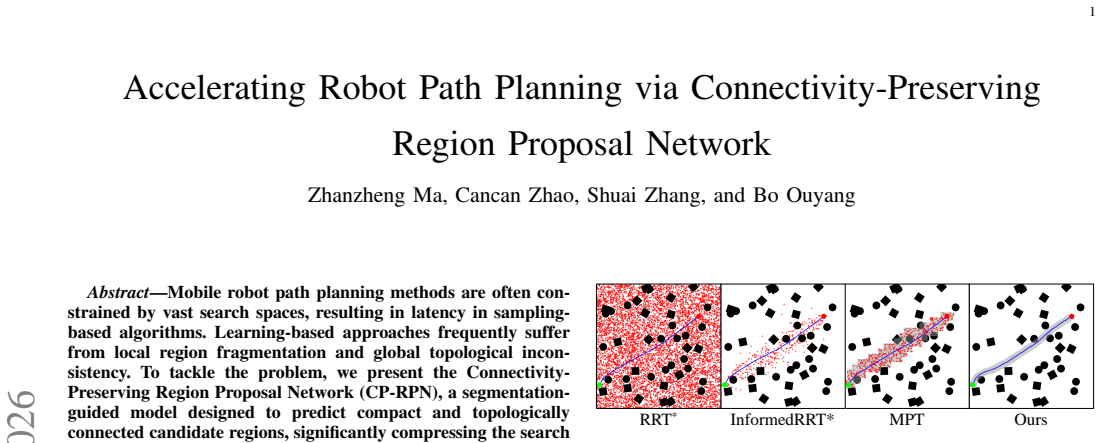
We present the Connectivity-Preserving Region Proposal Network (CP-RPN), a segmentation-guided model designed to predict compact and topologically connected candidate regions, significantly compressing the search space. Specifically, we design a segmentation model that leverages a Deformable Attention Transformer (DAT) to capture long-range dependencies for global connectivity, with a Deconvolutional decoder to preserve fine-grained spatial details. To guarantee the connectivity of the predicted mask, we design a composite loss function that combines Cross-Entropy loss for pixelwise supervision, a Connectivity-Aware loss to enhance local coherence, and a Topological Continuity loss based on
Load-bearing premise
The predicted masks will reliably contain feasible paths and preserve global topological connectivity so that the subsequent Voronoi planner succeeds without frequent fallback to full-space A*.
Editorial extensions
If this is right
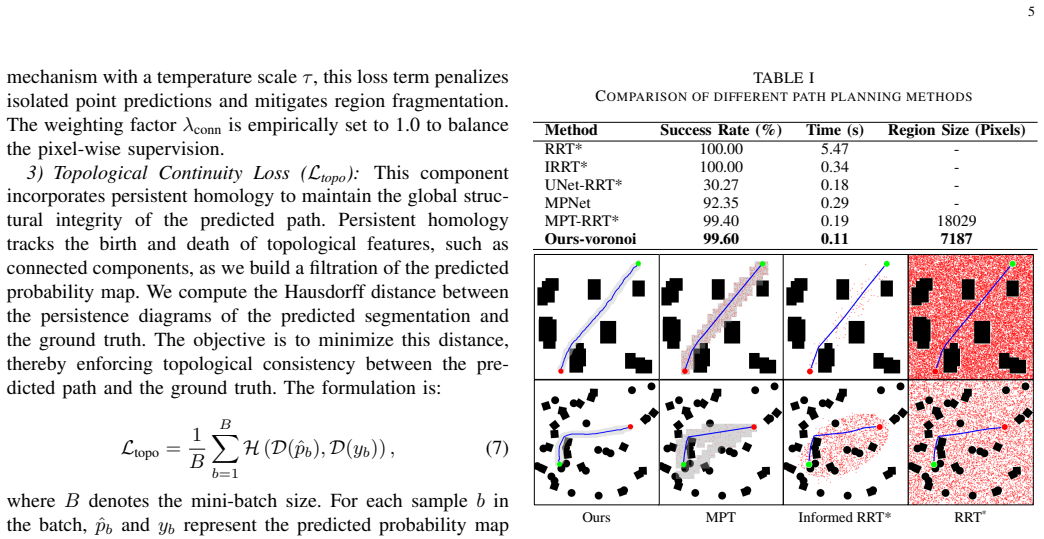
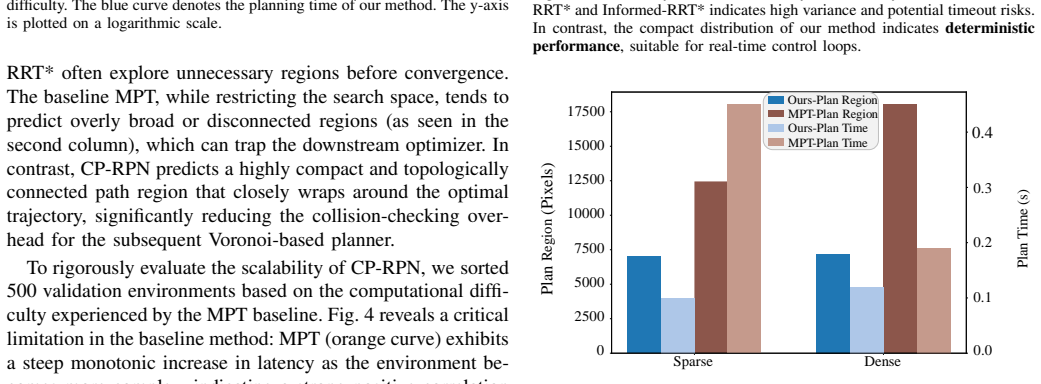
- Candidate region size is reduced by over 60.13% compared to the MPT baseline.
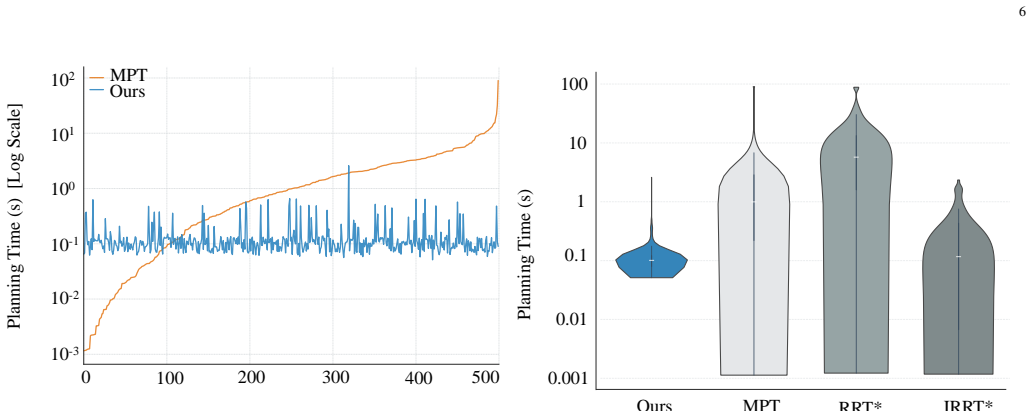
- Planning achieves deterministic low-latency with an average of 0.11 seconds.
- Success rate reaches 99.60% while providing better stability than traditional sampling-based algorithms.
- The high-connectivity regions allow the Voronoi planner to operate efficiently with occasional A* fallback.
Reading between the lines
- If the connectivity preservation holds, the method could support path planning in larger or more complex environments without proportional increase in computation.
- The separation of region prediction and path planning allows the network to be retrained for different map types independently of the planner.
- Persistent homology in the loss might be adaptable to ensure other topological properties in robotic perception tasks.
Signed reviews
Editorial analysis
A structured set of objections, weighed in public.
Referee Report
Summary. The paper introduces the Connectivity-Preserving Region Proposal Network (CP-RPN), a segmentation model that employs a Deformable Attention Transformer (DAT) encoder and Deconvolutional decoder to predict compact, topologically connected free-space regions for mobile robot path planning. A composite loss (cross-entropy + connectivity-aware + persistent-homology topological continuity) is used to train for local coherence and global connectivity. Paths are extracted via Voronoi diagram on the predicted mask, with a local A* fallback on the full space for robustness. The abstract reports that CP-RPN reduces candidate region size by over 60.13% relative to an MPT baseline while achieving 0.11 s average latency and 99.60% success rate.
Significance. If the performance numbers are shown to be reproducible with proper controls, the method could provide a practical learned prior for shrinking the search space of sampling-based planners while preserving topological connectivity, which is a recurring bottleneck in real-time navigation. The explicit use of persistent homology in the loss function is a technically interesting choice for enforcing global properties during training.
major comments (3)
- [Abstract] Abstract: The central quantitative claims (60.13% region-size reduction, 0.11 s average latency, 99.60% success rate) are presented without any reference to the test maps, number of trials, baseline implementation details, or statistical measures (standard deviation, confidence intervals). These omissions make it impossible to evaluate whether the reported gains are reliable or attributable to the proposed regions rather than the fallback mechanism.
- [Method] Method (loss function and inference): The composite loss supplies only a soft training signal; the manuscript does not describe any architectural constraint, post-processing step, or inference-time check that guarantees the predicted mask places the specific start and goal in the same connected component. Consequently, the frequency with which the Voronoi planner must fall back to full-space A* is unknown, rendering the latency and stability claims unverified.
- [Experiments] Experiments: No tables, figures, or text quantify fallback invocation rate, success rate conditioned on fallback usage, or region-size reduction per environment class. Without these breakdowns, it is impossible to determine whether the headline numbers derive from the CP-RPN masks or from the safety net.
minor comments (1)
- [Abstract] Abstract contains typographical issues: "Connectivity- Preserving" (extraneous space) and "highconnectivity" (missing hyphen).
Simulated Author's Rebuttal
We thank the referee for the constructive feedback, which highlights important aspects of reproducibility and evaluation. We address each major comment below and indicate where revisions will be made to strengthen the manuscript.
read point-by-point responses
-
Referee: [Abstract] Abstract: The central quantitative claims (60.13% region-size reduction, 0.11 s average latency, 99.60% success rate) are presented without any reference to the test maps, number of trials, baseline implementation details, or statistical measures (standard deviation, confidence intervals). These omissions make it impossible to evaluate whether the reported gains are reliable or attributable to the proposed regions rather than the fallback mechanism.
Authors: We agree that the abstract would benefit from additional context. In the revised manuscript, we will expand the abstract to reference the test environments (including number of maps and trials), note that baseline implementation details appear in Section 3, and indicate that standard deviations and confidence intervals are reported in the experimental results (Section 4). This will clarify the conditions under which the gains were measured. revision: yes
-
Referee: [Method] Method (loss function and inference): The composite loss supplies only a soft training signal; the manuscript does not describe any architectural constraint, post-processing step, or inference-time check that guarantees the predicted mask places the specific start and goal in the same connected component. Consequently, the frequency with which the Voronoi planner must fall back to full-space A* is unknown, rendering the latency and stability claims unverified.
Authors: The connectivity-aware loss and persistent-homology term provide a training signal for global connectivity, but we acknowledge these are soft constraints without an explicit inference-time guarantee. We will revise the method section to describe a lightweight post-processing connectivity check (via connected-component labeling on the predicted mask) between start and goal, and we will report the observed fallback frequency in the experiments. revision: yes
-
Referee: [Experiments] Experiments: No tables, figures, or text quantify fallback invocation rate, success rate conditioned on fallback usage, or region-size reduction per environment class. Without these breakdowns, it is impossible to determine whether the headline numbers derive from the CP-RPN masks or from the safety net.
Authors: We agree that such breakdowns would improve transparency. In the revised manuscript, we will add a new table (or extended figure) reporting fallback invocation rates, success rates conditioned on fallback usage, and region-size reduction stratified by environment class. This analysis will be performed on the existing evaluation set to isolate the contribution of the predicted regions. revision: yes
Circularity Check
No significant circularity; empirical claims rest on external baselines and measured metrics
full rationale
The paper describes a segmentation model (DAT + Deconv decoder) trained with a composite loss (CE + Connectivity-Aware + persistent-homology) and then evaluates it via direct comparison to an external MPT baseline on region size reduction, latency, and success rate. No equations, predictions, or first-principles results are presented that reduce by construction to the inputs or fitted parameters. The reported 60.13% reduction, 0.11 s latency, and 99.60% success are independent measured quantities, not tautological re-statements of the loss or architecture. Self-citations, if present, are not load-bearing for the central empirical claims.
Assumptions & free parameters
Cite this review
Pith. "Pith review of Accelerating Robot Path Planning via Connectivity-Preserving Region Proposal Network." pith.science (2026). https://pith.science/paper/RF3ICRD2
@misc{pith2026260528362,
  author       = {Pith},
  title        = {Pith review of: Accelerating Robot Path Planning via Connectivity-Preserving Region Proposal Network},
  year         = {2026},
  howpublished = {\url{https://pith.science/paper/RF3ICRD2}},
  note         = {Machine review of arXiv:2605.28362}
}
read the original abstract
Mobile robot path planning methods are often constrained by vast search spaces, resulting in latency in samplingbased algorithms. Learning-based approaches frequently suffer from local region fragmentation and global topological inconsistency. To tackle the problem, we present the Connectivity- Preserving Region Proposal Network (CP-RPN), a segmentationguided model designed to predict compact and topologically connected candidate regions, significantly compressing the search space. Specifically, we design a segmentation model that leverages a Deformable Attention Transformer (DAT) to capture long-range dependencies for global connectivity, with a Deconvolutional decoder to preserve fine-grained spatial details. To guarantee the connectivity of the predicted mask, we design a composite loss function that combines Cross-Entropy loss for pixelwise supervision, a Connectivity-Aware loss to enhance local coherence, and a Topological Continuity loss based on persistent homology to enforce global connectivity. Building on these highconnectivity corridor-like regions, the Voronoi diagram is used to plan the path, backed by a local A* fallback mechanism to ensure robustness. Experimental results demonstrate that CPRPN reduces the candidate region size by over 60.13% compared to the MPT baseline and achieves deterministic low-latency planning (avg. 0.11s) with a 99.60% success rate, outperforming traditional sampling-based algorithms in stability.
Figures
Figures from the paper (4 more)

Reference graph
Works this paper leans on
-
[1]
S. M. LaValle,Planning algorithms. Cambridge university press, 2006
2006
-
[2]
Sampling-based robot motion planning: A review,
M. Elbanhawi and M. Simi ´c, “Sampling-based robot motion planning: A review,”IEEE Access, vol. 2, pp. 56–77, 2014
2014
-
[3]
A formal basis for the heuristic determination of minimum cost paths,
P. E. Hart, N. J. Nilsson, and B. Raphael, “A formal basis for the heuristic determination of minimum cost paths,”IEEE transactions on Systems Science and Cybernetics, vol. 4, no. 2, pp. 100–107, 1968
1968
-
[4]
A note on two problems in connexion with graphs,
E. W. Dijkstra, “A note on two problems in connexion with graphs,” Numerische mathematik, vol. 1, no. 1, pp. 269–271, 1959
1959
-
[5]
Rapidly-exploring random trees : a new tool for path planning,
S. M. LaValle, “Rapidly-exploring random trees : a new tool for path planning,”The annual research report, 1998
1998
-
[6]
Prob- abilistic roadmaps for path planning in high-dimensional configuration spaces,
L. E. Kavraki, P. Svestka, J.-C. Latombe, and M. H. Overmars, “Prob- abilistic roadmaps for path planning in high-dimensional configuration spaces,”IEEE Transactions on robotics and automation, vol. 12, no. 4, pp. 566–580, 1996
1996
-
[7]
Chomp: Gradient optimization techniques for efficient motion planning,
N. D. Ratliff, M. Zucker, J. A. Bagnell, and S. S. Srinivasa, “Chomp: Gradient optimization techniques for efficient motion planning,”2009 IEEE International Conference on Robotics and Automation, pp. 489– 494, 2009
2009
-
[8]
Model predictive control: Theory and practice—a survey,
C. E. Garcia, D. M. Prett, and M. Morari, “Model predictive control: Theory and practice—a survey,”Automatica, vol. 25, no. 3, pp. 335–348, 1989. 8
1989
Show all 35 references
-
[9]
Neural rrt*: Learning-based optimal path planning,
J. Wang, W. Chi, C. Li, C. Wang, and M. Q. Meng, “Neural rrt*: Learning-based optimal path planning,”IEEE Transactions on Automa- tion Science and Engineering, vol. 17, pp. 1748–1758, 2020
2020
-
[10]
Path planning using neural a* search,
R. Yonetani, T. Taniai, M. Barekatain, M. Nishimura, and A. Kanezaki, “Path planning using neural a* search,” 2021
2021
-
[11]
Motion planning networks,
A. H. Qureshi, M. J. Bency, and M. C. Yip, “Motion planning networks,” 2019 International Conference on Robotics and Automation (ICRA), pp. 2118–2124, 2018
2019
-
[12]
A survey on deep learning for robot navigation,
R. J. Sanchez-Garcia, R. J. Lopez-Sastre, and S. T. Puente, “A survey on deep learning for robot navigation,”Artificial Intelligence Review, vol. 54, no. 8, pp. 5769–5823, 2021
2021
-
[13]
Motion planning transformers: One model to plan them all,
J. J. Johnson, L. Li, A. Qureshi, and M. C. Yip, “Motion planning transformers: One model to plan them all,” 2021
2021
-
[14]
Attention is all you need,
A. Vaswani, N. M. Shazeer, N. Parmar, J. Uszkoreit, L. Jones, A. N. Gomez, L. Kaiser, and I. Polosukhin, “Attention is all you need,” in Neural Information Processing Systems, 2017
2017
-
[15]
U-net: Convolutional networks for biomedical image segmentation,
O. Ronneberger, P. Fischer, and T. Brox, “U-net: Convolutional networks for biomedical image segmentation,” inInternational Conference on Medical image computing and computer-assisted intervention. Springer, 2015, pp. 234–241
2015
-
[16]
Vision transformer with deformable attention,
Z. Xia, X. Pan, S. Song, L. Li, and G. Huang, “Vision transformer with deformable attention,” inProceedings of the IEEE/CVF conference on computer vision and pattern recognition, 2022, pp. 589–598
2022
-
[17]
Learning deconvolution network for semantic segmentation,
H. Noh, S. Hong, and B. Han, “Learning deconvolution network for semantic segmentation,” in2015 IEEE International Conference on Computer Vision (ICCV), 2015, pp. 1520–1528
2015
-
[18]
Sensor based motion planning: the hierarchical generalized voronoi graph,
H. Choset, “Sensor based motion planning: the hierarchical generalized voronoi graph,” 1996
1996
-
[19]
Computational topology: An introduc- tion,
H. Edelsbrunner and J. Harer, “Computational topology: An introduc- tion,” 2009
2009
-
[20]
Dynamic snake convo- lution based on topological geometric constraints for tubular structure segmentation,
Y . Qi, Y . He, X. Qi, Y . Zhang, and G. Yang, “Dynamic snake convo- lution based on topological geometric constraints for tubular structure segmentation,”2023 IEEE/CVF International Conference on Computer Vision (ICCV), pp. 6047–6056, 2023
2023
-
[21]
Topology-preserving deep image segmentation,
X. Hu, F. Li, D. Samaras, and C. Chen, “Topology-preserving deep image segmentation,”ArXiv, vol. abs/1906.05404, 2019
1906 arXiv
-
[22]
Sampling-based algorithms for optimal motion planning,
S. Karaman and E. Frazzoli, “Sampling-based algorithms for optimal motion planning,”The International Journal of Robotics Research, vol. 30, pp. 846 – 894, 2011
2011
-
[23]
Informed RRT*: Optimal sampling-based path planning focused via direct sampling of an admissible ellipsoidal heuristic,
J. D. Gammell, S. S. Srinivasa, and T. D. Barfoot, “Informed RRT*: Optimal sampling-based path planning focused via direct sampling of an admissible ellipsoidal heuristic,” in2014 IEEE/RSJ International Conference on Intelligent Robots and Systems. IEEE, 2014, pp. 4298– 4305
2014
-
[24]
Learning sampling distributions for robot motion planning,
B. Ichter, J. Harrison, and M. Pavone, “Learning sampling distributions for robot motion planning,”2018 IEEE International Conference on Robotics and Automation (ICRA), pp. 7087–7094, 2017
2018
-
[25]
Fully convolutional networks for semantic segmentation,
E. Shelhamer, J. Long, and T. Darrell, “Fully convolutional networks for semantic segmentation,”2015 IEEE Conference on Computer Vision and Pattern Recognition (CVPR), pp. 3431–3440, 2014
2015
-
[26]
An image is worth 16x16 words: Trans- formers for image recognition at scale,
A. Dosovitskiy, L. Beyer, A. Kolesnikov, D. Weissenborn, X. Zhai, T. Unterthiner, M. Dehghani, M. Minderer, G. Heigold, S. Gelly, J. Uszkoreit, and N. Houlsby, “An image is worth 16x16 words: Trans- formers for image recognition at scale,”ArXiv, vol. abs/2010.11929, 2020
2010 arXiv
-
[27]
Swin transformer: Hierarchical vision transformer using shifted win- dows,
Z. Liu, Y . Lin, Y . Cao, H. Hu, Y . Wei, Z. Zhang, S. Lin, and B. Guo, “Swin transformer: Hierarchical vision transformer using shifted win- dows,”2021 IEEE/CVF International Conference on Computer Vision (ICCV), pp. 9992–10 002, 2021
2021
-
[28]
Segformer: Simple and efficient design for semantic segmentation with transformers,
E. Xie, W. Wang, Z. Yu, A. Anandkumar, J. M. ´Alvarez, and P. Luo, “Segformer: Simple and efficient design for semantic segmentation with transformers,” inNeural Information Processing Systems, 2021
2021
-
[29]
The perceptron: a probabilistic model for information storage and organization in the brain
F. Rosenblatt, “The perceptron: a probabilistic model for information storage and organization in the brain.”Psychological review, vol. 65, no. 6, p. 386, 1958
1958
-
[30]
V-net: Fully convolutional neural networks for volumetric medical image segmentation,
F. Milletar `ı, N. Navab, and S.-A. Ahmadi, “V-net: Fully convolutional neural networks for volumetric medical image segmentation,”2016 Fourth International Conference on 3D Vision (3DV), pp. 565–571, 2016
2016
-
[31]
Deep grabcut for object selection,
N. Xu, B. L. Price, S. D. Cohen, J. Yang, and T. S. Huang, “Deep grabcut for object selection,”ArXiv, vol. abs/1707.00243, 2017
2017 arXiv
-
[32]
Beyond the pixel-wise loss for topology-aware delineation,
A. Mosinska, P. M ´arquez-Neila, M. Kozi ´nski, and P. Fua, “Beyond the pixel-wise loss for topology-aware delineation,”2018 IEEE/CVF Conference on Computer Vision and Pattern Recognition, pp. 3136– 3145, 2017
2018
-
[33]
Goodfellow, Y
I. Goodfellow, Y . Bengio, and A. Courville,Deep learning. MIT press, 2016
2016
-
[34]
Adam: A method for stochastic optimization,
D. P. Kingma and J. Ba, “Adam: A method for stochastic optimization,” CoRR, vol. abs/1412.6980, 2014
2014 arXiv
-
[35]
Decoupled weight decay regularization,
I. Loshchilov and F. Hutter, “Decoupled weight decay regularization,” inInternational Conference on Learning Representations, 2017
2017
Reviewed June 29, 2026 · model on record in the stance chip above.
Discussion (0). Continue with ORCID to comment.