Dynamic masking for boundary-aware velocity reconstruction in volumetric particle tracking with moving solids
Pith reviewed 2026-06-25 20:18 UTC · model grok-4.3
The pith
Dynamic masking with a time-dependent signed-distance function enforces prescribed surface velocities on moving solids during particle-track velocity reconstruction.
A machine-rendered reading of the paper's core claim, the machinery that carries it, and where it could break.
Core claim
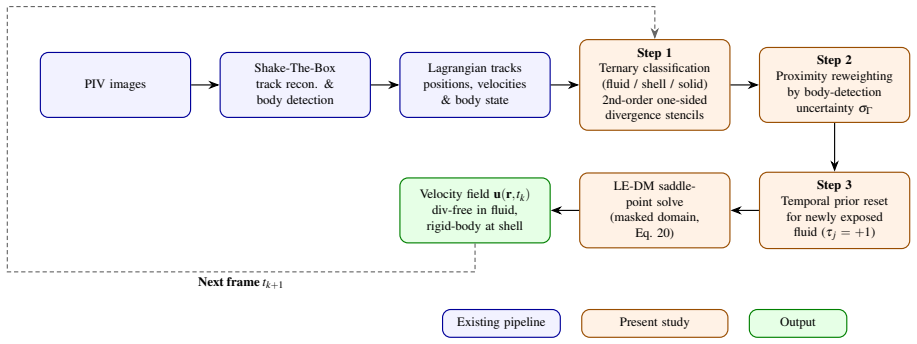
By classifying grid nodes as open fluid, boundary shell, or solid interior with a time-dependent signed-distance function, the method solves for a divergence-free velocity field on the masked domain that incorporates the particle data, incompressibility, prescribed surface velocity, and regularization in one step; this enforces surface kinematics to solver tolerance while the bulk reconstruction remains unchanged where no body is present.
What carries the argument
The time-dependent signed-distance function that classifies grid nodes and enables assembly of all constraints and data on the masked domain within a single solve.
If this is right
- Surface kinematics are enforced to solver tolerance.
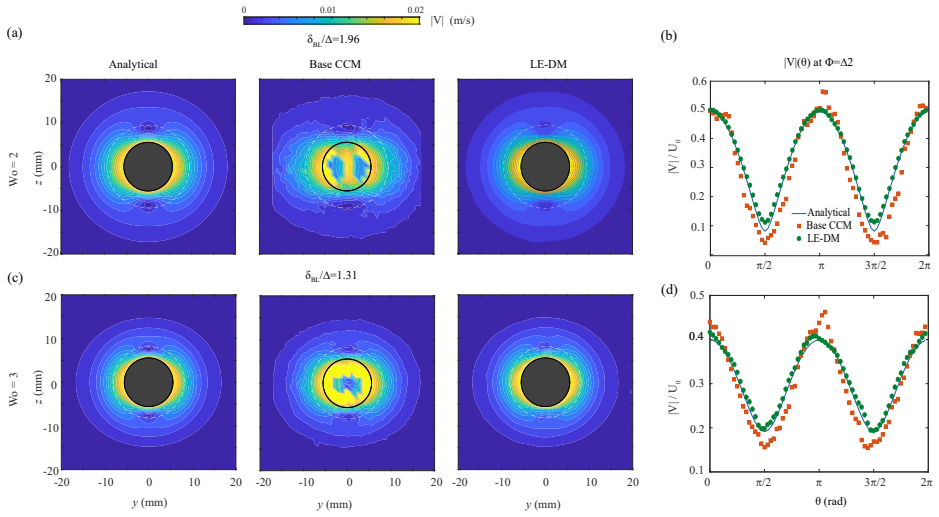
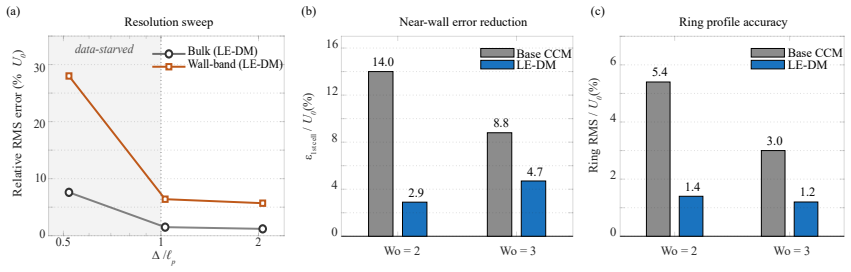
- In the analytical oscillating-sphere case the first-cell error drops from 14 percent to 3 percent of the body speed.
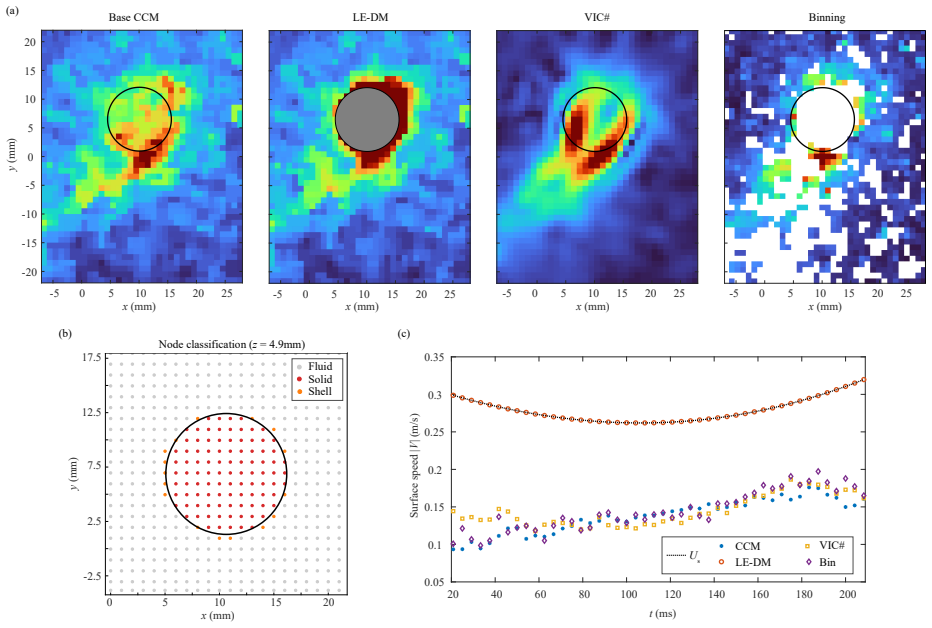
- In the refractive-index-matched experiment the method recovers the independently measured surface velocity while an all-fluid reconstruction does not.
- The same formulation represents stationary walls, translating bodies, rotating bodies, multiple bodies, and deforming bodies.
- The output velocity field is divergence-free and boundary-consistent and can be used directly for pressure and force estimation.
Where Pith is reading between the lines
- The single-solve structure may allow the method to be inserted into existing PTV processing chains with minimal changes to downstream pressure or force calculations.
- The masking approach could be tested on freely deforming bodies to determine whether shape changes require any additional terms beyond the signed-distance update.
- Similar node-classification logic might apply to other reconstruction tasks that involve sharp interfaces, such as free-surface flows.
Load-bearing premise
A time-dependent signed-distance function can classify grid nodes as open fluid, boundary shell, or solid interior such that particle data, incompressibility, prescribed surface velocity, and regularization assemble on the masked domain in a single solve without artifacts or inconsistencies.
What would settle it
A controlled test on synthetic tracks from a CFD simulation of a known moving sphere in which the reconstructed velocity immediately outside the surface deviates by more than a few percent of the body speed rather than matching the prescribed value to solver tolerance.
Figures
read the original abstract
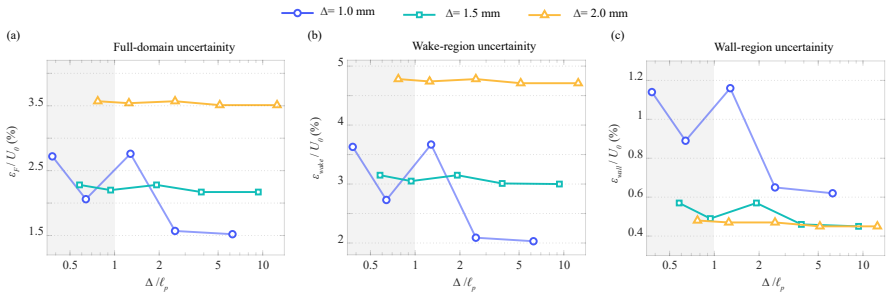
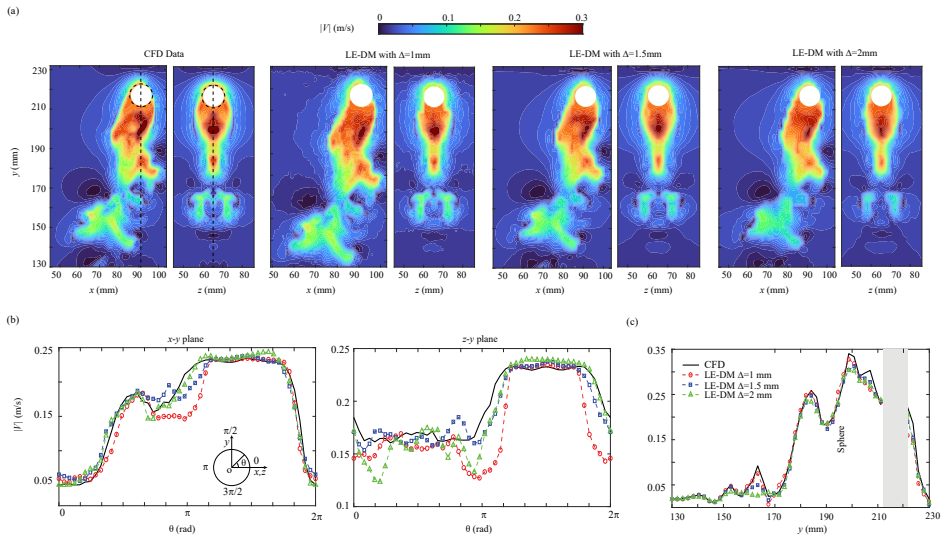
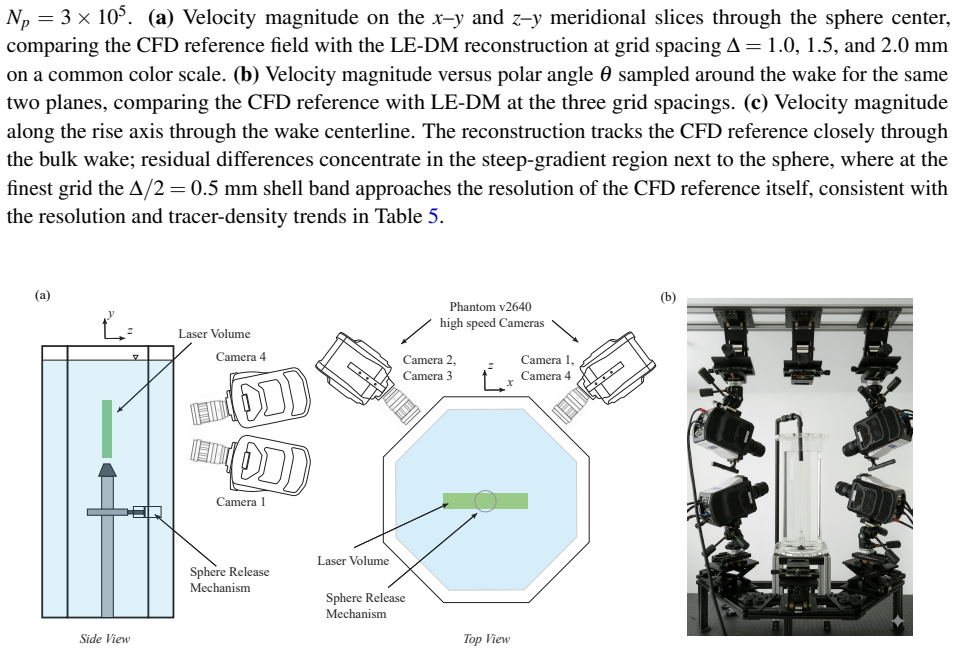
Volumetric particle tracking velocimetry (PTV) produces scattered Lagrangian tracks that must be reconstructed on an Eulerian grid before velocity gradients, pressure, or hydrodynamic loads can be evaluated. This step is usually performed on a domain treated as entirely fluid. When a solid body lies within the measurement volume, its surface kinematics are not imposed and the reconstruction is weakest in the steep-gradient region next to the body. We introduce LE-DM (Lagrangian-to-Eulerian reconstruction with Dynamic Masking), a constrained reconstruction framework for moving solid boundaries. A time-dependent signed-distance function classifies grid nodes as open fluid, boundary shell, or solid interior. The particle data, incompressibility constraint, prescribed surface velocity, and regularization terms are then assembled on the masked domain within a single solve. The method requires only a signed-distance field and a surface velocity, allowing stationary walls, translating, rotating, multiple, and deforming bodies to be represented in the same formulation. LE-DM is assessed using an analytical oscillating sphere, synthetic tracks from a CFD rising-sphere simulation, and a refractive-index-matched tomographic-PTV experiment on a freely rising sphere. The surface kinematics are enforced to solver tolerance, while the bulk reconstruction remains unchanged where no body is present. In the analytical case, the first-cell error is reduced from 14\% to 3\% of the body speed. In the experiment, LE-DM recovers the independently measured surface velocity, whereas an all-fluid reconstruction does not. The result is a divergence-free, boundary-consistent velocity field for pressure and force estimation.
Editorial analysis
A structured set of objections, weighed in public.
Referee Report
Summary. The manuscript introduces LE-DM, a constrained Lagrangian-to-Eulerian velocity reconstruction for volumetric PTV in domains containing moving solids. A time-dependent signed-distance function partitions grid nodes into open fluid, boundary shell, and solid interior; particle data, the incompressibility constraint, prescribed surface velocity, and regularization are then assembled on the masked domain in a single solve. The approach is claimed to enforce surface kinematics to solver tolerance while leaving the bulk field unchanged away from the body. Validation comprises an analytical oscillating sphere (first-cell error reduced from 14% to 3% of body speed), synthetic tracks from a CFD rising-sphere simulation, and a refractive-index-matched tomographic-PTV experiment on a freely rising sphere, where LE-DM recovers independently measured surface velocity unlike an all-fluid reconstruction.
Significance. If the central construction holds, the method supplies a practical, general-purpose route to divergence-free, boundary-consistent velocity fields for pressure and force estimation in fluid-structure interaction experiments. The reported quantitative improvement near the surface and the experimental confirmation of surface-velocity recovery are concrete strengths; the formulation's claimed independence from body-specific code (only SDF and surface velocity required) would also be a practical advantage.
minor comments (2)
- [Abstract] The abstract states that surface kinematics are enforced 'to solver tolerance,' but the manuscript does not specify the solver tolerance value, the precise form of the surface-velocity constraint, or how it is assembled with the divergence-free condition; a short methods subsection or equation block would clarify this.
- [Abstract] The claim that the bulk reconstruction 'remains unchanged where no body is present' is central but is only asserted; a direct side-by-side comparison (e.g., difference field or L2 norm away from the body) between LE-DM and the all-fluid solver on the same particle data would strengthen the statement.
Simulated Author's Rebuttal
We thank the referee for the positive assessment of LE-DM and for highlighting its practical advantages for boundary-consistent velocity reconstruction. The recommendation for minor revision is noted and will be followed. No major comments were listed in the report.
Circularity Check
No significant circularity; method assembles external constraints directly
full rationale
The paper presents LE-DM as a direct assembly of particle data, incompressibility, prescribed surface velocity, and regularization terms on a domain partitioned by an external time-dependent signed-distance function. No derivation step reduces a claimed result to a fitted parameter, self-citation, or input by construction; the surface enforcement and bulk preservation follow from standard constrained least-squares on the masked grid. The quantitative claims (error reduction, experimental recovery) are presented as outcomes of this assembly rather than inputs. The approach is self-contained against external benchmarks with no load-bearing self-referential steps.
Axiom & Free-Parameter Ledger
free parameters (1)
- regularization parameters
axioms (2)
- domain assumption Incompressibility constraint holds throughout the open fluid domain.
- domain assumption Signed-distance function and surface velocity are available and accurate for the moving body.
Reference graph
Works this paper leans on
-
[1]
Deepak Adhikari and Ellen K. Longmire. Visual hull method for tomographic PIV measurement of flow around moving objects. Experiments in Fluids, 53 0 (4): 0 943--964, 2012. doi:10.1007/s00348-012-1338-9
-
[2]
Karuna Agarwal, Omri Ram, Jin Wang, Yuhui Lu, and Joseph Katz. Reconstructing velocity and pressure from noisy sparse particle tracks using constrained cost minimization. Experiments in Fluids, 62 0 (4): 0 75, 2021. doi:10.1007/s00348-021-03172-0
-
[3]
Path oscillations and enhanced drag of light rising spheres
Franck Auguste and Jacques Magnaudet. Path oscillations and enhanced drag of light rising spheres. Journal of Fluid Mechanics, 841: 0 228--266, 2018. doi:10.1017/jfm.2018.100
-
[4]
On the refractive index of sodium iodide solutions for index matching in PIV
Hui Bai and Joseph Katz. On the refractive index of sodium iodide solutions for index matching in PIV . Experiments in Fluids, 55 0 (4): 0 1704, 2014. doi:10.1007/s00348-014-1704-x
-
[5]
Michele Benzi, Gene H. Golub, and J \"o rg Liesen. Numerical solution of saddle point problems. Acta Numerica, 14: 0 1--137, 2005. doi:10.1017/S0962492904000212
-
[6]
Momentum transfer of a boltzmann-lattice fluid with boundaries
M'hamed Bouzidi, Mouaouia Firdaouss, and Pierre Lallemand. Momentum transfer of a boltzmann-lattice fluid with boundaries. Physics of Fluids, 13 0 (11): 0 3452--3459, 2001. doi:10.1063/1.1399290
-
[7]
C ak r, Gabriel Gonzalez Saiz, Andrea Sciacchitano, and Bas W
Bora O. C ak r, Gabriel Gonzalez Saiz, Andrea Sciacchitano, and Bas W. van Oudheusden. Dense interpolations of LPT data in the presence of generic solid objects. Measurement Science and Technology, 33 0 (12): 0 124009, 2022. doi:10.1088/1361-6501/ac8ec7
-
[8]
Zaki, Charles Meneveau, and Joseph Katz
Patricio Clark Di Leoni, Karuna Agarwal, Tamer A. Zaki, Charles Meneveau, and Joseph Katz. Reconstructing turbulent velocity and pressure fields from under-resolved noisy particle tracks using physics-informed neural networks. Experiments in Fluids, 64 0 (5): 0 95, 2023. doi:10.1007/s00348-023-03629-4
-
[9]
Elsinga, Fulvio Scarano, Bernhard Wieneke, and Bas W
Gerrit E. Elsinga, Fulvio Scarano, Bernhard Wieneke, and Bas W. van Oudheusden. Tomographic particle image velocimetry. Experiments in Fluids, 41 0 (6): 0 933--947, 2006. doi:10.1007/s00348-006-0212-z
-
[10]
From Particle Tracks to Velocity and Acceleration Fields Using B-Splines and Penalties
Sebastian Gesemann. From particle tracks to velocity and acceleration fields using b-splines and penalties. arXiv preprint arXiv:1510.09034, 2015. doi:https://doi.org/10.48550/arXiv.1510.09034
work page internal anchor Pith review Pith/arXiv arXiv doi:10.48550/arxiv.1510.09034 2015
-
[11]
FlowFit3 : Efficient data assimilation of LPT measurements
Philipp Godbersen, Sebastian Gesemann, Daniel Schanz, and Andreas Schr "o der. FlowFit3 : Efficient data assimilation of LPT measurements. In Proceedings of the 21st International Symposium on the Application of Laser and Imaging Techniques to Fluid Mechanics, Lisbon, Portugal, 2024. doi:https://doi.org/10.55037/lxlaser.21st.216
-
[12]
Discrete lattice effects on the forcing term in the lattice boltzmann method
Zhaoli Guo, Chuguang Zheng, and Baochang Shi. Discrete lattice effects on the forcing term in the lattice boltzmann method. Physical Review E, 65 0 (4): 0 046308, 2002. doi:10.1103/PhysRevE.65.046308
-
[13]
Michael Horowitz and Charles H. K. Williamson. The effect of reynolds number on the dynamics and wakes of freely rising and falling spheres. Journal of Fluid Mechanics, 651: 0 251--294, 2010. doi:10.1017/S0022112009993934
-
[14]
Advanced iterative particle reconstruction for Lagrangian particle tracking
Tobias Jahn, Daniel Schanz, and Andreas Schr "o der. Advanced iterative particle reconstruction for Lagrangian particle tracking. Experiments in Fluids, 62 0 (8): 0 179, 2021. doi:10.1007/s00348-021-03276-7
-
[15]
Young Jin Jeon, Marius M \"u ller, and Dirk Michaelis. Fine scale reconstruction ( VIC\# ) by implementing additional constraints and coarse-grid approximation into VIC+ . Experiments in Fluids, 63 0 (4): 0 70, 2022. doi:10.1007/s00348-022-03422-9
-
[16]
On the application of refractive index matching to study the buoyancy-driven motion of spheres
Jibu Tom Jose, Aviel Ben-Harosh, and Omri Ram. On the application of refractive index matching to study the buoyancy-driven motion of spheres. International Journal of Multiphase Flow, page 105597, 2026. doi:https://doi.org/10.1016/j.ijmultiphaseflow.2025.105597
-
[17]
Sangtae Kim and Seppo J. Karrila. Microhydrodynamics: Principles and Selected Applications. Butterworth-Heinemann, Boston, 1991
1991
-
[18]
L. D. Landau and E. M. Lifshitz. Fluid Mechanics, volume 6 of Course of Theoretical Physics. Butterworth-Heinemann, Oxford, 2nd edition, 1987. Section 24: Oscillatory motion in a viscous fluid
1987
-
[19]
Lattice boltzmann method with regularized pre-collision distribution functions
Jonas Latt and Bastien Chopard. Lattice boltzmann method with regularized pre-collision distribution functions. Mathematics and Computers in Simulation, 72 0 (2--6): 0 165--168, 2006. doi:10.1016/j.matcom.2006.05.017
-
[20]
Lanyu Li and Zhao Pan. Three-dimensional time-resolved Lagrangian flow field reconstruction based on constrained least squares and stable radial basis function. Experiments in Fluids, 65 0 (4): 0 57, 2024. doi:10.1007/s00348-024-03788-y
-
[21]
Instantaneous pressure and material acceleration measurements using a four-exposure PIV system
Xiaofeng Liu and Joseph Katz. Instantaneous pressure and material acceleration measurements using a four-exposure PIV system. Experiments in Fluids, 41 0 (2): 0 227--240, 2006. doi:10.1007/s00348-006-0152-7
-
[22]
Francesco Mainardi, Pietro Pironi, and Francesco Tampieri. The analytic solution of Stokes for time-dependent creeping flow around a sphere: Application to linear viscoelasticity as an ingredient for the generalized Stokes -- Einstein relation and microrheology analysis. Journal of Non-Newtonian Fluid Mechanics, 183--184: 0 53--64, 2012. doi:10.1016/j.jnn...
-
[23]
R Mittal and G Iaccarino. Immersed boundary methods. Annual Review of Fluid Mechanics, 37: 0 239--261, 2005. doi:https://doi.org/10.1146/annurev.fluid.37.061903.175743
-
[24]
Journal of Computational Physics , volume =
R Mittal, H Dong, M Bozkurttas, F M Najjar, A Vargas, and A von Loebbecke. A versatile sharp interface immersed boundary method for incompressible flows with complex boundaries. Journal of Computational Physics, 227 0 (10): 0 4825--4852, 2008. doi:https://doi.org/10.1016/j.jcp.2008.01.028
-
[25]
Nathan J. Neeteson and David E. Rival. Pressure-field extraction on unstructured flow data using a Voronoi tessellation-based networking algorithm: a proof-of-principle study. Experiments in Fluids, 56 0 (2): 0 44, 2015. doi:10.1007/s00348-015-1911-0
-
[26]
Fulvio Scarano, Jan F. G. Schneiders, Gabriel Gonzalez Saiz, and Andrea Sciacchitano. Dense velocity reconstruction with VIC -based time-segment assimilation. Experiments in Fluids, 63 0 (6): 0 96, 2022. doi:10.1007/s00348-022-03437-2
-
[27]
Daniel Schanz, Sebastian Gesemann, and Andreas Schr \"o der. Shake- T he- B ox: L agrangian particle tracking at high particle image densities. Experiments in Fluids, 57 0 (5): 0 70, 2016. doi:10.1007/s00348-016-2157-1
-
[28]
Jan F. G. Schneiders and Fulvio Scarano. Dense velocity reconstruction from tomographic PTV with material derivatives. Experiments in Fluids, 57 0 (9): 0 139, 2016. doi:10.1007/s00348-016-2225-6
-
[29]
3D Lagrangian particle tracking in fluid mechanics
Andreas Schr "o der and Daniel Schanz. 3D Lagrangian particle tracking in fluid mechanics. Annual Review of Fluid Mechanics, 55 0 (1): 0 511--540, 2023. doi:10.1146/annurev-fluid-031822-041721
-
[30]
On the accuracy of data assimilation algorithms for dense flow field reconstructions
Andrea Sciacchitano, Benjamin Leclaire, and Andreas Schr "o der. On the accuracy of data assimilation algorithms for dense flow field reconstructions. Experiments in Fluids, 66: 0 42, 2025. doi:10.1007/s00348-025-03969-3
-
[31]
James A. Sethian. Level Set Methods and Fast Marching Methods. Cambridge University Press, Cambridge, 1999
1999
-
[32]
Jian Sheng, Edwin Malkiel, and Joseph Katz. Using digital holographic microscopy for simultaneous measurements of 3D near wall velocity and wall shear stress in a turbulent boundary layer. Experiments in Fluids, 45 0 (6): 0 1023--1035, 2008. doi:10.1007/s00348-008-0524-2
-
[33]
Pietro Sperotto, Sandra Pieraccini, and Miguel A. Mendez. A meshless method to compute pressure fields from image velocimetry. Measurement Science and Technology, 33 0 (9): 0 094005, 2022. doi:10.1088/1361-6501/ac70a9
-
[34]
Pietro Sperotto, Manuel Ratz, and Miguel A. Mendez. SPICY : a Python toolbox for meshless assimilation from image velocimetry using radial basis functions. Journal of Open Source Software, 9 0 (93): 0 5749, 2024. doi:10.21105/joss.05749
-
[35]
van Gent , Dirk Michaelis, Bas W
Paul L. van Gent , Dirk Michaelis, Bas W. van Oudheusden , Pierre- \'E mile Weiss, Roeland de Kat , Angeliki Laskari, Young Jin Jeon, Laurent David, Daniel Schanz, Florian Huhn, and Sebastian Gesemann. Comparative assessment of pressure field reconstructions from particle image velocimetry measurements and L agrangian particle tracking. Experiments in Flu...
-
[36]
Motion and wake structure of spherical particles
Christian Veldhuis, Arie Biesheuvel, Leen van Wijngaarden, and Detlef Lohse. Motion and wake structure of spherical particles. Nonlinearity, 18 0 (1): 0 C1--C8, 2004. doi:10.1088/0951-7715/18/1/000
-
[37]
Jin Wang, Chi Zhang, and Joseph Katz. GPU -based, parallel-line, omni-directional integration of measured pressure gradient field to obtain the 3D pressure distribution. Experiments in Fluids, 60 0 (4): 0 58, 2019. doi:10.1007/s00348-019-2700-y
-
[38]
Lagrangian particle tracking in the presence of obstructing objects
B Wieneke and T Rockstroh. Lagrangian particle tracking in the presence of obstructing objects. Measurement Science and Technology, 35 0 (5): 0 055303, 2024. doi:10.1088/1361-6501/ad289d
-
[39]
Volume self-calibration for 3d particle image velocimetry
Bernhard Wieneke. Volume self-calibration for 3d particle image velocimetry. Experiments in Fluids, 45 0 (4): 0 549--556, 2008. doi:10.1007/s00348-008-0521-5
-
[40]
Iterative reconstruction of volumetric particle distribution
Bernhard Wieneke. Iterative reconstruction of volumetric particle distribution. Measurement Science and Technology, 24 0 (2): 0 024008, 2013. doi:10.1088/0957-0233/24/2/024008
-
[41]
Ke Zhou, Samuel J. Grauer, Daniel Schanz, Philipp Godbersen, Andreas Schr "o der, Thomas Rockstroh, Yong Joo Jeon, and Bernhard Wieneke. Benchmarking data assimilation algorithms for 3D Lagrangian particle tracking. In Proceedings of the 21st International Symposium on the Application of Laser and Imaging Techniques to Fluid Mechanics, Lisbon, Portugal, 2...
discussion (0)
Sign in with ORCID, Apple, or X to comment. Anyone can read and Pith papers without signing in.