REVIEW 5 major objections 6 minor 64 references
S\"{o}ze: One Network Telemetry Is All You Need for Per-flow Weighted Bandwidth Allocation at Scale
T0 review · 5 major / 6 minor · reviewed 2026-08-07 · deepseek-v4-flash
Pith's one-line read One telemetry value per packet can steer every flow to its weighted fair share of bandwidth, with no per-flow, topology, or routing knowledge.
desk verdict A genuinely new single-signal mechanism for decentralized weighted fair allocation, with a real prototype, but the multi-hop convergence proof only holds at the fixed point and the transient dynamics are unanalyzed. read the letter →
The pith
A machine-rendered reading of the paper's core claim, the machinery that carries it, and where it could break.
The reading
What carries the argument
The engine of the design is the pair of functions $(T, U)$ plus the maxQD signal. $T(r/w) = p \cdot \frac{\ln(\alpha) - \ln(r/w)}{\ln(\alpha) - \ln(\beta)} + k$ is the target function: it assigns a queueing delay target to each flow's rate-per-weight and is strictly decreasing, so a higher rate-per-weight corresponds to a smaller target delay. $U(x, D) = \left( T^{-1}(D)/x \right)^{m}$ is the update function: each flow multiplies its current rate by the ratio $U$ once per RTT, and the parameter $m$ controls convergence speed versus oscillation. The signal is maxQD, the maximum per-hop queueing delay carried in a two-byte header field and echoed back in ACKs; the paper argues this single number identifies the bottleneck hop and encodes the fair share at that hop. The proof structure is three lemmas: single-link fairness converges iff $0 < m < 2$; single-link queueing delay converges to target iff $p > \Delta t/2 \cdot[\ln(\alpha) - \ln(\beta)]$; and at the converged allocation the bottleneck hop has the largest rate-per-weight and therefore the highest queueing delay, so maxQD comes from the bottleneck.
What would settle it
Take a two-hop path where a flow is bottlenecked at the second hop, and create a strong transient burst on the first hop so the first hop's queueing delay exceeds the second hop's; if Söze's senders react to that non-bottleneck signal and rates move away from weighted max-min fairness, the bottleneck-signal premise fails. Concretely, a packet-level simulation or a small testbed experiment with a heavy background flow on hop one and the bottleneck flow on hop two, recording whether maxQD tracks the true bottleneck before convergence, would settle it.
Extended reading notes
Core claim
The core claim is Theorem 3.1: for every flow in an arbitrary network, Söze converges to a weighted max-min fair allocation if and only if $0 < m < 2$ in the update function and $p > \Delta t/2 \cdot[\ln(\alpha) - \ln(\beta)]$ in the target function. Söze encodes the network's fair share as a queueing delay: each flow's rate per unit weight is mapped by a monotonically decreasing target function $T(r/w)$ to a target delay, and the sender updates its rate multiplicatively by $U = (T^{-1}(D)/(r/w))^{m}$, where $D$ is the observed maxQD. The system claims that maxQD always comes from the flow's bottleneck hop, because at the weighted max-min fair allocation a flow has the largest rate-per-weight only on its bottleneck hop, and the target function makes larger rate-per-weight correspond to smaller queueing delay. Since every flow bottlenecked at the same hop observes the same maxQD and reacts to the same implied fair share, the hop coordinates the flows sharing it; applying the single-link result hop by hop yields network-wide weighted max-min fairness.
Load-bearing premise
The entire multi-hop guarantee rests on the claim that the maximum queueing delay a flow sees always comes from its bottleneck hop, and that claim is argued only at the converged fixed point, leaving the transient dynamics of coupled queues unproven; the target function also presupposes that $\alpha$ and $\beta$ bracket the actual rate-per-weight range.
Editorial extensions
If this is right
- Söze turns weighted allocation into a host-side rate-control problem: only a two-byte telemetry field and a per-sender weight are needed, so non-integer weights and instant weight changes are supported without switch scheduling changes.
- If the theorem holds, the same decentralized rule yields network-wide weighted max-min fairness in arbitrary topologies, not just single links or simple trees.
- The paper's measurements indicate convergence in roughly ten RTTs and per-flow rates that track weight changes at five-per-mille increments, which would let applications reprioritize flows dynamically, for example for critical-path acceleration or straggler mitigation.
- Because senders need no topology or routing information, deployment is incremental at the host and transport layer; the switch only needs to stamp and compare queueing delays, which the paper implements in nine lines of code on a programmable switch.
- Weighted allocation of this kind can serve as a building block for job-level scheduling: the TPC-H evaluation reports up to 0.59x and 0.79x job completion time under the paper's weight policy.
Reading between the lines
- The paper proves the bottleneck-signal property at the converged fixed point; a natural next check is transient behavior, such as simulating Söze from adversarial initial rate distributions to see whether maxQD still tracks the true bottleneck before convergence.
- Nothing in the design limits the telemetry to queueing delay; if the target function is reparameterized, the same update rule should work with link utilization or ECN marking ratio, which the paper itself flags as future work and which could be tested directly.
- The parameters $\alpha$ and $\beta$ bracket the expected rate-per-weight range, which is arguably a piece of global traffic information; deriving these bounds online from each link's observed arrivals would make the scheme fully parameter-free and is an obvious next extension.
- Because every flow reacts to the same maxQD value, flows that share no bottleneck may still couple indirectly through transient queueing on common non-bottleneck hops; probing this coupling under bursty traffic would show whether the convergence guarantee degrades outside the fixed-point analysis.
Editorial analysis
A structured set of objections, weighed in public.
Referee Report
Summary. The paper proposes Söze, a decentralized host-based rate control scheme that uses only the maximum per-hop queueing delay (maxQD) reported by in-network telemetry to allocate bandwidth in proportion to per-flow weights. After motivating INT as a coordination channel, the authors define a target delay function T and a multiplicative update U, and claim that a single link converges to weighted fairness iff 0 < m < 2, and to the target queueing delay iff p > Δt/2·[ln(α)−ln(β)]. For arbitrary networks, they claim that maxQD always comes from a flow's bottleneck hop, so that Söze converges to a weighted max-min fair allocation for every flow. The paper reports implementations on a Tofino switch, in a Linux kernel module, in eRPC, and in NS-3, with evaluations including TPC-H job acceleration, FCT slowdown, granularity, agility, and scalability experiments.
Significance. If Theorem 3.1 were fully established, Söze would be an important contribution: weighted bandwidth allocation with no per-flow switch state, no centralized solver, fine-grained and agile weight changes, and a single telemetry field per packet. The engineering breadth is a genuine strength: a 9-line Tofino INT implementation, a kernel module, an eRPC integration, and an NS-3 implementation show that the proposal is concretely realizable. The microbenchmarks on weight granularity, bottleneck-hop changes, and scaling to one million flows are useful evidence of the system's behavior. However, the central theoretical claim for arbitrary networks is not proven: the bottleneck-identification argument is fixed-point only, and the evaluation does not test convergence from arbitrary initial rates. The paper's value currently rests on plausible empirical behavior in limited scenarios rather than on the stated theorem.
major comments (5)
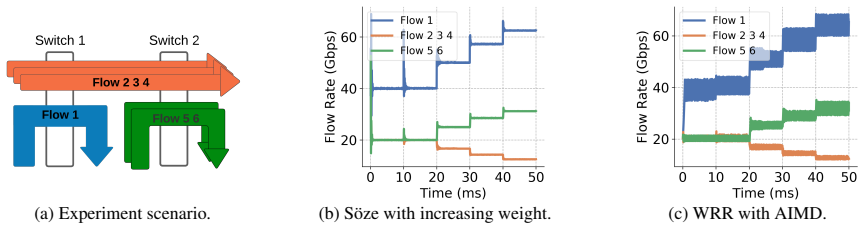
- [§3.2.3, Appendix E.3, Theorem 3.1] The proof that maxQD identifies the bottleneck hop is given only for the converged fixed point. Lemma E.3 says 'In the converged state, only on the bottleneck hop, a flow has the largest sending rate', and Appendix E.4 then applies the single-switch lemmas to the bottleneck hop. Nothing in Appendices C–E analyzes the coupled transient dynamics of queues on different hops before convergence. During a transient, a non-bottleneck saturated hop can carry the largest instantaneous queueing delay, so Algorithm 1 can move a flow away from its weighted max-min share; no argument shows that this error self-corrects. The multi-hop evaluation in §5.3.1 (Figure 17) changes one flow's weight from an already steady allocation and does not test convergence from arbitrary initial rates. This is load-bearing for Theorem 3.1.
- [Appendix E.1, Eq. (46)–(47)] The uniqueness proof is not valid as written. It assumes a non-bottleneck hop γ′ has a well-defined weighted fair-share rate Rx(γ′) in allocation x, asserts xi/wi = Rx(γ) < Rx(γ′), and then claims Rx(γ′) < yi/wi = Ry(γ′) < xi/wi after a rate decrease. The middle equality equates flow i's rate-per-weight with the fair-share rate of hop γ′ in allocation y, which is true only if γ′ is flow i's bottleneck in y, and the inequalities do not follow from the preceding text. This lemma must be repaired or replaced before the bottleneck-identification argument can rely on it.
- [Appendix D, Eq. (22)–(45)] The condition p > Δt/2·[ln(α)−ln(β)] is derived for the special case m = 1, for a one-dimensional local map near the fixed point, on a single link with synchronized updates. The theorem states that the condition is necessary and sufficient for all m in (0,2) and for arbitrary networks. The derivation does not treat m ≠ 1, does not prove global convergence from arbitrary initial queueing delay, and does not model asynchronous per-packet updates or multiple coupled hops. In addition, the discrete recurrence is not a consistent iteration: s(i+1) is computed from D(i) in Eq. (22), but D(i+1) is computed from s(i) in Eq. (29), so the indexing conflates states of consecutive intervals. Lemma 3.2's 'if and only if' is therefore not established.
- [§3.1.4, Eq. (6), and Theorem 3.1] The target function depends on α and β bracketing the range of rate-per-weight values; the text says β 'can be determined with the traffic pattern.' If the actual weighted fair share at any bottleneck falls outside [β, α], the target delay leaves the physical queueing-delay range and the one-to-one mapping between queueing delay and fair share is lost. The theorem claims convergence for every flow in an arbitrary network, but it silently assumes prior knowledge of the traffic's rate-per-weight range. This hidden assumption should be stated as a hypothesis of Lemma 3.2 and Theorem 3.1, since it is not included in their statements.
- [Appendix C, Eq. (17)–(20)] Lemma 3.1's 'if and only if' is not proven. The argument examines two flows and derives a condition on the ratio of update factors; it does not show that the nonlinear map reaches the weighted fixed point from every initial rate for an arbitrary number of flows, and it does not prove the only-if direction. In particular, the role of m < 0 is asserted rather than analyzed. The claim should be weakened to a sufficiency statement or completed with a full convergence proof.
minor comments (6)
- [Abstract and §5.1.6] The phrase 'improving TPC-H jobs completion time by up to 0.59× and 0.79× on average' is ambiguous because a smaller completion-time ratio is better; please report the reduction as a percentage or state the convention explicitly.
- [Appendix D, Figure 21] The second panel is captioned 'Convergence with oscillation', but the text and the preceding figure describe the case as 'Convergence without oscillation'; the caption should be corrected.
- [§3.1.4, Eq. (6)] Equation (6) introduces p, k, α, and β before they are defined in the text; moving the definitions immediately before the equation, rather than to Appendix A, would help the reader.
- [Appendix A and Appendix D] The symbol s(i) is overloaded: Appendix A uses s_i for flow i's rate-per-weight, while Appendix D uses s(i) for the discrete-time iterate; please use distinct notation, such as s_i for flows and s^(k) for iterates.
- [§5.3.1] The textual description says 'flow 4 and 5 only travel switch 2' after listing flow 4 among the flows that travel both switches, and Figure 17(a) mentions flow 6; the flow/topology description should be made consistent.
- [§5.1.6] The statement 'the maximum reduction is 0.59×' appears to conflict with the abstract's 'up to 0.59×'; please make the reported statistic and its direction consistent.
Circularity Check
No significant circularity: the central fairness theorem is not derived from its target, and the only self-citation is not load-bearing.
full rationale
Söze's derivation chain is not circular. The single-switch goal (Eq. 1) and the decentralized conditions (Eqs. 2-3) are shown to be algebraically equivalent in Appendix B; this is an equivalence proof, not a definitional shortcut. The target function T(s) in Eq. 6 is a free monotone design choice: because it is one-to-one, the fixed point D_star = T(r_i/w_i) for all flows forces equal rate-per-weight, and the converged value B/(sum w_i) is independent of alpha, beta, p, and k. The conditions 0 < m < 2 and p > Delta_t/2 [ln(alpha)-ln(beta)] are derived as stability conditions for the update/target pair (Appendices C and D); they are not fitted parameters later renamed as predictions. The maxQD-from-bottleneck claim (Lemma 3.3 and Appendix E.3) is a property stated at the weighted max-min fair fixed point; even if the transient multi-hop convergence argument is incomplete, that is a proof gap rather than a circular reduction. The paper's only self-citation, [58], supports an application-side critical-path heuristic in Section 5.1.1 and is not load-bearing for Theorem 3.1. No step in the paper exhibits a prediction equivalent to its own input by construction.
Assumptions & free parameters
free parameters (5)
- m =
0.25
- p =
20 µs
- k =
3 µs
- α =
Not specified; 'usually the link bandwidth divided by the smallest weight'
- β =
Not specified; 'determined with the traffic pattern'
assumptions (5)
- domain assumption Fluid queueing model dD/dt = (R-B)/B for D > 0 (Equation 4).
- domain assumption All flows sharing a link observe the same queueing delay, and the maxQD is correctly reflected in ACK headers.
- domain assumption At the converged state, the bottleneck hop has the highest queueing delay for each flow (Lemma 3.3).
- ad hoc to paper The target function parameters α and β bracket the actual weighted fair-share; otherwise the signal saturates.
- standard math Weighted max-min fairness definition as given in Definition 3.1 is adopted from prior work [14,38].
Cite this review
Pith. "Pith review of S\"{o}ze: One Network Telemetry Is All You Need for Per-flow Weighted Bandwidth Allocation at Scale." pith.science (2026). https://pith.science/paper/RHAQRDGY
@misc{pith2026250600834,
  author       = {Pith},
  title        = {Pith review of: S\"oze: One Network Telemetry Is All You Need for Per-flow Weighted Bandwidth Allocation at Scale},
  year         = {2026},
  howpublished = {\url{https://pith.science/paper/RHAQRDGY}},
  note         = {Machine review of arXiv:2506.00834}
}
abstract
Weighted bandwidth allocation is a powerful abstraction that has a wide range of use cases in modern data center networks. However, realizing highly agile and precise weighted bandwidth allocation for large-scale cloud environments is fundamentally challenging. In this paper, we propose S\"{o}ze, a lightweight decentralized weighted bandwidth allocation system that leverages simple network telemetry features of commodity Ethernet switches. Given the flow weights, S\"{o}ze can effectively use the telemetry information to compute and enforce the weighted bandwidth allocations without per-flow, topology, or routing knowledge. We demonstrate the effectiveness of S\"{o}ze through simulations and testbed experiments, improving TPC-H jobs completion time by up to $0.59\times$ and $0.79\times$ on average.
Figures


Figures from the paper (16 more)





Reference graph
Works this paper leans on
- [1]
- [2]
-
[3]
Accelerate ai development with google cloud tpus, 2024. https://cloud.google.com/tpu/
work page 2024
-
[4]
https://www.run.ai/guides/ cloud-deep-learning/google-tpu
Google tpu: Architecture and performance best practices, 2024. https://www.run.ai/guides/ cloud-deep-learning/google-tpu
work page 2024
-
[5]
In-band Network Telemetry in Barefoot Tofino,
-
[6]
In-band Network Telemetry in Broadcom Tomahawk
-
[7]
In-band Network Telemetry in Broadcom Trident3. https://www.broadcom.com/ blog/new-trident-3-switch-delivers-\ smarterprogrammability-for-enterprise-\ and-service-provider-datacenters , 2024
work page 2024
- [8]
Show all 64 references
-
[9]
https://www.intel
Tofino switches by intel, 2024. https://www.intel. com/content/www/us/en/products/details/ network-io/intelligent-fabric-processors. html
2024
-
[10]
https://www.nvidia.com/en-us/ data-center/rtx-server-gaming/
Nvidia rtx server: Powering the future of cloud gaming and ar/vr, 2024. https://www.nvidia.com/en-us/ data-center/rtx-server-gaming/
2024
-
[11]
Gpt-4 technical report
Josh Achiam, Steven Adler, Sandhini Agarwal, Lama Ahmad, Ilge Akkaya, Florencia Leoni Aleman, Diogo Almeida, Janko Altenschmidt, Sam Altman, Shyamal Anadkat, et al. Gpt-4 technical report. arXiv preprint arXiv:2303.08774, 2023
2023 arXiv
-
[12]
High performance datacen- ter networks: Architectures, algorithms, and opportuni- ties
Dennis Abts and John Kim. High performance datacen- ter networks: Architectures, algorithms, and opportuni- ties. Springer Nature, 2022
2022
-
[13]
pfabric: Minimal near-optimal datacenter transport
Mohammad Alizadeh, Shuang Yang, Milad Sharif, Sachin Katti, Nick McKeown, Balaji Prabhakar, and Scott Shenker. pfabric: Minimal near-optimal datacenter transport. ACM SIGCOMM Computer Communication Review, 43(4):435–446, 2013
2013
-
[14]
Data center tcp (dctcp)
Mohammad Alizadeh, Albert Greenberg, David A Maltz, Jitendra Padhye, Parveen Patel, Balaji Prabhakar, Sudipta Sengupta, and Murari Sridharan. Data center tcp (dctcp). In Proceedings of the ACM SIGCOMM 2010 Conference, pages 63–74, 2010
2010
-
[15]
The data- center as a computer: An introduction to the design of warehouse-scale machines
Luis Andre Barroso and Jimmy Clidaras. The data- center as a computer: An introduction to the design of warehouse-scale machines. Springer Nature, 2022
2022
-
[16]
Centralized and distributed algorithms for routing and weighted max- min fair bandwidth allocation
Miriam Allalouf and Yuval Shavitt. Centralized and distributed algorithms for routing and weighted max- min fair bandwidth allocation. IEEE/ACM Transactions on networking, 16(5):1015–1024, 2008
2008
-
[17]
Predictable memory-cpu co-scheduling with support for latency- sensitive tasks
Daniel Casini, Paolo Pazzaglia, Alessandro Biondi, Marco Di Natale, and Giorgio Buttazzo. Predictable memory-cpu co-scheduling with support for latency- sensitive tasks. In 2020 57th ACM/IEEE Design Au- tomation Conference (DAC), pages 1–6. IEEE, 2020
2020
-
[18]
Wf/sup 2/q: worst-case fair weighted fair queueing
Jon CR Bennett and Hui Zhang. Wf/sup 2/q: worst-case fair weighted fair queueing. In Proceedings of IEEE IN- FOCOM’96. Conference on Computer Communications, volume 1, pages 120–128. IEEE, 1996
1996
-
[19]
Effi- cient coflow scheduling with varys
Mosharaf Chowdhury, Yuan Zhong, and Ion Stoica. Effi- cient coflow scheduling with varys. InACM SIGCOMM, 2014
2014
-
[20]
Efficient coflow scheduling without prior knowledge
Mosharaf Chowdhury and Ion Stoica. Efficient coflow scheduling without prior knowledge. ACM SIG- COMM Computer Communication Review, 45(4):393– 406, 2015
2015
-
[21]
Analysis and simulation of a fair queueing algorithm
Alan Demers, Srinivasan Keshav, and Scott Shenker. Analysis and simulation of a fair queueing algorithm. ACM SIGCOMM Computer Communication Review , 19(4):1–12, 1989
1989
-
[22]
Differentiated end-to-end internet services using a weighted propor- tional fair sharing tcp
Jon Crowcroft and Philippe Oechslin. Differentiated end-to-end internet services using a weighted propor- tional fair sharing tcp. ACM SIGCOMM Computer Communication Review, 28(3):53–69, 1998
1998
-
[23]
A self-clocked fair queueing scheme for broadband applications
S Jamaloddin Golestani. A self-clocked fair queueing scheme for broadband applications. In Proceedings of INFOCOM’94 Conference on Computer Communica- tions, pages 636–646. IEEE, 1994
1994
-
[24]
Gearbox: A hierarchical packet sched- uler for approximate weighted fair queuing
Peixuan Gao, Anthony Dalleggio, Yang Xu, and H Jonathan Chao. Gearbox: A hierarchical packet sched- uler for approximate weighted fair queuing. In 19th USENIX Symposium on Networked Systems Design and Implementation (NSDI 22), pages 551–565, 2022
2022
-
[25]
Queues don’t matter when you can jump them! In 12th USENIX Symposium on Networked Systems Design and Implementation (NSDI 15) , pages 1–14, 2015
Matthew P Grosvenor, Malte Schwarzkopf, Ionel Gog, Robert NM Watson, Andrew W Moore, Steven Hand, and Jon Crowcroft. Queues don’t matter when you can jump them! In 12th USENIX Symposium on Networked Systems Design and Implementation (NSDI 15) , pages 1–14, 2015
2015
-
[26]
The compar- ison of microservice and monolithic architecture
Konrad Gos and Wojciech Zabierowski. The compar- ison of microservice and monolithic architecture. In 2020 IEEE XVIth International Conference on the Per- spective Technologies and Methods in MEMS Design (MEMSTECH), pages 150–153. IEEE, 2020
2020
-
[27]
Secondnet: a data center network virtu- alization architecture with bandwidth guarantees
Chuanxiong Guo, Guohan Lu, Helen J Wang, Shuang Yang, Chao Kong, Peng Sun, Wenfei Wu, and Yong- guang Zhang. Secondnet: a data center network virtu- alization architecture with bandwidth guarantees. In Proceedings of the 6th International COnference , pages 1–12, 2010
2010
-
[28]
Serving {DNNs} like clockwork: Performance predictability from the bottom up
Arpan Gujarati, Reza Karimi, Safya Alzayat, Wei Hao, Antoine Kaufmann, Ymir Vigfusson, and Jonathan Mace. Serving {DNNs} like clockwork: Performance predictability from the bottom up. In 14th USENIX Symposium on Operating Systems Design and Imple- mentation (OSDI 20), pages 44...
2020
-
[29]
Priority-based parameter propagation for distributed dnn training
Anand Jayarajan, Jinliang Wei, Garth Gibson, Alexan- dra Fedorova, and Gennady Pekhimenko. Priority-based parameter propagation for distributed dnn training. Pro- ceedings of Machine Learning and Systems , 1:132–145, 2019
2019
-
[30]
Tictac: Accelerating distributed deep learn- ing with communication scheduling
Sayed Hadi Hashemi, Sangeetha Abdu Jyothi, and Roy Campbell. Tictac: Accelerating distributed deep learn- ing with communication scheduling. Proceedings of Machine Learning and Systems , 1:418–430, 2019
2019
-
[31]
Datacenter {RPCs} can be general and fast
Anuj Kalia, Michael Kaminsky, and David Andersen. Datacenter {RPCs} can be general and fast. In 16th USENIX Symposium on Networked Systems Design and Implementation (NSDI 19), pages 1–16, 2019
2019
-
[32]
High speed networks need proactive congestion control
Lavanya Jose, Lisa Yan, Mohammad Alizadeh, George Varghese, Nick McKeown, and Sachin Katti. High speed networks need proactive congestion control. In Proceed- ings of the 14th acm workshop on hot topics in networks , pages 1–7, 2015
2015
-
[33]
Swift: Delay is simple and effective for congestion control in the datacenter
Gautam Kumar, Nandita Dukkipati, Keon Jang, Has- san MG Wassel, Xian Wu, Behnam Montazeri, Yaogong Wang, Kevin Springborn, Christopher Alfeld, Michael Ryan, et al. Swift: Delay is simple and effective for congestion control in the datacenter. In Proceedings of the Annual confe...
2020
-
[34]
Bwe: Flexible, hierarchical bandwidth allocation for wan distributed computing
Alok Kumar, Sushant Jain, Uday Naik, Anand Raghu- raman, Nikhil Kasinadhuni, Enrique Cauich Zermeno, C Stephen Gunn, Jing Ai, Björn Carlin, Mihai Amarandei-Stavila, et al. Bwe: Flexible, hierarchical bandwidth allocation for wan distributed computing. In Proceedings of the 201...
2015
-
[35]
Hpcc: High precision congestion control
Yuliang Li, Rui Miao, Hongqiang Harry Liu, Yan Zhuang, Fei Feng, Lingbo Tang, Zheng Cao, Ming Zhang, Frank Kelly, Mohammad Alizadeh, et al. Hpcc: High precision congestion control. In Proceedings of the ACM Special Interest Group on Data Communication , pages 44–58. 2019
2019
-
[36]
Netshare: Virtualizing data center networks across services
Terry Lam, Sivasankar Radhakrishnan, Amin Vahdat, and George Varghese. Netshare: Virtualizing data center networks across services. 2010
2010
-
[37]
Resource allocation and scheduling in cloud computing: Policy and algorithm
Tinghuai Ma, Ya Chu, Licheng Zhao, and Otgonbayar Ankhbayar. Resource allocation and scheduling in cloud computing: Policy and algorithm. IETE Technical re- view, 31(1):4–16, 2014
2014
-
[38]
Joint offloading and scheduling decisions for dag applications in mobile edge computing
Jie Liang, Kenli Li, Chubo Liu, and Keqin Li. Joint offloading and scheduling decisions for dag applications in mobile edge computing. Neurocomputing, 424:160– 171, 2021
2021
-
[39]
Timely: Rtt-based congestion control for the dat- acenter
Radhika Mittal, Vinh The Lam, Nandita Dukkipati, Emily Blem, Hassan Wassel, Monia Ghobadi, Amin Vahdat, Yaogong Wang, David Wetherall, and David Zats. Timely: Rtt-based congestion control for the dat- acenter. ACM SIGCOMM Computer Communication Review, 45(4):537–550, 2015
2015
-
[40]
Priority service and max-min fairness
Peter Marbach. Priority service and max-min fairness. In Proceedings. Twenty-First Annual Joint Conference of the IEEE Computer and Communications Societies , volume 1, pages 266–275. IEEE, 2002
2002
-
[41]
Scalable hardware priority queue architectures for high- speed packet switches
Sung-Whan Moon, Jennifer Rexford, and Kang G Shin. Scalable hardware priority queue architectures for high- speed packet switches. IEEE Transactions on computers, 49(11):1215–1227, 2000
2000
-
[42]
Homa: A receiver-driven low- latency transport protocol using network priorities
Behnam Montazeri, Yilong Li, Mohammad Alizadeh, and John Ousterhout. Homa: A receiver-driven low- latency transport protocol using network priorities. In Proceedings of the 2018 Conference of the ACM Special Interest Group on Data Communication, pages 221–235, 2018
2018
-
[43]
Scaling memcache at facebook
Rajesh Nishtala, Hans Fugal, Steven Grimm, Marc Kwiatkowski, Herman Lee, Harry C Li, Ryan McElroy, Mike Paleczny, Daniel Peek, Paul Saab, et al. Scaling memcache at facebook. In 10th USENIX Symposium on Networked Systems Design and Implementation (NSDI 13), pages 385–398, 2013
2013
-
[44]
Numfabric: Fast and flexible bandwidth allocation in dat- acenters
Kanthi Nagaraj, Dinesh Bharadia, Hongzi Mao, Sandeep Chinchali, Mohammad Alizadeh, and Sachin Katti. Numfabric: Fast and flexible bandwidth allocation in dat- acenters. In Proceedings of the 2016 ACM SIGCOMM Conference, pages 188–201, 2016
2016
-
[45]
Efficient flow scheduling in dis- tributed deep learning training with echelon formation
Rui Pan, Yiming Lei, Jialong Li, Zhiqiang Xie, Binhang Yuan, and Yiting Xia. Efficient flow scheduling in dis- tributed deep learning training with echelon formation. In Proceedings of the 21st ACM Workshop on Hot Topics in Networks, pages 93–100, 2022
2022
-
[46]
Global weighted scheduling and allocation algorithms
Houria Oudghiri and Bozena Kaminska. Global weighted scheduling and allocation algorithms. In Pro- ceedings The European Conference on Design Automa- tion, pages 491–492. IEEE Computer Society, 1992
1992
-
[47]
A generic communication scheduler for distributed dnn training acceleration
Yanghua Peng, Yibo Zhu, Yangrui Chen, Yixin Bao, Bairen Yi, Chang Lan, Chuan Wu, and Chuanxiong Guo. A generic communication scheduler for distributed dnn training acceleration. In ACM SOSP, 2019
2019
-
[48]
A generalized processor sharing approach to flow control in integrated services networks: the single-node case
Abhay K Parekh and Robert G Gallager. A generalized processor sharing approach to flow control in integrated services networks: the single-node case. IEEE/ACM transactions on networking, 1(3):344–357, 1993
1993
-
[49]
Inside the social network’s (dat- acenter) network
Arjun Roy, Hongyi Zeng, Jasmeet Bagga, George Porter, and Alex C Snoeren. Inside the social network’s (dat- acenter) network. In Proceedings of the 2015 ACM Conference on Special Interest Group on Data Commu- nication, pages 123–137, 2015
2015
-
[50]
Dynamic scheduling of task graphs in multi-fpga systems using critical path
Reza Ramezani. Dynamic scheduling of task graphs in multi-fpga systems using critical path. The Journal of Supercomputing, 77(1):597–618, 2021
2021
-
[51]
Sharing the data center network
Alan Shieh, Srikanth Kandula, Albert Greenberg, Changhoon Kim, and Bikas Saha. Sharing the data center network. In 8th USENIX Symposium on Net- worked Systems Design and Implementation (NSDI 11) , 2011
2011
-
[52]
Approximating fair queueing on reconfigurable switches
Naveen Kr Sharma, Ming Liu, Kishore Atreya, and Arvind Krishnamurthy. Approximating fair queueing on reconfigurable switches. In 15th USENIX Sympo- sium on Networked Systems Design and Implementation (NSDI 18), pages 1–16, 2018
2018
-
[53]
Dapper, a large- scale distributed systems tracing infrastructure
Benjamin H Sigelman, Luiz André Barroso, Mike Bur- rows, Pat Stephenson, Manoj Plakal, Donald Beaver, Saul Jaspan, and Chandan Shanbhag. Dapper, a large- scale distributed systems tracing infrastructure. 2010
2010
-
[54]
Effi- cient fair queueing using deficit round robin
Madhavapeddi Shreedhar and George Varghese. Effi- cient fair queueing using deficit round robin. InProceed- ings of the conference on Applications, technologies, ar- chitectures, and protocols for computer communication , pages 231–242, 1995
1995
-
[55]
Llama: Open and efficient foundation language models
Hugo Touvron, Thibaut Lavril, Gautier Izacard, Xavier Martinet, Marie-Anne Lachaux, Timothée Lacroix, Bap- tiste Rozière, Naman Goyal, Eric Hambro, Faisal Azhar, et al. Llama: Open and efficient foundation language models. arXiv preprint arXiv:2302.13971, 2023
2023 arXiv
-
[56]
Programmable packet scheduling at line rate
Anirudh Sivaraman, Suvinay Subramanian, Mohammad Alizadeh, Sharad Chole, Shang-Tse Chuang, Anurag Agrawal, Hari Balakrishnan, Tom Edsall, Sachin Katti, and Nick McKeown. Programmable packet scheduling at line rate. In Proceedings of the 2016 ACM SIGCOMM Conference, pages 44–57, 2016
2016
-
[57]
Infrastructure cost comparison of running web applications in the cloud using aws lambda and monolithic and microservice architectures
Mario Villamizar, Oscar Garces, Lina Ochoa, Harold Castro, Lorena Salamanca, Mauricio Verano, Rubby Casallas, Santiago Gil, Carlos Valencia, Angee Zam- brano, et al. Infrastructure cost comparison of running web applications in the cloud using aws lambda and monolithic and mic...
2016
-
[58]
Deadline-aware datacenter tcp (d2tcp)
Balajee Vamanan, Jahangir Hasan, and TN Vijayku- mar. Deadline-aware datacenter tcp (d2tcp). ACM SIG- COMM Computer Communication Review, 42(4):115– 126, 2012
2012
-
[59]
Ce- binae: scalable in-network fairness augmentation
Liangcheng Yu, John Sonchack, and Vincent Liu. Ce- binae: scalable in-network fairness augmentation. In Proceedings of the ACM SIGCOMM 2022 Conference , pages 219–232, 2022
2022
-
[60]
Mxdag: A hybrid abstraction for emerging applications
Weitao Wang, Sushovan Das, Xinyu Crystal Wu, Zhuang Wang, Ang Chen, and TS Eugene Ng. Mxdag: A hybrid abstraction for emerging applications. In Proceedings of the Twentieth ACM Workshop on Hot Topics in Net- works, pages 221–228, 2021
2021
-
[61]
Congestion control for large-scale rdma deploy- ments
Yibo Zhu, Haggai Eran, Daniel Firestone, Chuanxiong Guo, Marina Lipshteyn, Yehonatan Liron, Jitendra Pad- hye, Shachar Raindel, Mohamad Haj Yahia, and Ming Zhang. Congestion control for large-scale rdma deploy- ments. ACM SIGCOMM Computer Communication Review, 45(4):523–536, 2015
2015
-
[62]
Programmable packet scheduling with a single queue
Zhuolong Yu, Chuheng Hu, Jingfeng Wu, Xiao Sun, Vladimir Braverman, Mosharaf Chowdhury, Zhenhua Liu, and Xin Jin. Programmable packet scheduling with a single queue. In Proceedings of the 2021 ACM SIGCOMM 2021 Conference, pages 179–193, 2021
2021
-
[64]
weighted max-min fair
Yibo Zhu, Monia Ghobadi, Vishal Misra, and Jitendra Padhye. Ecn or delay: Lessons learnt from analysis of dcqcn and timely. In Proceedings of the 12th Interna- tional on Conference on emerging Networking EXperi- ments and Technologies, pages 313–327, 2016. A Notations We list ...
2016
-
[2024]
https://www.opencompute.org/ files/INT-In-Band-Network-Telemetry-A-\ PowerfulAnalytics-Framework-for-\ your-Data-Center-OCP-Final3.pdf
Reviewed August 7, 2026 · model on record in the stance chip above.
Discussion (0). Sign in to comment.