REVIEW 4 major objections 5 minor 1 cited by
Recursive Privacy-Preserving Estimation Over Markov Fading Channels
T0 review · 4 major / 5 minor · reviewed 2026-08-07 · deepseek-v4-flash
Pith's one-line read The paper claims that a scalar, memory-light encoding keeps a remote filter accurate over Markov fading channels while forcing an eavesdropper's mean state estimate to diverge after a single critical packet loss.
desk verdict The legitimate-user filter is plausible, but the paper's central secrecy theorem is false: the eavesdropper's mean estimation error does not diverge after a missed packet. read the letter →
The pith
A machine-rendered reading of the paper's core claim, the machinery that carries it, and where it could break.
The reading
What carries the argument
The load-bearing object is the privacy-preserving mechanism (10)-(12): a stochastic uniform quantizer $Q$ with levels $d\delta$ and probabilities (11), applied to the weighted innovation difference $(\varepsilon_k - a^{k-t_k}\bar\varepsilon_{t_k})/s$, where $t_k$ is the last successful legitimate reception and $a>1$ is a scalar amplifier. The same object does two opposite jobs: for the legitimate user it is an unbiased decoder with bounded variance, so the filter (13) tracks the state with only a small extra covariance term; for the eavesdropper who misses the packet at the critical event, the missing reference makes the decoding error propagate as $\bar e_k = a\bar e_{k-1}+s e_k$ and diverge. The analysis is carried by the mode-dependent Kalman-style recursion (13), the modified algebraic Riccati equation $g_\lambda(X)$ whose fixed point gives the threshold $\bar\lambda$ in condition (23), a stochastic Lyapunov bound over the Markov channel that yields (24) and (22), and a conditional-expectation comparison (Lemma 2) that lifts worst-case divergence to the general case.
What would settle it
Run the proposed PPM on an observable system with rank-deficient $C$, for example $C=[1\ 0; 1\ 0]$ so that $CC^\top$ is singular, simulate the eavesdropper's filter (13) under the critical event $E_0\cap E_1$, and compute $\lim_{k\to\infty}\lVert E[x_k-\hat x^e_{k|k}]\rVert$. If this limit is finite, Theorem 3's divergence claim fails in the rank-deficient case, and Proposition 2's $\bar\kappa=0$ is the reason.
Extended reading notes
Core claim
On its own terms, the paper's discovery is that a one-dimensional scaling of a quantized innovation already gives secrecy in the sense of Definition 1 for linear systems over Markov fading channels. The encoder forms $z_k = Q((\varepsilon_k - a^{k-t_k}\bar\varepsilon_{t_k})/s)$ with $t_k$ the last time the legitimate user received a packet, and the decoder recovers $\bar\varepsilon_k = s z_k + a^{k-t_k}\bar\varepsilon_{t_k}$; the filter (13) feeds this into a Kalman-style update whose covariance update carries the extra quantization term $s^2 K_k R_e K_k^\top$. The legitimate user is unbiased when it receives data, and Theorem 2 gives exponentially bounded expected trace under conditions (23)-(24). The eavesdropper's decoding error after a critical event obeys $\bar e_k = a\bar e_{k-1}+s e_k$, so with $a>1$ it grows without bound; Lemma 1 handles the worst case where the eavesdropper intercepts everything after the critical event, and Theorem 3 extends divergence to all channel realizations once a critical event has occurred.
Load-bearing premise
The divergence proof rests on the premise that the eavesdropper uses the same linear recursive filter (13) and that the measurement matrix $C$ has full row rank, so the Kalman-gain lower bound $(K^e)^\top K^e \ge \bar\kappa I$ in Proposition 2 holds with $\bar\kappa>0$; if either condition fails, the contradiction behind Lemma 1 does not go through.
Editorial extensions
If this is right
- A sensor that can compute a quantized innovation and read one acknowledgment bit can protect state trajectories from an eavesdropper; no modular exponentiation or homomorphic encryption is needed.
- The legitimate user's filter runs at roughly the cost of a standard Kalman filter, with encoding cost $O(d_y)$, making the scheme plausible for energy- and bandwidth-constrained devices.
- Secrecy no longer requires the eavesdropper's interception probability to be smaller than the legitimate user's reception probability, nor does it require the plant to be unstable; the stable three-tank example still shows divergence of the eavesdropper's mean square error.
- The scalar $a>1$ is a tunable secrecy margin: larger $a$ makes the eavesdropper's decoding bias diverge faster, while the legitimate user's decoder carries the same amplification on both sides of equation (12) and is unaffected.
- Choosing a smaller quantization level $\delta$ improves the legitimate user's accuracy and relaxes the boundedness condition (23), at the price of longer packet payloads.
Reading between the lines
- Beyond the paper: if $C$ is rank-deficient so that $CC^\top$ is singular, the constant $\bar\kappa$ in Proposition 2 is zero and the contradiction in Lemma 1's inequalities (53)-(54) is not established; a direct extension would need a different lower bound on the eavesdropper's gain or an additional observability assumption.
- Beyond the paper: the eavesdropper is assumed to run exactly the same linear recursive filter (13). The divergence guarantee is a statement about that estimator family; whether a batch smoother or a nonlinear estimator that knows the critical-event time can do better is left open by the paper.
- Beyond the paper: the scheme relies on a private, reliable acknowledgment channel for the reference time $t_k$. If that channel is not authenticated, an active attacker could manipulate acknowledged reception times, and the security analysis would need to be redone.
Editorial analysis
A structured set of objections, weighed in public.
Referee Report
Summary. The paper proposes a privacy-preserving mechanism (PPM) and a companion recursive filter for remote state estimation over Markov fading channels in the presence of an eavesdropper. The encoder (10)-(12) transmits a quantized, weighted innovation based on a previous decoded reference, and the filter (13) is designed to be lossless in expectation for the legitimate user. The main claimed results are: (i) the legitimate user's estimation error covariance is exponentially bounded (Theorem 2), and (ii) after a critical event (legitimate user receives, eavesdropper misses), the eavesdropper's mean estimation error diverges (Theorem 3), thereby satisfying the paper's Definition 1 of secrecy. Simulations on a three-tank system illustrate the behavior of the legitimate user's MSE and the eavesdropper's MSE.
Significance. If the claimed results were correct, the paper would provide a lightweight, scalar-parameter encoding scheme that extends state-secrecy codes to Markov fading channels while preserving data availability. The legitimate-user boundedness analysis explicitly accounts for the correlation between measurement noise and quantization error, which is a useful extension over prior work. However, the paper's central secrecy guarantee is the divergence of the eavesdropper's mean estimation error, and this claim is not established; the proof contains a fundamental error in Proposition 1 that invalidates the divergence argument even in the scalar, full-row-rank case. The simulation evidence is based on MSE, which may diverge through variance while the mean remains zero, so it does not substantiate the stated secrecy definition. The contribution as presented is therefore not valid.
major comments (4)
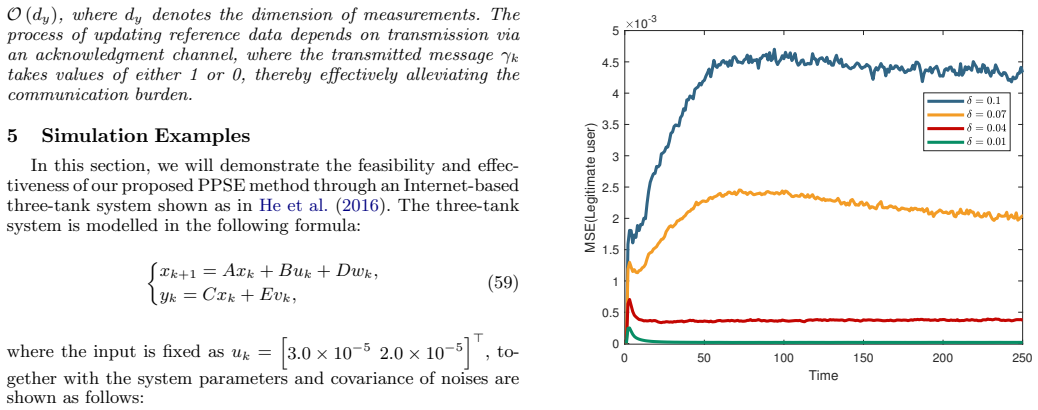
- [Section 4.2, Proposition 1 and eq. (50)] The claimed bias E[\bar e_{k0+1}] = \delta_e \neq 0 is false under the paper's own model. For t < k0, the eavesdropper decodes with the same reference as the legitimate user, and by the unbiasedness established in Theorem 1 together with zero-mean noises and zero-mean quantization errors, E[\bar \varepsilon_t] = E[\varepsilon_t] = 0 for every t < k0. The stale-reference decoding at k0+1 gives \bar e_{k0+1} = a(\bar \varepsilon^e_{k0-1} - \bar \varepsilon_{k0}) + s e_{k0+1}, whose expectation is zero. The recursion (50) then propagates a zero-mean error, so E[\bar e_k] = 0 for all k > k0. Substituting into (48) yields E[\tilde x^e_{k+1|k+1}] = A E[\tilde x^e_{k|k}], which for stable A remains bounded and does not diverge. Thus the central secrecy condition (9) is not established, and the MSE divergence plotted in Section 5 does not test the stated mean-error definition.
- [Section 4.2, Proposition 2] The inequality (K^e_{k,m})^\top K^e_{k,m} \geq \bar\kappa I_{d_y} requires C C^\top to be nonsingular, i.e., C to have full row rank. The system model in Section 2.1 only assumes (A,C) observable, which does not imply full row rank; when d_y > d_x or when the rows of C are linearly dependent, \bar\kappa = 0 and the contradiction in Lemma 1 (eqs. (53)-(54)) collapses. The proposition statement should explicitly assume full row rank of C, or the proof needs a substantially different argument.
- [Section 4.1, eq. (20)] The formula for the actual estimation covariance is missing the subtraction of the innovation covariance term. It should read \Sigma_{k|k,m} = \Sigma_{k|k-1,n} - \gamma_{k,m} K_{k,m}(C\Sigma_{k|k-1,n}C^\top + R) K_{k,m}^\top + \gamma_{k,m}s^2 K_{k,m}R_e K_{k,m}^\top + \gamma_{k,m}s K_{k,m}E[v_k e_k^\top + e_k v_k^\top]K_{k,m}^\top, as the corresponding term appears with a minus sign in eq. (25). As written, eq. (20) is inconsistent with the standard Kalman update and with the subsequent derivation in Theorem 2; this needs correction.
- [Definition 1 and Section 4.2] The secrecy definition is formulated for the eavesdropper's estimator in (7), which is the conditional-mean estimator, but Proposition 2 and Lemma 1 analyze the specific linear filter (13) with gain (14). Showing that a particular suboptimal linear filter has a divergent mean error does not imply that the optimal conditional-mean estimator diverges. The paper either needs to prove the result for the optimal estimator or explicitly restrict the adversarial estimator model in Definition 1.
minor comments (5)
- [Notations] The phrase 'Euclidean Euclidean space' is a duplicated-word typo; it should be 'Euclidean space'.
- [Notations] The definition 'Y \leq X denotes that the matrix (X-Y) is semi-positive semidefinite' should read 'positive semidefinite.'
- [Section 4.2, eq. (52)] The notation \lambda_{\min}\{CC\} is not standard; it should be \lambda_{\min}(CC^\top), and the argument should be made explicit.
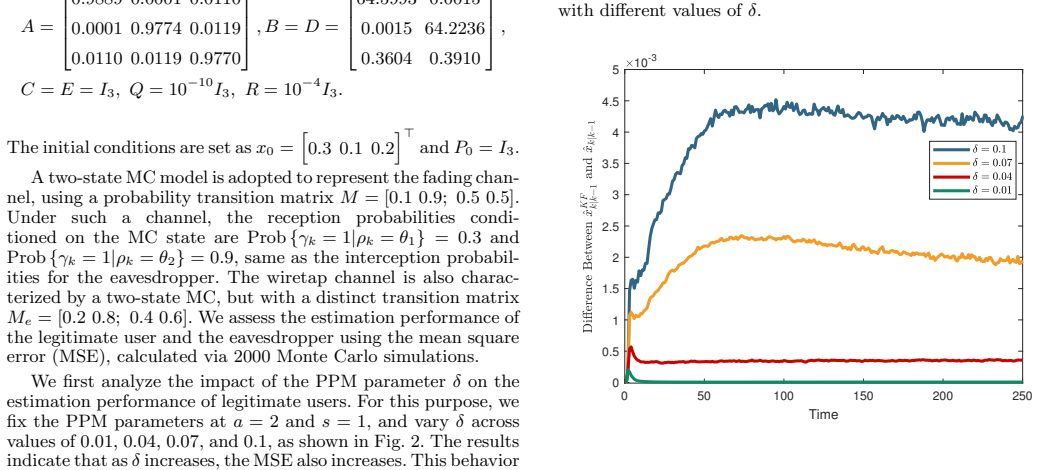
- [Section 5, Fig. 3 caption] The phrase 'MSE between state predictions generated by standard KF and PPF' is ambiguous; it likely means the mean squared difference between the two predictions, not the MSE of either filter.
- [Lemma 2] The proof of Lemma 2 appears to rely on the nonnegativity of E[Y|J_1] - E[Y|J_2], which is not valid for random variables in general; the statement may be true by a different argument, but the given proof needs correction.
Circularity Check
No significant circularity; the PPM-filter analysis is derived from the paper's stated system and channel assumptions, with self-citation only as prior lineage, not as load-bearing evidence.
full rationale
The paper's central claim is a co-designed PPM (10)-(12) and recursive filter (13). The claimed expectational losslessness follows directly from the quantizer's zero-mean error, E[ek(j)] = 0, together with the algebraic relation edec,k = s ek; no fitted parameter or target secrecy conclusion is used as an input. Theorem 2's boundedness analysis is a standard MARE/Lyapunov argument built on the stated MFC model, with the distortion bound (26) cited to external quantization theory (Gray & Neuhoff, 1998) and the MARE convergence cited to Sinopoli et al. (2004); it is not derived from or equivalent to the secrecy claim. The eavesdropper divergence chain (Proposition 1, Lemma 1, Theorem 3) is an internal argument based on a critical event, not a mere restatement of Definition 1. The questionable assertion in Proposition 1 that E[e_bar_{k0+1}] = delta_e != 0 is a technical correctness gap (under the paper's zero-mean quantization model the decoding error may have zero mean), and Proposition 2's lower bound on (K^e)^T K^e requires a full-row-rank C that the system model does not guarantee; however, these are validity/assumption issues rather than circular reductions of the conclusion into the premises. The self-citation to Huang et al. (2022) provides the weighted-reference encoding lineage and the critical-event definition, but the present paper re-derives the filter, the losslessness property, and the secrecy analysis from its own equations, so the cited prior work is not the sole justification of the central claim. No circular step is identifiable; the score of 2 reflects only the minor, non-load-bearing self-citation lineage, not any circular derivation.
Assumptions & free parameters
free parameters (3)
- a =
a=2 in simulations (varied 0.5, 1, 2, 5)
- s =
s=1
- δ =
δ ∈ {0.01, 0.04, 0.07, 0.1} in simulations
assumptions (5)
- domain assumption The predicted state x̂_{k|k-1,n} is approximated as Gaussian (Remark 1).
- domain assumption The decoding error covariance is bounded by the distortion rate: E[e_dec e_dec^T] ≤ δ_N E[ε ε^T] with δ_N ∈ (0,1) (eq. 26).
- domain assumption The eavesdropper uses the same linear filter (13) and decoding rule (12) as the legitimate user.
- ad hoc to paper The measurement matrix C has full row rank, so that (K^e)^T K^e ≥ \bar κ I holds.
- domain assumption The Markov channel is aperiodic and positive recurrent (Section 2.2).
Cite this review
Pith. "Pith review of Recursive Privacy-Preserving Estimation Over Markov Fading Channels." pith.science (2026). https://pith.science/paper/RIXLUXB2
@misc{pith2026250602725,
  author       = {Pith},
  title        = {Pith review of: Recursive Privacy-Preserving Estimation Over Markov Fading Channels},
  year         = {2026},
  howpublished = {\url{https://pith.science/paper/RIXLUXB2}},
  note         = {Machine review of arXiv:2506.02725}
}
read the original abstract
In industrial applications, the presence of moving machinery, vehicles, and personnel, contributes to the dynamic nature of the wireless channel. This time variability induces channel fading, which can be effectively modeled using a Markov fading channel (MFC). In this paper, we investigate the problem of secure state estimation for systems that communicate over a MFC in the presence of an eavesdropper. The objective is to enable a remote authorized user to accurately estimate the states of a dynamic system, while considering the potential interception of the sensor's packet through a wiretap channel. To prevent information leakage, a novel co-design strategy is established, which combines a privacy-preserving mechanism with a state estimator. To implement our encoding scheme, a nonlinear mapping of the innovation is introduced based on the weighted reconstructed innovation previously received by the legitimate user. Corresponding to this encoding scheme, we design a recursive privacy-preserving filtering algorithm to achieve accurate estimation. The boundedness of estimation error dynamics at the legitimate user's side is discussed and the divergence of the eavesdropper's estimation error is analyzed, which demonstrates the effectiveness of our co-design strategy in ensuring secrecy. Furthermore, a simulation example of a three-tank system is provided to demonstrate the effectiveness and feasibility of our privacy-preserving estimation method.
Figures

Figures from the paper (2 more)


Forward citations
Cited by 1 Pith paper
-
Privacy-Preserving Fusion for Multi-Sensor Systems Under Multiple Packet Dropouts
A privacy-preserving fusion filter is proposed for multi-sensor systems under multiple packet dropouts, with the legitimate user's error covariance bounded and the eavesdropper's mean estimation error divergent.
Reference graph
Works this paper leans on
-
[1]
Bibitem after note You are using a bibitem after a note in a subbibitems environment; note should the last item in a subbibitems environment \@itemnote @bb@error [] @noitemnote \@tempa \@noitemnote \@noitemnote \@itemnote @bibitem\@bibitem @lbibitem\@lbibitem \@bibitem#1 \@itemnote @bibitem #1 \@tempa @noitemnote \@lbibitem[#1]#2 \@itemnote @lbibitem[#1] ...
-
[2]
@stdbsttrue @ctr \@lbibitem [ @ctr] \@bibitem##1 @ctr \@lbibitem[ @ctr] ##1 @bb@error\@mkbberr @filesw @natbibloaded \@auxout \@itemslabel @bibnum a-- @ctr \@auxout \@itemslabel :s @bibnum \@auxout \@itemslabel @bibnum a-- @ctr \@auxout \@itemslabel :s @bibnum @ctr @bibnum @citex\@citex \@tempcntc @citex[#1]#2 @filesw \@auxout #2 \@tempcnta @\@tempcntb @n...
work page 1991
-
[3]
Vg 98 + qFI +4 HLÅZ Kp5 gn | P BN I _) )(J
@stdbsttrue @ctr \@lbibitem [ @ctr] \@bibitem##1 @ctr \@lbibitem[ @ctr] ##1 @bb@error\@mkbberr @filesw @natbibloaded \@auxout \@itemslabel @bibnum a-- @ctr \@auxout \@itemslabel :s @bibnum \@auxout \@itemslabel @bibnum a-- @ctr \@auxout \@itemslabel :s @bibnum @ctr @bibnum @citex\@citex \@tempcntc @citex[#1]#2 @filesw \@auxout #2 \@tempcnta @\@tempcntb @n...
-
[4]
author Alexandru, A. B. , author Gatsis, K. , author Shoukry, Y. , author Seshia, S. A. , author Tabuada, P. , & author Pappas, G. J. ( year 2021 ). title Cloud-based quadratic optimization with partially homomorphic encryption . journal IEEE Transactions on Automatic Control \/ , volume 66 \/ , pages 2357--2364
work page 2021
-
[5]
author An, W. , author Ding, D. , author Wang, Z. , author Liu, Q. , & author Dong, H. ( year 2025 ). title Privacy-preserving distributed optimization for economic dispatch in smart grids . journal Automatica \/ , volume 177 \/ , pages 112275
work page 2025
-
[6]
author Chen, B. , author Leahy, K. , author Jones, A. , & author Hale, M. ( year 2023 ). title Differential privacy for symbolic systems with application to Markov chains . journal Automatica \/ , volume 152 \/ , pages 110908
work page 2023
-
[7]
author Cintuglu, M. H. , & author Ishchenko, D. ( year 2019 ). title Secure distributed state estimation for networked microgrids . journal IEEE Internet of Things Journal \/ , volume 6 \/ , pages 8046--8055
work page 2019
-
[8]
author Crimson, M. J. , author Kennedy, J. M. , & author Quevedo, D. E. ( year 2023 ). title Remote state estimation with privacy against eavesdroppers . journal IFAC PapersOnLine \/ , volume 56 \/ , pages 8363--8368
work page 2023
Show all 49 references
-
[9]
author Crimson, M. J. , author Kennedy, J. M. , & author Quevedo, D. E. ( year 2025 ). title Remote state estimation with privacy against active eavesdroppers . journal Automatica \/ , volume 171 \/ , pages 111932
2025
-
[10]
, author Shames, I
author Farokhi, F. , author Shames, I. , & author Batterham, N. ( year 2017 ). title Secure and private control using semi-homomorphic encryption . journal Control Engineering Practice \/ , volume 67 \/ , pages 13--20
2017
-
[11]
, author Wang, Z
author Gao, C. , author Wang, Z. , author He, X. , & author Dong, H. ( year 2021 ). title Encryption-decryption-based consensus control for multi-agent systems: Handling actuator faults . journal Automatica \/ , volume 134 \/
2021
-
[12]
, author Wang, Z
author Gao, C. , author Wang, Z. , author Hu, J. , author Liu, Y. , & author He, X. ( year 2022 ). title Consensus-based distributed state estimation over sensor networks with encoding-decoding scheme: Accommodating bandwidth constraints . journal IEEE Transactions on Network ...
2022
-
[13]
, author Wang, Y
author Gao, H. , author Wang, Y. , & author Nedic, A. ( year 2023 ). title Dynamics based privacy preservation in decentralized optimization . journal Automatica \/ , volume 151 \/
2023
-
[14]
, & author Neuhoff, D
author Gray, R. , & author Neuhoff, D. ( year 1998 ). title Quantization . journal IEEE Transactions on Information Theory \/ , volume 44 \/ , pages 2325--2383
1998
-
[15]
, author Cai, L
author He, J. , author Cai, L. , & author Guan, X. ( year 2020 ). title Differential private noise adding mechanism and its application on consensus algorithm . journal IEEE Transactions on Signal Processing \/ , volume 68 \/ , pages 4069--4082
2020
-
[16]
, author Wang, Z
author He, X. , author Wang, Z. , author Qin, L. , & author Zhou, D. ( year 2016 ). title Active fault-tolerant control for an Internet -based networked three-tank system . journal IEEE Transactions on Control Systems Technology \/ , volume 24 \/ , pages 2150--2157
2016
-
[17]
, author Gao, C
author Huang, J. , author Gao, C. , & author He, X. ( year 2022 ). title Privacy-preserving state estimation with unreliable channels . journal ISA Transactions \/ , volume 127 \/ , pages 4--12
2022
-
[18]
, author Ding, K
author Huang, L. , author Ding, K. , author Leong, A. S. , author Quevedo, D. E. , & author Shi, L. ( year 2021 ). title Encryption scheduling for remote state estimation under an operation constraint . journal Automatica \/ , volume 127 \/ , pages 109537
2021
-
[19]
, author Tsiamis, A
author Impicciatore, A. , author Tsiamis, A. , author Zacchia Lun, Y. , author D Innocenzo, A. , & author Pappas, G. J. ( year 2022 ). title Secure state estimation over Markov wireless communication channels . In booktitle 2022 IEEE 61st Conference on Decision and Control (CD...
2022
-
[20]
, & author Xiong, K
author Ito, K. , & author Xiong, K. ( year 2000 ). title Gaussian filters for nonlinear filtering problems . journal IEEE Transactions on Automatic Control \/ , volume 45 \/ , pages 910--927
2000
-
[21]
, & author Fujita, T
author Kogiso, K. , & author Fujita, T. ( year 2015 ). title Cyber-security enhancement of networked control systems using homomorphic encryption . In booktitle 2015 54th IEEE Conference on Decision and Control (CDC) \/ (pp. pages 6836--6843 )
2015
-
[22]
, & author Djuric, P
author Kotecha, J. , & author Djuric, P. ( year 2003 ). title Gaussian particle filtering . journal IEEE Transactions on Signal Processing \/ , volume 51 \/ , pages 2592--2601
2003
-
[23]
author Leong, A. S. , author Quevedo, D. E. , & author Dey, S. ( year 2017 a ). title State estimation over Markov ian packet dropping links in the presence of an eavesdropper . In booktitle 2017 IEEE 56th Annual Conference on Decision and Control (CDC) \/ (pp. pages 6616--6621 )
2017
-
[24]
author Leong, A. S. , author Quevedo, D. E. , author Dolz, D. , & author Dey, S. ( year 2017 b ). title On remote state estimation in the presence of an eavesdropper . journal IFAC PapersOnLine \/ , volume 50 \/ , pages 7339--7344
2017
-
[25]
, author Lam, J
author Liang, S. , author Lam, J. , & author Lin, H. ( year 2023 ). title Secure estimation with privacy pprotection . journal IEEE Transactions on Cybernetics \/ , volume 53 \/ , pages 4947--4961
2023
-
[26]
, author Quevedo, D
author Liu, W. , author Quevedo, D. E. , author Li, Y. , author Johansson, K. H. , & author Vucetic, B. ( year 2022 ). title Remote state estimation with smart sensors over Markov fading channels . journal IEEE Transactions on Automatic Control \/ , volume 67 \/ , pages 2743--2757
2022
-
[27]
, author Zhang, J.-F
author Liu, X.-K. , author Zhang, J.-F. , & author Wang, J. ( year 2020 ). title Differentially private consensus algorithm for continuous-time heterogeneous multi-agent systems . journal Automatica \/ , volume 122 \/
2020
-
[28]
, author Leong, A
author Lu, J. , author Leong, A. S. , & author Quevedo, D. E. ( year 2020 ). title Optimal event-triggered transmission scheduling for privacy-preserving wireless state estimation . journal International Journal of Robust and Nonlinear Control \/ , volume 30 \/ , pages 4205--4224
2020
-
[29]
, & author Zhu, M
author Lu, Y. , & author Zhu, M. ( year 2018 ). title Privacy preserving distributed optimization using homomorphic encryption . journal Automatica \/ , volume 96 \/ , pages 314--325
2018
-
[30]
, & author Zhu, M
author Lu, Y. , & author Zhu, M. ( year 2019 ). title A control-theoretic perspective on cyber-physical privacy: Where data privacy meets dynamic systems . journal Annual Reviews in Control \/ , volume 47 \/ , pages 423--440
2019
-
[31]
author Meyn, S. P. ( year 1989 ). title Ergodic theorems for discrete time stochastic systems using a stochastic lyapunov function . journal SIAM Journal on Control and Optimization \/ , volume 27 \/ , pages 1409--1439
1989
-
[32]
author Quevedo, D. E. , author Ahlen, A. , & author Johansson, K. H. ( year 2013 ). title State estimation over sensor networks with correlated wireless fading channels . journal IEEE Transactions on Automatic Control \/ , volume 58 \/ , pages 581--593
2013
-
[33]
, author Giannakis, G
author Ribeiro, A. , author Giannakis, G. B. , & author Roumeliotis, S. I. ( year 2006 ). title SOI-KF : Distributed Kalman filtering with low-cost communications using the sign of innovations . journal IEEE Transactions on Signal Processing \/ , volume 54 \/ , pages 4782--4795
2006
-
[34]
, author Kennedy, R
author Sadeghi, P. , author Kennedy, R. A. , author Rapajic, P. B. , & author Shams, R. ( year 2008 ). title Finite-state Markov modeling of fading channels - a survey of principles and applications . journal IEEE Signal Processing Magazine \/ , volume 25 \/ , pages 57--80
2008
-
[35]
, & author Chen, T
author Shang, J. , & author Chen, T. ( year 2023 ). title Linear encryption against eavesdropping on remote state estimation . journal IEEE Transactions on Automatic Control \/ , volume 68 \/ , pages 4413--4419
2023
-
[36]
, author Schenato, L
author Sinopoli, B. , author Schenato, L. , author Franceschetti, M. , author Poolla, K. , author Jordan, M. , & author Sastry, S. ( year 2004 ). title Kalman filtering with intermittent observations . journal IEEE Transactions on Automatic Control \/ , volume 49 \/ , pages 1453--1464
2004
-
[37]
, author Gatsis, K
author Tsiamis, A. , author Gatsis, K. , & author Pappas, G. J. ( year 2017 a ). title State estimation codes for perfect secrecy . In booktitle 2017 IEEE 56th Annual Conference on Decision and Control (CDC) \/ (pp. pages 176--181 )
2017
-
[38]
, author Gatsis, K
author Tsiamis, A. , author Gatsis, K. , & author Pappas, G. J. ( year 2017 b ). title State estimation with secrecy against eavesdroppers . journal IFAC PapersOnLine \/ , volume 50 \/ , pages 8385--8392
2017
-
[39]
, author Gatsis, K
author Tsiamis, A. , author Gatsis, K. , & author Pappas, G. J. ( year 2018 ). title State-secrecy codes for stable systems . In booktitle 2018 Annual American Control Conference (ACC) \/ (pp. pages 171--177 )
2018
-
[40]
, author Gatsis, K
author Tsiamis, A. , author Gatsis, K. , & author Pappas, G. J. ( year 2020 ). title State-secrecy codes for networked linear systems . journal IEEE Transactions on Automatic Control \/ , volume 65 \/ , pages 2001--2015
2020
-
[41]
, & author Sandberg, H
author Umsonst, D. , & author Sandberg, H. ( year 2021 ). title On the confidentiality of controller states under sensor attacks . journal Automatica \/ , volume 123 \/
2021
-
[42]
, author Zhang, J.-F
author Wang, J. , author Zhang, J.-F. , & author He, X. ( year 2022 ). title Differentially private distributed algorithms for stochastic aggregative games . journal Automatica \/ , volume 142 \/
2022
-
[43]
, author Li, J.-X
author Xu, J. , author Li, J.-X. , & author Xu, S. ( year 2012 ). title Quantized innovations Kalman filter: Stability and modification with scaling quantization . journal Journal of Zhejiang University-Science C-Computers & Electronics \/ , volume 13 \/ , pages 118--130
2012
-
[44]
, author Xie, L
author You, K. , author Xie, L. , author Sun, S. , & author Xiao, W. ( year 2008 ). title Multiple-level quantized innovation Kalman filter . journal IFAC Proceedings Volumes \/ , volume 41 \/ , pages 1420--1425 . note 17th IFAC World Congress
2008
-
[45]
, author Zhao, Y
author You, K. , author Zhao, Y. , & author Xie, L. ( year 2009 ). title Recursive quantized state estimation of discrete-time linear stochastic systems . In booktitle 2009 7th Asian Control Conference \/ (pp. pages 170--175 )
2009
-
[46]
, author Yang, W
author Zhou, J. , author Yang, W. , author Zhang, H. , author Zheng, W. X. , author Xu, Y. , & author Tang, Y. ( year 2022 ). title Security analysis and defense strategy of distributed filtering under false data injection attacks . journal Automatica \/ , volume 138 \/ , pages 110151
2022
-
[47]
, author Wang, Z
author Zhu, K. , author Wang, Z. , author Ding, D. , author Dong, H. , & author Wei, G. ( year 2025 ). title Encryption-decryption-based set-membership filtering for two-dimensional systems: On security and boundedness . journal Automatica \/ , volume 173 \/ , pages 112091
2025
-
[48]
, author Wang, Z
author Zou, L. , author Wang, Z. , author Shen, B. , & author Dong, H. ( year 2023 ). title Encryption-decryption-based state estimation with multirate measurements against eavesdroppers: A recursive minimum-variance approach . journal IEEE Transactions on Automatic Control \/...
2023
-
[49]
write newline
" write newline "" before.all 'output.state := FUNCTION n.dashify 't := "" t empty not t #1 #1 substring "-" = t #1 #2 substring "--" = not "--" * t #2 global.max substring 't := t #1 #1 substring "-" = "-" * t #2 global.max substring 't := while if t #1 #1 substring * t #2 gl...
Reviewed August 7, 2026 · model on record in the stance chip above.
Discussion (0). Sign in to comment.