REVIEW 3 major objections 5 minor 50 references
Nonlinear dynamics of Josephson vortices in merging superfluid rings
T0 review · 3 major / 5 minor · reviewed 2026-08-14 · deepseek-v4-flash
Pith's one-line read The final state of two merging superfluid rings is decided by their population imbalance and trap shape.
desk verdict Solid new 3D simulation results with a real gap: the threshold Pcr and stable hybrids are plausible, but the paper's asserted insensitivity to the dissipation rate γ needs to be shown before publication. read the letter →
The pith
A machine-rendered reading of the paper's core claim, the machinery that carries it, and where it could break.
The reading
What carries the argument
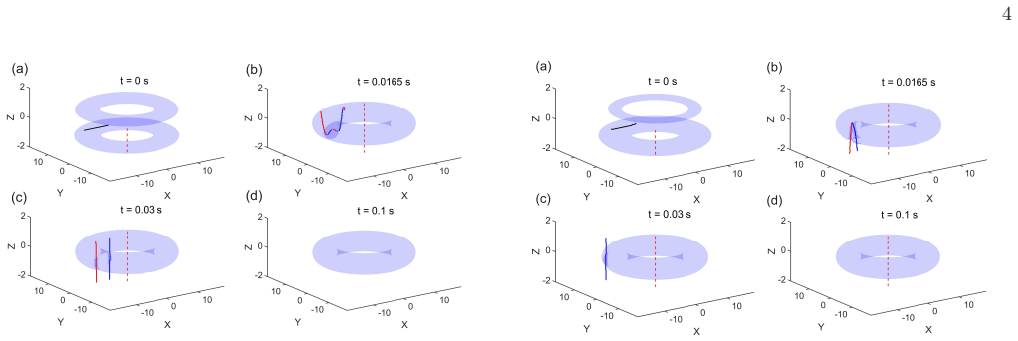
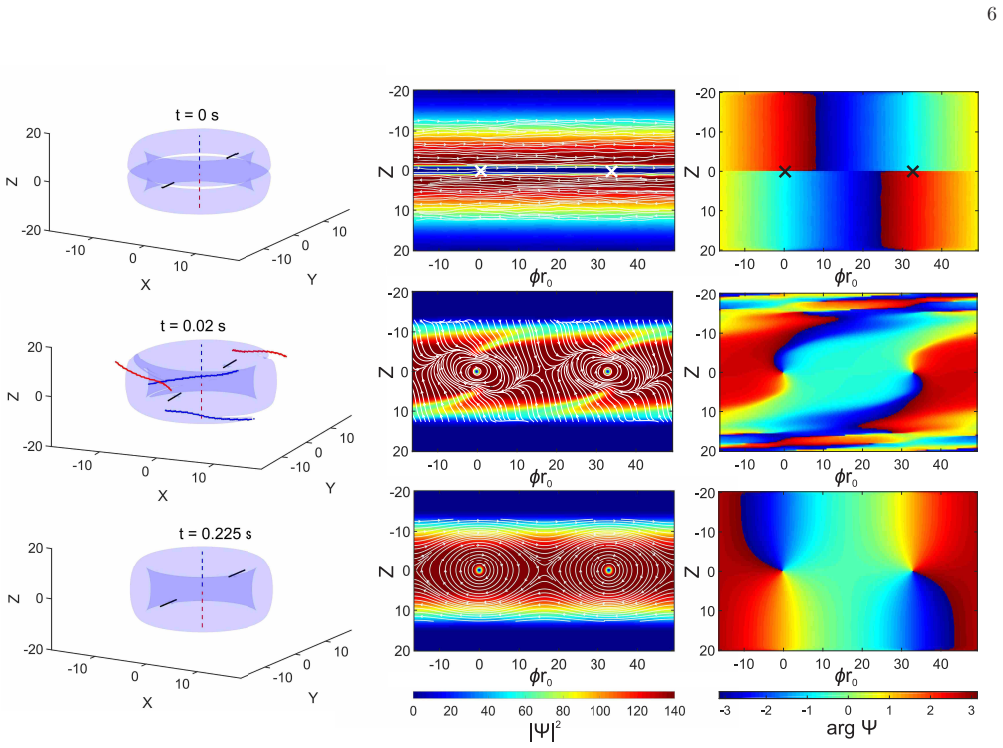
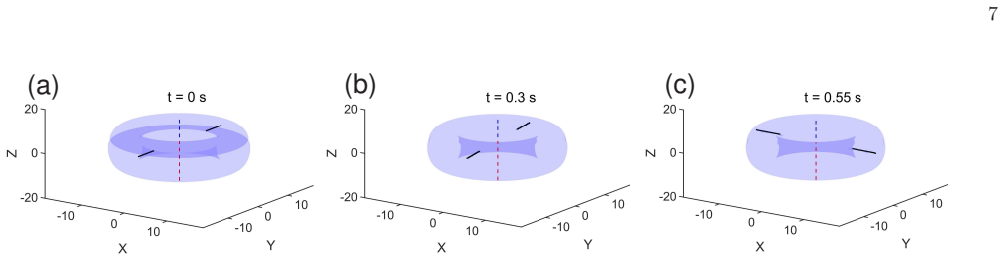
The load-bearing object is the Josephson vortex, a rotational fluxon that appears in the low-density barrier between two superflows with different topological charges because the tunneling current has azimuthal periodicity. The argument runs on the three-dimensional weakly dissipative Gross-Pitaevskii equation with a single dissipation constant $\gamma=0.03$, a toroidal trapping potential whose aspect ratio $A=\omega_z/\omega_r$ is either large (pancake) or small (elongated), and a time-dependent sheet barrier that vanishes linearly in time. The fluxon's fate—bending and splitting into vertically oriented vortex-antivortex pairs in pancake traps, or staying radially oriented in elongated traps—is what determines whether the final condensate acquires, keeps, or loses the angular momentum of the initially dominant ring. A geometric energy argument based on the ratio of Thomas-Fermi widths explains why the radial orientation is favored in elongated traps.
What would settle it
Prepare a double-ring condensate with vorticities $(m_1,m_2)=(1,0)$ and a pancake trap, ramp the barrier off, and measure the final angular momentum per particle for imbalances below and above $P=0.21$. Observing a gradual rather than steplike change of $L_p$ with $P$, or finding that the threshold shifts with the dissipation rate $\gamma$, would contradict the claim. Conversely, a direct measurement of a stable hybrid in an elongated trap with a residual barrier, whose $L_p$ changes when the barrier position is moved, would confirm the central prediction.
Extended reading notes
Core claim
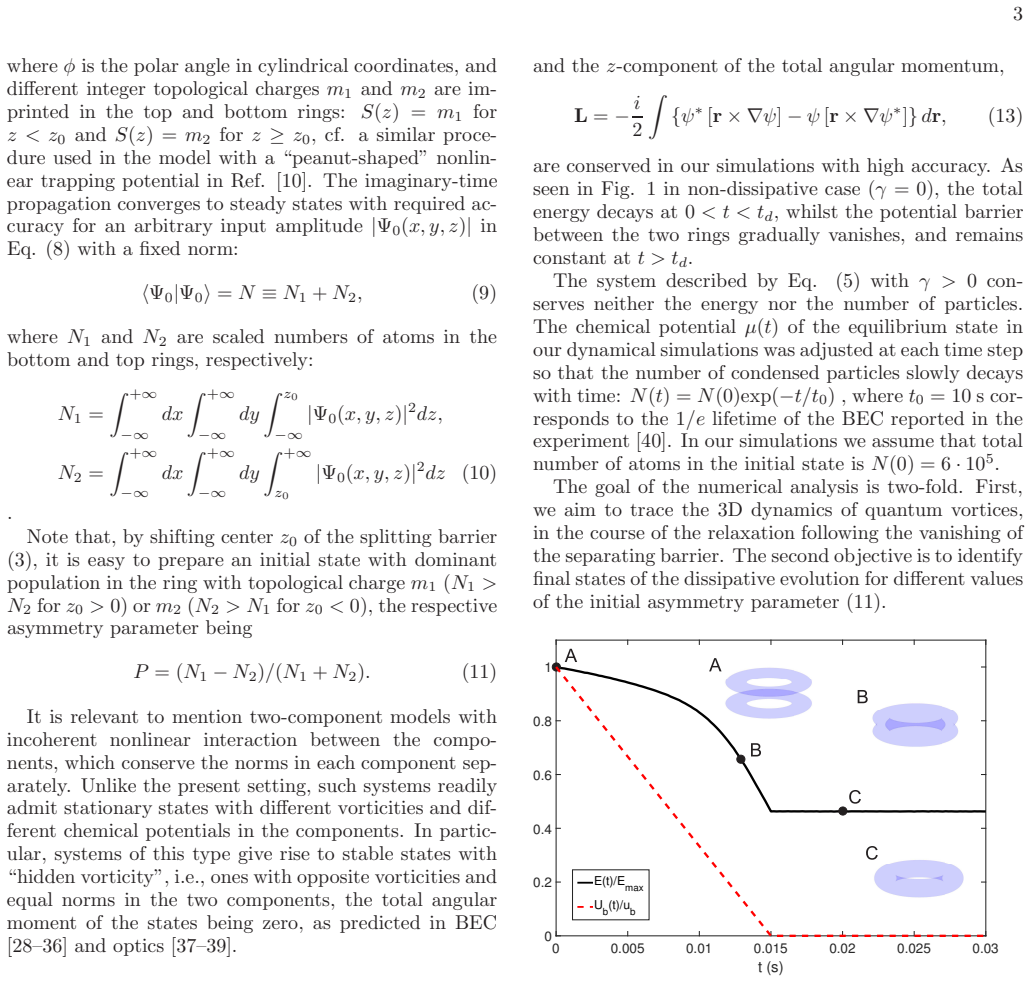
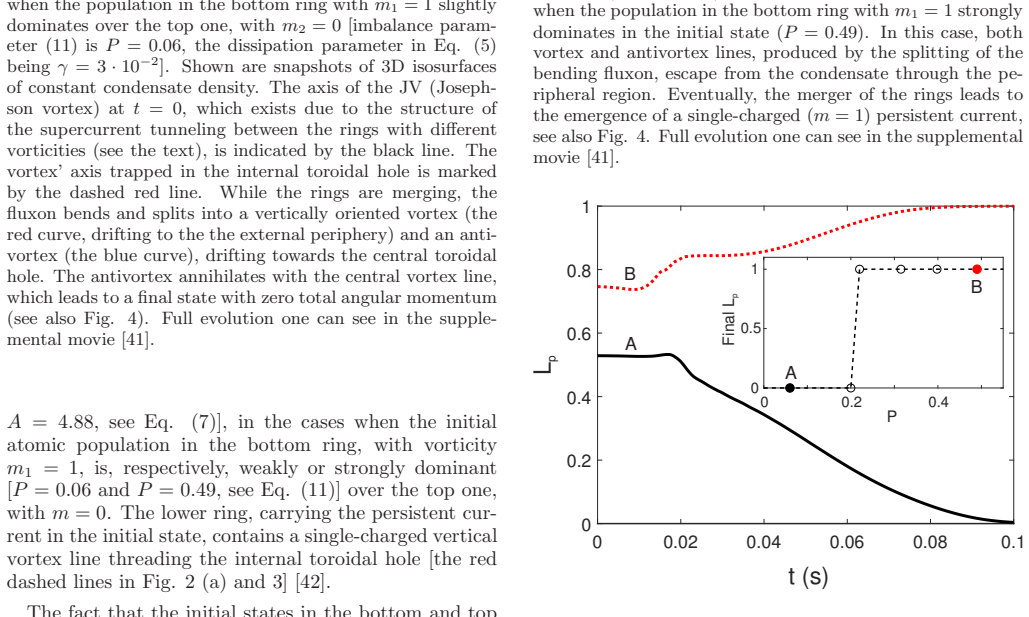
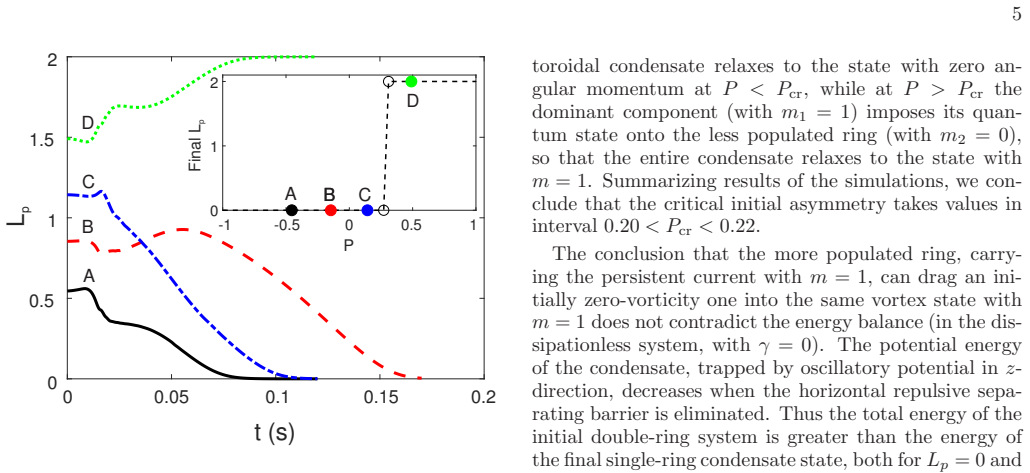
The paper's central claim is that the merger of two toroidal condensates with different vorticities is controlled by the nonlinear three-dimensional dynamics of Josephson vortices (rotational fluxons) that form in the tunneling barrier between the rings. For a pancake-shaped trap with initial vorticities $(m_1,m_2)=(1,0)$, the angular momentum per particle after relaxation is a step function of the initial population imbalance $P$: zero for $P<P_{\rm cr}$ and one quantum for $P>P_{\rm cr}$, with $0.20<P_{\rm cr}<0.22$. For $(m_1,m_2)=(2,0)$ the same logic selects a final state with either $m=0$ or $m=2$, never $m=1$, with $P_{\rm cr}\approx 0.29$. In an axially elongated trap with $m_1=1$, $m_2=-1$, the fluxons keep a horizontal (radial) orientation, the Kelvin-Helmholtz instability does not develop, and the long-lived hybrid state—two axially separated parts with different vorticities connected by radially oriented Josephson vortices—emerges. Keeping a nonzero residual barrier pins the fluxons and turns the hybrid into a completely stable stationary vortex complex whose angular momentum per particle can be tuned anywhere in $m_1<L_p<m_2$.
Load-bearing premise
The load-bearing assumption is that one small, spatially uniform friction parameter (set to 0.03 in the simulations) faithfully describes how real vortex lines drift and annihilate after the rings merge; the paper asserts without showing evidence that the outcomes do not depend on the exact value.
Editorial extensions
If this is right
- In pancake traps, the final angular momentum of a merged $(1,0)$ double ring is a sharply quantized switch: zero below $P_{\rm cr}\approx 0.21$, one quantum above it.
- A $(2,0)$ input cannot settle at $m=1$; symmetry forces the final state to either $m=0$ or $m=2$, with threshold $P_{\rm cr}\approx 0.29$.
- In elongated traps with $m_1=1,m_2=-1$, the 3D vortex lattice does not roll up into Kelvin-Helmholtz turbulence, even under noise of a few percent, so long-lived hybrids rather than turbulent decay are the expected outcome.
- Retaining a residual barrier pins the Josephson vortices and yields completely stable 3D hybrid vortex complexes with tunable angular momentum per particle over $m_1<L_p<m_2$.
- Tuning the barrier position after the hybrid forms changes $L_p$ dynamically, providing an in-situ control knob rather than only an initial-condition effect.
Reading between the lines
- If the central claim is right, a direct measurement of the step in $L_p$ at $P\approx 0.21$ in a pancake trap would be a clean experimental test, and the step location should be independent of ramp speed if the dissipation assumption is correct.
- The fluxon-splitting picture suggests that similar merger thresholds should appear in atomtronic circuits whenever two current-carrying loops with different circulation are connected by a tunable junction.
- If real dissipation is spatially nonuniform, the threshold $P_{\rm cr}$ likely becomes geometry-dependent rather than a universal number; varying the temperature of the thermal cloud could expose this.
- The completely stable hybrid with two axial vorticities and pinned fluxons is a natural platform for topologically protected information storage, since its two sectors carry distinct integer charges joined by Josephson vortices.
Signed reviews
Editorial analysis
A structured set of objections, weighed in public.
Referee Report
Summary. The paper studies the nonlinear merger dynamics of two vertically separated toroidal Bose-Einstein condensates carrying different initial vorticities, modeled by a three-dimensional weakly dissipative Gross-Pitaevskii equation with a gradually eliminated Gaussian barrier. For pancake-shaped traps with vorticities (m1,m2)=(1,0), the authors report a threshold initial population imbalance, Pcr in the interval 0.20<Pcr<0.22, below which the merged condensate relaxes to zero angular momentum and above which it relaxes to a single-charged persistent current; for (2,0) they report Pcr≈0.29 and no final m=1 state. For elongated (prolate) traps with m1=1, m2=-1, the simulations produce long-lived hybrid vortex structures with horizontal Josephson vortices, and the authors claim that a residual nonvanishing barrier pins these fluxons and makes the hybrids completely stable, with tunable angular momentum per particle.
Significance. If the reported effects hold, the paper contributes interesting and potentially testable predictions for persistent-current dynamics in atomtronic devices: a dominant superfluid ring can impose its vorticity on a less populated ring, and the final vorticity is controlled by the initial population imbalance and the trap aspect ratio. The model is standard and physically motivated, the explored regimes are clearly separated in parameter space, and the central claims are falsifiable by experiment and by direct simulation. The comparison with earlier 2D studies of Kelvin-Helmholtz instability is useful. However, the quantitative thresholds and the stability statements rest on numerical evidence that is not fully documented, and the asserted insensitivity to the dissipation parameter is not demonstrated.
major comments (3)
- [Section II, Eq. (1) and text after Eq. (1)] The paper states that "we have verified that results reported below do not essentially depend on a specific value of gamma << 1" but presents no data, figure, or table supporting this claim. This is load-bearing because the relaxation mechanism itself—vortex drift, fluxon bending and splitting, antivortex annihilation, and the vertical drift of fluxons—is explicitly described in Sections III.A and III.B as driven by gamma. A spatially uniform gamma=0.03 is a particular choice, and the threshold Pcr and the claimed hybrid lifetimes are dynamical outcomes that can in principle shift with gamma. Please provide a scan over gamma (e.g., final Lp versus P for gamma=0.01, 0.03, 0.06) or otherwise quantitatively demonstrate the insensitivity asserted in the text.
- [Section III.A, Figs. 4 and 5] The critical intervals 0.20<Pcr<0.22 for (m1,m2)=(1,0) and Pcr≈0.29 for (2,0) are determined from very sparse data: Fig. 4 shows only two evolution curves and its inset shows a handful of final points, while Fig. 5 shows four curves. No grid spacing, time step, domain size, or convergence tests are reported anywhere in the paper. Because the thresholds are central quantitative claims, the manuscript needs a statement of the numerical parameters and a demonstration that the threshold location is stable under resolution and time-step refinement, together with additional P values bracketing each threshold.
- [Section III.B, Fig. 8] The claim that a residual barrier makes the hybrid "completely stable" is supported only by finite-time simulations at a single value of gamma and without a quantitative stability analysis. The text states that hybrids are transient and will eventually transform into ordinary states, yet later calls the pinned configuration completely stable; the distinction is not established. Please provide either longer-time simulations with a stated duration, a scan over residual barrier height and gamma, or a linear stability analysis around the pinned state before using the word "stable" rather than "long-lived on the simulated timescale."
minor comments (5)
- [General/Introduction] There are several typos and inconsistent notations: "superfl uid" in the header, "filed" in the Introduction, and "withm = 0" in the caption of Fig. 3 should be "with m2 = 0."
- [Section II, Eqs. (1) and (8)] The wave function is denoted psi in Eq. (1) and Eq. (5) but Psi in Eq. (8); please use a single symbol or explicitly define the change. Also, Eq. (10) has a stray period after the closing brace.
- [Section II, text after Eq. (10)] The asymmetry parameter P is defined through N1 and N2, but the text discussing "N1 > N2 for z0 > 0" would benefit from an explicit statement of how z0 is related to the barrier center and the ring populations, since z0 is also used as a possible shift of the barrier position.
- [Section III.B, paragraph on hybrid decay] The sentences "they remain robust in the course of long evolution, and do not decay even being strongly perturbed" and "the emerging hybrid states are transient ones, as they will eventually transform into usual ones" are in tension; please clarify whether hybrids are finite-lifetime or effectively stable on experimental timescales.
- [References] Reference [9] is cited as an arXiv preprint; if it has been published, the published version should be cited. Additionally, the experimental parameters quoted from Refs. [26,27] would be easier to check if the corresponding trap geometries were summarized in one place.
Circularity Check
No significant circularity: the central thresholds and hybrid states are direct simulation outputs; the only self-citation is corroborative, not load-bearing.
full rationale
The paper's central quantitative claims—the threshold imbalance Pcr ≈ 0.21 for (m1,m2) = (1,0), Pcr ≈ 0.29 for (2,0), and the long-lived or stable 3D hybrids in elongated traps—are obtained by integrating the weakly dissipative Gross-Pitaevskii equation, Eq. (5), with fixed parameters and reading off the final angular momentum Lp from the simulated trajectories (Figs. 4, 5, 6, 8). No parameter is fitted to the target result, so the 'fitted input called prediction' pattern does not apply. The initial-state construction imprints integer vorticities m1 and m2 via Eq. (8), and the observed final states are genuinely different outputs (e.g., Lp = 0 versus Lp = 1 across Pcr). The one self-citation, Ref. [9], is used to assert that |m1 − m2| Josephson vortices form in the tunnel barrier, but the same section also states that this 'necessarily follows from the azimuthal periodicity of the condensate wave function', and the vortex structure is directly visible in the initial snapshots; hence the self-citation is corroborative rather than load-bearing. The hybrid Lp range m1 < Lp < m2 is consistent with the hybrid being composed of two domains of vorticities m1 and m2, but the stability and tunability of these hybrids are demonstrated numerically, not derived from that definition. The unsupported assertion of gamma-insensitivity (Section II) is a robustness assumption and a correctness risk, but it is not a circular reduction: varying gamma would affect the quantitative threshold, yet the threshold remains a simulation output rather than an input. Overall, the derivation chain is self-contained against direct numerical integration, so no circular step is identified.
Assumptions & free parameters
free parameters (3)
- gamma (dissipation parameter) =
0.03
- td (barrier elimination time) =
0.015 s
- ub (initial barrier strength) =
80 (scaled)
assumptions (3)
- domain assumption The 3D dissipative Gross-Pitaevskii equation with a single constant gamma models the coupled BEC dynamics.
- domain assumption Imaginary-time propagation with the phase ansatz Eq. (8) converges to physical stationary states with the desired vorticities in each ring.
- domain assumption The toroidal trapping potential of Eq. (2), with a harmonic radial minimum at rho0 and quadratic axial confinement, is an adequate representation of experimental double-ring traps.
Cite this review
Pith. "Pith review of Nonlinear dynamics of Josephson vortices in merging superfluid rings." pith.science (2026). https://pith.science/paper/RJ2NVEHR
@misc{pith2026190802468,
  author       = {Pith},
  title        = {Pith review of: Nonlinear dynamics of Josephson vortices in merging superfluid rings},
  year         = {2026},
  howpublished = {\url{https://pith.science/paper/RJ2NVEHR}},
  note         = {Machine review of arXiv:1908.02468}
}
read the original abstract
We consider merger of two parallel toroidal atomic Bose-Einstein condensates with different vorticities in a three-dimensional (3D) trap. In the tunnel-coupling regime, Josephson vortices (rotational fluxons) emerge in the barrier between the superflows. When the barrier is gradually eliminated, we observe essentially three-dimensional evolution of quantum vortices, which may include the development of the Kelvin-Helmholtz instability at the interface between the rings, in the framework of a weakly dissipative Gross-Pitaevskii equation. An initially more populated ring, carrying a persistent current, can drag an initially non-rotating less populated one into the same vortex state. The final state of the condensate crucially depends on an initial population imbalance in the double-ring set, as well as on the shape of the 3D trapping potential, oblate or prolate. In the prolate (axially elongated) configuration, robust 3D hybrid structures may appear as a result of the merger of persistent currents corresponding to different vorticities.
Figures
Figures from the paper (4 more)
Reference graph
Works this paper leans on
-
[1]
03 as in Refs. [12, 19]. Actually, we have verified that results reported below do not essentially depend on a specific value of γ ≪ 1. We consider a toroidal condensate, split by a blue- detuned sheet beam in upper and lower weakly coupled rings-shaped components. The respective total trapping potential is Vext(ρ,z,t ) = 1 2Mω 2 r(ρ −ρ0)2 + 1 2Mω 2 zz2 +Vb...
-
[2]
V. M. Kaurov and A. B. Kuklov, Phys. Rev. A 71, 011601 (2005)
work page 2005
-
[3]
A. V. Ustinov, Physica D 123, 315 (1998)
work page 1998
-
[4]
Gallem ´ ı, A. and Guilleumas, M. and Mayol, R. and Ma- teo, A. Mu˜ noz, Phys. Rev. A 93, 033618 (2016)
work page 2016
-
[5]
V. M. Kaurov and A. B. Kuklov, Phys. Rev. A 73, 013627 (2006), cond-mat/0508342
work page Pith review arXiv 2006
- [6]
- [7]
-
[8]
J. A. Gil Granados, A. Mu˜ noz Mateo, M. Guilleumas, and X. Vi˜ nas, New Journal of Physics21, 043036 (2019)
work page 2019
Show all 50 references
-
[9]
Christian Baals, Herwig Ott, Joachim Brand, Antonio Muoz Mateo, Phys. Rev. A 98, 053603 (2018)
2018
-
[10]
Driben, Y
R. Driben, Y. Kartashov, B. A. Malomed, T. Meier, and L. Torner, New J. Phys. 16, 063035 (2014)
2014
-
[11]
Oliinyk, A
A. Oliinyk, A. Yakimenko, and B. Malomed, arXiv e- prints (2019), arXiv:1901.06502 [cond-mat.quant-gas]
2019 arXiv
-
[12]
Tsubota, M
M. Tsubota, M. Kobayashi, H. Takeuchi, Phys. Rep. 522, 191 (2013)
2013
-
[13]
W. R. Peltier and C. P. Caulfield, Ann. Rev. Fluid Mech. 35, 135 (2003)
2003
-
[14]
Takeuchi, N
H. Takeuchi, N. Suzuki, K. Kasamatsu, H. Saito, and M. Tsubota, Phys. Rev. B 81, 094517 (2010), arXiv:0909.2144 [cond-mat.quant-gas]
2010 arXiv
-
[15]
for |m1 −m2| = 20, hence the respective vortex street contained 40 vortex cores. As pointed out in [15], in the absence of perturbations the vortex streets survived for a long time; however, under the action of noisy perturba- tions (whose magnitude was less than one percent o...
-
[16]
Suzuki, H
N. Suzuki, H. Takeuchi, K. Kasamatsu, M. Tsub- ota, and H. Saito, Phys. Rev. A 82, 063604 (2010), arXiv:1009.1740 [cond-mat.quant-gas]. 9
2010 arXiv
-
[17]
Baggaley, N.G
A.W. Baggaley, N.G. Parker, Phys. Rev. A 97, 053608 (2018)
2018
-
[18]
A. I. Yakimenko, Yu. M. Bidasyuk, O.O. Prikhodko, S.I. Vilchinskii, E.A. Ostrovskaya, and Yu. S. Kivshar, Phys. Rev. A 88, 043637 (2013)
2013
-
[19]
S. J. Rooney, A. S. Bradley, and P. B. Blakie, Phys. Rev. A 81, 023630 (2010)
2010
-
[20]
Moulder, S
S. Moulder, S. Beattie, R. P. Smith, N. Tammuz, and Z. Hadzibabic, Phys. Rev. A 86, 013629 (2012)
2012
-
[21]
A. I. Yakimenko, Y. M. Bidasyuk, O. O. Prikhodko, S. I. Vilchinskii, E. A. Ostrovskaya, and Y. S. Kivshar, Phys. Rev. A 88, 043637 (2013)
2013
-
[22]
A. J. Allen, E. Zaremba, C. F. Barenghi, and N. P. Proukakis, Phys. Rev. A 87, 013630 (2013)
2013
-
[23]
Y. M. Bidasyuk, A. V. Chumachenko, O. O. Prikhodko, S. I. Vilchinskii, M. Weyrauch, and A. I. Yakimenko, Phys. Rev. A 92, 053603 (2015)
2015
-
[24]
S. Choi, S. A. Morgan, and K. Burnett, Phys. Rev. A 57, 4057 (1998)
1998
-
[25]
N. P. Proukakis and B. Jackson, J. Phys. B: At. Mol. Opt. Phys. 41, 203002 (2008)
2008
-
[26]
Carretero-Gonzalez, N
R. Carretero-Gonzalez, N. Whitaker, P. G. Kevrekidis, and D. J. Frantzeskakis, Phys. Rev. A 77, 023605 (2008)
2008
-
[27]
Kasamatsu, M
K. Kasamatsu, M. Tsubota, and M. Ueda, Phys. Rev. A 67, 033610 (2003)
2003
-
[28]
K. C. Wright, R. B. Blakestad, C. J. Lobb, W. D. Phillips, G. K. Campbell, Phys. Rev. Lett. 110, 025302 (2013)
2013
-
[29]
Jendrzejewski, S
F. Jendrzejewski, S. Eckel, N. Murray, C. Lanier, M. Ed- wards, C. J. Lobb, and G. K. Campbell, Phys. Rev. Lett. 113, 045305 (2014)
2014
-
[30]
Brtka, A
M. Brtka, A. Gammal, and B. A. Malomed, Phys. Rev. A 82, 053610 (2010)
2010
-
[31]
L. Wen, Y. Qiao, Y. Xu, and L. Mao, Phys. Rev. A 87, 033604 (2013)
2013
-
[32]
A. I. Yakimenko, K. O. Isaieva, S. I. Vilchinskii, and M. Weyrauch, Phys. Rev. A 88, 051602 (2013)
2013
-
[33]
Ishino, M
S. Ishino, M. Tsubota, and H. Takeuchi, Phys. Rev. A 88, 063617 (2013)
2013
-
[34]
Ishino, M
S. Ishino, M. Tsuboto, and H. Takeuchi, EPL 111, 30005 (2015)
2015
-
[35]
Hoashi, Y
M. Hoashi, Y. Nakamura, and Y. Yamanaka, Phys. Rev. A 93, 043622 (2016)
2016
-
[36]
Xu, Z.-Q
S.-L. Xu, Z.-Q. Wang, J.-R. He, L. Xue, and M. R. Belic, J. Mod. Opt. 65, 1542 (2018)
2018
-
[37]
Y. Li, Z. Chen, Z. Luo, C. Huang, H. Tan, W. Pang, and B. A. Malomed, Phys. Rev. A 98, 063602 (2018), arXiv:1801.10274 [cond-mat.quant-gas]
2018 arXiv
-
[38]
Z. Chen, Y. Li, N. P. Proukakis, and B. A. Malomed, New J. Phys. 21, 073058 (2019)
2019
-
[39]
Leykam, B
D. Leykam, B. Malomed, and A. S. Desyatnikov, J. Op- tics 82, 053610 (2013)
2013
-
[40]
J. R. Salgueiro, J. Optics 18, 074004 (2016)
2016
-
[41]
Mayteevarunyoo, B
T. Mayteevarunyoo, B. Malomed, and D. Skryabin, New J. Phys. 20, 113019 (2018)
2018
-
[42]
Beattie, S
S. Beattie, S. Moulder, R. J. Fletcher, and Z. Hadzibabi c, Phys.Rev. Lett. 110, 025301 (2013)
2013
-
[43]
We present animations of dynamics of vortices with smal l and big initial imballance P , degradation of hybrid sys- tem in time and pinning possibility in systems of hybrid type
-
[44]
For vertically oriented vortex lines (detected in z =const plane) we use red (vortices) and blue (antivortices) colors
To detect the vortex cores we use an algorithm of numeri- cal phase unwrapping at each point of the grid in different planes: z =const, x =const or y =const. For vertically oriented vortex lines (detected in z =const plane) we use red (vortices) and blue (antivortices) colors. ...
-
[45]
A. I. Yakimenko, Y. M. Bidasyuk, M. Weyrauch, Y. I. Kuriatnikov, and S. I. Vilchinskii, Phys. Rev. A 91, 033607 (2015)
2015
-
[46]
Kanai, W
T. Kanai, W. Guo, and M. Tsubota, Phys. Rev. A 97, 013612 (2018)
2018
-
[47]
Kanai, W
T. Kanai, W. Guo, and M. Tsubota, Journal of Low Temperature Physics 195, 37 (2019)
2019
-
[48]
A. Ohta, R. Kashiwa, and H. Sakaguchi, Phys. Rev. A 82, 055602 (2010)
2010
-
[49]
Kasamatsu, M
K. Kasamatsu, M. Tsubota, Phys. Rev. A 79, 023606 (2009)
2009
-
[50]
Das Sarma, M
S. Das Sarma, M. Freedman, and C. Nayak, Phys. Rev. Lett. 94, 166802 (2005)
2005
Reviewed August 14, 2026 · model on record in the stance chip above.
Discussion (0). Continue with ORCID to comment.