REVIEW 3 major objections 4 minor 42 references
Radio continuum emission from local analogs of high-z faint LAEs: Blueberry galaxies
T0 review · 3 major / 4 minor · reviewed 2026-08-14 · deepseek-v4-flash
Pith's one-line read Radio-based star formation rates in blueberry galaxies are suppressed by a factor of about 3.4 relative to H-alpha-based rates, indicating that these young, compact starbursts have not yet built up equilibrium synchrotron emission or are…
desk verdict First radio detections of blueberry galaxies show a real SFR deficit, but the derived non-thermal fractions and B-fields are transforms of that one ratio, not independent measurements. read the letter →
The pith
A machine-rendered reading of the paper's core claim, the machinery that carries it, and where it could break.
The reading
What carries the argument
The central device is the comparison between two independent SFR tracers: the 1.4 GHz radio luminosity (calibrated by Murphy et al. 2011, Eq. 17) and the H-$\alpha$ luminosity from Yang et al. (2017). The argument works by assuming the thermal radio component traces H-$\alpha$, using the Tabatabaei et al. (2017) calibration, so that the observed deficit is attributed to the non-thermal or synchrotron component; the non-thermal fraction is then derived as $1 - \delta$, where $\delta$ is the ratio of the thermal radio luminosity expected from H-$\alpha$ to the observed total radio luminosity. The equipartition magnetic field estimate uses the revised Beck & Krause (2005) formula with an assumed proton-to-electron ratio of 100, a spectral index of $-0.7$, and a path length of 0.3 kpc.
What would settle it
Measure the radio continuum of a matched sample of blueberry galaxies at two widely separated frequencies, such as 1.4 GHz and ~33 GHz, and decompose the thermal and synchrotron components from the spectral index. If the thermal radio emission independently matches the H-alpha SFR while the non-thermal component is negligible, the low radio SFR is explained by missing synchrotron; but if a recalibration using the measured thermal fraction brings the radio SFR into agreement with H-alpha, the suppression factor would be shown to be partly a calibration artifact. A search for the predicted low-frequency spectral break from cosmic-ray diffusion or outflows would directly test the escape scenario.
Extended reading notes
Core claim
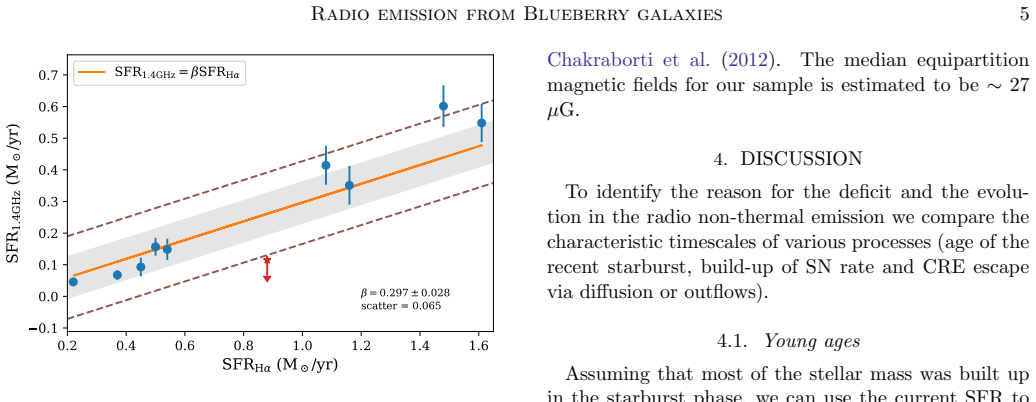
Using uGMRT Band-5 data, the authors detect 9 of 10 blueberry galaxies at about 1.25 GHz. Comparing SFRs derived from the Murphy et al. (2011) 1.4 GHz luminosity calibration with H-$\alpha$ SFRs from Yang et al. (2017), a least-squares fit gives a slope of 0.297 $\pm$ 0.028, meaning radio-based SFRs are suppressed by a factor of about 3.4. Because both SFR calibrators use the same Kroupa IMF and stellar mass limits, the offset is not an IMF artifact. Assuming the thermal radio component traces H-$\alpha$, the median non-thermal fraction is about 0.49, lower than in normal star-forming galaxies at similar frequencies; the inferred equipartition magnetic field is about 27 $\mu$G, higher than in spiral galaxies. The authors propose that the radio deficit is intrinsic, not due to inverse-Compton losses, and is caused by the young age of the starburst and/or escape of cosmic-ray electrons, with the strong magnetic fields likely produced by a small-scale dynamo.
Load-bearing premise
The argument assumes that the Murphy et al. (2011) radio-to-star-formation calibration, established on normal star-forming galaxies with an equilibrium mix of thermal and non-thermal emission, transfers unchanged to blueberries; if it does not, part or all of the reported ~3.4 suppression could be a calibration offset rather than a physical radio deficit.
Editorial extensions
If this is right
- Radio continuum undercounts ongoing star formation in very young starbursts, so SFR calibrations tuned on older normal galaxies need an age or evolution correction; for blueberries a factor of about 3.4 restores consistency with H-alpha.
- The low non-thermal fraction near 0.49 means thermal emission can dominate at about 1 GHz in these galaxies, unlike normal star-forming galaxies, so treating the radio emission as synchrotron-dominated would overestimate non-thermal processes.
- If the deficit is intrinsic and driven by young age or cosmic-ray escape, similar suppression should appear in high-redshift faint Lyman-alpha emitters even after removing inverse-Compton losses, implying that high-redshift radio deficits may be partly intrinsic.
- Equipartition fields of tens of microgauss in very young, small galaxies imply rapid magnetic amplification, favoring small-scale turbulent dynamo over large-scale rotational dynamo during early galaxy formation.
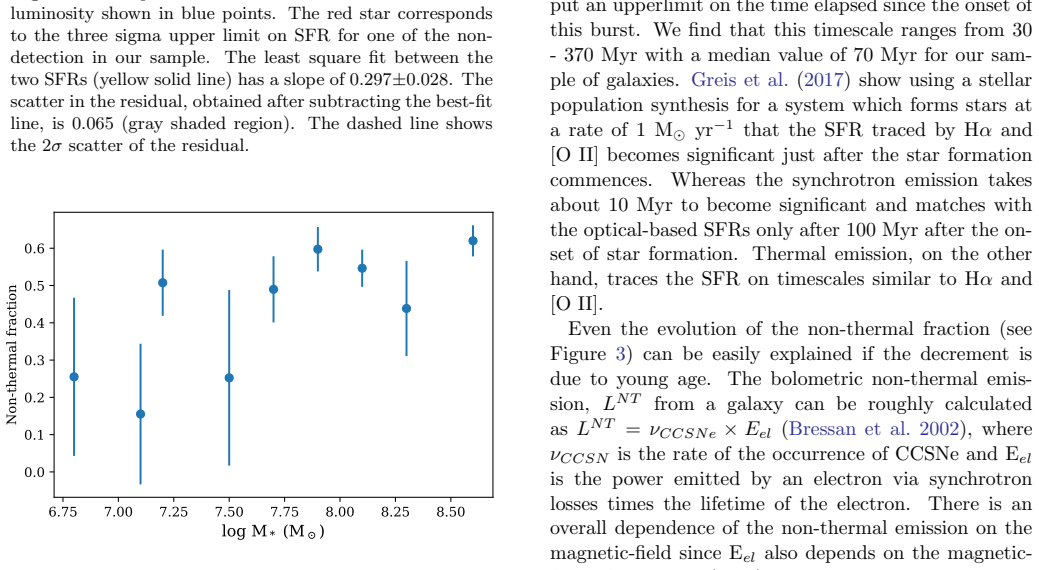
- The tentative positive correlation between non-thermal fraction and stellar mass, if confirmed, would trace a smooth growth of the synchrotron component as galaxies build up mass and age.
Reading between the lines
- A direct test separating the two proposed mechanisms would be broadband radio spectroscopy: an age-driven deficit should show a delayed onset or steepening of the synchrotron spectrum, while cosmic-ray escape via diffusion or advection should produce a low-frequency spectral break.
- If the suppression is age-related, the radio-to-H-alpha ratio within a single blueberry galaxy should increase as its starburst ages; spatially resolved or time-resolved star-formation histories could test whether the most recently ignited galaxies show the largest deficit.
- The Spearman correlation of about 0.68 between non-thermal fraction and stellar mass hints at an evolutionary sequence; extending the same analysis to green peas and more massive compact dwarfs could turn this tentative correlation into a quantitative mass-age relation.
- The combination of high equipartition fields with low non-thermal fraction suggests that magnetic energy may be present without a corresponding relativistic electron population; future polarization or Faraday-rotation measurements could reveal whether the field is volume-filling or confined to supernova remnants.
Signed reviews
Editorial analysis
A structured set of objections, weighed in public.
Referee Report
Summary. The paper presents the first radio continuum observations of nine 'blueberry' galaxies, a population of extremely young, low-mass, low-metallicity starbursts considered local analogs of high-redshift faint Lyman-alpha emitters. Using uGMRT Band-5 data at about 1.25 GHz, the authors detect nine of ten targets and compare 1.4 GHz radio-based star formation rates (computed with the Murphy et al. 2011 calibration) with H-alpha-based SFRs from Yang et al. (2017). They report a factor of about 3.4 suppression in radio-derived SFR relative to optical-line-derived SFR, a median non-thermal radio fraction of about 0.49 (derived by assuming the thermal radio luminosity traces the H-alpha star formation), and a median equipartition magnetic field of about 27 microgauss. They discuss two possible causes for the radio deficit: young starburst ages before supernova feedback establishes a steady-state cosmic-ray electron population, and escape of cosmic-ray electrons via diffusion or outflows. They further argue that the high magnetic field supports small-scale dynamo amplification. The paper is a pilot study with a small sample and explicitly states that it cannot distinguish between the proposed scenarios.
Significance. The observational data are new and valuable: this is the first radio study of blueberry galaxies, and the sample is relevant to understanding radio emission in low-mass, low-metallicity, young starburst systems that may resemble high-redshift LAEs. If the radio deficit is physical, it has implications for the applicability of standard radio-SFR calibrations to such populations and for the interpretation of stacked radio detections of high-redshift galaxies. The paper is honest about its limitations (small sample, no scenario discrimination) and presents the data in a useful way. However, the quantitative claims about the non-thermal fraction and magnetic field are strongly model-dependent, and the headline suppression factor is partly a calibration-transfer assumption rather than a purely observational ratio. The strength of the paper lies in the detections and the clear presentation of the observed SFR_1.4GHz/SFR_Halpha relation; the physical interpretation requires more support.
major comments (3)
- The headline claim that the radio-based SFR is suppressed by a factor of about 3.4 is obtained by comparing SFR_1.4GHz derived from the Murphy et al. (2011) total-radio calibration with the H-alpha SFR. The Murphy et al. calibration was established for normal star-forming galaxies in which the 1.4 GHz emission is roughly 90% non-thermal. The paper's own proposed mechanisms (young age, cosmic-ray escape) would suppress precisely the non-thermal component. Therefore the factor of 3.4 bundles together a possible physical deficit and the difference between the assumed non-thermal fraction in the calibration and the actual (unmeasured) non-thermal fraction in blueberries. The observed ratio of radio luminosity to H-alpha luminosity is model-independent, but its conversion to an SFR suppression is not. Please either present the result primarily as the observed SFR_1.4GHz/SFR_Halpha ratio and discuss explicitly that part of the factor could be a calibration offset, or provide a quantitative estimate of how much of the 3.4 factor remains under the assumption that only the non-thermal component is suppressed while the thermal component obeys the H-alpha relation.
- The non-thermal fraction is not independently measured; it is derived by assuming SFR_Halpha = SFR_th = beta * delta * L_tot. Combining this with the Murphy et al. calibration SFR_1.4GHz = C_M * L_tot and the fitted relation SFR_1.4GHz = 0.297 * SFR_Halpha gives delta = C_M / (0.297 * beta) for the median relation. Thus the median non-thermal fraction is algebraically fixed by the ratio of two calibrations and the fitted slope, not determined by the radio data themselves. The per-galaxy scatter in Figure 3 only reflects deviations from the global fit and measurement errors. Consequently, the derived non-thermal fraction can neither confirm nor independently constrain the radio deficit, and the subsequent magnetic-field estimate that depends on the non-thermal luminosity (1-delta)*L_tot inherits this same limitation. Please state explicitly that the non-thermal fraction is a derived quantity that follows from the assumption that thermal radio emission traces H-alpha, rather than a direct measurement, and do not present it as corroborating the suppression.
- The median equipartition magnetic field of about 27 microgauss depends on several unverified assumptions for this population: energy equipartition between cosmic rays and magnetic fields, a proton-to-electron ratio K=100, a radio spectral index alpha=-0.7, and a path length of 0.3 kpc. For low-mass, low-metallicity, young starbursts, equipartition is not guaranteed, and the derived field strength scales sensitively with the assumed non-thermal fraction and path length. The paper should provide a plausible range of B under alternative choices of K and path length (for example, using the observed scatter in the non-thermal fraction or values from the literature for dwarf starbursts) and should clearly label the quoted value as an indicative rather than a robust measurement.
minor comments (4)
- There are several typographical errors: 'can the be estimated' should read 'can then be estimated'; 'least square fit' should be 'least-squares fit'; and the diffusion timescale expression in Section 4.2 ('tD = R2 D') is missing the division sign and should be t_D = R^2 / D with D = l0 c / 3.
- The scatter quoted after the fit (0.065) is given without units; please specify whether it is in dex or in the linear units of the plotted SFR values, as this affects the interpretation of the gray band.
- The least-squares fit in Figure 2 does not incorporate the uncertainties on either SFR_1.4GHz or SFR_Halpha, and the sample contains only nine detections. Given the small dynamic range, please report the fit using a method that accounts for measurement errors (e.g., orthogonal or Bayesian regression) or at least discuss how including errors would affect the slope and its uncertainty.
- The non-detection of ObjID 5 is excluded from the main analysis, which is reasonable, but it would be useful to also show its 3-sigma upper limit in Figure 3 (or state explicitly that it is omitted) to indicate how the non-thermal fraction trend might be affected by including this source.
Circularity Check
Non-thermal fraction and inferred magnetic field are transformations of the radio/Hα slope by construction; the 3.4× suppression itself is an observed ratio, not circular.
-
self definitional
[Section 3, non-thermal fraction derivation (paragraph beginning 'In both the above cases...')]
"Under this assumption, we can estimate the non-thermal fraction as follows. Let δ be thermal fraction such that the thermal luminosity at L-band (L th) is δ times the total observed radio luminosity at L-band (L tot). And let β be the thermal radio calibration factor used to estimate the SFR from Tabatabaei et al. (2017). We can then relate the SFR from H α emission and δ as: SFRHα =SFRth =β × (Lth) = β × (δLtot). The non-thermal fraction, which is nothing but (1-δ), can the be estimated using this above relation."
The thermal fraction δ is defined by assuming SFR_Hα equals the thermal radio SFR. But SFR_1.4GHz was already computed from the same total L_tot via the Murphy et al. (2011) calibration, and the fitted relation is SFR_1.4GHz = 0.297 SFR_Hα. Hence δ = (C_Murphy/β_Tabatabaei)/0.297, and the non-thermal fraction 1−δ is a deterministic rescaling of the fitted slope and the two calibrations. It is not an independent estimate of the thermal/non-thermal partition; it merely restates the assumption that the entire radio deficit is non-thermal. Thus the median non-thermal fraction of ~0.49 is forced by the input definitions, not measured.
-
self definitional
[Section 3, equipartition magnetic-field estimate (paragraph starting 'The origin of the non-thermal radio emission...')]
"We estimate the magnetic fields from the non-thermal flux density values in these galaxies. We make use of the revised formula given by Beck & Krause (2005) for calculating the equipartition magnetic fields."
The non-thermal flux density used as input is not independently measured; it is obtained as (1−δ) L_tot, with δ from the circular relation above. Consequently the reported median equipartition field of 27 µG inherits the self-definitional non-thermal fraction. The magnetic-field estimate therefore does not provide independent support for the small-scale-dynamo interpretation; it is downstream of the same assumption that the radio deficit is entirely non-thermal.
full rationale
The headline result—that radio-based SFRs are lower than Hα-based SFRs by a factor ~3.4—is not circular: SFR_1.4GHz comes from the external Murphy et al. (2011) calibration of total radio luminosity, SFR_Hα comes from Yang et al. (2017) optical measurements, and the comparison is a direct observed ratio. No parameter is fit to the Hα data to produce the radio SFR. The circularity starts when the paper converts this ratio into a physical partition. The derivation of the non-thermal fraction explicitly assumes SFR_Hα = thermal radio SFR, and with the fitted slope 0.297 the non-thermal fraction is algebraically 1 − (C_Murphy/β_Tabatabaei)/0.297. It is a reparametrization of the fitted line and the calibration constants, not an independent check on the suppression mechanism. The equipartition magnetic field is then computed from this same circularly derived non-thermal flux. The paper is transparent about the assumption ('Under this assumption') and states it cannot distinguish the young-age and CRE-escape scenarios; nevertheless, presenting the resulting non-thermal fraction and magnetic field as estimated results is partially circular. The central 3.4× suppression, however, remains an independent empirical ratio, so the overall circularity is partial, not total.
Assumptions & free parameters
free parameters (5)
- radio-to-Halpha SFR slope =
0.297 +/- 0.028
- proton-to-electron energy density ratio K =
100
- radio spectral index alpha =
-0.7
- path length through the source =
0.3 kpc
- diffusion mean free path l0 =
0.3 kpc
assumptions (5)
- domain assumption Murphy et al. (2011) 1.4 GHz total radio luminosity to SFR calibration holds for blueberry galaxies.
- domain assumption Thermal radio luminosity traces SFR on the same timescale as Halpha, so SFR_Halpha = beta * L_th using the Tabatabaei et al. (2017) calibration.
- domain assumption Equipartition between cosmic ray energy density and magnetic field energy density holds in blueberry galaxies.
- domain assumption The stellar masses and Halpha fluxes from Yang et al. (2017) are accurate and the galaxies are at the quoted spectroscopic redshifts.
- standard math Standard WMAP9 cosmology applies (Omega_M=0.286, Omega_Lambda=0.714, h=0.69).
Cite this review
Pith. "Pith review of Radio continuum emission from local analogs of high-z faint LAEs: Blueberry galaxies." pith.science (2026). https://pith.science/paper/RJF6FID7
@misc{pith2026190806410,
  author       = {Pith},
  title        = {Pith review of: Radio continuum emission from local analogs of high-z faint LAEs: Blueberry galaxies},
  year         = {2026},
  howpublished = {\url{https://pith.science/paper/RJF6FID7}},
  note         = {Machine review of arXiv:1908.06410}
}
abstract
We present a radio continuum study of a population of extremely young and starburst galaxies, termed as blueberries at ${\sim}$ 1 GHz using the upgraded Giant Metrewave Radio Telescope (uGMRT). We find that their radio-based star formation rate (SFR) is suppressed by a factor of ${\sim}$ 3.4 compared to the SFR based on optical emission lines. This might be due to (i) the young ages of these galaxies as a result of which a stable equilibrium via feedback from supernovae has not yet been established (ii) escape of cosmic ray electrons via diffusion or galactic scale outflows. The estimated non-thermal fraction in these galaxies has a median value of ${\sim}$0.49, which is relatively lower than that in normal star-forming galaxies at such low frequencies. Their inferred equipartition magnetic field has a median value of 27 ${\mu}$G, which is higher than those in more evolved systems like spiral galaxies. Such high magnetic fields suggest that small-scale dynamo rather than large-scale dynamo mechanisms might be playing a major role in amplifying magnetic fields in these galaxies.
Figures

Reference graph
Works this paper leans on
-
[1]
N., Adelman-McCarthy, J
Abazajian, K. N., Adelman-McCarthy, J. K., Ag¨ ueros, M. A., et al. 2009, ApJS, 182, 543
2009
-
[2]
2005, Astronomische Nachrichten, 326, 414 Radio emission from Blueberry galaxies 7
Beck, R., & Krause, M. 2005, Astronomische Nachrichten, 326, 414 Radio emission from Blueberry galaxies 7
work page 2005
-
[3]
Dwarakanath, K. S. 2018, ApJ, 865, 39
work page 2018
- [4]
-
[5]
Bressan, A., Silva, L., & Granato, G. L. 2002, A&A, 392, 377
work page 2002
-
[6]
Calvez, A., Kusenko, A., & Nagataki, S. 2010, PhRvL, 105, 091101
work page 2010
-
[7]
2009, MNRAS, 399, 1191
Cardamone, C., Schawinski, K., Sarzi, M., et al. 2009, MNRAS, 399, 1191
2009
-
[8]
Carilli, C. L., Lee, N., Capak, P., et al. 2008, ApJ, 689, 883
work page 2008
Show all 42 references
-
[9]
2012, ApJL, 746, L6
Chakraborti, S., Yadav, N., Cardamone, C., & Ray, A. 2012, ApJL, 746, L6
2012
-
[10]
Condon, J. J. 1992, ARA&A, 30, 575
1992
-
[11]
J., Lang, D., et al
Dey, A., Schlegel, D. J., Lang, D., et al. 2019, AJ, 157, 168
2019
-
[12]
B., Garel, T., Wisotzki, L., et al
Drake, A. B., Garel, T., Wisotzki, L., et al. 2017, A&A, 608, A6
2017
-
[13]
L., et al
Dressler, A., Henry, A., Martin, C. L., et al. 2015, ApJ, 806, 19 Ferri` ere, K. M., & Blanc, M. 1996, J. Geophys. Res., 101, 19871
2015
-
[14]
2007, ApJ, 671, 278
Gawiser, E., Francke, H., Lai, K., et al. 2007, ApJ, 671, 278
2007
-
[15]
Greis, S. M. L., Stanway, E. R., Levan, A. J., Davies, L. J. M., & Eldridge, J. J. 2017, MNRAS, 470, 489
2017
-
[16]
2017, Current Science, 113, 707
Gupta, Y., Ajithkumar, B., Kale, H., et al. 2017, Current Science, 113, 707
2017
-
[17]
Heckman, T. M. 2002, in Astronomical Society of the Pacific Conference Series, Vol. 254, Extragalactic Gas at Low Redshift, ed. J. S. Mulchaey & J. T. Stocke, 292
2002
-
[18]
M., Armus, L., & Miley, G
Heckman, T. M., Armus, L., & Miley, G. K. 1990, ApJS, 74, 833
1990
-
[19]
P., Brinks, E., & Hunter, D
Heesen, V., Rau, U., Rupen, M. P., Brinks, E., & Hunter, D. A. 2011, ApJL, 739, L23
2011
-
[20]
2013, The Astrophysical Journal Supplement Series, 208, 19
Hinshaw, G., Larson, D., Komatsu, E., et al. 2013, The Astrophysical Journal Supplement Series, 208, 19
2013
-
[21]
E., & Miller, N
Ho, I.-T., Wang, W.-H., Morrison, G. E., & Miller, N. A. 2010, ApJ, 722, 1051
2010
-
[22]
I., Orlitov´ a, I., Schaerer, D., et al
Izotov, Y. I., Orlitov´ a, I., Schaerer, D., et al. 2016, Nature, 529, 178
2016
-
[23]
C., Calzetti, D., Aniano, G., et al
Kennicutt, R. C., Calzetti, D., Aniano, G., et al. 2011, PASP, 123, 1347
2011
-
[24]
2018, A&A, 611, A55
Klein, U., Lisenfeld, U., & Verley, S. 2018, A&A, 611, A55
2018
-
[25]
M., Cen, R., Ostriker, J
Kulsrud, R. M., Cen, R., Ostriker, J. P., & Ryu, D. 1997, ApJ, 480, 481
1997
-
[26]
W., Pooley, G
Lisenfeld, U., Wilding, T. W., Pooley, G. G., & Alexander, P. 2004, MNRAS, 349, 1335
2004
-
[27]
J., Lutz, D., et al
Magnelli, B., Ivison, R. J., Lutz, D., et al. 2015, A&A, 573, A45
2015
-
[28]
E., Finkelstein, S
Malhotra, S., Rhoads, J. E., Finkelstein, S. L., et al. 2012, ApJL, 750, L36
2012
-
[29]
J., Condon, J
Murphy, E. J., Condon, J. J., Schinnerer, E., et al. 2011, ApJ, 737, 67
2011
-
[30]
1995, PhD thesis, PhD Thesis, Univ
Niklas, S. 1995, PhD thesis, PhD Thesis, Univ. Bonn, (1995)
1995
-
[31]
2015, ApJ, 807, 141 P´ erez-Torres, M
Pannella, M., Elbaz, D., Daddi, E., et al. 2015, ApJ, 807, 141 P´ erez-Torres, M. A., & Alberdi, A. 2007, MNRAS, 379, 275
2015
-
[32]
G., & Prabhu, T
Ramya, S., Kantharia, N. G., & Prabhu, T. P. 2011, ApJ, 728, 124
2011
-
[33]
Rau, U., & Cornwell, T. J. 2011, A&A, 532, A71
2011
-
[34]
2015, IAU General Assembly, 22, 2243950
Rieder, M., & Teyssier, R. 2015, IAU General Assembly, 22, 2243950
2015
-
[35]
2018, arXiv e-prints, arXiv:1806.10149
Rong, Y., Yang, H., Zhang, H.-x., et al. 2018, arXiv e-prints, arXiv:1806.10149
2018 arXiv
-
[36]
Roychowdhury, S., & Chengalur, J. N. 2012, MNRAS, 423, L127
2012
-
[37]
Schleicher, D. R. G., Banerjee, R., Sur, S., et al. 2010, A&A, 522, A115
2010
-
[38]
S., Schinnerer, E., Krause, M., et al
Tabatabaei, F. S., Schinnerer, E., Krause, M., et al. 2017, ApJ, 836, 185
2017
-
[39]
X., Hibbard, J
Thuan, T. X., Hibbard, J. E., & L´ evrier, F. 2004, AJ, 128, 617
2004
-
[40]
To, C.-H., Wang, W.-H., & Owen, F. N. 2014, ApJ, 792, 139
2014
-
[41]
E., & Wang, J
Yang, H., Malhotra, S., Rhoads, J. E., & Wang, J. 2017, ApJ, 847, 38
2017
-
[42]
S., & Carilli, C
Yun, M. S., & Carilli, C. L. 2002, ApJ, 568, 88
2002
Reviewed August 14, 2026 · model on record in the stance chip above.
Discussion (0). Continue with ORCID to comment.