REVIEW 4 major objections 5 minor 1 cited by
High-performance orbit-following code ASCOT5 for Monte Carlo simulations in fusion plasmas
T0 review · 4 major / 5 minor · reviewed 2026-08-14 · deepseek-v4-flash
Pith's one-line read ASCOT5, a ground-up rewrite of the fusion-particle code ASCOT, matches neoclassical theory across all collisionality regimes and runs up to six times faster.
desk verdict ASCOT5 is a real engineering contribution with credible speedups and sensible verification, but the abstract oversells the validation and the preprint gives no code or error bars. read the letter →
The pith
A machine-rendered reading of the paper's core claim, the machinery that carries it, and where it could break.
The reading
What carries the argument
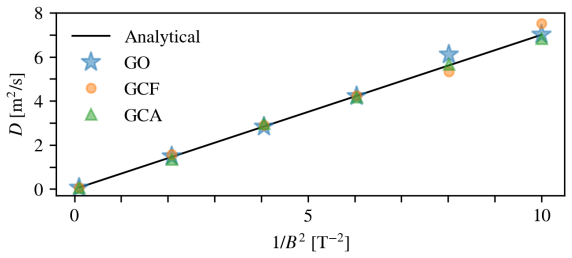
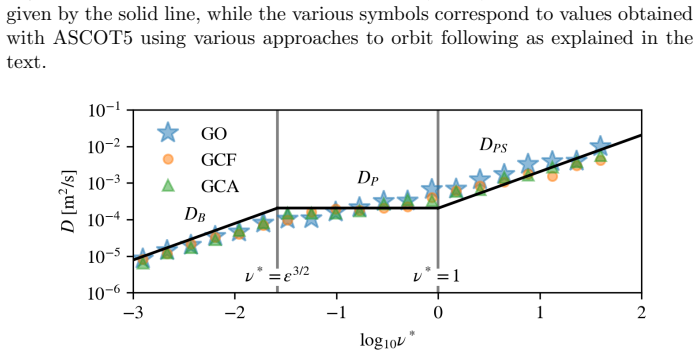
The central object is the batched guiding-center Monte Carlo marker set. The core simulation loop operates on arrays of NSIMD markers simultaneously, using OpenMP simd pragmas and declare-simd functions so that interpolation, field evaluation, and orbit updates all vectorize; each worker thread owns one such array and swaps finished markers for fresh ones. The physics machinery is the Langevin form of the Fokker-Planck equation, split into a Hamiltonian part and a collisional part: gyro orbits are advanced with an energy-conserving volume-preserving algorithm, guiding centers with RK4 or adaptive Cash-Karp, and Coulomb collisions with Euler-Maruyama or Milstein schemes. The verification anchors are the analytic diffusion coefficients $D_C$, $D_B$, $D_P$, and $D_{PS}$, and the code's claim to fidelity is reproducing them with only 100 to 200 markers.
What would settle it
Run the same neoclassical test suite with the guiding-center collision operator replaced by an independently verified full Fokker-Planck collision operator, or extract the operator's friction and diffusion moments in a uniform Maxwellian background and compare them directly to analytic Fokker-Planck moments; a mismatch beyond Monte Carlo noise would show the current agreement is not the operator's own doing. A cheaper check is to probe collisionalities near the banana-plateau transition, where the analytic formulas are expected to be least accurate, and see whether the code still follows them.
Extended reading notes
Core claim
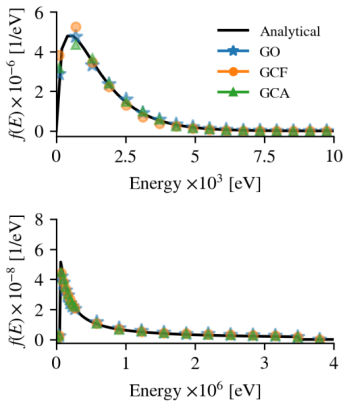
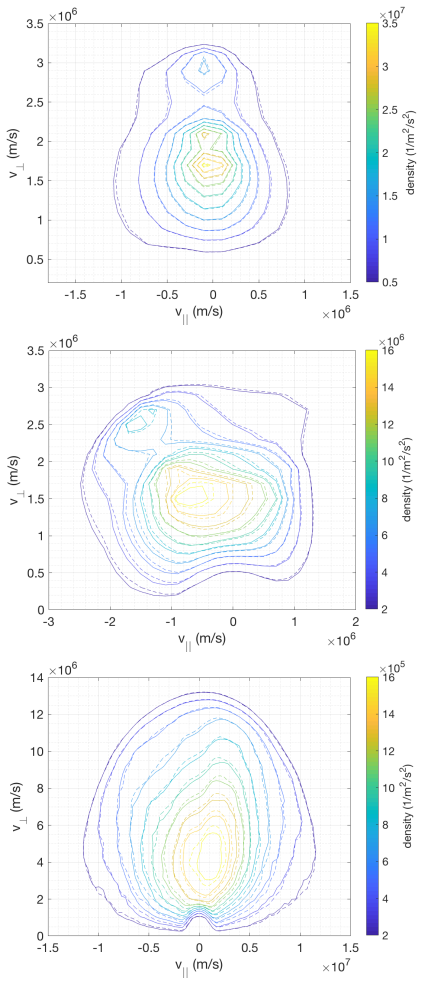
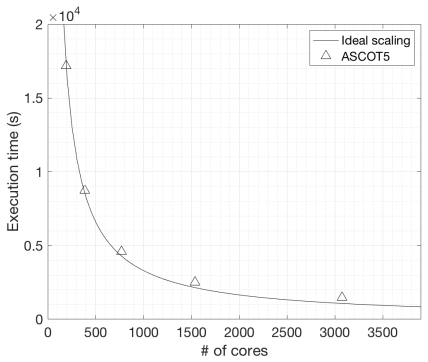
The central claim is that a full rewrite of the orbit-following code—organized around SIMD-friendly arrays of markers processed in lockstep, with worker threads and MPI only between nodes—produces a code that is both physically faithful and substantially faster. Using first-order relativistic guiding-center equations with a zeroth-order collision operator adapted from earlier work, the code matches analytic diffusion coefficients for classical transport with 1/$B^{2}$ scaling and for neoclassical transport across three collisionality regimes when density is varied from $10^{17}$ to $10^{22}$ $m^{-3}$. It also reproduces the analytic slowing-down and Maxwellian energy distributions for 3.5 MeV fusion $\alpha$ particles. In the JET-like and ITER-like benchmarks, ASCOT5 and ASCOT4 agree quantitatively, with total fast-ion losses matching within 1 percent, while benchmark runs show speedups of roughly four to six times on Skylake CPUs and larger gains on Knights Landing.
Load-bearing premise
The verification results depend on the simplified, zeroth-order collision operator behaving like the full Coulomb collision operator across the banana, plateau, and Pfirsch-Schlüter regimes, but the paper checks the combined code against transport theory rather than isolating the collision operator itself.
Editorial extensions
If this is right
- Simulations can use close to an order of magnitude more markers at the same computational cost, improving statistical precision for distribution functions and for peak wall-load estimates.
- Fast parameter scans and coupled transport simulations can be completed with much shorter turnaround, letting researchers explore larger regions of operating space.
- The modular interface design means new physics modules—MHD perturbations, time-dependent fields, turbulent fast-ion transport, and NBI and fusion sources—can be added without restructuring the core loop.
- The same OpenMP-based codebase can be extended to GPUs and other accelerators, keeping a single code usable across diverse supercomputer architectures.
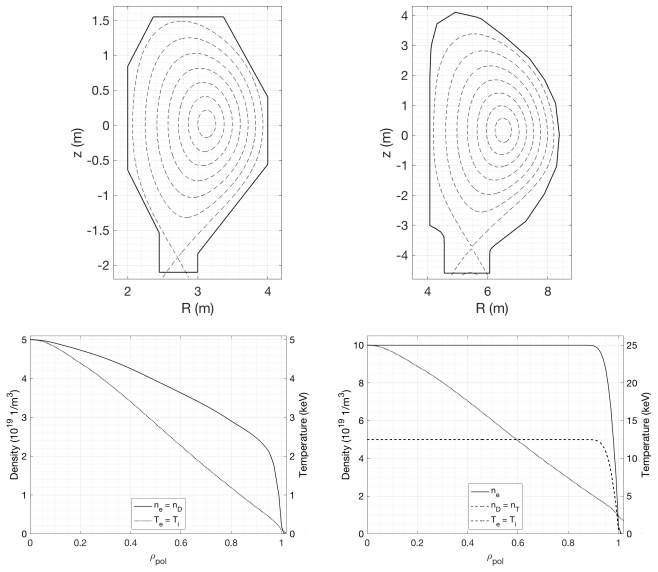
- The reproduction of ASCOT4 results in the 2D and 3D benchmark cases supports using ASCOT5 as a drop-in replacement for fast-ion studies in existing workflows.
Reading between the lines
- The paper leaves implicit that the collision operator itself is not tested in isolation; a standalone comparison of its friction and diffusion tensors against full Fokker-Planck moments would tell whether the neoclassical agreement is robust or partly coincidental.
- The near-ideal strong scaling suggests that for very large marker counts the dominant costs become memory bandwidth and field/wall interpolation rather than MPI communication, so performance on finer 3D wall meshes is a natural stress test.
- The 1 percent loss agreement between ASCOT4 and ASCOT5 in the ripple case implies that the octree-based wall intersection search introduces negligible systematic error at that resolution; pushing to finer wall meshes and time-dependent perturbations would test that conclusion.
- The speedup on Knights Landing highlights that random-number generation is a first-order performance factor in Monte Carlo collision codes, suggesting that accuracy-versus-performance trade-offs of alternative RNGs deserve explicit benchmarking.
Signed reviews
Editorial analysis
A structured set of objections, weighed in public.
Referee Report
Summary. The paper presents ASCOT5, a from-scratch rewrite of the ASCOT Monte Carlo orbit-following code for minority-species distribution functions in fusion plasmas. The physics model combines full-orbit and guiding-center equations of motion with a Langevin/Fokker-Planck treatment of Coulomb collisions, and the code is parallelized with OpenMP and MPI and designed for SIMD vectorization. The verification section compares ASCOT5 against analytic results for classical and neoclassical diffusion, checks slowing-down and equilibrium energy distributions, and benchmarks the new code against ASCOT4 for a JET-like 2D case and an ITER-like 3D case. Performance benchmarks show up to a factor of about 6 speedup on Skylake-class CPUs compared with the MPI-only ASCOT4. The central claim is that ASCOT5 is a comprehensively validated, faster replacement for ASCOT4.
Significance. If the claims hold, the paper is a useful contribution to fusion simulation software: it demonstrates a concrete path to exploiting many-core and SIMD hardware in Monte Carlo particle codes, and it provides a verification anchor via analytic neoclassical theory and an established predecessor code. The performance engineering details, including the SIMD array swapping and the choice of random-number generator, are valuable and believable. The verification strategy is sensible in principle, and the explicit acknowledgment that the guiding-center collision operator is zeroth order is candid. However, the strength of the central physics claim is weakened by the absence of statistical uncertainty and convergence studies in the key verification figures, and by the limited scope of the theoretical tests relative to the word 'comprehensively' in the abstract.
major comments (4)
- [§4.1, Figs. 1 and 2] The central claim that ASCOT5 'faithfully reproduce[s] neoclassical diffusion across three different collisionality regimes' rests on 100 markers per point in Fig. 2 and 200 markers per point in Fig. 1, with no error bars, no repeated runs, and no marker-convergence study. Because the vertical axis is logarithmic and the theory line spans orders of magnitude, the plots cannot distinguish agreement within Monte Carlo error from a systematic bias of the order of the scatter. Please add confidence intervals or error bars (e.g., from several independent realizations or from binning), report the time step and total simulated time for each point, and include a convergence test with, say, 100, 1000, and 10000 markers at representative points in the banana, plateau, and Pfirsch-Schlüter regimes.
- [§2, guiding-center collision operator] The paper states that the guiding-center collision operator is 'a zeroth order operator adapted from [5]' while the equations of motion are first order. Because the neoclassical verification in Fig. 2 includes guiding-center modes, the accuracy of this operator is load-bearing. The gyro-orbit symbols in Fig. 2 provide a useful internal cross-check, but the figure lacks quantitative uncertainty, and no direct test of the operator's drag and diffusion moments against the full Fokker-Planck operator is given. Please add a moment-level comparison or a quantitative gyro-orbit versus guiding-center comparison at a representative collisionality to demonstrate that the zeroth-order approximation is sufficient at the claimed fidelity.
- [§4.2, Fig. 5 and loss comparison] The ASCOT4/ASCOT5 agreement for realistic cases is described as 'closely agree' in the distribution functions, and only the total fast-ion losses are quantified ('within 1 %'). No uncertainty is given for either the binwise distributions or the loss fraction. Please report a quantitative metric (e.g., normalized L2 difference over the energy-pitch grid) and the statistical error of the loss count, so that 'verified to reproduce results' is substantiated rather than asserted.
- [Abstract and §4] The phrase 'comprehensively validated against existing theoretical work' overstates the coverage. The theoretical verification is limited to classical transport, neoclassical diffusion for a single collision partner in an axisymmetric circular plasma, and slowing-down/equilibrium energy distributions; it does not test the 3D-field, wall, electric-field, or multi-species aspects of the physics model against theory. Please either add corresponding tests or qualify the claim so that the abstract matches the actual scope of the verification.
minor comments (5)
- [Eq. (8)] There is a typo with a double comma in the slowing-down distribution, and the notation for the thermalization cutoff is introduced inconsistently: the text defines E_min, while the formula uses βE_th,i. Please align the notation.
- [Table 1] The entry for the ITER-like case on Knights Landing appears to contain a stray '1' and no ASCOT4 runtime; the accompanying text says ASCOT4 could not run there, but the table should state this explicitly and clarify what the '1' refers to.
- [§4.1] The parameters of the magnetic field are given as 'B0 = 5.3' without units; presumably tesla, but please state the unit.
- [Eq. (4)] The expression for ν_ei is not in a standard textbook form; please check the normalization and prefactors, and state explicitly which Coulomb logarithm convention is used.
- [Figure 2 caption] The caption refers to 'the various symbols' but does not define the marker types; a legend or explicit list of symbols would improve readability.
Circularity Check
No significant circularity: validation is anchored to external analytic theory and an independently benchmarked predecessor code, not to fitted inputs or self-defined predictions.
full rationale
The paper's central physics verification compares ASCOT5 output to textbook analytic results for classical and neoclassical transport (Wesson; Helander and Sigmar), with no parameter in the analytic formulas fitted from the simulations. The Langevin/Fokker-Planck correspondence in Section 2 is a standard mathematical relation, and the transport coefficients in Eqs. (3)-(7) are independent inputs, not outputs of ASCOT5. Figures 1-3 therefore test the code against external predictions. The ASCOT4 comparisons in Section 4.2 are regression checks against a separately benchmarked code, and those results are not used to define the theoretical expectations. Self-citations, including the zeroth-order guiding-center collision operator adapted from [5], supply implementation details and prior derivations but do not provide the neoclassical coefficients being verified; the verification against analytic theory is precisely an independent test of that approximation. The explicit statement that the collision operator is zeroth order is an accuracy limitation, not a circular step, because no quoted reduction shows the tested result equivalent to its inputs by construction. No fitted-input-called-prediction, self-definitional, self-citation-load-bearing, or uniqueness-importing pattern is present, so the honest finding is no circularity with score 0.
Assumptions & free parameters
assumptions (5)
- domain assumption The Fokker-Planck equation (Eq. 1) with Maxwellian background species describes the minority species distribution function.
- standard math The Langevin equation (Eq. 2) is a valid Monte Carlo representation of the Fokker-Planck equation (Eq. 1).
- domain assumption The non-canonical Hamiltonian guiding-center equations [3] and first-order relativistic transformation [4] are accurate for the simulated fast ions.
- domain assumption The zeroth-order guiding-center collision operator from [5] is adequate for the neoclassical regimes tested.
- domain assumption The analytic neoclassical diffusion formulas (Eqs. 5-7) are valid for the circular-plasma parameters chosen (R=6.2 m, r=0.6 m, B0=5.3 T).
Cite this review
Pith. "Pith review of High-performance orbit-following code ASCOT5 for Monte Carlo simulations in fusion plasmas." pith.science (2026). https://pith.science/paper/RKJA5K2L
@misc{pith2026190802482,
  author       = {Pith},
  title        = {Pith review of: High-performance orbit-following code ASCOT5 for Monte Carlo simulations in fusion plasmas},
  year         = {2026},
  howpublished = {\url{https://pith.science/paper/RKJA5K2L}},
  note         = {Machine review of arXiv:1908.02482}
}
read the original abstract
We present a novel implementation of a Monte Carlo particle-following code for solving the distribution function of minority species in fusion plasmas, called ASCOT5, and verify it using theoretical results for neoclassical transport. The code has been developed from ground up with an OpenMP-MPI hybrid paradigm to take full advantage of current and next generation many-core CPUs with multithreading and SIMD operations. Up to 6-fold increase in performance is demonstrated compared to a previous version of the code which only utilizes MPI. The physics model of the code is comprehensively validated against existing theoretical work, and it is shown to faithfully reproduce neoclassical diffusion across three different collisionality regimes. In simulations for realistic tokamak plasmas, including complex non-axisymmetric geometry, ASCOT5 is verified to reproduce results from the previous version ASCOT4.
Figures
Figures from the paper (3 more)
Forward citations
Cited by 1 Pith paper
-
The fixed boundary plasma equilibrium basis for a one Gigawatt electric stellarator power plant
An evolved fixed-boundary stellarator equilibrium (GIGA v549) is optimized from a modified W7-X configuration to meet quantified requirements for a 3 GW fusion / 1 GWe plant.
Reference graph
Works this paper leans on
-
[5]
Monte carlo implementation of a guiding-center fokker-planck kinetic equa- tion
Eero Hirvijoki, Alain Brizard, Antti Snicker, and Taina Kurki-Suonio. Monte carlo implementation of a guiding-center fokker-planck kinetic equa- tion. Physics of Plasmas , 20(9):092505, 2013
work page 2013
-
[1]
As- cot: Solving the kinetic equation of minority particle species in tokamak plasmas
Eero Hirvijoki, Otto Asunta, Tuomas Koskela, Taina Kurki-Suonio, Juho Miettunen, Seppo Sipil¨ a, Antti Snicker, and Simppa ¨Ak¨ aslompolo. As- cot: Solving the kinetic equation of minority particle species in tokamak plasmas. Computer Physics Communications , 185(4):1310–1321, 2014
work page 2014
-
[2]
Eero Hirvijoki, Taina Kurki-Suonio, Simppa ¨Ak¨ aslompolo, Jari Varje, Tuo- mas Koskela, and Juho Miettunen. Monte carlo method and high perfor- mance computing for solving fokker–planck equation of minority plasma particles. Journal of Plasma Physics , 81(3), 2015
work page 2015
-
[3]
Hamiltonian theory of guiding-center motion
John R Cary and Alain J Brizard. Hamiltonian theory of guiding-center motion. Reviews of modern physics , 81(2):693, 2009
work page 2009
-
[4]
Guiding-centre transformation of the radiation–reaction force in a non-uniform magnetic field
Eero Hirvijoki, Joan Decker, AJ Brizard, and Ola Embr´ eus. Guiding-centre transformation of the radiation–reaction force in a non-uniform magnetic field. Journal of Plasma Physics , 81(5), 2015
work page 2015
-
[6]
Volume-preserving algorithm for secular relativistic dynamics of charged particles
Ruili Zhang, Jian Liu, Hong Qin, Yulei Wang, Yang He, and Yajuan Sun. Volume-preserving algorithm for secular relativistic dynamics of charged particles. Physics of Plasmas , 22(4):044501, 2015
work page 2015
-
[7]
Adaptive time- stepping monte carlo integration of coulomb collisions
Konsta S¨ arkim¨ aki, Eero Hirvijoki, and Juuso Ter¨ av¨ a. Adaptive time- stepping monte carlo integration of coulomb collisions. Computer Physics Communications, 222:374–383, 2018
work page 2018
-
[8]
Antoine J Cerfon and Jeffrey P Freidberg. “one size fits all” analytic so- lutions to the grad–shafranov equation. Physics of Plasmas , 17(3):032502, 2010
work page 2010
Show all 19 references
-
[9]
Tokamaks, volume 149
John Wesson and David J Campbell. Tokamaks, volume 149. Oxford university press, 2011
2011
-
[10]
Collisional transport in magnetized plasmas, volume 4
Per Helander and Dieter J Sigmar. Collisional transport in magnetized plasmas, volume 4. Cambridge University Press, 2005
2005
-
[11]
Simulation of localized fast-ion heat loads in test blanket module simulation experiments on diii-d
GJ Kramer, A McLean, N Brooks, RV Budny, X Chen, WW Heidbrink, T Kurki-Suonio, R Nazikian, T Koskela, MJ Schaffer, and JET contrib- utors. Simulation of localized fast-ion heat loads in test blanket module simulation experiments on diii-d. Nuclear Fusion, 53(12):123018, 2013
2013
-
[12]
Modelling neutral beams in fusion devices: Beamlet-based model for fast particle simulations
Otto Asunta, J Govenius, R Budny, M Gorelenkova, Giovanni Tardini, Taina Kurki-Suonio, Antti Salmi, and Seppo Sipil¨ a. Modelling neutral beams in fusion devices: Beamlet-based model for fast particle simulations. Computer Physics Communications , 188:33–46, 2015. 13
2015
-
[13]
Synthetic fast ion diagnostics in tokamaks: Comparing the monte carlo test particle code ASCOT against experiments
Simppa ¨Ak¨ aslompolo, Taina Kurki-Suonio, Seppo Sipil¨ a, and ASCOT Group. Synthetic fast ion diagnostics in tokamaks: Comparing the monte carlo test particle code ASCOT against experiments. Fusion Science and Technology, 69(3):620–627, 2016
2016
-
[14]
Synthetic NPA diagnostic for ener- getic particles in JET plasmas.Journal of Instrumentation, 12(11):C11025– C11025, 2017
Jari Varje, Paula Sir´ en, Henri Weisen, Taina Kurki-Suonio, Simppa ¨Ak¨ aslompolo, and JET contributors. Synthetic NPA diagnostic for ener- getic particles in JET plasmas.Journal of Instrumentation, 12(11):C11025– C11025, 2017
2017
-
[15]
Synthetic neutron camera and spectrometer in JET based on AFSI- ASCOT simulations
Paula Sir´ en, Jari Varje, Henri Weisen, Tuomas Koskela, and JET contrib- utors. Synthetic neutron camera and spectrometer in JET based on AFSI- ASCOT simulations. Journal of Instrumentation , 12(09):C09010–C09010, 2017
2017
-
[16]
Synthetic di- agnostic for the jet scintillator probe lost alpha measurements
Jari Varje, Vasily Kiptily, Paula Sir´ en, and Henri Weisen. Synthetic di- agnostic for the jet scintillator probe lost alpha measurements. in press, 2019
2019
-
[17]
Improvements in physics models of AFSI-ASCOT-based synthetic neutron diagnostics at JET
Paula Sir´ en, Jari Varje, Henri Weisen, Luca Giacomelli, Aaron Ho, and Massimo Nocente. Improvements in physics models of AFSI-ASCOT-based synthetic neutron diagnostics at JET. Fusion Engineering and Design ,
-
[18]
Calculating the 3d magnetic field of iter for euro- pean tbm studies
Simppa ¨Ak¨ aslompolo, Otto Asunta, Thijs Bergmans, Mario Gagliardi, Jose Galabert, Eero Hirvijoki, Taina Kurki-Suonio, Seppo Sipil¨ a, Antti Snicker, and Konsta S¨ arkim¨ aki. Calculating the 3d magnetic field of iter for euro- pean tbm studies. Fusion Engineering and Design ,...
2015
-
[19]
Versatile fusion source integrator afsi for fast ion and neutron studies in fusion devices
Paula Sir´ en, Jari Varje, Simppa¨Ak¨ aslompolo, Otto Asunta, Carine Giroud, Taina Kurki-Suonio, Henri Weisen, and JET contributors. Versatile fusion source integrator afsi for fast ion and neutron studies in fusion devices. Nuclear Fusion, 58(1):016023, 2017. 14
2017
Reviewed August 14, 2026 · model on record in the stance chip above.
Discussion (0). Continue with ORCID to comment.