REVIEW 1 major objections 6 minor 39 references
Generation of 14.0W of single frequency light at 770 nm by intracavity frequency doubling
T0 review · 1 major / 6 minor · reviewed 2026-08-14 · deepseek-v4-flash
Pith's one-line read A laser system doubles 18.8 W of 1540 nm fiber light to deliver 14.0 W of single-frequency 770 nm output, with enough stability and linewidth for cold-atom experiments.
desk verdict A solid, useful laser-engineering result that deserves peer review; the main gap is the missing spectral purity check on the 14 W output, plus some honest unresolved details. read the letter →
The pith
A machine-rendered reading of the paper's core claim, the machinery that carries it, and where it could break.
The reading
What carries the argument
The central object is a bow-tie enhancement ring cavity, 29.5 cm round trip, with a 30 mm lithium triborate crystal at its center and a build-up factor of about 19. Type-I non-critical phase matching converts two z-polarized 1540 nm photons into one y-polarized 770 nm photon, and the crystal is temperature-tuned near 88 °C to satisfy the phase-matching condition. A Pound-Drever-Hall lock using 130 MHz phase modulation on the seed holds the cavity on resonance. The quantitative engine is the cavity conversion equation $$√ε = \frac{4T_1\sqrt{E_{NL}P_{m,1}}}{\left[2-\sqrt{1-T_1}(2-L-\sqrt{ε E_{NL}P_{m,1}})\right]^2},$$ which, with measured $T_1 = 5\%$, $E_{NL} = 1.23\times10^{-6}\,\mathrm{W}^{-1}$, $L \sim 1\%$, and $m \sim 0.95$, reproduces the observed output-versus-power curve.
What would settle it
Measure the output spectrum or pass the cavity output through a filter that transmits 770 nm and blocks 1540 nm, then compare the filtered power with the reported 14.0 W at 18.8 W input; if the 770 nm-only power falls materially below 14.0 W, the central power claim is not supported.
Extended reading notes
Core claim
The central claim is that lithium triborate, despite its weak optical nonlinearity, can frequency double 1540 nm light at high power and high efficiency when placed inside a resonant cavity, because the circulating power compensates for the small nonlinear coefficient. At 18.8 W input the authors observe 14.0 W of 770 nm output, a conversion efficiency of about 74 percent that saturates as the circulating fundamental is depleted and cavity losses take over. The authors attribute the remaining limit mainly to residual absorption in the LBO crystal at 1.5 µm and to the available pump power, rather than to the nonlinear interaction itself. The measured conversion curve is reproduced by a coupled-cavity model using the input coupler transmission, single-pass nonlinear conversion coefficient, round-trip loss, and mode-matching coefficient.
Load-bearing premise
The reported 14.0 W is entirely 770 nm second-harmonic light; if a meaningful fraction of the measured output were 1540 nm fundamental leaking through the harmonic-transmitting cavity mirrors, the harmonic power and conversion efficiency would be overestimated.
Editorial extensions
If this is right
- A 14 W single-frequency source near 770 nm becomes available for potassium and rubidium trapping, Raman manipulation, and magic-wavelength optical traps.
- Conversion efficiency saturates near 74 percent because the circulating fundamental is depleted and cavity losses remain, so further power scaling requires reducing LBO absorption and other round-trip loss.
- The Pound-Drever-Hall lock, with 130 MHz modulation, maintains a stable lock through thermal transients that defeat Hänsch–Couillaud locking, making the system usable for continuous operation.
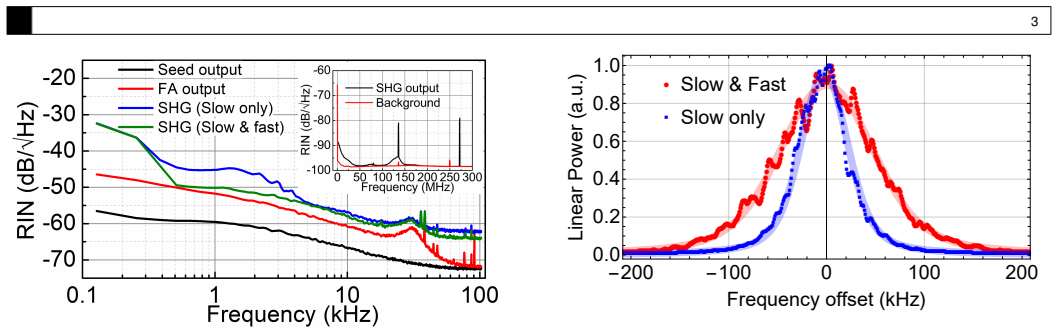
- After a few minutes of settling, the output and crystal temperature stabilize, and the self-heterodyne linewidth remains 25–49 kHz, narrow enough not to broaden atomic transitions.
Reading between the lines
- The same cavity architecture should transfer to other wavelengths in the telecom band: changing the seed wavelength, mirror coatings, and LBO temperature would likely produce high-power light at other alkali transitions, as long as crystal absorption at the new fundamental stays low.
- Because conversion efficiency saturates, pushing beyond 14 W will require reducing round-trip loss rather than simply adding pump power; a lower-loss crystal or a coating with smaller absorption could raise the efficiency above the reported 74 percent.
- A direct verification step the paper does not describe would be to insert a dichroic mirror or spectrum analyzer after the cavity and confirm that the measured 14.0 W is entirely 770 nm light with no significant 1540 nm leakage.
- The reported power-dependent phase-matching temperature shift suggests that practical deployment will need active temperature control tied to intracavity power, a point the paper demonstrates but does not generalize into a control recipe.
Signed reviews
Editorial analysis
A structured set of objections, weighed in public.
Referee Report
Summary. This manuscript reports a continuous-wave narrow-linewidth laser system generating up to 14.0 W at 770 nm by intracavity second-harmonic generation of a 1540 nm fiber amplifier seeded by a single-frequency diode laser. The system uses a bow-tie ring enhancement cavity containing an LBO crystal, with Pound-Drever-Hall locking and two-stage temperature control. The authors report a conversion efficiency of >74% at 18.8 W fundamental input, and characterize the output via spatial mode quality (M2<1.4), relative intensity noise, self-heterodyne linewidth (25–49 kHz), and long-term power/temperature stability. The manuscript also analyzes why Hänsch-Couillaud locking is unsuitable at high power due to temperature-dependent birefringence in LBO.
Significance. If the reported output power is verified to be purely at 770 nm, this result represents a substantial advance for high-power tunable sources in the 760–780 nm region: 14.0 W single-frequency, single-transverse-mode light from an LBO enhancement cavity, exceeding earlier cavity-doubled results (e.g., 1.05 W at 775 nm with PPKTP) and complementing single-pass PPLN systems with the high-power robustness of LBO. The direct power measurement is the central falsifiable claim, and the supporting characterization (linewidth, RIN, M2, stability) is relevant for cold-atom applications. The paper also provides a useful analysis of the thermal mechanism behind Hänsch-Couillaud lock failure, with quantitative agreement between calculation and observation. The main risk to the central claim is the lack of demonstrated spectral purity of the measured 14.0 W output, as residual 1540 nm fundamental leakage could be included in the power reading.
major comments (1)
- [Fig. 1 and 'A maximum harmonic output of 14.0 W at 18.8 W input power is observed as shown in Fig. 2'] The 14.0 W output power measurement is not shown to be free of residual 1540 nm fundamental light. The output path is not described as including any dichroic filter, bandpass filter, or spectral characterization, and the cavity mirrors M2–M4 are specified as rear-side AR coated for both 1540 nm and 770 nm, which implies that fundamental light can leave the cavity through the same path as the harmonic. A thermal power meter would register both wavelengths. With the stated build-up factor of ~19 at 18.8 W input, the circulating fundamental is ~357 W; if the output mirror has even 0.1–0.3% transmission at 1540 nm, this would add 0.36–1.07 W of fundamental light to the measurement beam, corresponding to 2.5–7.6% of the claimed 14.0 W. The authors should either specify a dichroic filter and its rejection ratio, report the output mirror's transmission at 1540 nm and any measured leakage with a filter, or show an optical spectrum of the output demonstrating that the fundamental component is negligible. This is load-bearing because the headline power, the >74% conversion efficiency, and the suitability claims all depend on the measured 14.0 W being entirely at 770 nm.
minor comments (6)
- [Following Eq. (1)] Please clarify how ENL = 1.23E-6 W^-1 was obtained from 'direct measurements.' If it was derived from a fit to the SHG output data in Fig. 2, the agreement between the calculated curve and the data would be by construction; if it was measured independently (e.g., single-pass conversion or calculated from d_eff), describe that measurement so that the consistency check is not circular.
- [Phase-matching temperature paragraph] The 22°C discrepancy between the observed (88°C) and predicted (110°C) phase-matching temperature is acknowledged and unexplained; please discuss possible systematic causes (e.g., LBO cut angle, temperature sensor calibration, Sellmeier uncertainty) so that readers can assess whether the same offset could affect high-power operation.
- [Fig. 3 and RIN discussion] Please define what is meant by 'mechanical and laser modulation' in the RIN discussion; presumably these refer to PZT feedback and EOM modulation, but the text should state this explicitly for reproducibility.
- [Fig. 5 caption and linewidth description] The self-heterodyne measurement uses an 11 km fiber delay line at 770 nm; please specify the fiber type, its attenuation, and whether it is single-mode at 770 nm, because standard telecom fiber is multi-mode at this wavelength and would affect the measured linewidth.
- [Fig. 4 caption] Please clarify what the 'scale breaker' indicates (e.g., a discontinuous time axis) and state the approximate duration of the transient before steady state is reached.
- [Fig. 2 and derived efficiency values] Please add error bars or stated systematic uncertainties on the power measurements; without uncertainties, the significance of the >74% conversion efficiency claim cannot be assessed.
Circularity Check
No significant circularity: the reported 14.0 W is a direct measurement, and the calculated curve in Fig. 2 uses parameters measured independently of the SHG output data.
full rationale
The central claim is an experimental observation: 'A maximum harmonic output of 14.0 W at 18.8 W input power is observed as shown in Fig. 2.' This is a direct measurement, not a derived quantity. The theoretical curve in Fig. 2 is computed from Eq. (1) using T1 = 5%, ENL = 1.23e-6 W^-1, L ~ 1%, and m ~ 0.95, each obtained from independent measurements (input-coupler transmission, direct single-pass conversion, cavity finesse, and reflection dip). These inputs are not fitted to the SHG output data; the curve is a consistency check, not a prediction forced by the data. The only self-citation, ref. [28], supports the priority statement 'the first high power, high efficiency frequency doubling of a 1540 nm laser using an enhancement cavity and LBO crystal,' which is a novelty claim and not load-bearing for any physics result in the paper. The acknowledged discrepancy between the measured phase-matching temperature (88 C) and the predicted value (110 C) is disclosed rather than used to force agreement. No fitted parameter is renamed as a prediction, no uniqueness theorem is imported, and no ansatz is smuggled via citation. The paper is self-contained as an experimental report with independent characterization of the nonlinear and cavity parameters.
Assumptions & free parameters
free parameters (5)
- ENL =
1.23e-6 W^-1
- T1 =
5%
- L =
~1%
- m =
~0.95
- Phase-matching temperature (low power) =
88 C
assumptions (3)
- standard math The intracavity SHG model of Polzik and Kimble (Eq. 1) accurately describes depletion and efficiency for this cavity.
- domain assumption Kato's Sellmeier equations for LBO give the temperature dependence of refractive indices, used in Eq. (2) to predict the HC error-signal degeneracy rate.
- domain assumption The output power P2 measured at 770 nm is uncontaminated by residual fundamental light.
Cite this review
Pith. "Pith review of Generation of 14.0W of single frequency light at 770 nm by intracavity frequency doubling." pith.science (2026). https://pith.science/paper/RKJN6FGZ
@misc{pith2026190900106,
  author       = {Pith},
  title        = {Pith review of: Generation of 14.0W of single frequency light at 770 nm by intracavity frequency doubling},
  year         = {2026},
  howpublished = {\url{https://pith.science/paper/RKJN6FGZ}},
  note         = {Machine review of arXiv:1909.00106}
}
read the original abstract
We present a continuous, narrow-linewidth, tunable laser system that outputs up to 14.0 W at 770 nm. The light is generated by frequency doubling 18.8 W of light from a 1540 nm fiber amplifier that is seeded by a single mode diode laser achieving >74% conversion efficiency. We utilize a Lithium Triborate Crystal in an enhancement ring cavity. The low intensity noise and narrow linewidth of the 770 nm output are suitable for cold atom experiments.
Figures


Figures from the paper (1 more)

Reference graph
Works this paper leans on
-
[1]
Absorption measurements of oxygen between 330 and 1140 nm,
G. D. Greenblatt, J. J. Orlando, J. B. Burkholder, and A. R. Ravis- hankara, “Absorption measurements of oxygen between 330 and 1140 nm,” J. Geophys. Res.95, 18577 (1990)
work page 1990
-
[2]
T. G. Tiecke, “Properties of Potassium,” Tech. Rep. 20 (2010)
work page 2010
- [3]
-
[4]
Accurate determi- nation of wavenumbers for iodine molecular lines in the red spectral region,
S. Rakowsky, D. Zimmermann, and W. E. Ernst, “Accurate determi- nation of wavenumbers for iodine molecular lines in the red spectral region,” Appl. Phys. B Photophysics Laser Chem.48, 463–466 (1989)
work page 1989
-
[5]
Triply magic conditions for microwave transitions of optically trapped alkali-metal atoms
G. Li, P . Zhang, and T. Zhang, “Triply magic conditions for microwave transition of optically trapped alkali-metal atoms,” arxiv:1905.11094 (2019)
work page Pith review arXiv 2019
-
[6]
Magic-wavelength op- tical dipole trap of cesium and rubidium atoms,
J. Wang, Y . Cheng, S. Guo, B. Y ang, and J. He, “Magic-wavelength op- tical dipole trap of cesium and rubidium atoms,” Proc. SPIE, Quantum Opt. II 8440, 84400Q (2012)
work page 2012
-
[7]
Implementation of a stable, high-power optical lattice for quantum gas microscopy,
A. Mazurenko, S. Blatt, F . Huber, M. F . Parsons, C. S. Chiu, G. Ji, D. Greif, and M. Greiner, “Implementation of a stable, high-power optical lattice for quantum gas microscopy,” Rev. Sci. Instruments90, 033101 (2019)
work page 2019
-
[8]
S. Guo, Y . Ge, J. He, and J. Wang, “Singly resonant sum-frequency generation of 520-nm laser via a variable input-coupling transmission cavity,” J. Mod. Opt.62, 1583–1590 (2015)
work page 2015
Show all 39 references
-
[9]
11 W narrow linewidth laser source at 780nm for laser cooling and manipulation of Rubidium,
S. S. Sané, S. Bennetts, J. E. Debs, C. C. N. Kuhn, G. D. McDonald, P . A. Altin, J. D. Close, and N. P . Robins, “11 W narrow linewidth laser source at 780nm for laser cooling and manipulation of Rubidium,” Opt. Express 20, 8915 (2012)
2012
-
[10]
A 750-mW, continuous-wave, solid-state laser source at 313 nm for cooling and manipulating trapped 9Be+ ions,
A. C. Wilson, C. Ospelkaus, A. P . VanDevender, J. A. Mlynek, K. R. Brown, D. Leibfried, and D. J. Wineland, “A 750-mW, continuous-wave, solid-state laser source at 313 nm for cooling and manipulating trapped 9Be+ ions,” Appl. Phys. B105, 741–748 (2011)
2011
-
[11]
A simple 2 W continuous-wave laser system for trapping ultracold metastable helium atoms at the 319.8 nm magic wavelength,
R. J. Rengelink, R. P . M. J. W. Notermans, and W. Vassen, “A simple 2 W continuous-wave laser system for trapping ultracold metastable helium atoms at the 319.8 nm magic wavelength,” Appl. Phys. B122, 122 (2016)
2016
-
[12]
High power single frequency 780nm laser source generated from frequency doubling of a seeded fiber amplifier in a cascade of PPLN crystals,
R. Thompson, M. Tu, D. Aveline, N. Lundblad, and L. Maleki, “High power single frequency 780nm laser source generated from frequency doubling of a seeded fiber amplifier in a cascade of PPLN crystals,” Opt. Express 11, 1709 (2003)
2003
-
[13]
Compact and robust laser system for rubidium laser cooling based on the frequency doubling of a fiber bench at 1560 nm,
F . Lienhart, S. Boussen, O. Carraz, N. Zahzam, Y . Bidel, and A. Bres- son, “Compact and robust laser system for rubidium laser cooling based on the frequency doubling of a fiber bench at 1560 nm,” Appl. Phys. B 89, 177–180 (2007)
2007
-
[14]
Coherent Operations, Entanglement, and Progress To- ward Quantum Search in a Large 2D Array of Neutral Atom Qubits,
M. Lichtman, “Coherent Operations, Entanglement, and Progress To- ward Quantum Search in a Large 2D Array of Neutral Atom Qubits,” Ph.D. thesis, University of Wisconsin-Madison (2015)
2015
-
[15]
High Average Power Second-Harmonic Generation of a CW Erbium Fiber MOPA,
T. H. Runcorn, R. T. Murray, and J. R. Taylor, “High Average Power Second-Harmonic Generation of a CW Erbium Fiber MOPA,” IEEE Photonics Technol. Lett. 29, 1576–1579 (2017)
2017
-
[16]
Compact single-pass laser frequency conversion to 780.2 nm and 852.3 nm based on PPMgO:LN bulk crystals and diode-laser-seeded fiber amplifiers,
K. Zhang, J. He, and J. Wang, “Compact single-pass laser frequency conversion to 780.2 nm and 852.3 nm based on PPMgO:LN bulk crystals and diode-laser-seeded fiber amplifiers,” arxiv:1811.03799 (2018)
2018 arXiv
-
[17]
Frequency doubled 1534 nm laser system for potassium laser cooling,
G. Stern, B. Allard, M. Robert-de Saint-Vincent, J.-P . Brantut, B. Bat- telier, T. Bourdel, and P . Bouyer., “Frequency doubled 1534 nm laser system for potassium laser cooling,” Appl. Opt.49, 3092 (2010)
2010
-
[18]
High-efficiency fre- quency doubling of continuous-wave laser light,
S. Ast, R. M. Nia, A. Schönbeck, N. Lastzka, J. Steinlechner, T. Eberle, M. Mehmet, S. Steinlechner, and R. Schnabel, “High-efficiency fre- quency doubling of continuous-wave laser light,” Opt. Lett. 36, 3467 (2011)
2011
-
[19]
Thermally induced dephasing in periodically poled KTP frequency-doubling crystals,
Z. M. Liao, S. A. Payne, J. W. Dawson, A. D. Drobshoff, C. A. Ebbers, D. M. Pennington, I. Jovanovic, and L. R. Taylor, “Thermally induced dephasing in periodically poled KTP frequency-doubling crystals,” in Nonlinear Optics: Materials, Fundamentals and Applications , vol. 21 ...
2004
-
[20]
Optimizing non-resonant frequency conversion in periodically poled media,
S. Spiekermann, F . Laurell, V. Pasiskevicius, H. Karlsson, and I. Freitag, “Optimizing non-resonant frequency conversion in periodically poled media,” Appl. Phys. B: Lasers Opt.79, 211–219 (2004)
2004
-
[21]
Thermal inhibi- tion of high-power second-harmonic generation in periodically poled LiNbO3 and LiTaO3 crystals,
O. A. Louchev, N. E. Yu, S. Kurimura, and K. Kitamura, “Thermal inhibi- tion of high-power second-harmonic generation in periodically poled LiNbO3 and LiTaO3 crystals,” Appl. Phys. Lett.87, 131101 (2005)
2005
-
[22]
Cavity- enhanced generation of 6 W cw second-harmonic power at 532 nm in periodically-poled MgO:LiTaO3,
I. Ricciardi, M. De Rosa, A. Rocco, P . Ferraro, and P . De Natale, “Cavity- enhanced generation of 6 W cw second-harmonic power at 532 nm in periodically-poled MgO:LiTaO3,” Opt. Express18, 10985 (2010)
2010
-
[23]
Green-induced infrared absorption in MgO doped LiNbO3,
Y . Furukawa, K. Kitamura, A. Alexandrovski, R. K. Route, M. M. Fejer, and G. Foulon, “Green-induced infrared absorption in MgO doped LiNbO3,” Appl. Phys. Lett.78, 1970–1972 (2001)
2001
-
[24]
High-Power CW Green Lasers for Optical Metrology and Their Joint Benefit in Particle Physics Experiments,
T. Meier, “High-Power CW Green Lasers for Optical Metrology and Their Joint Benefit in Particle Physics Experiments,” Ph.D. thesis, Gottfried Wilhelm Leibniz Universität Hannover (2011)
2011
-
[25]
Absolute scale of second-order nonlinear-optical coefficients,
I. Shoji, T. Kondo, A. Kitamoto, M. Shirane, and R. Ito, “Absolute scale of second-order nonlinear-optical coefficients,” J. Opt. Soc. Am. B14, 2268 (1997)
1997
-
[26]
High efficiency frequency doubling with a passive enhancement cavity,
S. Cui, L. Zhang, H. Jiang, W. Pan, X. Y ang, G. Qin, and Y . Feng, “High efficiency frequency doubling with a passive enhancement cavity,” Laser Phys. Lett. 16, 035105 (2019)
2019
-
[27]
Continuous-wave single- frequency 532 nm laser source emitting 130 W into the fundamental transversal mode,
T. Meier, B. Willke, and K. Danzmann, “Continuous-wave single- frequency 532 nm laser source emitting 130 W into the fundamental transversal mode,” Opt. Lett.35, 3742 (2010)
2010
-
[28]
Rydberg-mediated Atomic Ensemble Entanglement and Hy- perfine Qubit Detection,
M. Kwon, “Rydberg-mediated Atomic Ensemble Entanglement and Hy- perfine Qubit Detection,” Ph.D. thesis, University of Wisconsin-Madison (2019)
2019
-
[29]
Laser phase and frequency stabilization using an optical resonator,
R. W. P . Drever, J. L. Hall, F . V. Kowalski, J. Hough, G. M. Ford, A. J. Munley, and H. Ward, “Laser phase and frequency stabilization using an optical resonator,” Appl. Phys. B Photophysics Laser Chem. 31, 97–105 (1983)
1983
-
[30]
Temperature-tuned 90◦ phase-matching properties of LBO,
K. Kato, “Temperature-tuned 90◦ phase-matching properties of LBO,” IEEE J. Quantum Electron. 30, 2950–2952 (1994)
1994
-
[31]
Laser frequency stabilization by polariza- tion spectroscopy of a reflecting reference cavity,
T. Hansch and B. Couillaud, “Laser frequency stabilization by polariza- tion spectroscopy of a reflecting reference cavity,” Opt. Commun.35, 441–444 (1980)
1980
-
[32]
Stabilization of an optical cavity containing a birefringent element,
J. Boon-Engering, W. van der Veer, E. Bente, and W. Hogervorst, “Stabilization of an optical cavity containing a birefringent element,” Opt. Commun. 140, 285–288 (1997)
1997
-
[33]
Frequency doubling with KNbO3 in an external cavity,
E. S. Polzik and H. J. Kimble, “Frequency doubling with KNbO3 in an external cavity,” Opt. Lett.16, 1400 (1991)
1991
-
[34]
Ultra-narrow linewidth measurement based on Voigt profile fitting,
M. Chen, Z. Meng, J. Wang, and W. Chen, “Ultra-narrow linewidth measurement based on Voigt profile fitting,” Opt. Express 23, 6803 (2015)
2015
-
[35]
1/f frequency noise effects on self-heterodyne linewidth measurements,
L. Mercer, “1/f frequency noise effects on self-heterodyne linewidth measurements,” J. Light. Technol.9, 485–493 (1991)
1991
-
[36]
Cavity-enhanced optical frequency doubler based on transmission-mode Hänsch–Couillaud locking,
M. Vainio, J. E. Bernard, and L. Marmet, “Cavity-enhanced optical frequency doubler based on transmission-mode Hänsch–Couillaud locking,” Appl. Phys. B104, 897–908 (2011)
2011
-
[37]
Laser-noise-induced heating in far-off resonance optical traps,
T. Savard, K. O’Hara, and J. Thomas, “Laser-noise-induced heating in far-off resonance optical traps,” Phys. Rev. A 56, R1095–R1098 (1997)
1997
-
[38]
Photoacoustic absorption spectrometer for highly transparent dielectrics with parts-per-million sensitivity,
N. Waasem, S. Fieberg, J. Hauser, G. Gomes, D. Haertle, F . Küh- nemann, and K. Buse, “Photoacoustic absorption spectrometer for highly transparent dielectrics with parts-per-million sensitivity,” Rev. Sci. Instruments 84 (2013)
2013
-
[39]
75%-Efficiency blue gen- eration from an intracavity PPKTP frequency doubler,
R. Le Targat, J.-J. Zondy, and P . Lemonde, “75%-Efficiency blue gen- eration from an intracavity PPKTP frequency doubler,” Opt. Commun. 247, 471–481 (2005)
2005
Reviewed August 14, 2026 · model on record in the stance chip above.
Discussion (0). Continue with ORCID to comment.