REVIEW 2 major objections 5 minor 1 cited by
Non-thermal emission from cosmic rays accelerated in HII regions
T0 review · 2 major / 5 minor · reviewed 2026-08-14 · deepseek-v4-flash
Pith's one-line read The paper argues that non-thermal radio emission from HII regions is synchrotron radiation from thermal electrons accelerated to relativistic energies by first-order Fermi acceleration at the regions' own shocks.
desk verdict A solid, honest application of diffusive shock acceleration to HII regions with a genuine spectral-index match, but the full-ionization assumption is load-bearing and likely too fragile for shocks at the ionization boundary. read the letter →
The pith
A machine-rendered reading of the paper's core claim, the machinery that carries it, and where it could break.
The reading
What carries the argument
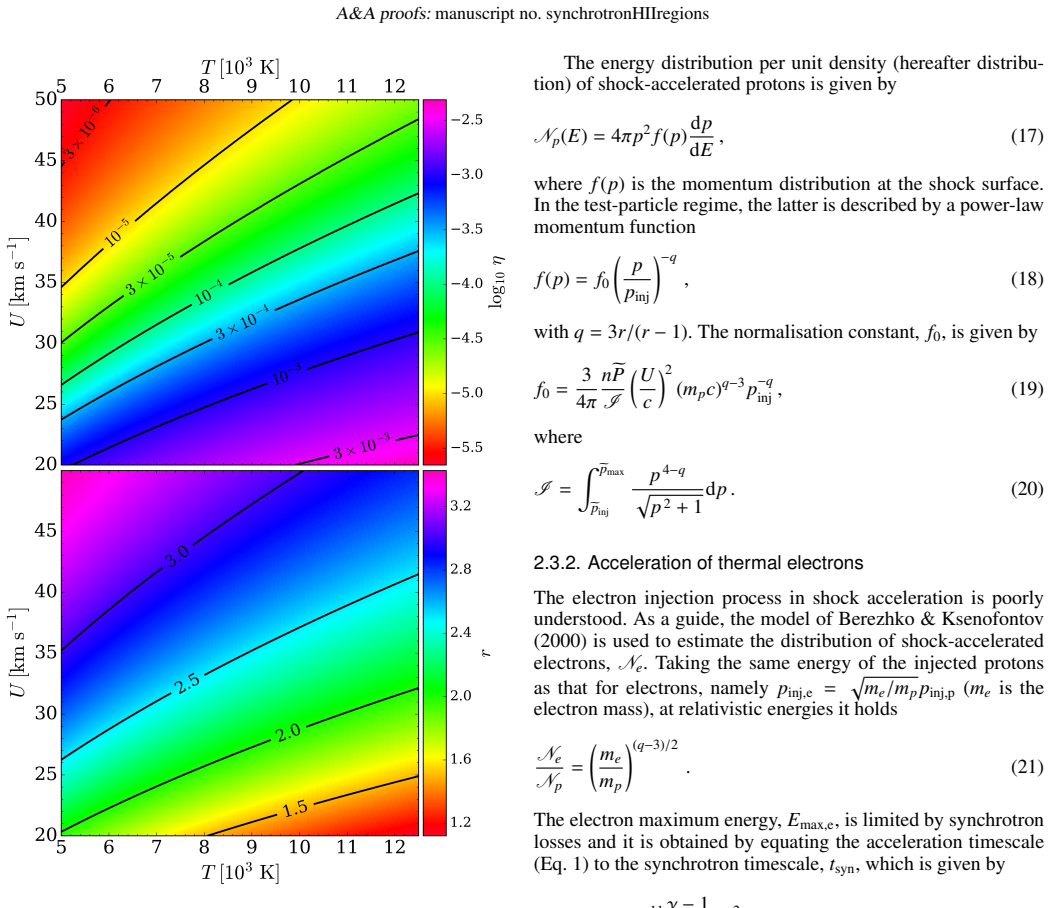
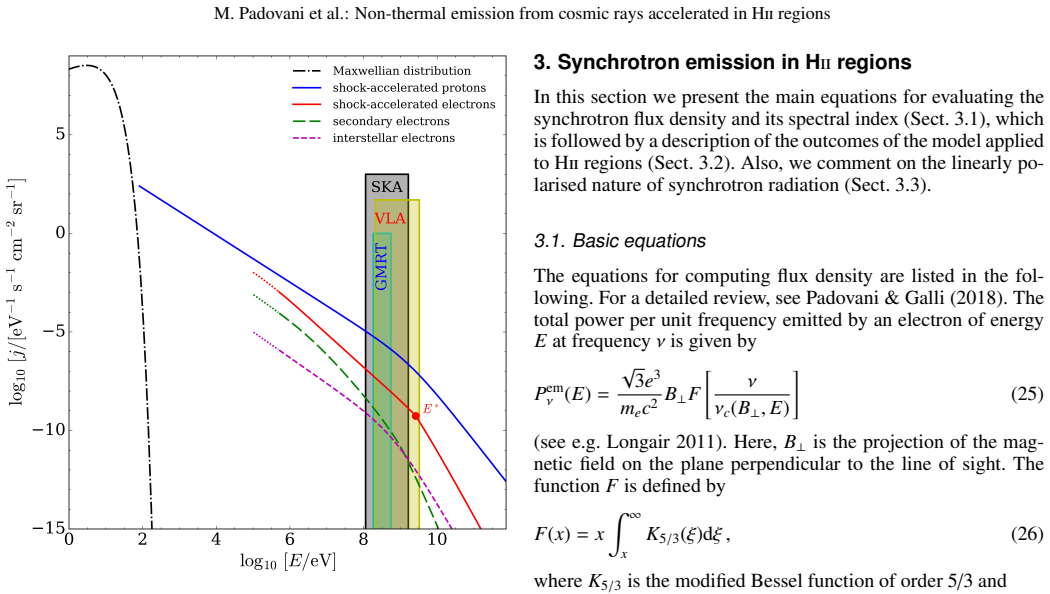
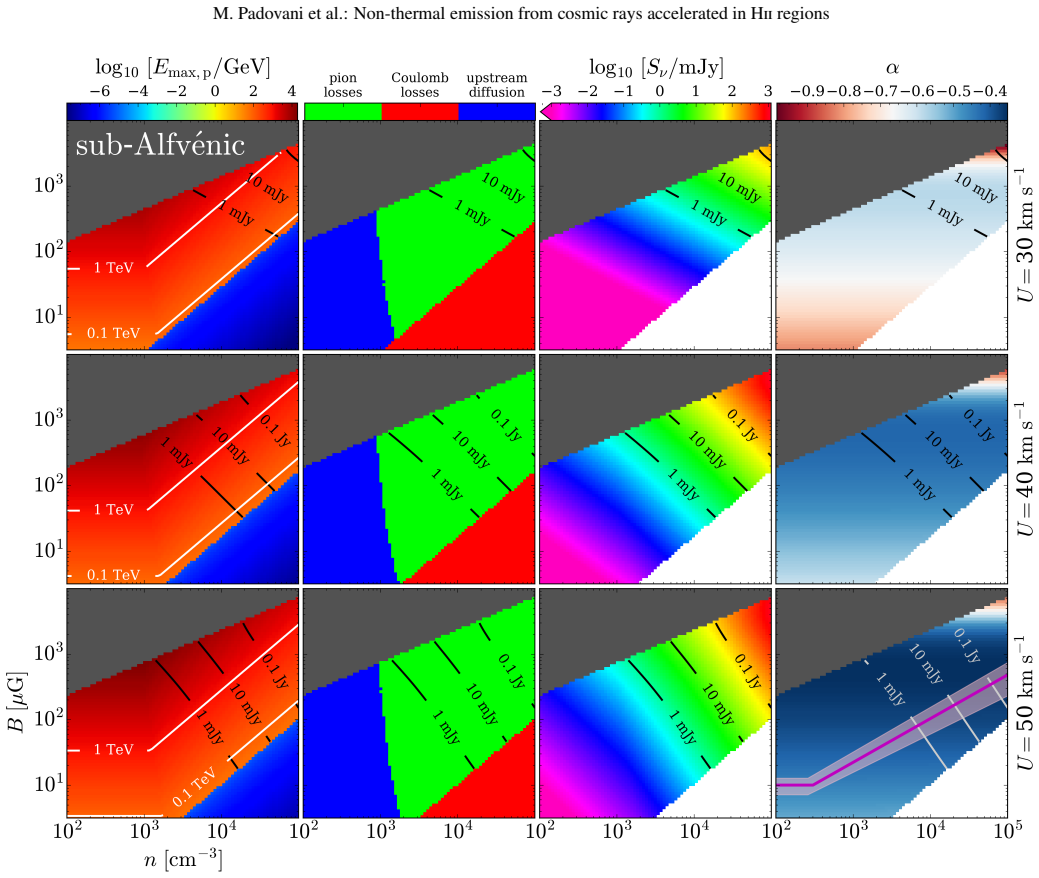
The engine is first-order Fermi (diffusive shock) acceleration of thermal electrons at a parallel shock, with Bohm diffusion as the baseline scattering regime. The maximum proton energy follows from equating the acceleration timescale to the minimum of the collisional loss, upstream diffusion, and dynamical timescales; the electron maximum energy is further capped by synchrotron losses, and above the energy where synchrotron cooling beats the dynamical time the electron spectrum steepens by one power. Electron flux normalisation comes from the shock-efficiency relation between acceleration pressure and injection momentum, with the electron-to-proton ratio fixed by injection at the same momentum; synchrotron emissivity then yields flux density and a local spectral index $\alpha$. The fit to Sgr B2(DS) requires non-Bohm diffusion with upstream coefficient $k_u \sim 10$.
What would settle it
Measure the ionisation fraction of the emitting shell in Sgr B2(DS), for example through recombination-line-to-continuum ratios or molecular tracers; if it is below about 0.95, ion-neutral damping quenches first-order Fermi acceleration and the model no longer reproduces the observed flux densities. A second check is to search for linear polarisation in the non-thermal component, which synchrotron predicts but the Bohm-diffusion assumption makes difficult to detect.
Extended reading notes
Core claim
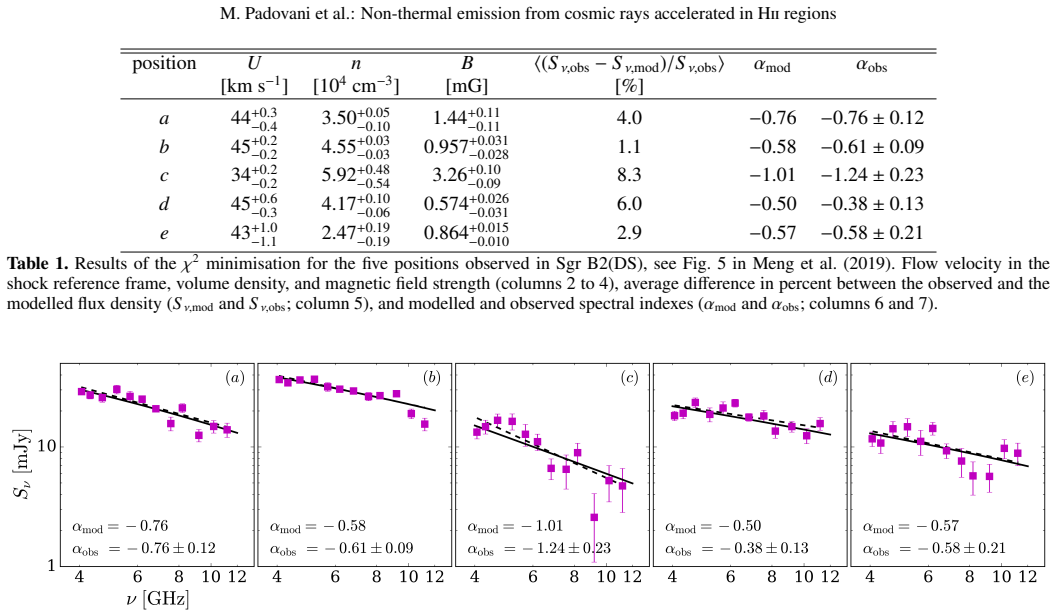
The central claim is that the non-thermal radio component in HII regions, exemplified by Sgr B2(DS), is synchrotron radiation from relativistic electrons accelerated at shocks within the region itself, rather than from interstellar cosmic-ray electrons or their secondaries. The model computes electron fluxes from diffusive shock acceleration using competing timescales --- acceleration, Coulomb and pion losses, upstream diffusion, and dynamical age --- and converts them to synchrotron flux densities and spectral indexes over the parameter space $(n,B)$. For Sgr B2(DS), a $\chi^2$ fit gives $U \approx 33$--$50$ km s$^{-1}$, $n \approx 1$--$9\times10^4$ cm$^{-3}$, and $B \approx 0.3$--$4$ mG, with modelled flux densities within 20 percent and modelled spectral indexes within the observed error bars. The mechanism requires a fully ionised medium: even an ionisation fraction $x=0.95$ strongly shrinks the viable parameter space, and sub-Alfvénic flows cannot accelerate particles at all.
Load-bearing premise
The load-bearing premise is that the acceleration region is completely ionised ($x=1$); the paper shows that even $x=0.95$ sharply reduces the parameter space in which the model reproduces observed fluxes, so a modest neutral fraction would break the mechanism.
Editorial extensions
If this is right
- Non-thermal HII-region emission can be powered locally, so interstellar cosmic-ray electrons need not be invoked for these sources.
- Efficient acceleration requires shock-frame velocities above about 30 km s$^{-1}$ and full ionisation; slower shocks or partly neutral gas quench the mechanism.
- For Sgr B2(DS) the mechanism constrains magnetic field, density, and shock velocity to narrow ranges that can be checked with independent measurements.
- Because the emission is optically thin down to 60 MHz, the predicted local spectral index can be tested across a broad frequency range, including with future low-frequency radio arrays.
- Non-thermal spots in other HII regions such as IRAS 17160-3707 and IRAS 17256-3631 may share the same origin.
Reading between the lines
- A decisive test would measure the ionisation fraction in the Sgr B2(DS) shell; below about 0.95 the proposed acceleration is quenched and the non-thermal emission would need another source.
- Polarisation observations could discriminate between the Bohm and non-Bohm regimes: strong linear polarisation would support synchrotron but is hard to reconcile with the fully turbulent field assumed in the Bohm limit, while the fitted $k_u\sim 10$ leaves a narrow window where polarisation might be detectable.
- The same shocks should also accelerate protons to high energies; in dense HII regions those protons could produce gamma rays through hadronic interactions, a signature not explored in the paper.
- Applying the model across a sample of known non-thermal HII regions would test whether the required parameters cluster on the observed magnetic field--density relation and whether the 30 km s$^{-1}$ threshold holds statistically.
Signed reviews
Editorial analysis
A structured set of objections, weighed in public.
Referee Report
Summary. The paper proposes that the non-thermal radio emission observed in HII regions is synchrotron radiation from thermal electrons accelerated to relativistic energies by first-order Fermi acceleration at shocks inside the HII region. The model computes acceleration and loss timescales, maximum energies, and emerging electron fluxes, then converts them to synchrotron flux densities and spectral indices under assumptions of full ionization, Bohm diffusion, and a parallel shock. After showing that interstellar or secondary cosmic-ray electron fluxes are insufficient, the authors apply the model to five positions in Sgr B2(DS), fitting the shock velocity, density, and magnetic-field strength by a chi-square test and fixing the acceleration efficiency at P~=5%. They report that the modelled flux densities reproduce the observations with average deviations of 1-8% (less than 20% for the whole region) and that the modelled spectral indices are consistent with the observed values across all five positions. The paper also provides constraints on B (0.3-4 mG), n (1-9 x 10^4 cm^-3), and U (33-50 km/s) and makes predictions for polarization and for future SKA observations.
Significance. If the mechanism operates as proposed, the paper provides a plausible local origin for relativistic electrons in HII regions, solving a long-standing discrepancy between the observed non-thermal emission and the available interstellar or secondary electron fluxes. The main strengths are the use of standard diffusive-shock-acceleration equations, the independent spectral-index check that is a genuine by-product of the fitting and agrees with the data, and the public web application that makes the model easy to test against future observations. The constraints on B, n, and U for Sgr B2(DS) are useful and falsifiable. The significance is, however, conditional on the full-ionization assumption and on the fact that the flux-density agreement is partly obtained by construction through fitted parameters.
major comments (2)
- [Appendix A, Eq. (A.1), Table 1] The central Sgr B2(DS) result is obtained under x=1, and the authors themselves state in Appendix A that even x=0.95 strongly reduces the viable parameter space. The paper does not, however, check whether the best-fit parameters in Table 1 satisfy the ion-neutral coupling condition R>1 at x slightly below 1. Evaluating Eq. (A.1) with the Table 1 values (e.g., position a: U=44 km/s, n=3.5 x 10^4 cm^-3, B=1.44 mG, P~=0.05, T4=0.8) and x=0.95 gives R of order 10^-5 with beta~1, far below unity. This suggests the flux-density reproduction is realised only at exactly x=1 and is not robust to a small neutral fraction, which is plausible at the ionization-shock boundary where the non-thermal emission is expected. I request a quantitative robustness analysis: compute the minimum x (or the allowed region in U-n-B) for which the Table 1 parameters give R>1, and state explicitly whether the proposed mechanism can operate in the physical conditions of Sgr B2(DS).
- [Section 4, Table 1, Abstract] The flux-density agreement is not an independent validation: P~ is set to 5% specifically to match the observed non-thermal flux densities, and U, n, and B are obtained by a chi-square minimisation against the same flux-density measurements. The genuinely independent check is the spectral-index comparison, alpha_mod versus alpha_obs, which does match within errors (Table 1) and which the paper correctly describes as a by-product. Because the abstract and conclusions state that the model 'succeeded in reproducing the observed flux densities' without this caveat, I recommend rewording the claims to emphasise that the flux densities are reproduced by construction (within the assumed injection efficiency) and that the spectral indices provide the independent test.
minor comments (5)
- [Section 4, Figure 5 caption] The caption says observed flux densities are shown with magenta squares and their best fits with dashed black lines, but the text then says solid black lines show the model results; please clarify which curves correspond to the chi-square best-fit spectra and what the dashed lines represent.
- [Abstract and Section 4] The abstract reports an accuracy of less than 20% while Table 1 quotes individual positional accuracies between 1.1% and 8.3% and Section 4 says 'average accuracy of 5%'; state explicitly that the 20% refers to the integrated Sgr B2(DS) fit in Meng et al. (2019), whereas the 5% refers to the five fitted positions.
- [Appendix A, Eq. (A.1)] The normalised quantities U3, n6, and B_-5 are used in Eq. (A.1) without definition in the appendix; define them (100 km/s, 10^6 cm^-3, and 10 microG, respectively) and specify the particle energy or Lorentz factor used for beta and gamma.
- [Section 4] The chi-square minimisation is described only verbally; for reproducibility, give the number of observed frequencies per position, the data uncertainties (or a reference to the table in Meng et al. 2019), and the convergence criterion for the iterative recomputation of ku via Eq. (32).
- [Section 3.1, Eq. (28)] The electron flux j_e(E) is not explicitly defined before being used in the emissivity integral; define it as the electron flux per unit energy, time, area, and solid angle in analogy with Eq. (23).
Circularity Check
Flux-density 'reproduction' in Sgr B2(DS) is partly a chi-square fit with ~P chosen to match the data; the spectral-index agreement is the independent part.
-
fitted input called prediction
[Section 4 (Comparison with observations), Sgr B2(DS) fit; see also Abstract and Table 1.]
"We also assumed~P = 5% to explain the non-thermal flux densities observed in DS. [...] We performed a chi2 test identifying the best U, n, and B values that reproduce the observed flux densities. [...] The observed flux densities fall in the range 1-40 mJy and they were reproduced by our model with an average accuracy of 5% [...] It is remarkable that the modelled spectral indexes, alpha_mod, which are obtained as a by-product of the chi2 minimisation, are also within the error bars of the observed spectral indexes alpha_obs."
The electron-flux normalization is not predicted from first principles: the fraction ~P of ram pressure injected into accelerated particles is set to 5% specifically 'to explain the non-thermal flux densities observed in DS', and U, n, B are then chosen by a chi-square minimization against those same observed S_nu values. The reported <20% (average 5%) agreement between modelled and observed flux densities is therefore a consistency check of the fit, not an independent model prediction. The spectral indexes alpha_mod, however, are not fitted: they emerge as a by-product of the fitted parameters and agree with alpha_obs within errors, providing genuine non-circular support.
full rationale
The only load-bearing circular step is in the Sgr B2(DS) application: ~P is set to 5% 'to explain the non-thermal flux densities observed in DS', and U, n, and B are then determined by a chi-square fit to those same flux densities, so the reported <20% (average 5%) flux-density agreement is a consistency check of a fit rather than an independent prediction. This is a genuine but partial circularity: the spectral indexes alpha_mod are computed as a by-product of the fit, are not fitted quantities, and agree with alpha_obs within errors, providing non-circular support for the acceleration mechanism. The general forward model of Sect. 3.2 also gives order-of-magnitude flux densities for assumed ~P = 1% and observational parameter ranges, which is independent of the DS fit. The x = 1 full-ionization assumption and the Appendix A R < 1 quenching at x = 0.95 are robustness concerns, not circularity: they make the central claim fragile to a small neutral fraction, but they do not make the derivation self-referential. No load-bearing uniqueness argument is imported from the authors' prior work; the acceleration and coupling equations are stated in the paper and are standard diffusive-shock-acceleration results. The self-citations to Padovani et al. (2015, 2016) support the model but are not the mechanism by which the Sgr B2(DS) flux-density agreement is forced; the forcing is the explicit choice of ~P and the chi-square fit to the same observed flux densities.
Assumptions & free parameters
free parameters (3)
- P~ (fraction of ram pressure in accelerated particles) =
1% (general), 5% (Sgr B2(DS))
- epsilon (diffusion length fraction) =
0.1
- Shock velocity U, density n, magnetic field B for each of five positions in Sgr B2(DS) =
e.g. position a: U = 44 km/s, n = 3.5e4 cm-3, B = 1.44 mG; see Table 1
assumptions (5)
- domain assumption First-order Fermi (diffusive shock) acceleration as formulated by Drury (1983) and Padovani et al. (2015, 2016) operates in HII region shocks.
- domain assumption The shock-acceleration region is completely ionised, x=1.
- domain assumption The shock is parallel and particle diffusion is Bohm-like; non-Bohm corrections are applied iteratively using Pelletier et al. (2006).
- domain assumption Electron injection follows Berezhko & Ksenofontov (2000), with electron injection momentum scaled as sqrt(me/mp) times the proton injection momentum.
- domain assumption The magnetic field and accelerated electron distribution are constant along the line of sight and equal to the values at the shock.
Cite this review
Pith. "Pith review of Non-thermal emission from cosmic rays accelerated in HII regions." pith.science (2026). https://pith.science/paper/RKSN6HD6
@misc{pith2026190807246,
  author       = {Pith},
  title        = {Pith review of: Non-thermal emission from cosmic rays accelerated in HII regions},
  year         = {2026},
  howpublished = {\url{https://pith.science/paper/RKSN6HD6}},
  note         = {Machine review of arXiv:1908.07246}
}
abstract
Radio observations at metre-centimetre wavelengths shed light on the nature of the emission of HII regions. Usually this category of objects is dominated by thermal radiation produced by ionised hydrogen, namely protons and electrons. However, a number of observational studies have revealed the existence of HII regions with a mixture of thermal and non-thermal radiation. The latter represents a clue as to the presence of relativistic electrons. However, neither the interstellar cosmic-ray electron flux nor the flux of secondary electrons, produced by primary cosmic rays through ionisation processes, is high enough to explain the observed flux densities. We investigate the possibility of accelerating local thermal electrons up to relativistic energies in HII region shocks. We assumed that relativistic electrons can be accelerated through the first-order Fermi acceleration mechanism and we estimated the emerging electron fluxes, the corresponding flux densities, and the spectral indexes. We find flux densities of the same order of magnitude of those observed. In particular, we applied our model to the "deep south" (DS) region of Sagittarius B2 and we succeeded in reproducing the observed flux densities with an accuracy of less than 20% as well as the spectral indexes. The model also gives constraints on magnetic field strength ($0.3-4$ mG), density ($1-9\times10^4$ cm$^{-3}$), and flow velocity in the shock reference frame ($33-50$ km s$^{-1}$) expected in DS. We suggest a mechanism able to accelerate thermal electrons inside HII regions through the first-order Fermi acceleration. The existence of a local source of relativistic electrons can explain the origin of both the observed non-thermal emission and the corresponding spectral indexes.
Figures

Figures from the paper (2 more)
Forward citations
Cited by 1 Pith paper
-
The physical and chemical structure of Sagittarius B2 -- V. Non-thermal emission in the envelope of Sgr B2
Sgr B2(DS) contains an H II region whose radio continuum mixes thermal free-free and extended non-thermal synchrotron emission, plausibly produced by first-order Fermi acceleration at the bubble edge.
Reference graph
Works this paper leans on
-
[1]
Berezhko, E. G. & Ellison, D. C. 1999, ApJ, 526, 385
work page 1999
-
[2]
Berezhko, E. G. & Ksenofontov, L. T. 2000, Astronomy Letters, 26, 639
work page 2000
- [3]
-
[4]
Blumenthal, G. R. & Gould, R. J. 1970, Reviews of Modern Physics, 42, 237
1970
-
[5]
2002, ARA&A, 40, 27
Churchwell, E. 2002, ARA&A, 40, 27
2002
-
[6]
Crusius-Watzel, A. R. 1990, ApJ, 361, L49
work page 1990
-
[7]
Crutcher, R. M. 2012, ARA&A, 50, 29
2012
-
[8]
Cummings, A. C., Stone, E. C., Heikkila, B. C., et al. 2016, ApJ, 831, 18 de Gouveia dal Pino, E. M. & Lazarian, A. 2005, A&A, 441, 845
work page 2016
Show all 51 references
-
[9]
Drury, L. O. 1983, Reports on Progress in Physics, 46, 973
1983
-
[10]
Feigelson, E. D. & Montmerle, T. 1999, ARA&A, 37, 363
1999
-
[11]
& Jokipii, J
Giacalone, J. & Jokipii, J. R. 2007, ApJ, 663, L41
2007
-
[12]
J., & Gaensler, B
Harvey-Smith, L., Madsen, G. J., & Gaensler, B. M. 2011, ApJ, 736, 83
2011
-
[13]
Heiles, C., Chu, Y .-H., & Troland, T. H. 1981, ApJ, 247, L77
1981
-
[14]
G., Purcell, C
Hoare, M. G., Purcell, C. R., Churchwell, E. B., et al. 2012, PASP, 124, 939
2012
-
[15]
V ., Padovani, M., Galli, D., & Caselli, P
Ivlev, A. V ., Padovani, M., Galli, D., & Caselli, P. 2015, ApJ, 812, 135
2015
-
[16]
Jokipii, J. R. 1987, ApJ, 313, 842
1987
-
[17]
Kirk, J. G. 1994, in Saas-Fee Advanced Course 24: Plasma Astrophysics, ed. J. G. Kirk, D. B. Melrose, E. R. Priest, A. O. Benz, & T. J.-L. Courvoisier, 225
1994
-
[18]
G., Duffy, P., & Gallant, Y
Kirk, J. G., Duffy, P., & Gallant, Y . A. 1996, A&A, 314, 1010
1996
-
[19]
2005, in IAU Symposium, V ol
Kurtz, S. 2005, in IAU Symposium, V ol. 227, Massive Star Birth: A Crossroads of Astrophysics, ed. R. Cesaroni, M. Felli, E. Churchwell, & M. Walmsley, 111–119
2005
-
[20]
1976, ApJ, 208, 177
Lampton, M., Margon, B., & Bowyer, S. 1976, ApJ, 208, 177
1976
-
[21]
Lockman, F. J. 1989, ApJS, 71, 469
1989
-
[22]
Longair, M. S. 2011, High Energy Astrophysics
2011
-
[23]
& Schlickeiser, R
Mannheim, K. & Schlickeiser, R. 1994, A&A, 286, 983
1994
-
[24]
M., Palmer, P., Goss, W
Mehringer, D. M., Palmer, P., Goss, W. M., & Yusef-Zadeh, F. 1993, ApJ, 412, 684 Article number, page 9 of 10 A&A proofs: manuscript no. synchrotronHIIregions
1993
-
[25]
2019, arXiv e-prints, arXiv:1908.07237 Mücke, A., Koribalski, B
Meng, F., Sánchez-Monge, Á., Schilke, P., et al. 2019, arXiv e-prints, arXiv:1908.07237 Mücke, A., Koribalski, B. S., Moffat, A. F. J., Corcoran, M. F., & Stevens, I. R. 2002, ApJ, 571, 366
2019 arXiv
-
[26]
S., Vig, S., et al
Nandakumar, G., Veena, V . S., Vig, S., et al. 2016, AJ, 152, 146 O’C Drury, L., Duffy, P., & Kirk, J. G. 1996, A&A, 309, 1002
2016
-
[27]
& Galli, D
Padovani, M. & Galli, D. 2011, A&A, 530, A109
2011
-
[28]
& Galli, D
Padovani, M. & Galli, D. 2018, A&A, 620, L4
2018
-
[29]
Padovani, M., Galli, D., & Glassgold, A. E. 2009, A&A, 501, 619
2009
-
[30]
2013, A&A, 560, A114
Padovani, M., Hennebelle, P., & Galli, D. 2013, A&A, 560, A114
2013
-
[31]
2015, A&A, 582, L13
Padovani, M., Hennebelle, P., Marcowith, A., & Ferrière, K. 2015, A&A, 582, L13
2015
-
[32]
V ., Galli, D., & Caselli, P
Padovani, M., Ivlev, A. V ., Galli, D., & Caselli, P. 2018, A&A, 614, A111
2018
-
[33]
2016, A&A, 590, A8
Padovani, M., Marcowith, A., Hennebelle, P., & Ferrière, K. 2016, A&A, 590, A8
2016
-
[34]
Parizot, E., Marcowith, A., Ballet, J., & Gallant, Y . A. 2006, A&A, 453, 387
2006
-
[35]
2006, A&A, 453, 181
Pelletier, G., Lemoine, M., & Marcowith, A. 2006, A&A, 453, 181
2006
-
[36]
M., et al
Prantzos, N., Boehm, C., Bykov, A. M., et al. 2011, Reviews of Modern Physics, 83, 1001
2011
-
[37]
R., Hoare, M
Purcell, C. R., Hoare, M. G., Cotton, W. D., et al. 2013, ApJS, 205, 1
2013
-
[38]
J., Argon, A
Reid, M. J., Argon, A. L., Masson, C. R., Menten, K. M., & Moran, J. M. 1995, ApJ, 443, 238
1995
-
[39]
Rieger, F. M. & Duffy, P. 2006, ApJ, 652, 1044
2006
-
[40]
F., Marti, J., Canto, J., Moran, J
Rodriguez, L. F., Marti, J., Canto, J., Moran, J. M., & Curiel, S. 1993, Rev. Mexicana Astron. Astrofis., 25, 23 Rodríguez-Kamenetzky, A., Carrasco-González, C., Araudo, A., et al. 2017, ApJ, 851, 16
1993
-
[41]
Rybicki, G. B. & Lightman, A. P. 1986, Radiative Processes in Astrophysics, 400 Sánchez-Monge, Á., Beltrán, M. T., Cesaroni, R., et al. 2013a, A&A, 550, A21 Sánchez-Monge, Á., Kurtz, S., Palau, A., et al. 2013b, ApJ, 766, 114 Sánchez-Monge, Á., Palau, A., Estalella, R., Beltrá...
1986
-
[42]
2019, A&A, 623, L3
Sanna, A., Moscadelli, L., Goddi, C., et al. 2019, A&A, 623, L3
2019
-
[43]
M., & Hofner, P
Sewilo, M., Churchwell, E., Kurtz, S., Goss, W. M., & Hofner, P. 2004, ApJ, 605, 285
2004
-
[44]
Shchekinov, Y . A. & Sobolev, A. M. 2004, A&A, 418, 1045
2004
-
[45]
G., Hoare, M
Steggles, H. G., Hoare, M. G., & Pittard, J. M. 2017, MNRAS, 466, 4573 Treviño-Morales, S. P., Pilleri, P., Fuente, A., et al. 2014, A&A, 569, A19
2017
-
[46]
S., Vig, S., Tej, A., et al
Veena, V . S., Vig, S., Tej, A., et al. 2016, MNRAS, 456, 2425
2016
-
[47]
2018, A&A, 619, A124
Wang, Y ., Bihr, S., Rugel, M., et al. 2018, A&A, 619, A124
2018
-
[48]
E., Wilson, T
Wink, J. E., Wilson, T. L., & Bieging, J. H. 1983, A&A, 127, 211
1983
-
[49]
Wood, D. O. S. & Churchwell, E. 1989, ApJS, 69, 831
1989
-
[50]
Y ., Thompson, M
Yang, A. Y ., Thompson, M. A., Tian, W. W., et al. 2019, MNRAS, 482, 2681
2019
-
[51]
1967, AJ, 72, 839 Appendix A: Shock acceleration in an incomplete ionised Hii region In our model we assumed that the medium is completely ionised
Zuckerman, B., Palmer, P., & Penfield, H. 1967, AJ, 72, 839 Appendix A: Shock acceleration in an incomplete ionised Hii region In our model we assumed that the medium is completely ionised. However, if x < 1, the frictional force between ions and neu- trals can quench the accel...
1967
Reviewed August 14, 2026 · model on record in the stance chip above.
Discussion (0). Continue with ORCID to comment.