Statistical Characteristics of Tunneling States in Strong-Field Atomic Ionization
Pith reviewed 2026-06-25 19:51 UTC · model grok-4.3
The pith
Tunneling electrons occupy an exit-position-dependent quasibound state whose kinetic energy is half the Coulomb potential at the tunnel exit.
A machine-rendered reading of the paper's core claim, the machinery that carries it, and where it could break.
Core claim
Numerical solutions of the time-dependent Schrödinger equation for atoms in strong circular laser fields yield an isotropic ring-shaped photoelectron momentum distribution in which the most probable momentum corresponds to a kinetic energy lower than the strong-field approximation by an amount close to half the Coulomb potential at the tunnel exit. This difference holds for varied target atoms and laser parameters and is reproduced by a model that places the tunneling electron in an exit-position-dependent quasibound state consistent with the virial theorem.
What carries the argument
The exit-position-dependent quasibound state of the tunneling electron that satisfies the virial theorem and accounts for the kinetic-energy offset between TDSE and SFA momentum distributions.
If this is right
- The kinetic-energy offset remains close to half the exit Coulomb potential for many different atoms and laser parameters.
- The photoelectron momentum distribution remains isotropic and ring-shaped, allowing clear identification of the most probable momentum.
- The proposed model supplies a quantitative statistical description of the tunneling state.
- The state is exit-position dependent, so its properties vary with the precise location where the electron emerges from the barrier.
Where Pith is reading between the lines
- The same statistical signature could be sought in high-harmonic or rescattering spectra to test whether the quasibound state influences later electron dynamics.
- Extension of the comparison to linear polarization would reveal whether the ring-shaped distribution and virial relation are specific to circular fields.
- If the quasibound picture holds, classical trajectory models that begin electrons at the tunnel exit should be initialized with a kinetic energy reduced by half the local potential.
Load-bearing premise
The measured kinetic-energy difference between TDSE and SFA calculations arises from a quasibound state obeying the virial theorem rather than from other dynamical effects or from limitations in the numerical TDSE solutions.
What would settle it
A systematic scan over additional atoms or laser intensities in which the kinetic-energy difference between TDSE and SFA deviates substantially from half the exit Coulomb potential would falsify the quasibound-state model.
Figures
read the original abstract
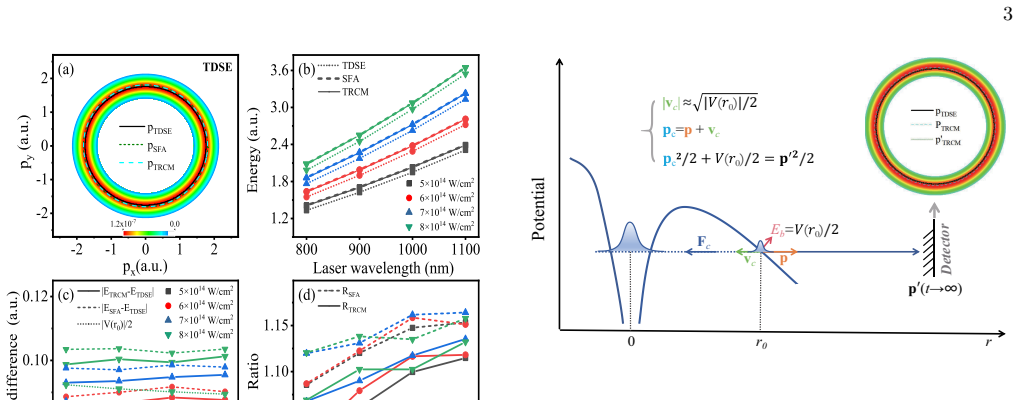
The state of the tunneling electron under the potential barrier is important in strong laser-atom interaction but is difficult to identify. Recent experiments showed that the tunneling electron may be located in a bound state with high symmetry [Phys. Rev. Lett. 134, 213201 (2025)]. However, the quantitative characteristic of the tunneling state in a tunneling event remains unclear. Here, we study tunneling ionization of atoms in strong circular laser fields. The calculated photoelectron momentum distribution (PMD) through numerical solution of time-dependent Schr\"odinger equation (TDSE) presents an isotropic ring-shaped distribution and the most probable momentum (MPM) along the ring can be easily identified. The kinetic energy related to MPM is remarkably smaller than that predicted by the strong-field approximation (SFA) that ignores Coulomb potential. Surprisingly, for different target atoms and laser parameters, the kinetic energy difference of MPM between TDSE and SFA is always close to half of the corresponding Coulomb potential at the tunnel exit. This phenomenon can be well described by a proposed model, which indicates that the tunneling electron is in an exit-position-dependent quasibound state agreeing with the virial theorem. These results quantitatively reveal the characteristics of tunneling states from a statistical perspective.
Editorial analysis
A structured set of objections, weighed in public.
Referee Report
Summary. The manuscript studies tunneling ionization of atoms in strong circular laser fields via numerical TDSE solutions, comparing to SFA. It reports that the kinetic energy at the most probable momentum (MPM) in the isotropic ring-shaped PMD is lower in TDSE than SFA, with the difference always close to half the Coulomb potential at the tunnel exit across atoms and parameters. A model is proposed indicating the tunneling electron occupies an exit-position-dependent quasibound state consistent with the virial theorem, providing a statistical characterization of the tunneling state.
Significance. If the numerical observation and model hold with full validation, the work would offer a quantitative statistical view of tunneling states, which are hard to access directly and relevant to strong-field physics. The choice of circular polarization to yield clear MPM identification is a methodological strength. However, the current lack of quantitative error analysis, full model derivation, and direct validation of the virial application limits the assessed significance.
major comments (3)
- [Abstract] Abstract: the central claim that the kinetic energy difference 'is always close to half' of the Coulomb potential is stated without any quantitative data (e.g., mean deviation, standard deviation, or number of cases), error analysis, or tabulated comparisons, preventing assessment of how close or universal the agreement actually is.
- [Proposed model] Proposed model (details referenced in abstract but not derived): the model is introduced to reproduce the observed half-factor shift and is said to agree with the virial theorem, yet no independent derivation from the TDSE wave packet, explicit computation of <T> and <V> at exit, or justification for applying the stationary-state virial relation 2<T> = −<V> to the short-time, non-stationary tunneling process is provided; this makes it unclear whether the quasibound state is predicted or constructed post hoc.
- [Abstract] Abstract and model description: the attribution of the TDSE–SFA difference specifically to an exit-position-dependent quasibound state (rather than other Coulomb effects, gauge issues, or numerical artifacts in TDSE) is load-bearing for the interpretation but lacks direct validation such as wave-packet expectation values or a falsifiable test beyond fitting the shift.
minor comments (1)
- [Abstract] The abstract contains a typographical artifact (" for quotes) that should be cleaned for publication.
Simulated Author's Rebuttal
We thank the referee for the careful reading and constructive comments, which help clarify the presentation of our results. We address each major comment below and have revised the manuscript to incorporate additional quantitative analysis, model details, and validation steps.
read point-by-point responses
-
Referee: [Abstract] Abstract: the central claim that the kinetic energy difference 'is always close to half' of the Coulomb potential is stated without any quantitative data (e.g., mean deviation, standard deviation, or number of cases), error analysis, or tabulated comparisons, preventing assessment of how close or universal the agreement actually is.
Authors: We agree that quantitative support is needed to substantiate the claim. The revised manuscript includes a new table compiling the TDSE-SFA kinetic energy differences and half-Coulomb potentials for hydrogen, helium, neon, and argon across 12 combinations of laser intensity and wavelength. We report a mean relative deviation of 4.1% with a standard deviation of 2.3%, along with numerical convergence error estimates. These data are now referenced in the abstract and main text. revision: yes
-
Referee: [Proposed model] Proposed model (details referenced in abstract but not derived): the model is introduced to reproduce the observed half-factor shift and is said to agree with the virial theorem, yet no independent derivation from the TDSE wave packet, explicit computation of <T> and <V> at exit, or justification for applying the stationary-state virial relation 2<T> = −<V> to the short-time, non-stationary tunneling process is provided; this makes it unclear whether the quasibound state is predicted or constructed post hoc.
Authors: The original model section presents the quasibound state via the observed shift and virial consistency. To address the request for independent derivation, the revision adds an appendix with explicit TDSE wave-packet calculations of time-dependent <T> and <V> at tunnel exit for sample cases, confirming approximate adherence to 2<T> ≈ −<V>. A brief discussion justifies the short-time application by comparing the tunneling duration to the relevant orbital timescales, showing the relation holds as an effective description rather than a post-hoc fit. revision: yes
-
Referee: [Abstract] Abstract and model description: the attribution of the TDSE–SFA difference specifically to an exit-position-dependent quasibound state (rather than other Coulomb effects, gauge issues, or numerical artifacts in TDSE) is load-bearing for the interpretation but lacks direct validation such as wave-packet expectation values or a falsifiable test beyond fitting the shift.
Authors: We acknowledge the need for direct validation. The revised manuscript adds wave-packet expectation value analysis at the exit position, confirming the position-dependent quasibound character. A falsifiable extension to elliptical polarization is included, predicting distinct shifts from pure Coulomb corrections. Gauge consistency is maintained by using identical vector potential in SFA and TDSE; numerical artifacts are addressed via documented convergence tests with grid and time-step variations now in the methods section. revision: yes
Circularity Check
No significant circularity; numerical observation independent of interpretive model
full rationale
The paper first computes photoelectron momentum distributions independently via TDSE and SFA for multiple atoms and laser parameters, identifies the MPM kinetic-energy difference as a numerical fact, and reports that this difference is consistently close to half the Coulomb potential at the tunnel exit. It then proposes a model to interpret this observation as an exit-position-dependent quasibound state consistent with the virial theorem. No equation or step reduces the reported difference or the model to a fitted parameter, self-citation, or definitional equivalence; the numerical discrepancy stands on its own as an external benchmark, and the model is presented as a descriptive interpretation rather than a derivation that forces the result by construction. The virial theorem is an external principle whose applicability is asserted but not shown to be smuggled in via prior self-work.
Axiom & Free-Parameter Ledger
axioms (1)
- domain assumption The virial theorem applies to the exit-position-dependent quasibound state of the tunneling electron.
invented entities (1)
-
exit-position-dependent quasibound state
no independent evidence
Reference graph
Works this paper leans on
-
[1]
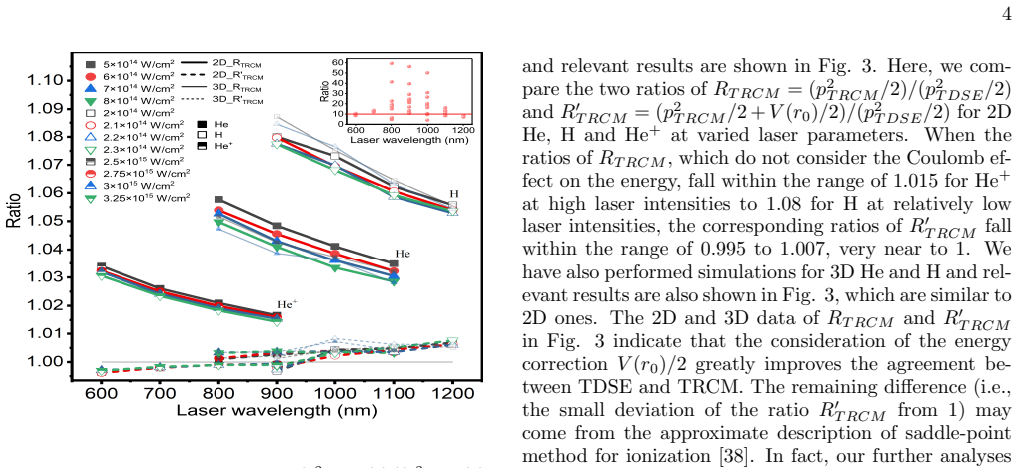
However, when the Coulomb potential is considered, the Coulomb forceF c will pull the electron back when it tunnels through the barrier under the action of the laser electric field. This will equivalently induce an ad- ditional velocityv c at the tunnel exit, with the direction 4 /s32/s32/s50/s68/s95/s82 /s84 /s82/s67/s77 /s32/s32/s50/s68/s95/s82/s39 /s84...
-
[2]
L. V. Keldysh, Ionization in the field of a strong electro- magnetic wave, Sov. Phys. JETP20, 1307 (1965)
1965
-
[3]
F. H. M. Faisal, Multiple absorption of laser photons by atoms, J. Phys. B6, L89 (1973)
1973
-
[4]
H. R. Reiss, Effect of an intense electromagnetic field on a weakly bound system, Phys. Rev. A22, 1786 (1980)
1980
-
[5]
Agostini, F
P. Agostini, F. Fabre, G. Mainfray, G. Petite and N. K. Rahman, Free-Free Transitions Following Six-Photon Ionization of Xenon Atoms, Phys. Rev. Lett.42, 1127 (1979)
1979
-
[6]
M. V. Ammosov, N. B. Delone, and V. P. Krainov, Tun- nel ionization of complex atoms and of atomic ions in an alternating electromagnetic field, Sov. Phys. JETP64, 1191 (1986)
1986
-
[7]
Becker, F
W. Becker, F. Grasbon, R. Kopold, D. B. Milo˘ sevi´ c, G. G. Paulus and H. Walther, Above-threshold ionization: from classical features to quantum effects, Adv. At. Mol. Opt. Phys.48, 35 (2002)
2002
-
[8]
B. Yang, K. J. Schafer, B. Walker, K. C. Kulander, P. Agostini and L. F. DiMauro, Intensity-dependent scatter- ing rings in high order above-threshold ionization, Phys. Rev. Lett.71, 3770 (1993)
1993
-
[9]
G. G. Paulus, W. Becker, W. Nicklich and H. Walther, Rescattering effects in above-threshold ionization: a clas- sical model, J. Phys. B27, L703 (1994)
1994
-
[10]
Lewenstein, K
M. Lewenstein, K. C. Kulander, K. J. Schafer and P. H. Bucksbaum, Rings in above-threshold ionization: A quasiclassical analysis, Phys. Rev. A51, 1495 (1995)
1995
-
[11]
McPherson, G
A. McPherson, G. Gibson, H. Jara, U. Johann, T. S. Luk, I. A. McIntyre, K. Boyer and C. K. Rhodes, Studies of multiphoton production of vacuum-ultraviolet radiation in the rare gases, J. Opt. Soc. Am. B4, 595 (1987)
1987
-
[12]
Ferray, A
M. Ferray, A. L’Huillier, X. F. Li, L. A. Lompre, G. Mainfray, and C. Manus, Multiple-harmonic conversion of 1064 nm radiation in rare gases, J. Phys. B21, L31 (1988)
1988
-
[13]
P. B. Corkum, Plasma perspective on strong field multi- photon ionization, Phys. Rev. Lett.71, 1994 (1993)
1994
-
[14]
Lewenstein, Ph
M. Lewenstein, Ph. Balcou, M. Yu. Ivanov, A. L’Huillier, and P. B. Corkum, Theory of high-harmonic generation by low-frequency laser fields, Phys. Rev. A49, 2117 (1994)
1994
-
[15]
Eckle, A
P. Eckle, A. N. Pfeiffer, C. Cirelli, A. Staudte, R. D¨ orner, H. G. Muller, M. Buttiker, U. Keller, Attosecond Ioniza- tion and Tunneling Delay Time Measurements in Helium, Science322, 1525 (2008)
2008
-
[16]
Krausz and M
F. Krausz and M. Ivanov, Attosecond physics, Rev. Mod. Phys.81, 163 (2009)
2009
-
[17]
Shafir, H
D. Shafir, H. Soifer, B. D. Bruner, M. Dagan, Y. Mairesse, S. Patchkovskii, M. Y. Ivanov, O. Smirnova, and N. Dudovich, Resolving the time when an electron exits a tunnelling barrier, Nature (London)485, 343 (2012)
2012
-
[18]
U. S. Sainadh, H. Xu, X. Wang, A. Atia-Tul-Noor, W. C. Wallace, N. Douguet, A. Bray, I. Ivanov, K. Bartschat, A. Kheifets, R. T. Sang, and I. V. Litvinyuk, Attosecond angular streaking and tunneling time in atomic hydrogen, Nature (London)568, 75-77 (2019)
2019
-
[19]
S. P. Goreslavski, G. G. Paulus, S. V. Popruzhenko, and N. I. Shvetsov-Shilovski, Coulomb asymmetry in above- threshold ionization, Phys. Rev. Lett.93, 233002 (2004)
2004
-
[20]
T. M. Yan, S. V. Popruzhenko, M. J. J. Vrakking, and D. Bauer, Low-energy structures in strong field ioniza- tion revealed by quantum orbits, Phys. Rev. Lett.105, 253002 (2010)
2010
-
[21]
R. Boge, C. Cirelli, A. S. Landsman, S. Heuser, A. Lud- wig, J. Maurer, M. Weger, L. Gallmann, and U. Keller, Probing Nonadiabatic Effects in Strong-Field Tunnel Ion- ization, Phys. Rev. Lett.111, 103003 (2013)
2013
-
[22]
M. Li, J. Geng, H. Liu, Y. K. Deng, C. Y. Wu, L. Y. Peng, Q. H. Gong, and Y. Q. Liu, Classical-Quantum cor- respondence for above-threshold ionization, Phys. Rev. Lett.112, 113002 (2014)
2014
-
[23]
Torlina, F
L. Torlina, F. Morales, J. Kaushal, I. Ivanov, A. Kheifets, A. Zielinski, A. Scrinzi, H. G. Muller, S. Sukiasyan, M. Ivanov, and O. Smirnova, Interpreting attoclock mea- surements of tunneling times, Nat. Phys.11, 503 (2015)
2015
-
[24]
X. J. Xie, C. Chen, G. G. Xin, J. Liu, and Y. J. Chen, Coulomb-induced ionization time lag after electrons tun- nel out of a barrier, Opt. Express28, 33228 (2020)
2020
-
[25]
Trabert, N
D. Trabert, N. Anders, S. Brennecke, M. S. Sch¨ offler, T. Jahnke, L. Ph. H. Schmidt, M. Kunitski, M. Lein, R. D¨ orner, S. Eckart, Nonadiabatic strong field ionization of atomic hydrogen, Phys. Rev. Lett.127, 273201 (2021)
2021
-
[26]
M. O. Scully and M. S. Zubairy, Quantum Optics (Cam- bridge University Press, Cambridge, 1997)
1997
-
[27]
Khurelbaatar, M
T. Khurelbaatar, M. Klaiber, S. Sukiasyan, K. Z. Hat- sagortsyan, C. H. Keitel, and D. E. Kim, Unveiling Under-the-Barrier Electron Dynamics in Strong Field Tunneling, Phys. Rev. Lett.134, 213201 (2025)
2025
-
[28]
H. G. Muller, Tunneling Excitation to Resonant States in Helium as Main Source of Superponderomotive Photo- electrons in the Tunneling Regime, Phys. Rev. Lett.83, 3158 (1999)
1999
-
[29]
Klaiber, K
M. Klaiber, K. Z. Hatsagortsyan, and C. H. Keitel, Tun- neling Dynamics in Multiphoton Ionization and Atto- clock Calibration, Phys. Rev. Lett.114, 083001 (2015)
2015
-
[30]
E. E. Serebryannikov and A. M. Zheltikov, Strong-Field Photoionization as Excited-State Tunneling, Phys. Rev. Lett.116, 123901 (2016)
2016
-
[31]
J. N. Wu, Z. Y. Chen, S. Q. Shen, S. Wang, J. Y. Che, and Y. J. Chen, Aspects of harmonic emission in the attoclock, Opt. Express33, 35679 (2025)
2025
-
[32]
A. S. Landsman, C. Hofmann, A. N. Pfeiffer, C. Cirelli, and U. Keller, Unified Approach to Probing Coulomb Effects in Tunnel Ionization for Any Ellipticity of Laser Light, Phys. Rev. Lett.111, 263001 (2013)
2013
-
[33]
J. Y. Che, J. Y. Huang, F. B. Zhang, C. Chen, G. G. Xin, and Y. J. Chen, Roles of laser ellipticity in attoclocks, Phys. Rev. A107, 043109 (2023)
2023
-
[34]
C. Chen, X. X. Ji, W. Y. Li, X. Han, and Y. J. Chen, Local most-probable routes and classical-quantum corre- spondence in strong-field two-dimensional tunneling ion- ization, Phys. Rev. A104, 013106 (2021)
2021
-
[35]
M. Feit, J. Fleck, and A. Steiger, Solution of the Schr¨ odinger equation by a spectral method, J. Comput. Phys.47, 412 (1982)
1982
-
[36]
J. Y. Che, C. Chen, W. Y. Li, S. Wang, X. J. Xie, J. Y. Huang, Y. G. Peng, G. G. Xin, and Y. J. Chen, Re- sponse time of photoemission at quantum-classic bound- ary, arXiv:2111.08491
-
[37]
J. Y. Che, C. Chen, W. Y. Li, W. Li, and Y. J. Chen, 6 Advances in response time of strong-field ionization of atoms, Acta Phys. Sin.72, 193301 (2023)
2023
-
[38]
F. Guo, D. Usanov, E. B. Guedes, M. Fanciulli, K. Kawaguchi, R. Mori, T. Kondo, A. Magrez, M. Puppin, and J. Hugo Dil. Dependency of quantum time scales on symmetry, Newton2,100374 (2025)
2025
-
[39]
Z. Y. Chen, S. Q. Shen, Y. P. Li, Z. Q. Yang, J. Y. Che, and Y. J. Chen, Coulomb-related symmetry in laser- induced tunneling ionization of atoms and molecules, Phys. Rev. A111, 053118 (2025)
2025
discussion (0)
Sign in with ORCID, Apple, or X to comment. Anyone can read and Pith papers without signing in.