REVIEW 3 major objections 6 minor 21 references
On the edge-vertex ratio of maximal thrackles
T0 review · 3 major / 6 minor · reviewed 2026-08-14 · deepseek-v4-flash
Pith's one-line read This paper constructs maximal thrackles with arbitrarily small edge-vertex ratio in the geometric case, and an infinite family without isolated vertices with ratio exactly 5/6 in the topological case.
desk verdict New extremal constructions for maximal thrackles, with the 5/6 family resting on a plausibly true but under-formalized belt construction. read the letter →
The pith
A machine-rendered reading of the paper's core claim, the machinery that carries it, and where it could break.
The reading
What carries the argument
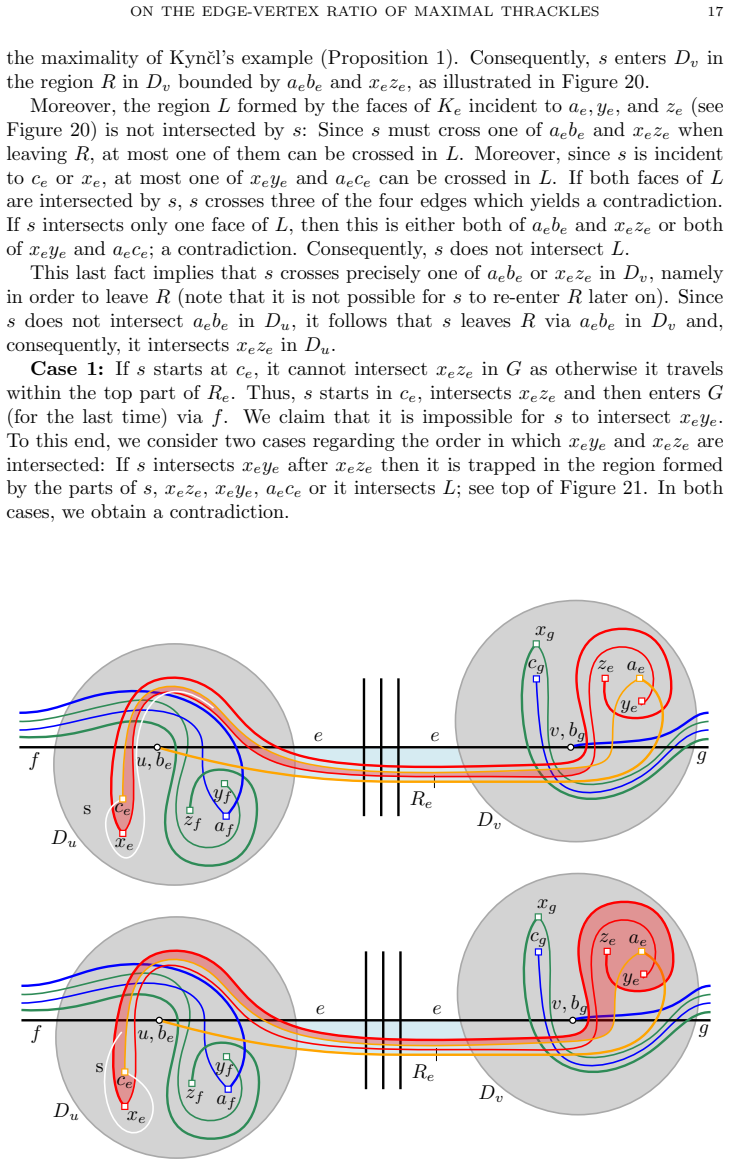
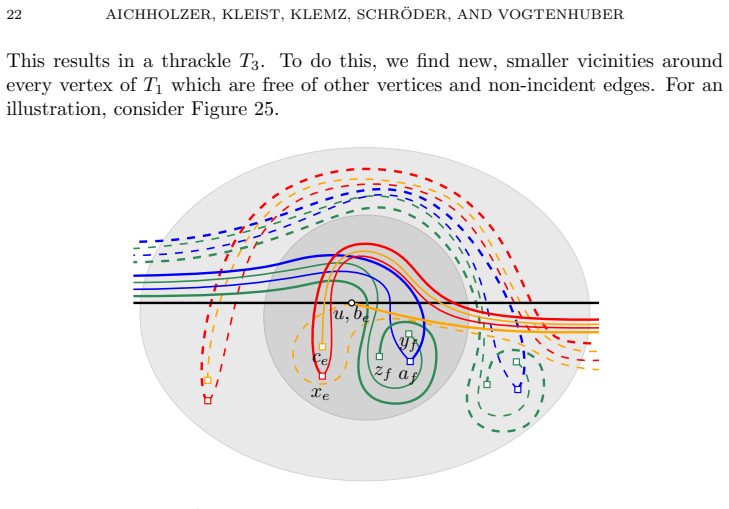
The load-bearing mechanism is the belt construction: for each directed edge $e=uv$ of a cycle thrackle, place a copy of a four-edge, six-vertex local example with its vertices split between small disks around $u$ and $v$, and route every edge of the copy in a thin tunnel along $e$ so that it crosses all edges of the original drawing exactly once, while the two copies attached to consecutive edges also cross each other exactly once. The construction is engineered so that exactly four new edges and five new vertices are added per original edge, which fixes the edge-vertex ratio at $5/6$. The second mechanism is the maximality transfer encoded in Property 3: if a new edge can be added to the inflated drawing, it can be rerouted step by step until its endpoints lie in the underlying cycle, so maximality of the inflated drawing follows from maximality of the cycle.
What would settle it
Take the smallest case of the construction, $n=2$, for which $T_1$ is a 10-cycle, build an explicit drawing of $T_2$, and check every potential new edge between nonadjacent vertices: if any curve joins two such vertices while crossing every edge of $T_2$ exactly once, then $T_2$ is not maximal and Theorem 3 collapses. A systematic search over rotation systems of the 10-vertex drawing would settle the check.
Extended reading notes
Core claim
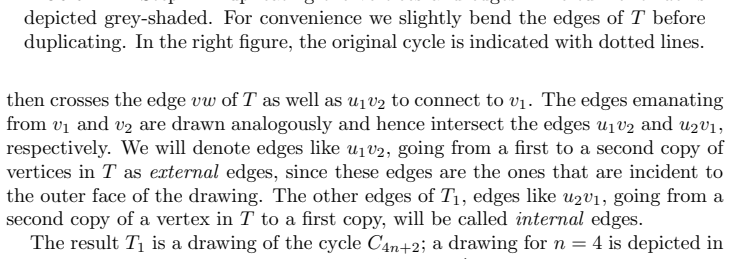
The central discovery is the infinite family of Theorem 3: there exist maximal topological thrackles without isolated vertices with edge-vertex ratio exactly $5/6$. The proof begins with a star-shaped drawing of the odd cycle $C_{2n+1}$, duplicates every vertex and edge to obtain a maximal thrackle $T_1$ on the cycle $C_{4n+2}$, and then applies the belt construction to every edge of $T_1$. For each edge it places a copy of a fixed four-edge, six-vertex local example in a thin tunnel around that edge, interlacing the copy with the edge and its two neighbours so that every new edge crosses every other edge of the drawing exactly once. Each original edge survives and gains four new companion edges, while five new vertices are introduced, so the ratio $5/6$ follows by counting. The paper proves maximality of $T_2$ by a rerouting argument: any hypothetical new edge in $T_2$ can be locally rerouted to one whose endpoints belong to $T_1$, contradicting the known maximality of $T_1$.
Load-bearing premise
The construction assumes that all these small copies can be drawn simultaneously in thin tunnels around the edges so that every pair of edges crosses exactly once and no unintended intersections appear; the paper demonstrates the required interlacing in figures but does not give a formal proof that the simultaneous placement is always achievable.
Editorial extensions
If this is right
- Maximality does not force a thrackle to have as many edges as vertices; maximal topological thrackles without isolated vertices can have ratio $5/6$, and geometric ones can approach $1/2$.
- The lower bound $1/2$ from the handshaking lemma is asymptotically tight for maximal geometric thrackles without isolated vertices.
- Adding isolated vertices is enough to drive the ratio to zero in both geometric and topological settings, so any positive lower bound for maximal thrackles must exclude isolated vertices.
- The belt construction preserves maximality while inflating the edge count, giving a local operation that builds larger maximal thrackles from smaller ones.
- Iterating the same construction on the original edges is proposed in the paper as a route toward ratios approaching $4/5$, which would leave the gap between $1/2$ and $5/6$ open.
Reading between the lines
- The paper states the iterated belt construction as ongoing work; this reader's extrapolation is that the exact counting would give $4/5$ per additional round, but the difficulty is the maximality transfer, not the ratio.
- The rerouting strategy suggests a reusable design principle: if a small, non-extendable local drawing is placed in a tunnel around each edge of a maximal thrackle, and every hypothetical new edge can be pulled back into the underlying cycle, then the inflated drawing inherits maximality. Testing this principle on other local modules could produce ratios below $5/6$.
- A natural next experiment is to replace the four-edge, six-vertex local module by other non-extendable drawings with fewer edges per vertex and check whether the belt construction still closes; the paper does not explore this.
Signed reviews
Editorial analysis
A structured set of objections, weighed in public.
Referee Report
Summary. The paper studies maximal thrackles, drawings of graphs in which every pair of edges intersects exactly once (at a common vertex or at a proper crossing), and investigates the possible values of the edge-vertex ratio ε(T)=|E|/|V|. It proves three existence results: (1) geometric maximal thrackles can have arbitrarily small ε, and, if isolated vertices are forbidden, can have ε arbitrarily close to the handshaking bound 1/2; (2) topological maximal thrackles with isolated vertices can have arbitrarily small ε; and (3) there is an infinite family of maximal topological thrackles without isolated vertices with ε exactly 5/6. The main construction in Theorem 3 starts from a star-shaped drawing of an odd cycle, duplicates vertices and edges to obtain a maximal thrackled cycle T1, and then applies a 'Kynčl belt construction' that attaches a copy of Kynčl's four-edge maximal thrackle to each edge of T1. The resulting graph T2 is shown to be maximal by a sequence of rerouting lemmas and structural properties (Lemmas 2–7, Properties 1–3).
Significance. If Theorem 3 is accepted, it is a valuable extremal result: apart from the trivial K1,1, it gives the first infinite family of maximal thrackles without isolated vertices whose edge-vertex ratio is strictly below 1, and it does so through a flexible gadget construction that may be adaptable to other saturation questions. The paper also contains a self-contained proof that Kynčl's example is maximal and a detailed proof that the duplicated cycle T1 is maximal, along with an independent verification of the specific case where Conway's conjecture for n≤12 is invoked. The constructions are explicit and the intermediate lemmas are clearly stated. The main weakness is that the Kynčl belt construction is described informally, with reference to figures, rather than by a formal existence proof, and the later lemmas inherit this informality. The paper does not include machine-checked proofs, but the case analysis is extensive and appears internally coherent.
major comments (3)
- [Section 4, paragraph after Figure 17] The Kynčl belt construction is not proved to exist. The text states that the copies K_e are drawn in thin tunnels around each edge e and that 'This ensures three facts', but no argument is given that a simultaneous drawing with the required intersection pattern is realizable. In particular, the claims that each edge of K_e intersects each edge of K_f and K_g precisely once, and that each edge of K_e intersects each edge of every remaining Kynčl copy exactly once, are global assertions about the interaction of 4|E(T1)| new curves. The existence of pairwise disjoint vertex vicinities and of tunnels with the required crossing behavior needs a proof or at least a constructive ordering, such as an ε-tunnel argument. As written, Theorem 3 and all subsequent lemmas rest on an unverified geometric hypothesis.
- [Section 4, Lemmas 2–7 and Properties 1–3] The proofs of these results depend on the precise local layout of the Kynčl copies inside the vertex vicinities, but this layout is described only by figures and informal phrases such as 'as illustrated in Figure 17' and 'the red-shaded region in Figure 19'. For example, Lemma 3 uses regions R, L, and G without textual definitions, and Property 3 refers to the triangular region T_u that is only shown in Figure 11. Since these lemmas establish maximality of T2, the authors should provide a combinatorial description of the local drawing in each vicinity, including the cyclic order of edges around each vertex and the sectors through which edges leave the disk, so that the case analyses can be checked independently of the figures.
- [Section 4, Proposition 2] The maximality proof of T1, though extensive, is not fully formal. In Case 1, the region R and the face C are not precisely defined, and the claim that the new edge crosses the boundary of R an even number of times 'since it contains C' is stated without proof. Similar issues appear in Cases 3 and 4 with the definitions of lower, middle, and upper parts of edges. Because Proposition 2 is used in the concluding step of Theorem 3 via Property 3, the argument should be made fully rigorous, for example by defining the relevant regions explicitly and justifying the parity or crossing claims.
minor comments (6)
- [Introduction] In the discussion of k-simple graphs, 'th k-simple property' should read 'the k-simple property'.
- [Section 5] The phrase 'maximal trackles' appears twice; it should be 'maximal thrackles'.
- [Lemma 3] The phrase 'we apply the usual modification for removing multiple edge crossings' is vague; please specify how the modification works and why it preserves the thrackle condition.
- [Property 3] In the sentence about replacing sections of s, 'close to the boundary of DU' should be 'close to the boundary of D_u'.
- [Theorem 2, direct proof in Case 3] The argument uses the fact that a thrackle cannot contain a 4-cycle without proof or citation; this is a standard consequence of Woodall's characterization of thrackled cycles and should be stated explicitly.
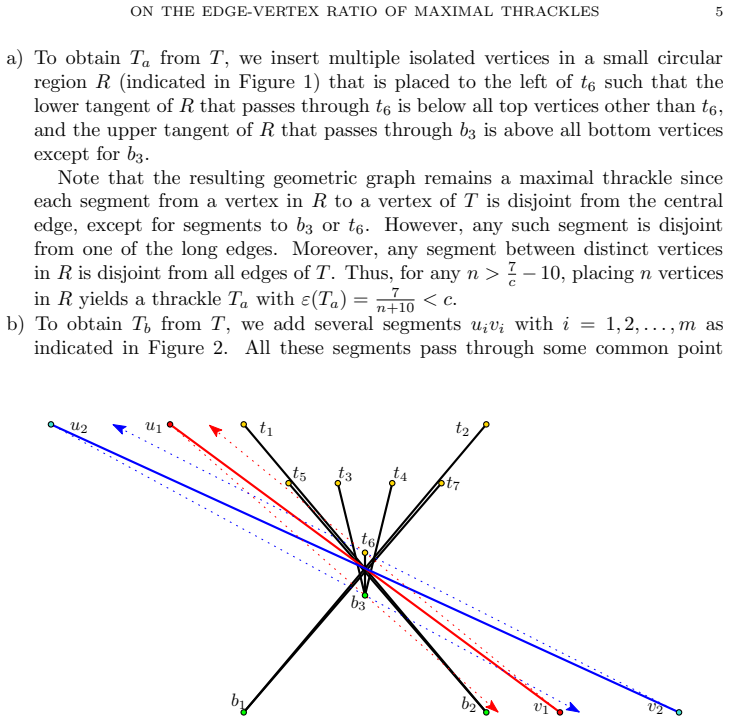
- [Section 2, proof of Theorem 1(b)] The sentence 'It is clear that by adding any number of segments in this way, we obtain a thrackle' is not fully justified; a short explanation of why the new segments intersect each other exactly once would be helpful.
Circularity Check
No circularity: all central constructions and maximality proofs are direct, with no fitted inputs or author-imposed uniqueness assumptions.
full rationale
I walked the derivation chain of each theorem. The paper's central results are existence constructions, and every load-bearing claim is either proved directly or reduced to an independently proven proposition. The Kyncl example is introduced as external prior work, but the paper explicitly proves that it is a maximal thrackle in Proposition 1 rather than importing maximality. Theorem 3's key reduction is Property 3, which shows that if T1 is maximal then T2 is maximal; this is not circular because Proposition 2 independently proves maximality of T1, and Property 3 is a rerouting argument that establishes a rigorous implication. The use of the Pammer bound for n <= 12 in Theorem 2 is accompanied by an explicit independent direct proof, so it is not load-bearing self-citation. No fitted values are renamed as predictions, no quantity is defined in terms of the claimed output, and no author-imposed uniqueness theorem forces the constructions. The geometric feasibility of the belt construction is asserted with reference to figures rather than fully formalized, but that is a completeness or robustness concern, not circularity: the assertion is not equivalent to the theorem's conclusion by construction. The edge-vertex ratios are computed by explicit vertex and edge counts, not by assuming the desired ratio. Overall, the derivation chain is self-contained against external benchmarks and exhibits no circular step.
Assumptions & free parameters
assumptions (3)
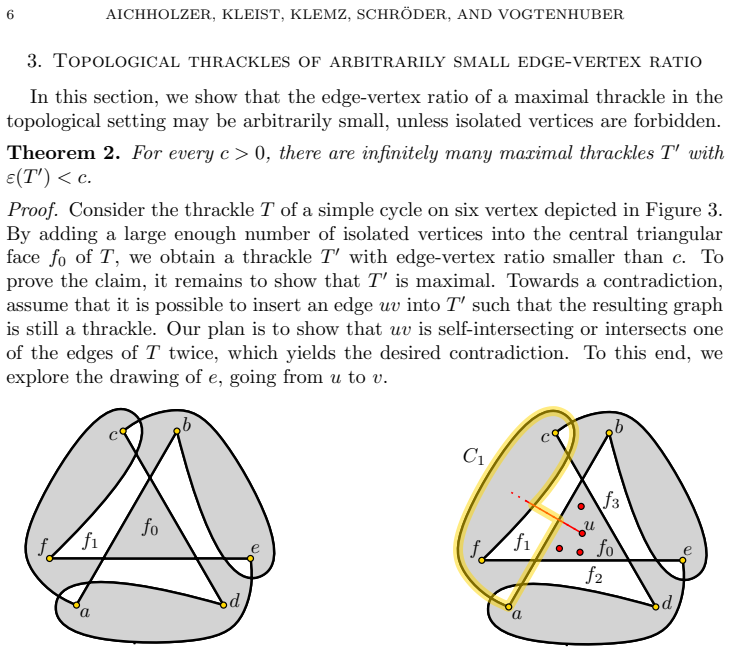
- domain assumption The drawing in Figure 3 is a thrackle of a 6-cycle with a central triangular face f0 and three adjacent quadrilateral faces f1, f2, f3.
- domain assumption The Kynčl belt construction is geometrically realizable: each copy K_e can be drawn in a thin tunnel around its edge e so that every edge of K_e intersects every other edge of T2 exactly once and copies do not interfere.
- standard math Standard planar topology facts, including Euler's formula and face-counting arguments used in the case analyses.
Cite this review
Pith. "Pith review of On the edge-vertex ratio of maximal thrackles." pith.science (2026). https://pith.science/paper/RLDUAV4H
@misc{pith2026190808857,
  author       = {Pith},
  title        = {Pith review of: On the edge-vertex ratio of maximal thrackles},
  year         = {2026},
  howpublished = {\url{https://pith.science/paper/RLDUAV4H}},
  note         = {Machine review of arXiv:1908.08857}
}
read the original abstract
A drawing of a graph in the plane is a thrackle if every pair of edges intersects exactly once, either at a common vertex or at a proper crossing. Conway's conjecture states that a thrackle has at most as many edges as vertices. In this paper, we investigate the edge-vertex ratio of maximal thrackles, that is, thrackles in which no edge between already existing vertices can be inserted such that the resulting drawing remains a thrackle. For maximal geometric and topological thrackles, we show that the edge-vertex ratio can be arbitrarily small. When forbidding isolated vertices, the edge-vertex ratio of maximal geometric thrackles can be arbitrarily close to the natural lower bound of 1/2. For maximal topological thrackles without isolated vertices, we present an infinite family with an edge-vertex ratio of 5/6.
Figures

Figures from the paper (19 more)








Reference graph
Works this paper leans on
-
[1]
Discrete Mathe- matics 338(12), 2507–2513 (2015)
Cairns, G., Koussas, T., Nikolayevsky, Y.: Great-circle spherical thrackles. Discrete Mathe- matics 338(12), 2507–2513 (2015)
work page 2015
-
[2]
Discrete & Computational Geometry 23(2), 191–206 (2000)
Cairns, G., Nikolayevsky, Y.: Bounds for generalized thrackles. Discrete & Computational Geometry 23(2), 191–206 (2000)
work page 2000
-
[3]
Discrete & Computational Geometry 41(1), 119–134 (2009)
Cairns, G., Nikolayevsky, Y.: Generalized thrackle drawings of non-bipartite graphs. Discrete & Computational Geometry 41(1), 119–134 (2009)
work page 2009
-
[4]
Graphs and Combinatorics 28(1), 85–96 (2012)
Cairns, G., Nikolayevsky, Y.: Outerplanar thrackles. Graphs and Combinatorics 28(1), 85–96 (2012)
work page 2012
-
[5]
Cleve, J., Mulzer, W., Perz, D., Steiner, R., Welzl, E.: Unpublished Manuscript (August 2019)
work page 2019
-
[6]
Conway, J.H.: Unsolved problems in Combinatorics, pp. 351–363. Mathematical Institute, Oxford (1972)
work page 1972
-
[7]
Computa- tional Geometry: Theory and Applications 44(6–7), 345–355 (2011)
Fulek, R., Pach, J.: A computational approach to Conway’s Thrackle Conjecture. Computa- tional Geometry: Theory and Applications 44(6–7), 345–355 (2011)
work page 2011
-
[8]
Discrete Applied Mathematics 259, 226–231 (2019)
Fulek, R., Pach, J.: Thrackles: An improved upper bound. Discrete Applied Mathematics 259, 226–231 (2019)
work page 2019
Show all 21 references
-
[9]
Discrete & Computational Ge- ometry 58(2), 410–416 (2017)
Goddyn, L., Xu, Y.: On the bounds of Conway’s thrackles. Discrete & Computational Ge- ometry 58(2), 410–416 (2017)
2017
-
[10]
Journal of Graph Algorithms and Applications 22(1), 117–138 (2018)
Hajnal, P., Igamberdiev, A., Rote, G., Schulz, A.: Saturated simple and 2-simple topological graphs with few edges. Journal of Graph Algorithms and Applications 22(1), 117–138 (2018)
2018
-
[11]
Discrete & Computational Geometry 50(3), 727–770 (2013)
Kynˇ cl, J.: Improved enumeration of simple topological graphs. Discrete & Computational Geometry 50(3), 727–770 (2013). https://doi.org/10.1007/s00454-013-9535-8
2013 doi
-
[12]
Kynˇ cl, J., Pach, J., Radoiˇ ci´ c, R., T´ oth, G.: Saturated simple and k-simple topological graphs. Comput. Geom. 48(4), 295–310 (2015). https://doi.org/10.1016/j.comgeo.2014.10.008
2015 doi
-
[13]
Vertex 2(4), 1 (2006)
Li, W., Daniels, K., Rybnikov, K.: A study of Conway’s Thrackle Conjecture. Vertex 2(4), 1 (2006)
2006
-
[14]
Discrete & Computa- tional Geometry 18(4), 369–376 (1997)
Lov´ asz, L., Pach, J., Szegedy, M.: On Conway’s thrackle conjecture. Discrete & Computa- tional Geometry 18(4), 369–376 (1997)
1997
-
[15]
Discrete Mathematics & Theo- retical Computer Science V ol
Misereh, G., Nikolayevsky, Y.: Annular and pants thrackles. Discrete Mathematics & Theo- retical Computer Science V ol. 20 no. 1 (2018). https://doi.org/10.23638/DMTCS-20-1-16
2018 doi
-
[16]
In: M´ arquez, A., Ramos, P., Urru- tia, J
Pach, J., Radoicic, R., T´ oth, G.: Tangled thrackles. In: M´ arquez, A., Ramos, P., Urru- tia, J. (eds.) Computational Geometry - XIV Spanish Meeting on Computational Geometry, EGC 2011, Dedicated to Ferran Hurtado on the Occasion of His 60th Birthday, Alcal´ a de Henares, Sp...
2011 doi
-
[17]
The American Mathe- matical Monthly 118(6), 544–548 (2011)
Pach, J., Sterling, E.: Conway’s conjecture for monotone thrackles. The American Mathe- matical Monthly 118(6), 544–548 (2011)
2011
-
[18]
Pammer, J.: Rotation Systems and Good Drawings, pp. 1–83. TUGraz (2014)
2014
-
[19]
European Journal of Combinatorics 51, 398–406 (2016)
Ruiz-Vargas, A.J., Suk, A., T´ oth, C.D.: Disjoint edges in topological graphs and the tangled- thrackle conjecture. European Journal of Combinatorics 51, 398–406 (2016)
2016
-
[20]
http://www.thrackle.org/thrackle.html (2013)
Wehner, S.: On the thrackle problem. http://www.thrackle.org/thrackle.html (2013)
2013
-
[21]
Combinatorial Mathematics and its Applications pp
Woodall, D.: Thrackles and deadlock. Combinatorial Mathematics and its Applications pp. 335–347 (1969)
1969
Reviewed August 14, 2026 · model on record in the stance chip above.
Discussion (0). Continue with ORCID to comment.