Single-Shot Realization of 10000-Mode Octave-Spanning Artificial Gauge Fields
Pith reviewed 2026-06-26 06:48 UTC · model grok-4.3
The pith
Integrated photonics realizes over 100 artificial gauge fields hosting more than 10,000 modes across nearly an optical octave, achieving the first frequency-comb version of the integer quantum Hall model for photons.
A machine-rendered reading of the paper's core claim, the machinery that carries it, and where it could break.
Core claim
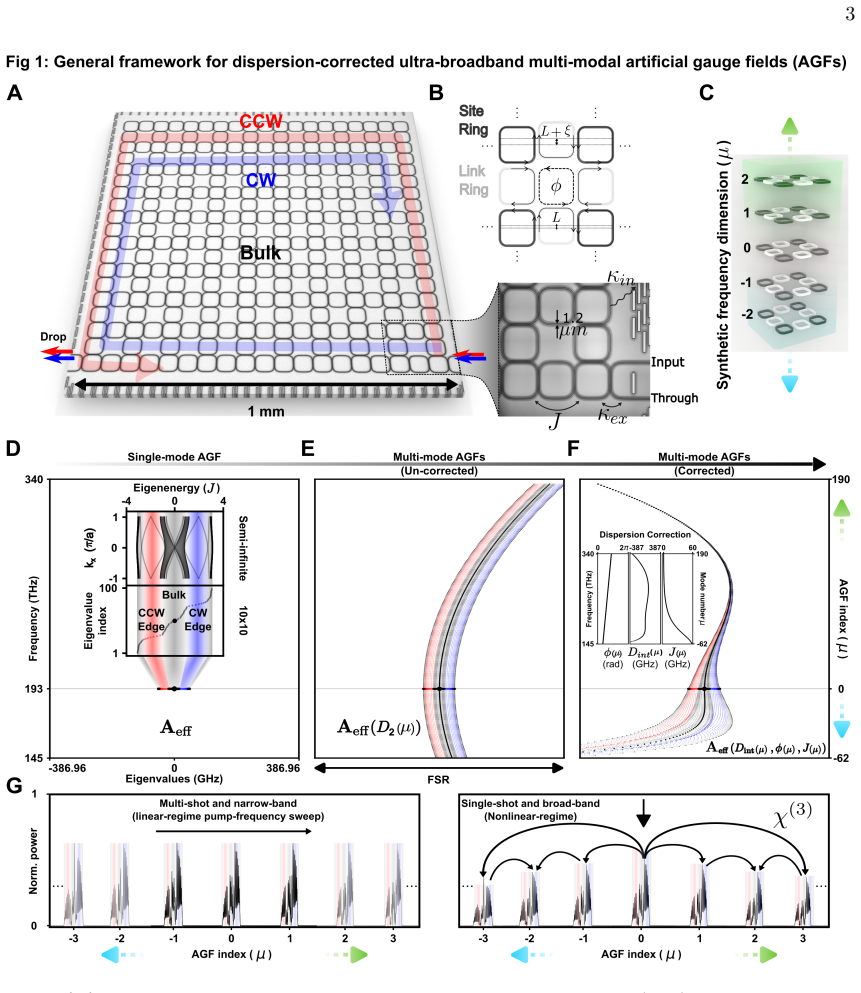
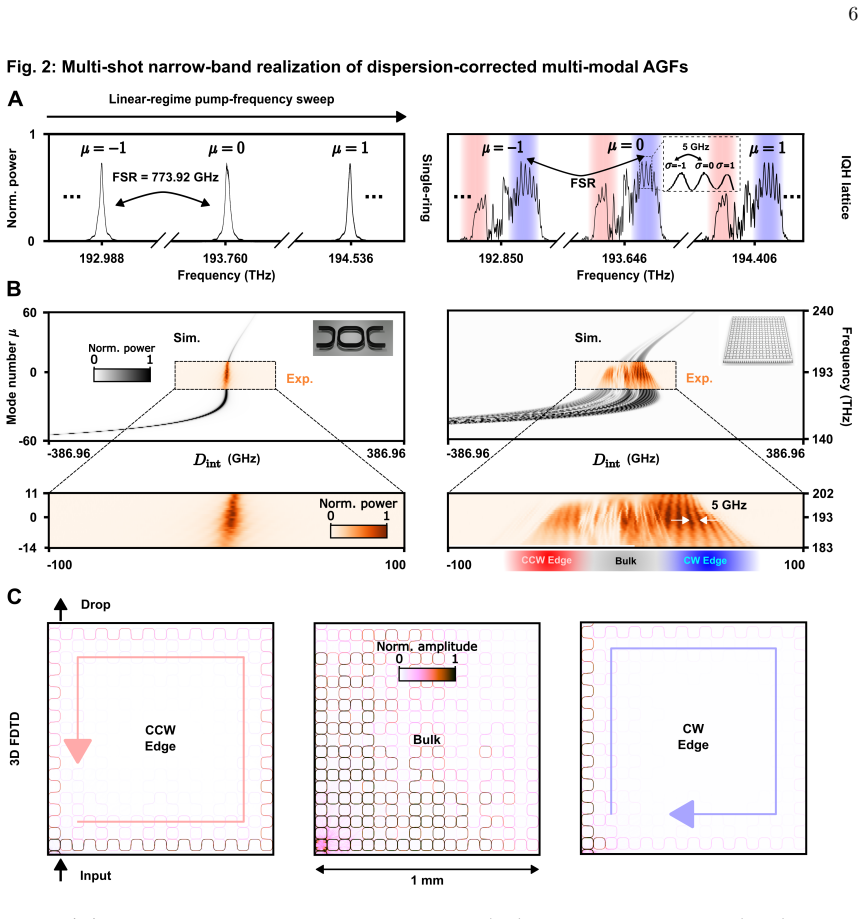
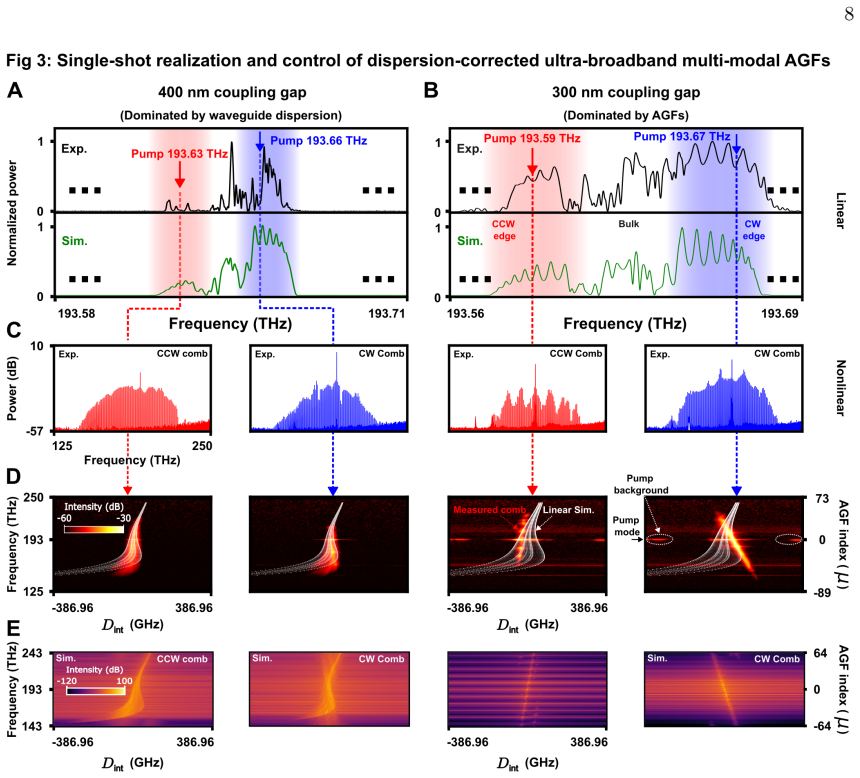
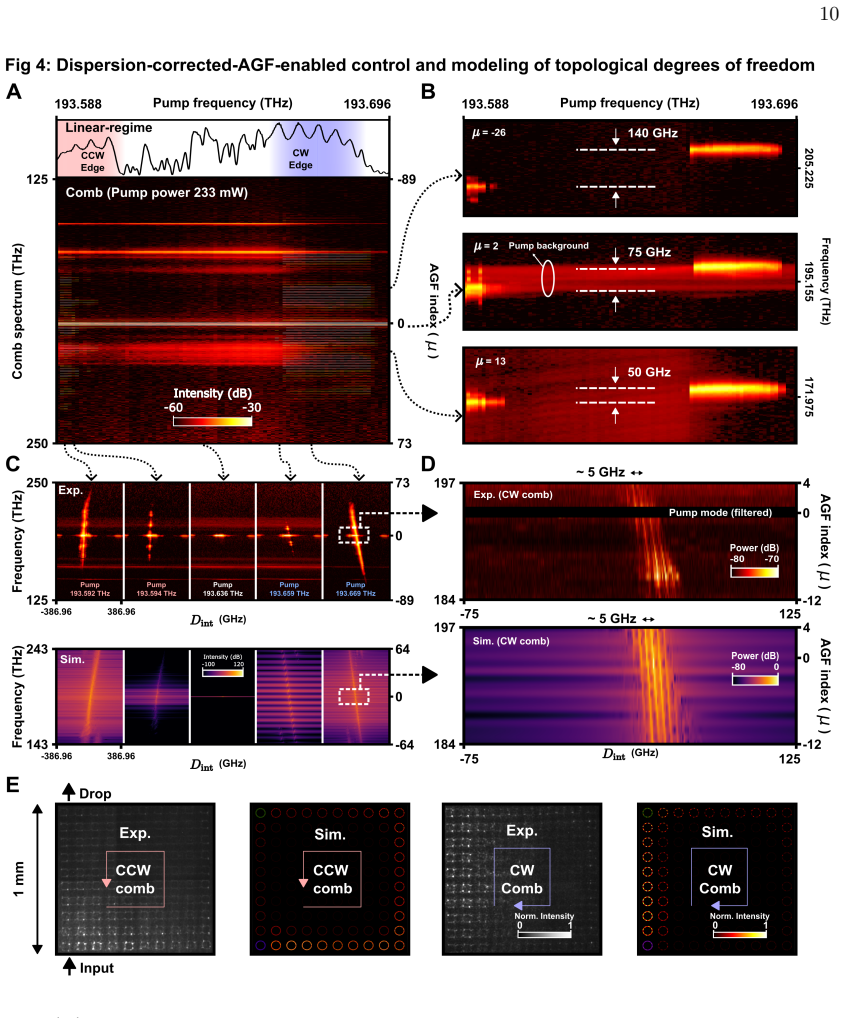
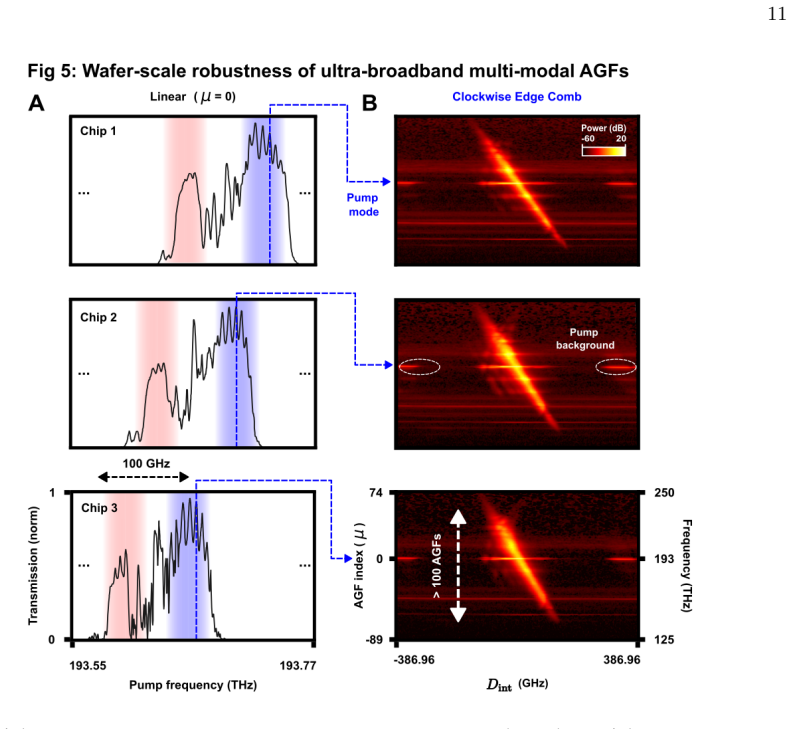
We introduce a general theoretical framework for ultra-broadband, multi-modal dispersion-corrected AGFs in both linear and nonlinear regimes. Using integrated photonics, we realize over 100 distinct AGFs hosting more than 10,000 modes across nearly an optical octave—the first frequency-comb realization of the integer quantum Hall model for photons. Leveraging Kerr nonlinearity, we achieve single-shot AGF control beyond waveguide dispersion, robust to wafer-scale fabrication variations.
What carries the argument
Dispersion-corrected artificial gauge fields realized through Kerr nonlinearity in integrated photonic devices, enabling single-shot control across octave bandwidth and thousands of modes.
If this is right
- Exotic dispersion-corrected AGF dynamics and simulations become accessible in photonic systems.
- Waveguide-dispersion-resilient photonic circuits can be manufactured at volume scale.
- AGF-enabled programmable nonlinear and quantum optics and optoelectronics become feasible.
- The integer quantum Hall model for photons can now be studied in frequency-comb formats with high mode counts.
Where Pith is reading between the lines
- The demonstrated robustness suggests these AGF devices could be fabricated in standard foundry processes without custom tuning per chip.
- Combining the octave bandwidth with frequency-comb sources may enable new multimode topological simulations that link optical and microwave regimes.
- The single-shot control method could extend to other nonlinear platforms where dispersion engineering has been a bottleneck.
Load-bearing premise
The Kerr nonlinearity enables single-shot AGF control beyond waveguide dispersion and remains robust to wafer-scale fabrication variations.
What would settle it
A direct measurement of the mode transmission spectra that fails to show the predicted chiral edge transport signatures or that falls short of octave-spanning coverage would falsify the claimed realization.
Figures
read the original abstract
Artificial gauge fields (AGFs) enable photons and other bosons to emulate fermionic phenomena such as chiral edge transport and quantum Hall phases; however, existing theories and realizations remain confined to narrow bandwidths under single-mode approximation. We introduce a general theoretical framework for ultra-broadband, multi-modal dispersion-corrected AGFs in both linear and nonlinear regimes. Using integrated photonics, we realize over 100 distinct AGFs hosting more than 10,000 modes across nearly an optical octave -- the first frequency-comb realization of the integer quantum Hall model for photons. Leveraging Kerr nonlinearity, we achieve single-shot AGF control beyond waveguide dispersion, robust to wafer-scale fabrication variations. Our results establish a new regime of ultra-broadband multimodal AGFs, opening pathways to exotic dispersion-corrected AGF dynamics and simulations, as well as volume-manufacturable device functionalities such as waveguide-dispersion-resilient photonic circuits, and AGF-enabled programmable nonlinear and quantum optics and optoelectrics.
Editorial analysis
A structured set of objections, weighed in public.
Referee Report
Summary. The manuscript introduces a general theoretical framework for ultra-broadband, multi-modal dispersion-corrected artificial gauge fields (AGFs) in both linear and nonlinear regimes. Using integrated photonics, it claims realization of over 100 distinct AGFs hosting more than 10,000 modes across nearly an optical octave—the first frequency-comb realization of the integer quantum Hall model for photons—achieved by leveraging Kerr nonlinearity for single-shot AGF control beyond waveguide dispersion and robust to wafer-scale fabrication variations.
Significance. If the experimental claims hold with supporting data and analysis, the work would advance photonic emulation of quantum Hall physics into an ultra-broadband multimodal regime, with implications for dispersion-resilient circuits and programmable nonlinear optics. The general theoretical framework for dispersion-corrected AGFs is a clear strength. The significance is limited by the absence of quantitative validation for the Kerr-enabled robustness claim.
major comments (1)
- [Abstract] Abstract: The claim that 'Leveraging Kerr nonlinearity, we achieve single-shot AGF control beyond waveguide dispersion, robust to wafer-scale fabrication variations' is presented as the enabling mechanism for the >10,000-mode realization, yet supplies no quantitative tolerance analysis (variation amplitude, Chern-number drift, or measured vs. designed gauge-field strength). This directly undermines the central experimental claim when dispersion and ~1-5% geometric scatter are considered.
Simulated Author's Rebuttal
We thank the referee for the detailed review and constructive feedback on our manuscript. We address the single major comment below and agree that adding quantitative support will strengthen the presentation of our central claims.
read point-by-point responses
-
Referee: [Abstract] Abstract: The claim that 'Leveraging Kerr nonlinearity, we achieve single-shot AGF control beyond waveguide dispersion, robust to wafer-scale fabrication variations' is presented as the enabling mechanism for the >10,000-mode realization, yet supplies no quantitative tolerance analysis (variation amplitude, Chern-number drift, or measured vs. designed gauge-field strength). This directly undermines the central experimental claim when dispersion and ~1-5% geometric scatter are considered.
Authors: We agree with the referee that the abstract states the robustness claim without accompanying quantitative metrics, which weakens its impact. The manuscript develops the general theoretical framework and demonstrates the multi-modal AGF realizations via simulations, but does not include an explicit tolerance analysis quantifying variation amplitudes (e.g., 1-5% geometric scatter), resulting Chern-number drift, or direct comparisons of Kerr-controlled vs. designed gauge-field strengths. We will add this analysis in the revision, including new figures or an appendix with the requested metrics to support the claim. revision: yes
Circularity Check
No circularity: experimental realization stands on independent measurements
full rationale
The paper's core claim is an experimental demonstration of >100 distinct AGFs across >10,000 modes using integrated photonics and Kerr nonlinearity. No derivation step reduces a predicted quantity to a fitted parameter by construction, nor does any load-bearing premise rest solely on self-citation whose content is itself unverified. The theoretical framework is presented as general and the results are tied to fabricated devices whose performance is reported via direct measurement; the Kerr-enabled single-shot control is asserted as an enabling mechanism but is not shown to be tautological with the reported mode counts or Chern numbers. The work is therefore self-contained against external benchmarks.
Axiom & Free-Parameter Ledger
axioms (1)
- domain assumption A general theoretical framework exists for ultra-broadband, multi-modal dispersion-corrected AGFs in linear and nonlinear regimes.
Reference graph
Works this paper leans on
-
[1]
(D) The exact linear and nonlinear simulations of panel (C)
Second row: The linear integrated dispersion of the same lattice measured within the same frequency range. (D) The exact linear and nonlinear simulations of panel (C). 40 FIG. S18. (A) The linear drop spectrum of a 300 nm gap IQH device. We generate frequency combs by sweeping the pump wavelength across one of the chiral edge bands with a fixed pump power...
-
[2]
Dalibard, F
J. Dalibard, F. Gerbier, G. Juzeli¯ unas, and P. ¨Ohberg, Reviews of Modern Physics 83, 1523 (2011)
2011
-
[3]
Gross and I
C. Gross and I. Bloch, Science 357, 995 (2017)
2017
-
[4]
S. Ding, G. Si, Y. Zheng, Z. Wang, and C. Lu, Applied Physics Reviews 12 (2025)
2025
-
[5]
Aidelsburger, S
M. Aidelsburger, S. Nascimbene, and N. Goldman, Comptes Rendus Physique 19, 394 (2018)
2018
-
[6]
Z. Wang, Y. Chong, J. D. Joannopoulos, and M. Soljaˇ ci´ c, Nature461, 772 (2009)
2009
-
[7]
K. Fang, Z. Yu, and S. Fan, Nature photonics 6, 782 (2012)
2012
-
[8]
M. C. Rechtsman, J. M. Zeuner, Y. Plotnik, Y. Lumer, D. Podolsky, F. Dreisow, S. Nolte, M. Segev, and A. Szameit, Nature 496, 196 (2013)
2013
-
[9]
Roushan, C
P. Roushan, C. Neill, A. Megrant, Y. Chen, R. Babbush, R. Barends, B. Campbell, Z. Chen, B. Chiaro, A. Dunsworth, et al. , Nature Physics 13, 146 (2017)
2017
-
[10]
A. Dutt, Q. Lin, L. Yuan, M. Minkov, M. Xiao, and S. Fan, Science 367, 59 (2020)
2020
-
[11]
I. T. Rosen, S. Muschinske, C. N. Barrett, A. Chatterjee, M. Hays, M. A. DeMarco, A. H. Karamlou, D. A. Rower, R. Das, D. K. Kim, et al. , Nature Physics 20, 1881 (2024)
2024
-
[12]
Hafezi, E
M. Hafezi, E. A. Demler, M. D. Lukin, and J. M. Taylor, Nature Physics 7, 907 (2011)
2011
-
[13]
Mittal, V
S. Mittal, V. V. Orre, D. Leykam, Y. D. Chong, and M. Hafezi, Physical review letters 123, 043201 (2019)
2019
- [15]
-
[16]
J. Suh, G. Kim, H. Park, S. Fan, N. Park, and S. Yu, Physical Review Letters 132, 033803 (2024)
2024
-
[17]
S¨ usstrunk and S
R. S¨ usstrunk and S. D. Huber, Science349, 47 (2015)
2015
-
[18]
K. Fang, J. Luo, A. Metelmann, M. H. Matheny, F. Marquardt, A. A. Clerk, and O. Painter, Nature Physics 13, 465 (2017)
2017
-
[19]
Galitski, G
V. Galitski, G. Juzeli¯ unas, and I. B. Spielman, Physics Today 72, 38 (2019)
2019
-
[20]
Klembt, T
S. Klembt, T. Harder, O. Egorov, K. Winkler, R. Ge, M. Bandres, M. Emmerling, L. Worschech, T. Liew, M. Segev, et al. , Nature 562, 552 (2018)
2018
-
[21]
Gardin, G
A. Gardin, G. Bourcin, J. Bourhill, V. Vlaminck, C. Person, C. Fumeaux, G. C. Tettamanzi, and V. Castel, Physical Review Applied 21, 064033 (2024)
2024
-
[22]
Hafezi, A
M. Hafezi, A. S. Sørensen, E. Demler, and M. D. Lukin, Physical Review A—Atomic, Molecular, and Optical Physics 76, 023613 (2007)
2007
-
[23]
L. W. Clark, N. Schine, C. Baum, N. Jia, and J. Simon, Nature 582, 41 (2020)
2020
-
[24]
J. Deng, H. Dong, C. Zhang, Y. Wu, J. Yuan, X. Zhu, F. Jin, H. Li, Z. Wang, H. Cai, et al. , Science 378, 966 (2022)
2022
-
[25]
Wang, F.-M
C. Wang, F.-M. Liu, M.-C. Chen, H. Chen, X.-H. Zhao, C. Ying, Z.-X. Shang, J.-W. Wang, Y.-H. Huo, C.-Z. Peng, et al. , Science 384, 579 (2024)
2024
-
[26]
W. Song, Y. Yang, Z. Lin, X. Liu, S. Wu, C. Chen, Y. Ke, C. Lee, W. Liu, S. Zhu, et al. , Nature Reviews Physics , 1 (2025)
2025
-
[27]
A. Celi, P. Massignan, J. Ruseckas, N. Goldman, I. B. Spielman, G. Juzeli¯ unas, and M. Lewenstein, Physical review letters 112, 043001 (2014)
2014
-
[28]
Ozawa and H
T. Ozawa and H. M. Price, Nature Reviews Physics 1, 349 (2019)
2019
-
[29]
Y.-J. Lin, R. L. Compton, K. Jim´ enez-Garc´ ıa, J. V. Porto, and I. B. Spielman, Nature462, 628 (2009)
2009
-
[30]
H. Qian, M. Gong, J. Zhang, S. Guo, C. Zha, F. Chen, Y. Ye, Y. Wu, S. Cao, C. Ying, et al. , Science 390, 930 (2025)
2025
-
[31]
Whittaker, T
C. Whittaker, T. Dowling, A. Nalitov, A. Yulin, B. Royall, E. Clarke, M. Skolnick, I. Shelykh, and D. Krizhanovskii, Nature Photonics 15, 193 (2021). 48
2021
- [32]
-
[33]
Chen, Y.-L
Y. Chen, Y.-L. Zhang, Z. Shen, C.-L. Zou, G.-C. Guo, and C.-H. Dong, Physical review letters 126, 123603 (2021)
2021
-
[34]
J. J. Slim, J. Del Pino, and E. Verhagen, Nature Communications 16, 7471 (2025)
2025
-
[35]
Y. Yang, B. Yang, G. Ma, J. Li, S. Zhang, and C. Chan, Science 383, eadf9621 (2024)
2024
-
[36]
Cheng, K
D. Cheng, K. Wang, C. Roques-Carmes, E. Lustig, O. Y. Long, H. Wang, and S. Fan, Nature 637, 52 (2025)
2025
-
[37]
Z. Dong, X. Chen, and L. Yuan, Nature Communications 16, 10166 (2025)
2025
-
[38]
Y. Lai, Y. Zhang, and K. Chang, Physical Review Letters 135, 233802 (2025)
2025
-
[39]
Barczyk, L
R. Barczyk, L. Kuipers, and E. Verhagen, Nature Photonics 18, 574 (2024)
2024
-
[40]
Barsukova, F
M. Barsukova, F. Gris´ e, Z. Zhang, S. Vaidya, J. Guglielmon, M. I. Weinstein, L. He, B. Zhen, R. McEntaffer, and M. C. Rechtsman, Nature Photonics 18, 580 (2024)
2024
-
[41]
Jalali Mehrabad and M
M. Jalali Mehrabad and M. Hafezi, Nature Photonics 18, 527 (2024)
2024
-
[42]
Jalali Mehrabad, A
M. Jalali Mehrabad, A. Foster, R. Dost, E. Clarke, P. Patil, I. Farrer, J. Heffernan, M. Skolnick, and L. Wilson, Applied physics letters 116 (2020)
2020
-
[43]
Jalali Mehrabad, A
M. Jalali Mehrabad, A. P. Foster, R. Dost, E. Clarke, P. K. Patil, A. M. Fox, M. S. Skolnick, and L. R. Wilson, Optica 7, 1690 (2020)
2020
-
[44]
K. Wang, A. Dutt, K. Y. Yang, C. C. Wojcik, J. Vuˇ ckovi´ c, and S. Fan, Science371, 1240 (2021)
2021
-
[45]
K. Wang, A. Dutt, C. C. Wojcik, and S. Fan, Nature 598, 59 (2021)
2021
-
[46]
H. Zhao, X. Qiao, T. Wu, B. Midya, S. Longhi, and L. Feng, Science 365, 1163 (2019)
2019
-
[47]
W. Song, T. Li, S. Wu, Z. Wang, C. Chen, Y. Chen, C. Huang, K. Qiu, S. Zhu, Y. Zou, et al., Physical Review Letters 129, 053901 (2022)
2022
-
[48]
T. Dai, A. Ma, J. Mao, Y. Ao, X. Jia, Y. Zheng, C. Zhai, Y. Yang, Z. Li, B. Tang, et al. , Nature Materials 23, 928 (2024)
2024
-
[49]
X. Feng, T. Wu, Z. Gao, H. Zhao, S. Wu, Y. Zhang, L. Ge, and L. Feng, Nature Photonics 19, 264 (2025)
2025
-
[50]
Mittal, E
S. Mittal, E. A. Goldschmidt, and M. Hafezi, Nature 561, 502 (2018)
2018
-
[51]
Blanco-Redondo, B
A. Blanco-Redondo, B. Bell, D. Oren, B. J. Eggleton, and M. Segev, Science 362, 568 (2018)
2018
-
[52]
Tambasco, G
J.-L. Tambasco, G. Corrielli, R. J. Chapman, A. Crespi, O. Zilberberg, R. Osellame, and A. Peruzzo, Science advances 4, eaat3187 (2018)
2018
-
[53]
Mittal, V
S. Mittal, V. V. Orre, E. A. Goldschmidt, and M. Hafezi, Nature Photonics 15, 542 (2021)
2021
-
[54]
M. A. Bandres, S. Wittek, G. Harari, M. Parto, J. Ren, M. Segev, D. N. Christodoulides, and M. Kha- javikhan, Science 359, eaar4005 (2018)
2018
-
[55]
Amelio and I
I. Amelio and I. Carusotto, Physical Review X 10, 041060 (2020)
2020
-
[56]
Mittal, G
S. Mittal, G. Moille, K. Srinivasan, Y. K. Chembo, and M. Hafezi, Nature Physics 17, 1169 (2021)
2021
-
[57]
C. J. Flower, M. Jalali Mehrabad, L. Xu, G. Moille, D. G. Suarez-Forero, O.¨Orsel, G. Bahl, Y. Chembo, K. Srinivasan, S. Mittal, et al. , Science 384, 1356 (2024)
2024
-
[58]
L. Xu, M. J. Mehrabad, C. J. Flower, G. Moille, A. Restelli, D. G. Suarez-Forero, Y. Chembo, S. Mittal, K. Srinivasan, and M. Hafezi, Science Advances 11, eadw7696 (2025)
2025
-
[59]
M. J. Mehrabad, L. Xu, G. Moille, C. J. Flower, S. Sarkar, A. Padhye, S.-C. Ou, D. G. Su´ arez-Forero, M. Ghafariasl, Y. Chembo, et al. , Science 390, 612 (2025)
2025
-
[60]
Hafezi, S
M. Hafezi, S. Mittal, J. Fan, A. Migdall, and J. Taylor, Nature Photonics 7, 1001 (2013)
2013
-
[61]
A. Ma, T. Dai, J. Mao, Z. Fu, Y. Yang, X. Hu, Q. Gong, and J. Wang, Optica 11, 1533 (2024)
2024
- [62]
-
[63]
Huang, W
L. Huang, W. Zhang, Y. Zong, L. He, and X. Zhang, ACS Photonics 12, 219 (2024)
2024
-
[64]
S. D. Hashemi and S. Mittal, Science Advances 11, eadu6554 (2025)
2025
-
[65]
S. D. Hashemi and S. Mittal, Nature Communications 15, 9642 (2024)
2024
-
[66]
X. Xu, M. Tan, B. Corcoran, J. Wu, T. G. Nguyen, A. Boes, S. T. Chu, B. E. Little, R. Morandotti, A. Mitchell, et al. , Laser & Photonics Reviews 14, 2000070 (2020)
2020
-
[67]
See SI section S3 for details
The ratio between the relative size and shift of the link ring. See SI section S3 for details
-
[68]
Hafezi, Physical Review Letters 112, 210405 (2014)
M. Hafezi, Physical Review Letters 112, 210405 (2014). 49
2014
-
[69]
Y. K. Chembo and C. R. Menyuk, Physical Review A: Atomic, molecular, and optical physics [1990- 2015] 87, 053852 (2013)
1990
-
[70]
Mittal, S
S. Mittal, S. Ganeshan, J. Fan, A. Vaezi, and M. Hafezi, Nature Photonics 10, 180 (2016)
2016
-
[71]
Q.-F. Yang, X. Yi, K. Y. Yang, and K. Vahala, Nature Photonics 11, 560 (2017)
2017
-
[72]
Vasco and V
J. Vasco and V. Savona, Physical Review Applied 12, 064065 (2019)
2019
-
[73]
Mittal, V
S. Mittal, V. V. Orre, G. Zhu, M. A. Gorlach, A. Poddubny, and M. Hafezi, Nature Photonics 13, 692 (2019)
2019
-
[74]
H. Yang, J. Xu, Z. Xiong, X. Lu, R.-Y. Zhang, H. Li, Y. Chen, and S. Zhang, Physical Review Letters 127, 043904 (2021)
2021
-
[75]
T. Liu, M. Qiu, and W. Yan, Nature Communications (2025)
2025
-
[76]
A. Dutt, L. Yuan, K. Y. Yang, K. Wang, S. Buddhiraju, J. Vuˇ ckovi´ c, and S. Fan, Nature Communi- cations 13, 3377 (2022)
2022
-
[77]
Y. Hu, M. Yu, N. Sinclair, D. Zhu, R. Cheng, C. Wang, and M. Lonˇ car, Nature Communications 13, 6293 (2022)
2022
-
[78]
M. K. Chin and S. T. Ho, Journal of Lightwave Technology 16, 1433 (1998)
1998
-
[79]
E. S. Hosseini, S. Yegnanarayanan, A. H. Atabaki, M. Soltani, and A. Adibi, Optics Express 18, 2127 (2010)
2010
-
[80]
Moille, Q
G. Moille, Q. Li, T. C. Briles, S.-P. Yu, T. Drake, X. Lu, A. Rao, D. Westly, S. B. Papp, and K. Srinivasan, Optics Letters 44, 4737 (2019)
2019
- [81]
discussion (0)
Sign in with ORCID, Apple, or X to comment. Anyone can read and Pith papers without signing in.