REVIEW 3 major objections 4 minor 26 references
Harmonically balanced capitulation over quadratic fields of type (9,9)
T0 review · 3 major / 4 minor · reviewed 2026-08-14 · deepseek-v4-flash
Pith's one-line read Artin patterns force non-metabelian 3-class towers for (9,9) quadratic fields.
desk verdict The finite results are solid and useful; the 'infinitely many' claim relies on a conjecture, but the paper deserves serious refereeing with requested revisions. read the letter →
The pith
A machine-rendered reading of the paper's core claim, the machinery that carries it, and where it could break.
The reading
What carries the argument
The central object is the Artin pattern $\mathrm{AP}(K)=(\kappa(K),\tau(K))$: for each unramified abelian extension $K\le N\le F_3^1(K)$, it records the kernel $\ker(T_{K,N}:\mathrm{Cl}_3(K)\to\mathrm{Cl}_3(N))$ and the target $\mathrm{Cl}_3(N)$. By Artin reciprocity these match the group-theoretic Artin transfers $T_{G,S}:G/G'\to S/S'$ of the tower group, so a finite computation on the base field prescribes the pattern the group must fit. The second load-bearing mechanism is the descendant tree of the metabelian root $R=\langle 243,2\rangle$, extended beyond the small-groups database by the p-group generation algorithm; its periodic trifurcation produces a chain $V_i$ of groups with nuclear rank 3, each with a unique $\sigma$-child $S_{i+1}$ and three non-metabelian Schur $\sigma$-group children $T_{i+1,j}$. The third ingredient is the Shafarevich cohomology bound, which for imaginary quadratic fields forces relation rank $d_2=d_1=2$, so the tower group must be a balanced Schur group; for real quadratic fields it allows $d_2\le3$, which explains the different two-stage results.
What would settle it
Run the descendant-tree computation of the roots $\langle 6561,23\rangle$ and $\langle 6561,25\rangle$ past logarithmic order 100 and look for the first index $i>30$ where $V_i$ lacks a unique $\sigma$-child $S_{i+1}$ of step size 3 or where $S_{i+1}$ has fewer than three non-metabelian Schur $\sigma$-children of step size 2; such a break would disprove Conjecture 6.1 and remove the infinite-family conclusions. Alternatively, search imaginary quadratic fields of type $(9,9)$ for an Artin pattern (8.6) or (8.8) whose fourth-layer target $\tau_4$ or second-order invariant $\tau_{2,1}$ is not of the form produced by any $T_{i,k}$.
Extended reading notes
Core claim
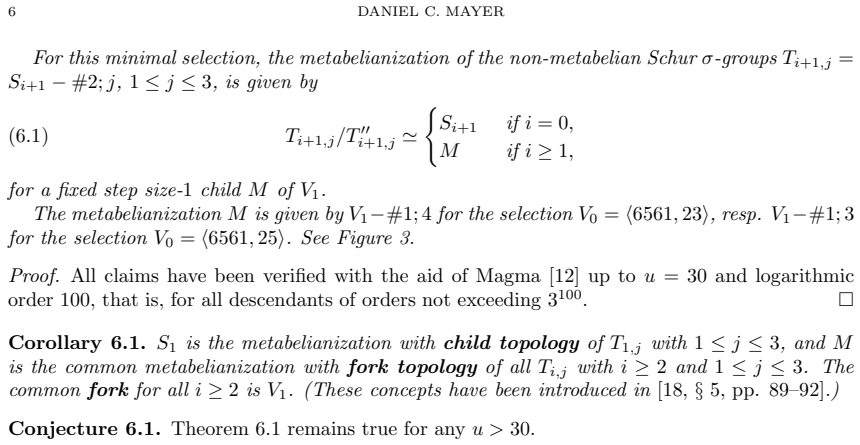
On the paper's own terms, the discovery is that Artin patterns determine the isomorphism type of the 3-class tower group for quadratic fields of type $(9,9)$. For six Artin patterns, stated in Theorems 8.1–8.5, 8.7, and 10.1, the tower group is metabelian, has order $3^8$, and the tower length is exactly 2. For the two patterns (8.6) and (8.8), Theorems 8.6 and 8.9 assert that the tower length is at least 3 and the tower group is one of the infinitely many non-metabelian Schur $\sigma$-groups $T_{i,k}$ with $i\ge1$, $1\le k\le3$, living in the descendant tree of the metabelian root $\langle 6561,25\rangle$ or $\langle 6561,23\rangle$; these groups have variable fourth-layer target $\tau_4=(2+i,2,2)$, coclass $5+3i$, and metabelianization $S_1$ for $i=1$ and a fixed child of $V_1$ for $i\ge2$. The paper also proves a stage separation criterion: for pattern (8.6)/(8.7), the second-order abelian quotient invariants $\tau_{2,1}$ decide whether the tower has length 2 or at least 3. All non-metabelian groups obtained carry explicitly described harmonically balanced capitulation permutations. The 'infinitely many' part depends on a periodic-trifurcation theorem verified computationally up to logarithmic order 100 and conjectured to continue (Conjecture 6.1).
Load-bearing premise
The entire 'infinitely many' statement rests on Conjecture 6.1: the periodic trifurcation of $\sigma$-groups verified by computation up to $u=30$ (orders up to $3^{100}$) continues for every $u>30$; if the chain of parents or the three non-metabelian grandchildren ever stops, Theorems 8.6 and 8.9 no longer yield infinite families.
Editorial extensions
If this is right
- Any imaginary quadratic field with Artin pattern (8.6) or (8.8) has a 3-class field tower of length at least 3, so its Galois group is not metabelian and the second Hilbert 3-class field cannot be the whole tower.
- For fields with pattern (8.6) or (8.7), the second-order invariant $\tau_{2,1}$ decides between a two-stage tower and a tower of length at least 3 without computing the full tower group.
- The two non-metabelian families exhibit tower groups of coclass $5+3i$ and fourth-layer target $(2+i,2,2)$ for $i\ge1$, so the possible tower groups for type $(9,9)$ are not a finite set but an infinite periodic collection.
- The known real quadratic fields of type $(9,9)$ with pattern (10.1) have metabelian two-stage towers whose groups have relation rank 3, showing that the imaginary-field Schur condition $d_2=2$ is what forces the non-metabelian cases.
Reading between the lines
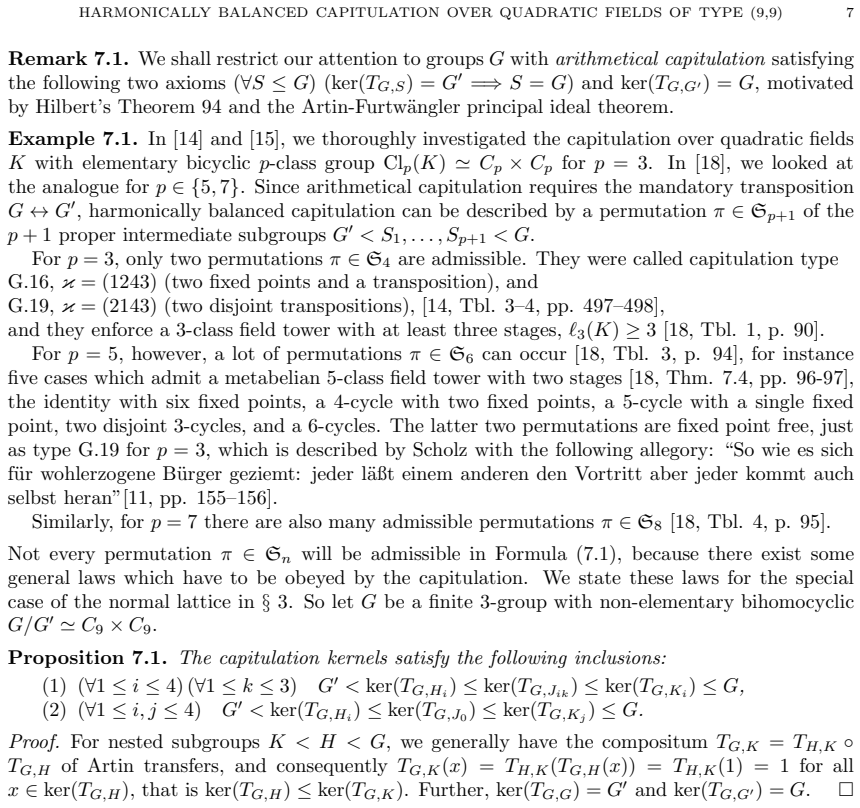
- If Conjecture 6.1 holds, the periodic trifurcation provides a model for infinite non-metabelian p-class tower families, and a similar descendant-tree search could be attempted for fields with $\mathrm{Cl}_p(K)\cong C_{p^2}\times C_{p^2}$ for primes $p>3$, where the paper notes that more capitulation permutations become admissible.
- The stage separation invariant $\tau_{2,1}$ could serve as a practical arithmetic sieve: it uses only subfields of relative degree up to 27 and could be computed before deciding whether a field warrants the expensive full tower computation.
- The explicit permutation description of harmonically balanced capitulation suggests a possible route to proving Conjecture 6.1: if the balanced kernel equations force the trifurcation pattern at each step purely group-theoretically, the computational verification up to order $3^{100}$ could be replaced by an inductive argument.
Signed reviews
Editorial analysis
A structured set of objections, weighed in public.
Referee Report
Summary. The paper determines the isomorphism type of the Galois group G of the finite 3-class field tower of quadratic fields K with 3-class group Cl_3(K) isomorphic to C_9 x C_9. The method is pattern recognition: arithmetic Artin patterns (transfer kernels and transfer targets) are computed by Magma and matched by group-theoretic Artin patterns of candidate 3-groups generated from the root R = <243,2> using the p-group generation algorithm. The paper gives finite classifications for several two-stage towers (Theorems 8.1-8.5, 8.7, 10.1), introduces a notion of harmonically balanced capitulation, and states that certain Artin patterns force a tower of length at least 3 with Galois group isomorphic to one of an infinite family of non-metabelian Schur sigma-groups T_{i,k} (Theorems 8.6 and 8.9). A stage separation criterion using second-order abelian quotient invariants is proposed in Theorem 8.8.
Significance. If the main claims hold, the paper gives a fairly complete and explicit classification of 3-class tower groups for a natural family of quadratic fields, with concrete discriminant examples and falsifiable predictions. The finite classifications for two-stage towers are plausible and internally coherent, and the group-theoretic analysis of harmonically balanced capitulation is a useful contribution. The paper's concrete strengths are the explicit lists of small discriminants with their Artin patterns (Examples 8.1-8.5 and 10.1), the use of standard computational tools (Magma SmallGroups and p-group generation), and the clear separation of metabelian from non-metabelian cases via relation ranks. However, the central infinite-family assertions are not fully proved: they depend on an explicit conjecture about periodic trifurcations that has only been verified up to a finite bound, and the exhaustiveness of the finite descendant-tree searches is asserted rather than demonstrated.
major comments (3)
- [Section 6, Theorem 6.1 and Conjecture 6.1; Section 8, Theorems 8.6, 8.8, 8.9] Theorems 8.6 and 8.9 state that the tower group G is isomorphic to one of the infinitely many non-metabelian Schur sigma-groups T_{i,k} with i >= 1 and 1 <= k <= 3. The existence of T_{i,k} for all i is not proved: Theorem 6.1 is verified only for u <= 30 by a Magma computation, and Conjecture 6.1 explicitly asserts that the periodic trifurcation continues for u > 30. The simultaneous proof of Theorems 8.6, 8.8, and 8.9 says only that the claims were verified as described in the proof of Theorem 6.1 and expressed in Conjecture 6.1. Thus the words 'infinitely many' and the parameter range i >= 1 exceed the proven content. The statements should be restricted to the verified range i <= 30, or an inductive proof of the periodicity should be supplied, before the infinite-family claims are presented as theorems.
- [Section 8, proofs of Theorems 8.1-8.5; Section 9] The proofs of the finite classifications construct a descendant tree with 27,222 vertices and sift it by pattern recognition with respect to transfer targets and relation rank. No argument is given in the manuscript that every metabelian 3-group M arising from a quadratic field with the displayed Artin pattern must occur among the vertices of this finite tree. The related assertion in Section 9 that all quadratic fields with Cl_3(K) = C9 x C9 have higher 3-class groups in the descendant tree of R = <243,2> is stated without proof or reference. Without such an exhaustiveness statement, the conclusions of the form 'G is isomorphic to one of ...' are conditional on the completeness of the search, not merely on the correctness of individual group computations. The author should supply the missing structural theorem or state explicitly that the classification is restricted to the finite searched subtree.
- [Section 8, Theorem 8.8] The stage separation criterion is stated as an 'if and only if', but its proof is the same simultaneous verification used for Theorems 8.6-8.9 and is therefore doubly conditional: on Conjecture 6.1 and on the exhaustiveness of the descendant-tree search. In particular, the claim that the second-order invariants tau_{2,1} = ([(511)^3,331]^12; [(322)^4,(331)^9]) force length at least 3 and one of the infinite family T_{i,k} is not unconditional as written. The theorem should be reformulated to distinguish the unconditional finite part from the parts that depend on Conjecture 6.1 and on the search bound.
minor comments (4)
- [General reproducibility] The paper does not include the Magma code, scripts, or output logs used for the computations in Theorem 6.1 and the descendant-tree searches. Given that the central claims rest on computational verification, making the code available as supplementary material would greatly improve verifiability.
- [Theorems 8.6 and 8.9] The notation tau_4 = (2+i, 2, 2) should be explained explicitly; in the logarithmic type-invariant convention the entry '2+i' is presumably a formal exponent, but the paper does not define this notation at the point of use.
- [Reference [17]] The DOI given for reference [17] is 10.4236/apm.2018.62008, but the bibliographic data report Adv. Pure Math. 6 (2016), No. 2; the DOI appears to be for a different volume or year and should be corrected.
- [Proof of Theorem 8.1] In the proof of Theorem 8.1, the three sibling groups that are said to have different second-layer Artin patterns are not identified by SmallGroups identifiers; giving their identifiers would make the verification easier.
Circularity Check
No core circularity: the Artin-pattern matching compares independently computed arithmetic and group-theoretic invariants, but Theorems 8.6 and 8.9 extend to 'infinitely many' groups only via unproved Conjecture 6.1, and several bridge theorems are quoted from the author's prior papers.
full rationale
The central derivation chain is not circular. The arithmetic Artin pattern AP(K) is computed by Magma class-field routines, while the group-theoretic Artin pattern AP(M) is computed from p-group presentations; Theorem 2.1 identifies them via Artin reciprocity. The descendant-tree search is then filtered by transfer targets and relation rank, and the Shafarevich bound decides whether the tower is metabelian or not. These are independent inputs and outputs: the candidate isomorphism types are not used to define the search pattern. The harmonically balanced capitulation property (Definition 7.1) is a group-theoretic condition on computed kernels, characterized in Proposition 7.2, and the statements that particular groups possess it are verified consequences of the computations, not assumptions that force the classification. Several foundational results are cited to the author's earlier papers (e.g., Theorem 2.1 to [18], Theorem 4.1 to [16]), but these are standard, externally checkable theorems rather than self-authored uniqueness claims used to forbid alternatives, so they do not make the derivation circular. The main caveat is a proof gap, not circularity: Theorem 6.1 is verified only 'up to u = 30 and logarithmic order 100', and Conjecture 6.1 explicitly asserts that the periodic trifurcation 'remains true for any u > 30'. The simultaneous proof of Theorems 8.6, 8.8, 8.9, and 8.7 says the claims about the non-metabelian Schur sigma-groups T_{i,k} were verified 'as described in the proof of Theorem 6.1 and expressed in Conjecture 6.1'. Thus the assertion of 'infinitely many' candidate groups in Theorems 8.6 and 8.9 exceeds the verified range and depends on an unproved conjecture; additionally, pattern recognition over a finite descendant subtree does not by itself exclude a deeper group with the same Artin pattern. These are repairable overclaims, not reductions of the conclusion to the input by construction. Score 2 reflects minor reliance on the author's prior papers and the conjectural infinite-family caveat, not circularity in the main pattern-recognition argument.
Assumptions & free parameters
free parameters (2)
- verification bound u =
30
- descendant tree truncation =
depth 2, step size up to 3
assumptions (5)
- standard math Artin reciprocity identifies arithmetic and algebraic Artin patterns (Theorem 2.1).
- standard math For imaginary quadratic fields, the tower group is a Schur σ-group and higher class field groups are σ2-groups (Theorem 4.2).
- ad hoc to paper All quadratic fields with Cl3 ≅ C9×C9 have higher 3-class groups in the descendant tree of R = ⟨243,2⟩.
- ad hoc to paper The periodic trifurcation sequence continues indefinitely (Conjecture 6.1 for u > 30).
- domain assumption Correctness of Magma computations and the p-group generation algorithm.
Cite this review
Pith. "Pith review of Harmonically balanced capitulation over quadratic fields of type (9,9)." pith.science (2026). https://pith.science/paper/RMAUF6JM
@misc{pith2026190801982,
  author       = {Pith},
  title        = {Pith review of: Harmonically balanced capitulation over quadratic fields of type (9,9)},
  year         = {2026},
  howpublished = {\url{https://pith.science/paper/RMAUF6JM}},
  note         = {Machine review of arXiv:1908.01982}
}
read the original abstract
The isomorphism type of the Galois group G of finite 3-class field towers of quadratic number fields with 3-class group of type (9,9) is determined by means of Artin patterns which contain information on the transfer of 3-classes to unramified abelian 3-extensions. First, as an approximation of the group G, its metabelianization M=G/G", which is isomorphic to the Galois group of the second Hilbert 3-class field, is sought by sifting the SmallGroups library with the aid of pattern recognition. In cases with order |M|>3^8, the SmallGroups database must be extended by means of the p-group generation algorithm, which reveals new phenomena of groups with harmonically balanced transfer kernels and trees with periodic trifurcations. Bounds for the relation rank d2(M) of M in dependence on the signature of the quadratic base field admit the decision whether the derived length of G is dl(G)=2 or dl(G)>=3.
Figures


Figures from the paper (1 more)
Reference graph
Works this paper leans on
-
[1]
Arrigoni, On Schur σ -groups, Math
M. Arrigoni, On Schur σ -groups, Math. Nachr. 192 (1998), 71–89
work page 1998
-
[2]
Artin, Beweis des allgemeinen Reziprozit¨ atsgesetzes, Abh
E. Artin, Beweis des allgemeinen Reziprozit¨ atsgesetzes, Abh. Math. Sem. Univ. Hamburg 5 (1927), 353–363, DOI 10.1007/BF02952531
-
[3]
Artin, Idealklassen in Oberk¨ orpern und allgemeines Reziprozit¨atsgesetz, Abh
E. Artin, Idealklassen in Oberk¨ orpern und allgemeines Reziprozit¨atsgesetz, Abh. Math. Sem. Univ. Hamburg 7 (1929), 46–51, DOI 10.1007/BF02941159
-
[4]
E. Benjamin and C. Snyder, On the rank of the 2-class group of the Hilbert 2-class field of some quadratic fields, Quart. J. Math. 69 (2018), 1163–1193, DOI 10.1093/qmath/hay021
-
[5]
H. U. Besche, B. Eick and E. A. O’Brien, The SmallGroups Library — a Library of Groups of Small Order , 2005, an accepted and refereed GAP package, available also i n MAGMA
work page 2005
- [6]
- [7]
-
[8]
N. Boston, M. R. Bush and F. Hajir, Heuristics for p-class towers of imaginary quadratic fields , Math. Ann. 368 (2017), no. 1, 633–669, DOI 10.1007/s00208-016-1449-3
Show all 26 references
-
[9]
Boston, M
N. Boston, M. R. Bush and F. Hajir, Heuristics for p-class towers of real quadratic fields , preprint, 2017. HARMONICALLY BALANCED CAPITULATION OVER QUADRATIC FIELDS OF TYPE (9,9) 13
2017
-
[10]
Koch und B
H. Koch und B. B. Venkov, ¨Uber den p-Klassenk¨ orperturm eines imagin¨ ar-quadratischen Zahlk¨ orpers, Ast´ erisque24–25 (1975), 57–67
1975
-
[11]
Lemmermeyer and P
F. Lemmermeyer and P. Roquette, The correspondence between Hasse and Scholz , https://pdfs.semanticscholar.org/b998/ec08c801f67c820620b227aeeda16bc67112.pdf
-
[12]
MAGMA Developer Group, MAGMA Computational Algebra System , Version 2.24-8, Sydney, 2019, (http://magma.maths.usyd.edu.au)
2019
-
[13]
MAGMA Developer Group, MAGMA Data for groups of order 38, data3to8.tar.gz, Sydney, 2012, (http://magma.maths.usyd.edu.au)
2012
-
[14]
D. C. Mayer, The second p-class group of a number field , Int. J. Number Theory 8 (2012), No. 2, 471–505, DOI 10.1142/S179304211250025X
2012 doi
-
[15]
D. C. Mayer, Principalization algorithm via class group structure , J. Th´ eor. Nombres Bordeaux 26 (2014), No. 2, 415–464, DOI 10.5802/jtnb.874
2014 doi
-
[16]
D. C. Mayer, New number fields with known p-class tower , Tatra Mt. Math. Pub., 64 (2015), 21–57, DOI 10.1515/tmmp-2015-0040, Special Issue on Number Theory an d Cryptology ‘15
2015 doi
-
[17]
D. C. Mayer, Artin transfer patterns on descendant trees of finite p-groups, Adv. Pure Math. 6 (2016), No. 2, 66–104, DOI 10.4236/apm.2018.62008, Special Issue on Gr oup Theory Research, January 2016
2016
-
[18]
D. C. Mayer, Recent progress in determining p-class field towers , Gulf J. Math. 4 (2016), No. 4, 74–102
2016
-
[19]
D. C. Mayer, Criteria for three-stage towers of p-class fields , Adv. Pure Math. 7 (2017), No. 2, 135–179, DOI 10.4236/apm.2017.72008, Special Issue on Number Theory, F ebruary 2017
2017
-
[20]
D. C. Mayer, Successive approximation of p-class towers , Adv. Pure Math. 7 (2017), No. 12, 660–685, DOI 10.4236/apm.2017.712041, Special Issue on Abstract Algeb ra, December 2017
2017
-
[21]
D. C. Mayer, Co-periodicity isomorphisms between forests of finite p-groups, Adv. Pure Math. 8 (2018), No. 1, 77–140, DOI 10.4236/apm.2018.81006, Special Issue on Gr oup Theory Studies, January 2018
2018
-
[22]
D. C. Mayer and M. F. Newman, The strategy of pattern recognition via Artin transfers, ap plied to finite towers of 2-class fields , Preprint, 2019
2019
-
[23]
M. F. Newman, Determination of groups of prime-power order , pp. 73–84, in: Group Theory, Canberra, 1975, Lecture Notes in Math., Vol. 573, Springer, Berlin, 1977
1975
-
[24]
E. A. O’Brien, The p-group generation algorithm , J. Symbolic Comput. 9 (1990), 677–698, DOI 10.1016/S0747-7171(80)80082-X
1990 doi
-
[25]
Scholz und O
A. Scholz und O. Taussky, Die Hauptideale der kubischen Klassenk¨ orper imagin¨ ar quadratischer Zahlk¨ orper: ihre rechnerische Bestimmung und ihr Einfluß auf den Klassen k¨ orperturm, J. Reine Angew. Math. 171 (1934), 19–41
1934
-
[26]
Schoof, Infinite class field towers of quadratic fields , J
R. Schoof, Infinite class field towers of quadratic fields , J. Reine Angew. Math. 372 (1986), 209–220. Naglergasse 53, 8010 Graz, Austria E-mail address : algebraic.number.theory@algebra.at URL: http://www.algebra.at
1986
Reviewed August 14, 2026 · model on record in the stance chip above.
Discussion (0). Continue with ORCID to comment.