REVIEW 3 major objections 5 minor 117 references
Fine-tuning the complex organic molecule formation: sulfur and CO ice as regulators of surface chemistry
T0 review · 3 major / 5 minor · reviewed 2026-08-06 · deepseek-v4-flash
Pith's one-line read The paper argues that sulfur and CO ice, by competing for atomic hydrogen on grain surfaces, regulate the formation of methanol and other complex organic molecules in dense cores.
desk verdict Honest, careful astrochemistry with a genuinely new sulfur-gap diagnostic; the inferred profiles rest on a questionable extinction-radius mapping and an over-strong 'only' claim. read the letter →
The pith
A machine-rendered reading of the paper's core claim, the machinery that carries it, and where it could break.
The reading
What carries the argument
The carrying mechanism is the competition for atomic hydrogen on grain surfaces between sulfur hydride formation and the hydrogenation of CO into methanol. When sulfur is plentiful in the ice, it captures H to form HS and H2S, starving the reaction sequence that builds CH3OH; when sulfur is depleted, H stays available and methanol production rises. A second coupled mechanism is the decline of binding energies as CO freezes out and becomes a major ice constituent, which makes adsorbed species more mobile and easier to release into the gas phase. These are implemented in Nautilus, a time-dependent gas-grain chemical model run on a spherical, isotropically illuminated model cloud and projected along the line of sight for comparison with the observed offset profiles.
What would settle it
Measure gas kinetic temperatures and the three-dimensional density structure at the extinction peaks of Barnard 1b and IC348 using independent tracers such as ammonia inversion lines and high-resolution continuum maps, then redo the radiative-transfer and chemical fits; if the sulfur gap disappears under a corrected geometry, the claim fails. A complementary check is a JWST search for solid NH4SH or polysulfane features toward the peaks, which would confirm or rule out the proposed H2S sink.
Extended reading notes
Core claim
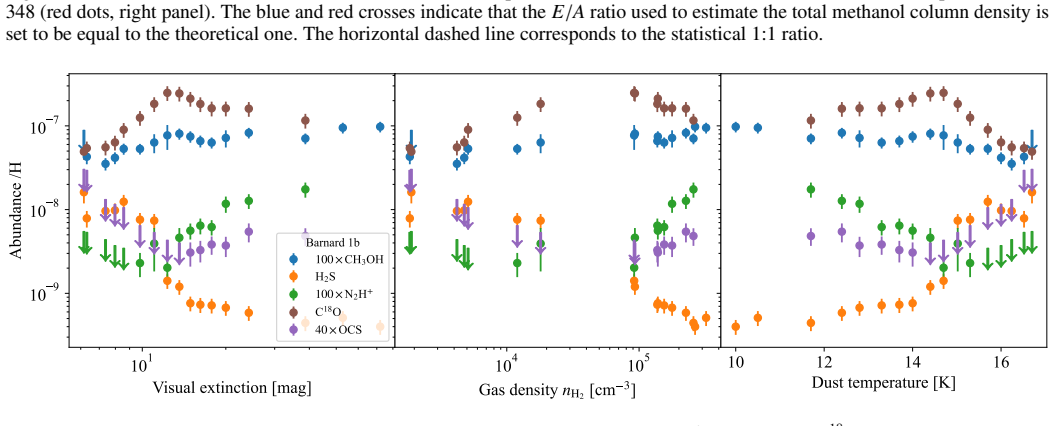
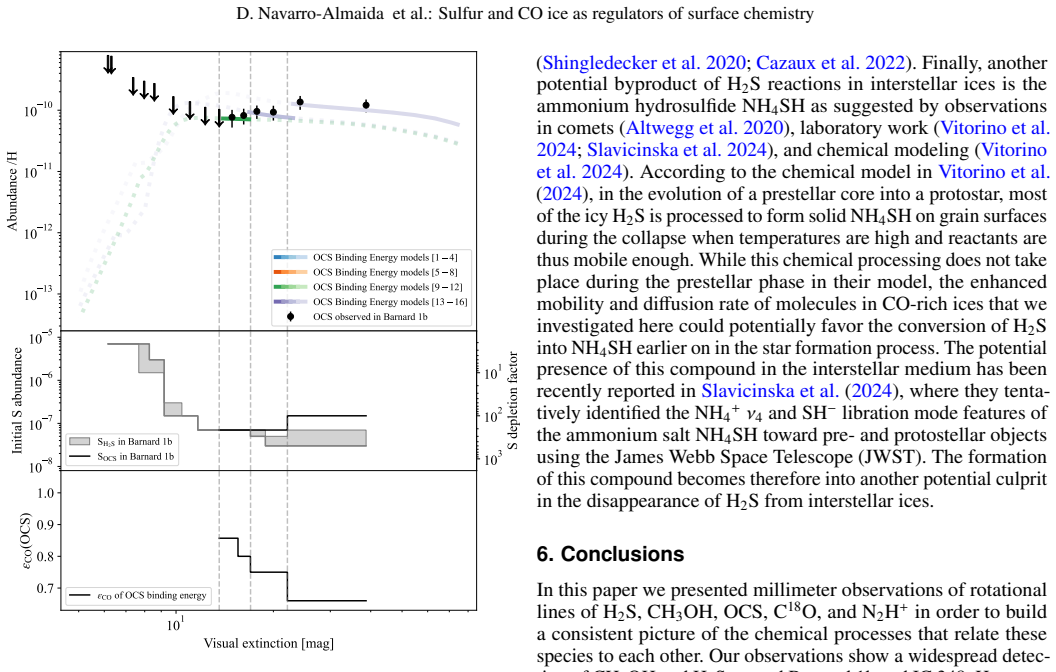
On the paper's own terms, the central claim is that sulfur is a regulator of surface chemical complexity: in the dense, cold interiors of Barnard 1b and IC348, the observed gas-phase abundances of CH3OH, H2S, OCS, and C18O are reproduced only when the elemental sulfur budget falls toward the extinction peak and the binding energies of key species are lowered where CO dominates the ice. Sulfur depletion raises the abundance of atomic hydrogen in the ice matrix, allowing the hydrogenation chain that builds methanol to run more efficiently, while CO-ice growth weakens adsorption and raises diffusion and desorption. The same fits expose a sulfur gap: the depletion required by H2S exceeds that required by CH3OH or OCS, by up to two orders of magnitude in part of the extinction range, which the authors take as evidence of an unidentified sulfur sink or of different spatial origins for the emitting molecules.
Load-bearing premise
The spatial comparison rests on assuming each dense core is a spherical, isotropically illuminated cloud with effective extinction half the projected value and with gas temperature equal to dust temperature; if those assumptions fail, the inferred densities and radial placements of the sulfur and binding-energy profiles shift, and the sulfur gap could be created or erased.
Editorial extensions
If this is right
- Methanol and other hydrogenation products should be most abundant where sulfur is most depleted, not simply where CO is most abundant.
- H2S is a clean tracer of the local sulfur budget, whereas CH3OH jointly probes sulfur depletion and binding energies.
- Chemical models that assume a single sulfur abundance and single binding energies will miss the nearly uniform methanol plateau; both quantities must vary with extinction.
- The sulfur gap predicts that a solid-phase sulfur reservoir or a spatial separation between H2S and methanol emission should be found in these cores.
Reading between the lines
- If the sulfur–hydrogen competition is generic, isotopic fractionation in methanol (deuterium enrichment) should vary systematically with the sulfur budget, because the H-atom population on grains is what sulfur depletes.
- The same regulation should transfer to other environments: low-sulfur cores or regions with earlier CO freeze-out should reach COMs at lower extinction, and disks that inherit sulfur-depleted ices could have different prebiotic starting compositions.
- A testable extension is to search for the predicted sulfur sink with JWST ice spectroscopy toward the extinction peaks; detecting solid NH4SH or sulfur allotropes in the amounts implied by the gap would close the H2S budget.
- A further extension is to measure gas kinetic temperature independently of dust temperature and map the cores' 3D structure; if the spherical mapping is wrong, the sulfur gap may shrink or vanish.
Editorial analysis
A structured set of objections, weighed in public.
Referee Report
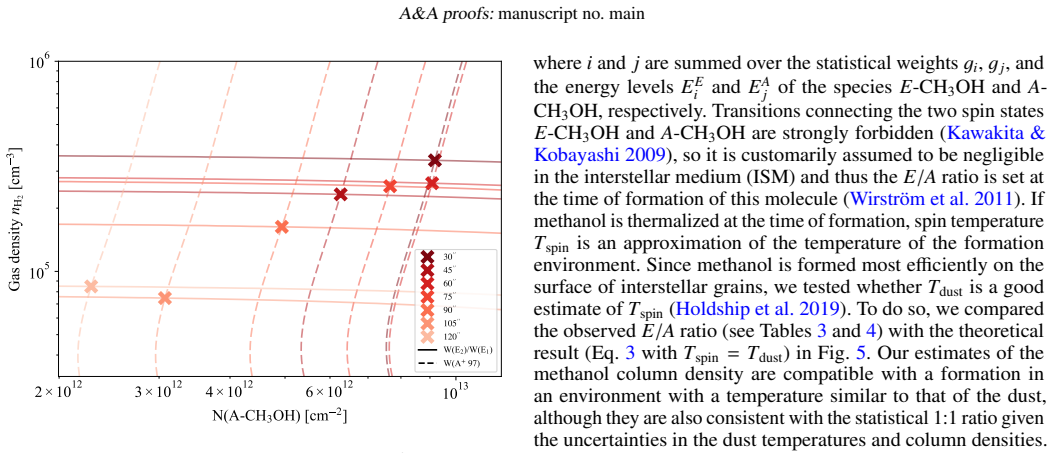
Summary. The paper presents IRAM 30m and Yebes 40m observations of CH3OH, H2S, OCS, N2H+, and C18O along strips across the dense cores Barnard 1b and IC 348. Gas densities and molecular column densities are derived with RADEX, using methanol lines to break the density/column degeneracy, and the resulting abundance profiles are compared with the gas-grain model Nautilus. The authors vary the initial sulfur abundance over twelve values and the binding energies of seven species over sixteen models, following the CO-ice scaling of Molpeceres et al. (2024). They conclude that reproducing the observed H2S abundances requires a sulfur budget that decreases toward the extinction peak, that this sulfur depletion enhances methanol production by freeing atomic hydrogen on grain surfaces, and that decreasing binding energies are needed to match CH3OH and C18O at the highest extinctions. They further report that the sulfur depletion required by H2S is larger than that required by CH3OH or OCS, which they interpret as evidence for an additional sulfur sink.
Significance. The observational dataset is carefully reduced and the RADEX-based abundance derivation is presented in detail, which is a genuine strength. The model grid is extensive for a paper of this type, and the proposed mechanism—sulfur competing with CO for atomic hydrogen and thereby regulating COM formation—is physically plausible and supported by the reaction-network analysis in Fig. 16. If the derived sulfur depletion profiles are robust, the paper would provide valuable constraints on sulfur chemistry and CO-ice effects in prestellar cores. However, the quantitative claims, especially the spatially resolved 'sulfur gap', rest on a simplified extinction–radius mapping and on model selection by visual inspection rather than on independent predictions with a stated goodness-of-fit. These issues need to be addressed before the central conclusions can be considered established.
major comments (3)
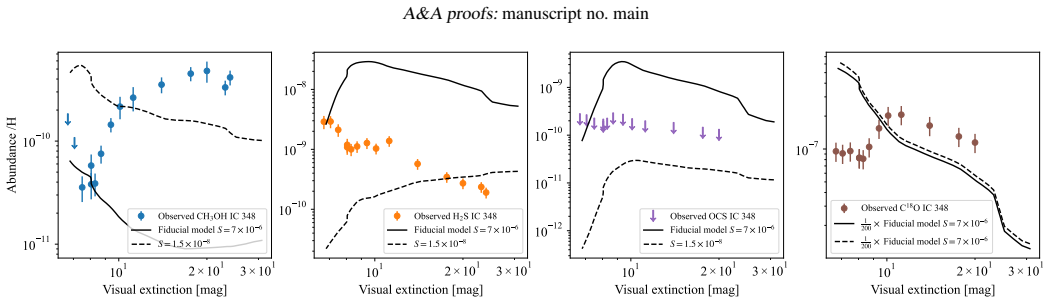
- [Sect. 4.1, Fig. 8] The effective extinction assigned to each radius is taken as half the projected extinction at the same offset. For a spherical cloud the projected column at impact parameter r is 2∫_r^{rmax} n_H(r') r'/√(r'^2-r^2) dr', which is always larger than twice the radial column ∫_r^{rmax} n_H(r') dr', so this prescription systematically overestimates the radial extinction at intermediate radii. That is exactly the range (A_V ≈ 12–19 mag in Barnard 1b, Sect. 5.2) where the sulfur gap between S_H2S and S_CH3OH is largest. Because every model abundance is compared against an observed A_V, this mapping error shifts the physical conditions of all fitted models and could create or erase the reported sulfur gap. Please recompute the comparison with A_V(r) derived self-consistently from the assumed Plummer density profile, or forward-model the projected abundances along the line of sight, and test how the derived sulfur profiles change under alternative mappings.
- [Abstract and Sect. 4.3.2] The abstract's statement that the abundances 'can only be reproduced' with a decreasing sulfur budget is too strong. The grid explores only the initial sulfur abundance and binding-energy scaling; the chemical age is fixed at 10^6 yr (Sect. 4.1), the cosmic-ray ionization rate and desorption efficiencies are fixed, and non-diffusive chemistry is explicitly omitted (Sect. 5.1). No quantitative goodness-of-fit or model-selection statistic is reported; fits are judged by eye against shaded regions. Moreover, Sect. 4.3.2 itself states that no single sulfur-abundance profile reproduces both H2S and CH3OH simultaneously, so the 'sulfur gap' is a mismatch between two independently fitted profiles rather than a predicted feature. The wording should be softened and the degeneracy with the other fixed parameters quantified.
- [Sects. 3.1 and 4.1] The density profiles used in the chemical models are derived from RADEX fits that assume gas temperature equals dust temperature. The manuscript acknowledges that this is only an approximation at n_H2 < 10^4 cm^-3 and can be off by 1–2 K (citing Friesen et al. 2017). Since the Plummer radii and the radius–extinction interpolation in Figs. 8 and 10 are anchored to these RADEX densities, a systematic temperature error propagates into the physical model and into the derived sulfur and binding-energy profiles. A sensitivity test with T_gas = T_dust ± 2 K (or T_gas from NH3 where available) would show whether the sulfur gap survives.
minor comments (5)
- [Table 6] In the offset 165'' row, N(C18O)/N(H) is printed as (8±2)×10^-7, but the listed N(C18O)=1.3×10^15 cm^-2 and A_V=8.3 imply a ratio near 8×10^-8; please check this entry.
- [Fig. E.1 and similar captions] The caption 'S = (7 1.5) × 10^6 [i-l]' appears to be a typo; models i–l have initial sulfur abundances of (7–1.5)×10^-8, not 10^-6.
- [Fig. 11 caption] In the fourth panel, the legend entry '1/200 × Fiducial model S = 7 × 10^6' is repeated for both curves; presumably the second curve corresponds to S = 1.5×10^-8.
- [Sect. 3.1] The word 'tipically' should be 'typically'.
- [Sect. 3.2] The H2S column densities assume an ortho-to-para ratio of 3:1; a brief justification or a sensitivity test with a different ratio would be useful, since the derived H2S abundance scales directly with this assumption.
Circularity Check
No significant circularity: the sulfur profiles are fitted constraints, and the sulfur-regulates-methanol mechanism is an independent output of the Nautilus network, not a restatement of the fitting.
full rationale
The paper's central mechanistic claim is that a decreasing elemental sulfur budget lowers H2S and enhances CH3OH by freeing atomic hydrogen on grain surfaces (Sect. 5.1, Fig. 16). This claim is a property of the externally developed Nautilus/Wakelam chemical network, and the paper explicitly checks the reaction pathway: at high S/H, HSice grows while Hice, CH2OHice, CH3Oice, and CH3OHgas drop. That is a causal model output, not an input fitted to the CH3OH observations. The sulfur profiles S_H2S, S_CH3OH, and S_OCS are indeed obtained by selecting grid models that reproduce the corresponding observed abundance profiles (Sects. 4.3.1-4.3.2), so they are fitted values rather than out-of-sample predictions. However, the cross-molecule statements, such as the S abundance required by H2S overproducing CH3OH around A_V ~ 13-20 mag, are nontrivial model results from the same grid, and the 'sulfur gap' is a comparison of independently fitted profiles, not a definitional identity. The paper also states the degeneracy explicitly ('the determination of the appropriate scaling for the binding energies is a degenerate problem that relies on the accurate estimation of the sulfur abundance'), showing the authors do not claim a unique forced solution. Self-citations (Navarro-Almaida et al. 2020; Fuente et al. 2023) set input parameters such as the FUV field, cosmic-ray ionization rate, and reference S/H; these are external measurements or modeling and are not used to prove the causal sulfur-CH3OH link. The Conclusions bullet saying models 'successfully predict' the observed abundances is loose wording, since those abundances were used for fitting, but this presentation overstatement does not reduce the derivation to its inputs. No circular step meeting the quoted-equation standard was found.
Assumptions & free parameters
free parameters (5)
- Initial sulfur abundance S/H =
Grid from 7e-6 down to 1.5e-8, chosen per region and per extinction
- Binding energy scaling factor epsilon_CO =
16 discrete models from reference values (Model 1) to Molpeceres scaling (Model 16), chosen per extinction
- Isotopic ratio 16O/18O =
200
- Chemical age =
1e6 yr
- Density profile parameters (Plummer n0, rf, a; envelope nc, rmin) =
n0 ~4.5e5 cm^-3 (B1b), 6.4e5 cm^-3 (IC348); r_f ~2e4 au; a ~4-6
assumptions (6)
- domain assumption Nautilus gas-grain chemical network (Ruaud et al. 2016; Wakelam et al. 2024) correctly describes the relevant gas-phase and grain-surface reactions, including H sequestration by sulfur.
- domain assumption Gas temperature equals dust temperature across the cores.
- domain assumption Spherical symmetry with effective extinction A_V/2 and line-of-sight projection of model abundances.
- domain assumption Binding energies decrease with CO ice fraction following Molpeceres et al. (2024) scaling.
- ad hoc to paper Chemical age of 1e6 years for both cores.
- domain assumption Methanol E/A and H2S ortho-to-para ratios are statistical (1:1 and 3:1).
Cite this review
Pith. "Pith review of Fine-tuning the complex organic molecule formation: sulfur and CO ice as regulators of surface chemistry." pith.science (2026). https://pith.science/paper/RNLJY3HW
@misc{pith2026250717595,
  author       = {Pith},
  title        = {Pith review of: Fine-tuning the complex organic molecule formation: sulfur and CO ice as regulators of surface chemistry},
  year         = {2026},
  howpublished = {\url{https://pith.science/paper/RNLJY3HW}},
  note         = {Machine review of arXiv:2507.17595}
}
abstract
Grain-surface chemistry plays a crucial role in the formation of molecules of astrobiological interest, including H$_{2}$S and complex organic molecules (COMs). They are commonly observed in the gas phase toward star-forming regions, but their detection in ices remains limited. Combining gas-phase observations with chemical modeling is therefore essential for advancing our understanding of their chemistry. In this paper we investigate the factors that promote or hinder molecular complexity combining gas-phase observations of CH$_{3}$OH, H$_{2}$S, OCS, N$_{2}$H$^{+}$, and C$^{18}$O with chemical modeling in two dense cores: Barnard-1b and IC348. We observed millimeter emission lines of CH$_{3}$OH, H$_{2}$S, OCS, N$_{2}$H$^{+}$, and C$^{18}$O along strips using the IRAM 30m and Yebes 40m telescopes. We used the gas-grain chemical model \texttt{Nautilus} to reproduce the observed abundance profiles adjusting parameters such as initial sulfur abundances and binding energies. H$_{2}$S, N$_{2}$H$^{+}$ and C$^{18}$O gas-phase abundances vary up to one order of magnitude towards the extinction peak. CH$_{3}$OH abundance remains quite uniform. These abundances can only be reproduced assuming a decreasing sulfur budget, which lowers H$_{2}$S and enhances CH$_{3}$OH abundances. Decreasing binding energies, which are expected in CO-rich apolar ices, are also required. The sulfur depletion required by H$_2$S is generally higher than that required by CH$_3$OH, suggesting unknown sulfur sinks. These findings highlight the intricate relationship between sulfur chemistry and COM formation, driven by the competition between sulfur and CO for hydrogen atoms. Our study emphasizes that the growth of CO ice and the progressive sequestration of hydrogen atoms by sulfur are critical in determining whether chemical complexity can develop, providing key insights into the early stages of star and planet formation.
Figures


Figures from the paper (14 more)








Reference graph
Works this paper leans on
-
[1]
2020, Nature Astronomy, 4, 533 Arslan, Ö., Hocuk, S., Caselli, P., & Küçük, ˙I
Altwegg, K., Balsiger, H., Hänni, N., et al. 2020, Nature Astronomy, 4, 533 Arslan, Ö., Hocuk, S., Caselli, P., & Küçük, ˙I. 2023, MNRAS, 518, 2050
2020
-
[2]
J., & Scott, P
Asplund, M., Grevesse, N., Sauval, A. J., & Scott, P. 2009, ARA&A, 47, 481
2009
-
[3]
1990, A&A, 231, 174
Bachiller, R., Cernicharo, J., Martin-Pintado, J., Tafalla, M., & Lazareff, B. 1990, A&A, 231, 174
1990
-
[4]
2012, A&A, 541, L12
Bacmann, A., Taquet, V ., Faure, A., Kahane, C., & Ceccarelli, C. 2012, A&A, 541, L12
2012
-
[5]
2015, MNRAS, 449, L16
Balucani, N., Ceccarelli, C., & Taquet, V . 2015, MNRAS, 449, L16
2015
-
[6]
2024, MNRAS, 531, 1371
Bariosco, V ., Pantaleone, S., Ceccarelli, C., et al. 2024, MNRAS, 531, 1371
2024
-
[7]
2025, MNRAS, 539, 82
Bariosco, V ., Tinacci, L., Pantaleone, S., et al. 2025, MNRAS, 539, 82
2025
-
[8]
2014, A&A, 569, A27
Bizzocchi, L., Caselli, P., Spezzano, S., & Leonardo, E. 2014, A&A, 569, A27
2014
Show all 117 references
-
[9]
A., Sutton, E
Blake, G. A., Sutton, E. C., Masson, C. R., & Phillips, T. G. 1987, ApJ, 315, 621
1987
-
[10]
C., Savage, B
Bohlin, R. C., Savage, B. D., & Drake, J. F. 1978, ApJ, 224, 132
1978
-
[11]
Boogert, A. C. A., Brewer, K., Brittain, A., & Emerson, K. S. 2022, ApJ, 941, 32
2022
-
[12]
Boogert, A. C. A., Schutte, W. A., Helmich, F. P., Tielens, A. G. G. M., & Wooden, D. H. 1997, A&A, 317, 929
1997
-
[13]
2016, MNRAS, 462, S253
Calmonte, U., Altwegg, K., Balsiger, H., et al. 2016, MNRAS, 462, S253
2016
-
[14]
I., & Herbst, E
Caselli, P., Hasegawa, T. I., & Herbst, E. 1993, ApJ, 408, 548
1993
-
[15]
I., & Herbst, E
Caselli, P., Hasegawa, T. I., & Herbst, E. 1994, ApJ, 421, 206
1994
-
[16]
A., et al
Caselli, P., Keto, E., Bergin, E. A., et al. 2012, ApJ, 759, L37
2012
-
[17]
M., Tafalla, M., Dore, L., & Myers, P
Caselli, P., Walmsley, C. M., Tafalla, M., Dore, L., & Myers, P. C. 1999, ApJ, 523, L165
1999
-
[18]
M., et al
Cazaux, S., Carrascosa, H., Muñoz Caro, G. M., et al. 2022, A&A, 657, A100
2022
-
[19]
Cazaux, S., Tielens, A. G. G. M., Ceccarelli, C., et al. 2003, ApJ, 593, L51
2003
-
[20]
2018, A&A, 612, A47
Chaabouni, H., Diana, S., Nguyen, T., & Dulieu, F. 2018, A&A, 612, A47
2018
-
[21]
Charnley, S. B. 1997, ApJ, 481, 396
1997
-
[22]
B., Tielens, A
Charnley, S. B., Tielens, A. G. G. M., & Millar, T. J. 1992, ApJ, 399, L71
1992
-
[23]
2024, A&A, 685, A55
Chen, L.-F., Quan, D., He, J., et al. 2024, A&A, 685, A55
2024
-
[24]
E., Linke, R
Cummins, S. E., Linke, R. A., & Thaddeus, P. 1986, ApJS, 60, 819
1986
-
[25]
Dagdigian, P. J. 2020, MNRAS, 494, 5239
2020
-
[26]
2021, A&A, 647, A177
Dartois, E., Chabot, M., Id Barkach, T., et al. 2021, A&A, 647, A177
2021
-
[27]
Draine, B. T. 1978, ApJS, 36, 595
1978
-
[28]
& Wakelam, V
Druard, C. & Wakelam, V . 2012, MNRAS, 426, 354 el Akel, M., Kristensen, L. E., Le Gal, R., et al. 2022, A&A, 659, A100
2012
-
[29]
2021, A&A, 655, A9
Enrique-Romero, J., Ceccarelli, C., Rimola, A., et al. 2021, A&A, 655, A9
2021
-
[30]
2022, ApJS, 259, 39
Enrique-Romero, J., Rimola, A., Ceccarelli, C., et al. 2022, ApJS, 259, 39
2022
-
[31]
2023, in European Confer- ence on Laboratory Astrophysics ECLA2020
Enrique-Romero, J., Rimola, A., Ceccarelli, C., et al. 2023, in European Confer- ence on Laboratory Astrophysics ECLA2020. The Interplay of Dust, 57–61
2023
-
[32]
B., Viti, S., Goicoechea, J
Esplugues, G. B., Viti, S., Goicoechea, J. R., & Cernicharo, J. 2014, A&A, 567, A95
2014
-
[33]
M., Ioppolo, S., Lamberts, T., & Linnartz, H
Fedoseev, G., Cuppen, H. M., Ioppolo, S., Lamberts, T., & Linnartz, H. 2015, MNRAS, 448, 1288
2015
-
[34]
2023, ApJ, 944, 142
Ferrero, S., Pantaleone, S., Ceccarelli, C., et al. 2023, ApJ, 944, 142
2023
-
[35]
K., Pineda, J
Friesen, R. K., Pineda, J. E., co-PIs, et al. 2017, ApJ, 843, 63
2017
-
[36]
W., Cuppen, H
Fuchs, G. W., Cuppen, H. M., Ioppolo, S., et al. 2009, A&A, 505, 629
2009
-
[37]
2016, A&A, 593, A94
Fuente, A., Cernicharo, J., Roueff, E., et al. 2016, A&A, 593, A94
2016
-
[38]
G., Caselli, P., et al
Fuente, A., Navarro, D. G., Caselli, P., et al. 2019, A&A, 624, A105
2019
-
[39]
2023, A&A, 670, A114
Fuente, A., Rivière-Marichalar, P., Beitia-Antero, L., et al. 2023, A&A, 670, A114
2023
-
[40]
Garrod, R. T. & Herbst, E. 2006, A&A, 457, 927
2006
-
[41]
T., Jin, M., Matis, K
Garrod, R. T., Jin, M., Matis, K. A., et al. 2022, ApJS, 259, 1
2022
-
[42]
T., Wakelam, V ., & Herbst, E
Garrod, R. T., Wakelam, V ., & Herbst, E. 2007, A&A, 467, 1103
2007
-
[43]
T., Widicus Weaver, S
Garrod, R. T., Widicus Weaver, S. L., & Herbst, E. 2008, ApJ, 682, 283
2008
-
[44]
R., Baas, F., Greenberg, J
Geballe, T. R., Baas, F., Greenberg, J. M., & Schutte, W. 1985, A&A, 146, L6
1985
-
[45]
D., Hamberg, M., Thomas, R
Geppert, W. D., Hamberg, M., Thomas, R. D., et al. 2006, Faraday Discussions, 133, 177
2006
-
[46]
2015, A&A, 577, L2
Gerin, M., Pety, J., Fuente, A., et al. 2015, A&A, 577, L2
2015
-
[47]
Hasegawa, T. I. & Herbst, E. 1993, MNRAS, 263, 589
1993
-
[48]
& van Dishoeck, E
Herbst, E. & van Dishoeck, E. F. 2009, ARA&A, 47, 427
2009
-
[49]
2008, in Handbook of Star Forming Regions, V olume I, ed
Herbst, W. 2008, in Handbook of Star Forming Regions, V olume I, ed. B. Reipurth, V ol. 4, 372
2008
-
[50]
2010, ApJ, 712, 778
Hiramatsu, M., Hirano, N., & Takakuwa, S. 2010, ApJ, 712, 778
2010
-
[51]
1999, in Star Formation 1999, ed
Hirano, N., Kamazaki, T., Mikami, H., Ohashi, N., & Umemoto, T. 1999, in Star Formation 1999, ed. T. Nakamoto, 181–182
1999
-
[52]
& Liu, F.-c
Hirano, N. & Liu, F.-c. 2014, ApJ, 789, 50
2014
-
[53]
2017, A&A, 604, A58
Hocuk, S., Sz˝ ucs, L., Caselli, P., et al. 2017, A&A, 604, A58
2017
-
[54]
2019, ApJ, 880, 138
Holdship, J., Viti, S., Codella, C., et al. 2019, ApJ, 880, 138
2019
-
[55]
2004, ApJ, 611, 605
Horn, A., Møllendal, H., Sekiguchi, O., et al. 2004, ApJ, 611, 605
2004
-
[56]
& Hirano, N
Huang, Y .-H. & Hirano, N. 2013, ApJ, 766, 131
2013
-
[57]
2019, MNRAS, 489, 1509
Iglesias-Groth, S. 2019, MNRAS, 489, 1509
2019
-
[58]
& Marin-Dobrincic, M
Iglesias-Groth, S. & Marin-Dobrincic, M. 2023, MNRAS, 521, 2248
2023
-
[59]
J., et al
Ioppolo, S., Fedoseev, G., Chuang, K. J., et al. 2021, Nature Astronomy, 5, 197 Jiménez-Escobar, A. & Muñoz Caro, G. M. 2011, A&A, 536, A91 Jiménez-Serra, I., Megías, A., Salaris, J., et al. 2025, arXiv e-prints, arXiv:2502.10123 Jiménez-Serra, I., Vasyunin, A. I., Caselli, P....
2021 arXiv
-
[60]
& Garrod, R
Jin, M. & Garrod, R. T. 2020, ApJS, 249, 26 Jørgensen, J. K., Schöier, F. L., & van Dishoeck, E. F. 2004, A&A, 416, 603
2020
-
[61]
& Kobayashi, H
Kawakita, H. & Kobayashi, H. 2009, ApJ, 693, 388
2009
-
[62]
Laas, J. C. & Caselli, P. 2019, A&A, 624, A108
2019
-
[63]
J., Muench, A
Lada, C. J., Muench, A. A., Luhman, K. L., et al. 2006, AJ, 131, 1574 Le Gal, R., Öberg, K. I., Teague, R., et al. 2021, ApJS, 257, 12
2006
-
[64]
A., & Evans, Neal J., I
Lee, J.-E., Bergin, E. A., & Evans, Neal J., I. 2004, ApJ, 617, 360
2004
-
[65]
1985, A&A, 144, 147
Leger, A., Jura, M., & Omont, A. 1985, A&A, 144, 147
1985
-
[66]
J., Orgel, L
Leman, L. J., Orgel, L. E., & Ghadiri, M. R. 2004, Science, 306, 283
2004
-
[67]
C., Roueff, E., Gerin, M., et al
Lis, D. C., Roueff, E., Gerin, M., et al. 2002, ApJ, 571, L55
2002
-
[68]
2003, ApJ, 591, 1220
Lodders, K. 2003, ApJ, 591, 1220
2003
-
[69]
2019, MNRAS, 485, 5777
Loison, J.-C., Wakelam, V ., Gratier, P., et al. 2019, MNRAS, 485, 5777
2019
-
[70]
G., et al
Luo, G., Zhang, Z.-Y ., Bisbas, T. G., et al. 2023, ApJ, 942, 101
2023
-
[71]
2005, ApJ, 620, 308
Marcelino, N., Cernicharo, J., Roueff, E., Gerin, M., & Mauersberger, R. 2005, ApJ, 620, 308
2005
-
[72]
2018, A&A, 620, A80
Marcelino, N., Gerin, M., Cernicharo, J., et al. 2018, A&A, 620, A80
2018
-
[73]
E., Friberg, P., & Irvine, W
Matthews, H. E., Friberg, P., & Irvine, W. M. 1985, ApJ, 290, 609
1985
-
[74]
K., Rocha, W
McClure, M. K., Rocha, W. R. M., Pontoppidan, K. M., et al. 2023, Nature Astronomy, 7, 431
2023
-
[75]
J., Herbst, E., & Charnley, S
Millar, T. J., Herbst, E., & Charnley, S. B. 1991, ApJ, 369, 147
1991
-
[76]
2016, A&A, 585, A24
Minissale, M., Dulieu, F., Cazaux, S., & Hocuk, S. 2016, A&A, 585, A24
2016
-
[77]
2024, A&A, 688, A150 Muñoz Caro, G
Molpeceres, G., Furuya, K., & Aikawa, Y . 2024, A&A, 688, A150 Muñoz Caro, G. M., Jiménez-Escobar, A., Martín-Gago, J. Á., et al. 2010, A&A, 522, A108
2024
-
[78]
A., Lada, C
Muench, A. A., Lada, C. J., Luhman, K. L., Muzerolle, J., & Young, E. 2007, AJ, 134, 411
2007
-
[79]
Mumma, M. J. & Charnley, S. B. 2011, ARA&A, 49, 471
2011
-
[80]
1980, in IAU Symposium, V ol
Nakagawa, N. 1980, in IAU Symposium, V ol. 87, Interstellar Molecules, ed. B. H. Andrew, 365
1980
-
[81]
2020, A&A, 637, A39
Navarro-Almaida, D., Le Gal, R., Fuente, A., et al. 2020, A&A, 637, A39
2020
-
[82]
2008, ApJ, 680, 1174 Öberg, K
Nishiyama, S., Nagata, T., Tamura, M., et al. 2008, ApJ, 680, 1174 Öberg, K. I. 2016, Chemical Reviews, 116, 9631, pMID: 27099922 Öberg, K. I., Bottinelli, S., Jørgensen, J. K., & van Dishoeck, E. F. 2010, ApJ, 716, 825
2008
-
[83]
E., Tielens, A
Palumbo, M. E., Tielens, A. G. G. M., & Tokunaga, A. T. 1995, ApJ, 449, 674
1995
-
[84]
2021, ApJ, 917, 49
Pantaleone, S., Enrique-Romero, J., Ceccarelli, C., et al. 2021, ApJ, 917, 49
2021
-
[85]
2020, ApJ, 897, 56
Pantaleone, S., Enrique-Romero, J., Ceccarelli, C., et al. 2020, ApJ, 897, 56
2020
-
[86]
2024, ApJ, 971, 36
Perrero, J., Beitia-Antero, L., Fuente, A., Ugliengo, P., & Rimola, A. 2024, ApJ, 971, 36
2024
-
[87]
2021, A&A, 651, A104
Poggio, E., Drimmel, R., Cantat-Gaudin, T., et al. 2021, A&A, 651, A104
2021
-
[88]
Prasad, S. S. & Tarafdar, S. P. 1983, ApJ, 267, 603
1983
-
[89]
D., Clark, P
Priestley, F. D., Clark, P. C., Glover, S. C. O., et al. 2023, MNRAS, 526, 4952
2023
-
[90]
& Flower, D
Rabli, D. & Flower, D. R. 2010, MNRAS, 406, 95
2010
-
[91]
A., Martín-Pintado, J., Rodríguez-Franco, A., et al
Requena-Torres, M. A., Martín-Pintado, J., Rodríguez-Franco, A., et al. 2006, A&A, 455, 971
2006
-
[92]
2023, A&A, 680, A87
Riedel, W., Sipilä, O., Redaelli, E., et al. 2023, A&A, 680, A87
2023
-
[93]
Rocha, W. R. M., van Dishoeck, E. F., Ressler, M. E., et al. 2024, A&A, 683, A124 Rodríguez-Baras, M., Fuente, A., Riviére-Marichalar, P., et al. 2021, A&A, 648, A120
2024
-
[94]
C., Hickson, K
Ruaud, M., Loison, J. C., Hickson, K. M., et al. 2015, MNRAS, 447, 4004
2015
-
[95]
2016, MNRAS, 459, 3756
Ruaud, M., Wakelam, V ., & Hersant, F. 2016, MNRAS, 459, 3756
2016
-
[96]
P., Hartquist, T
Ruffle, D. P., Hartquist, T. W., Caselli, P., & Williams, D. A. 1999, MNRAS, 306, 691 Schöier, F. L., van der Tak, F. F. S., van Dishoeck, E. F., & Black, J. H. 2005, A&A, 432, 369
1999
-
[97]
& Shirley, Y
Scibelli, S. & Shirley, Y . 2020, ApJ, 891, 73
2020
-
[98]
2024, MNRAS, 533, 4104
Scibelli, S., Shirley, Y ., Megías, A., & Jiménez-Serra, I. 2024, MNRAS, 533, 4104
2024
-
[99]
J., Greenberg, J
Shen, C. J., Greenberg, J. M., Schutte, W. A., & van Dishoeck, E. F. 2004, A&A, 415, 203
2004
-
[100]
N., Lamberts, T., Laas, J
Shingledecker, C. N., Lamberts, T., Laas, J. C., et al. 2020, ApJ, 888, 52 Sipilä, O., Silsbee, K., & Caselli, P. 2021, ApJ, 922, 126
2020
-
[101]
2024, arXiv e-prints, arXiv:2410.02860
Slavicinska, K., Boogert, A., Tychoniec, Ł., et al. 2024, arXiv e-prints, arXiv:2410.02860
2024 arXiv
-
[102]
Tafalla, M., Kumar, M. S. N., & Bachiller, R. 2006, A&A, 456, 179
2006
-
[103]
C., Caselli, P., & Walmsley, C
Tafalla, M., Myers, P. C., Caselli, P., & Walmsley, C. M. 2004, A&A, 416, 191
2004
-
[104]
2023, A&A, 670, A141
Taillard, A., Wakelam, V ., Gratier, P., et al. 2023, A&A, 670, A141
2023
-
[105]
2022, ACS Earth and Space Chemistry, 6, 1514 van der Tak, F
Tinacci, L., Germain, A., Pantaleone, S., et al. 2022, ACS Earth and Space Chemistry, 6, 1514 van der Tak, F. F. S., Black, J. H., Schöier, F. L., Jansen, D. J., & van Dishoeck, E. F. 2007, A&A, 468, 627
2022
-
[106]
2014, ApJ, 795, L2
Vastel, C., Ceccarelli, C., Lefloch, B., & Bachiller, R. 2014, ApJ, 795, L2
2014
-
[107]
I., Caselli, P., Dulieu, F., & Jiménez-Serra, I
Vasyunin, A. I., Caselli, P., Dulieu, F., & Jiménez-Serra, I. 2017, ApJ, 842, 33
2017
-
[108]
Vasyunin, A. I. & Herbst, E. 2013, ApJ, 769, 34
2013
-
[109]
Vidal, T. H. G., Loison, J.-C., Jaziri, A. Y ., et al. 2017, MNRAS, 469, 435
2017
-
[110]
& Williams, D
Viti, S. & Williams, D. A. 1999, MNRAS, 310, 517
1999
-
[111]
C., Wakelam, V ., Congiu, E., & Dulieu, F
Vitorino, J., Loison, J. C., Wakelam, V ., Congiu, E., & Dulieu, F. 2024, MNRAS, 533, 52
2024
-
[112]
2021, A&A, 652, A63
Wakelam, V ., Dartois, E., Chabot, M., et al. 2021, A&A, 652, A63
2021
-
[113]
C., et al
Wakelam, V ., Gratier, P., Loison, J. C., et al. 2024, arXiv e-prints, arXiv:2407.15958
2024 arXiv
-
[114]
& Kouchi, A
Watanabe, N. & Kouchi, A. 2002, ApJ, 571, L173
2002
-
[115]
Wilson, T. L. 1999, Reports on Progress in Physics, 62, 143 Wirström, E. S., Geppert, W. D., Hjalmarson, Å., et al. 2011, A&A, 533, A24
1999
-
[116]
J., & Bouy, H
Zari, E., Lombardi, M., Alves, J., Lada, C. J., & Bouy, H. 2016, A&A, 587, A106
2016
-
[117]
CH3OH E1 20, 2 10, 1 CH3OH A+ 20, 2 10, 1 CH3OH E2 21, 2 11, 1 0.00 1.00 2.00TMB (K) 15
Zucker, C., Schlafly, E. F., Speagle, J. S., et al. 2018, ApJ, 869, 83 Article number, page 19 of 46 A&A proofs:manuscript no. main Appendix A: Molecular spectra - Barnard 1b 0.00 1.00 2.00TMB (K) 0" CH3OH E1 20, 2 10, 1 CH3OH A+ 20, 2 10, 1 CH3OH E2 21, 2 11, 1 0.00 1.00 2.00...
2018
Reviewed August 6, 2026 · model on record in the stance chip above.
Discussion (0). Sign in to comment.