Elastic electron scattering from Zn, Cd, and Hg
Pith reviewed 2026-05-20 02:55 UTC · model grok-4.3
The pith
Elastic electron scattering cross sections are calculated for zinc, cadmium, and mercury using a self-consistent semi-empirical method.
A machine-rendered reading of the paper's core claim, the machinery that carries it, and where it could break.
Core claim
We present an extensive set of theoretical results for differential, integrated, and momentum transfer cross sections for the elastic scattering of electrons by zinc, cadmium, and mercury. This study extends the application of our method of calculations, previously employed for stable inert gases and alkaline-earth-metals. Our approach is a self-consistent calculation, with a semi-empirical element in the adjustable cut-off radius of the polarization potential. Our method is expected to provide a set of accurate data for Zn, Cd and Hg, based on the satisfactory agreement in our previous investigations with experimental values and other precise theoretical results.
What carries the argument
Self-consistent calculation with a polarization potential whose cut-off radius is adjusted semi-empirically to model the incoming electron's effect on the target atom.
If this is right
- The calculations supply a set of data for Zn, Cd, and Hg expected to match experiment closely.
- The results extend the range of atoms for which the method has been shown to work well.
- These cross sections can be compared directly with future measurements or independent theories.
Where Pith is reading between the lines
- The same approach could be tested on additional heavy atoms to check consistency across the periodic table.
- The cross section values may help model electron behavior in vapors or plasmas containing these metals.
Load-bearing premise
The semi-empirically chosen cut-off radius for the polarization potential will give accurate results for Zn, Cd, and Hg as it did for the atoms studied in prior work.
What would settle it
New experimental measurements of differential cross sections for low-energy electron scattering from Zn, Cd, or Hg that differ markedly from the calculated values.
Figures


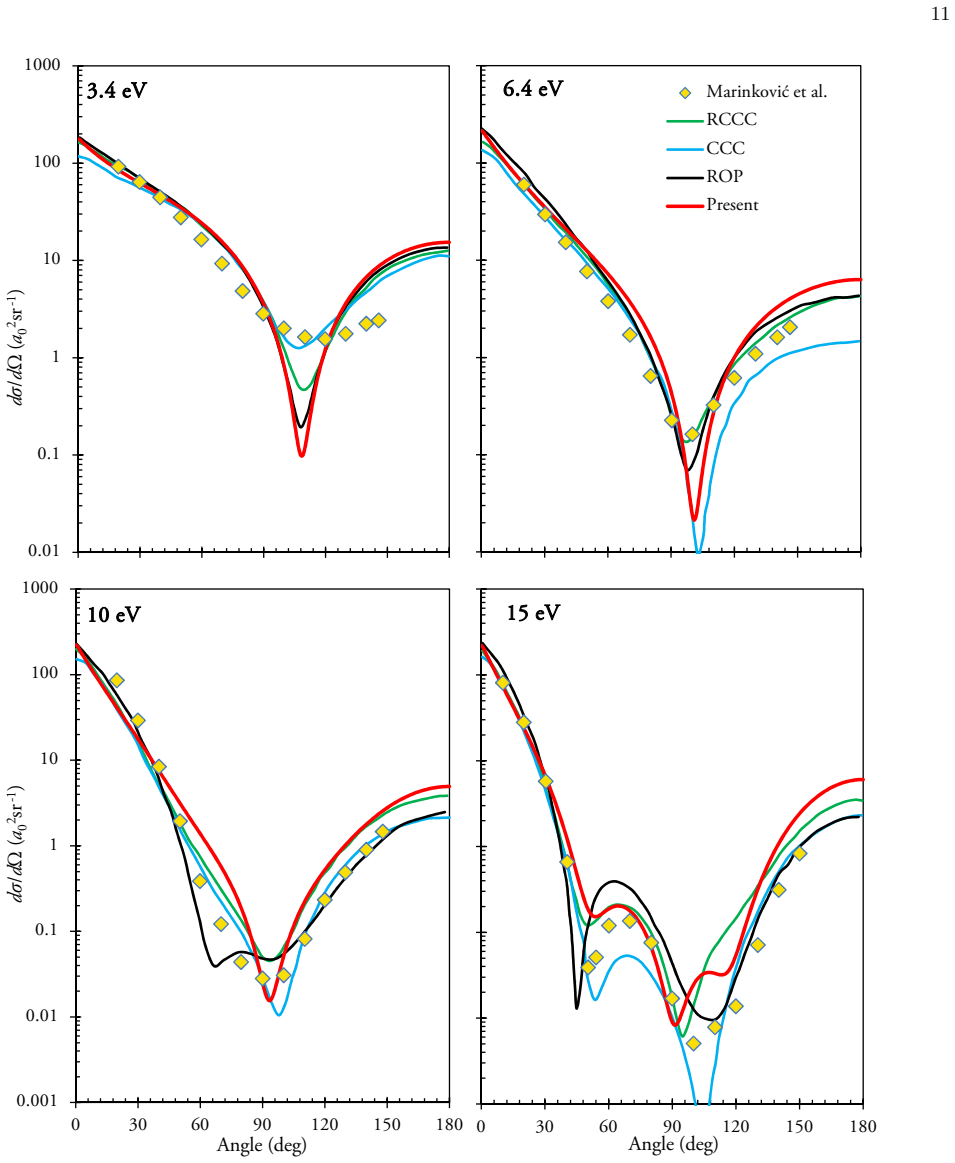


read the original abstract
We present an extensive set of theoretical results for differential, integrated, and momentum transfer cross sections for the elastic scattering of electrons by zinc, cadmium, and mercury. This study extends the application of our method of calculations, previously employed for stable inert gases and alkaline-earth-metals. Our approach is a self-consistent calculation, with a semi-empirical element in the adjustable cut-off radius of the polarization potential. Our method is expected to provide a set of accurate data for Zn, Cd and Hg, based on the satisfactory agreement in our previous investigations with experimental values and other precise theoretical results.
Editorial analysis
A structured set of objections, weighed in public.
Referee Report
Summary. The manuscript presents calculations of differential, integrated, and momentum transfer cross sections for elastic electron scattering from Zn, Cd, and Hg. It extends a self-consistent method previously applied to inert gases and alkaline-earth metals, incorporating a semi-empirical adjustable cut-off radius in the polarization potential, and asserts that the results should be accurate based on prior agreement with experiment and other theories.
Significance. If the central claim holds, the work would supply a useful dataset for electron scattering on these d-block atoms, where data are relatively sparse. The extension of an established computational approach is a modest but positive contribution to atomic collision physics.
major comments (1)
- [Abstract and §2] Abstract and §2 (Theoretical framework): The claim that the method will yield accurate data for Zn, Cd, and Hg rests on transferability of the adjustable cut-off radius r_c of the polarization potential. No explicit procedure for selecting or validating r_c for these atoms is shown, nor is a sensitivity analysis or direct comparison to r_c values from the prior noble-gas/alkaline-earth cases provided; this leaves the accuracy assertion dependent on an untested semi-empirical choice rather than a demonstrated parameter-free or re-optimized derivation.
minor comments (2)
- Results tables would benefit from inclusion of estimated uncertainties or direct side-by-side comparison with recent experimental or other theoretical values for at least one energy.
- [Abstract] Clarify the precise energy range and angular coverage of the reported cross sections in the abstract or introduction.
Simulated Author's Rebuttal
We thank the referee for the careful reading of our manuscript and the constructive feedback. We address the major comment point by point below and indicate the revisions we plan to make.
read point-by-point responses
-
Referee: [Abstract and §2] Abstract and §2 (Theoretical framework): The claim that the method will yield accurate data for Zn, Cd, and Hg rests on transferability of the adjustable cut-off radius r_c of the polarization potential. No explicit procedure for selecting or validating r_c for these atoms is shown, nor is a sensitivity analysis or direct comparison to r_c values from the prior noble-gas/alkaline-earth cases provided; this leaves the accuracy assertion dependent on an untested semi-empirical choice rather than a demonstrated parameter-free or re-optimized derivation.
Authors: We agree with the referee that the selection of the cut-off radius r_c requires more explicit documentation to support the claim of accuracy. In our prior works on inert gases and alkaline-earth metals, r_c was adjusted semi-empirically to achieve optimal agreement with available experimental differential cross sections at low energies while maintaining the self-consistent nature of the calculation. For Zn, Cd, and Hg, we used r_c values determined by a similar fitting procedure to the limited available data and by analogy to the neighboring atoms in the periodic table. To address this concern, we will revise Section 2 to include: (i) the specific r_c values employed for each target atom, (ii) a comparison table with r_c from previous studies, and (iii) a sensitivity analysis demonstrating that the cross sections are robust against small changes in r_c. This will make the semi-empirical aspect more transparent without altering the core results. revision: yes
Circularity Check
Accuracy claim for Zn/Cd/Hg reduces to transfer of semi-empirical cut-off radius from prior fits
specific steps
-
fitted input called prediction
[Abstract]
"Our approach is a self-consistent calculation, with a semi-empirical element in the adjustable cut-off radius of the polarization potential. Our method is expected to provide a set of accurate data for Zn, Cd and Hg, based on the satisfactory agreement in our previous investigations with experimental values and other precise theoretical results."
The adjustable cut-off radius is tuned semi-empirically on prior atoms; the claim that the identical method will be accurate for Zn, Cd, Hg therefore imports the fitted value as the basis for the new results rather than deriving them independently.
full rationale
The paper's central expectation of accurate cross sections for the new targets rests on the prior performance of the same self-consistent method (including its adjustable polarization cut-off) on other atoms. No independent derivation or re-optimization of the cut-off radius is shown for Zn, Cd, or Hg; the accuracy is therefore carried by the fitted parameter's transferability rather than by a parameter-free calculation or new external validation.
Axiom & Free-Parameter Ledger
free parameters (1)
- cut-off radius of the polarization potential
axioms (1)
- domain assumption The self-consistent scattering method validated on inert gases and alkaline-earth metals extends directly to Zn, Cd, and Hg with only the polarization cut-off adjusted.
Lean theorems connected to this paper
-
IndisputableMonolith/Cost/FunctionalEquation.leanwashburn_uniqueness_aczel unclear?
unclearRelation between the paper passage and the cited Recognition theorem.
Our approach is a self-consistent calculation, with a semi-empirical element in the adjustable cut-off radius of the polarization potential... rc(E) = 1/3 ln(E/R) + ⟨r⟩ns (E ≥ threshold), constant below.
-
IndisputableMonolith/Foundation/RealityFromDistinction.leanreality_from_one_distinction unclear?
unclearRelation between the paper passage and the cited Recognition theorem.
The result was a combination of the central static atomic, exchange, and polarization potentials that produced a consistent agreement...
What do these tags mean?
- matches
- The paper's claim is directly supported by a theorem in the formal canon.
- supports
- The theorem supports part of the paper's argument, but the paper may add assumptions or extra steps.
- extends
- The paper goes beyond the formal theorem; the theorem is a base layer rather than the whole result.
- uses
- The paper appears to rely on the theorem as machinery.
- contradicts
- The paper's claim conflicts with a theorem or certificate in the canon.
- unclear
- Pith found a possible connection, but the passage is too broad, indirect, or ambiguous to say the theorem truly supports the claim.
Reference graph
Works this paper leans on
-
[1]
M. Adibzadeh and C. E. Theodosiou, Atomic Data and Nuclear Data Tables91, 8 (2005), ISSN 0092-640X, URLhttps: //www.sciencedirect.com/science/article/pii/S0092640X05000343. 6
work page 2005
-
[2]
M. Adibzadeh and C. E. Theodosiou, Phys. Rev. A70, 052704 (2004), URLhttps://link.aps.org/doi/10.1103/ PhysRevA.70.052704
work page 2004
-
[3]
M. Adibzadeh, C. E. Theodosiou, and N. J. Harmon, Atoms12(2024), ISSN 2218-2004, URLhttps://www.mdpi.com/ 2218-2004/12/6/33
work page 2024
-
[4]
R. B. Brode, Phys. Rev.35, 504 (1930), URLhttps://link.aps.org/doi/10.1103/PhysRev.35.504
-
[5]
E. C. Childs, H. S. W. Massey, and E. Rutherford, Proceedings of the Royal Society of Lon- don. Series A, Containing Papers of a Mathematical and Physical Character141, 473 (1933), https://royalsocietypublishing.org/doi/pdf/10.1098/rspa.1933.0131, URLhttps://royalsocietypublishing.org/ doi/abs/10.1098/rspa.1933.0131
-
[6]
W. Williams and D. Bozinis, Phys. Rev. A12, 57 (1975), URLhttps://link.aps.org/doi/10.1103/PhysRevA.12.57
-
[7]
P. D. Burrow, J. A. Michejda, and J. Comer, Journal of Physics B: Atomic and Molecular Physics9, 3225 (1976), URL https://doi.org/10.1088/0022-3700/9/18/014
-
[8]
B. P. Marinkovi´ c, R. Panajotovi´ c, D.ˇSevi´ c, R. P. McEachran, G. Garc´ ıa, F. Blanco, and M. J. Brunger, Phys. Rev. A99, 062702 (2019), URLhttps://link.aps.org/doi/10.1103/PhysRevA.99.062702
-
[9]
D. B. McGarrah, A. J. Antolak, and J. Williamson, W., Journal of Applied Physics69, 6812 (1991), ISSN 0021-8979, https://pubs.aip.org/aip/jap/article-pdf/69/10/6812/18643209/6812 1 online.pdf, URLhttps://doi.org/10. 1063/1.347670
work page 1991
-
[10]
J. Yuan and Z. Zhang, Phys. Rev. A45, 535 (1992), URLhttps://link.aps.org/doi/10.1103/PhysRevA.45.535
-
[11]
P. Kumar, A. K. Jain, A. N. Tripathi, and S. N. Nahar, Phys. Rev. A49, 899 (1994), URLhttps://link.aps.org/doi/ 10.1103/PhysRevA.49.899
-
[12]
M. Born, Journal of Physics D: Applied Physics34, 909 (2001), URLhttps://dx.doi.org/10.1088/0022-3727/34/6/313
-
[13]
R. D. White, R. P. McEachran, R. E. Robson, M. T. Elford, and K. Bartschat, Journal of Physics D: Applied Physics37, 021 (2004), URLhttps://dx.doi.org/10.1088/0022-3727/37/22/021
-
[14]
D. V. Fursa, I. Bray, R. Panajotovi´ c, D.ˇSevi´ c, V. Pejˇ cev, D. M. Filipovi´ c, and B. P. Marinkovi´ c, Phys. Rev. A72, 012706 (2005), URLhttps://link.aps.org/doi/10.1103/PhysRevA.72.012706
-
[16]
C. J. Bostock, D. V. Fursa, and I. Bray, Phys. Rev. A85, 062707 (2012), URLhttps://link.aps.org/doi/10.1103/ PhysRevA.85.062707
work page 2012
-
[17]
R. P. McEachran, B. P. Marinkovi´ c, G. Garc´ ıa, R. D. White, P. W. Stokes, D. B. Jones, and M. J. Brunger, Jour- nal of Physical and Chemical Reference Data49, 013102 (2020), ISSN 0047-2689, https://pubs.aip.org/aip/jpr/article- pdf/doi/10.1063/1.5135573/19747681/013102 1 online.pdf, URLhttps://doi.org/10.1063/1.5135573
-
[18]
F. Arretche, W. Tenfen, and B. K. Sahoo, Atoms10(2022), ISSN 2218-2004, URLhttps://www.mdpi.com/2218-2004/ 10/3/69
work page 2022
-
[19]
J. C. Nogueira, W. R. Newell, and W. M. Johnston, Journal of Physics B: Atomic and Molecular Physics20, L537 (1987), URLhttps://dx.doi.org/10.1088/0022-3700/20/16/005
-
[20]
B. Marinkovi´ c, V. Pejˇ cev, D. Filipovi´ c, and L. Vuˇ skovi´ c, Journal of Physics B: Atomic, Molecular and Optical Physics24, 1817 (1991), URLhttps://dx.doi.org/10.1088/0953-4075/24/7/029
-
[21]
J. E. Kontros, L. Sz´ ot´ er, I. V. Chernyshova, and O. B. Shpenik, Journal of Physics B: Atomic, Molecular and Optical Physics35, 2195 (2002), URLhttps://dx.doi.org/10.1088/0953-4075/35/10/301
-
[22]
J. E. Kontros, I. V. Chernyshova, and O. B. Shpenik, Technical Physics48, 964 (2003), URLhttps://doi.org/10.1134/ 1.1607490
work page 2003
-
[23]
J. P. Sullivan, P. D. Burrow, D. S. Newman, K. Bartschat, J. A. Michejda, R. Panajotovic, M. Moghbelalhossein, R. P. McEachran, and S. J. Buckman, New Journal of Physics5, 159 (2003), URLhttps://dx.doi.org/10.1088/1367-2630/ 5/1/159
-
[24]
B. Marinkovi´ c, R. McEachran, D. Fursa, I. Bray, H. Umer, F. Blanco, M. Brunger, L. Campbell, and D. Jones, Journal of Physical and Chemical Reference Data52(2023)
work page 2023
-
[25]
A. W. Pangantiwar and R. Srivastava, Phys. Rev. A40, 2346 (1989), URLhttps://link.aps.org/doi/10.1103/ PhysRevA.40.2346
work page 1989
-
[26]
S. N. Nahar, Phys. Rev. A43, 2223 (1991), URLhttps://link.aps.org/doi/10.1103/PhysRevA.43.2223
-
[27]
D. H. Madison, K. Bartschat, and R. Srivastava, Journal of Physics B: Atomic, Molecular and Optical Physics24, 1839 (1991), URLhttps://dx.doi.org/10.1088/0953-4075/24/7/030
-
[28]
M. J. Berrington, C. J. Bostock, D. V. Fursa, I. Bray, R. P. McEachran, and A. D. Stauffer, Phys. Rev. A85, 042708 (2012), URLhttps://link.aps.org/doi/10.1103/PhysRevA.85.042708
-
[29]
M. M. Haque, A. K. Haque, M. A. Uddin, M. Maaza, M. A. R. Patoary, A. K. Basak, and B. C. Saha (Academic Press, 2021), vol. 84 ofAdvances in Quantum Chemistry, pp. 1–72, URLhttps://www.sciencedirect.com/science/article/ pii/S0065327620300046
work page 2021
-
[30]
L. R. Maxwell, Proceedings of the National Academy of Sciences12, 509 (1926), https://www.pnas.org/doi/pdf/10.1073/pnas.12.8.509, URLhttps://www.pnas.org/doi/abs/10.1073/pnas.12.8.509
-
[31]
H. Beuthe, Annalen der Physik389, 949 (1928), https://onlinelibrary.wiley.com/doi/pdf/10.1002/andp.19283892402, URL https://onlinelibrary.wiley.com/doi/abs/10.1002/andp.19283892402
-
[32]
T. J. Jones, Phys. Rev.32, 459 (1928), URLhttps://link.aps.org/doi/10.1103/PhysRev.32.459
-
[33]
R. B. Brode, Proceedings of the Royal Society of London. Series A, Containing Papers of a Mathematical and Physical Character125, 134 (1929), https://royalsocietypublishing.org/doi/pdf/10.1098/rspa.1929.0156, URLhttps: 7 //royalsocietypublishing.org/doi/abs/10.1098/rspa.1929.0156
-
[34]
F. L. Arnot, Proceedings of the Royal Society of London. Series A, Containing Papers of a Mathematical and Physical Character130, 655 (1931), https://royalsocietypublishing.org/doi/pdf/10.1098/rspa.1931.0031, URLhttps: //royalsocietypublishing.org/doi/abs/10.1098/rspa.1931.0031
-
[35]
R. R. Palmer, Phys. Rev.37, 70 (1931), URLhttps://link.aps.org/doi/10.1103/PhysRev.37.70
- [36]
-
[37]
H. Deichsel, E. Reichert, and H. Steidl, Zeitschrift f¨ ur Physik189, 212 (1966)
work page 1966
-
[38]
J. P. Bromberg, The Journal of Chemical Physics51, 4117 (1969), ISSN 0021-9606, https://pubs.aip.org/aip/jcp/article- pdf/51/9/4117/18865009/4117 1 online.pdf, URLhttps://doi.org/10.1063/1.1672634
-
[39]
Gronemeier, Zeitschrift f¨ ur Physik A Hadrons and nuclei232, 483 (1970)
K.-H. Gronemeier, Zeitschrift f¨ ur Physik A Hadrons and nuclei232, 483 (1970)
work page 1970
-
[40]
M. D¨ uweke, N. Kirchner, E. Reichert, and S. Schon, Journal of Physics B: Atomic and Molecular Physics9, 1915 (1976), URLhttps://dx.doi.org/10.1088/0022-3700/9/11/017
-
[41]
K. Jost and B. Ohnemus, Phys. Rev. A19, 641 (1979), URLhttps://link.aps.org/doi/10.1103/PhysRevA.19.641
-
[42]
G. F. Hanne, K. J. Kollath, and W. Wubker, Journal of Physics B: Atomic and Molecular Physics13, L395 (1980), URL https://dx.doi.org/10.1088/0022-3700/13/12/009
-
[43]
G. Holtkamp, K. Jost, F. J. Peitzmann, and J. Kessler, Journal of Physics B: Atomic and Molecular Physics20, 4543 (1987), URLhttps://dx.doi.org/10.1088/0022-3700/20/17/030
-
[44]
F. J. Peitzmann and J. Kessler, Journal of Physics B: Atomic, Molecular and Optical Physics23, 4005 (1990), URL https://doi.org/10.1088/0953-4075/23/21/030
-
[45]
R. Panajotovi´ c, V. Pejˇ cev, M. Konstantinovi´ c, D. Filipovi´ c, V. Boˇ cvarski, and B. Marinkovi´ c, Journal of Physics B: Atomic, Molecular and Optical Physics26, 1005 (1993), URLhttps://dx.doi.org/10.1088/0953-4075/26/5/020
-
[46]
M. Zubek, A. Danjo, and G. C. King, Journal of Physics B: Atomic, Molecular and Optical Physics28, 4117 (1995), URL https://dx.doi.org/10.1088/0953-4075/28/18/014
-
[47]
C. W. McCutchen, Phys. Rev.112, 1848 (1958), URLhttps://link.aps.org/doi/10.1103/PhysRev.112.1848
-
[48]
M. Fink and A. C. Yates, Atomic Data and Nuclear Data Tables1, 385 (1969), ISSN 0092-640X, URLhttps://www. sciencedirect.com/science/article/pii/S0092640X6980029X
work page 1969
-
[49]
S. D. Rockwood, Phys. Rev. A8, 2348 (1973), URLhttps://link.aps.org/doi/10.1103/PhysRevA.8.2348
-
[50]
D. W. Walker, Journal of Physics B: Atomic and Molecular Physics8, L161 (1975), URLhttps://dx.doi.org/10.1088/ 0022-3700/8/9/004
work page 1975
-
[51]
L. T. S. F. Lam, Australian Journal of Physics33, 261 (1980)
work page 1980
-
[52]
M. T. Elford, Australian Journal of Physics33, 251 (1980)
work page 1980
-
[53]
R. P. McEachran and A. D. Stauffer, Journal of Physics B: Atomic and Molecular Physics20, 5517 (1987), URLhttps: //dx.doi.org/10.1088/0022-3700/20/20/027
- [54]
-
[55]
J. E. Sienkiewicz, Journal of Physics B: Atomic, Molecular and Optical Physics30, 1261 (1997), URLhttps://dx.doi. org/10.1088/0953-4075/30/5/019
-
[56]
D. V. Fursa, I. Bray, and G. Lister, Journal of Physics B: Atomic, Molecular and Optical Physics36, 4255 (2003), URL https://dx.doi.org/10.1088/0953-4075/36/21/006
-
[57]
D. V. Fursa and I. Bray, AIP Conference Proceedings697, 175 (2003), ISSN 0094-243X, https://pubs.aip.org/aip/acp/article-pdf/697/1/175/11445185/175 1 online.pdf, URLhttps://doi.org/10.1063/1. 1643694
work page doi:10.1063/1 2003
-
[58]
R. P. McEachran and M. T. Elford, Journal of Physics B: Atomic, Molecular and Optical Physics36, 427 (2003), URL https://dx.doi.org/10.1088/0953-4075/36/3/303
-
[60]
C. J. Bostock, D. V. Fursa, and I. Bray, Phys. Rev. A82, 022713 (2010), URLhttps://link.aps.org/doi/10.1103/ PhysRevA.82.022713
work page 2010
-
[61]
M. M. Haque, A. K. F. Haque, P. P. Bhattacharjee, M. A. Uddin, M. A. R. Patoary, A. K. Basak, M. Maaza, and B. C. Saha, Molecular Physics117, 2303 (2019), https://doi.org/10.1080/00268976.2018.1548712, URLhttps://doi.org/10. 1080/00268976.2018.1548712
-
[62]
J. B. Furness and I. E. McCarthy, Journal of Physics B: Atomic and Molecular Physics6, 2280 (1973), URLhttps: //dx.doi.org/10.1088/0022-3700/6/11/021
-
[63]
D. Kolb, W. R. Johnson, and P. Shorer, Phys. Rev. A26, 19 (1982), URLhttps://link.aps.org/doi/10.1103/PhysRevA. 26.19
-
[64]
F. Salvat, J. Fern´ andez-Varea, and W. Williamson, Computer Physics Communications90, 151 (1995), ISSN 0010-4655, URLhttps://www.sciencedirect.com/science/article/pii/001046559500039I. 8 15 eV Marinković et al. BSR ROP CCC Present 0 30 60 90 120 150 180 Angel (deg) 25 eV 0.001 0.01 0.1 1 10 100 1000dσ/dΩ ( a02sr-1) 10 eV 0.01 0.1 1 10 100 1000 0 30 60 90...
discussion (0)
Sign in with ORCID, Apple, or X to comment. Anyone can read and Pith papers without signing in.