REVIEW 2 major objections 5 minor 1 cited by
Gamma-ray light curves for the BL Lac Mrk 421 using HAWC data derived with a new approach
T0 review · 2 major / 5 minor · reviewed 2026-08-14 · deepseek-v4-flash
Pith's one-line read ZEBRA, a new HAWC analysis framework, reproduces the previously published gamma-ray light curves of Mrk 421 and the Crab, with overall flux differences under ten percent.
desk verdict ZEBRA is a sound new analysis tool for HAWC, but the paper proves consistency only on daily timescales, not the advertised sub-transit capability. read the letter →
The pith
A machine-rendered reading of the paper's core claim, the machinery that carries it, and where it could break.
The reading
What carries the argument
The central object is ZEBRA (Zenith Band Response Analysis), a Monte-Carlo-based framework that characterizes the HAWC detector response as a function of zenith angle. It convolves that response with the actual exposure time at each zenith angle to estimate counts from a source over an arbitrary period, updating the point spread function per zenith band. This replaces LiFF's approach of computing detector response as a function of declination under a minimum full-transit exposure assumption. The zenith-resolved response is the mechanism that removes the need for an overall correction factor when short time windows are wanted.
What would settle it
A day-by-day residual analysis between ZEBRA and LiFF on all 17 months that shows a substantial fraction of days with deviations above 2σ, or an hour-scale ZEBRA light curve around a Mrk 421 flare that disagrees with simultaneous observations, would falsify the claim.
Extended reading notes
Core claim
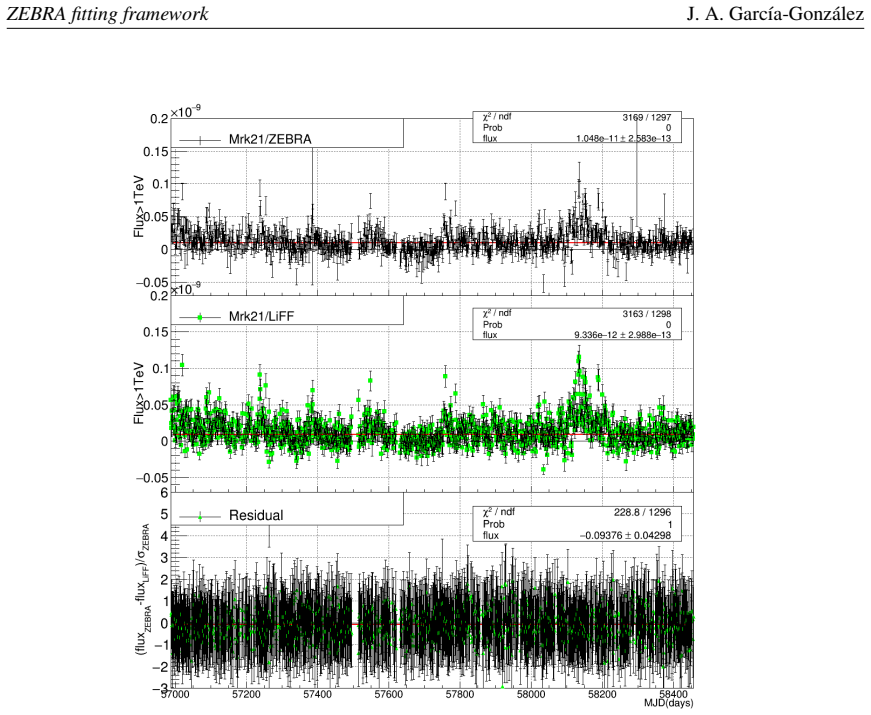
On its own terms, the paper's discovery is that a flux measurement is independent of the fitting framework: ZEBRA and LiFF produce consistent results for a flux measurement of the same source and data. Concretely, for both the Crab and Mrk 421, the ZEBRA and LiFF daily light curves agree in their high and low flux states, have similar average fluxes within uncertainties, and show no differences above 2σ. The paper states that the overall flux difference is less than 10%, consistent with the systematic uncertainties considered for LiFF in the 17-month analysis. This consistency is what allows the authors to conclude that future analyses with ZEBRA will recover the same physics, such as Bayesian-block variability structure and correlations with other wavelengths.
Load-bearing premise
The load-bearing assumption is that agreement with LiFF on daily binned light curves guarantees unbiased fluxes on much shorter time windows, since ZEBRA's stated advantage of arbitrary timescales is asserted but not validated with hour-scale data.
Editorial extensions
If this is right
- Future HAWC light curves for Mrk 421 and the Crab can be produced with ZEBRA, and the physics derived from them should match the earlier 2017 analysis.
- Bayesian Blocks, X-ray/gamma-ray correlation studies, and variability analyses planned with ZEBRA can proceed on the strength of this consistency check.
- The zenith-dependent response opens a route to flux measurements on time scales shorter than a full transit, where LiFF required a correction factor.
- The small overall flux difference can be read as the approximate systematic floor for ZEBRA's daily flux points, comparable to the systematic uncertainties already quoted for LiFF.
Reading between the lines
- Beyond the paper, the same zenith-resolved machinery should apply to other HAWC-monitored blazars, so the consistency test could be repeated on Mrk 501 or a fainter source with little additional work.
- The paper asserts, but does not demonstrate, that ZEBRA works on sub-transit time scales; a natural next test is to compute hour-scale fluxes around a known Mrk 421 flare and check their residuals against simultaneous observations.
- If the 10% agreement band reflects a systematic floor, then future ZEBRA-based variability claims will need to show that flux changes exceed that floor rather than just statistical errors.
Signed reviews
Editorial analysis
A structured set of objections, weighed in public.
Referee Report
Summary. The paper presents ZEBRA, a new analysis framework for deriving gamma-ray light curves from HAWC data in which the detector response is computed as a function of zenith angle and convolved with the actual exposure of a given time window, in contrast to the previous LiFF method that assumes a full-transit exposure. Using the first 17 months of HAWC data, the authors derive daily-binned light curves for the Crab and Mrk 421 with ZEBRA and compare them with those obtained with LiFF. They report that the flux difference is less than 10%, consistent with systematic uncertainties, and conclude that the two methods give consistent results, thus validating ZEBRA for future studies of variability on short timescales.
Significance. If the consistency claim holds and ZEBRA indeed delivers unbiased fluxes on arbitrary timescales, the framework would enable HAWC to probe intra-night variability of blazars, a key capability for constraining emission models. The paper also strengthens the multi-messenger and variability program of HAWC by providing a more flexible analysis tool. However, the significance is conditional: the manuscript itself provides only a visual and qualitative comparison on daily timescales, so the load-bearing claim of short-timescale capability is not yet demonstrated.
major comments (2)
- [Section 3, Figures 1 and 2] The quantitative evidence for consistency is limited to the statement that the flux difference is 'less than %10' and 'consistent with the systematic uncertainties.' No test statistic is provided: the lower panels show (flux_ZEBRA - flux_LiFF)/sigma_ZEBRA, but the reader is not told the mean, standard deviation, or fraction of points exceeding 2 sigma or 3 sigma of this pull distribution. I request a quantitative comparison, e.g., the chi-square per degree of freedom of the two light curves, the mean and RMS of the pull, and a histogram or table of the daily differences, so that the 'consistent results' claim can be checked rather than taken on visual inspection.
- [Sections 2.2 and 4] The advertised main advantage of ZEBRA is the capability to derive fluxes for arbitrary timescales, including windows of hours or less, yet the only validation presented is on daily bins. A daily bin averages over a full transit, so the zenith-dependent point spread function and background systematics are only tested in aggregate. This leaves open the possibility that systematic errors which average out over a transit become significant in hour-scale windows. To support the central claim of the paper's stated advantage, please provide either a simulation study of bias as a function of time-window length, a cross-check on sub-transit bins, or at least a comparison of ZEBRA on half-transit or two-hour windows with an independent estimator.
minor comments (5)
- [Section 3] In the Mrk 421 model description, 'an exponential cutoff at 5 eV' should almost certainly read '5 TeV'; as written, the cutoff energy is physically implausible and inconsistent with the HAWC energy range.
- [Section 3] The phrase 'There is an overall flux difference less than %10' should read 'less than 10%.' It would also be helpful to specify whether this refers to the mean absolute difference, the maximum, or a per-point property, and whether it is computed before or after applying the <0.5 coverage cut.
- [Section 3, Figures 1 and 2] The lower panels plot (flux_ZEBRA - flux_LiFF)/sigma_ZEBRA, but sigma_ZEBRA is not defined; state explicitly whether it is the statistical uncertainty of the ZEBRA flux only or includes systematic contributions.
- [Section 1] The paper states that the previous LiFF method 'assumes a minimum exposure on a full transit of the source,' but the discussion of the 'correction factor' in the previous work is vague; a more precise description of what the correction factor does and why it fails for short windows would help the reader evaluate the claimed advantage of ZEBRA.
- [Section 3] The comparison with HESS for the Crab at >1 TeV is mentioned, but the energy range of the ZEBRA and LiFF results (300 GeV to 100 TeV) is not explicitly restated in the comparison; clarify whether the HESS comparison is on the integrated flux or on a specific energy band.
Circularity Check
No circularity: ZEBRA–LiFF agreement is a genuine cross-check, not a fitted or self-referential prediction.
full rationale
The paper's central claim is that flux measurements from ZEBRA and LiFF are consistent. This is tested directly by comparing daily light curves for Crab and Mrk 421 (Section 3, Figs. 1 and 2), with a difference normalized by ZEBRA uncertainty. The agreement is not built in by construction: while ZEBRA and LiFF share the same selection criteria, quality cuts, and spectral models (explicitly 'The selection criteria and quality checks are the same used in [Abeysekara et al.(2017)]' and 'as in [Abeysekara et al.(2017)]'), the two methods use different detector-response computations—declination-averaged exposure over a full transit for LiFF versus zenith-resolved response convolved with exposure for ZEBRA. This is exactly the degree of freedom the comparison is meant to test, so agreement is informative. No parameter is fit to the LiFF fluxes and then renamed a ZEBRA prediction; no uniqueness theorem or prior result is invoked to force consistency. The paper's advertised advantage of arbitrary timescales is not demonstrated by the daily-bin validation—an extrapolation concern, not a circularity—so it does not affect the circularity score. The HAWC self-citations (Abeysekara et al. 2017, Younk et al. 2015) provide the external data and framework being compared, and do not constitute load-bearing circular support.
Assumptions & free parameters
free parameters (3)
- Crab spectral index =
2.63
- Mrk 421 spectral index =
2.2
- Mrk 421 exponential cutoff energy =
5 TeV (text says 5 eV, likely a typo)
assumptions (3)
- domain assumption The HAWC Monte Carlo detector response model is an accurate description of the real detector.
- domain assumption The assumed spectral models for Crab and Mrk 421 are physically appropriate over the analyzed energy range.
- domain assumption The selection criteria and quality checks from [1], including the requirement of at least 50% transit coverage, do not introduce a bias in the comparison.
Cite this review
Pith. "Pith review of Gamma-ray light curves for the BL Lac Mrk 421 using HAWC data derived with a new approach." pith.science (2026). https://pith.science/paper/RPBMHNKI
@misc{pith2026190809452,
  author       = {Pith},
  title        = {Pith review of: Gamma-ray light curves for the BL Lac Mrk 421 using HAWC data derived with a new approach},
  year         = {2026},
  howpublished = {\url{https://pith.science/paper/RPBMHNKI}},
  note         = {Machine review of arXiv:1908.09452}
}
read the original abstract
The HAWC gamma ray observatory is located at the Sierra Negra Volcano in Puebla, Mexico, at an altitude of 4,100 meters. HAWC is a wide field of view array of 300 water Cherenkov detectors that are continuously surveying 2sr of the sky since March 2015. The large collected data sample consisting in more than 3 years makes HAWC an ideal instrument to perform an unbiased monitoring of blazars in the very-high-energy (VHE) emission. This is particular relevant for Mrk 421, one of the closest and brightest blazars in the gamma-ray/X-ray classified as highsynchrotron-peaked BL Lac class. In this work we present light curves for Mrk 421 and the Crab nebula obtained with the first 17 months of data and a new analysis framework. We compare the results with the light curves reported in [1]. The main advantage of the new framework is the capability to derive fluxes for arbitrary timescales. We show that both, previous and present, methods give consistent results
Figures

Forward citations
Cited by 1 Pith paper
-
Study of long-term spectral evolution and X-ray and Gamma-ray correlation of blazars seen by HAWC
A 2143-day HAWC/Swift-XRT campaign finds a linear X-ray/TeV correlation for Mrk 421, tentative correlation evidence for Mrk 501, and confirms harder-when-brighter gamma-ray behavior in Mrk 421.
Reference graph
Works this paper leans on
-
[1]
U., Albert, A., Alfaro, R., et al.\ 2017, , 841, 100
Abeysekara, A. U., Albert, A., Alfaro, R., et al.\ 2017, , 841, 100
work page 2017
-
[2]
Aharonian, F., Akhperjanian, A. G., Bazer-Bachi, A. R., et al.\ 2006, , 457, 899
work page 2006
- [3]
-
[4]
D., & K \"o nigl, A.\ 1979, , 232, 34
Blandford, R. D., & K \"o nigl, A.\ 1979, , 232, 34
work page 1979
- [5]
-
[6]
Fraija, N.\ 2015, Astroparticle Physics, 71, 1
work page 2015
-
[7]
Fraija, N., Ben \' tez, E., Hiriart, D., et al.\ 2017, , 232, 7
work page 2017
-
[8]
Marcha, M. J. M., Browne, I. W. A., Impey, C. D., & Smith, P. S.\ 1996, , 281, 425
work page 1996
Show all 12 references
-
[9]
W., Cawley, M
Punch, M., Akerlof, C. W., Cawley, M. F., et al.\ 1992, , 358, 477
1992
-
[10]
Sbarufatti, B., Treves, A., & Falomo, R.\ 2005, , 635, 173
2005
-
[11]
M.\ 1997, , 35, 445
Ulrich, M.-H., Maraschi, L., & Urry, C. M.\ 1997, , 35, 445
1997
-
[12]
W., Lauer, R
Younk, P. W., Lauer, R. J., Vianello, G., et al.\ 2015, 34th International Cosmic Ray Conference (ICRC2015), 34, 948
2015
Reviewed August 14, 2026 · model on record in the stance chip above.
Discussion (0). Continue with ORCID to comment.