Coexisting Regular and Chaotic Dynamics in the Dysprosium Feshbach Spectrum
Pith reviewed 2026-06-29 01:43 UTC · model grok-4.3
The pith
Dysprosium Feshbach resonances display stronger level repulsion near the center of the magnetic-moment distribution than at its lower edge.
A machine-rendered reading of the paper's core claim, the machinery that carries it, and where it could break.
Core claim
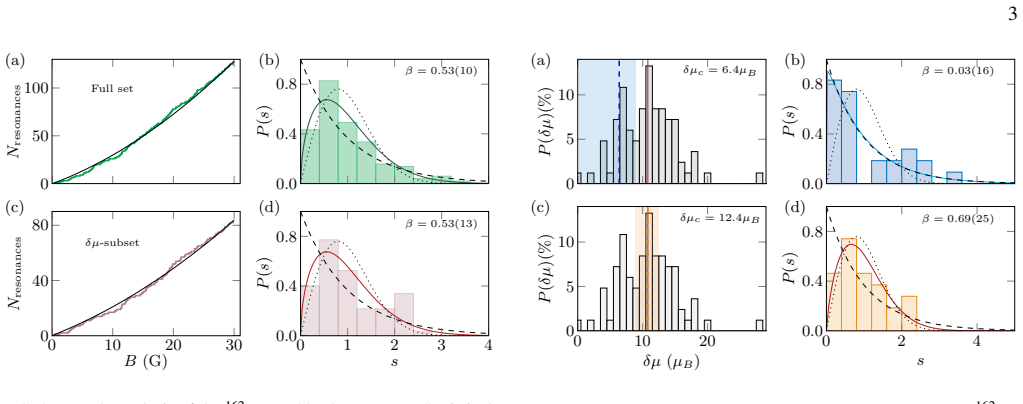
Resonances associated with states near the center of the magnetic-moment distribution display enhanced level repulsion, whereas those near the lower edge remain close to Poisson statistics. The results reveal hidden structure within the chaotic dysprosium Feshbach spectrum and identify molecular-state composition as a key ingredient in the emergence of quantum chaos in strongly dipolar scattering.
What carries the argument
Differential magnetic moments of the bound states, used as an eigenstate-sensitive probe to sort resonances by position in the overall magnetic-moment distribution before computing separate level statistics for each subset.
If this is right
- Level statistics inside a single Feshbach spectrum are not uniform across all resonances.
- Quantum chaos in dipolar scattering requires molecular states with balanced channel composition rather than extreme compositions.
- The full spectrum contains coexisting regular and chaotic subsets distinguished by magnetic-moment position.
- Molecular-state composition is a controlling variable for the onset of chaos in strongly dipolar gases.
Where Pith is reading between the lines
- Similar position-dependent statistics may appear in the Feshbach spectra of erbium or thulium once comparable magnetic-moment data become available.
- Experiments could selectively excite resonances at chosen magnetic-moment values to tune the effective degree of chaos in scattering rates.
- The result suggests that chaos in other many-channel quantum systems may also be confined to a central subset of states rather than appearing uniformly.
Load-bearing premise
The measured differential magnetic moments accurately reflect eigenstate composition and place each resonance correctly inside the full magnetic-moment distribution.
What would settle it
Recomputing the level statistics after randomly reassigning a substantial fraction of resonances to the opposite magnetic-moment subset and finding that the difference in repulsion between subsets disappears.
Figures
read the original abstract
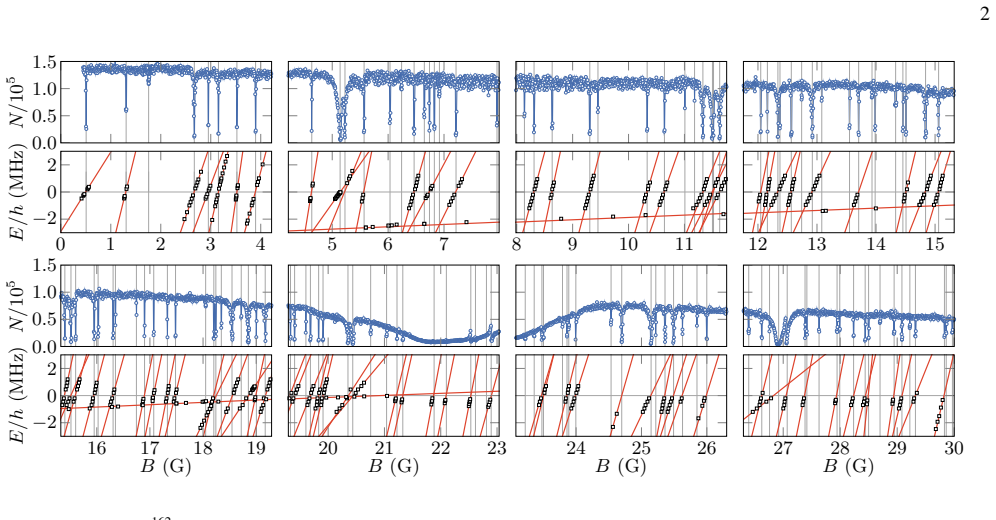
Strongly dipolar gases, such as dysprosium, erbium and thulium, exhibit dense Feshbach spectra whose level statistics have been associated with quantum chaos arising from couplings among many molecular channels. Here, we combine a precise calibration of the Feshbach spectrum of $^{162}$Dy with spectroscopic measurements of the differential magnetic moments of bound states associated with more than 80 resonances between 0 and 30 G. These magnetic moments provide an eigenstate-sensitive probe of the molecular states underlying the resonance spectrum. We find that the level statistics are not uniform: resonances associated with states near the center of the magnetic-moment distribution display enhanced level repulsion, whereas those near the lower edge remain close to Poisson statistics. Our results reveal hidden structure within the chaotic dysprosium Feshbach spectrum and identify molecular-state composition as a key ingredient in the emergence of quantum chaos in strongly dipolar scattering.
Editorial analysis
A structured set of objections, weighed in public.
Referee Report
Summary. The paper calibrates the Feshbach spectrum of 162Dy and reports spectroscopic measurements of differential magnetic moments for >80 resonances between 0 and 30 G. It claims that level statistics are not uniform across the spectrum: resonances associated with states near the center of the magnetic-moment distribution exhibit enhanced level repulsion, while those near the lower edge remain close to Poisson statistics. This is interpreted as revealing hidden structure in the chaotic spectrum and identifying molecular-state composition as a key factor in the emergence of quantum chaos in strongly dipolar scattering.
Significance. If the central claim is supported by the full dataset and analysis, the result is significant because it demonstrates that level statistics in a dense Feshbach spectrum are not uniform but depend on eigenstate properties probed by magnetic moments. This provides a concrete experimental handle on the conditions for quantum chaos in complex molecular systems and could guide theory in other dipolar gases. The experimental calibration and large number of independent resonance measurements are strengths that avoid circular fitting.
major comments (2)
- [Results section on magnetic-moment measurements and level statistics] The partition of resonances into center vs. lower-edge subsets of the magnetic-moment distribution (and the resulting contrast in nearest-neighbor spacing statistics) is load-bearing for the headline claim. The manuscript must demonstrate that differential magnetic moment assignments are free of significant mis-identification of overlapping resonances or systematic calibration offsets that could move resonances between bins and erase the reported statistical difference; without explicit error propagation, completeness checks in the 0–30 G window, and robustness tests under plausible assignment variations, the contrast remains vulnerable to the selection-bias concern.
- [Methods and statistical analysis] The unfolding procedure, choice of binning for the magnetic-moment distribution, and quantitative statistical tests (e.g., Brody parameter or exact p-values for the observed repulsion vs. Poisson) are not described in sufficient detail to verify that the reported qualitative difference is robust rather than sensitive to analysis choices.
minor comments (2)
- [Figure or table presenting the distribution] Clarify the precise definition of 'center' and 'lower edge' of the magnetic-moment distribution (e.g., quantiles or absolute ranges) and show the raw histogram of all measured moments.
- [Data availability statement] Ensure all resonance positions, measured moments, and assigned subsets are tabulated or deposited as supplementary data to allow independent re-analysis.
Simulated Author's Rebuttal
We thank the referee for the careful reading and constructive comments on our manuscript. We address each major comment below and have revised the manuscript to incorporate additional details and checks where appropriate.
read point-by-point responses
-
Referee: [Results section on magnetic-moment measurements and level statistics] The partition of resonances into center vs. lower-edge subsets of the magnetic-moment distribution (and the resulting contrast in nearest-neighbor spacing statistics) is load-bearing for the headline claim. The manuscript must demonstrate that differential magnetic moment assignments are free of significant mis-identification of overlapping resonances or systematic calibration offsets that could move resonances between bins and erase the reported statistical difference; without explicit error propagation, completeness checks in the 0–30 G window, and robustness tests under plausible assignment variations, the contrast remains vulnerable to the selection-bias concern.
Authors: We agree that robustness against mis-assignments is essential. The revised manuscript adds an appendix with explicit error propagation for all differential magnetic moments, derived from the spectroscopic fits and field calibration uncertainties. We include a completeness check verifying that the 0–30 G window contains no unaccounted overlaps capable of shifting resonances between bins. Robustness is demonstrated by re-binning with shifted boundaries and reclassifying near-boundary resonances; the reported contrast in level statistics persists under these variations. revision: yes
-
Referee: [Methods and statistical analysis] The unfolding procedure, choice of binning for the magnetic-moment distribution, and quantitative statistical tests (e.g., Brody parameter or exact p-values for the observed repulsion vs. Poisson) are not described in sufficient detail to verify that the reported qualitative difference is robust rather than sensitive to analysis choices.
Authors: We acknowledge that additional methodological transparency is needed. The revised Methods section now details the unfolding procedure (polynomial fit to the cumulative resonance density), explains the rationale for the chosen binning of the magnetic-moment distribution, and reports quantitative measures including the Brody parameter together with p-values from statistical tests comparing the nearest-neighbor spacings to Poisson and GOE limits. These additions confirm that the qualitative difference is not sensitive to reasonable variations in the analysis choices. revision: yes
Circularity Check
No circularity: experimental measurements and post-hoc statistical partitioning
full rationale
The paper reports direct spectroscopic calibration of the 162Dy Feshbach spectrum (0–30 G) together with independent measurements of differential magnetic moments for >80 resonances. Level statistics (nearest-neighbor spacing) are then computed on two data-driven subsets defined by the measured moments. No derivation, ansatz, fitted parameter, or self-citation chain is invoked to obtain the reported contrast between center and edge subsets; the statistical contrast is an empirical observation on the measured data. The analysis is therefore self-contained against external benchmarks and contains none of the enumerated circularity patterns.
Axiom & Free-Parameter Ledger
axioms (1)
- standard math Level statistics of quantum chaotic systems follow GOE (level repulsion) while integrable systems follow Poisson statistics.
Reference graph
Works this paper leans on
-
[1]
Baier, M
S. Baier, M. J. Mark, D. Petter, K. Aikawa, L. Chomaz, Z. Cai, M.Baranov,P.Zoller,andF.Ferlaino,ExtendedBose-Hubbard modelswithultracoldmagneticatoms,Science352,201(2016)
2016
-
[2]
L.Su,A.Douglas,M.Szurek,R.Groth,S.F.Ozturk,A.Krahn, A.H.Hébert, G.A.Phelps, S.Ebadi, S.Dickerson, F.Ferlaino, O.Marković,andM.Greiner,Dipolarquantumsolidsemerging in a Hubbard quantum simulator, Nature622, 724 (2023)
2023
-
[3]
Chomaz, I
L. Chomaz, I. Ferrier-Barbut, F. Ferlaino, B. Laburthe-Tolra, B.L.Lev,andT.Pfau,Dipolarphysics: areviewofexperiments with magnetic quantum gases, Rep. Prog. Phys.86, 026401 (2022)
2022
-
[4]
Biagioni, N
G. Biagioni, N. Antolini, B. Donelli, L. Pezzè, A. Smerzi, M. Fattori, A. Fioretti, C. Gabbanini, M. Inguscio, L. Tanzi, and G. Modugno, Measurement of the superfluid fraction of a supersolid by Josephson effect, Nature629, 773 (2024)
2024
-
[5]
Lecomte, A
M. Lecomte, A. Journeaux, J. Veschambre, J. Dalibard, and R. Lopes, Production and Stabilization of a Spin Mixture of Ultracold Dipolar Bose Gases, Phys. Rev. Lett.134, 013402 (2025)
2025
-
[6]
L. Lafforgue, N. Mehta, J. Houwman, F. Claude, S. Rit- tenhouse, F. Ferlaino, and M. Mark, Observation of Fano- suppression in scattering resonances of bosonic erbium atoms, 5 arXiv:2512.17556 (2025)
arXiv 2025
-
[7]
K.Gawryluk,M.Brewczyk,K.Bongs,andM.Gajda,Resonant Einstein–de Haas Effect in a Rubidium Condensate, Phys. Rev. Lett.99, 130401 (2007)
2007
-
[8]
Świsłocki, T
T. Świsłocki, T. Sowiński, J. Pietraszewicz, M. Brewczyk, M. Lewenstein, J. Zakrzewski, and M. Gajda, Tunable dipolar resonances and Einstein-de Haas effect in a87Rb-atom conden- sate, Phys. Rev. A83, 063617 (2011)
2011
-
[9]
Matsui, Y
H. Matsui, Y. Miyazawa, R. Goto, C. Nakano, Y. Kawaguchi, M.Ueda,andM.Kozuma,ObservationoftheEinstein–deHaas effect in a Bose–Einstein condensate, Science391, 384 (2026)
2026
-
[10]
K.Baumann,N.Q.Burdick,M.Lu,andB.L.Lev,Observation of low-field Fano-Feshbach resonances in ultracold gases of dysprosium, Phys. Rev. A89, 020701 (2014)
2014
-
[11]
Frisch, M
A. Frisch, M. Mark, K. Aikawa, S. Baier, R. Grimm, A. Petrov, S.Kotochigova,G.Quéméner,M.Lepers,O.Dulieu,andF.Fer- laino, Ultracold dipolar molecules composed of strongly mag- netic atoms, Phys. Rev. Lett.115, 203201 (2015)
2015
-
[12]
Maier, H
T. Maier, H. Kadau, M. Schmitt, M. Wenzel, I. Ferrier-Barbut, T. Pfau, A. Frisch, S. Baier, K. Aikawa, L. Chomaz, M. J. Mark, F. Ferlaino, C. Makrides, E. Tiesinga, A. Petrov, and S. Kotochigova, Emergence of Chaotic Scattering in Ultracold Er and Dy, Phys. Rev. X5, 041029 (2015)
2015
-
[13]
V.A.Khlebnikov,D.A.Pershin,V.V.Tsyganok,E.T.Davletov, I. S. Cojocaru, E. S. Fedorova, A. A. Buchachenko, and A. V. Akimov, Random to Chaotic Statistic Transformation in Low- FieldFano-FeshbachResonancesofColdThuliumAtoms,Phys. Rev. Lett.123, 213402 (2019)
2019
-
[14]
Frisch, M
A. Frisch, M. Mark, K. Aikawa, F. Ferlaino, J. L. Bohn, C. Makrides, A. Petrov, and S. Kotochigova, Quantum chaos in ultracold collisions of gas-phase erbium atoms, Nature507, 475 (2014)
2014
-
[15]
Maier, I
T. Maier, I. Ferrier-Barbut, H. Kadau, M. Schmitt, M. Wenzel, C.Wink,T.Pfau,K.Jachymski,andP.S.Julienne,Broaduniver- sal Feshbach resonances in the chaotic spectrum of dysprosium atoms, Phys. Rev. A92, 060702(R) (2015)
2015
-
[16]
Kotochigova and A
S. Kotochigova and A. Petrov, Anisotropy in the interaction of ultracold dysprosium, Phys. Chem. Chem. Phys.13, 19165 (2011)
2011
-
[17]
A.Petrov,E.Tiesinga,andS.Kotochigova,Anisotropy-Induced FeshbachResonancesinaQuantumDipolarGasofHighlyMag- netic Atoms, Phys. Rev. Lett.109, 103002 (2012)
2012
-
[18]
Kotochigova, Controlling interactions between highly mag- netic atoms with Feshbach resonances, Rep
S. Kotochigova, Controlling interactions between highly mag- netic atoms with Feshbach resonances, Rep. Prog. Phys.77, 093901 (2014)
2014
-
[19]
Makrides, M
C. Makrides, M. Li, E. Tiesinga, and S. Kotochigova, Frac- tal universality in near-threshold magnetic lanthanide dimers, Science Advances4, eaap8308 (2018)
2018
-
[20]
L. D. Augustovičová and J. L. Bohn, Manifestation of quantum chaos in Fano-Feshbach resonances, Phys. Rev. A98, 023419 (2018)
2018
-
[21]
McCann, J
J. McCann, J. L. Bohn, and L. D. Augustovičová, Magnetic momentsoflanthanidevanderWaalsdimers,Phys.Rev.A103, 042812 (2021)
2021
-
[22]
Mur-Petit and R
J. Mur-Petit and R. A. Molina, Spectral statistics of molecular resonances in erbium isotopes: How chaotic are they?, Phys. Rev. E92, 042906 (2015)
2015
-
[23]
K. Roy, B. Chakrabarti, N. Chavda, V. Kota, M. Lekala, and G.Rampho,Spectralanalysisofmolecularresonancesinerbium isotopes: Aretheyclosetosemi-Poisson?,Europhys.Lett.118, 46003 (2017)
2017
-
[24]
I.Casal,L.Muñoz,andR.A.Molina,Accuracyandprecisionof theestimationofthenumberofmissinglevelsinchaoticspectra using long-range correlations, The European Physical Journal Plus136, 263 (2021)
2021
-
[25]
E. J. Heller, Time-dependent approach to semiclassical dynam- ics, The Journal of Chemical Physics62, 1544 (1975)
1975
-
[26]
MJ Giannoni, A Voros and J Zinn-Justin, Session LII(North Holland, Amsterdam, 1991)
D.Delande,Chaos and quantum physics, Les Houches Summer School, ed. MJ Giannoni, A Voros and J Zinn-Justin, Session LII(North Holland, Amsterdam, 1991)
1991
-
[27]
R.BluemelandW.P.Reinhardt,Chaos in Atomic Physics(Cam- bridge University Press, Cambridge, 1997)
1997
-
[28]
Zakrzewski and D
J. Zakrzewski and D. Delande, Parametric motion of energy levels in quantum chaotic systems. I. Curvature distributions, Phys. Rev. E47, 1650 (1993)
1993
-
[29]
Zakrzewski, D
J. Zakrzewski, D. Delande, and M. Kuś, Parametric motion of energy levels in quantum chaotic systems. II. Avoided-crossing distributions, Phys. Rev. E47, 1665 (1993)
1993
-
[30]
Weidenmüller and G
H. Weidenmüller and G. Mitchell, Random matrices and chaos in nuclear physics: Nuclear structure, Rev. Mod. Phys.81, 539 (2009)
2009
-
[31]
Haake,Quantum Signatures of Chaos(Springer, Berlin, 2010)
F. Haake,Quantum Signatures of Chaos(Springer, Berlin, 2010)
2010
-
[32]
Stoeckmann,Quantum Chaos: An Introduction(Cam- bridge University Press, Cambridge, 2007)
H.-J. Stoeckmann,Quantum Chaos: An Introduction(Cam- bridge University Press, Cambridge, 2007)
2007
-
[33]
Repulsion of Energy Levels
N. Rosenzweig and C. E. Porter, " Repulsion of Energy Levels" inComplexAtomicSpectra,PhysicalReview120,1698(1960)
1960
-
[34]
M. V. Berry and M. Robnik, Semiclassical level spacings when regular and chaotic orbits coexist, Journal of Physics A: Math- ematical and General17, 2413 (1984)
1984
-
[35]
T.ProsenandM.Robnik,Intermediatestatisticsintheregimeof mixed classical dynamics, Journal of Physics A: Mathematical and General32, 1863 (1999)
1999
-
[36]
Batistić, T
B. Batistić, T. Manos, and M. Robnik, The intermediate level statisticsindynamicallylocalizedchaoticeigenstates,Europhys. Lett.102, 50008 (2013)
2013
-
[37]
Batistić, Č
B. Batistić, Č. Lozej, and M. Robnik, Statistical properties of the localization measure of chaotic eigenstates and the spec- tral statistics in a mixed-type billiard, Physical Review E100, 062208 (2019)
2019
-
[38]
A.GubinandL.FSantos,Quantumchaos: Anintroductionvia chainsofinteractingspins1/2,AmericanJournalofPhysics80, 246 (2012)
2012
-
[39]
Giraud, N
O. Giraud, N. Macé, É. Vernier, and F. Alet, Probing symme- triesofquantummany-bodysystemsthroughgapratiostatistics, Phys. Rev. X12, 011006 (2022)
2022
-
[40]
J.Zakrzewski,Quantumchaosandleveldynamics,Entropy25, 491 (2023)
2023
-
[41]
H.Yan,Spacingratiosinmixed-typesystems,Phys.Rev.E111, 054213 (2025)
2025
-
[42]
SeeSupplementalMaterialfordetailsontheFeshbach-spectrum measurement protocol, bound-state spectroscopy, additional robustness checks of the magnetic-moment-resolved level- statistics analysis, and a discussion of the complementarity be- tween the Brody parameter𝛽and the average gap ratio⟨𝑟⟩
-
[43]
Fioretti, C
E.Lucioni,L.Tanzi,A.Fregosi,J.Catani,S.Gozzini,M.Ingus- cio, A. Fioretti, C. Gabbanini, and G. Modugno, Dysprosium dipolar Bose-Einstein condensate with broad Feshbach reso- nances, Phys. Rev. A97, 060701 (2018)
2018
-
[44]
Kao, K.-Y
W. Kao, K.-Y. Li, K.-Y. Lin, S. Gopalakrishnan, and B. L. Lev, Topologicalpumpingofa1Ddipolargasintostronglycorrelated prethermal states, Science371, 296 (2021)
2021
-
[45]
Lecomte, A
M. Lecomte, A. Journeaux, L. Renaud, J. Dalibard, and R. Lopes, Loss features in ultracold162Dygases: Two- versus three-body processes, Phys. Rev. A109, 023319 (2024)
2024
-
[46]
M. Duerbeck, L. Reihs, J. P. Marulanda-Serna, B. Choudhari, J. Seifert, N. Werum, G. Meijer, and G. Valtolina, A dipo- lar Bose-Bose mixture of Dysprosium isotopes with control- 6 lableinterspeciesinteractions(2026),arXiv:2606.23528[cond- mat.quant-gas]
Pith/arXiv arXiv 2026
-
[47]
Journeaux, J
A. Journeaux, J. Veschambre, M. Lecomte, E. Uzan, J. Dal- ibard, F. Werner, D. S. Petrov, and R. Lopes, Two-body contact dynamics in a Bose gas near a Fano-Feshbach resonance, Phys. Rev. Lett.136, 083404 (2026)
2026
-
[48]
In practice this corresponds to having 𝛼= Γ 𝛽+2 𝛽+1 𝛽+1 ,(6) whereΓ(𝑥)is the gamma function
-
[49]
For completeness, we also test for a possible smooth magnetic- field dependence of the Brody parameter by writing𝛽𝑖 =𝛽 0 + 𝛽1 ¯𝐵𝑖,where ¯𝐵𝑖 =(𝐵 𝑖+1 +𝐵 𝑖)/2[12,19].Theresultingfitgives 𝛽0 =0.54(10)and𝛽 1 =−0.06(37)G −1, consistent with no measurable field dependence over the investigated range
-
[50]
Casella and R
G. Casella and R. L. Berger,Statistical Inference, 2nd ed. (Duxbury, Pacific Grove, 2002). [51]𝛿𝜇 𝑐 is defined as the mean value of𝛿𝜇over the selected reso- nances
2002
-
[51]
Oganesyan and D
V. Oganesyan and D. A. Huse, Localization of interacting fermions at high temperature, Phys. Rev. B75, 155111 (2007)
2007
-
[52]
Y.Y.Atas,E.Bogomolny,O.Giraud,andG.Roux,Distribution of the ratio of consecutive level spacings in random matrix ensembles, Phys. Rev. Lett.110, 084101 (2013)
2013
-
[53]
A. Journeaux, M. Lecomte, J. Veschambre, M. Lepers, J. Dal- ibard, and R. Lopes, Determination of the ground state polariz- ability of162 Dy near 530 nm, arXiv:2604.03177 (2026)
Pith/arXiv arXiv 2026
-
[54]
In this case, the observed atom loss results from dipolar relaxation involving atoms transferred to |−7⟩
The same modulation technique is also used to calibrate the magneticfieldanditsdynamicalresponsebydrivingtheatomic transition |−8⟩ → |−7⟩. In this case, the observed atom loss results from dipolar relaxation involving atoms transferred to |−7⟩
-
[55]
C. Chin, R. Grimm, P. S. Julienne, and E. Tiesinga, Feshbach resonancesinultracoldgases,Rev.Mod.Phys.82,1225(2010)
2010
-
[56]
Veschambreet al., Article in preparation
J. Veschambreet al., Article in preparation. 7 Supplemental Material for: Coexisting Regular and Chaotic Dynamics in the Dysprosium Feshbach Spectrum Feshbach-spectrum measurement protocol For the measurements of the Feshbach spectrum, we start from non-degenerate spin-polarized samples of typically 105 atoms at a temperature of about350 nK, confined in a...
-
[57]
Near the lower edge of the𝛿𝜇distribution, the result depends more strongly on the window size
For windows centered near the mean of the differential- magnetic-momentdistribution,𝛿𝜇 𝑐 ≃ 𝛿𝜇=10.70(13)𝜇 B,we consistently find a relatively large Brody parameter,𝛽≃0.6. Near the lower edge of the𝛿𝜇distribution, the result depends more strongly on the window size. For sufficiently selective windows, corresponding to smaller𝑁 res, the extracted𝛽is consiste...
discussion (0)
Sign in with ORCID, Apple, or X to comment. Anyone can read and Pith papers without signing in.