REVIEW 4 major objections 6 minor 26 references
Search for very-high-energy emission with HAWC from GW170817 event
T0 review · 4 major / 6 minor · reviewed 2026-08-14 · deepseek-v4-flash
Pith's one-line read The HAWC observatory detected no TeV gamma-ray counts from GRB 170817A in its first ~120 days of monitoring and reports upper limits from 1 to 100 TeV.
desk verdict Honest null HAWC limits for GW170817 out to 120 days, but the central 'no counts' claim is under-specified and the exact numbers aren't reproducible from the text. read the letter →
The pith
A machine-rendered reading of the paper's core claim, the machinery that carries it, and where it could break.
The reading
What carries the argument
The central object is HAWC's ten sliding time-window sky maps, built from sidereal-day maps separated into nine shower-multiplicity bins. The search counts events in the direction of each burst and compares them with a background model whose fluctuations are taken to be Poisson, so the significance distribution is normal; flux upper limits follow from a confidence-interval prescription applied with extragalactic background light attenuation. The maps and the background-subtraction procedure are the same machinery as HAWC's daily monitoring analysis, which makes the limits reproducible and ties the analysis to established detector response as a function of declination and shower multiplicity.
What would settle it
Run the same ten-window pipeline on an equal number of empty sky regions matched in zenith angle: if the distribution of significances is not normal, the Poisson background assumption fails and the quoted upper limits would be biased. Alternatively, a TeV instrument with substantially better sensitivity covering the same 120 days could detect the predicted synchrotron self-Compton component, contradicting the limits.
Extended reading notes
Core claim
The paper's central claim is that HAWC, despite continuous all-sky monitoring, recorded no gamma-ray counts attributable to GRB 170817A over ten sliding time windows spanning the first $\sim$120 days after the gravitational-wave trigger, in the energy range $1$–$100$ TeV. This absence is presented as flux upper limits derived with a confidence-interval prescription, assuming a spectral index of $-2.5$ at a pivot energy of 1 TeV and accounting for extragalactic background light attenuation. The limits, strongest for GRB 170817A because of its closeness, are not constraining: the predicted synchrotron self-Compton flux at TeV energies lies below them. The same null result holds for the three short bursts from the recent Fermi-GBM sample that spent enough time in HAWC's field of view, with limits that improve with exposure time.
Load-bearing premise
The analysis assumes that HAWC's background in each time window is exactly Poisson and that the resulting significance is normally distributed, with no unmodeled drift in detector response or cosmic-ray background over the 120 days.
Editorial extensions
If this is right
- No TeV counts were found, so any very-high-energy component from the merger in the first 120 days must lie below the reported $1$–$100$ TeV upper limits.
- The reported upper limits do not constrain the synchrotron self-Compton prediction derived from the X-ray afterglow, because the predicted flux sits below the limits.
- For the three short bursts with enough HAWC exposure, no TeV excess was seen; the limits improve with longer exposure and closer redshift.
- HAWC's continuous sky coverage allows TeV searches for short bursts on timescales from seconds to days, extending the analysis beyond targeted follow-up campaigns.
Reading between the lines
- Inference: an implication left implicit in the paper is that the non-detection is consistent with an off-axis jet interpretation, where the TeV component would be delayed and faint; a more sensitive TeV instrument could test the predicted late synchrotron self-Compton component directly.
- Inference: the Poisson-background assumption could be checked by running the same ten-window pipeline on off-source sky regions matched in zenith angle; a non-normal distribution of significances in such a control would shift the quoted limits.
- Inference: the all-sky, high-duty-cycle monitoring demonstrated here suggests that TeV observations of gravitational-wave alerts can be performed a posteriori, without waiting for a gamma-ray trigger, and the same pipeline could be applied to future neutron-star mergers.
Signed reviews
Editorial analysis
A structured set of objections, weighed in public.
Referee Report
Summary. This ICRC2019 proceedings paper reports a HAWC search for very-high-energy (1-100 TeV) gamma-ray emission from the neutron-star merger GW170817/GRB 170817A, motivated by the late-time X-ray and radio afterglow peak around 120 days. The authors state that no counts were observed up to about 120 days after the trigger and derive upper limits using a Feldman-Cousins approach with an assumed photon spectral index of -2.5, a pivot energy of 1 TeV, and EBL attenuation. They also extend the search to a sample of similar short GRBs proposed by von Kienlin et al. (2019), reporting exposure times and upper limits for three bursts in the HAWC field of view. The paper concludes that no TeV emission was found and that the derived upper limits are not constraining compared with a synchrotron self-Compton (SSC) prediction.
Significance. If the result holds, the paper provides an important multi-messenger constraint: HAWC saw no TeV gamma rays from GRB 170817A in the first ~120 days, with energy-dependent upper limits in the 1-100 TeV range. The analysis is based on established HAWC methods cited to the daily-monitoring paper, uses a standard Feldman-Cousins confidence-interval approach, and explicitly compares the limits with an SSC model prediction, so the upper limits are not circularly dependent on that model. The extension to similar short GRBs is a useful first step, though the small sample and preliminary nature limit the significance. The main value is as a timely conference contribution documenting the non-detection and its limits; however, as written the paper lacks the numerical details needed to verify or use those limits.
major comments (4)
- [Abstract and Section 3] The central claim 'Since no counts were observed up to ~120 days' is ambiguous and is not backed by the required bookkeeping. A literal reading of zero events is implausible for a 205.27 hr exposure because cosmic-ray background events will populate the source region; the sentence must mean either zero events after all gamma/hadron cuts or no statistically significant excess over an estimated background. Section 3 does not report the observed on-source counts, the expected background counts, the confidence level used, or the number of energy bins and time windows. Without these numbers, the Feldman-Cousins upper limits in Figure 1 cannot be reproduced or checked, so this is a load-bearing omission.
- [Section 3 and Figure 1] The upper limits themselves are never given numerically in the text. For a proceedings paper whose main result is a set of upper limits, the reader needs at least a table or a quoted flux range (e.g., the 95% confidence-level flux limits at a reference energy or in the 1-100 TeV band for each of the 10 time windows). As it stands, the only quantitative claim in the abstract is the energy range, while the actual limits are confined to a preliminary figure with no axis numbers described in the text, which is insufficient for the result to be used by the community.
- [Sections 2 and 3 and Table 1] There are several internal inconsistencies that affect the interpretation of the reported exposures and source identifications. The text gives the HAWC observation start as '2017 August 17 at 20:53 UTC' while Section 2 says the Fermi trigger was '2017 September 17 12:41:20 UTC'; the date 'GW170917' also appears. The GRB in the third row of Table 1 is labeled 'GRB 170817A' but the text in Section 4 says 'GRB 170111A' while Table 1 lists 'GRB 170111B'; the discovery text refers to 'GRB 1701817A'. These naming and date errors must be corrected because they make the exposure-time and upper-limit statements for individual bursts untrustworthy as written.
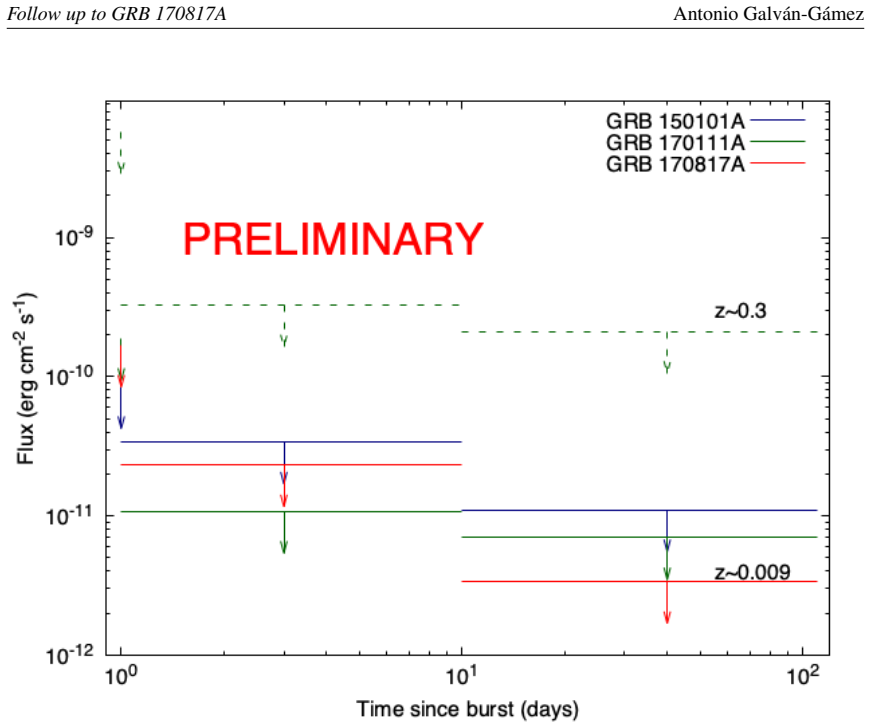
- [Section 4 and Figure 2] The discussion of the derived upper limits for GRB 150101B, GRB 170111A/B, and GRB 170817A compares limits across bursts with different redshifts and exposures, but no flux values, confidence levels, or spectral assumptions for these additional bursts are given. The statement that 'the best flux upper limit is obtained for GRB 170817A because of their closeness and medium low exposure' is not quantifiable, and the claimed behavior of limits versus time window cannot be checked. Adding a table with the numerical upper limits for the three bursts in the three time bins of Figure 2 would make the extension to the von Kienlin sample a substantive result rather than an illustration.
minor comments (6)
- [Abstract] The phrase 'aboard on the Fermi satellite' is ungrammatical; it should be 'aboard the Fermi satellite'.
- [Section 1] The date of the GRB trigger is inconsistent between Section 1/2 ('2017 September 17') and the later '2017 August 17' for the HAWC observation start. Please unify the dates, keeping GW170817's actual date of 2017 August 17.
- [Section 3] The typo 'GRB 1701817A' should be corrected to 'GRB 170817A'.
- [Table 1 and Section 4] The burst name is given as GRB 170111B in Table 1 but as GRB 170111A in Section 4; please make this consistent.
- [Figure 1] The figure is labeled 'PRELIMINARY' and the caption says the solid line is the SSC prediction at 40 TeV, but the y-axis label is 'Flux Density (µJy)' and the HAWC upper limit curve has a 'x10^5' scaling that is not explained in the caption. A clear caption with the energy band and the meaning of the scaling is needed.
- [Section 4] The sentence 'The decreasing behavior of the flux upper limits as a function of time is a clear consequence of the increasing time window' should clarify that this is true for a fixed signal model only when the assumed flux is constant; otherwise it can be misleading.
Circularity Check
No circularity found: the HAWC upper limits are computed directly from event counts via a standard Feldman-Cousins procedure, and the SSC model comparison is an explicitly non-constraining, post-hoc check.
full rationale
The paper's central result is the HAWC upper limits on TeV emission from GRB 170817A, derived from the observed event counts in the HAWC data. Section 3 states that background fluctuations are Poissonian and that upper limits are obtained 'using a Feldman-Cousins confidence interval approach and considering the extragalactic background light (EBL) attenuation [26],' with an assumed spectral index of -2.5. These are standard, externally specified statistical inputs, and none of them is defined in terms of the SSC prediction or of the upper limits themselves. The SSC model enters only after the fact: 'We have estimated a theoretical prediction of SSC emission from the observed X-ray emission. The upper limits are not constraining as observed in Figure 1.' Because the authors explicitly report that the limits do not constrain the SSC model, the model comparison cannot be serving as a disguised input to the limit calculation. The sample of similar sGRBs is taken from von Kienlin et al. [22], an external catalog, and the HAWC analysis method is cited to the collaboration's standard analysis paper [23]; these citations provide independent procedural support. The abstract's phrase 'no counts were observed' is ambiguous about whether it means zero events after cuts or no significant excess, but ambiguity about the event-count reporting is a clarity issue, not circularity. No equation or fitted parameter in the paper is equivalent by construction to the reported upper limits, so there is no circular step.
Assumptions & free parameters
free parameters (2)
- assumed photon spectral index =
-2.5
- assumed redshift for sGRBs with unknown distance =
0.009 and 0.3
assumptions (3)
- domain assumption The HAWC effective area and background maps described in [23] are correct for this analysis.
- domain assumption The Poisson background and normal significance approximation from [25] holds over all time windows.
- domain assumption The EBL attenuation model of Franceschini et al. 2008 [26] correctly describes photon-photon absorption.
Cite this review
Pith. "Pith review of Search for very-high-energy emission with HAWC from GW170817 event." pith.science (2026). https://pith.science/paper/RPM7BLUG
@misc{pith2026190810031,
  author       = {Pith},
  title        = {Pith review of: Search for very-high-energy emission with HAWC from GW170817 event},
  year         = {2026},
  howpublished = {\url{https://pith.science/paper/RPM7BLUG}},
  note         = {Machine review of arXiv:1908.10031}
}
abstract
The detection of the gravitational wave GW170817 defined a breakthrough in multi-messenger astronomy. For the first time, a gravitational wave transient detected by the Laser Interferometer Gravitational-Wave Observatory (LIGO) and Virgo interferometer was associated with a faint electromagnetic gamma-ray counterpart reported by the Gamma-ray Burst Monitor (GBM) aboard on the Fermi satellite. GRB 170817A was followed up by an enormous observational campaign covering a large fraction of the electromagnetic spectrum. In this work, we use the data from High Altitude Water Cherenkov (HAWC) gamma-ray observatory to search for very-high-energy (VHE) TeV photons in coincidence with the X-ray emission from GRB 170817A. Since no counts were observed up to $\sim$120 days after the trigger time, we derive and report the corresponding upper limits in the energy range from 1 to 100 TeV. In addition, we extend the analysis to GRBs with similar features proposed by A. von Kienlin.
Figures

Reference graph
Works this paper leans on
-
[1]
R. Clasey Essick, LIGO/Virgo G298048: Fermi GBM trigger 524666471/170817529: LIGO/Virgo Identification of a possible gravitational-wave counterpart, GRB Coordinates Network, Circular Service, No. 21505, (2017) 21505 (2017)
work page 2017
-
[2]
V . Connaughton, LIGO/Virgo G298048: Fermi GBM trigger 170817.529 and LIGO single IFO trigger, GRB Coordinates Network, Circular Service, No. 21506, (2017) 21506 (2017)
work page 2017
-
[3]
B. P. Abbott, R. Abbott, T. D. Abbott, F. Acernese, K. Ackley, C. Adams et al., Multi-messenger Observations of a Binary Neutron Star Merger, ApJ 848 (2017) L12 [1710.05833]. 3 Follow up to GRB 170817A Antonio Galván-Gámez 10-4 10-3 10-2 10-1 100 101 102 103 101 102 3 GHz (x 10) 6 GHz Optical (x 200) 1 keV (x 2500) Theoretical SSC @ 1 TeV (x 10 9 ) HAWC U...
arXiv 2017
-
[4]
A. von Kienlin, C. Meegan and A. Goldstein, GRB 170817A: Fermi GBM detection., GRB Coordinates Network, Circular Service, No. 21520, #1 (2017) 21520 (2017)
work page 2017
-
[5]
Rossi, GW170817/GRB170817A: LBT optical detection., GRB Coordinates Network, Circular Service, No
A. Rossi, GW170817/GRB170817A: LBT optical detection., GRB Coordinates Network, Circular Service, No. 22763, (2017) 22763 (2017)
work page 2017
- [6]
-
[7]
R. Margutti, E. Berger, W. Fong, C. Guidorzi, K. D. Alexander, B. D. Metzger et al., The 4 Follow up to GRB 170817A Antonio Galván-Gámez Figure 2: Upper limits for the GRB 150101B, GRB 170111B, GRB 170817A derived by HAWC into 3 temporal bins. Electromagnetic Counterpart of the Binary Neutron Star Merger LIGO/Virgo GW170817. V . Rising X-Ray Emission from...
arXiv 2017
-
[8]
G. Hallinan, A. Corsi, K. P. Mooley, K. Hotokezaka, E. Nakar, M. M. Kasliwal et al., A radio counterpart to a neutron star merger, Science 358 (2017) 1579 [1710.05435]
arXiv 2017
Show all 26 references
-
[9]
K. P. Mooley, E. Nakar, K. Hotokezaka, G. Hallinan, A. Corsi, D. A. Frail et al., A mildly relativistic wide-angle outflow in the neutron star merger GW170817, ArXiv e-prints (2017) [ 1711.11573]
2017 arXiv
-
[10]
Lazzati, R
D. Lazzati, R. Perna, B. J. Morsony, D. López-Cámara, M. Cantiello, R. Ciolfi et al., Late time afterglow observations reveal a collimated relativistic jet in the ejecta of the binary neutron star merger GW170817, ArXiv e-prints (2017) [ 1712.03237]
2017 arXiv
-
[11]
Fraija, A
N. Fraija, A. C. C. d. E. S. Pedreira and P. Veres, Light Curves of a Shock-breakout Material and a Relativistic Off-axis Jet from a Binary Neutron Star System, ApJ 871 (2019) 200
2019
-
[12]
Fraija, F
N. Fraija, F. De Colle, P. Veres, S. Dichiara, R. Barniol Duran, A. Galvan-Gamez et al., The Short GRB 170817A: Modeling the Off-axis Emission and Implications on the Ejecta Magnetization, ApJ 871 (2019) 123
2019
-
[13]
Fraija, F
N. Fraija, F. De Colle, P. Veres, S. Dichiara, R. Barniol Duran, A. C. C. d. E. S. Pedreira et al., Description of atypical bursts seen slightly off-axis, arXiv e-prints (2019) arXiv:1906.00502 [1906.00502]. 5 Follow up to GRB 170817A Antonio Galván-Gámez
2019 arXiv
-
[14]
Fraija, D
N. Fraija, D. Lopez-Camara, A. C. C. d. E. S. Pedreira, B. Betancourt Kamenetskaia, P. Veres and S. Dichiara, Signatures from a Cocoon and an off-axis material ejected in a merger of compact objects: An analytical approach, arXiv e-prints (2019) arXiv:1904.07732 [1904.07732]
2019 arXiv
-
[15]
Fraija, S
N. Fraija, S. Dichiara, A. C. C. d. E. S. Pedreira, A. Galvan-Gamez, R. L. Becerra, A. Montalvo et al., Modeling observations of GRB 180720B: From radio to GeV gamma-rays, arXiv e-prints (2019) arXiv:1905.13572 [1905.13572]
2019 arXiv
-
[16]
Fraija, R
N. Fraija, R. Barniol Duran, S. Dichiara and P. Beniamini, Synchrotron self-Compton as a likely mechanism of photons beyond the synchrotron limit in GRB 190114C, arXiv e-prints (2019) arXiv:1907.06675 [1907.06675]
2019 arXiv
-
[17]
Fraija, GRB 110731A: Early Afterglow in Stellar Wind Powered By a Magnetized Outflow, ApJ 804 (2015) 105 [1503.07449]
N. Fraija, GRB 110731A: Early Afterglow in Stellar Wind Powered By a Magnetized Outflow, ApJ 804 (2015) 105 [1503.07449]
2015 arXiv
-
[18]
Fraija, W
N. Fraija, W. Lee and P. Veres, Modeling the Early Multiwavelength Emission in GRB130427A, ApJ 818 (2016) 190 [1601.01264]
2016 arXiv
-
[19]
Fraija, P
N. Fraija, P. Veres, B. B. Zhang, R. Barniol Duran, R. L. Becerra, B. Zhang et al., Theoretical Description of GRB 160625B with Wind-to-ISM Transition and Implications for a Magnetized Outflow, ApJ 848 (2017) 15 [1705.09311]
2017 arXiv
-
[20]
Fraija, GeV-PeV neutrino production and oscillation in hidden jets from gamma-ray bursts, MNRAS 437 (2014) 2187 [1310.7061]
N. Fraija, GeV-PeV neutrino production and oscillation in hidden jets from gamma-ray bursts, MNRAS 437 (2014) 2187 [1310.7061]
2014 arXiv
-
[21]
Fraija, S
N. Fraija, S. Dichiara, A. C. C. d. E. S. Pedreira, A. Galvan-Gamez, R. L. Becerra, R. Barniol Duran et al., Analysis and Modeling of the Multi-wavelength Observations of the Luminous GRB 190114C, ApJ 879 (2019) L26 [1904.06976]
2019 arXiv
-
[22]
von Kienlin, P
A. von Kienlin, P. Veres, O. J. Roberts, R. Hamburg, E. Bissaldi, M. S. Briggs et al., Fermi-GBM GRBs with Characteristics Similar to GRB 170817A, ApJ 876 (2019) 89 [1901.06158]
2019 arXiv
-
[23]
A. U. Abeysekara, A. Albert, R. Alfaro, C. Alvarez, J. D. Álvarez, R. Arceo et al., Daily Monitoring of TeV Gamma-Ray Emission from Mrk 421, Mrk 501, and the Crab Nebula with HAWC, ApJ 841 (2017) 100 [1703.06968]
2017 arXiv
-
[24]
A. U. Abeysekara, A. Albert and e. a. Alfaro, The 2HWC HAWC Observatory Gamma-Ray Catalog, ApJ 843 (2017) 40 [1702.02992]
2017 arXiv
-
[25]
A. A. Abdo, B. T. Allen, R. Atkins, T. Aune, W. Benbow, D. Berley et al., Observation and Spectral Measurements of the Crab Nebula with Milagro, ApJ 750 (2012) 63 [1110.0409]
2012 arXiv
-
[26]
Franceschini, G
A. Franceschini, G. Rodighiero and M. Vaccari, Extragalactic optical-infrared background radiation, its time evolution and the cosmic photon-photon opacity, A&A 487 (2008) 837 [0805.1841]. 6
2008 arXiv
Reviewed August 14, 2026 · model on record in the stance chip above.
Discussion (0). Continue with ORCID to comment.