Error Estimation for Adaptive Mesh Refinement in Droplet Simulations
Pith reviewed 2026-05-25 08:18 UTC · model grok-4.3
The pith
A flux-based error estimator from the mixed finite element discretization enables adaptive mesh refinement that reduces computational cost in one-dimensional droplet simulations while preserving accuracy.
A machine-rendered reading of the paper's core claim, the machinery that carries it, and where it could break.
Core claim
The mixed form of the governing equation naturally provides smooth interface gradients that can be used to compute the error estimate. The computed error estimate is then used to drive the adaptive mesh refinement algorithm, reducing computational cost significantly without compromising accuracy.
What carries the argument
Flux-based error estimator computed from the smooth interface gradients supplied by the mixed Galerkin finite element discretization of the front-tracked droplet equations.
If this is right
- Mesh points concentrate only near the interface where convective effects are strongest during pinch-off.
- Total degrees of freedom drop while the computed droplet profile and curvature remain equivalent to uniform refinement.
- The error-driven adaptation automatically tracks the moving interface without manual intervention.
- The approach avoids the rapid growth of solution jumps that otherwise produce erroneous curvature in non-mixed forms.
Where Pith is reading between the lines
- The same gradient smoothness property could be tested in related moving-boundary problems with strong convection.
- Extension to two or three dimensions would require checking whether the mixed form continues to supply usable error indicators at the interface.
- Coupling the estimator with a time-step controller might further reduce cost by adapting both space and time.
Load-bearing premise
The mixed discretization produces gradients smooth enough that the flux-based error indicator correctly identifies where curvature or interface position would otherwise be inaccurate.
What would settle it
A side-by-side run of the adaptive algorithm and a uniformly refined mesh to the same tolerance that yields visibly different pinch-off timing or droplet shape.
Figures
read the original abstract
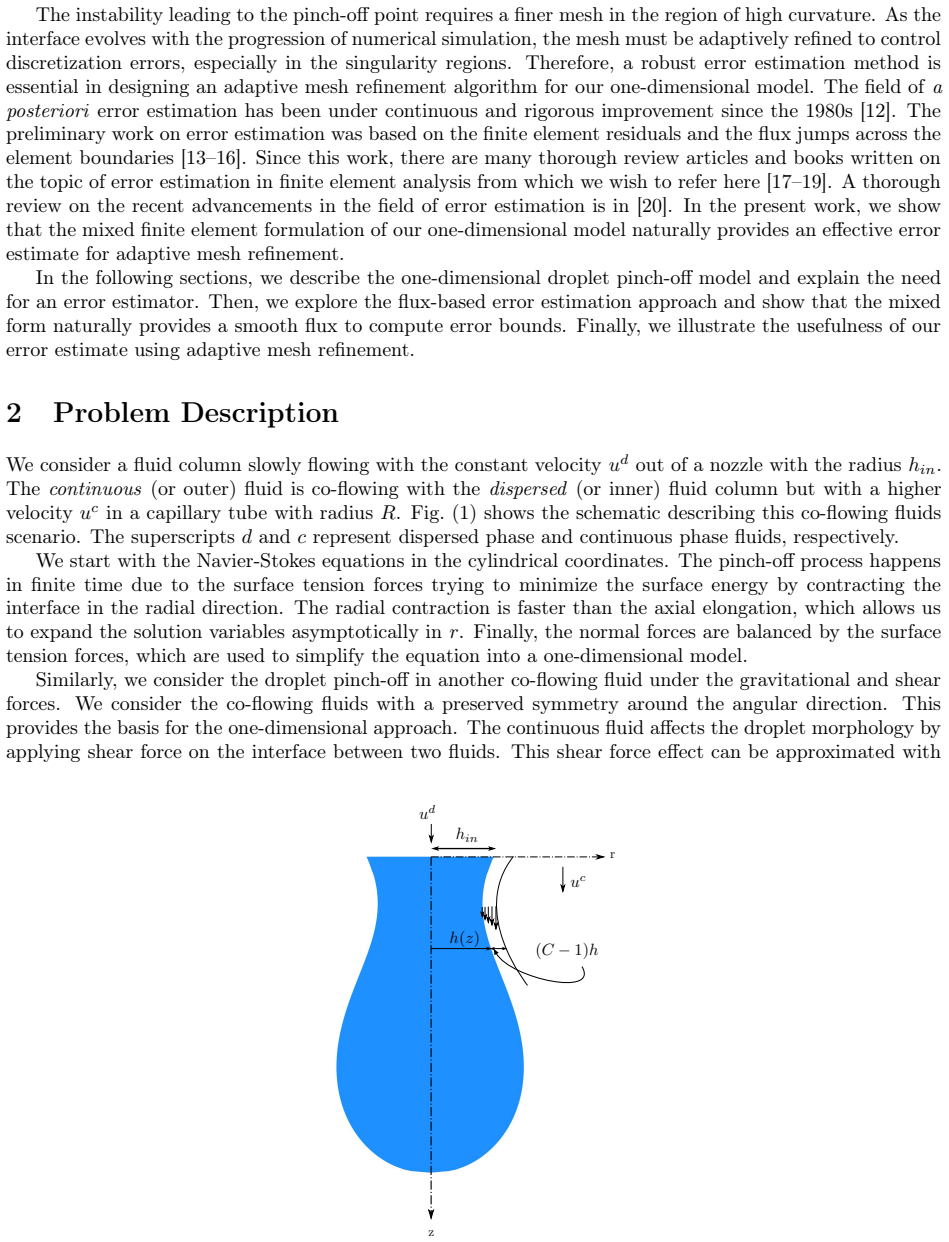
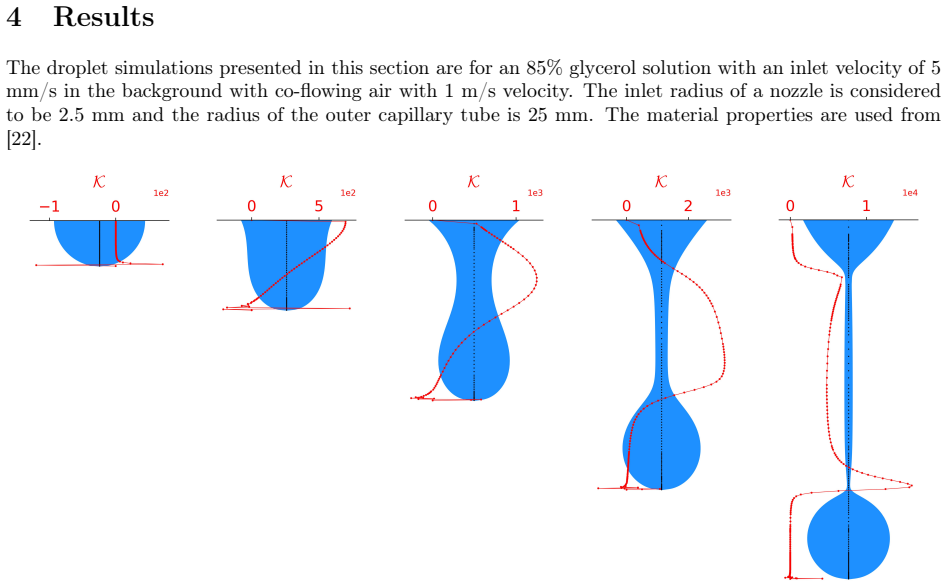
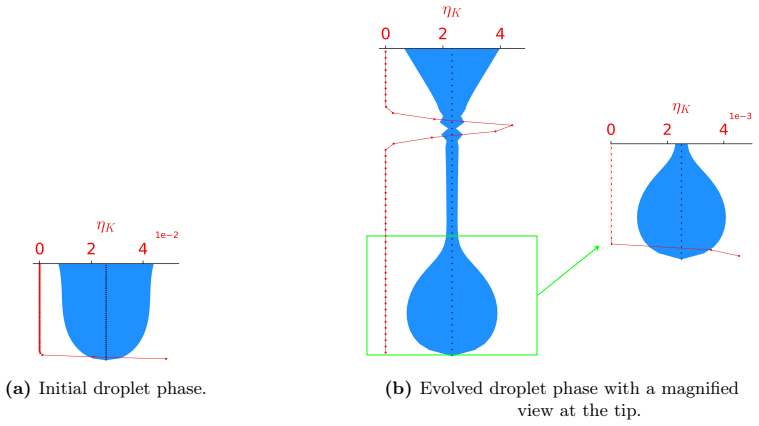
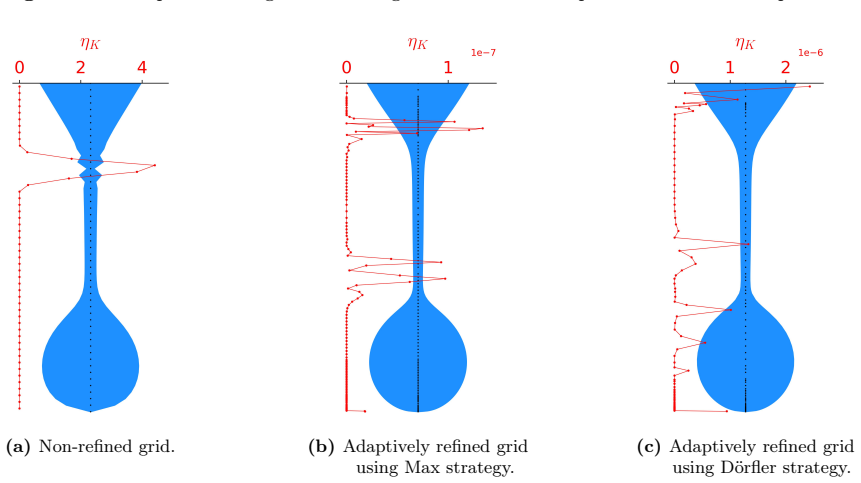
We present a one-dimensional shear-force-driven droplet formation model with a flux-based error estimator. The model is derived using asymptotic expansion and a front-tracking method to simulate the droplet interface. The model is then discretized using the Galerkin finite element method in the mixed form. However, the solution gradients exhibit large jumps across element boundaries and can grow rapidly due to the highly convective pinch-off process. This leads to an erroneous droplet interface and incorrect curvature. Therefore, the mesh must be sufficiently refined to capture the interface accurately. The mixed form of the governing equation naturally provides smooth interface gradients that can be used to compute the error estimate. The computed error estimate is then used to drive the adaptive mesh refinement algorithm. The efficacy of the error estimator is illustrated by comparing the droplet profiles obtained with adaptive refinement to those obtained with regular refinement. The adaptive mesh refinement approach reduces the computational cost significantly without compromising accuracy.
Editorial analysis
A structured set of objections, weighed in public.
Referee Report
Summary. The manuscript presents a 1D shear-force-driven droplet formation model derived via asymptotic expansion and front-tracking, discretized by mixed Galerkin FEM. It introduces a flux-based error estimator that exploits the mixed formulation's interface gradients to drive adaptive mesh refinement, and asserts that AMR yields substantial computational savings while preserving accuracy, as shown by visual comparison of droplet profiles against uniform refinement.
Significance. If the error estimator is shown to correctly identify regions of interface and curvature error (including at pinch-off), the method could offer a practical, low-overhead AMR strategy for convective free-boundary problems. The absence of quantitative error norms, timing data, or convergence rates in the supplied description, however, leaves the claimed cost-accuracy trade-off unverified and limits immediate impact.
major comments (3)
- [Abstract] Abstract: the statement that 'the mixed form of the governing equation naturally provides smooth interface gradients' is placed immediately after the observation that 'solution gradients exhibit large jumps across element boundaries and can grow rapidly' in the convective pinch-off regime. No derivation or numerical test is supplied showing how the mixed formulation removes the jumps that would otherwise invalidate the flux-based estimator; this assumption is load-bearing for the entire AMR claim.
- [Abstract] Abstract (efficacy paragraph): the central claim that 'the adaptive mesh refinement approach reduces the computational cost significantly without compromising accuracy' rests solely on 'comparing the droplet profiles' with no reported L2 or interface error norms, no timing or DOF counts, and no description of how the uniform-refinement baseline mesh density was chosen. Without these metrics the cost-accuracy assertion cannot be assessed.
- [Abstract] Abstract (error-estimator paragraph): the flux-based estimator is asserted to be driven by the mixed-form gradients, yet the same paragraph notes that gradients 'grow rapidly' and produce 'erroneous droplet interface and incorrect curvature.' No independent verification (e.g., comparison of the estimator against a known curvature error or manufactured-solution test) is described, leaving open the possibility that AMR under-refines exactly where accuracy is lost.
Simulated Author's Rebuttal
We thank the referee for the thoughtful comments on our manuscript. We address each of the major comments below and indicate the revisions we plan to make.
read point-by-point responses
-
Referee: [Abstract] Abstract: the statement that 'the mixed form of the governing equation naturally provides smooth interface gradients' is placed immediately after the observation that 'solution gradients exhibit large jumps across element boundaries and can grow rapidly' in the convective pinch-off regime. No derivation or numerical test is supplied showing how the mixed formulation removes the jumps that would otherwise invalidate the flux-based estimator; this assumption is load-bearing for the entire AMR claim.
Authors: The abstract's phrasing does juxtapose these ideas closely, which may cause confusion. In the mixed finite element formulation, the flux is introduced as an independent variable approximated in a continuous polynomial space, which by construction yields smooth gradients at the interface. This property is derived in the methods section of the manuscript. We will revise the abstract to more clearly distinguish the challenges of the convective regime from the advantages of the mixed discretization. revision: yes
-
Referee: [Abstract] Abstract (efficacy paragraph): the central claim that 'the adaptive mesh refinement approach reduces the computational cost significantly without compromising accuracy' rests solely on 'comparing the droplet profiles' with no reported L2 or interface error norms, no timing or DOF counts, and no description of how the uniform-refinement baseline mesh density was chosen. Without these metrics the cost-accuracy assertion cannot be assessed.
Authors: We acknowledge that quantitative metrics would provide stronger support for the efficacy claim. The manuscript currently illustrates the approach through visual comparison of droplet profiles. In the revised version, we will include L2 error norms, degrees of freedom counts for adaptive versus uniform meshes, and timing data to better quantify the computational savings. We will also clarify the choice of the uniform refinement baseline. revision: yes
-
Referee: [Abstract] Abstract (error-estimator paragraph): the flux-based estimator is asserted to be driven by the mixed-form gradients, yet the same paragraph notes that gradients 'grow rapidly' and produce 'erroneous droplet interface and incorrect curvature.' No independent verification (e.g., comparison of the estimator against a known curvature error or manufactured-solution test) is described, leaving open the possibility that AMR under-refines exactly where accuracy is lost.
Authors: The rapid growth of gradients refers to the behavior in the standard (non-mixed) formulation, which the mixed approach mitigates. The estimator uses the smooth fluxes from the mixed form to identify regions needing refinement. While a manufactured solution test is not included, the numerical results show that the adaptive meshes produce interface shapes consistent with uniform refinement, including near pinch-off. We will update the abstract to emphasize this and indicate that additional verification tests could be explored in future work. revision: partial
Circularity Check
No significant circularity in derivation chain
full rationale
The paper derives the flux-based error estimator directly from the mixed Galerkin discretization and validates AMR performance via explicit numerical comparison of droplet profiles against an independent uniform-refinement run. No self-definitional reductions, fitted inputs renamed as predictions, or load-bearing self-citation chains appear in the provided text. The smoothness claim for interface gradients is asserted as a property of the mixed form rather than defined in terms of the estimator output itself. The cost-accuracy claim therefore rests on external benchmark comparison and remains self-contained.
Axiom & Free-Parameter Ledger
axioms (1)
- domain assumption The mixed form of the governing equation naturally provides smooth interface gradients that can be used to compute the error estimate.
Reference graph
Works this paper leans on
-
[1]
Laplace, P. S. Traité de mécanique céleste, vol. 4.Supplements au Livre X(1805)
-
[2]
Young, T. III. An essay on the cohesion of fluids. Philosophical transactions of the royal society of London, 65–87 (1805)
-
[3]
Eggers, J. & Villermaux, E. Physics of liquid jets.Reports on progress in physics71, 036601 (2008)
work page 2008
-
[4]
Eggers, J. & Dupont, T. F. Drop formation in a one-dimensional approximation of the Navier–Stokes equation. Journal of fluid mechanics262, 205–221 (1994)
work page 1994
-
[5]
Ambravaneswaran, B., Wilkes, E. D. & Basaran, O. A. Drop formation from a capillary tube: Com- parison of one-dimensional and two-dimensional analyses and occurrence of satellite drops.Physics of Fluids 14, 2606–2621 (2002)
work page 2002
-
[6]
Inoue, C. & Maeda, I. On the droplet entrainment from gas-sheared liquid film.Physics of Fluids 33, 011705 (2021)
work page 2021
-
[7]
Berna, C., Escrivá, A., Muñoz-Cobo, J. & Herranz, L. Review of droplet entrainment in annular flow: Characterization of the entrained droplets.Progress in Nuclear Energy79, 64–86 (2015)
work page 2015
-
[8]
Cramer, C., Fischer, P. & Windhab, E. J. Drop formation in a co-flowing ambient fluid.Chemical Engineering Science 59, 3045–3058 (2004)
work page 2004
- [9]
-
[10]
Dewandre, A., Rivero-Rodriguez, J., Vitry, Y., Sobac, B. & Scheid, B. Microfluidic droplet generation based on non-embedded co-flow-focusing using 3D printed nozzle.Scientific reports 10, 1–17 (2020)
work page 2020
-
[11]
Nathawani, D. & Knepley, M. A one-dimensional mathematical model for shear-induced droplet for- mation in co-flowing fluids.Theoretical and Computational Fluid Dynamics,1–17 (2024)
work page 2024
-
[12]
Grätsch, T. & Bathe, K.-J. A posteriori error estimation techniques in practical finite element analysis. Computers & structures83, 235–265 (2005)
work page 2005
-
[13]
Babuška, I. & Rheinboldt, W. C. A-posteriori error estimates for the finite element method.Interna- tional journal for numerical methods in engineering12, 1597–1615 (1978). 7
work page 1978
-
[14]
Babuška, I. & Rheinboldt, W. C. Analysis of optimal finite-element meshes inR1. Mathematics of computation 33, 435–463 (1979)
work page 1979
-
[15]
Babuška, I. & Miller, A. A feedback finite element method with a posteriori error estimation: Part I. The finite element method and some basic properties of the a posteriori error estimator.Computer Methods in Applied Mechanics and Engineering61, 1–40 (1987)
work page 1987
-
[16]
W., De SR Gago, J., Zienkiewicz, O
Kelly, D. W., De SR Gago, J., Zienkiewicz, O. C. & Babuska, I. A posteriori error analysis and adaptive processes in the finite element method: Part I—error analysis. International journal for numerical methods in engineering19, 1593–1619 (1983)
work page 1983
- [17]
-
[18]
Becker, R. & Rannacher, R. An optimal control approach to a posteriori error estimation in finite element methods.Acta numerica 10, 1–102 (2001)
work page 2001
-
[19]
Bangerth, W. & Rannacher, R. Adaptive finite element methods for differential equations(Springer Science & Business Media, 2003)
work page 2003
-
[20]
Chamoin, L. & Legoll, F. An introductory review on a posteriori error estimation in finite element computations. SIAM Review 65, 963–1028 (2023)
work page 2023
-
[21]
Nathawani, D. K. Droplet Formation: One-Dimensional Mathematical Model and ComputationsPhD thesis (State University of New York at Buffalo, 2023)
work page 2023
-
[22]
Nathawani, D. K. & Knepley, M. G. Droplet formation simulation using mixed finite elements.Physics of Fluids 34, 064105 (2022)
work page 2022
-
[23]
Balay, S. et al. PETSc/TAO Users Manualtech. rep. ANL-21/39 - Revision 3.22 (Argonne National Laboratory, 2024)
work page 2024
-
[24]
Balay, S. et al. PETSc Web pagehttps://petsc.org/. 2024. https://petsc.org/
work page 2024
-
[25]
Dörfler, W. A convergent adaptive algorithm for Poisson’s equation.SIAM Journal on Numerical Anal- ysis 33, 1106–1124 (1996)
work page 1996
-
[26]
Georgalis, G., Nathawani, D., Knepley, M. & Patra, A.Uncertainty Quantification of Shear-induced Paraffin Droplet Pinch-off in Hybrid Rocket Motorsin AIAA SCITECH 2024 Forum(2024), 1021. 8
work page 2024
discussion (0)
Sign in with ORCID, Apple, or X to comment. Anyone can read and Pith papers without signing in.