REVIEW 3 minor 3 cited by
Fundamental limits in photonics and electromagnetics: a tutorial
T0 review · 0 major / 3 minor · reviewed 2026-06-30 · grok-4.3
Pith's one-line read A tutorial reviews fundamental physical bounds on light-matter interactions across scales in photonics and electromagnetics.
desk verdict This is a tutorial review that organizes existing bounds on light-matter interactions but introduces no new results or frameworks. read the letter →
The pith
A machine-rendered reading of the paper's core claim, the machinery that carries it, and where it could break.
The reading
What carries the argument
Hierarchical scales of limits, from optical material responses to wave propagation, scattering, and optical phenomena and functions.
What would settle it
Discovery of a major physical bound or constraint in photonics or electromagnetics that is omitted from the tutorial or presented with clear interpretive error.
Extended reading notes
Core claim
The tutorial synthesizes existing physical bounds and constraints on light-matter interactions, structured hierarchically from material responses to wave propagation, scattering, and related optical functions, while highlighting unresolved questions to support progress on a universal framework.
Load-bearing premise
The tutorial's selection and synthesis of prior literature accurately and comprehensively represents the key limits without significant omissions or interpretive bias.
Signed reviews
Editorial analysis
A structured set of objections, weighed in public.
Referee Report
Summary. The manuscript is a tutorial review that first outlines fundamental principles constraining light-matter interactions in photonics and electromagnetics, then surveys physical bounds and limits across hierarchical scales (optical material responses, wave propagation, scattering, and related functions), and concludes by advocating a unified treatment while identifying open questions to accelerate reader entry into the research frontier.
Significance. If the synthesis accurately and comprehensively represents the cited literature without interpretive bias, the tutorial would provide a useful entry point for newcomers by consolidating disparate bounds into one narrative and flagging unresolved issues; the absence of new derivations or predictions means its value rests entirely on the quality of the literature selection and organization.
minor comments (3)
- The abstract states the goal of a 'more unified treatment,' but the manuscript should explicitly define what unification means (e.g., common mathematical framework, shared assumptions across scales) in an early section to avoid the impression of a simple juxtaposition of results.
- Several cited limits (e.g., those derived from causality or passivity) are referenced without a brief recap of their key assumptions or the precise statement of the bound; adding one-sentence reminders would improve accessibility for readers new to the sub-area.
- The discussion of open questions at the end would benefit from a short table or enumerated list that cross-references each question to the relevant earlier section, making the connection between reviewed results and frontiers more concrete.
Simulated Author's Rebuttal
We thank the referee for their positive summary of the manuscript and for recommending minor revision. The report correctly identifies the tutorial's scope and intent to consolidate bounds across scales while highlighting open questions. No specific major comments were raised.
Circularity Check
No circularity: tutorial synthesis of external literature
full rationale
The paper is explicitly a tutorial review whose purpose is to synthesize and unify existing results on physical bounds in photonics and electromagnetics drawn from prior literature. No original derivations, quantitative predictions, fitted parameters, or new technical claims are advanced that could reduce by construction to self-citations or inputs. The abstract and structure confirm the work reviews fundamental principles at multiple scales and highlights open questions without introducing load-bearing steps that equate to the paper's own content. As a result the derivation chain is absent and the content remains self-contained against external benchmarks.
Assumptions & free parameters
Cite this review
Pith. "Pith review of Fundamental limits in photonics and electromagnetics: a tutorial." pith.science (2026). https://pith.science/paper/RQBQOHZX
@misc{pith2026260524738,
  author       = {Pith},
  title        = {Pith review of: Fundamental limits in photonics and electromagnetics: a tutorial},
  year         = {2026},
  howpublished = {\url{https://pith.science/paper/RQBQOHZX}},
  note         = {Machine review of arXiv:2605.24738}
}
read the original abstract
Theoretical limits and physical bounds across many areas of science, mathematics, and technology -- including Shannon's information-capacity limits, Bennett and Landauer's thermodynamic limits on computation, and G\"odel's incompleteness theorem in formal logic -- serve as defining pillars of their fields. In photonics and electromagnetism, numerous physical bounds and constraints have likewise been uncovered over the past several decades. In this Tutorial, we first review the fundamental principles that constrain light-matter interactions, and then discuss limits at different hierarchical scales, from optical material responses to wave propagation, scattering, and related optical phenomena and functions, relevant to a wide range of applications. By providing a more unified treatment of these results and highlighting the many open questions that remain, our goal is to help readers rapidly get up to speed with the frontier of this research area and contribute to advancing the broader vision of a universal framework for fundamental limits of light interactions with matter.
Figures


Figures from the paper (45 more)










Forward citations
Cited by 3 Pith papers
-
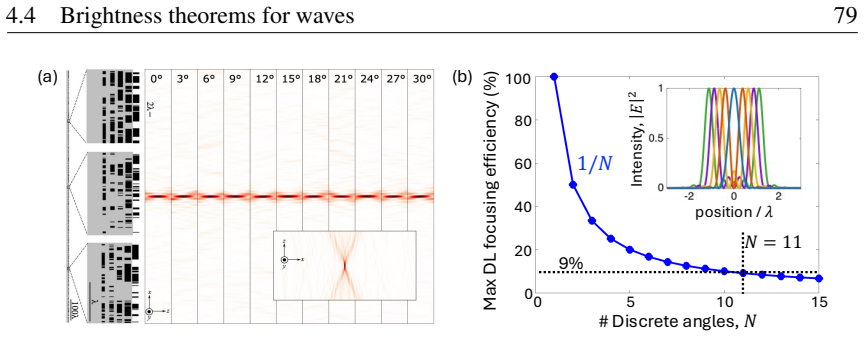
Maximum brightness theorem for waves
In any passive linear wave system, each ranked separable brightness component of the output is bounded above by the corresponding component of the input.
-
Causality Sum Rules in Conventional Scattering Matrices
A phase correction that removes the reference-domain time advance turns the conventional scattering matrix into a Schur function, yielding projected and determinant causality sum rules that generalize known bounds to ...
-
What should a linear optical frontend compute? Assessing the role of meta-optics, nonlocality, and coherence in hybrid inference systems
A linear optical frontend improves classification at a small sensor bottleneck through coherent, nonlocal field mixing, producing quadratic features that can outperform a trained linear preprocessor.
Reference graph
Works this paper leans on
-
[1]
Beiträge zur theorie des mikroskops und der mikroskopischen wahrnehmung
1E. Abbe, “Beiträge zur theorie des mikroskops und der mikroskopischen wahrnehmung”, Archiv für mikroskopische Anatomie9, 413–468 (1873) (cit. on p. 3). 2E. Yablonovitch, “Statistical ray optics”, Journal of the Optical Society of America72, 899–907 (1982) (cit. on p. 3). 3H. M. Nussenzveig,Causality and dispersion relations(Academic Press, New York, NY,
work page 1982
-
[2]
Conservation-law-based global bounds to quantum optimal control
(cit. on pp. 5, 9, 16, 18, 88, 93, 122, 123, 129). 4H. Zhang, Z. Kuang, S. Puri, and O. D. Miller, “Conservation-law-based global bounds to quantum optimal control”, Physical Review Letters127, 110506 (2021) (cit. on pp. 5, 97). 5W. Shockley and H. J. Queisser, “Detailed balance limit of efficiency of p-n junction solar cells”, J. Appl. Phys.32, 510–519 (...
work page 2021
-
[3]
A perfectly matched layer for the absorption of electromagnetic waves
(cit. on p. 5). 11J.-P. Berenger, “A perfectly matched layer for the absorption of electromagnetic waves”, en, J. Comput. Phys.114, 185–200 (1994) (cit. on p. 7). 12Z. S. Sacks, D. M. Kingsland, R. Lee, and J.-F. Lee, “A perfectly matched anisotropic absorber for use as an absorbing boundary condition”, IEEE Trans. Antennas Propag. 43, 1460–1463 (1995) (c...
work page 1994
-
[4]
Perfect single-sided radiation and absorption without mirrors
(cit. on p. 9). Bibliography 142 18H. Zhou, B. Zhen, C. W. Hsu, O. D. Miller, S. G. Johnson, J. D. Joannopoulos, and M. Soljaˇci´c, “Perfect single-sided radiation and absorption without mirrors”, Optica3, 1079–1086 (2016) (cit. on p. 10). 19M. Yildirim, N. U. Dinç, I. Oguz, D. Psaltis, and C. Moser, “Nonlinear processing with linear optics”, Nat. Photoni...
work page 2016
-
[5]
Time-varying media, dispersion, and the princi- ple of causality
(cit. on pp. 10, 11, 13, 83). 22T. T. Koutserimpas and F. Monticone, “Time-varying media, dispersion, and the princi- ple of causality”, Optical Materials Express14, 1222–1236 (2024) (cit. on pp. 12, 28, 41). 23J. Pendry, “Photon number conservation in time dependent systems”, Optics Express 31, 452–458 (2022) (cit. on p. 12). 24Z. Hayran and F. Monticone...
-
[6]
Complex-frequency excitations in photonics and wave physics
(cit. on pp. 14, 24, 25, 29, 30, 50, 86, 129). 36S. Kim, A. Krasnok, and A. Alù, “Complex-frequency excitations in photonics and wave physics”, Science387, eado4128 (2025) (cit. on p. 14). 37H. A. Haus,Waves and fields in optoelectronics(Prentice-Hall,
work page 2025
-
[7]
Electro- magnetic nonreciprocity
(cit. on pp. 14, 15, 118, 133). 39C. Caloz, A. Alu, S. Tretyakov, D. Sounas, K. Achouri, and Z.-L. Deck-Léger, “Electro- magnetic nonreciprocity”, Physical Review Applied10, 047001 (2018) (cit. on pp. 14, 15). 40D. Jalas, A. Petrov, M. Eich, W. Freude, S. Fan, Z. Yu, R. Baets, M. Popovi´c, A. Melloni, J. D. Joannopoulos, et al., “What is—and what is not—a...
-
[8]
Broadband and giant nonreciprocity at the subwavelength scale in magnetoplasmonic materials
(cit. on pp. 17, 19, 30, 37, 40, 89, 90, 105, 121). 46M. I. Abdelrahman and F. Monticone, “Broadband and giant nonreciprocity at the subwavelength scale in magnetoplasmonic materials”, Physical Review B102, 155420 (2020) (cit. on p. 17). 47R. M. Foster, “A reactance theorem”, Bell System technical journal3, 259–267 (1924) (cit. on p. 18). 48P. Triverio, S...
work page 2020
Show all 37 references
-
[9]
Causality and passivity: from electromagnetism and network theory to metamaterials
(cit. on p. 18). 50A. Srivastava, “Causality and passivity: from electromagnetism and network theory to metamaterials”, Mechanics of Materials154, 103710 (2021) (cit. on p. 18). Bibliography 144 51D. Youla, L. Castriota, and H. Carlin, “Bounded real scattering matrices and the...
2021
-
[10]
Physical limitations on broadband invisibility based on fast-light media
(cit. on pp. 18, 19, 28, 30, 32, 40, 41, 120, 126). 55M. I. Abdelrahman, Z. Hayran, A. Chen, and F. Monticone, “Physical limitations on broadband invisibility based on fast-light media”, Nature Communications12, 3041 (2021) (cit. on p. 19). 56G. Raisbeck, “A definition of pass...
2021
-
[11]
Dissipative dynamical systems part ii: linear systems with quadratic supply rates
(cit. on pp. 19, 20). 59J. C. Willems, “Dissipative dynamical systems part ii: linear systems with quadratic supply rates”, Archive for rational mechanics and analysis45, 352–393 (1972) (cit. on p. 19). 60S. Boyd and L. O. Chua, “On the passivity criterion for lti n-ports”, In...
1972
-
[12]
Nonlocal response in plasmonic nanostructures
(cit. on p. 28). 80M. Wubs and N. A. Mortensen, “Nonlocal response in plasmonic nanostructures”, in Quantum plasmonics(Springer, 2016), pp. 279–302 (cit. on p. 28). 81R. W. Boyd,Nonlinear optics(Academic Press,
2016
-
[13]
Energy of electromagnetic waves in the presence of absorption and dispersion
(cit. on pp. 29, 102, 103). 83J. Askne and B. Lind, “Energy of electromagnetic waves in the presence of absorption and dispersion”, Physical Review A2, 2335 (1970) (cit. on pp. 30, 111). 84S. A. Ramakrishna and T. M. Grzegorczyk,Physics and applications of negative refractive ...
1970
-
[14]
Linear and nonlinear wave propagation in negative refraction metamaterials
(cit. on pp. 30, 111). Bibliography 146 85V . Agranovich, Y . Shen, R. H. Baughman, and A. A. Zakhidov, “Linear and nonlinear wave propagation in negative refraction metamaterials”, Physical Review B69, 165112 (2004) (cit. on p. 30). 86M. G. Silveirinha, “Metamaterial homogeni...
2004
-
[15]
Fundamental limits to the refractive index of transparent optical materials
(cit. on pp. 31, 48, 104, 112, 113). 88H. Shim, F. Monticone, and O. D. Miller, “Fundamental limits to the refractive index of transparent optical materials”, Advanced Materials33, 2103946 (2021) (cit. on pp. 31, 33–35). 89L. Zhang, F. Monticone, and O. D. Miller, “All electro...
2021
-
[16]
Maximum refractive index of an atomic medium
(cit. on p. 32). 91C. Caloz,Physical interpretation of a simple sum rule, Private communication, 2019 (cit. on p. 32). 92F. Andreoli, M. J. Gullans, A. A. High, A. Browaeys, and D. E. Chang, “Maximum refractive index of an atomic medium”, Physical Review X11, 011026 (2021) (ci...
2019
-
[17]
The uniqueness theorem for nonlocal hydrodynamic media
(cit. on p. 37). Bibliography 147 101C. Mystilidis, G. Fikioris, C. Tserkezis, G. A. Vandenbosch, and X. Zheng, “The uniqueness theorem for nonlocal hydrodynamic media”, IEEE Transactions on Antennas and Propagation (2024) (cit. on p. 37). 102A. Ishimaru,Electromagnetic wave p...
2024
-
[18]
Nonreciprocal cavities and the time–bandwidth limit
(cit. on p. 38). 103S. A. Mann, D. L. Sounas, and A. Alu, “Nonreciprocal cavities and the time–bandwidth limit”, Optica6, 104–110 (2019) (cit. on pp. 38, 135). 104D. E. Fernandes and M. G. Silveirinha, “Topological origin of electromagnetic energy sinks”, Physical Review Appli...
2019
-
[19]
How to deal with the loss in plasmonics and metamaterials
(cit. on p. 39). 107J. B. Khurgin, “How to deal with the loss in plasmonics and metamaterials”, Nature nanotechnology10, 2–6 (2015) (cit. on pp. 39, 108, 109). 108S. A. Hassani Gangaraj and F. Monticone, “Physical violations of the bulk-edge corre- spondence in topological ele...
2015
-
[20]
Physical limits on electronic nonlinear molecular susceptibilities
(cit. on p. 41). Bibliography 148 118M. G. Kuzyk, “Physical limits on electronic nonlinear molecular susceptibilities”, Physical review letters85, 1218 (2000) (cit. on pp. 41, 42). 119M. G. Kuzyk, “Erratum: physical limits on electronic nonlinear molecular suscepti- bilities [...
2000
-
[21]
Radiating and nonradiating classical current distributions and the fields they generate
(cit. on p. 50). 137A. J. Devaney and E. Wolf, “Radiating and nonradiating classical current distributions and the fields they generate”, Phys. Rev. D8, 1044–1047 (1973) (cit. on p. 51). 138S. W. Hell and J. Wichmann, “Breaking the diffraction resolution limit by stimulated em...
1973 doi
-
[22]
Inverse design in nanophotonics
(cit. on p. 55). 160S. Molesky, Z. Lin, A. Y . Piggott, W. Jin, J. Vuckovi´c, and A. W. Rodriguez, “Inverse design in nanophotonics”, en, Nat. Photonics12, 659–670 (2018) (cit. on p. 55). 161 ˇC. Brukner and A. Zeilinger, “Diffraction of matter waves in space and in time”, Phy...
2018
-
[23]
Reciprocity theorems for electromagnetic fields whose time-dependence is arbitrary
(cit. on pp. 59, 100). 168W. J. Welch, “Reciprocity theorems for electromagnetic fields whose time-dependence is arbitrary”, IRE Trans. Antennas Propag.8, 68–73 (1960) (cit. on p. 60). 169A. T. de Hoop, “Time-domain reciprocity theorems for electromagnetic fields in disper- si...
1960 doi
-
[24]
Communicating with waves between volumes: evaluating orthogonal spatial channels and limits on coupling strengths
(cit. on p. 64). 191D. A. Miller, “Communicating with waves between volumes: evaluating orthogonal spatial channels and limits on coupling strengths”, Applied optics39, 1681–1699 (2000) (cit. on pp. 64, 65). 192D. A. B. Miller, L. Zhu, and S. Fan, “Universal modal radiation la...
2000 doi
-
[25]
Nonimaging optics: a tutorial
(cit. on pp. 76, 78). 212R. Winston, L. Jiang, and M. Ricketts, “Nonimaging optics: a tutorial”, Adv. Opt. Photonics (2018) (cit. on p. 76). 213H. Goldstein, C. P. Poole, J. Safko, et al.,Classical mechanics, V ol. 2 (Addison-wesley Reading, MA,
2018
-
[26]
Observation of parity–time symmetry in optics
(cit. on p. 76). 214C. E. Rüter, K. G. Makris, R. El-Ganainy, D. N. Christodoulides, M. Segev, and D. Kip, “Observation of parity–time symmetry in optics”, en, Nat. Phys.6, 192–195 (2010) (cit. on p. 77). 215A. Regensburger, C. Bersch, M.-A. Miri, G. Onishchukov, D. N. Christo...
2010
-
[27]
Coherency matrix formulation for partially coherent imaging to evaluate the degree of coherence for image
(cit. on p. 78). 220K. Yamazoe, “Coherency matrix formulation for partially coherent imaging to evaluate the degree of coherence for image”, J. Opt. Soc. Am. A29, 1529 (2012) (cit. on p. 78). 221C. Okoro, H. E. Kondakci, A. F. Abouraddy, and K. C. Toussaint, “Demonstration of ...
2012
-
[28]
Topology optimization of freeform large-area metasurfaces
(cit. on p. 79). 224Z. Lin, V . Liu, R. Pestourie, and S. G. Johnson, “Topology optimization of freeform large-area metasurfaces”, Opt. Express27, 15765–15775 (2019) (cit. on p. 79). 225W. Suh, Z. Wang, and S. Fan, “Temporal coupled-mode theory and the presence of non-orthogon...
2019
-
[29]
Fundamental limits to optical response in absorptive systems
(cit. on pp. 80, 135). 227O. D. Miller, A. G. Polimeridis, M. T. H. Reid, C. W. Hsu, B. G. DeLacy, J. D. Joannopoulos, M. Soljaˇci´c, and S. G. Johnson, “Fundamental limits to optical response in absorptive systems”, Opt. Express24, 3329 (2016) (cit. on pp. 81, 84). 228Y . Yan...
2016
-
[30]
Optimal characteristics of an arbitrary receive antenna
(cit. on p. 82). 233D.-H. Kwon and D. M. Pozar, “Optimal characteristics of an arbitrary receive antenna”, IEEE Trans. Antennas Propag.57, 3720–3727 (2009) (cit. on pp. 82, 83). 234Z. Kuang, L. Zhang, and O. D. Miller, “Maximal single-frequency electromagnetic response”, Optic...
2009 doi
-
[31]
Upper bounds on focusing efficiency
(cit. on pp. 85, 140). 241M. Gustafsson, K. Schab, L. Jelinek, and M. Capek, “Upper bounds on focusing efficiency”, Optics Express30, 46490–46508 (2022) (cit. on p. 85). 242Y . Ivanenko, M. Gustafsson, and S. Nordebo, “Optical theorems and physical bounds on absorption in loss...
2022
-
[32]
On the passivity criterion for ltiN-ports
(cit. on p. 93). 280S. Boyd and L. O. Chua, “On the passivity criterion for ltiN-ports”, en, Int. J. Circuit Theory Appl.10, 323–333 (1982) (cit. on p. 93). 281A. Bernland, A. Luger, and M. Gustafsson, “Sum rules and constraints on passive systems”, en, J. Phys. A: Math. Theor...
1982 doi
-
[33]
All electromagnetic scattering bodies are matrix-valued oscillators
(cit. on p. 94). 288L. Zhang, F. Monticone, and O. Miller, “All electromagnetic scattering bodies are matrix-valued oscillators”, Nat. Commun.14, 10.1038/s41467-023-43221-2 (2023) (cit. on pp. 94, 95). 289Z. Kuang and O. D. Miller, “Computational bounds to light–matter interac...
2023 doi
-
[34]
An optimal-storage approach to semidefinite programming using approximate complementarity
(cit. on p. 97). 294L. Ding, A. Yurtsever, V . Cevher, J. A. Tropp, and M. Udell, “An optimal-storage approach to semidefinite programming using approximate complementarity”, en, SIAM J. Optim.31, 2695–2725 (2021) (cit. on p. 97). 295K. Anstreicher and H. Wolkowicz, “On lagran...
2021
-
[35]
Embedded photonic eigenvalues in 3d nanostructures
(cit. on pp. 104, 108). 304F. Monticone and A. Alu, “Embedded photonic eigenvalues in 3d nanostructures”, Physical Review Letters112, 213903 (2014) (cit. on pp. 104, 106, 107). 305D. Jones, “Scattering by inhomogeneous dielectric particles”, The Quarterly Journal of Mechanics ...
2014
-
[36]
Theoretical limitations on the broadband matching of arbitrary impedances
(cit. on p. 127). 366R. M. Fano, “Theoretical limitations on the broadband matching of arbitrary impedances”, Journal of the Franklin Institute249, 57–83 (1950) (cit. on pp. 127, 128). 367H. Carlin and P. Civalleri, “Wideband circuit design, ser”, Electronic Engineering System...
1950
-
[37]
Compact all-pass filters in photonic crystals as the building block for high-capacity optical delay lines
(cit. on pp. 134, 137). 389Z. Wang and S. Fan, “Compact all-pass filters in photonic crystals as the building block for high-capacity optical delay lines”, Physical Review E68, 066616 (2003) (cit. on p. 135). 390S. A. Hassani Gangaraj and F. Monticone, “Do truly unidirectional...
2003
Reviewed June 30, 2026 · model on record in the stance chip above.
Discussion (0). Continue with ORCID to comment.