REVIEW 3 major objections 4 minor 3 cited by
Combinatorial Selection with Costly Information
T0 review · 3 major / 4 minor · reviewed 2026-08-11 · deepseek-v4-flash
Pith's one-line read The paper proves that local per-alternative approximations compose without loss into global bounds for costly-information combinatorial selection, yielding √2, 2, O(κ), and 0.582 guarantees for Pandora's Box variants.
desk verdict Ambitious and likely important framework, but the central lower-bound proof has a gap that needs a real fix. read the letter →
The pith
A machine-rendered reading of the paper's core claim, the machinery that carries it, and where it could break.
The reading
What carries the argument
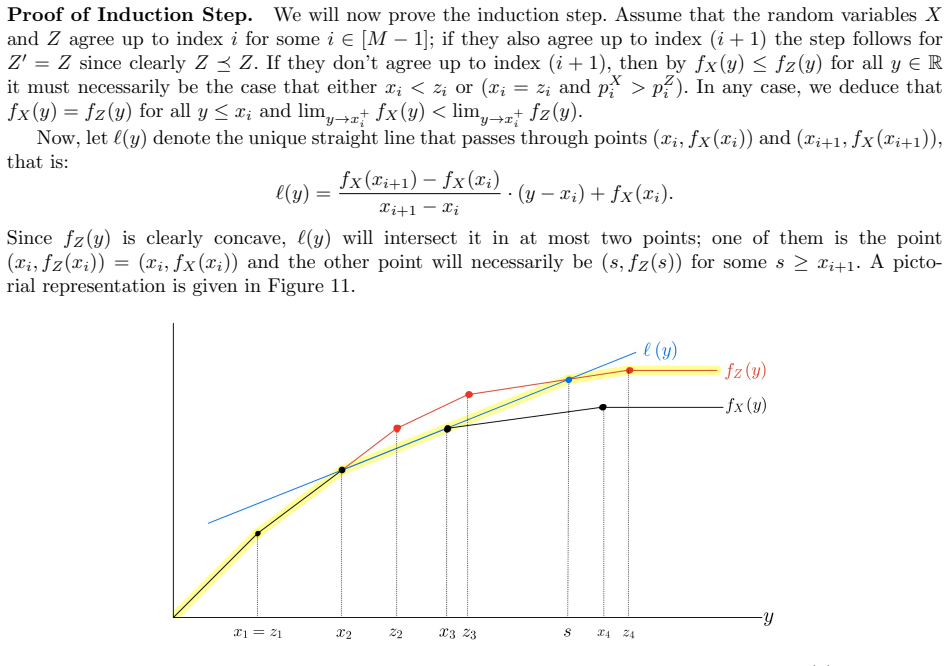
The load-bearing object is the water-filling surrogate cost W*_M, a random variable extracted from an MDP's optimality curve fM(y) by the relation fM(y) = E[min(y, W*_M)]; it is the MDP-level generalization of the surrogate costs familiar from Pandora's Box analysis. For Markov chains, W*_M is generated by a bottom-up water-filling amortization that distributes each action's cost onto the cheapest downstream trajectories; the paper's novel step is Lemma 3.5, which extends this to general acyclic MDPs by showing that for every deterministic commitment π there exists an amortized cost function ρπ on trajectories—with cost-sharing and cost-dominance properties—whose induced distribution over surrogate costs is exactly W*_M, independent of π. This action independence is what makes both the global lower bound and the composition theorem work: the interaction between global and local decision-making is severed, so an α-local approximation condition on each MDP alone (f_{Mπ}(αy) ≤ α f_M(y) for all outside options y) suffices to bound the commitment gap of the whole instance by α. Each application then boils down to finding such local commitments: peeking-versus-opening for PBPI, a minimum-index static probing order for APB, One-Sided Halving for WS, and a semilocal (α, β) approximation plus a matroid-greedy composition argument for PBOI.
What would settle it
Solve, by exhaustive dynamic programming, a small matroid-min-CICS instance (e.g., two finite acyclic MDPs under a rank-1 matroid) for the true optimal cost OPT(I) and compare it with the expected minimum surrogate cost E[min_{S∈F} Σ_{i∈S} W*_{Mi}], where each W*_{Mi} is read off the optimality curve fM(y) = E[min(y, W*_M)] per Definition 7. Theorem 3.4 asserts OPT(I) ≥ E[min_{S∈F} Σ_{i∈S} W*_{Mi}]; one instance where the strict reverse inequality holds would refute the amortization foundation and, with it, all the composition results.
Extended reading notes
Core claim
On the paper's own terms, the central claim is that the commitment gap of a Costly Information Combinatorial Selection instance can be bounded by local approximation ratios of its constituent information-acquisition MDPs. For each MDP M, Whittle's local game (M, y)—the choice between advancing M and accepting an outside option of cost y—defines an optimality curve fM(y), which in turn defines a water-filling surrogate cost W*_M via fM(y) = E[min(y, W*_M)]. The paper proves a lower bound on the unrestricted optimum, OPT(I) ≥ E[min_{S∈F} Σ_{i∈S} W*_{Mi}] (Theorem 3.4), using a new amortization lemma (Lemma 3.5) showing that for every deterministic commitment, action costs can be shifted onto terminal outcomes so that the induced surrogate-cost distribution equals W*_M regardless of the commitment—action independence. It then proves the composition theorem (Theorem 4.1): if each Mi admits an α-local approximation (f_{Mπ_i}(αy) ≤ α f_{Mi}(y) for all y), the global commitment gap is at most α. The four applications—√2 for matroid-PBPI, 2 for matroid-APB, O(κ) for matroid-WS with the One-Sided Halving commitment, and 0.582 for matroid-max-PBOI via a semilocal approximation—are instantiations of this recipe.
Load-bearing premise
The entire framework rests on the action-independence lemma: for every way of committing to actions inside an alternative's (acyclic) information process, action costs can be shifted onto terminal outcomes so the resulting surrogate-cost distribution is exactly the one read off the MDP's optimality curve; if that fails—say for cyclic processes, which are explicitly excluded—the lower bound and all composition results collapse.
Editorial extensions
If this is right
- For any matroid-CICS instance, constructing an α-approximation reduces to a per-MDP search for α-local commitments; the composed policy inherits the ratio with no dependence on the number of alternatives n.
- Mixed instances containing partial-inspection, additive, and optional-inspection boxes together still have commitment gap at most 2, so heterogeneous inspection protocols no longer require bespoke algorithms.
- The framework transfers to any feasibility constraint admitting a frugal approximation algorithm, with the global factor becoming the product of the local α and the frugal β (Corollary B.3).
- Additive Pandora's Box—equivalently, Pandora's Shortest Path on disjoint s-t paths—has constant commitment gap 2 regardless of the number of components per box, though the achieving commitment in the proof is existential.
- Matroid-max-PBOI attains the first efficiently computable committing policy strictly better than the trivial 0.5, namely 0.582, via semilocal approximation.
Reading between the lines
- Because W*_M is strategy-independent, it functions as a canonical 'price of information' for an alternative; a natural (untested) conjecture is that index policies built from these surrogate costs remain near-optimal for constraints that are 'almost' greedy, such as laminar matroids, losing only a constant or poly-log factor.
- The framework assumes known distributions and mutually independent MDPs; an extension the paper leaves implicit would replace true distributions by empirical estimates, with the water-filling construction suggesting that estimation error would propagate additively through the composition bound at an O(1/√n) rate per alternative.
- Theorem 7.2 shows pointwise approximation for Weighing Scale cannot be constant, yet the paper leaves open whether the weaker local approximation notion yields a universal constant; the PBOI precedent (where local failed but semilocal succeeded) suggests the better WS bound may need a similarly non-pointwise condition.
- The semilocal composition is the one place the framework exploits matroid structure beyond frugality; porting semilocal approximation to other MDP families with a grab-like deterministic-terminal action—flagged by the paper itself—would extend the 0.582-style gains to new domains.
Signed reviews
Editorial analysis
A structured set of objections, weighed in public.
Referee Report
Summary. The paper defines Costly Information Combinatorial Selection (CICS), a class of stochastic selection problems in which each variable is inspected through an independent acyclic MDP, and proposes a framework for approximately optimal committing policies under matroid feasibility constraints (with an extension to frugal constraints). The main ingredients are an amortized surrogate-cost construction for MDPs, a Whittle-integral-style lower bound on the optimal adaptive cost, a notion of local approximation that composes into global approximation guarantees, and applications to four problems: Pandora's Box with Partial Inspection (a sqrt(2) commitment gap), Additive Pandora's Box (a 2-approximation), a new Weighing Scale problem (an O(kappa) gap), and matroid PBOI (a 0.582 approximation in the maximization setting). The paper also carries the framework through the maximization setting and to general frugal algorithms.
Significance. If the lower-bound theorem and composition theorem were fully established, this would be a substantive contribution: it offers a unified decomposition for bandit superprocesses beyond indexable settings, gives new approximation bounds for several variants of Pandora's Box, introduces a natural new problem (the Weighing Scale problem), and provides the first efficient policy that beats 0.5 for matroid-PBOI. The appendix contains substantial, mostly self-contained proofs, and the action-independence/water-filling construction is a genuinely novel technical idea. The significance, however, is contingent on repairing the proof of the central Whittle-integral lower bound (Theorem 3.4), because the PBPI, APB, WS, and PBOI results are all derived through it.
major comments (3)
- [Appendix D.2, proof of Claim 4] The claim that the expected cost of following commitment pi is at least E[X(pi) W*_M] is reduced to proving E[W*_{Mpi}] >= E[W*_M]. The displayed calculation proves only the unconditional expectation comparison. The indicator X(pi) is correlated with the realized trajectory, because the global policy's stopping decision depends on realized terminal values, so E[X W*_{Mpi}] >= E[X W*_M] does not follow. Since inequality (8) in Theorem 3.4 and hence the Whittle-integral lower bound, Theorem 4.1, and the ratios sqrt(2), 2, O(kappa), and 0.582 all depend on this step, the submitted proof is incomplete. A possible repair is to apply Lemma 3.1 directly to the amortization supplied by Lemma 3.5; the paper should supply that argument, or an equivalent coupling, rather than the unconditional comparison given in the current text.
- [Lemma 3.5 and its proof] The lemma states that the cost-sharing vector b^pi is non-negative, but the proof defines b^pi_{sigma tau} = E[rho^pi(tau)] - E[rho^{pi|s}(tau_s)]. Lemma 3.6 only guarantees E[m(z)] <= z for each z; it does not imply E[m(g_j vee rho^{pi|s}(tau_s))] >= E[rho^{pi|s}(tau_s)], so individual entries can be negative even though the aggregate over tau is non-negative. The lemma statement and the Markov-chain amortization definition in Definition 4 require b_{s tau} >= 0. This is not merely cosmetic: Lemma 3.1's proof retains terms of the form b_{s tau}(Pr[I(s)]Pr[R(tau)|R(s)] - Pr[A cap R(tau)]), which can change sign if b_{s tau} < 0. The proof should establish entrywise non-negativity, or the subsequent uses of the lemma should be reformulated.
- [Section 5.2, Claims 1-2] The two claims are stated for all y in R with alpha equal to (c_o/c_p)(1 - c_o/g_p) and 1 + min(c_p/c_o, c_o/g_p), respectively. Neither claim states the regime assumption g_p < g_o < tau that the preceding paragraph introduces, and the first alpha can be less than 1 in general; for a deterministic value X = 0 it becomes c_o/(c_o + c_p) < 1. Because Definition 8 and Theorem 4.1 require alpha >= 1, the claims need to include the regime in their statements or explicitly split off the complementary case in which opening the box is 1-locally optimal. Without this, the derivation of the sqrt(2) bound at the end of Section 5.2 is not complete.
minor comments (4)
- [Section 3.3, proof of Lemma 3.5] In several places the proof writes rho^{pi|sigma} and b^{pi|sigma} where the intended objects are rho^{pi|s} and b^{pi|s}, the restrictions of the commitment after transitioning to state s; this should be corrected.
- [Section 8.3 and Appendix I] The semilocal composition algorithm is numbered Algorithm 2 in the main text and Algorithm 3 in Appendix I; the numbering should be made consistent.
- [Section 7, Theorem 7.1] The parameter kappa_i = mu_i/M_i + log(mu_i/g_i) is undefined when M_i = 0 or g_i = 0; the statement should give the quantile convention for the median and the assumptions required for g_i > 0.
- [Definition 1] The definition says that the terminal accept action 'results in a value v(s)', but in the minimization setting that value is a cost and in the maximization setting it is a reward; the sign convention should be made explicit at the definition.
Circularity Check
No significant circularity: the paper's bounds are derived from explicitly proven amortization and local-approximation theorems, not from self-referential definitions or fitted predictions.
full rationale
The central derivation chain is not circular. Theorem 3.4 lower-bounds OPT by E[min_{S∈F} Σ_i W*_{M_i}], where each W*_{M_i} is defined via the local-game optimality curve f_{M_i} (Definition 7), not via the global optimum or via the commitment being evaluated. Lemma 3.5 is an explicit inductive construction using the stochastic-dominance lemma (Lemma 3.6), which is itself proven in Appendix D.3; the action-independence property is derived, not assumed. The composition theorem (Theorem 4.1) is proven by repeated stochastic-dominance substitution using Definition 8 as a local inequality against f_M, and the paper explicitly notes that standard local α-approximation would give an exponential-in-n bound (Appendix C), which is exactly the kind of content check that rules out a merely definitional equivalence. The application-specific constants (√2 for PBPI, 2 for APB, O(κ) for WS, 0.582 for matroid-PBOI) are derived from these theorems with fixed parameters; no parameter is fitted to the quantity it later predicts. Self-citations to Scully and Doval [2024] and Gupta et al. [2019] are not load-bearing: the relevant Markov-chain optimality result is restated and reproved in Theorem 3.2 with a self-contained amortization argument, and the local-approximation composition is reproved as Theorem 4.1. Appendix I.1 cites Scully and Doval [2024, Theorem 5.4] only as a proof strategy while giving the full argument. The skeptical concern about Claim 4 in Appendix D.2 (the acceptance-weighted step E[X·W*_{Mπ}] ≥ E[X·W*_M] may not follow from the unconditional inequality) is a possible correctness gap, not circularity: it does not assume the target lower bound. Under the review rules, correctness risk is not circularity, so the circularity score is 0.
Assumptions & free parameters
assumptions (5)
- domain assumption Each costly information MDP is acyclic (finite horizon).
- domain assumption Finite state, action, and value supports.
- domain assumption Independence of the constituent MDPs.
- domain assumption Known distributions for values and transitions.
- domain assumption Matroid (or frugal) feasibility constraint.
Cite this review
Pith. "Pith review of Combinatorial Selection with Costly Information." pith.science (2026). https://pith.science/paper/RQXEHWJ4
@misc{pith2026241203860,
  author       = {Pith},
  title        = {Pith review of: Combinatorial Selection with Costly Information},
  year         = {2026},
  howpublished = {\url{https://pith.science/paper/RQXEHWJ4}},
  note         = {Machine review of arXiv:2412.03860}
}
read the original abstract
We consider a class of optimization problems over stochastic variables where the algorithm can learn information about the value of any variable through a series of costly steps; we model this information acquisition process as a Markov Decision Process (MDP). The algorithm's goal is to minimize the cost of its solution plus the cost of information acquisition, or alternately, maximize the value of its solution minus the cost of information acquisition. Such bandit superprocesses have been studied previously but solutions are known only for fairly restrictive special cases. We develop a framework for approximate optimization of bandit superprocesses that applies to arbitrary acyclic MDPs with a matroid feasibility constraint. Our framework establishes a bound on the optimal cost through a novel cost amortization; it then couples this bound with a notion of local approximation that allows approximate solutions for each component MDP in the superprocess to be composed without loss into a global approximation. We use this framework to obtain approximately optimal solutions for several variants of bandit superprocesses for both maximization and minimization. We obtain new approximations for combinatorial versions of the previously studied Pandora's Box with Optional Inspection and Pandora's Box with Partial Inspection; the less-studied Additive Pandora's Box problem; as well as a new problem that we call the Weighing Scale problem.
Figures


Figures from the paper (9 more)



Forward citations
Cited by 3 Pith papers
-
Markovian Pandora's box
For Pandora's box with Markovian reward correlations and order constraints, the paper claims optimal fully adaptive strategies for forest precedence graphs and fast static-transition approximations.
-
T-TAMER: Provably Taming Trade-offs in ML Serving
T-TAMER claims recall is necessary and sufficient for provably optimal early-exit and cascade serving policies, but the main extensions are under-derived and partly reduce to known Gittins-index results.
-
The Gittins Index: A Design Principle for Decision-Making Under Uncertainty
The Gittins index is presented as a general design principle that optimally solves many independent-chain decision problems and gives strong approximate solutions in Bayesian optimization and tail-latency scheduling.
Reference graph
Works this paper leans on
-
[1]
The pandora's box problem with sequential inspections
Ali Aouad, Jingwei Ji, and Yaron Shaposhnik. The pandora's box problem with sequential inspections. Available at SSRN 3726167, 2020
work page 2020
-
[2]
Maximizing stochastic monotone submodular functions
Arash Asadpour and Hamid Nazerzadeh. Maximizing stochastic monotone submodular functions. Management Science, 62 0 (8): 0 2374--2391, 2016
work page 2016
-
[3]
Pandora's problem with combinatorial cost
Ben Berger, Tomer Ezra, Michal Feldman, and Federico Fusco. Pandora's problem with combinatorial cost. Proceedings of the 24th ACM Conference on Economics and Computation, 2023
work page 2023
-
[4]
Approximately-optimal mechanisms in auction design, search theory, and matching markets
Hedyeh Beyhaghi. Approximately-optimal mechanisms in auction design, search theory, and matching markets. Cornell University, 2019
work page 2019
-
[5]
Pandora’s problem with nonobligatory inspection: Optimal structure and a PTAS
Hedyeh Beyhaghi and Linda Cai. Pandora’s problem with nonobligatory inspection: Optimal structure and a PTAS . Proceedings of the 55th Annual ACM Symposium on Theory of Computing, 2022
work page 2022
-
[6]
Recent developments in pandora's box problem: Variants and applications
Hedyeh Beyhaghi and Linda Cai. Recent developments in pandora's box problem: Variants and applications. SIGecom Exch., 21 0 (1): 0 20–34, October 2024
work page 2024
- [7]
-
[8]
Pandora's box problem with order constraints
Shant Boodaghians, Federico Fusco, Philip Lazos, and Stefano Leonardi. Pandora's box problem with order constraints. Proceedings of the 21st ACM Conference on Economics and Computation, 2020
work page 2020
Show all 37 references
-
[9]
Matching with nested and bundled pandora boxes
Robin Bowers and Bo Waggoner. Matching with nested and bundled pandora boxes. arXiv, abs/2406.08711, 2024 a
2024 arXiv
-
[10]
High-welfare matching markets via descending price
Robin Bowers and Bo Waggoner. High-welfare matching markets via descending price. In Web and Internet Economics: 19th International Conference, WINE 2023, Shanghai, China, December 4–8, 2023, Proceedings, page 59–76, 2024 b
2023
-
[11]
Prophet inequalities for bandits, cabinets, and dags
Robin Bowers, Elias Lindgren, and Bo Waggoner. Prophet inequalities for bandits, cabinets, and dags. arXiv, abs/2502.08976, 2025
2025
-
[12]
Optimal sequential exploration: Bandits, clairvoyants, and wildcats
David Brown and James Smith. Optimal sequential exploration: Bandits, clairvoyants, and wildcats. Operations Research, 61: 0 644--665, June 2013
2013
-
[13]
Pandora's box with correlations: Learning and approximation
Shuchi Chawla, Evangelia Gergatsouli, Yifeng Teng, Christos Tzamos, and Ruimin Zhang. Pandora's box with correlations: Learning and approximation. 2020 IEEE 61st Annual Symposium on Foundations of Computer Science (FOCS), 2019
2020
-
[14]
Approximating pandora's box with correlations
Shuchi Chawla, Evangelia Gergatsouli, Jeremy McMahan, and Christos Tzamos. Approximating pandora's box with correlations. In International Workshop and International Workshop on Approximation, Randomization, and Combinatorial Optimization. Algorithms and Techniques, 2021
2021
-
[15]
Whether or not to open pandora's box
Laura Doval. Whether or not to open pandora's box. Journal of Economic Theory, 175: 0 127--158, 2018
2018
-
[16]
On playing golf with two balls
Ioana Dumitriu, Prasad Tetali, and Peter Winkler. On playing golf with two balls. SIAM Journal on Discrete Mathematics, 16 0 (4): 0 604--615, 2003
2003
-
[17]
Online pandora's boxes and bandits
Hossein Esfandiari, Mohammad Taghi Hajiaghayi, Brendan Lucier, and Michael Mitzenmacher. Online pandora's boxes and bandits. In AAAI Conference on Artificial Intelligence, 2019
2019
-
[18]
Pandora box problem with nonobligatory inspection: Hardness and approximation scheme
Hu Fu, Jia-Wen Li, and Daogao Liu. Pandora box problem with nonobligatory inspection: Hardness and approximation scheme. Proceedings of the 55th Annual ACM Symposium on Theory of Computing, 2022
2022
-
[19]
Stochastic Finance - An Introduction in Discrete Time
Hans Föllmer and Alexander Schied. Stochastic Finance - An Introduction in Discrete Time. De Gruyter, 2016
2016
-
[20]
Weitzman's rule for pandora's box with correlations
Evangelia Gergatsouli and Christos Tzamos. Weitzman's rule for pandora's box with correlations. In Proceedings of the 37th International Conference on Neural Information Processing Systems, 2024
2024
-
[21]
Bandit processes and dynamic allocation indices
John C Gittins. Bandit processes and dynamic allocation indices. Journal of the Royal Statistical Society Series B: Statistical Methodology, 41 0 (2): 0 148--164, 1979
1979
-
[22]
Glazebrook
Kevin D. Glazebrook. On a sufficient condition for superprocesses due to whittle. Journal of Applied Probability, 19: 0 99 -- 110, 1982
1982
-
[23]
Information acquisition and exploitation in multichannel wireless networks
Sudipto Guha, Kamesh Munagala, and Saswati Sarkar. Information acquisition and exploitation in multichannel wireless networks. arXiv, abs/0804.1724, 2008
2008 arXiv
-
[24]
The Markovian Price of Information
Anupam Gupta, Haotian Jiang, Ziv Scully, and Sahil Singla. The Markovian Price of Information . In Conference on Integer Programming and Combinatorial Optimization, 2019
2019
-
[25]
Dylan Hadfield-Menell and Stuart J. Russell. Multitasking: Optimal planning for bandit superprocesses. In Conference on Uncertainty in Artificial Intelligence, 2015
2015
-
[26]
Threshold Testing and Semi-Online Prophet Inequalities
Martin Hoefer and Kevin Schewior. Threshold Testing and Semi-Online Prophet Inequalities . In 31st Annual European Symposium on Algorithms (ESA), 2023
2023
-
[27]
Stochastic probing with increasing precision
Martin Hoefer, Kevin Schewior, and Daniel Schmand. Stochastic probing with increasing precision. SIAM Journal on Discrete Mathematics, 38 0 (1): 0 148--169, 2024
2024
-
[28]
Ke and J
T. Ke and J. Villas-Boas. Optimal learning before choice. Journal of Economic Theory, 180, 2019
2019
-
[29]
Glen Weyl
Bobby Kleinberg, Bo Waggoner, and E. Glen Weyl. Descending price optimally coordinates search. Proceedings of the 2016 ACM Conference on Economics and Computation, 2016
2016
-
[30]
P. Nash. Optimal Allocation of Resources Between Research Projects. University of Cambridge, 1973
1973
-
[31]
Wojciech Olszewski and Richard R. Weber. A more general pandora rule? Journal of Economic Theory, 160: 0 429--437, 2015
2015
-
[32]
Local hedging approximately solves pandora’s box problems with optional inspection
Ziv Scully and Laura Doval. Local hedging approximately solves pandora’s box problems with optional inspection. arXiv, abs/2410.19011, 2024
2024 arXiv
-
[33]
The price of information in combinatorial optimization
Sahil Singla. The price of information in combinatorial optimization. In ACM-SIAM Symposium on Discrete Algorithms, 2017
2017
-
[34]
Strassen
V. Strassen. The Existence of Probability Measures with Given Marginals . The Annals of Mathematical Statistics, 36 0 (2): 0 423 -- 439, 1965
1965
-
[35]
On the Gittins Index for Multiarmed Bandits
Richard Weber. On the Gittins Index for Multiarmed Bandits . The Annals of Applied Probability, 2 0 (4): 0 1024 -- 1033, 1992
1992
-
[36]
Optimal search for the best alternative
Martin L Weitzman. Optimal search for the best alternative. Econometrica, pages 641--654, 1979
1979
-
[37]
Multi-Armed Bandits and the Gittins Index
Peter Whittle. Multi-Armed Bandits and the Gittins Index . Journal of the Royal Statistical Society: Series B (Methodological), 42 0 (2): 0 143--149, 1980
1980
Reviewed August 11, 2026 · model on record in the stance chip above.
Discussion (0). Continue with ORCID to comment.