REVIEW 3 major objections 7 minor 67 references
Seismic Signatures of Stellar Magnetic Activity -- What Can We Expect from TESS?
T0 review · 3 major / 7 minor · reviewed 2026-08-14 · deepseek-v4-flash
Pith's one-line read An extended TESS mission should detect activity-driven p-mode frequency shifts in a few thousand evolved stars, turning a rare seismic measurement into a survey-scale result.
desk verdict A candid, conditional forecast: the TESS yield numbers rest on openly admitted ad hoc scaling factors, but the paper is honest, useful, and its Section 7 bias warning is a genuine contribution. read the letter →
The pith
A machine-rendered reading of the paper's core claim, the machinery that carries it, and where it could break.
The reading
What carries the argument
The load-bearing object is a scaling relation for the amplitude of activity-related acoustic-mode frequency shifts: δν ∝ [R/(M νmax)] ΔR′HK,mod, where R′HK,mod divides an observed chromospheric activity index by R², by max(√(Ro−1),1) for stars with Rossby numbers above about 2, and by √tage. A companion relation, Pcyc = 0.5 Prot max(√(Ro−1),1), converts full-cycle shifts into the frequency shift expected between two TESS epochs separated by two or four years. The detection pipeline shifts a synthetic power spectrum by that predicted amount and measures the shift back with a cross-correlation technique, using a synthetic catalogue of 12,731 TESS short-cadence targets as the test population.
What would settle it
Take the existing four-year Kepler light curves of low-luminosity red giants with νmax between about 30 and 300 μHz, measure their p-mode frequency shifts between epochs with the cross-correlation method, and compare the distribution with the shifts predicted by the paper's scaling relation: if typical measured shifts are below about 0.1 μHz rather than the predicted several tenths to μHz, the forecast of thousands of TESS detections is not realized.
Extended reading notes
Core claim
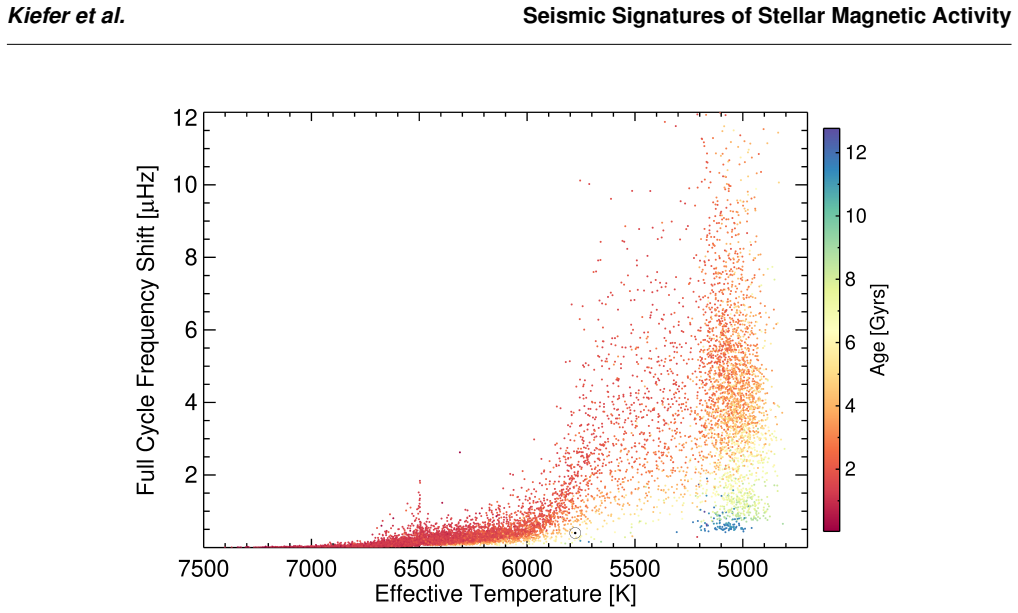
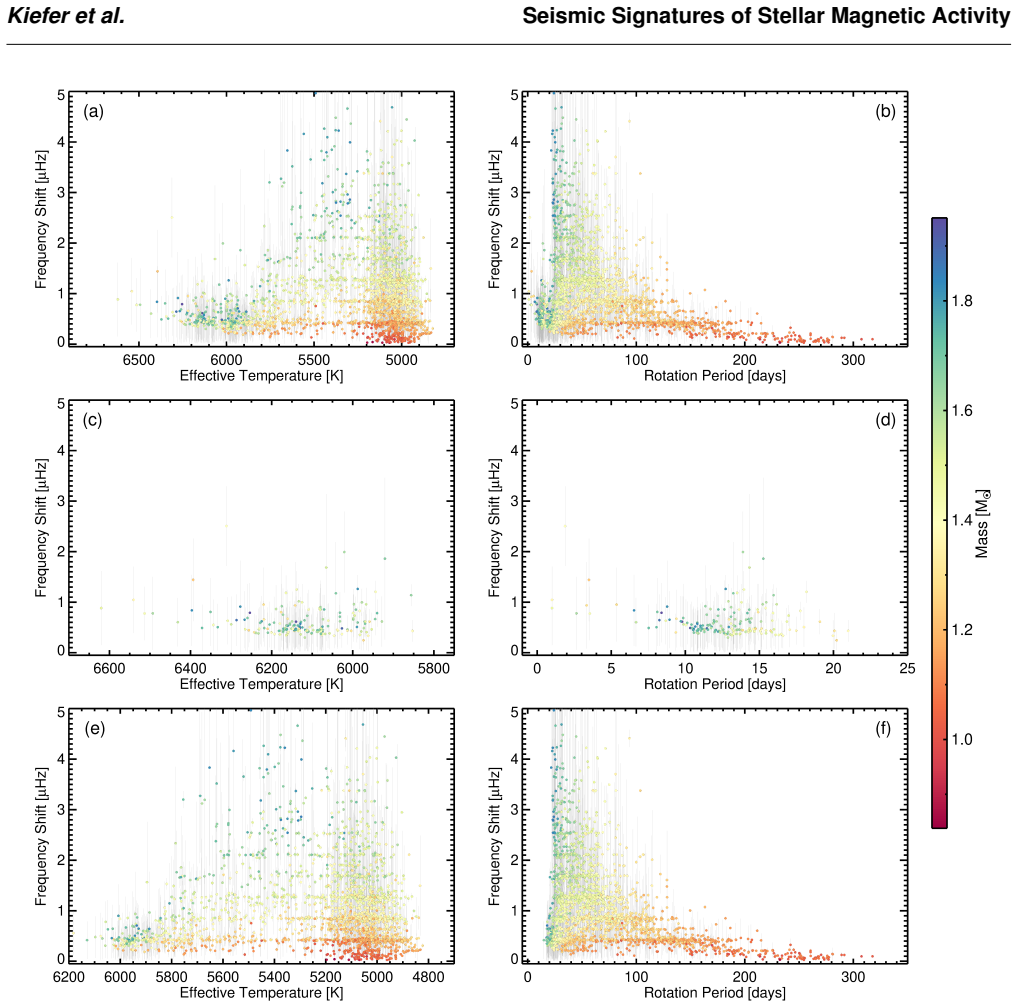
The paper's central claim is that activity-related p-mode frequency shifts are not only present but abundant in an extended TESS mission. Using a new scaling relation, δν ∝ R/(M νmax) ΔR′HK,mod, where the modified calcium activity index is divided by stellar surface area, a Rossby-number transition factor, and age, the predicted full-cycle shifts are roughly 6 μHz for a low-luminosity red giant, whereas an earlier scaling relation would give over 50 μHz. Simulating detection with a cross-correlation technique on the synthetic TESS sample, the paper finds, for a four-year extension, significant shifts in 171 main-sequence/early subgiant stars and 2275 evolved subgiant and low-luminosity red giants with the cross-correlation method, and 717 and 3087 with the peak-bagging uncertainty assumption. For a two-year extension the totals are 2349 and 3305. The shifts should be measurable even in single-sector observations, and the paper argues that shifts of several μHz at νmax would bias asteroseismic mass and radius estimates unless global seismic parameters are calibrated for activity level.
Load-bearing premise
The predicted counts rest on the assumption that the paper's modified activity indicator—an observed chromospheric-emission measure divided by extra factors for surface area, a rotation-activity transition, and stellar age—describes how real full-cycle frequency shifts scale for evolved stars; if that scaling is wrong, the yields change by factors of several.
Editorial extensions
If this is right
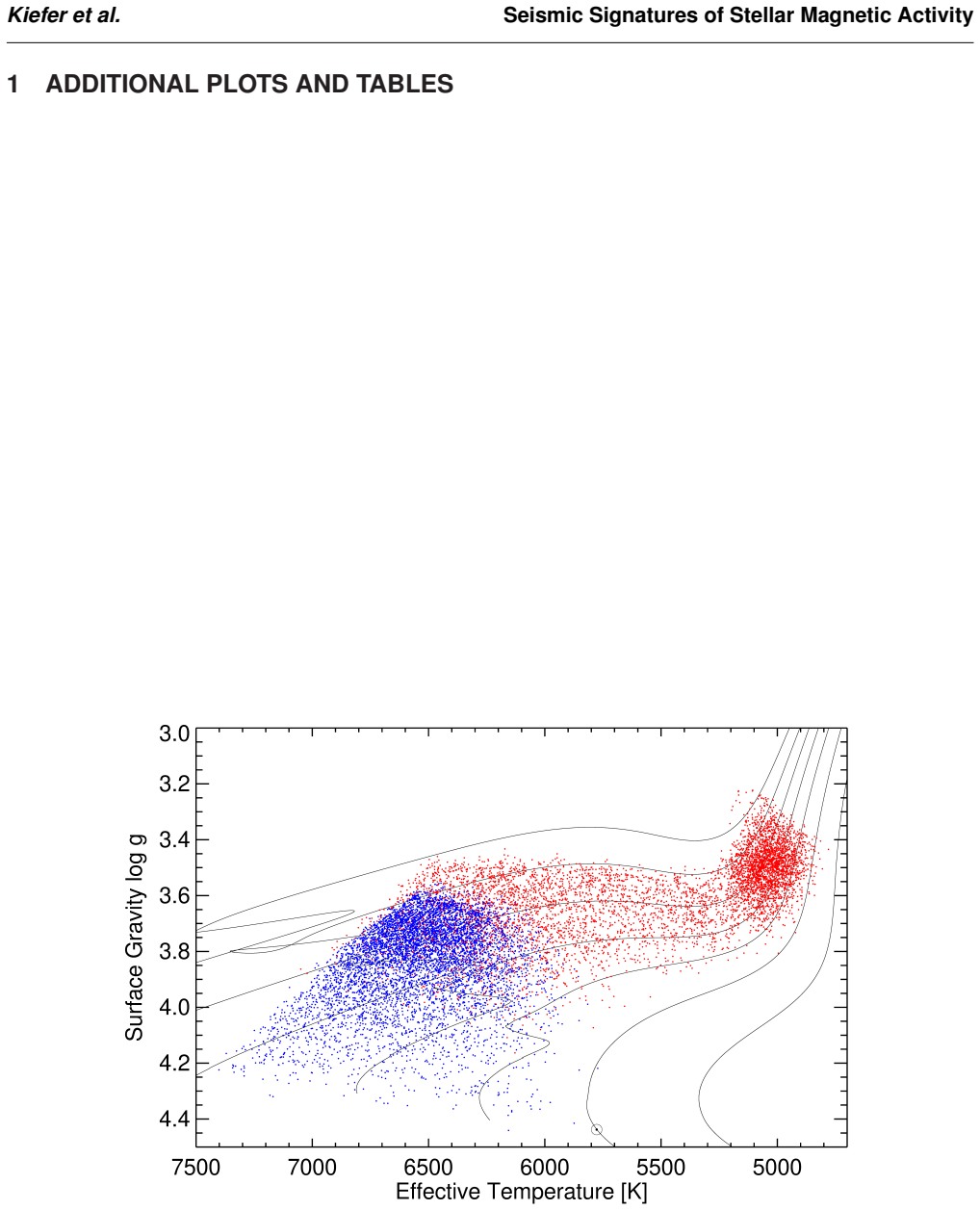
- A four-year TESS extension should yield significant activity-related frequency shifts in 171 main-sequence and early subgiant stars (717 with the peak-bagging uncertainty assumption) and 2275 late subgiants and low-luminosity red giants (3087 with peak-bagging).
- Most detected stars are cooler than about 6500 K; F-type stars make up only a small fraction of detections because their broad mode peaks hide small shifts.
- Even stars observed in a single TESS sector can show measurable shifts, so the search is not limited to continuous long-baseline targets.
- Activity shifts of several μHz at νmax would cause asteroseismic scaling relations to overestimate stellar mass and radius unless global parameters are calibrated for activity level.
- The predicted yields and shift amplitudes differ enough among the three competing scaling relations that an extended TESS sample could discriminate between them observationally.
Reading between the lines
- Beyond the paper: because the same scaling relation predicts that activity shifts should already be present in four-year Kepler light curves of low-luminosity red giants, re-analysing existing Kepler data would test the relation before TESS is extended; the paper notes such a study is in preparation but does not use it as evidence.
- Beyond the paper: if the peak-bagging uncertainty assumption (half the cross-correlation uncertainty) is too optimistic, the true detectable yield will sit between the cross-correlation and peak-bagging columns, roughly 2400 to 3800 stars for a four-year extension.
- Beyond the paper: the same relation implies that ensemble asteroseismic masses and radii for red giants, used in Galactic archaeology, may carry a small activity-dependent bias even when individual shifts are not the target; calibrating νmax and Δν for activity could reduce that bias.
Signed reviews
Editorial analysis
A structured set of objections, weighed in public.
Referee Report
Summary. This paper predicts how many activity-related p-mode frequency shifts can be detected in an extended TESS mission. The authors derive a new scaling relation for full-cycle frequency shifts, δν ∝ (R/M ν_max) ΔR'_HK,mod (Eq. 15), combining a mode-sensitivity factor derived in Section 3 (Eqs. 4-11) with a modified Ca II H&K activity index that includes surface-area dilution, a Rossby-number cutoff, and an age-degradation factor (Eq. 14). Using the synthetic TESS light-curve catalogue of Ball et al. (2018), they inject into each power spectrum the frequency shift expected over a two- or four-year gap under an assumed cycle-period formula (Eqs. 17-18) and measure shifts with a cross-correlation technique, approximating peak-bagging uncertainties as half the CC uncertainties. Their central result is the yield forecast in Table 1: for a four-year extension, a couple hundred main-sequence and early subgiant stars (171 CC, 717 PB) and a few thousand late subgiant and low-luminosity red giants (2275 CC, 3087 PB) would show significant frequency shifts. The paper additionally argues (Section 7) that unaccounted activity shifts would bias asteroseismic mass and radius estimates from the standard scaling relations.
Significance. If the forecast holds, it is a transformative result for stellar activity-cycle science: the sample of stars with detected activity-related seismic frequency shifts would grow from a few dozen to thousands, enabling systematic study of dynamo behaviour across mass, age, and rotation. The paper has real strengths: the derivation of the mode-sensitivity factor is transparent and is shown to agree with Metcalfe et al. (2007) to within a factor of √T_eff (0.91-1.14); the absolute scale is anchored by the solar 0.4 μHz calibration; the simulation is built on a public synthetic catalogue with stated data availability; a false-positive test under zero input shift is performed; and Section 7 yields a concrete, falsifiable consequence for asteroseismic scaling relations. The forecast itself is falsifiable with extended TESS data. The principal weakness is that the region-II yield, which dominates the numbers, is extrapolated through a scaling relation whose evolved-star behaviour is adjusted by hand in Section 5 and is unanchored by any confirmed detection in subgiants or red giants, as the paper itself acknowledges.
major comments (3)
- [Section 5, Eq. (14)] The three activity-evolution factors in Eq. (14) — the R^-2 surface-area dilution, the max(sqrt(Ro-1),1) Rossby cutoff, and the t_Age^-0.5 decay — are introduced after the fact because the unmodified Metcalfe et al. relation gives full-cycle shifts above 50 μHz on the lower red giant branch; Section 5 states that 'this is why we looked for reasonable adjustments.' Since Eq. (15) feeds directly into the injected shifts via Eq. (18) and hence into the Table 1 detection counts, the headline yield (171 CC / 717 PB detections in region I; 2275 CC / 3087 PB in region II for a four-year extension) is fully conditional on the magnitudes and functional forms of three hand-chosen factors. The manuscript itself concedes (Section 5) that activity may decline faster than t^-0.5 or stop entirely at some evolutionary stage, and that the same uncertainty applies to the Rossby factor, and it states (Section 8) that the relation may not be valid even with the adjustments. No evolved-star data anchor these choices, since the comparison in Section 6.1 is restricted to main-sequence stars and the paper notes there is currently no confirmed frequency-shift detection in subgiants or red giants. Please add a sensitivity analysis of Table 1 with respect to each factor (including omitting them individually and varying the age exponent), and quote the yield as a range or explicitly label it as conditional on the adopted scaling.
- [Section 4, Eqs. (17)-(18)] The fraction of the full-cycle shift that appears in the two- or four-year gap is set entirely by the cycle-period estimate through Eq. (18), and Eq. (17) is described in Section 5 as 'obviously very crude.' Because most of the predicted detections are in region II, where cycles are long and the min(2n/P_cyc,1) factor suppresses the injected shift, a factor-of-two error in P_cyc directly changes the injected δν and therefore changes which stars clear the significance threshold in Tables 1-4. The yield columns should be re-computed for a range of plausible P_cyc scalings (for example, P_cyc multiplied by 0.5 and 2.0, or using the observed short-cycle and long-cycle branches separately) so that the dependence of the forecast on this admittedly crude input is quantified in the paper rather than left implicit.
- [Sections 4 and 6, detection criterion] The definition of a 'significant frequency shift' as one that is 'at least 1σ > 0' and within 3σ of the input shift is weak on the first condition, and the false-positive test described in Section 6 is reported only for the PB method ('We found no false positives detections with the PB method'), even though the primary numbers in Table 1 are CC detections. Under a pure-noise realisation with zero input shift, the condition 'at least 1σ > 0' would by itself admit roughly 16% of a Gaussian noise distribution, so the reported absence of false positives is non-trivial and needs an explanation. Please report the CC false-positive rate explicitly, describe how the detection thresholds interact with the Lorentzian fit of the cross-correlation function, and justify the asymmetric 1σ threshold.
minor comments (7)
- [Section 3, Eqs. (14)-(15)] Equation (15) uses ΔR'_HK,mod, but Eq. (14) defines only R'_HK,mod; please state explicitly that ΔR'_HK,mod is obtained by applying the Saar-Brandenburg relation in Eq. (1) to R'_HK,mod, as the text currently leaves this inference implicit.
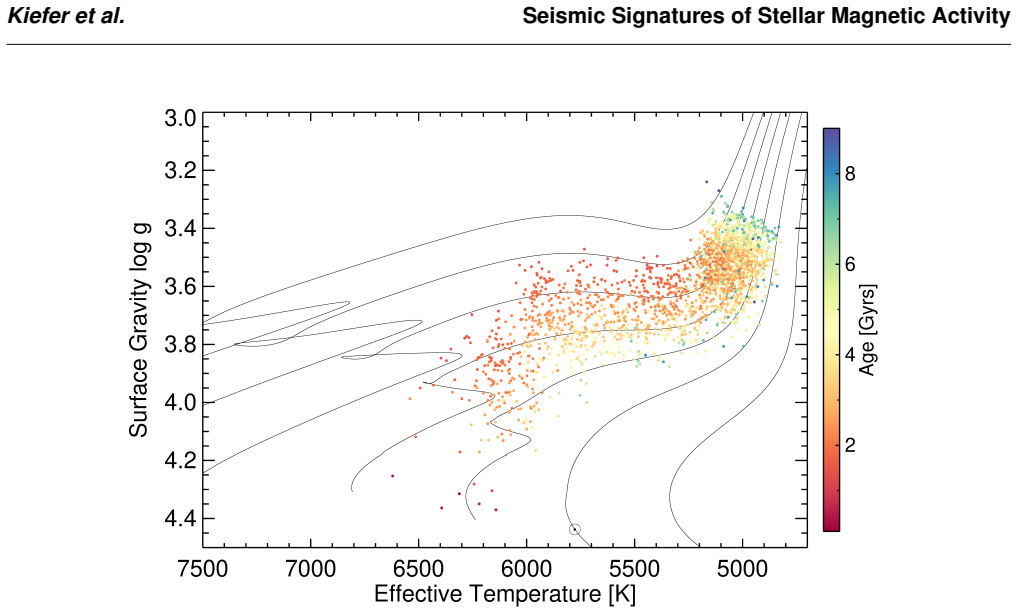
- [Section 2, abstract, Section 6] Region I is defined in Section 2 as the main sequence (pre-TAMS, core hydrogen abundance above 10^-5), but the abstract and Section 6 describe region I as 'main-sequence and early subgiant stars'; please reconcile this terminology so the reader can map the abstract's claim onto the Table 1 rows.
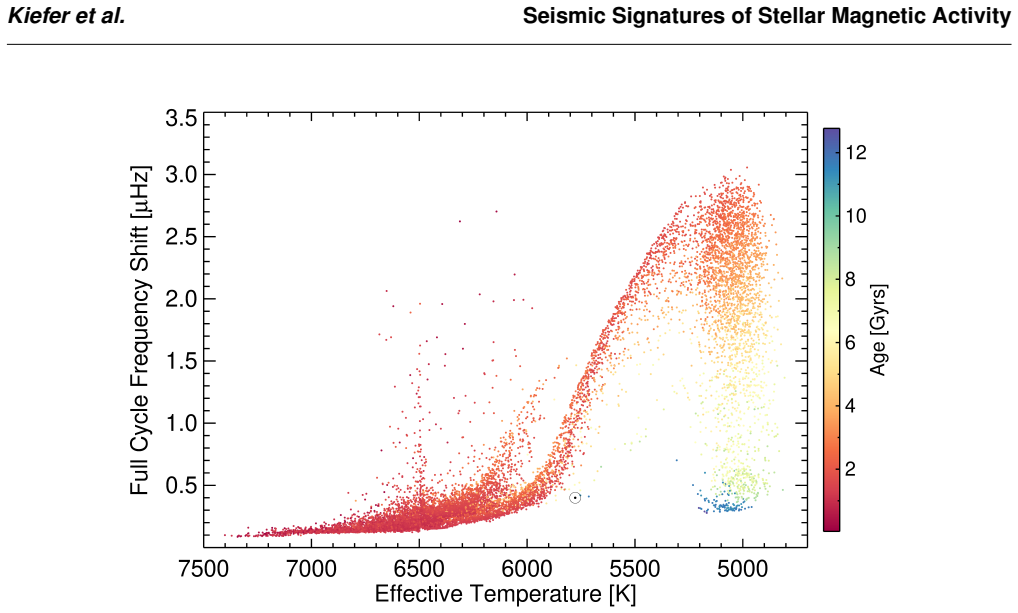
- [Figure 9] The caption of Figure 9 says 'As Figure 1 but for the full-cycle frequency shifts,' which appears to be a typo for 'As Figure 2.'
- [Section 6, typographical errors] The sentence 'We found no false positives detections with the PB method' contains the word 'detections' where 'detections' is repeated awkwardly, and 'omitting' is misspelled as 'ommiting' in the same paragraph; both should be corrected in a final pass.
- [Section 5, PB vs CC uncertainty] The assumption that peak-bagging uncertainties are smaller than cross-correlation uncertainties by a factor of two is stated without justification; a reference to the comparison studies cited in Section 4 or a brief sensitivity statement would help the reader interpret the PB columns of Tables 1-4.
- [Data Availability Statement] The Data Availability Statement gives only the word 'Link' as the repository address; please provide the actual URL or a DOI.
- [Section 3, Figure 2] The 6500 K spike in Figure 2, attributed to the rotation-period modelling transition in Ball et al., is mentioned in the text; please quantify how many of the region-I F-star detections in Table 1 lie in the affected temperature range so that the influence of this modelling artifact on the quoted F-star fractions is explicit.
Circularity Check
No significant circularity: the TESS yield forecast is a forward simulation conditional on an explicitly labeled scaling relation, not a fit disguised as a prediction.
full rationale
The central yield forecast is a forward model, not a circular derivation. The scaling relation in Eq. (15) is calibrated externally to the solar frequency shift of 0.4 microhertz and built from published empirical relations (Saar & Brandenburg, Noyes et al., Metcalfe et al.) that are not derived from the predicted sample. The three modifications in Eq. (14) are introduced after the paper notes that the unmodified Metcalfe relation gives implausibly large shifts for low-luminosity red giants ('This is why we looked for reasonable adjustments.'), but these factors have no free parameters fitted to the target data and are explicitly described as an 'attempt to circumvent our ignorance' rather than as measured constraints. Likewise, the cycle-period estimate in Eq. (17) is labeled 'obviously very crude' and is an input assumption, not an output of the derivation. The detection simulation injects shifts computed from Eq. (15) and measures them with cross-correlation and peak-bagging; the resulting counts are conditional on the scaling relation, which the paper repeatedly states ('according to our scaling relation'). The comparison with Santos et al. (2018) is an external empirical check, even though one author overlaps, and the self-citations to Kiefer et al. (2017) are used as observational context rather than as the proof of the new scaling relation. The admitted uncertainties in the activity-evolution factors and cycle periods are robustness concerns, not circularity.
Assumptions & free parameters
free parameters (5)
- Surface-area dilution factor R^-2 =
exponent -2
- Rossby number activity cutoff =
Ro_crit = 2, sqrt(Ro-1) scaling
- Age-degradation power =
t_Age^-0.5
- Cycle-period coefficient =
0.5 P_rot in Equation 17
- PB to CC uncertainty ratio =
1/2
assumptions (6)
- domain assumption Equation (4) variational expression for frequency shifts
- domain assumption Saar and Brandenburg amplitude relation Delta R'_HK proportional to R'_HK^0.77
- domain assumption Noyes et al. rotation-activity relation (Equation 12)
- ad hoc to paper Approximations in Equations (8) to (11): derivative replaced by xi_r/r, inertia as R^3 rho |xi|^2, source at photosphere
- domain assumption Synthetic TESS sample of Ball et al. (2018) is representative of real TESS ATL targets
- domain assumption Activity does not suppress oscillation amplitudes in the simulation
Cite this review
Pith. "Pith review of Seismic Signatures of Stellar Magnetic Activity -- What Can We Expect from TESS?." pith.science (2026). https://pith.science/paper/RRB4PTY3
@misc{pith2026190801191,
  author       = {Pith},
  title        = {Pith review of: Seismic Signatures of Stellar Magnetic Activity -- What Can We Expect from TESS?},
  year         = {2026},
  howpublished = {\url{https://pith.science/paper/RRB4PTY3}},
  note         = {Machine review of arXiv:1908.01191}
}
read the original abstract
Asteroseismic methods offer a means to investigate stellar activity and activity cycles as well as to identify those properties of stars which are crucial for the operation of stellar dynamos. With data from CoRoT and \textit{Kepler}, signatures of magnetic activity have been found in the seismic properties of a few dozen stars. Now, NASA's Transiting Exoplanet Survey Satellite (TESS) mission offers the possibility to expand this, so far, rather exclusive group of stars. This promises to deliver new insight into the parameters that govern stellar magnetic activity as a function of stellar mass, age, and rotation rate. We derive a new scaling relation for the amplitude of the activity-related acoustic (p-mode) frequency shifts that can be expected over a full stellar cycle. Building on a catalogue of synthetic TESS time series, we use the shifts obtained from this relation and simulate the yield of detectable frequency shifts in an extended TESS mission. We find that, according to our scaling relation, we can expect to find significant p-mode frequency shifts for a couple hundred main-sequence and early subgiant stars and for a few thousand late subgiant and low-luminosity red giant stars.
Figures

Figures from the paper (6 more)



Reference graph
Works this paper leans on
-
[1]
Chromospheric variations in main-sequence stars
Baliunas SL, Donahue RA, Soon WH, Horne JH, Frazer J, Woodard-Eklund L, et al. Chromospheric variations in main-sequence stars. Astrophys. J. 438 (1995) 269–287. doi:10.1086/175072
doi:10.1086/175072 1995
-
[2]
Time Evolution of the Magnetic Activity Cycle Period
Saar SH, Brandenburg A. Time Evolution of the Magnetic Activity Cycle Period. II. Results for an Expanded Stellar Sample. Astrophys. J. 524 (1999) 295–310. doi:10.1086/307794
doi:10.1086/307794 1999
-
[3]
Looking for activity cycles in late-type Kepler stars using time-frequency analysis
Vida K, Ol´ah K, Szab´o R. Looking for activity cycles in late-type Kepler stars using time-frequency analysis. Mon. Notices R. Astron. Soc. 441 (2014) 2744–2753. doi:10.1093/mnras/stu760
-
[4]
Solar activity cycle frequency shifts of low-degree p-modes
Jim´enez-Reyes SJ, R ´egulo C, Pall ´e PL, Roca Cort ´es T. Solar activity cycle frequency shifts of low-degree p-modes. Astron. Astrophys. 329 (1998) 1119–1124
work page 1998
-
[5]
A Helioseismic Perspective on the Depth of the Minimum Between Solar Cycles 23 and 24
Broomhall AM. A Helioseismic Perspective on the Depth of the Minimum Between Solar Cycles 23 and 24. Solar Phys. 292 (2017) 67. doi:10.1007/s11207-017-1068-5
-
[6]
Broomhall AM, Nakariakov VM. A Comparison Between Global Proxies of the Sun’s Magnetic Activity Cycle: Inferences from Helioseismology. Solar Phys. 290 (2015) 3095–3111. doi:10.1007/ s11207-015-0728-6
work page 2015
-
[7]
Scientific Objectives for a Minisat: CoRoT
Baglin A, Auvergne M, Barge P, Deleuil M, Catala C, Michel E, et al. Scientific Objectives for a Minisat: CoRoT. Fridlund M, Baglin A, Lochard J, Conroy L, editors,The CoRoT Mission Pre-Launch Status - Stellar Seismology and Planet Finding (2006), ESA Special Publication, vol. 1306, 33
work page 2006
-
[9]
CoRoT Reveals a Magnetic Activity Cycle in a Sun-Like Star
Garc´ıa RA, Mathur S, Salabert D, Ballot J, R´egulo C, Metcalfe TS, et al. CoRoT Reveals a Magnetic Activity Cycle in a Sun-Like Star. Science 329 (2010) 1032. doi:10.1126/science.1191064
Show all 67 references
-
[10]
The spectrum of solar p-modes and the solar activity cycle
Pall´e P, R´egulo C, Roca Cort´es T. The spectrum of solar p-modes and the solar activity cycle. Osaki Y , Shibahashi H, editors,Progress of Seismology of the Sun and Stars (Springer Berlin Heidelberg), Lecture Notes in Physics, vol. 367 (1990), 129–134. doi:10.1007/3-540-53091-6 73
1990 doi
-
[11]
Width and Energy of Solar p-Modes Observed by Global Oscillation Network Group
Komm RW, Howe R, Hill F. Width and Energy of Solar p-Modes Observed by Global Oscillation Network Group. Astrophys. J. 543 (2000) 472–485. doi:10.1086/317101. This is a provisional file, not the final typeset article 18 Kiefer et al. Seismic Signatures of Stellar Magnetic Activity
2000 doi
-
[12]
About the p-mode frequency shifts in HD 49933
Salabert D, R ´egulo C, Ballot J, Garc ´ıa RA, Mathur S. About the p-mode frequency shifts in HD 49933. Astron. Astrophys. 530 (2011) A127. doi:10.1051/0004-6361/201116633
2011 doi
-
[13]
Solar-cycle effects on solar oscillation frequencies
Libbrecht KG, Woodard MF. Solar-cycle effects on solar oscillation frequencies. Nature 345 (1990) 779–782. doi:10.1038/345779a0
1990 doi
-
[14]
Solar p modes in 10 years of the IRIS network
Salabert D, Fossat E, Gelly B, Kholikov S, Grec G, Lazrek M, et al. Solar p modes in 10 years of the IRIS network. Astron. Astrophys. 413 (2004) 1135–1142. doi:10.1051/0004-6361:20031541
2004 doi
-
[15]
Kepler planet-detection mission: Introduction and first results
Borucki WJ, Koch D, Basri G, Batalha N, Brown T, Caldwell D, et al. Kepler planet-detection mission: Introduction and first results. Science 327 (2010) 977–980. doi:10.1126/science.1185402
2010 doi
-
[16]
Kepler Mission Design, Realized Photometric Performance, and Early Science
Koch DG, Borucki WJ, Basri G, Batalha NM, Brown TM, Caldwell D, et al. Kepler Mission Design, Realized Photometric Performance, and Early Science. Astrophys. J. Lett. 713 (2010) L79-L86. doi:10.1088/2041-8205/713/2/L79
2010 doi
-
[17]
Magnetic variability in the young solar analog KIC 10644253
Salabert D, R ´egulo C, Garc´ıa RA, Beck PG, Ballot J, Creevey OL, et al. Magnetic variability in the young solar analog KIC 10644253. Observations from the Kepler satellite and the HERMES spectrograph. Astron. Astrophys. 589 (2016) A118. doi:10.1051/0004-6361/201527978
2016 doi
-
[19]
Stellar magnetic activity and variability of oscillation parameters: An investigation of 24 solar-like stars observed by Kepler
Kiefer R, Schad A, Davies G, Roth M. Stellar magnetic activity and variability of oscillation parameters: An investigation of 24 solar-like stars observed by Kepler. Astron. Astrophys. 598 (2017) A77. doi:10.1051/0004-6361/201628469
2017 doi
-
[20]
Frequency dependence of p-mode frequency shifts induced by magnetic activity in Kepler solar-like stars
Salabert D, R´egulo C, P´erez Hern´andez F, Garc´ıa RA. Frequency dependence of p-mode frequency shifts induced by magnetic activity in Kepler solar-like stars. Astron. Astrophys. 611 (2018) A84. doi:10.1051/0004-6361/201731714
2018 doi
-
[21]
Signatures of Magnetic Activity in the Seismic Data of Solar-type Stars Observed by Kepler
Santos ˆARG, Campante TL, Chaplin WJ, Cunha MS, Lund MN, Kiefer R, et al. Signatures of Magnetic Activity in the Seismic Data of Solar-type Stars Observed by Kepler. Astrophys. J. Suppl. Series 237 (2018) 17. doi:10.3847/1538-4365/aac9b6
2018 doi
-
[22]
Evidence for the Impact of Stellar Activity on the Detectability of Solar-like Oscillations Observed by Kepler
Chaplin WJ, Bedding TR, Bonanno A, Broomhall AM, Garc ´ıa RA, Hekker S, et al. Evidence for the Impact of Stellar Activity on the Detectability of Solar-like Oscillations Observed by Kepler. Astrophys. J. Lett. 732 (2011) L5. doi:10.1088/2041-8205/732/1/L5
2011 doi
-
[23]
Chromospheric Activity in G and K Main-Sequence Stars, and What It Tells Us about Stellar Dynamos
B¨ohm-Vitense E. Chromospheric Activity in G and K Main-Sequence Stars, and What It Tells Us about Stellar Dynamos. Astrophys. J. 657 (2007) 486–493. doi:10.1086/510482
2007 doi
-
[24]
Improved Age Estimation for Solar-Type Dwarfs Using Activity- Rotation Diagnostics
Mamajek EE, Hillenbrand LA. Improved Age Estimation for Solar-Type Dwarfs Using Activity- Rotation Diagnostics. Astrophys. J. 687 (2008) 1264–1293. doi:10.1086/591785
2008 doi
-
[25]
Magnetic cycles and rotation periods of late-type stars from photometric time series
Su´arez Mascare˜no A, Rebolo R, Gonz ´alez Hern´andez JI. Magnetic cycles and rotation periods of late-type stars from photometric time series. Astron. Astrophys. 595 (2016) A12. doi:10.1051/ 0004-6361/201628586
2016
-
[26]
Magnetic Evolution and the Disappearance of Sun-Like Activity Cycles
Metcalfe TS, van Saders J. Magnetic Evolution and the Disappearance of Sun-Like Activity Cycles. Solar Phys. 292 (2017) 126. doi:10.1007/s11207-017-1157-5
2017 doi
-
[27]
Reconciling solar and stellar magnetic cycles with nonlinear dynamo simulations
Strugarek A, Beaudoin P, Charbonneau P, Brun AS, do Nascimento JD. Reconciling solar and stellar magnetic cycles with nonlinear dynamo simulations. Science 357 (2017) 185–187. doi:10.1126/ science.aal3999
2017
-
[28]
Dynamo cycles in global convection simulations of solar-like stars
Warnecke J. Dynamo cycles in global convection simulations of solar-like stars. Astron. Astrophys. 616 (2018) A72. doi:10.1051/0004-6361/201732413
2018 doi
-
[29]
On the Sensitivity of Magnetic Cycles in Global Simulations of Solar-like Stars
Strugarek A, Beaudoin P, Charbonneau P, Brun AS. On the Sensitivity of Magnetic Cycles in Global Simulations of Solar-like Stars. Astrophys. J. 863 (2018) 35. doi:10.3847/1538-4357/aacf9e. Frontiers 19 Kiefer et al. Seismic Signatures of Stellar Magnetic Activity
2018 doi
-
[30]
Inferences on Stellar Activity and Stellar Cycles from Asteroseismology
Chaplin WJ, Basu S. Inferences on Stellar Activity and Stellar Cycles from Asteroseismology. Space Sci. Rev. 186 (2014) 437–456. doi:10.1007/s11214-014-0090-2
2014 doi
-
[31]
The variability of magnetic activity in solar-type stars
Fabbian D, Simoniello R, Collet R, Criscuoli S, Korhonen H, Krivova NA, et al. The variability of magnetic activity in solar-type stars. Astronomische Nachrichten 338 (2017) 753–772. doi:10.1002/ asna.201713403
2017
-
[32]
Total Solar Irradiance: What Have We Learned from the Last Three Cycles and the Recent Minimum? Space Sci
Fr¨ohlich C. Total Solar Irradiance: What Have We Learned from the Last Three Cycles and the Recent Minimum? Space Sci. Rev. 176 (2013) 237–252. doi:10.1007/s11214-011-9780-1
2013 doi
-
[33]
The nature of solar brightness variations
Shapiro AI, Solanki SK, Krivova NA, Cameron RH, Yeo KL, Schmutz WK. The nature of solar brightness variations. Nature Astronomy 1 (2017) 612–616. doi:10.1038/s41550-017-0217-y
2017 doi
-
[34]
Variability of Sun-like stars: reproducing observed photometric trends
Shapiro AI, Solanki SK, Krivova NA, Schmutz WK, Ball WT, Knaack R, et al. Variability of Sun-like stars: reproducing observed photometric trends. Astron. Astrophys. 569 (2014) A38. doi:10.1051/ 0004-6361/201323086
2014
-
[35]
Photometric magnetic-activity metrics tested with the Sun: application to Kepler M dwarfs
Mathur S, Salabert D, Garc´ıa RA, Ceillier T. Photometric magnetic-activity metrics tested with the Sun: application to Kepler M dwarfs. Journal of Space Weather and Space Climate 4 (2014) A15. doi:10.1051/swsc/2014011
2014
-
[36]
Photospheric and chromospheric magnetic activity of seismic solar analogs
Salabert D, Garc ´ıa RA, Beck PG, Egeland R, Pall ´e PL, Mathur S, et al. Photospheric and chromospheric magnetic activity of seismic solar analogs. Observational inputs on the solar-stellar connection from Kepler and Hermes. Astron. Astrophys. 596 (2016) A31. doi:10.1051/0004...
2016 doi
-
[37]
Photospheric activity of the Sun with VIRGO and GOLF
Salabert D, Garc´ıa RA, Jim´enez A, Bertello L, Corsaro E, Pall´e PL. Photospheric activity of the Sun with VIRGO and GOLF. Comparison with standard activity proxies. Astron. Astrophys. 608 (2017) A87. doi:10.1051/0004-6361/201731560
2017 doi
-
[38]
Stellar cycles from photometric data: CoRoT stars
Ferreira Lopes CE, Le˜ao IC, de Freitas DB, Canto Martins BL, Catelan M, De Medeiros JR. Stellar cycles from photometric data: CoRoT stars. Astron. Astrophys. 583 (2015) A134. doi:10.1051/ 0004-6361/201424900
2015
-
[39]
Long-term Photometric Variability in Kepler Full-frame Images: Magnetic Cycles of Sun-like Stars
Montet BT, Tovar G, Foreman-Mackey D. Long-term Photometric Variability in Kepler Full-frame Images: Magnetic Cycles of Sun-like Stars. Astrophys. J. 851 (2017) 116. doi:10.3847/1538-4357/ aa9e00
2017 doi
-
[40]
Sounding stellar cycles with Kepler - III
Karoff C, Metcalfe TS, Montet BT, Jannsen NE, Santos ARG, Nielsen MB, et al. Sounding stellar cycles with Kepler - III. Comparative analysis of chromospheric, photometric, and asteroseismic variability. Mon. Notices R. Astron. Soc. 485 (2019) 5096–5104. doi:10.1093/mnras/stz782
2019 doi
-
[41]
A Synthetic Sample of Short-cadence Solar-like Oscillators for TESS
Ball WH, Chaplin WJ, Schofield M, Miglio A, Bossini D, Davies GR, et al. A Synthetic Sample of Short-cadence Solar-like Oscillators for TESS. Astrophys. J. Suppl. Series 239 (2018) 34. doi:10. 3847/1538-4365/aaedbc
2018
-
[42]
Transiting Exoplanet Survey Satellite (TESS)
Ricker GR, Winn JN, Vanderspek R, Latham DW, Bakos G´A, Bean JL, et al. Transiting Exoplanet Survey Satellite (TESS). Journal of Astronomical Telescopes, Instruments, and Systems 1 (2015) 014003. doi:10.1117/1.JATIS.1.1.014003
2015 doi
-
[43]
Star counts in the Galaxy
Girardi L, Groenewegen MAT, Hatziminaoglou E, da Costa L. Star counts in the Galaxy. Simulating from very deep to very shallow photometric surveys with the TRILEGAL code. Astron. Astrophys. 436 (2005) 895–915. doi:10.1051/0004-6361:20042352
2005 doi
-
[44]
The Asteroseismic Target List for Solar-like Oscillators Observed in 2 minute Cadence with the Transiting Exoplanet Survey Satellite
Schofield M, Chaplin WJ, Huber D, Campante TL, Davies GR, Miglio A, et al. The Asteroseismic Target List for Solar-like Oscillators Observed in 2 minute Cadence with the Transiting Exoplanet Survey Satellite. Astrophys. J. Suppl. Series 241 (2019) 12. doi:10.3847/1538-4365/ab04f5
2019 doi
-
[45]
Amplitudes of stellar oscillations: the implications for asteroseismology
Kjeldsen H, Bedding TR. Amplitudes of stellar oscillations: the implications for asteroseismology. Astron. Astrophys. 293 (1995) 87–106. This is a provisional file, not the final typeset article 20 Kiefer et al. Seismic Signatures of Stellar Magnetic Activity
1995
-
[46]
The Asteroseismic Potential of TESS: Exoplanet-host Stars
Campante TL, Schofield M, Kuszlewicz JS, Bouma L, Chaplin WJ, Huber D, et al. The Asteroseismic Potential of TESS: Exoplanet-host Stars. Astrophys. J. 830 (2016) 138. doi:10.3847/0004-637X/830/ 2/138
2016 doi
-
[47]
On prospects for sounding activity cycles of Sun-like stars with acoustic modes
Chaplin WJ, Elsworth Y , Houdek G, New R. On prospects for sounding activity cycles of Sun-like stars with acoustic modes. Mon. Notices R. Astron. Soc. 377 (2007) 17–29. doi:10.1111/j.1365-2966. 2007.11581.x
2007 arXiv
-
[48]
A new look at dynamo cycle amplitudes
Saar SH, Brandenburg A. A new look at dynamo cycle amplitudes. Astronomische Nachrichten 323 (2002) 357–360. doi:10.1002/1521-3994(200208)323:3/4⟨357::AID-ASNA357⟩3.0.CO;2-I
2002 doi
-
[49]
Asteroseismic signatures of stellar magnetic activity cycles
Metcalfe TS, Dziembowski WA, Judge PG, Snow M. Asteroseismic signatures of stellar magnetic activity cycles. Mon. Notices R. Astron. Soc. 379 (2007) L16–L20. doi:10.1111/j.1745-3933.2007. 00325.x
2007
-
[50]
Rotation, convection, and magnetic activity in lower main-sequence stars
Noyes RW, Hartmann LW, Baliunas SL, Duncan DK, Vaughan AH. Rotation, convection, and magnetic activity in lower main-sequence stars. Astrophys. J. 279 (1984) 763–777. doi:10.1086/161945
1984 doi
-
[51]
Relation of Chromospheric Activity to Convection, Rotation, and Pre–Main-Sequence Evolution
Gilliland RL. Relation of Chromospheric Activity to Convection, Rotation, and Pre–Main-Sequence Evolution. Astrophys. J. 300 (1986) 339. doi:10.1086/163807
1986 doi
-
[52]
Theoretical values of convective turnover times and Rossby numbers for solar-like, pre-main sequence stars
Landin NR, Mendes LTS, Vaz LPR. Theoretical values of convective turnover times and Rossby numbers for solar-like, pre-main sequence stars. Astron. Astrophys. 510 (2010) A46. doi:10.1051/ 0004-6361/200913015
2010
-
[53]
Time Scales for CaII Emission Decay, Rotational Braking, and Lithium Depletion
Skumanich A. Time Scales for CaII Emission Decay, Rotational Braking, and Lithium Depletion. Astrophys. J. 171 (1972) 565–567. doi:10.1086/151310
1972 doi
-
[54]
Solar cycle induced variations of the low L solar acoustic spectrum
Palle PL, Regulo C, Roca Cortes T. Solar cycle induced variations of the low L solar acoustic spectrum. Astron. Astrophys. 224 (1989) 253–258
1989
-
[55]
Solar p-Mode Frequencies over Three Solar Cycles
Chaplin WJ, Elsworth Y , Miller BA, Verner GA, New R. Solar p-Mode Frequencies over Three Solar Cycles. Astrophys. J. 659 (2007) 1749–1760. doi:10.1086/512543
2007 doi
-
[56]
sunstardb: A Database for the Study of Stellar Magnetism and the Solar-stellar Connection
Egeland R. sunstardb: A Database for the Study of Stellar Magnetism and the Solar-stellar Connection. Astrophys. J. Suppl. Series 236 (2018) 19. doi:10.3847/1538-4365/aab771
2018 doi
-
[57]
Sounding stellar cycles with Kepler - I
Karoff C, Metcalfe TS, Chaplin WJ, Elsworth Y , Kjeldsen H, Arentoft T, et al. Sounding stellar cycles with Kepler - I. Strategy for selecting targets. Mon. Notices R. Astron. Soc. 399 (2009) 914–923. doi:10.1111/j.1365-2966.2009.15323.x
2009
-
[58]
Asteroseismic Fundamental Properties of Solar-type Stars Observed by the NASA Kepler Mission
Chaplin WJ, Basu S, Huber D, Serenelli A, Casagrande L, Silva Aguirre V , et al. Asteroseismic Fundamental Properties of Solar-type Stars Observed by the NASA Kepler Mission. Astrophys. J. Suppl. Series 210 (2014) 1. doi:10.1088/0067-0049/210/1/1
2014 doi
-
[59]
Significantly improving stellar mass and radius estimates: a new reference function for the ∆ν scaling relation
Guggenberger E, Hekker S, Basu S, Bellinger E. Significantly improving stellar mass and radius estimates: a new reference function for the ∆ν scaling relation. Mon. Notices R. Astron. Soc. 460 (2016) 4277–4281. doi:10.1093/mnras/stw1326
2016 doi
-
[60]
Testing the Asteroseismic Scaling Relations for Red Giants with Eclipsing Binaries Observed by Kepler
Gaulme P, McKeever J, Jackiewicz J, Rawls ML, Corsaro E, Mosser B, et al. Testing the Asteroseismic Scaling Relations for Red Giants with Eclipsing Binaries Observed by Kepler. Astrophys. J. 832 (2016) 121. doi:10.3847/0004-637X/832/2/121
2016 doi
-
[61]
Influence of magnetic activity on the determination of stellar parameters through asteroseismology
P´erez Hern´andez F, Garc´ıa RA, Mathur S, Santos ARG, R´egulo C. Influence of magnetic activity on the determination of stellar parameters through asteroseismology. Frontiers in Astronomy and Space Sciences 6 (2019) 41. doi:10.3389/fspas.2019.00041
2019
-
[62]
Revised Stellar Properties of Kepler Targets for the Quarter 1-16 Transit Detection Run
Huber D, Silva Aguirre V , Matthews JM, Pinsonneault MH, Gaidos E, Garc´ıa RA, et al. Revised Stellar Properties of Kepler Targets for the Quarter 1-16 Transit Detection Run. Astrophys. J. Suppl. Series 211 (2014) 2. doi:10.1088/0067-0049/211/1/2. Frontiers 21 Kiefer et al. Se...
2014 doi
-
[63]
Asteroseismology of 16,000 Kepler Red Giants: Global Oscillation Parameters, Masses, and Radii
Yu J, Huber D, Bedding TR, Stello D, Hon M, Murphy SJ, et al. Asteroseismology of 16,000 Kepler Red Giants: Global Oscillation Parameters, Masses, and Radii. Astrophys. J. Suppl. Series 236 (2018)
2018
-
[64]
doi:10.3847/1538-4365/aaaf74
-
[65]
Asteroseismic detection of latitudinal differential rotation in 13 Sun-like stars
Benomar O, Bazot M, Nielsen MB, Gizon L, Sekii T, Takata M, et al. Asteroseismic detection of latitudinal differential rotation in 13 Sun-like stars. Science 361 (2018) 1231–1234. doi:10.1126/ science.aao6571
2018
-
[66]
The Influence of Metallicity on Stellar Differential Rotation and Magnetic Activity
Karoff C, Metcalfe TS, Santos ˆARG, Montet BT, Isaacson H, Witzke V , et al. The Influence of Metallicity on Stellar Differential Rotation and Magnetic Activity. Astrophys. J. 852 (2018) 46. doi:10.3847/1538-4357/aaa026
2018 doi
-
[67]
Sounding stellar cycles with Kepler - II
Karoff C, Metcalfe TS, Chaplin WJ, Frandsen S, Grundahl F, Kjeldsen H, et al. Sounding stellar cycles with Kepler - II. Ground-based observations. Mon. Notices R. Astron. Soc. 433 (2013) 3227–3238. doi:10.1093/mnras/stt964
2013 doi
-
[68]
Evidence for photometric activity cycles in 3203 Kepler stars
Reinhold T, Cameron RH, Gizon L. Evidence for photometric activity cycles in 3203 Kepler stars. Astron. Astrophys. 603 (2017) A52. doi:10.1051/0004-6361/201730599
2017 doi
-
[69]
The PLATO 2.0 mission
Rauer H, Catala C, Aerts C, Appourchaux T, Benz W, Brandeker A, et al. The PLATO 2.0 mission. Experimental Astronomy 38 (2014) 249–330. doi:10.1007/s10686-014-9383-4. This is a provisional file, not the final typeset article 22 Kiefer et al. Seismic Signatures of Stellar Magneti...
2014 doi
Reviewed August 14, 2026 · model on record in the stance chip above.
Discussion (0). Continue with ORCID to comment.