Snow: Self-organizing Broadcast Protocol for Cloud
Pith reviewed 2026-05-22 21:36 UTC · model grok-4.3
The pith
Snow forms a multi-way balanced tree from local membership views for reliable broadcast under node churn.
A machine-rendered reading of the paper's core claim, the machinery that carries it, and where it could break.
Core claim
Snow is a self-organizing broadcast protocol designed for cloud environments that dynamically sends or forwards messages based on each node's membership view, ultimately forming a broadcast structure resembling a multi-way balanced tree where the height difference of leaf nodes is at most 1.
What carries the argument
Membership-view-driven forwarding rule that lets nodes self-organize into a balanced tree without central coordination or explicit reconnection steps.
If this is right
- Node departures no longer require child nodes to reconnect, avoiding temporary message duplication and latency spikes.
- The protocol delivers messages with deterministic reliability rather than the probabilistic guarantees of gossip.
- Bandwidth stays low because nodes forward only when their local view indicates they are responsible.
- The balanced-tree property holds continuously as long as membership views remain consistent.
Where Pith is reading between the lines
- If membership views can be maintained with low cost, the same forwarding logic might apply to other tree-structured overlays that currently rely on periodic repair.
- The approach suggests a middle ground between rigid trees and fully randomized gossip that could be tested in systems with partial view inconsistency.
- An experiment that injects controlled view errors would quantify how much view accuracy is required before the balanced-tree guarantee breaks.
Load-bearing premise
Every node maintains an accurate and up-to-date membership view that permits dynamic tree adjustment without introducing instability or extra overhead.
What would settle it
Run the protocol with deliberately delayed or inconsistent membership information and check whether duplicate messages, lost deliveries, or latency spikes exceed those of a standard tree or gossip baseline.
Figures
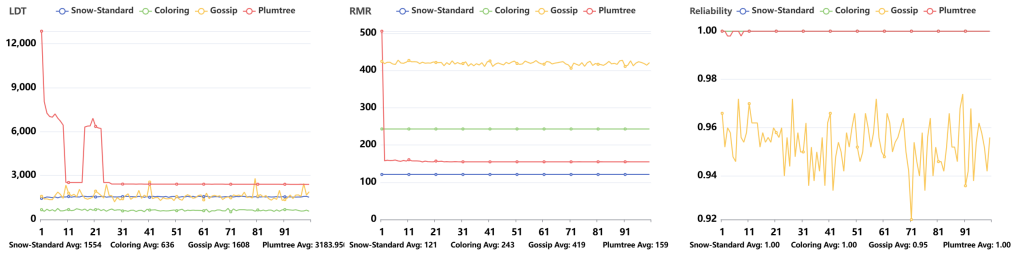
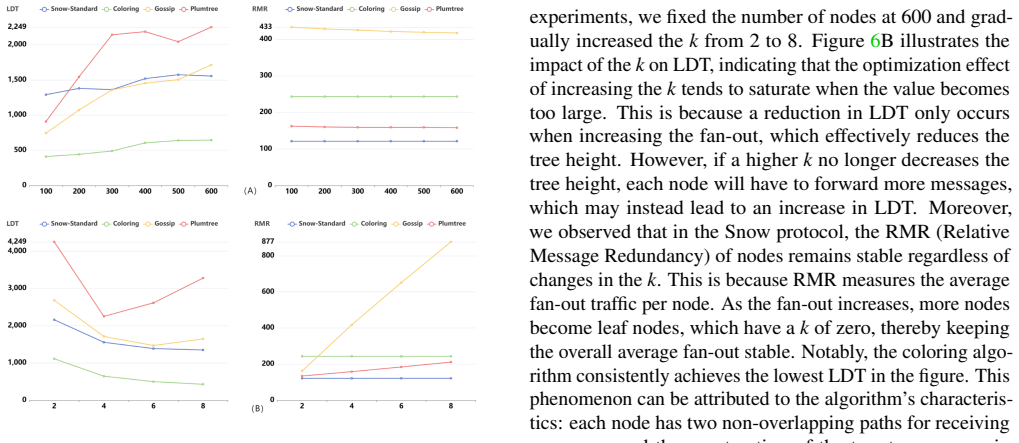
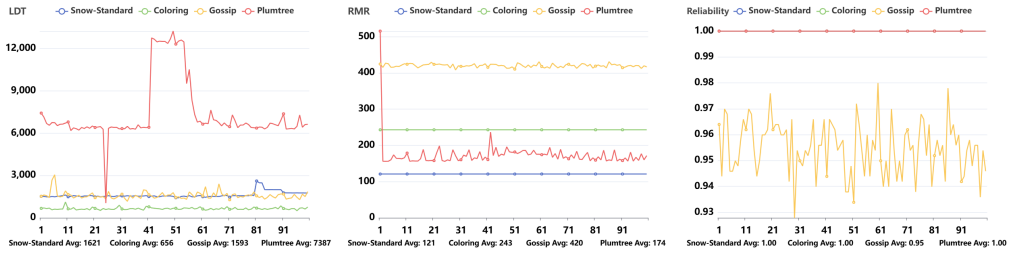
read the original abstract
In large-scale distributed applications, efficient and reliable broadcast protocols are essential for node communication. Tree-based broadcast lacks flexibility and may suffer performance degradation or even broadcast failure when cluster membership changes. Gossip-based broadcast incurs high bandwidth overhead and only provides probabilistic delivery guarantees. In tree-based broadcasting, when an internal node leaves, its child nodes need to reconnect to a new parent. This process may introduce instability, leading to potential message duplication and increased transmission latency. However, in cloud environments, node departures and arrivals are common, causing frequent performance degradation in tree-based broadcasting. This paper introduces Snow, a self-organizing broadcast protocol designed for cloud environments. Instead, it dynamically sends or forwards messages based on each node's membership view, ultimately forming a broadcast structure resembling a multi-way balanced tree(the height difference of leaf nodes is at most 1). Our experimental results showed that Snow maintains message delivery reliability and latency guarantees under node churn while maintaining low overhead without sending unnecessary redundant messages.
Editorial analysis
A structured set of objections, weighed in public.
Referee Report
Summary. The paper introduces Snow, a self-organizing broadcast protocol for cloud environments. It claims that nodes use local membership views to dynamically forward messages and form a balanced multi-way tree (leaf height difference at most 1), and that experiments demonstrate reliable delivery and latency under churn with low overhead and no unnecessary redundant messages.
Significance. If the empirical claims hold with proper validation, Snow could offer a practical middle ground between rigid tree-based and high-overhead gossip-based broadcast in dynamic settings.
major comments (2)
- [Abstract] Abstract: the claim that 'Our experimental results showed that Snow maintains message delivery reliability and latency guarantees under node churn while maintaining low overhead without sending unnecessary redundant messages' is presented with zero description of methods, controls, metrics, node counts, churn models, or data; this directly undermines the central empirical assertion.
- [Abstract] Abstract: the protocol is said to form a balanced tree 'solely from its membership view' and forward without duplication, yet no mechanism, algorithm, or analysis is supplied for maintaining accurate views under arrivals/departures or for bounding repair latency and duplication when views are stale; this is load-bearing for the 'no unnecessary redundant messages' guarantee.
minor comments (1)
- [Abstract] Abstract: the sentence beginning 'Instead, it dynamically sends...' reads as a fragment continuing from omitted prior text.
Simulated Author's Rebuttal
We thank the referee for the constructive feedback. We agree that the abstract is overly concise and will revise it to include key experimental details and a brief outline of the protocol mechanism, while ensuring the claims remain supported by the body of the paper.
read point-by-point responses
-
Referee: [Abstract] Abstract: the claim that 'Our experimental results showed that Snow maintains message delivery reliability and latency guarantees under node churn while maintaining low overhead without sending unnecessary redundant messages' is presented with zero description of methods, controls, metrics, node counts, churn models, or data; this directly undermines the central empirical assertion.
Authors: We acknowledge that the abstract provides no specifics on the experimental setup. The Evaluation section of the manuscript reports simulations with 500 to 2000 nodes, a Poisson churn model with mean session time of 5 minutes, metrics including delivery ratio (>99%), end-to-end latency, and per-node message count, plus controls comparing against gossip and static tree baselines. We will revise the abstract to concisely reference the scale (thousands of nodes) and primary metrics while pointing to the Evaluation section for full details. revision: yes
-
Referee: [Abstract] Abstract: the protocol is said to form a balanced tree 'solely from its membership view' and forward without duplication, yet no mechanism, algorithm, or analysis is supplied for maintaining accurate views under arrivals/departures or for bounding repair latency and duplication when views are stale; this is load-bearing for the 'no unnecessary redundant messages' guarantee.
Authors: The Design section details the algorithm: each node maintains a local membership view updated via periodic gossip-style exchanges, computes its position in the implicit multi-way tree using view size and node IDs, and forwards only to children in that structure. Duplication is prevented by sequence numbers and view-based forwarding rules. A simple bound on repair latency (one view-update round) is analyzed when views are temporarily stale. The abstract omits this summary, so we will add one sentence outlining the view-driven self-organization and duplication avoidance. revision: yes
Circularity Check
No significant circularity; claims are empirical without derivations
full rationale
The paper introduces Snow as a protocol that dynamically forms a multi-way balanced tree (height difference ≤1) from each node's membership view, with experimental claims of reliability and low overhead under churn. No equations, derivations, fitted parameters, or self-citations appear in the provided text that reduce any result to its inputs by construction. The membership-view precondition is stated as an assumption rather than derived, and central claims rest on empirical results rather than analytical steps that could exhibit self-definitional or fitted-input circularity. This is a standard non-finding for a protocol paper lacking first-principles math.
Axiom & Free-Parameter Ledger
axioms (1)
- domain assumption Nodes maintain accurate membership views
invented entities (1)
-
Snow protocol
no independent evidence
Reference graph
Works this paper leans on
- [1]
-
[2]
AUMASSON , J.-P., AND BERNSTEIN , D. J. Siphash: a fast short- input prf. In International Conference on Cryptology in India (2012), Springer, pp. 489–508
work page 2012
-
[3]
Blake2: simpler, smaller, fast as md5
AUMASSON , J.-P., N EVES , S., W ILCOX -O’HEARN , Z., AND WIN- NERLEIN , C. Blake2: simpler, smaller, fast as md5. In International Conference on Applied Cryptography and Network Security (2013), Springer, pp. 119–135
work page 2013
-
[4]
P., H AYDEN , M., O ZKASAP , O., X IAO, Z., B UDIU , M., AND MINSKY , Y
BIRMAN , K. P., H AYDEN , M., O ZKASAP , O., X IAO, Z., B UDIU , M., AND MINSKY , Y. Bimodal multicast. ACM Transactions on Computer Systems (TOCS) 17, 2 (1999), 41–88
work page 1999
-
[5]
Splitstream: High-bandwidth mul- ticast in cooperative environments
CASTRO , M., D RUSCHEL , P., K ERMARREC , A.-M., N ANDI , A., ROWSTRON , A., AND SINGH , A. Splitstream: High-bandwidth mul- ticast in cooperative environments. ACM SIGOPS operating systems review 37, 5 (2003), 298–313
work page 2003
-
[6]
CASTRO , M., D RUSCHEL , P., K ERMARREC , A.-M., AND ROW- STRON , A. I. Scribe: A large-scale and decentralized application-level multicast infrastructure. IEEE Journal on Selected Areas in communi- cations 20, 8 (2002), 1489–1499
work page 2002
-
[7]
Tree-based broadcasting in multihop radio networks
CHLAMTAC , AND KUTTEN . Tree-based broadcasting in multihop radio networks. IEEE Transactions on Computers 100 , 10 (1987), 1209–1223
work page 1987
-
[8]
G., S ESHAN , S., AND ZHANG , H
CHU, Y.-H., R AO, S. G., S ESHAN , S., AND ZHANG , H. A case for end system multicast. IEEE Journal on selected areas in communica- tions 20, 8 (2002), 1456–1471
work page 2002
-
[9]
Incentives build robustness in bittorrent
COHEN , B. Incentives build robustness in bittorrent. In Workshop on Economics of Peer-to-Peer systems (2003), vol. 6, Berkeley, CA, USA, pp. 68–72
work page 2003
-
[10]
Lifeguard: Local health awareness for more accurate failure detection
DADGAR , A., P HILLIPS , J., AND CURREY , J. Lifeguard: Local health awareness for more accurate failure detection. In 2018 48th Annual IEEE/IFIP International Conference on Dependable Systems and Networks Workshops (DSN-W) (2018), IEEE, pp. 22–25. 11
work page 2018
-
[11]
Swim: Scalable weakly- consistent infection-style process group membership protocol
DAS, A., G UPTA, I., AND MOTIVALA , A. Swim: Scalable weakly- consistent infection-style process group membership protocol. In Proceedings International Conference on Dependable Systems and Networks (2002), IEEE, pp. 303–312
work page 2002
-
[12]
DEERING , S. E., AND CHERITON , D. R. Multicast routing in data- gram internetworks and extended lans. ACM Transactions on Computer Systems (TOCS) 8, 2 (1990), 85–110
work page 1990
-
[13]
Crew: A gossip-based flash-dissemination system
DESHPANDE , M., X ING , B., L AZARDIS , I., H ORE , B., V ENKATA - SUBRAMANIAN , N., AND MEHROTRA , S. Crew: A gossip-based flash-dissemination system. In 26th IEEE International Conference on Distributed Computing Systems (ICDCS’06) (2006), IEEE, pp. 45–45
work page 2006
-
[14]
O., B RAND , P., AND HARIDI , S
EL-ANSARY, S., A LIMA , L. O., B RAND , P., AND HARIDI , S. Effi- cient broadcast in structured p2p networks. In Peer-to-Peer Systems II: Second International Workshop, IPTPS 2003, Berkeley, CA, USA, February 21-22, 2003. Revised Papers 2 (2003), Springer, pp. 304–314
work page 2003
-
[15]
EUGSTER , P. T., F ELBER , P. A., G UERRAOUI , R., AND KERMAR - REC , A.-M. The many faces of publish/subscribe. ACM computing surveys (CSUR) 35, 2 (2003), 114–131
work page 2003
-
[16]
T., G UERRAOUI , R., H ANDURUKANDE , S
EUGSTER , P. T., G UERRAOUI , R., H ANDURUKANDE , S. B., KOUZNETSOV , P., AND KERMARREC , A.-M. Lightweight prob- abilistic broadcast. ACM Transactions on Computer Systems (TOCS) 21, 4 (2003), 341–374
work page 2003
-
[17]
J., K ERMARREC , A.-M., AND MASSOULIÉ , L
GANESH , A. J., K ERMARREC , A.-M., AND MASSOULIÉ , L. Scamp: Peer-to-peer lightweight membership service for large-scale group com- munication. In Networked Group Communication: Third International COST264 Workshop, NGC 2001 London, UK, November 7–9, 2001 Proceedings 3 (2001), Springer, pp. 44–55
work page 2001
-
[18]
Fast replication in content distribution overlays
GANGULY, S., S AXENA , A., B HATNAGAR , S., I ZMAILOV , R., AND BANERJEE , S. Fast replication in content distribution overlays. In Proceedings IEEE 24th Annual Joint Conference of the IEEE Computer and Communications Societies. (2005), vol. 4, IEEE, pp. 2246–2256
work page 2005
-
[19]
GUPTA, I., K ERMARREC , A.-M., AND GANESH , A. J. Efficient epidemic-style protocols for reliable and scalable multicast. In 21st IEEE Symposium on Reliable Distributed Systems, 2002. Proceedings. (2002), IEEE, pp. 180–189
work page 2002
-
[20]
HUNT, P., K ONAR , M., J UNQUEIRA , F. P., AND REED , B. {ZooKeeper}: Wait-free coordination for internet-scale systems. In 2010 USENIX Annual Technical Conference (USENIX ATC 10) (2010)
work page 2010
-
[21]
JANNOTTI , J., G IFFORD , D. K., J OHNSON , K. L., K AASHOEK , M. F., AND O’TOOLE JR, J. W. Overcast: Reliable multicasting with an overlay network. In F ourth Symposium on Operating Systems Design and Implementation (OSDI 2000) (2000)
work page 2000
-
[22]
Research on multicast routing protocols for mobile ad-hoc networks
JUNHAI , L., L IU, X., AND DANXIA , Y. Research on multicast routing protocols for mobile ad-hoc networks. Computer Networks 52, 5 (2008), 988–997
work page 2008
-
[23]
Tree based broadcast in ad hoc networks
JÜTTNER , A., AND MAGI, Á. Tree based broadcast in ad hoc networks. Mobile Networks and Applications 10 (2005), 753–762
work page 2005
-
[24]
Broadcast with tree selection from multiple spanning trees on an overlay network
KANEKO , T., AND SHUDO , K. Broadcast with tree selection from multiple spanning trees on an overlay network. IEICE Transactions on Communications 106, 2 (2023), 145–155
work page 2023
-
[25]
Cassandra: a decentralized struc- tured storage system
LAKSHMAN , A., AND MALIK , P. Cassandra: a decentralized struc- tured storage system. ACM SIGOPS operating systems review 44 , 2 (2010), 35–40
work page 2010
-
[26]
LEITAO , J., P EREIRA , J., AND RODRIGUES , L. Epidemic broad- cast trees. In 2007 26th IEEE International Symposium on Reliable Distributed Systems (SRDS 2007) (2007), IEEE, pp. 301–310
work page 2007
-
[27]
Hyparview: A membership protocol for reliable gossip-based broadcast
LEITAO , J., P EREIRA , J., AND RODRIGUES , L. Hyparview: A membership protocol for reliable gossip-based broadcast. In 37th Annual IEEE/IFIP International Conference on Dependable Systems and Networks (DSN’07) (2007), IEEE, pp. 419–429
work page 2007
-
[28]
Multicast tree construction and flooding in wireless ad hoc networks
LIM, H., AND KIM, C. Multicast tree construction and flooding in wireless ad hoc networks. In Proceedings of the 3rd ACM international workshop on Modeling, analysis and simulation of wireless and mobile systems (2000), pp. 61–68
work page 2000
-
[29]
Deadline-aware fast one-to-many bulk transfers over inter-datacenter networks
LUO, L., K ONG , Y., N OORMOHAMMADPOUR , M., Y E, Z., S UN, G., Y U, H., AND LI, B. Deadline-aware fast one-to-many bulk transfers over inter-datacenter networks. IEEE Transactions on Cloud Computing 10, 1 (2019), 304–321
work page 2019
-
[30]
Probabilistic semantically reliable multicast
PEREIRA , J., R ODRIGUES , L., O LIVEIRA , R., AND KERMARREC , A.- M. Probabilistic semantically reliable multicast. In Proceedings IEEE International Symposium on Network Computing and Applications. NCA 2001 (2001), IEEE, pp. 100–103
work page 2001
-
[31]
A scalable content-addressable network
RATNASAMY , S., F RANCIS , P., H ANDLEY , M., K ARP, R., AND SHENKER , S. A scalable content-addressable network. In Proceedings of the 2001 conference on Applications, technologies, architectures, and protocols for computer communications (2001), pp. 161–172
work page 2001
-
[32]
Application-level multicast using content-addressable networks
RATNASAMY , S., H ANDLEY , M., K ARP, R., AND SHENKER , S. Application-level multicast using content-addressable networks. In International Workshop on Networked Group Communication (2001), Springer, pp. 14–29
work page 2001
-
[33]
Pastry: Scalable, decentralized object location, and routing for large-scale peer-to-peer systems
ROWSTRON , A., AND DRUSCHEL , P. Pastry: Scalable, decentralized object location, and routing for large-scale peer-to-peer systems. In Middleware 2001: IFIP/ACM international conference on distributed systems platforms heidelberg, Germany, November 12–16, 2001 pro- ceedings 2 (2001), Springer, pp. 329–350
work page 2001
-
[34]
{CodedBulk}:{Inter-Datacenter} bulk transfers using net- work coding
TSENG , S.-H., A GARWAL , S., A GARWAL , R., B ALLANI , H., AND TANG , A. {CodedBulk}:{Inter-Datacenter} bulk transfers using net- work coding. In 18th USENIX Symposium on Networked Systems Design and Implementation (NSDI 21) (2021), pp. 15–28
work page 2021
-
[35]
P2p docker registry capable of distributing tbs of data in seconds
UBER. P2p docker registry capable of distributing tbs of data in seconds. https://github.com/uber/kraken. Accessed on 2024- 12-11
work page 2024
-
[36]
Large-scale cluster management at google with borg
VERMA , A., P EDROSA , L., K ORUPOLU , M., O PPENHEIMER , D., TUNE , E., AND WILKES , J. Large-scale cluster management at google with borg. In Proceedings of the tenth european conference on computer systems (2015), pp. 1–17
work page 2015
-
[37]
Dynamic resource allocation using virtual machines for cloud computing environment
XIAO, Z., S ONG , W., AND CHEN , Q. Dynamic resource allocation using virtual machines for cloud computing environment. IEEE trans- actions on parallel and distributed systems 24 , 6 (2012), 1107–1117
work page 2012
-
[38]
J., W ANG , H., Y AO, G., Z HANG , M., AND CHEN , K
ZHANG , Y., J IANG , J., X U, K., N IE, X., R EED , M. J., W ANG , H., Y AO, G., Z HANG , M., AND CHEN , K. Bds: A centralized near-optimal overlay network for inter-datacenter data replication. In Proceedings of the Thirteenth EuroSys Conference (2018), pp. 1–14
work page 2018
-
[39]
Y., K UBIATOWICZ , J., J OSEPH , A
ZHAO, B. Y., K UBIATOWICZ , J., J OSEPH , A. D., ET AL . Tapestry: An infrastructure for fault-tolerant wide-area location and routing
-
[40]
ZHUANG , S. Q., Z HAO, B. Y., J OSEPH , A. D., K ATZ, R. H., AND KUBIATOWICZ , J. D. Bayeux: An architecture for scalable and fault- tolerant wide-area data dissemination. In Proceedings of the 11th international workshop on Network and operating systems support for digital audio and video (2001), pp. 11–20. A Convergence proof Theorem: If all nodes in th...
work page 2001
discussion (0)
Sign in with ORCID, Apple, or X to comment. Anyone can read and Pith papers without signing in.