REVIEW 2 major objections 4 minor 28 references
Early supernova emission -- logarithmic corrections to the planar phase
T0 review · 2 major / 4 minor · reviewed 2026-08-14 · deepseek-v4-flash
Pith's one-line read During the planar phase, the shell that supplies a supernova's observed radiation recedes inward logarithmically in mass, reaching about ten times the breakout mass.
desk verdict The luminosity-shell recession is real, but the claimed factor ~10 and the two-order-of-magnitude temperature drop rest on an undisplayed constant in Eq. (23). read the letter →
The pith
A machine-rendered reading of the paper's core claim, the machinery that carries it, and where it could break.
The reading
What carries the argument
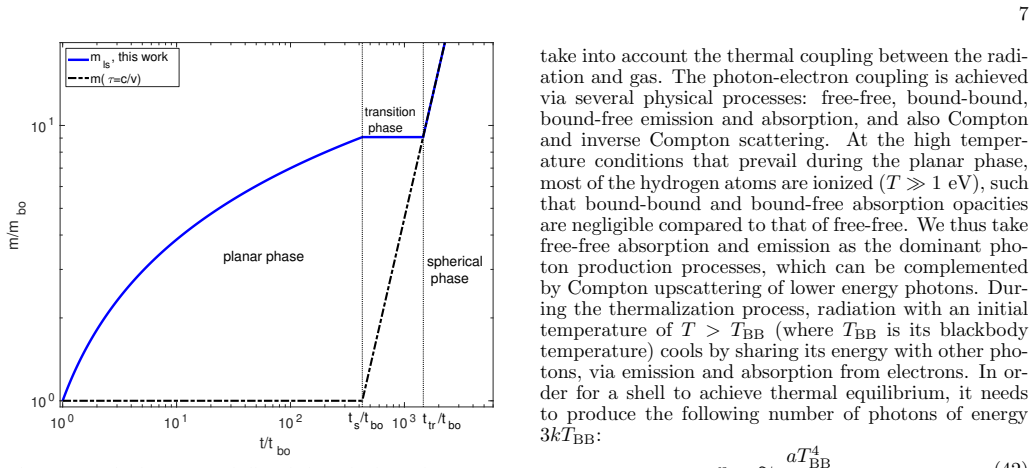
The engine of the argument is a two-stage self-similar construction. First the post-shock planar hydrodynamics is taken from the Sakurai shock solution, expressed in Lagrangian mass $m$, with density $\rho\propto (R-r)^n$ and shock velocity $v_{\rm sh}\propto (R-r)^{-\mu n}$. Then the energy-diffusion equation $\partial u/\partial t=-\partial(4\pi r^2 F)/\partial m-u/(3t)$ is transformed by normalizing mass and specific energy to the luminosity shell $m_{\rm ls}(t)$; requiring the transformed equation to be an ordinary differential equation fixes $m_{\rm ls}(t)$ to the logarithmic growth law. The same solution yields the outer diffusive energy profile $u\propto m^{-\mu n/(n+1)}$, whose flux sets the bolometric luminosity, and the thermal-coupling coefficient $\eta$ (free-free photon production versus the photon number needed for a blackbody) that sets the observed temperature.
What would settle it
Compute a numerical radiation-hydrodynamics model of a realistic RSG, BSG, or WR progenitor from breakout through the planar phase and track, in Lagrangian mass, the shell whose optical depth satisfies $\tau=c/v$ and the shell from which the escaping luminosity originates. If the emitting shell's mass stays within a few percent of $m_{\rm bo}$ rather than following $[1+\ln(t/t_{\rm bo})]^{(n+1)/(n+1-\mu n)}$ up to $\sim 10\,m_{\rm bo}$, the paper's central claim is wrong. A cheaper observational check is to measure the early temperature decline of a nearby type Ib/c supernova: the predicted steepening produces a drop to roughly 100 eV at the end of the planar phase, whereas the fixed-shell model keeps the radiation in hard X-rays.
Extended reading notes
Core claim
The paper's central claim is that the Lagrangian mass coordinate from which the observed post-breakout radiation escapes is not constant. Because the planar phase contains many dynamical times, photons from shells deeper than the breakout shell have time to diffuse outward and refill the outer diffusive profile; the shell from which luminosity effectively emerges therefore satisfies a growing condition rather than the naive $\tau=c/v$ condition. The self-similar solution forces this mass to grow as $m_{\rm ls}(t)=m_{\rm bo}[1+\ln(t/t_{\rm bo})]^{(n+1)/(n+1-\mu n)}$, reaching $m_{\rm pl}\approx 10\,m_{\rm bo}$ at the planar-to-spherical transition. This means the radiation observed during the planar phase originates in layers about ten times denser and with an order of magnitude more mass than the breakout shell. As a direct consequence the free-free photon production rate rises roughly a hundredfold, thermal coupling improves with time, and the observed temperature declines faster than adiabatic cooling alone would predict, although bolometric luminosity is almost unchanged because the internal luminosity profile is flat in mass.
Load-bearing premise
The calculation assumes the pre-explosion envelope is a single power-law density profile $\rho\propto (R-r)^n$ and that the Sakurai shock solution holds all the way to the stellar edge; if a realistic progenitor's density deviates over the shells swept by the receding luminosity shell, the logarithmic exponent and the factor of ten would change.
Editorial extensions
If this is right
- The bolometric luminosity stays close to $L\propto t^{-4/3}$, so light-curve observations alone will not reveal the correction.
- For blue supergiant and Wolf-Rayet explosions, radiation remains out of thermal equilibrium through the planar phase, but the observed peak shifts from X-rays toward the UV or soft X-ray band, with $T_{\rm obs}$ dropping by two orders of magnitude by the end of the phase.
- For red supergiant explosions, the radiation reaches thermal equilibrium during the planar phase, whereas previous fixed-shell models predicted a longer nonthermal phase.
- At the planar-to-spherical transition, the luminosity shell has grown to roughly $10m_{\rm bo}$ and the transition lasts about $3t_s$, after which the planar correction leaves no trace in the observed properties.
- Light-travel-time effects smear the early emission over a timescale $R/c$ and broaden the spectrum into a power law whose slope is set by the temperature decay index.
Reading between the lines
- If the correction holds, fast-cadence UV and soft-X-ray observations of nearby type Ib/c supernovae could measure the inward recession of the luminosity shell directly by fitting the predicted $[1+\ln(t/t_{\rm bo})]$ temperature slope, without resolving the breakout itself.
- The same Lagrangian-recession mechanism should appear in other radiation-dominated diffusion problems with power-law envelopes and many dynamical times, such as failed supernovae or neutron-star merger outflows, with the logarithmic exponent set by the local density index.
- Because the predicted breakout temperatures for Wolf-Rayet stars exceed the pair-production threshold near 50 keV, an extension that includes pair production could cap $T_{\rm obs}$ while preserving the density-enhancement effect on thermalization.
- Since the bolometric luminosity is almost insensitive to the correction, observers should prioritize spectral and temperature measurements in early-time surveys rather than relying on light-curve shape alone.
Signed reviews
Editorial analysis
A structured set of objections, weighed in public.
Referee Report
Summary. The paper derives a self-similar solution for the specific energy of radiation diffusing through a supernova envelope during the planar post-breakout phase, building on the Sakurai (1960) power-law hydrodynamic profiles. Its central claim is that the luminosity shell is not fixed at the breakout shell: the Lagrangian mass of the shell from which the observed radiation escapes grows logarithmically with time, m_ls(t) = m_bo [1 + ln(t/t_bo)]^{(n+1)/(n+1-\mu n)} (Eq. 23), reaching roughly 10 m_bo by the end of the planar phase. The authors argue that this logarithmic recession exposes regions about ten times denser than the breakout shell, enhancing free-free photon production and accelerating thermalization. They apply the result to RSG, BSG, and WR progenitors, and derive revised bolometric luminosities, observed temperatures, and the planar-to-spherical transition.
Significance. If the derivation is completed, the paper corrects a longstanding assumption in early supernova emission models: the planar-phase luminosity shell is not identical to the breakout shell. The claimed effect on the observed temperature, especially for BSG and WR explosions, is observationally consequential and would shift predicted early-time spectra from X-rays toward the UV/soft X-ray bands. The paper's self-similar framework is transparent, the exponents in the luminosity and temperature scalings are internally consistent, and the authors compare with previous analytic and numerically calibrated models rather than fitting their own output. The main quantitative claim, however, rests on an undetermined normalization in the derivation of Eq. (23), which must be addressed before the factor-of-ten result can be considered established.
major comments (2)
- [§4.2, Eqs. (22)–(24)] The derivation of Eq. (23) from Eq. (22) is incomplete and load-bearing. Integrating F'(t) F(t)^{-\mu n/(n+1)} ∝ t^{-1} with F(t_bo)=m_bo yields F(t) = m_bo [1 + A ln(t/t_bo)]^{(n+1)/(n+1-\mu n)}, where A is an undetermined combination of the proportionality constant in Eq. (22), the normalization m_bo^{\mu n/(n+1)}, and the exponent. The paper simply states Eq. (23) with A=1, and Eq. (24) builds that choice into the self-similar variables. The subsequent central estimate m_ls(t_s)≈10 m_bo and the associated 'density ~10 times higher' claim are controlled by A; for t_s/t_bo=10^3 and n=3/2, A=0.1 gives m_ls/m_bo≈1.8 while A=10 gives ≈120. The observation in the paragraph following Eq. (23) that the first leaking shell sits at m=0 when t=t_bo/e is a consequence of the A=1 choice, not an independent physical boundary condition, because the power-law profile is explicitly unrealistic as m→0. Please derive A by substituting a general ansatz for F(t) into Eq. (19) and enforcing that the transformed equation is time-independent, or equivalently show that the proportionality in Eq. (22) carries the required coefficient.
- [§8 and Eq. (23)] The quantitative application assumes a single power-law density profile ρ ∝ (R-r)^n over the entire radial range probed by the receding luminosity shell. The authors acknowledge this limitation in Section 8, but because the luminosity shell reaches ~10 m_bo, this range is not confined to the outermost envelope where the single power law is best calibrated. I request a quantitative sensitivity test, for example evaluating Eq. (23) for a broken power-law profile or against one of the MESA models mentioned in Section 8.1, to show that the factor ~10 is not an artifact of extrapolating the power law to larger depth.
minor comments (4)
- [§4.2] Please specify that log denotes the natural logarithm and show the intermediate integration step between Eq. (22) and Eq. (23), including the proportionality constant explicitly.
- [Tables 1 and 2] Table 1 is captioned for γ=5/3 while Table 2 is captioned for γ=4/3; please clarify which adiabatic index is used in the S60 shock solution and which is used for the radiation-dominated internal energy, and whether the table entries are consistent with the equations that follow.
- [§4.1 and §4.2] The order-of-magnitude estimate in Eq. (18) gives m_ls ≈ m_bo [2 log(t/...)]^{(n+1)/(n+1-\mu n)}, while the self-similar solution in Eq. (23) gives m_bo [1 + log(t/t_bo)]^{...}; a short paragraph reconciling the factor of two and the additive constant would help readers understand which prefactor is physical.
- [Abstract and §8] The abstract states that the observed temperature will decrease by two orders of magnitude, but the quantitative comparison with the uncorrected models in Figures 7 and 8 appears closer to one order of magnitude at the end of the planar phase; please state the comparison point explicitly so the claim is unambiguous.
Circularity Check
Eq. (23) sets an undetermined integration constant to unity, and the paper's headline factor-10 density/temperature predictions are powers of that choice.
-
self definitional
[Section 4.2, Eqs. (22)-(23); quantitative consequence in Eq. (32)]
"F′(t)·[F(t)]^{−µn/(n+1)} ∝ t^{−1} (22) with the initial condition F(t = tbo) = mbo. The two conditions above give the solution for F(t): mls(t) = F(t) = mbo [1 + log(t/tbo)]^{(n+1)/(n+1−µn)} (23)."
Eq. (22) is a first-order ODE with a free multiplicative constant (the ∝). Integrating it with F(tbo)=mbo gives F(t)=mbo[1+A ln(t/tbo)]^q with q=(n+1)/(n+1−µn), where A is undetermined. Eq. (23) is the A=1 member. The paper never derives A; the following remark that the first leaking shell sits at m=0 when t=tbo/e is a consequence of A=1, not an independent constraint. The headline factor mls(ts)/mbo≈10 in Eq. (32), the abstract's 'density is ∼10 times higher', and the two-order-of-magnitude temperature drop all evaluate [1+ln(ts/tbo)]^q with A=1; e.g. for ts/tbo=10^3 and n=3/2, A=1 gives ≈10, A=0.1 gives ≈1.8. Thus the central quantitative prediction is fixed by the arbitrary normalization placed in the self-similar variable (Eq. 24a), not derived from the diffusion equation.
full rationale
The hydrodynamic and diffusive ingredients are largely self-contained: the Sakurai power-law envelope and the planar self-similar profiles are external inputs, and no parameter is fitted to the predicted luminosity or temperature curves. The only self-citation is NS10, whose thermalization formalism is used in Section 6; that is a prior external framework invoked after the log-correction derivation, so it is not load-bearing for the central claim. However, the central quantitative claim is not fully derived. Eq. (22) fixes only F'(t)F(t)^{-μn/(n+1)} up to a constant; with the stated initial condition the general solution is F(t)=mbo[1+A ln(t/tbo)]^q, and Eq. (23) quietly sets A=1. The 't=tbo/e first leakage' remark restates that choice rather than deriving it, and the later factors mpl≈10mbo, density enhancement ∼10, and the two-order-of-magnitude temperature decrease are powers of [1+ln(ts/tbo)] evaluated with A=1. The qualitative logarithmic propagation survives for any A>0, so the paper is not wholly circular, but the advertised numerical predictions reduce by construction to an unstated normalization. The Section 8 caveat that the single power-law profile may not hold over the full radius range is a correctness/robustness limitation, not itself a circularity.
Assumptions & free parameters
free parameters (4)
- n =
3/2 or 3
- mu =
0.19
- C1, C2 =
C1~0.5, C2~0.9 (RSG); C1~0.35, C2~0.97 (BSG/WR)
- A =
1.17 (n=3/2), 0.97 (n=3)
assumptions (7)
- domain assumption Pre-explosion density is a pure power law in distance from the stellar edge, rho proportional to (R-r)^n
- domain assumption The Sakurai shock solution, derived without gravity, applies all the way to the stellar edge
- domain assumption Planar phase: radius nearly constant, shell width d ~ v t after width doubles, density proportional to t^{-1}
- domain assumption Fully ionized gas with Thomson scattering as the dominant opacity
- domain assumption Free-free emission is the dominant photon production process for thermalization
- standard math The diffusion equation for specific energy can be reduced to an ODE by a self-similar ansatz with the luminosity shell mass as the sole scale
- domain assumption During the planar phase, thermalization is assumed to occur in shells with mbo < m <= mls
Cite this review
Pith. "Pith review of Early supernova emission -- logarithmic corrections to the planar phase." pith.science (2026). https://pith.science/paper/RSJKWJIU
@misc{pith2026190806990,
  author       = {Pith},
  title        = {Pith review of: Early supernova emission -- logarithmic corrections to the planar phase},
  year         = {2026},
  howpublished = {\url{https://pith.science/paper/RSJKWJIU}},
  note         = {Machine review of arXiv:1908.06990}
}
abstract
When the shock wave generated in a supernova explosion breaks out of the stellar envelope, the first photons, typically in the X-ray to UV range, escape to the observer. Following this breakout emission, radiation from deeper shells diffuses out of the envelope as the supernova ejecta expands. Previous studies have shown that the radiation throughout the planar phase (i.e., before the expanding envelope has doubled its radius) originates in the same mass coordinate, called the `breakout shell'. We derive a self-similar solution for the radiation inside the envelope, and show that this claim is incorrect, and that the diffusion wave propagates logarithmically into the envelope (in Lagrangian sense) rather than remaining at a fixed mass coordinate. The logarithmic correction implies that the luminosity originates in regions where the density is $\sim 10$ times higher than previously thought, where the photon production rate is increased and helps thermalization. We show that this result has significant implications on the observed temperature. In our model, the radiation emitted from blue supergiant and Wolf-Rayet explosions is still expected to be out of thermal equilibrium during the entire planar phase, but the observed temperature will decrease by two orders of magnitude, contrary to previous estimates. Considering the conditions at the end of the planar phase, we also find how the temperature and luminosity transition into the spherical phase.
Figures


Figures from the paper (5 more)


Reference graph
Works this paper leans on
- [1]
- [2]
-
[3]
Chevalier, R. A. 1992, ApJ, 394, 599
work page 1992
- [4]
-
[5]
Colgate, S. A. 1974, ApJ, 187, 333
work page 1974
-
[6]
Dessart, L., & Hillier, D. J. 2018, arXiv e-prints, arXiv:1812.07620
work page Pith review arXiv 2018
-
[7]
1992, ApJ, 393, 742
Ensman, L., & Burrows, A. 1992, ApJ, 393, 742
1992
-
[8]
Falk, S. W. 1978, ApJ, 225, L133
work page 1978
Show all 28 references
-
[9]
S., Nadezhin, D
Imshennik, V. S., Nadezhin, D. K., & Utrobin, V. P. 1981, Ap&SS, 78, 105
1981
-
[10]
I., & Chevalier, R
Klein, R. I., & Chevalier, R. A. 1978, ApJ, 223, L109
1978
-
[11]
2007, ApJ, 658, L5
Maeda, K., Kawabata, K., Tanaka, M., et al. 2007, ApJ, 658, L5
2007
-
[12]
Malesani, D., Fynbo, J. P. U., Hjorth, J., et al. 2009, ApJ, 692, L84
2009
-
[13]
D., & McKee, C
Matzner, C. D., & McKee, C. F. 1999, ApJ, 510, 379
1999
-
[14]
A., Deng, J., Nomoto, K., et al
Mazzali, P. A., Deng, J., Nomoto, K., et al. 2006, Nature, 442, 1018
2006
-
[15]
Z., Garnavich, P
Modjaz, M., Stanek, K. Z., Garnavich, P. M., et al. 2006, ApJ, 645, L21
2006
-
[16]
L., Renzo, M., & Ott, C
Morozova, V., Piro, A. L., Renzo, M., & Ott, C. D. 2016, ApJ, 829, 109
2016
-
[17]
2010, ApJ, 725, 904 —
Nakar, E., & Sari, R. 2010, ApJ, 725, 904 —. 2012, ApJ, 747, 88
2010
-
[18]
2011, ApJS, 192, 3
Paxton, B., Bildsten, L., Dotter, A., et al. 2011, ApJS, 192, 3
2011
-
[19]
A., Masetti, N., et al
Pian, E., Mazzali, P. A., Masetti, N., et al. 2006, Nature, 442, 1011
2006
-
[20]
L., Chang, P., & Weinberg, N
Piro, A. L., Chang, P., & Weinberg, N. N. 2010, ApJ, 708, 598
2010
-
[21]
2011, ApJ, 728, 63
Rabinak, I., & Waxman, E. 2011, ApJ, 728, 63
2011
-
[22]
1960, Comm
Sakurai, A. 1960, Comm. Pure Appl. Math., 13, 353
1960
-
[23]
2016, ArXiv e-prints, arXiv:1610.05323
Shussman, T., Waldman, R., & Nakar, E. 2016, ArXiv e-prints, arXiv:1610.05323
2016 arXiv
-
[24]
M., Berger, E., Page, K
Soderberg, A. M., Berger, E., Page, K. L., et al. 2008, Nature, 453, 469
2008
-
[25]
1984, MNRAS, 209, 175
Svensson, R. 1984, MNRAS, 209, 175
1984
-
[26]
Weaver, T. A. 1976, ApJS, 32, 233
1976
-
[27]
E., Pinto, P
Woosley, S. E., Pinto, P. A., & Ensman, L. 1988, ApJ, 324, 466
1988
-
[28]
2008, in COSPAR Meeting, Vol
Xu, D., Watson, D., Fynbo, J., et al. 2008, in COSPAR Meeting, Vol. 37, 37th COSPAR Scientific Assembly, 3512
2008
Reviewed August 14, 2026 · model on record in the stance chip above.
Discussion (0). Continue with ORCID to comment.