REVIEW 3 major objections 6 minor 45 references
Evaluating the Impact of Detector Design on Jet Flavor Tagging for Future Colliders
T0 review · 3 major / 6 minor · reviewed 2026-08-10 · deepseek-v4-flash
Pith's one-line read Particle-ID capability, not calorimeter precision, drives jet-flavor tagging differences between future collider detector designs.
desk verdict Useful framework and SiD variation scan, but the headline PID claim rests on a detector model that assigns drift-chamber cluster counting to a silicon-tracker concept. read the letter →
The pith
A machine-rendered reading of the paper's core claim, the machinery that carries it, and where it could break.
The reading
What carries the argument
The central object is ParticleNetIdea, a graph neural network that represents each jet as a graph of up to 75 constituents with 34 input features including relative kinematics, track-related variables, and particle-identification variables, trained with cross-entropy loss and evaluated with ROC curves and mistag rates. It sits on top of three Delphes modules that carry the detector comparison: TimeOfFlight, which infers particle masses from time-of-flight; ClusterCounting, which infers them from ionization cluster counting; and TrackCovariance, which estimates track parameters and their covariances from the detector geometry. These modules provide the PID information that the paper identifies as the main source of the s-tagging gap between detector concepts.
What would settle it
A full Geant4-based simulation of the same three detector concepts, processed with the same ParticleNetIdea tagger and the same ZH samples, would falsify the central claim if the s-tagging mistag-rate advantage of IDEA and FCCeeDetWithSiTracking over SiD fell below the reported 1.4 times at the 90% efficiency working point.
Extended reading notes
Core claim
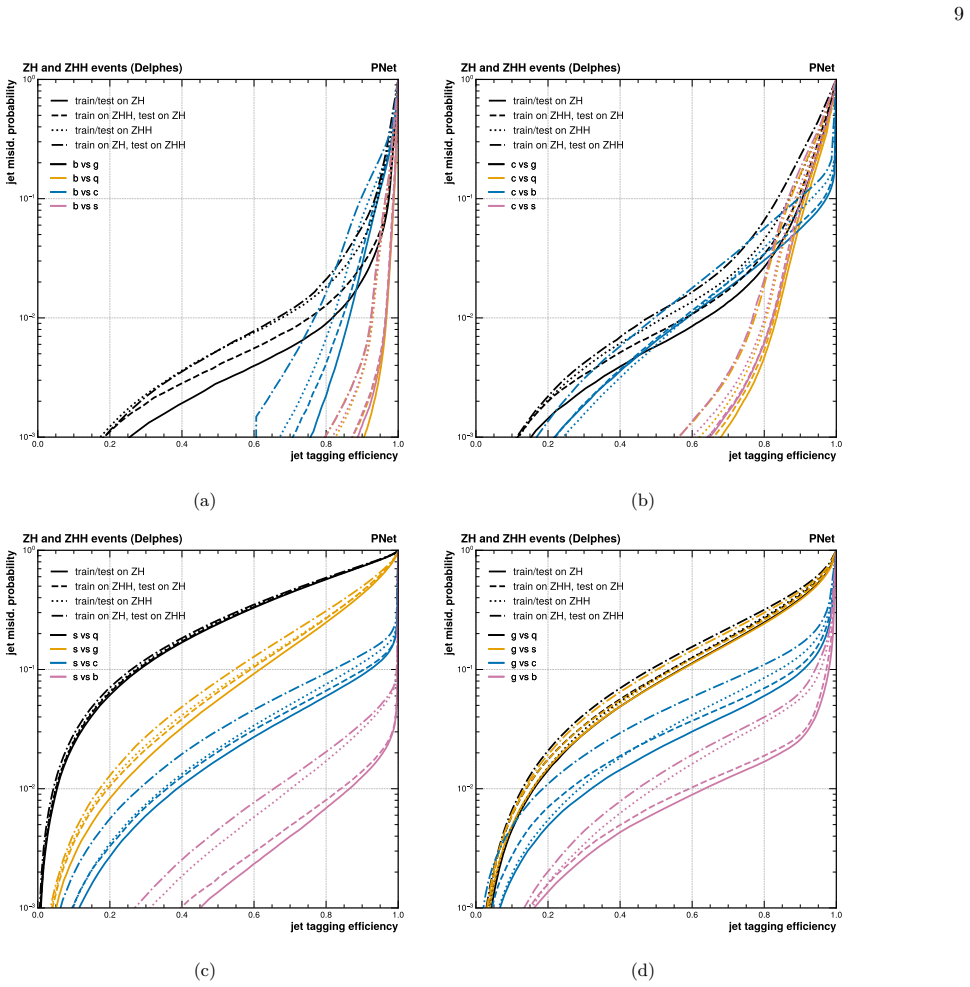
Using a unified framework based on Delphes fast simulation and the ParticleNetIdea graph-neural-network tagger, the paper claims that IDEA and FCCeeDetWithSiTracking outperform the all-silicon SiD detector in overall jet flavor discrimination, with their dedicated particle identification via time-of-flight and cluster counting emerging as the key differentiating factor. The advantage is most pronounced for s-tagging, where the mistag rates at 80% and 90% signal efficiency are 1.4 to 2.5 times larger at SiD than at the other two detectors. The paper further claims that varying the SiD ECAL and HCAL energy and spatial resolutions over wide ranges leaves mistag rates essentially stable, while moving the first vertex barrel layer from 10 to 16 mm causes only modest degradation in b- and c-tagging; it also reports that training a tagger at 250 GeV and applying it at 550 GeV, or vice versa, can change mistag rates by up to an order of magnitude.
Load-bearing premise
The fast-simulation models, including the assumed time-of-flight resolutions of 3–30 ps and the cluster-counting efficiencies, faithfully reproduce the relative detector response relevant to flavor tagging, so the PID advantage seen for IDEA and FCCeeDetWithSiTracking is not a simulation artifact.
Editorial extensions
If this is right
- Future e+e− detector concepts without dedicated particle ID should expect a 1.4–2.5 times higher s-jet mistag rate at fixed signal efficiency than concepts with TOF and cluster counting.
- Calorimeter energy and spatial resolution can be relaxed substantially without compromising flavor tagging, opening a potential cost-saving direction for detector optimization, provided other physics benchmarks are maintained.
- Jet-flavor taggers trained at one center-of-mass energy perform markedly worse when applied at another, so future collider experiments will need matched or reweighted training samples.
- The first vertex barrel layer can be placed at radii up to 16 mm with only modest losses in b- and c-tagging, giving vertex-detector designers additional flexibility.
- The flexible Delphes-plus-GNN framework allows rapid re-evaluation of tagging performance as detector designs evolve, providing direct feedback during design optimization.
Reading between the lines
- The PID advantage seen for s-tagging likely extends beyond strange jets: the paper itself reports 1.2–2 times lower mistag rates for gluon tagging with PID, suggesting kaon/pion separation helps in multiple flavor categories, though the effect is strongest for s-jets.
- The observed robustness to calorimeter degradation is specific to flavor tagging; other flagship measurements such as H → γγ and W/Z separation still demand excellent calorimetry, so the cost-saving implication does not generalize without those benchmarks.
- The large center-of-mass energy dependence suggests that a tagger trained on a mixture of ZH and ZHH samples, or on momentum-reweighted samples, could achieve more portable performance; this is a testable extension the paper does not perform.
- Since beam-induced background is not included in the fast simulation, the absolute and relative mistag rates could shift once such backgrounds are added, particularly for tracking-based and PID-based variables.
Editorial analysis
A structured set of objections, weighed in public.
Referee Report
Summary. This paper presents a Delphes fast-simulation study of jet flavor tagging with the ParticleNetIdea graph-network tagger for three future e+e- detector concepts: SiD, IDEA, and FCCeeDetWithSiTracking. Using identical ZH events, PFO reconstruction, and training setup, the authors compare ROC curves and mistag rates for b, c, s, and g tagging, and also scan SiD vertex-geometry and ECAL/HCAL resolution parameters and the center-of-mass energy. The main reported findings are that IDEA and FCCeeDetWithSiTracking outperform SiD, most strongly in s-tagging, an effect attributed to TOF and cluster-counting PID, and that flavor tagging is robust to large calorimeter resolution variations.
Significance. The paper's strengths are its unified comparison framework—same generator samples, same tagger, same analysis for all detector models—and the public release of the code and SiD Delphes card. The study also makes a useful, falsifiable statement: detector PID, not calorimeter resolution, is the main lever for s-tagging at future e+e- colliders, with implications for cost optimization. However, the central attribution is weakened by an internal inconsistency in the FCCeeDetWithSiTracking model: cluster counting is assigned to a silicon-tracker concept that cannot provide it. Until that model is corrected or justified, the quantitative ordering among detectors and the 'PID is key' conclusion are not established. The fast-simulation-only validation and absence of statistical uncertainties are secondary but related concerns.
major comments (3)
- [II B, Table I, III A] Section II B defines FCCeeDetWithSiTracking as an IDEA-like detector with its tracking system replaced by CLD's silicon tracker, yet Table I marks 'Cluster Counting dN/dx' as available for this concept, and Section III A says that 'cluster counting information assuming the IDEA drift chamber' contributes to its PID. Ionization cluster counting requires a gas-filled drift chamber; a silicon-only tracker cannot provide this information. The reported s-tagging advantage of FCCeeDetWithSiTracking over SiD, and the conclusion that PID is the key differentiator, therefore rests at least partly on a capability from a subdetector that the concept does not contain. Please remove cluster counting from the FCCeeDetWithSiTracking model and re-train/re-evaluate, or provide a convincing physics justification for why a silicon tracker can supply equivalent dN/dx information. If cluster counting is removed, FCCeeDetWithSiTracking would retain only 30 ps TOF, which is worse than SiD's 10 ps, so the ordering could change.
- [III A, Table II] Table II and Fig. 1 quote mistag rates and AUC values to four decimal places without uncertainties. The central quantitative claims—e.g., '1.4–2.5 times' lower s-tagging mistag rates for IDEA/FCCeeDetWithSiTracking and the statement that IDEA and FCCeeDetWithSiTracking are only mildly different—require at least binomial or bootstrap confidence intervals on the test set, which is 15% of 2e6 jets per flavor. Without error bars, it is not possible to tell whether the observed ordering is statistically significant, especially for the sub-percent b/c mistag rates and for the close AUC values between IDEA and FCCeeDetWithSiTracking.
- [II A, III A] The fast-simulation PID modules carry the main physics message, but their fidelity is not tested. Section II A acknowledges that Delphes 'may lead to more optimistic performance' and calls for Geant4 validation, yet the conclusion that TOF plus cluster counting is the key differentiator rests on the assumed 3 ps/30 ps TOF resolutions and on the ClusterCounting module's efficiencies. Please add a sensitivity study, for example degrading or removing each PID input in the IDEA model, or a comparison against full simulation for at least one configuration, so that the robustness of the detector ordering to these model assumptions is demonstrated.
minor comments (6)
- [Table I] The FCCeeDetWithSiTracking column appears to omit the magnetic-field value; please fill in the missing entry, presumably 2 T.
- [Table II] The three detector configurations are distinguished only by color in the table body; add explicit labels or symbols so the table is interpretable in grayscale and for color-blind readers.
- [Eq. (3)] The symbol B is used for the background flavor in Eq. (3) while B elsewhere denotes bottom-quark jets; rename the integration variable to avoid ambiguity.
- [III A, Conclusions] The 'up to 2.5 times' factor for s-tagging is not directly traceable to Table II; please specify the exact working point and background flavor used, as several ratios visible in the table are closer to 1.5–2.
- [Fig. 2] The baseline configuration is indicated only by thicker vertical lines; add an explicit legend entry or axis annotation identifying the nominal SiD values for each variation scan.
- [II C] The labels 'ParticleNetIdea' in Section II C and 'PNet' in the figures are used interchangeably; define the shorthand on first use.
Circularity Check
No significant circularity: the detector comparison is an empirical fast-simulation benchmark with a fixed tagger, and the only minor self-citation burden does not make the central claim reduce to its inputs.
full rationale
The paper's central comparison is an empirical fast-simulation study, not a derivation. ParticleNetIdea is a fixed architecture inherited from prior work and is applied identically to all detector configurations; no tagger parameter or physics parameter is fitted to the reported mistag rates. The s-tagging advantage of IDEA and FCCeeDetWithSiTracking over SiD is the ROC output of the Delphes detector cards, so it does not reduce by construction to an algebraic identity or to a fitted parameter renamed as a prediction. The main self-citation is [20] (Bedeschi-Gouskos-Selvaggi), which is used for the tagger implementation and for the statement that cluster counting provides most of the PID gain. This attribution is somewhat load-bearing for the qualitative conclusion, but [20] is an external, separately published simulation study with its own inputs, and the present paper provides independent raw ROC evidence from three detector cards; therefore the citation is not the sole justification and does not make the present result circular. The noted inconsistency that FCCeeDetWithSiTracking is assigned drift-chamber cluster counting despite its CLD silicon tracker (Section II B vs. Table I and Section III A) is a modeling-fidelity or internal-consistency concern rather than a circularity: the paper explicitly states the 'assuming the IDEA drift chamber' assumption, and the conclusion follows from the simulation only in the ordinary sense that simulation outputs depend on simulation inputs. The paper also appropriately flags the limitations of fast simulation and the need for Geant4 validation in Sections II A and IV. Overall, no significant circularity is found; score 2 reflects only a minor self-citation burden.
Assumptions & free parameters
free parameters (4)
- SiD vertex and tracker single-hit spatial resolution =
3x3 um2 vertex, 7x7 um2 tracker
- SiD ECAL energy resolution stochastic term and transverse granularity =
S=12.2%, sigma_xy=0.1 cm
- SiD HCAL energy resolution stochastic term and transverse granularity =
S=46%, sigma_xy=3 cm
- TOF resolution values per detector =
SiD 10 ps, IDEA 3 ps, FCCeeDetWithSiTracking 30 ps
assumptions (5)
- domain assumption Delphes fast simulation parameterizations are adequate proxies for full Geant4 detector simulation for flavor tagging comparisons.
- domain assumption The updated SiD detector parameters represent the SiD concept as foreseen in [27].
- domain assumption TOF and cluster-counting PID modules in Delphes model realistic PID performance for IDEA and FCCeeDetWithSiTracking.
- domain assumption Beam-induced background has small impact on flavor tagging.
- domain assumption Pythia6 and Whizard event generation with the exclusive Durham kT clustering provide adequate samples for tagger training.
Cite this review
Pith. "Pith review of Evaluating the Impact of Detector Design on Jet Flavor Tagging for Future Colliders." pith.science (2026). https://pith.science/paper/RSUDWULD
@misc{pith2026250116584,
  author       = {Pith},
  title        = {Pith review of: Evaluating the Impact of Detector Design on Jet Flavor Tagging for Future Colliders},
  year         = {2026},
  howpublished = {\url{https://pith.science/paper/RSUDWULD}},
  note         = {Machine review of arXiv:2501.16584}
}
abstract
Jet flavor tagging is of utmost importance for unlocking the full physics potential of any future collider experiment. The performance of any jet flavor identification algorithm depends both on its underlying architecture and on the detector's design and capabilities. In this work, we present an analysis of the dependence of jet tagging algorithm performance on three detector designs being considered for future $e^{+}e^{-}$ colliders. To fully exploit the potential of these detector concepts, we utilize a graph neural network-based jet tagging algorithm. In addition, we evaluate the impact on the jet tagging performance of variations in the tracking and calorimeter systems for one of these detector concepts, the SiD detector, as well as the dependence on the center-of-mass energy.
Figures


Reference graph
Works this paper leans on
-
[1]
M. Thomson, Eur. Phys. J. C 76, 72 (2016), arXiv:1509.02853 [hep-ex]
work page Pith review arXiv 2016
-
[2]
The International Linear Collider: Report to Snowmass 2021,
A. Aryshev et al. (ILC International Development Team), “The International Linear Collider: Report to Snowmass 2021,” (2022), arXiv:2203.07622 [physics.acc-ph]
arXiv 2022
- [3]
-
[4]
P. Azzi, L. Gouskos, M. Selvaggi, and F. Simon, Eur. Phys. J. Plus 137, 39 (2022), arXiv:2107.05003 [hep-ex]
arXiv 2022
-
[5]
S. Banerjee et al. (Heavy Flavor Averaging Group (HFLAV)), “Averages ofb-hadron, c-hadron, and τ-lepton properties as 9 0.0 0.2 0.4 0.6 0.8 1.0 jet tagging efficiency 10 3 10 2 10 1 100 jet misid. probability ZH and ZHH events (Delphes) PNet train/test on ZH train on ZHH, test on ZH train/test on ZHH train on ZH, test on ZHH b vs g b vs q b vs c b vs s b ...
arXiv 2024
-
[6]
Albert et al., in Snowmass 2021 (2022) arXiv:2203.07535 [hep-ex]
A. Albert et al., in Snowmass 2021 (2022) arXiv:2203.07535 [hep-ex]
arXiv 2022
-
[7]
E. Bols, J. Kieseler, M. Verzetti, M. Stoye, and A. Stakia, JINST 15, P12012 (2020), arXiv:2008.10519 [hep-ex]
arXiv 2020
- [8]
Show all 45 references
-
[9]
H. Qu, C. Li, and S. Qian, in Proceedings of the 39th Inter- national Conference on Machine Learning , Vol. 162 (PMLR, 2022)
2022
-
[10]
ATLAS Collaboration, Graph Neural Network Jet Flavour Tagging with the ATLAS Detector , Technical Report ATL- PHYS-PUB-2022-027 (CERN, 2022)
2022
-
[11]
A. M. Sirunyan et al. (CMS), JINST 12, P10003 (2017), arXiv:1706.04965 [physics.ins-det]
2017 arXiv
-
[12]
M. A. Thomson, Nucl. Instrum. Meth. A 611, 25 (2009), arXiv:0907.3577 [physics.ins-det]. 10
2009 arXiv
-
[13]
de Favereau, C
J. de Favereau, C. Delaere, P. Demin, A. Giammanco, V. Lemaˆ ıtre, A. Mertens, and M. Selvaggi (DELPHES 3), JHEP 02, 057 (2014), arXiv:1307.6346 [hep-ex]
2014 arXiv
-
[14]
Agostinelli et al
S. Agostinelli et al. (GEANT4), Nucl. Instrum. Meth. A 506, 250 (2003)
2003
-
[15]
TimeOfFlight module in Delphes,
“ TimeOfFlight module in Delphes,” https://github.com/ delphes/delphes/blob/master/modules/TimeOfFlight.cc (2021)
2021
-
[16]
ClusterCounting module in Delphes,
“ ClusterCounting module in Delphes,” https: //github.com/delphes/delphes/blob/master/modules/ ClusterCounting.cc (2021)
2021
-
[17]
TrackCovariance module in Delphes,
“ TrackCovariance module in Delphes,” https: //github.com/delphes/delphes/blob/master/modules/ TrackCovariance.cc (2020)
2020
-
[18]
Jet Flavour Tagging at FCC- ee with a Transformer-based Neural Network: DeepJetTrans- former,
F. Blekman, F. Canelli, A. D. Moor, K. Gautam, A. Ilg, A. Macchiolo, and E. Ploerer, “Jet Flavour Tagging at FCC- ee with a Transformer-based Neural Network: DeepJetTrans- former,” (2024), arXiv:2406.08590 [hep-ex]
2024 arXiv
-
[19]
J. S. Marshall and M. A. Thomson, in International Confer- ence on Calorimetry for the High Energy Frontier (2013) pp. 305–315, arXiv:1308.4537 [physics.ins-det]
2013 arXiv
-
[20]
Bedeschi, L
F. Bedeschi, L. Gouskos, and M. Selvaggi, Eur. Phys. J. C 82, 646 (2022), arXiv:2202.03285 [hep-ex]
2022 arXiv
-
[21]
SiD Collaboration, SiD Letter of Intent, Tech. Rep. SLAC-R- 989, FERMILAB-LOI-2009-01, FERMILAB-PUB-09-681-E (SLAC, 2009) arXiv:0911.0006 [physics.ins-det]
2009 arXiv
-
[22]
FCC-ee IDEA detector Delphes card,
“FCC-ee IDEA detector Delphes card,” https: //github.com/delphes/delphes/blob/master/cards/ delphes_card_IDEA.tcl (Accessed: December, 2024)
2024
-
[23]
FCC-ee detector with Si tracking Delphes card,
“FCC-ee detector with Si tracking Delphes card,” https://github.com/delphes/delphes/blob/master/ cards/delphes_card_FCCeeDetWithSiTracking.tcl (Ac- cessed: December, 2024)
2024
-
[24]
CLD – A Detector Concept for the FCC- ee,
N. Bacchetta et al., “CLD – A Detector Concept for the FCC- ee,” (2019), arXiv:1911.12230 [physics.ins-det]
2019 arXiv
-
[25]
C. T. Potter, in International Workshop on Future Linear Colliders (2016) arXiv:1602.07748 [hep-ph]
2016 arXiv
-
[26]
The International Linear Collider Technical Design Report - Volume 4: Detectors,
H. Abramowicz et al. , “The International Linear Collider Technical Design Report - Volume 4: Detectors,” (2013), arXiv:1306.6329 [physics.ins-det]
2013 arXiv
-
[27]
Updating the SiD Detector concept,
M. Breidenbach, J. E. Brau, P. Burrows, T. Markiewicz, M. Stanitzki, J. Strube, and A. P. White, “Updating the SiD Detector concept,” (2021), arXiv:2110.09965 [physics.ins- det]
2021
-
[28]
Monolithic Active Pixel Sensors on CMOS technologies,
N. Apadula et al., “Monolithic Active Pixel Sensors on CMOS technologies,” (2022), arXiv:2203.07626 [physics.ins-det]
2022 arXiv
-
[29]
J. E. Brau, M. Breidenbach, A. Habib, L. Rota, and C. Vernieri, Instruments 6, 51 (2022)
2022
-
[30]
315, 03005 (2024)
Brau, James E., Breidenbach, Martin, Dragone, Angelo, Habib, Alexandre, Rota, Lorenzo, Vassilev, Mirella, and Vernieri, Caterina, EPJ Web Conf. 315, 03005 (2024)
2024
-
[31]
Sefkow, A
F. Sefkow, A. White, K. Kawagoe, R. P¨ oschl, and J. Re- pond, Rev. Mod. Phys. 88, 015003 (2016), arXiv:1507.05893 [physics.ins-det]
2016 arXiv
-
[32]
SiD detector Delphes card,
D. Ntounis, “SiD detector Delphes card,” https://github. com/dntounis/SiD_Delphes (2024)
2024
-
[33]
Navas et al
S. Navas et al. (Particle Data Group), Phys. Rev. D 110, 030001 (2024)
2024
-
[34]
Kilian, T
W. Kilian, T. Ohl, and J. Reuter, Eur. Phys. J. C 71, 1742 (2011), arXiv:0708.4233 [hep-ph]
2011 arXiv
-
[35]
O’Mega: An Optimizing matrix element generator,
M. Moretti, T. Ohl, and J. Reuter, “O’Mega: An Optimizing matrix element generator,” (2001), arXiv:hep-ph/0102195
2001 arXiv
-
[36]
Sjostrand, S
T. Sjostrand, S. Mrenna, and P. Z. Skands, JHEP 05, 026 (2006), arXiv:hep-ph/0603175
2006 arXiv
-
[37]
HEP-FCC/FCCAnalyses: v0.10.0,
C. Helsens, E. Perez, M. Selvaggi, V. Volkl, L. Forthomme, and J. Munch Torndal, “HEP-FCC/FCCAnalyses: v0.10.0,” (2024)
2024
-
[38]
Cacciari, G
M. Cacciari, G. P. Salam, and G. Soyez, Eur. Phys. J. C 72, 1896 (2012), arXiv:1111.6097 [hep-ph]
2012 arXiv
-
[39]
Catani, Y
S. Catani, Y. L. Dokshitzer, M. Olsson, G. Turnock, and B. R. Webber, Phys. Lett. B 269, 432 (1991)
1991
-
[40]
weaver-core package,
H. Qu, “ weaver-core package,” https://github.com/ hqucms/weaver-core
-
[41]
Ranger - a synergistic optimizer
L. Wright, “Ranger - a synergistic optimizer. ” https:// github.com/lessw2020/Ranger-Deep-Learning-Optimizer (2019)
2019
-
[42]
CMS Collaboration, A unified approach for jet tagging in Run 3 at√s=13.6 TeV in CMS, Detector Performance Note CMS-DP-2024-066 (CERN, 2024)
2024
-
[43]
CEPC Conceptual Design Report: Volume 2 - Physics & Detector,
M. Dong et al. (CEPC Study Group), “CEPC Conceptual Design Report: Volume 2 - Physics & Detector,” (2018), arXiv:1811.10545 [hep-ex]
2018 arXiv
-
[44]
ILC Collaboration, The International Linear Collider Tech- nical Design Report - Volume 2: Physics , Technical Design Report ILC-REPORT-2013-040 (2013) arXiv:1306.6352 [hep- ph]
2013 arXiv
-
[45]
Vernieri, E
C. Vernieri, E. A. Nanni, S. Dasu, M. E. Peskin, T. Bark- low, R. Bartoldus, P. C. Bhat, K. Black, J. E. Brau, and M. Breidenbach, JINST18, P07053 (2023), arXiv:2110.15800 [hep-ex]
2023 arXiv
Reviewed August 10, 2026 · model on record in the stance chip above.
Discussion (0). Continue with ORCID to comment.