REVIEW 2 major objections 4 minor 1 cited by
Crossing bridges between percolation models and Bienaym\'e-Galton-Watson trees
T0 review · 2 major / 4 minor · reviewed 2026-08-12 · deepseek-v4-flash
Pith's one-line read The critical Divide-and-Color percolation threshold on a supercritical Galton-Watson tree, conditioned on non-extinction, is $(1 - m a_\emptyset)/(m(1 - a_\emptyset))$, which locates the appearance of infinite same-type families in the…
desk verdict A mostly survey paper with a genuinely new DaC/MIM correspondence and a threshold theorem that is correct in substance but printed with an indexing error in the MIM law. read the letter →
The pith
A machine-rendered reading of the paper's core claim, the machinery that carries it, and where it could break.
The reading
What carries the argument
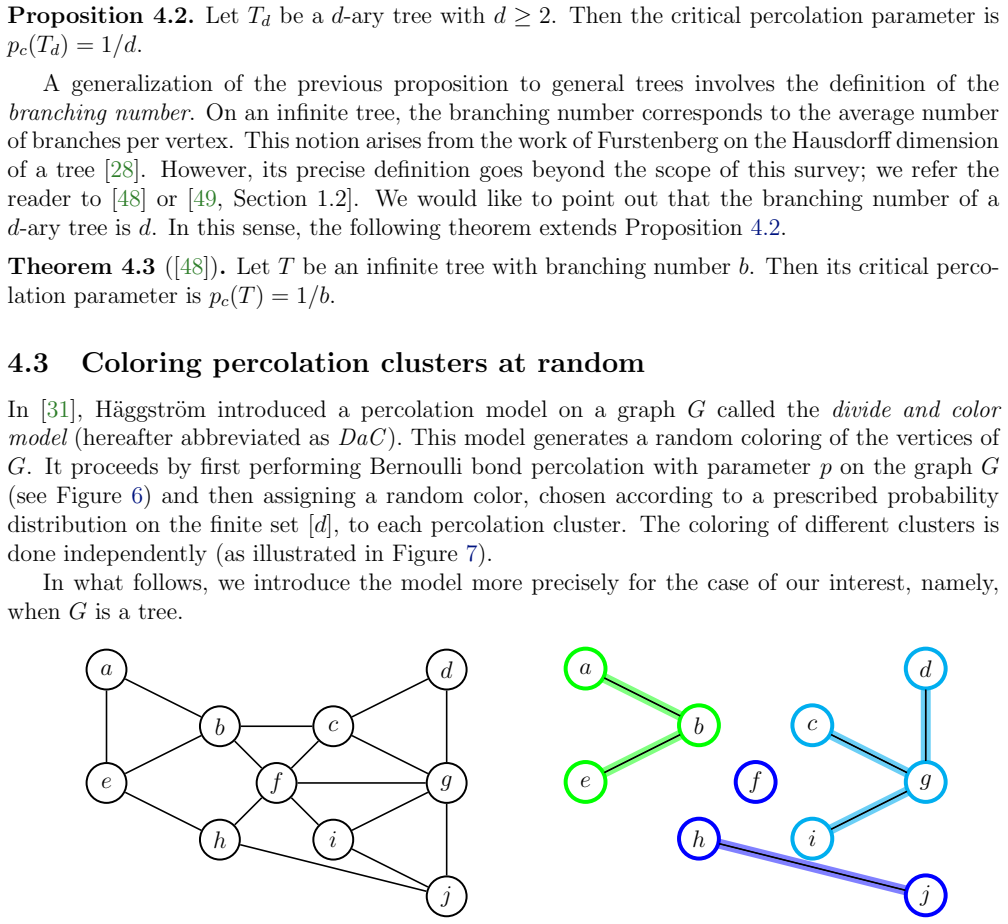
The key machinery is the exploration argument for Divide-and-Color percolation on trees. It observes that, for a fixed percolation configuration, a child of a vertex either belongs to the same percolation cluster as its parent, which happens with probability $p$, or belongs to a different cluster independently assigned the parent's color, which happens with probability $(1-p)a_\emptyset$; hence the child inherits the parent's color with probability $\tilde p = p+(1-p)a_\emptyset = 1-(1-p)(1-a_\emptyset)$. This reduces the same-color connected component of the root to a Bernoulli bond-percolation cluster at parameter $\tilde p$, and the known critical value $1/m$ for BGW trees conditioned on non-extinction then yields the formula by solving $\tilde p = 1/m$ for $p$.
What would settle it
Take a BGW tree with offspring distribution $P(\xi=0)=0.1$ and $P(\xi=3)=0.9$, so $m=2.7$, set $a_\emptyset=0.3$, and compute the claimed threshold $p=(1-2.7\cdot 0.3)/(2.7\cdot 0.7)\approx 0.1005$. Use dynamic programming over the first $n$ generations to compute the probability that the root's same-color DaC component reaches depth $n$; the claimed distributional equivalence predicts survival probability $0$ at this $p$ and positive survival only for $p$ above it. If the recursion gives positive survival at the claimed threshold, the identification of the color component with a Bernoulli($\tilde p$) percolation cluster on a random BGW tree fails.
Extended reading notes
Core claim
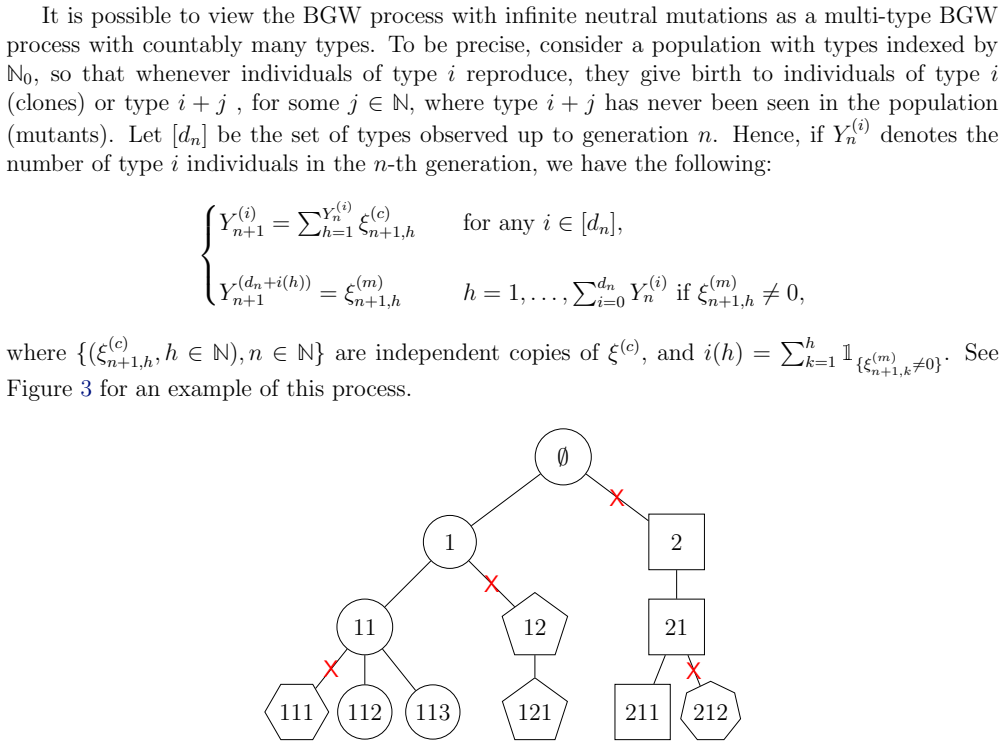
The paper's central discovery is that two apparently different probability models are the same object viewed from two directions, plus a new threshold for one of them. On a BGW tree, Bernoulli bond percolation with parameter $1-r$ reproduces the allelic partition of a BGW process with infinite neutral alleles: open edges are clone edges and closed edges are mutations. For finitely many alleles, the paper proposes that Divide-and-Color percolation, bond percolation followed by independent random coloring of clusters, matches the mother-independent mutation (MIM) model, while the restricted Divide-and-Color model, in which a daughter cluster cannot inherit its mother's color, matches the mother-dependent model. Theorem 5.2 asserts that on a supercritical BGW tree conditioned on non-extinction, the root's same-color component is distributed as the cluster of the root in Bernoulli bond percolation at effective parameter $\tilde p = 1-(1-p)(1-a_\emptyset)$; consequently the critical value of $p$ is $(1-m a_\emptyset)/(m(1-a_\emptyset))$ almost surely, and the probabilities that an infinite same-type subtree exists and that the root's type-subtree is infinite both switch at this threshold.
Load-bearing premise
The load-bearing assumption is that on a random Galton-Watson tree the root's same-color Divide-and-Color component has exactly the distribution of a Bernoulli bond-percolation cluster at effective parameter $\tilde p = 1-(1-p)(1-a_\emptyset)$, with the critical value $1/m$ applying after conditioning on non-extinction; the paper imports this identification from the deterministic-tree case rather than proving it for random trees.
Editorial extensions
If this is right
- For the mother-independent finite-allele model with $d$ equally likely alleles, so $a_\emptyset=1/d$, an infinite same-type family appears if and only if $1-r$ exceeds $(1-m/d)/(m(1-1/d))$.
- For the mother-dependent mutation model, the restricted Divide-and-Color construction gives the same $1/m$ critical condition, so its infinite-type phase transition is governed by the same Bernoulli-percolation threshold.
- The infinite-allele neutral-mutation model and Bernoulli percolation on a BGW tree are the same construction, so percolation theorems on BGW trees translate directly into statements about infinite allelic subtrees.
- Conditioned on non-extinction, the threshold depends only on the mean $m$ and the color probability $a_\emptyset$, not on finer details of the offspring distribution.
Reading between the lines
- The distributional identification in Theorem 5.2 is carried from deterministic trees to random BGW trees by analogy; if it holds only for the event of an infinite component rather than for the full law of the root's color cluster, the threshold derivation would need an extra step.
- The formula implies that with $d$ uniform alleles the critical mutation rate is $r_c = d(m-1)/(m(d-1))$, which decreases as $d$ grows, so larger allele repertoires make an infinite same-type family harder to maintain and require a smaller mutation rate.
- Because the threshold is a function of $m$ alone, the same formula should describe every BGW tree with the same mean offspring, giving a testable universal prediction for finite-allele mutation models on random genealogies.
Signed reviews
Editorial analysis
A structured set of objections, weighed in public.
Referee Report
Summary. This paper is a survey of connections between percolation models and Bienaymé–Galton–Watson (BGW) branching structures. It reviews Bernoulli bond percolation on trees, the infinite-allele neutral mutation model, and Haggström's Divide-and-Color (DaC) percolation. Its main new contribution is Theorem 5.2, which claims that for a BGW tree with mean offspring number m>1 and conditioning on non-extinction, the critical DaC percolation parameter is ep_T^c = (1 - m a_∅)/(m(1 - a_∅)) almost surely. The paper also introduces two finite-allele mutation models, the mother-dependent model (MDM) and the mother-independent model (MIM), and claims a distributional correspondence between MIM and DaC percolation and between MDM and a restricted DaC model.
Significance. If Theorem 5.2 is correct, it genuinely extends Haggström's phase-transition result from deterministic trees to random BGW trees conditioned on non-extinction, and it gives a phase-transition threshold for a finite-allele neutral mutation model. The theorem is obtained by combining external known results—Lyons' p_c = 1/m for BGW trees and Haggström's exploration equivalence—rather than by a fully self-contained proof, but the claimed threshold is falsifiable and, as the stress-test discussion confirms, the proof can be made rigorous through Proposition 4.5 without full distributional equality. The expository portions of the paper are well organized and useful. No machine-checked proofs or code are provided, but the main result is elementary enough that this is not a barrier.
major comments (2)
- [§3.4.2, Eq. (7); §5.1.2, Eq. (14)] The summation in the MIM offspring distribution starts at k=1, where k denotes the number of clone children. The case k=0 must be included: a mother can have zero clone children, and both the mechanism described in §3.4.2 and the DaC model assign positive probability to that event. As printed, Eq. (7) gives probability 0 to every configuration with v_i=0, so the claimed coincidence with the DaC measure in §5.1.2 is false as written. The lower summation limit should be changed from 1 to 0.
- [Theorem 5.2, proof in §5.2.2] The proof states that the same-color connected component containing a given vertex 'is distributed as in Bernoulli percolation' with parameter ep, but it gives no proof of this distributional identification for the random-tree case. As written, Proposition 4.5 only establishes equivalence of positive probability of an infinite component, not full distributional equality. Since only the threshold is needed, the equivalence in Proposition 4.5 combined with Theorem 5.1 suffices to derive the stated formula; the proof should be expanded along those lines, explicitly invoking the exploration coupling or citing it precisely in the BGW setting.
minor comments (4)
- [§4.3.1, Proposition 4.5] The symbol a_∅ is used in the statement and proof but is not defined in the proposition; it should be defined as the probability that a percolation cluster receives the same color as the root (i.e., a_1 in the two-color case).
- [§5.2.2, Eqs. (21)–(22)] The interpretation of Theorem 5.2 for the MIM model should display the substitutions p = 1-r and a_∅ = 1/d before writing conditions in terms of 1-r, so that the comparison between the mutation parameter and ep_T^c is explicit.
- [References] References [25] and [26] contain the typo 'Phyisica' instead of 'Physica'; the spelling of Haggström should also be made consistent throughout.
- [§2.2 and §3.1] The notation for the number of offspring of a vertex is ku(t) in §2.2 but k∅(T) in §3.1; using one convention throughout would improve readability.
Circularity Check
No significant circularity: Theorem 5.2 composes external results (Haggstrom's DaC exploration equivalence and Lyons' p_c=1/m) rather than fitting or self-referential derivation; the only self-citation [12] is background and non-load-bearing.
full rationale
The paper's central new result, Theorem 5.2, is not derived from its own assumptions by construction. Its proof invokes the deterministic DaC exploration equivalence (Proposition 4.4/4.5, credited to Haggstrom [31]) to replace the same-color component with Bernoulli bond percolation at parameter ep = 1 - (1-p)(1-a_empty), and then applies Lyons' external theorem (Theorem 5.1, [48]) that the critical value on a BGW tree of mean m > 1 conditioned on non-extinction is 1/m. Solving ep_c = 1/m yields the displayed formula; there is no fitted parameter renamed as a prediction and no step where an input is defined in terms of the output. The only self-citation, Blancas and Rivero [12], appears in the introduction as background on infinite-allele mutation limits and is not used to justify Theorem 5.2 or the DaC-MIM correspondence, so it is non-load-bearing. I therefore find no circular reduction; the score 2 reflects only this minor non-load-bearing self-citation, not any circular reasoning. (Separately, the summation in Eqs. (7) and (14) starts at k=1, omitting the k=0 term; this is a correctness/consistency issue in the printed MIM definition, not a circularity.)
Assumptions & free parameters
assumptions (4)
- standard math Branching property of Galton-Watson and multi-type Galton-Watson trees
- domain assumption Lyons theorem: for a Galton-Watson tree conditioned to be infinite, the Bernoulli percolation critical parameter equals 1/m almost surely
- domain assumption Haggstrom exploration identification: the DaC component of the root's color has the same distribution as a Bernoulli percolation cluster with parameter ep
- standard math Phase transition criterion for Galton-Watson processes: extinction is almost sure when the mean offspring number is at most 1
Cite this review
Pith. "Pith review of Crossing bridges between percolation models and Bienaym\'e-Galton-Watson trees." pith.science (2026). https://pith.science/paper/RT2CHSZF
@misc{pith2026241109621,
  author       = {Pith},
  title        = {Pith review of: Crossing bridges between percolation models and Bienaym\'e-Galton-Watson trees},
  year         = {2026},
  howpublished = {\url{https://pith.science/paper/RT2CHSZF}},
  note         = {Machine review of arXiv:2411.09621}
}
read the original abstract
In this survey, we explore the connections between two areas of probability: percolation theory and population genetic models. Our first goal is to highlight a construction on Galton-Watson trees, which has been described in two different ways: Bernoulli bond percolation and neutral mutations. Next, we introduce a novel connection between the Divide-and-Color percolation model and a particular multi-type Galton-Watson tree. We provide a gentle introduction to these topics while presenting an overview of the results that connect them.
Figures


Figures from the paper (8 more)




Forward citations
Cited by 1 Pith paper
-
Allele trees for the mother-dependent neutral mutations model and their scaling limits in the rare mutations regime
The multitype allele tree for a finite-allele neutral mutation model converges in the rare-mutation limit to Bertoin's universal allele tree with deterministic type labels.
Reference graph
Works this paper leans on
-
[1]
A. M. Polyakov A. A. Belavin and A. B. Zamolodchikov. Infinite conformal symmetry in two-dimensional quantum field theory. Nuclear Phys. B. , 241(2):333–380, 1984
work page 1984
-
[2]
A. M. Polyakov A. A. Belavin and A. B. Zamolodchikov. Infinite conformal symmetry of critical fluctuations in two dimensions. J. Statist. Phys. , 34(5-6):763–774, 1984
work page 1984
-
[3]
R. Abraham and J.-F. Delmas. An introduction to Galton-Watson trees and their local limits. Available at hal-01164661v2, 2015
work page 2015
-
[4]
M. Aizenman, H. Duminil-Copin, and V. Sidoravicius. Random currents and continuity of Ising model’s spontaneous magnetization. Comm. Math. Phys. , 334(2):719–742, 2015
work page 2015
-
[5]
K. B. Athreya and P. E. Ney. Branching Processes. Springer-Verlag, 1972
work page 1972
-
[6]
V. Beffara and H. Duminil-Copin. The self-dual point of the two-dimensional random-cluster model is critical for q ≥ 1. Probab. Theory Related Fields, 153(3-4):511–542, 2012. 24
work page 2012
-
[7]
J. Bertoin. The structure of the allelic partition of the total population for galton–watson processes with neutral mutations. Ann. Probab., 37(4):1502–1523, 2009
work page 2009
-
[8]
J. Bertoin. A limit theorem for trees of alleles in branching processes with rare neutral mutations. Stoch. Process. Their Appl. , 120(5):678–697, 2010
work page 2010
Show all 57 references
-
[9]
Bertoin and G
J. Bertoin and G. Uribe Bravo. Supercritical percolation on large scale-free random trees. Ann. Appl. Probab., 25(1):81–103, 2015
2015
-
[10]
Berzunza
G. Berzunza. The existence of a giant cluster for percolation on large Crump–Mode–Jagers trees. Adv. Appl. Probab., 52(1):266–290, 2020
2020
-
[11]
I. J. Bienaym´ e. De la loi de multiplication et de la duree des families. Soc. Philomat. Paris Extraits, S´ er 5, pages 37–39, 1845
-
[12]
Blancas and V
A. Blancas and V. Rivero. On branching process with rare neutral mutation. Bernoulli, 24(2):1576 – 1612, 2018
2018
-
[13]
Bollob´ as, C
B. Bollob´ as, C. Borgs, J. Chayes, and O. Riordan. Percolation on dense graph sequences. Ann. Probab., 38(1):150–183, 2010
2010
-
[14]
Broadbent and J
S. Broadbent and J. Hammersley. Percolation processes: I. Crystals and mazes. Proceedings of the Cambridge Philosophical Society , 53
-
[15]
Duminil-Copin, M
H. Duminil-Copin, M. Gagnebin, M. Harel, I. Manolescu, and V. Tassion. Discontinuity of the phase transition for the planar random-cluster and Potts models with q >4. Ann. Sci. ´Ec. Norm. Sup´ er, 54(6):1363–1413, 2021
2021
-
[16]
Duminil-Copin, S
H. Duminil-Copin, S. Goswami, A. Raoufi, F. Severo, and A. Yadin. Existence of phase transition for percolation using the Gaussian free field. Duke Math. J. , 169(18):3539–3563, 2020
2020
-
[17]
Duminil-Copin, K
H. Duminil-Copin, K. K. Kozlowski, D. Krachun, and I. Manolescu. Rotational invariance in critical planar lattice models. Preprint, available at arXiv:2012.11672, 2020
2012 arXiv
-
[18]
Duminil-Copin, A
H. Duminil-Copin, A. Raoufi, and V. Tassion. Sharp phase transition for the random-cluster and Potts models via decision trees. Ann. Math., 189(1):75–99, 2019
2019
-
[19]
Duminil-Copin, V
H. Duminil-Copin, V. Sidoravicius, and V. Tassion. Continuity of the phase transition for planar random-cluster and Potts models with 1 ≤ q ≤ 4. Comm. Math. Phys., 349(1):47–107, 2017
2017
-
[20]
Duminil-Copin and V
H. Duminil-Copin and V. Tassion. A new proof of the sharpness of the phase transition for Bernoulli percolation and the Ising model. Comm. Math. Phys. , 343:725–745, 2016
2016
-
[21]
Duquesne and J.-F
T. Duquesne and J.-F. Le Gall. Random trees, L´ evy processes and spatial branching processes, volume 281. Soci´ et´ e math´ ematique de France Paris, France, 2002
2002
-
[22]
P. Easo. Existence of a percolation threshold on finite transitive graphs. Int. Math. Res. Not., 2023(21):18781–18802, 2023. 25
2023
-
[23]
Easo and T
P. Easo and T. Hutchcroft. The critical percolation probability is local. Preprint, available at arXiv:2310.10983, 2023
2023 arXiv
-
[24]
Easo and T
P. Easo and T. Hutchcroft. Supercritical percolation on finite transitive graphs i: Uniqueness of the giant component. Duke Math. J. , 173(13):2563–2618, 2024
2024
-
[25]
C. Fortuin. On the random-cluster model: II. The percolation model. Phyisica, 58, 1972
1972
-
[26]
C. Fortuin. On the random-cluster model: III. The simple random-cluster model. Phyisica, 59, 1972
1972
-
[27]
Fortuin and P
C. Fortuin and P. Kasteleyn. On the random-cluster model: I. Introduction and relation to other models. Phyisica, 57, 1972
1972
-
[28]
Furstenberg
H. Furstenberg. Intersections of Cantor sets and transversality of semigroups. In Problems in Analysis. Symp in Honor of Salomon Bochner, Princeton Univ. , pages 41–59. Princeton University Press, 1971
1971
-
[29]
Grimmett
G. Grimmett. Percolation. Springer, 1999
1999
-
[30]
Grimmett
G. Grimmett. The Random-Cluster Model . Springer, 2006
2006
-
[31]
Haggstr¨ om
O. Haggstr¨ om. Coloring percolation clusters at random.Stoch. Process. Their Appl., 96:213– –242, 2001
2001
-
[32]
M. Hairer. The work of Hugo Duminil-Copin. In Proceedings of the International Congress of Mathematicians 2022 (ICM 2022) Vol. I: Plenary Lectures and Ceremonies , pages 1–23, 2022
2022
-
[33]
J. L. Jacobsen, J. Salas, and A. D. Sokal. Spanning forests and the q-state Potts model in the limit q → 0. J. Stat. Phys , 119:1153–1281, 2005
2005
-
[34]
Jukes and C.R
T.H. Jukes and C.R. Cantor. Evolution of protein molecules. Mammalian Protein Metabolism, 3(24):21–132, 1969
1969
-
[35]
D. G. Kendall. The genealogy of genealogy branching processes before (and after) 1873. B. Lond. Math. Soc. , 7(3):225–253, 1975
1975
-
[36]
H. Kesten. The work of Stanislav Smirnov. In Proceedings of the International Congress of Mathematicians 2010 (ICM 2010) Vol. I: Plenary Lectures and Ceremonies , pages 72–84, 2010
2010
-
[37]
M. Kimura. Theoretical foundation of population genetics at the molecular level. Theor. Popul. Biol , 2(2):174–208, 1971
1971
-
[38]
M. Kimura. A simple method for estimating evolutionary rates of base substitutions through comparative studies of nucleotide sequences. J. Mol. Evol. , 16(2):111–120, 1980
1980
-
[39]
M. Kimura. Estimation of evolutionary distances between homologous nucleotide sequences. Proc. Natl. Acad. Sci. U.S.A. , 78(1):454–458, 1981. 26
1981
-
[40]
Kuipers, K
J. Kuipers, K. Jahn, B. J. Raphael, and N. Beerenwinkel. Single-cell sequencing data reveal widespread recurrence and loss of mutational hits in the life histories of tumors. Genome Res., 27(11):1885–1894, 2017
2017
-
[41]
A. Lambert. Population dynamics and random genealogies. Stoch. Models, 24(sup1):45–163, 2008
2008
-
[42]
G. F. Lawler, O. Schramm, and W. Werner. Values of Brownian intersection exponents, I: Half-plane exponents. Acta Math., 187:237–273, 2001
2001
-
[43]
G. F. Lawler, O. Schramm, and W. Werner. Values of Brownian intersection exponents, II: Plane exponents. Acta Math., 187:275–308, 2001
2001
-
[44]
G. F. Lawler, O. Schramm, and W. Werner. Analyticity of intersection exponents for planar Brownian motion. Acta Math., 189(2):179–201, 2002
2002
-
[45]
G. F. Lawler, O. Schramm, and W. Werner. One-arm exponent for critical 2D percolation. Electron. J. Probab., 7:1–13, 2002
2002
-
[46]
G. F. Lawler, O. Schramm, and W. Werner. Values of Brownian intersection exponents III: Two-sided exponents. Ann. Inst. Henri Poincar´ e B, 38(1):109–123, 2002
2002
-
[47]
G. F. Lawler, O. Schramm, and W. Werner. Conformal invariance of planar loop-erased random walks and uniform spanning trees. Ann. Probab., 32(1B):939–995, 2004
2004
-
[48]
R. Lyons. Random walks and percolation on trees. Ann. Probab., 18(3):931–958, 1990
1990
-
[49]
Lyons and Y
R. Lyons and Y. Peres. Probability on trees and networks , volume 42. Cambridge University Press, 2017
2017
-
[50]
L. A. Mathew, P. R. Staab, L. E. Rose, and D. Metzler. Why to account for finite sites in population genetic studies and how to do this with Jaatha 2.0. Ecol. Evol., 3(11):3647–3662, 2013
2013
-
[51]
C. M. Newman. The work of Wendelin Werner. In International Congress of Mathematicians 2006 (ICM 2006). Vol. I: Plenary Lectures and Ceremonies , pages 88–95, 2007
2006
-
[52]
O. Schramm. Scaling limits of loop-erased random walks and uniform spanning trees. Isr. J. Math., 118:221–288, 2000
2000
-
[53]
S. Smirnov. Critical percolation in the plane: conformal invariance, Cardy’s formula, scaling limits. C. R. Acad. Sci. , 333:239–244, 2001
2001
-
[54]
Smirnov and Wendelin W
S. Smirnov and Wendelin W. Critical exponents for two-dimensional percolation. C. R. Acad. Sci., 333:239–244, 2001
2001
-
[55]
H. W. Watson and F. Galton. On the probability of the extinction of families.J. R. Anthropol. Inst., 4:138–144, 1875
-
[56]
K. G. Wilson. The renormalization group and critical phenomena. Rev. Mod. Phys. , 55(5- 6):763–774, 1983. 27
1983
-
[57]
Zafar, A
H. Zafar, A. Tzen, N. Navin, K. Chen, and L. Nakhleh. SiFit: inferring tumor trees from single-cell sequencing data under finite-sites models. Genome Biol. , 18:1–20, 2017. 28
2017
Reviewed August 12, 2026 · model on record in the stance chip above.
Discussion (0). Continue with ORCID to comment.