REVIEW 2 major objections 5 minor 47 references
Energy Efficient Routing and Network Coding in Core Networks
T0 review · 2 major / 5 minor · reviewed 2026-08-14 · deepseek-v4-flash
Pith's one-line read In non-bypass IP-over-WDM core networks, XOR-coding opposite-direction flows at intermediate nodes cuts total network power by up to 33 percent, and the savings follow a closed-form expression in average hop count.
desk verdict Useful closed-form result, but the 27–33% savings ride on an unmeasured port-power premium and need hardware data before being taken at face value. read the letter →
The pith
A machine-rendered reading of the paper's core claim, the machinery that carries it, and where it could break.
The reading
What carries the argument
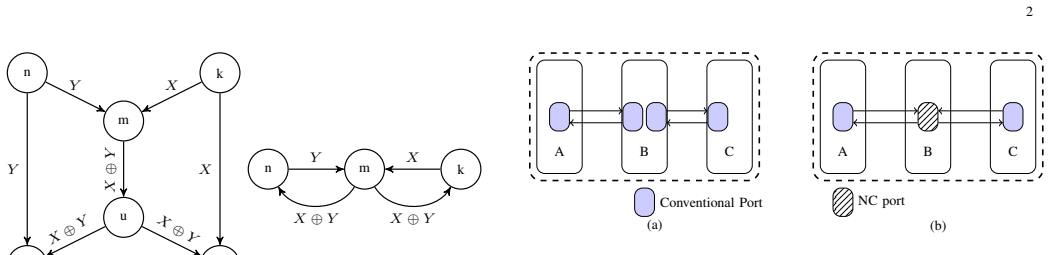
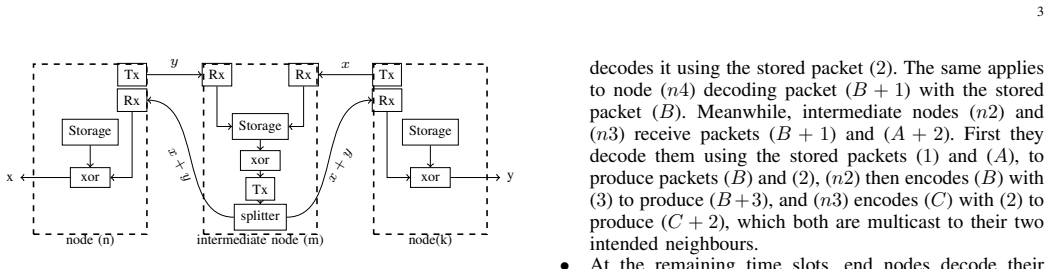
The load-bearing object is the network-coding-enabled port: a conventional port augmented with a second receiver, a small storage/buffer for synchronization, an XOR unit, a splitter/coupler to multicast the encoded flow, and an amplifier. It replaces two conventional ports at an intermediate node on a bidirectional flow. The argument is carried by a MILP whose objective sums router-port, transponder, switch, mux/demux, and EDFA power, with linearized constraints that identify coding opportunities and count NC ports by the maximum of the two opposite flows. The closed-form analysis reduces the whole system to the ratio $r$ and the average hop count $h$, producing $\varphi = (0.45h - 1)/h$ for the paper's $r=1.1$ and asymptotes of 45% (ring, line) and 22.5% (star) as network size grows.
What would settle it
Measure the end-to-end power draw of the proposed network-coding port (two receivers, storage, XOR unit, coupler, amplifier) against a conventional port at the same line rate; if the coding-enabled port draws 1.6 kW or more while the conventional port draws 1 kW, the zero-padding savings disappear, and if the bypass coded transponder draws more than about 660 W at 400 Gbps, the bypass savings disappear.
Extended reading notes
Core claim
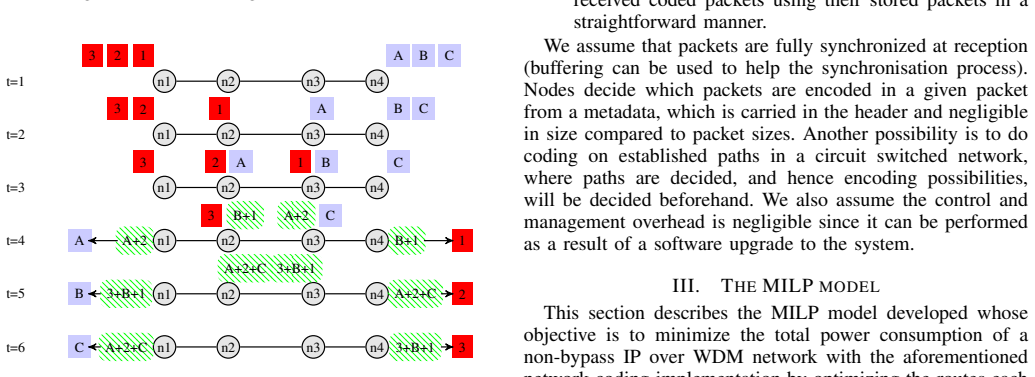
The central discovery is that XOR network coding, normally associated with multicast or wireless broadcast, pays off in wired unicast core networks because opposite-direction flows that pass through the same intermediate node can be merged at the IP layer. In the non-bypass architecture the paper proposes, a single NC port at the intermediate node replaces two conventional router ports: it receives both flows, synchronizes and stores them, XORs them, and transmits the encoded packet back to both neighbors, who decode using their own stored copy. The MILP model optimizes routes, coding locations, and port counts, and the paper reports that this substitution reduces daily-average network power by 27% on the NSFNET and 33% on the USNET against conventional non-bypass routing with the same traffic matrices. The savings are governed by the ratio $r$ of NC-port-plus-transponder power to conventional-port-plus-transponder power; with $r = 1.1$ the closed form becomes $\varphi = (0.45h - 1)/h$, and savings persist as long as $r < 2$ for zero padding and beyond for packet partitioning. The paper claims the minimum-hop heuristic reproduces the MILP savings closely, so the benefit does not require solving the NP-hard optimization.
Load-bearing premise
The entire non-bypass saving figure rests on the unmeasured assumption that a network-coding-enabled port draws only 10 percent more power than a conventional port (1.1 kW vs 1 kW); the paper itself shows that if that premium reaches about 60 to 100 percent, the zero-padding savings vanish.
Editorial extensions
If this is right
- Network operators could retrofit XOR coding at the IP layer of existing non-bypass routers and reap 27-33% daily-average power savings without changing wavelengths, fibers, or traffic demands.
- Savings scale with average hop count, so ring, line, and other high-hop topologies benefit most, while full-mesh and star gains are small or zero.
- The minimum-hop heuristic captures most of the MILP-optimal savings, meaning the benefit is attainable without solving an NP-hard routing optimization at run time.
- The closed form $\varphi = (0.45h - 1)/h$ gives a design-time rule of thumb: estimate average hop count and port power ratio to predict whether coding pays.
- Packet partitioning extends the benefit to asymmetric bidirectional traffic and survives a higher port power premium than zero padding.
Reading between the lines
- The paper evaluates only core topologies; the same coding mechanism would plausibly transfer to metro or data-center fabrics with high hop counts, though that extension is not tested here.
- The closed form gives planners a cheap metric: because savings rise with average hop count, topology changes that lengthen paths increase coding's payoff, at the cost of added latency.
- The decisive open question is the real power draw of an NC port; a component-level measurement of the second receiver, buffer, XOR, coupler, and amplifier would confirm or overturn the 27-33% figures.
- The model assumes a proportional power profile for partially used ports; relaxing that to discrete port activation could shift the break-even port ratio and is a natural next model.
Signed reviews
Editorial analysis
A structured set of objections, weighed in public.
Referee Report
Summary. This paper proposes a network-coding-enabled IP port architecture for core IP-over-WDM networks, in which opposite-direction unicast flows are XOR-coded at intermediate nodes, replacing two conventional ports with one NC port. The authors formulate a MILP for non-bypass and bypass routing, propose a minimum-hop heuristic, and derive closed-form savings expressions as a function of the port power ratio r and the average hop count h. They report daily-average power savings of 27% and 33% for NSFNET and USNET in the non-bypass case, 28% for the bypass case, and verify the MILP results with analytic bounds and closed forms for regular topologies.
Significance. If the hardware power assumptions were adequately supported, the paper would make a useful contribution: it extends network coding from wireless multicast settings to wired unicast core networks, provides a detailed MILP formulation, and reduces the savings to an explicit closed-form expression in r and h that is checked against the MILP and heuristic. The derivation in Section VII is not fitted to the MILP output, and the paper includes explicit sensitivity analyses (Figs. 16 and 18), which are strengths because they show where the claimed benefits disappear. The optimization model and the analytic derivation are internally consistent modulo typographical errors. The main limitation is that the headline quantitative savings depend on an unmeasured 10% premium for NC ports in the non-bypass case and on a 360 W coded-transponder assumption in the bypass case; without supporting evidence or a fully parameterized presentation, the results are conditional rather than definitive.
major comments (2)
- [Section IV / Table IV / Eq. (49) / Fig. 16] The central non-bypass savings figures (27% for NSFNET and 33% for USNET) and the closed-form expression φ = (h−1)(1−r/2)/h with r ≈ 1.1 rest entirely on the 'moderate estimate' that an NC port consumes 1.1 kW instead of 1 kW. No component-level power model or measurement is given for the extra receiver, coupler/splitter, amplifier, XOR logic, and synchronization buffer shown in Fig. 3, and Table V makes the same kind of assumption for the 360 W coded transponder in the bypass case. Since Fig. 16 shows that zero-padding savings vanish at r ≈ 1.6, the quantitative headline is directly determined by the least-supported parameter in the paper. The authors should either add a bill-of-materials or datasheet-based model for Px and for the coded transponder, or present the headline results as explicit functions of r with a justified uncertainty range, and adjust the abstract and conclusions accordingly.
- [Section VI / Fig. 17 / Abstract] The abstract states '28% power savings' for the bypass case without specifying the baseline. The text clarifies that this 28% is measured against the non-bypass architecture; against the conventional bypass architecture the saving is 18% at the same 10% coded-transponder premium. Using the higher-power non-bypass baseline in the headline overstates the benefit of coding in the bypass case. Please report the conventional-bypass comparison as the primary baseline or explicitly qualify the abstract's bypass-savings claim.
minor comments (5)
- [Eq. (49)] Equation (49) as printed reads φ = (0.45h − 1)/h, but the derivation and Eqs. (50)–(57) use φ = 0.45(h − 1)/h. This is not a notational nit: for the star topology with h = 2 the printed form gives a negative saving, while the intended formula gives 22.5%.
- [Table V] The coded transponder power in Table V is listed as 360 kW; it should be 360 W, otherwise it exceeds the total network power reported in Fig. 17 by orders of magnitude.
- [Eq. (26)] In Section V, Equation (26) defines Y^m_nk = (w^m_nk − w^m_nk)/B as written, which is identically zero. The intended expression is (w^m_nk − w^m_kn)/B, the difference of the two opposite-direction flows through node m.
- [Section V, after Eq. (29)] The paragraph after Eq. (29) says 'the first term of equation (29) is used to calculate the number of conventional ports in the zero padding case.' This is confusing because Eq. (29) is the partitioning-model port count; please rephrase to distinguish the zero-padding total-port formula in Eq. (13) from the partitioning formula in Eq. (29).
- [Abstract and Section VII.B] The abstract says the savings are 'proportional to the average hop count,' but Eq. (49) gives a concave, saturating function 0.45(h − 1)/h; 'increasing with' or 'dependent on' would be more accurate.
Circularity Check
No circularity found: the closed-form savings expression is derived analytically from declared power parameters; the unmeasured r=1.1 NC-port premium is an assumption that affects the magnitude of the result, not a circular input.
full rationale
The paper's central quantitative claim—daily average savings of 27% on NSFNET and 33% on USNET—follows from a MILP model and from the closed-form expression φ = (0.45h−1)/h (Eq. 49, properly read as 0.45(h−1)/h). This expression is obtained by algebraic manipulation of the cost accounting in Eqs. (39)–(45), with the ratio r = (p_t+p_x)/(p_t+p_p) introduced as a declared parameter and then set to approximately 1.1 using the component power values in Table IV. Nothing in the derivation takes the target savings percentages as inputs, and the MILP is an optimization over routing and port counts, not a curve fit to a predetermined savings value. The agreement between the analytic formula, the MILP, and the minimum-hop heuristic is therefore an internal consistency check among three models that share the same stated power assumptions; it does not independently validate the assumed 1.1 kW NC-port power, but it is not circular. The paper's self-citations, mainly to prior works [28], [29], [36], and [37], describe earlier related frameworks and methods, but the model, constraints, and analytic derivations in this paper are presented in full and do not rely on an unverified self-cited result as the load-bearing step. The one substantive concern, as the paper itself acknowledges through its sensitivity analysis (Figs. 16 and 18), is that the headline savings are sensitive to the unmeasured assumption that an NC port consumes only 10% more power than a conventional port (r ≈ 1.1) and that a coded bypass transponder consumes 360 W. Those are empirical or modeling uncertainties, not circular reasoning: the predictions are conditional on the assumptions, and the paper makes the dependence explicit. Overall, no step in the claimed derivation chain reduces by construction to its own inputs, so the appropriate circularity score is 0.
Assumptions & free parameters
free parameters (3)
- NC port power premium (r = 1.1) =
1.1 kW NC port vs 1 kW conventional port
- Coded transponder power (bypass case) =
360 W (also 500 W in one scenario)
- Traffic model averages per time zone =
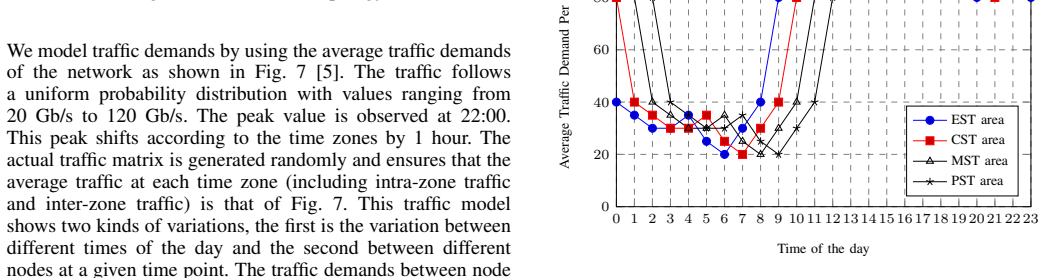
20 to 120 Gbps average per node pair, with demands 10 to 230 Gbps
assumptions (4)
- domain assumption The MILP relaxation of port counts (Equations 11-12 use non-integer values instead of ceilings) does not materially distort the savings.
- domain assumption Proportional power consumption for partially used wavelengths and ports, achievable by grooming.
- domain assumption Control and management overhead, and the power of the additional storage/XOR processing at end nodes, are negligible.
- standard math The non-bypass network is fully configured with one IP router port per node pair adjacency, as implied by Equation (14) with Ym summing over neighbours.
invented entities (2)
-
NC enabled port (IP layer)
-
Coded transponder (bypass/optical layer)
Cite this review
Pith. "Pith review of Energy Efficient Routing and Network Coding in Core Networks." pith.science (2026). https://pith.science/paper/RUSMLAYR
@misc{pith2026190807903,
  author       = {Pith},
  title        = {Pith review of: Energy Efficient Routing and Network Coding in Core Networks},
  year         = {2026},
  howpublished = {\url{https://pith.science/paper/RUSMLAYR}},
  note         = {Machine review of arXiv:1908.07903}
}
read the original abstract
We propose network coding as an energy efficient data transmission technique in core networks with non-bypass and bypass routing approaches. The improvement in energy efficiency is achieved through reduction in the traffic flows passing through intermediate nodes. A mixed integer linear program (MILP) is developed to optimize the use of network resources, and the results show that our proposed network coding approach introduces up to 33% power savings for the non-bypass case compared with the conventional architectures. For the bypass case, 28% power savings are obtained considering futuristic network components power consumption. A heuristic based on the minimum hop count routing shows power savings comparable to the MILP results. Furthermore, we study how the change in network topology affects the savings produced by network coding. The results show that the savings are proportional to the average hop count of the network topology. We also derive power consumption analytic bounds and closed form expressions for networks that implement network coding and thus also verify the results obtained by the MILP model.
Figures
Figures from the paper (17 more)



Reference graph
Works this paper leans on
-
[1]
GeSI, “GeSI SMARTer 2030: ”ICT Solutions for 21st Century Chal- lenges”,” 2015
work page 2015
-
[2]
M. Gupta and S. Singh, “Greening of the internet,” Karlsruhe, Germany, pp. 19–26, 2003
work page 2003
-
[3]
Energy Efficiency in Telecom Optical Networks,
Y . Zhang, P. Chowdhury, M. Tornatore, and B. Mukherjee, “Energy Efficiency in Telecom Optical Networks,” vol. 12, no. 4, pp. 441–458, 2010
work page 2010
-
[4]
Ip over wdm networks employing renewable energy sources,
X. Dong, T. El-Gorashi, and J. M. Elmirghani, “Ip over wdm networks employing renewable energy sources,” Lightwave Technology, Journal of, vol. 29, no. 1, pp. 3–14, 2011. 18
work page 2011
-
[5]
Green IP Over WDM Networks With Data Centers,
X. Dong, T. El-Gorashi, and J. M. H. Elmirghani, “Green IP Over WDM Networks With Data Centers,” Journal of Lightwave Technology, vol. 29, no. 12, pp. 1861–1880, Jun. 2011. [Online]. Available: http://ieeexplore.ieee.org/lpdocs/epic03/wrapper.htm?arnumber=5756625
work page 2011
-
[6]
Future energy efficient data centers with disaggregated servers,
H. M. M. Ali, T. E. El-Gorashi, A. Q. Lawey, and J. M. Elmirghani, “Future energy efficient data centers with disaggregated servers,” Jour- nal of Lightwave Technology , vol. 35, no. 24, pp. 5361–5380, 2017
work page 2017
-
[7]
On the Energy Ef fi ciency of Physical Topology Design for IP Over WDM Networks,
X. Dong, T. E. H. El-gorashi, and J. M. H. Elmirghani, “On the Energy Ef fi ciency of Physical Topology Design for IP Over WDM Networks,” vol. 30, no. 12, pp. 1931–1942, 2012
work page 1931
-
[8]
Distributed energy effi- cient clouds over core networks,
A. Lawey, T. El-Gorashi, and J. Elmirghani, “Distributed energy effi- cient clouds over core networks,” Lightwave Technology, Journal of , vol. 32, no. 7, pp. 1261–1281, April 2014
work page 2014
Show all 47 references
-
[9]
Energy-efficient future high-definition tv,
N. Osman, T. El-Gorashi, L. Krug, and J. Elmirghani, “Energy-efficient future high-definition tv,” Lightwave Technology, Journal of , vol. 32, no. 13, pp. 2364–2381, July 2014
2014
-
[10]
Bittorrent content distri- bution in optical networks,
A. Lawey, T. El-Gorashi, and J. Elmirghani, “Bittorrent content distri- bution in optical networks,” Lightwave Technology, Journal of, vol. 32, no. 21, pp. 4209–4225, Nov 2014
2014
-
[11]
Energy efficient iot virtualization framework with peer to peer net- working and processing,
Z. T. Al-Azez, A. Q. Lawey, T. E. El-Gorashi, and J. M. Elmirghani, “Energy efficient iot virtualization framework with peer to peer net- working and processing,” IEEE Access, vol. 7, pp. 50 697–50 709, 2019
2019
-
[12]
Patient-centric cellular networks optimization using big data analytics,
M. S. Hadi, A. Q. Lawey, T. E. El-Gorashi, and J. M. Elmirghani, “Patient-centric cellular networks optimization using big data analytics,” IEEE Access, vol. 7, pp. 49 279–49 296, 2019
2019
-
[13]
Big data analytics for wireless and wired network design: A survey,
M. S. Hadi, A. Q. Lawey, T. E. El-Gorashi, and J. M. Elmirghani, “Big data analytics for wireless and wired network design: A survey,” Computer Networks, vol. 132, pp. 180–199, 2018
2018
-
[14]
Energy efficient big data networks: Impact of volume and variety,
A. M. Al-Salim, A. Q. Lawey, T. E. El-Gorashi, and J. M. Elmirghani, “Energy efficient big data networks: Impact of volume and variety,” IEEE Transactions on Network and Service Management, vol. 15, no. 1, pp. 458–474, 2017
2017
-
[15]
Energy efficient virtual network embedding for cloud networks,
L. Nonde, T. El-Gorashi, and J. Elmirghani, “Energy efficient virtual network embedding for cloud networks,” Lightwave Technology, Jour- nal of, vol. 33, no. 9, pp. 1828–1849, May 2015
2015
-
[16]
Optimized energy aware 5g network function virtualization,
A. N. Al-Quzweeni, A. Q. Lawey, T. E. Elgorashi, and J. M. Elmirghani, “Optimized energy aware 5g network function virtualization,” IEEE Access, vol. 7, pp. 44 939–44 958, 2019
2019
-
[17]
Greentouch greenmeter core network energy- efficiency improvement measures and optimization,
J. Elmirghani, T. Klein, K. Hinton, L. Nonde, A. Lawey, T. El-Gorashi, M. Musa, and X. Dong, “Greentouch greenmeter core network energy- efficiency improvement measures and optimization,” IEEE/OSA Journal of Optical Communications and Networking , vol. 10, no. 2, pp. A250– A269, 2018
2018
-
[18]
Bounds on greentouch greenmeter network energy efficiency,
M. O. Musa, T. E. El-Gorashi, and J. M. Elmirghani, “Bounds on greentouch greenmeter network energy efficiency,” Journal of Light- wave Technology, vol. 36, no. 23, pp. 5395–5405, 2018
2018
-
[19]
Network information flow,
R. Ahlswede, C. Ning, S. Y . R. Li, and R. W. Yeung, “Network information flow,” Information Theory, IEEE Transactions on , vol. 46, no. 4, pp. 1204–1216, 2000
2000
-
[20]
Fragouli and E
C. Fragouli and E. Soljanin, Network coding applications . Now Publishers Inc, 2007
2007
-
[21]
Network coding in passive optical networks,
M. Belzner and H. Haunstein, “Network coding in passive optical networks,” in Optical Communication, 2009. ECOC ’09. 35th European Conference on, 2009, pp. 1–2
2009
-
[22]
Network coding in next- generation passive optical networks,
K. Fouli, M. Maier, and M. Medard, “Network coding in next- generation passive optical networks,”Communications Magazine, IEEE, vol. 49, no. 9, pp. 38–46, 2011
2011
-
[23]
Network- Coding-Based Energy Management for Next-Generation Passive Optical Networks,
X. Liu, K. Fouli, R. Kang, M. Maier, and S. Member, “Network- Coding-Based Energy Management for Next-Generation Passive Optical Networks,” vol. 30, no. 6, pp. 864–875, 2012
2012
-
[24]
Network Protection Codes Against Link Failures Using Network Coding,
S. A. Aly and A. E. Kamal, “Network Protection Codes Against Link Failures Using Network Coding,” in Global Telecommunications Conference, 2008. IEEE GLOBECOM 2008. IEEE , 2008, pp. 1–6
2008
-
[25]
Overlay Protection Against Link Failures Using Network Coding,
A. E. Kamal, A. Ramamoorthy, L. Long, and L. Shizheng, “Overlay Protection Against Link Failures Using Network Coding,” Networking, IEEE/ACM Transactions on, vol. 19, no. 4, pp. 1071–1084, 2011
2011
-
[26]
Optimal dedicated protection approach to shared risk link group failures using network coding,
P. Babarczi, J. Tapolcai, P.-H. Ho, and M. M ´edard, “Optimal dedicated protection approach to shared risk link group failures using network coding,” in Communications (ICC), 2012 IEEE International Confer- ence on. IEEE, 2012, pp. 3051–3055
2012
-
[27]
Linear network coding and parallel transmission increase fault tolerance and optical reach,
X. Chen, A. Engelmann, A. Jukan, and M. M ´edard, “Linear network coding and parallel transmission increase fault tolerance and optical reach,” IEEE/OSA Journal of Optical Communications and Networking, vol. 9, no. 4, pp. 244–256, 2017
2017
-
[28]
Bounds for energy-efficient survivable ip over wdm networks with network coding,
M. Musa, T. Elgorashi, and J. Elmirghani, “Bounds for energy-efficient survivable ip over wdm networks with network coding,” IEEE/OSA Journal of Optical Communications and Networking , vol. 10, no. 5, pp. 471–481, 2018
2018
-
[29]
Energy efficient survivable ip over wdm networks with network coding,
M. Musa, T. Elgorashi, and J. Elmirghani, “Energy efficient survivable ip over wdm networks with network coding,” IEEE/OSA Journal of Optical Communications and Networking , vol. 9, no. 3, pp. 207–217, 2017
2017
-
[30]
Network coding for optical-layer multicast,
E. D. Manley, J. S. Deogun, and X. Lisong, “Network coding for optical-layer multicast,” in Broadband Communications, Networks and Systems, 2008. BROADNETS 2008. 5th International Conference on , 2008, pp. 452–459
2008
-
[31]
All-Optical Network Coding,
E. D. Manley, J. S. Deogun, L. Xu, and D. R. Alexander, “All-Optical Network Coding,”Optical Communications and Networking, IEEE/OSA Journal of, vol. 2, no. 4, pp. 175–191, 2010
2010
-
[32]
Optical Physical-Layer Network Coding,
Z. Liu, M. Li, L. Lu, C.-K. Chan, S.-C. Liew, and L.-K. Chen, “Optical Physical-Layer Network Coding,” IEEE Photonics Technology Letters, vol. 24, no. 16, pp. 1424–1427, Aug. 2012. [Online]. Available: http://ieeexplore.ieee.org/lpdocs/epic03/wrapper.htm?arnumber=6226828
2012
-
[33]
Ge- netic representations for evolutionary minimization of network coding resources,
M. Kim, V . Aggarwal, U.-M. OReilly, M. M ´edard, and W. Kim, “Ge- netic representations for evolutionary minimization of network coding resources,” Applications of Evolutionary Computing , pp. 21–31, 2007
2007
-
[34]
Evolutionary computation with spatial receding horizon control to minimize network coding resources,
X.-B. Hu and M. S. Leeson, “Evolutionary computation with spatial receding horizon control to minimize network coding resources,” The Scientific World Journal, vol. 2014, 2014
2014
-
[35]
Optimization-based linear network coding for general connections of continuous flows,
Y . Cui, M. M ´edard, E. Yeh, D. Leith, and K. Duffy, “Optimization-based linear network coding for general connections of continuous flows,” in Communications (ICC), 2015 IEEE International Conference on . IEEE, 2015, pp. 4492–4498
2015
-
[36]
Energy Efficient Core Networks Using Network Coding,
M. Musa, T. El-Gorashi, and J. Elmirghani, “Energy Efficient Core Networks Using Network Coding,” in Transparent Optical Networks (ICTON), 2015 17th International Conference on , July 2015
2015
-
[37]
Network coding for energy efficiency in bypass ip/wdm networks,
M. Musa, T. E. El-Gorashi, and J. M. Elmirghani, “Network coding for energy efficiency in bypass ip/wdm networks,” in 2016 18th Interna- tional Conference on Transparent Optical Networks (ICTON) . IEEE, 2016
2016
-
[38]
XORs in the air: practical wireless network coding,
S. Katti, H. Rahul, W. Hu, D. Katabi, M. Muriel, #233, Dard, and J. Crowcroft, “XORs in the air: practical wireless network coding,” SIGCOMM Comput. Commun. Rev., vol. 36, no. 4, pp. 243–254, 2006
2006
-
[39]
Cisco crs-1 16-slot single-shelf system
Cisco, “Cisco crs-1 16-slot single-shelf system.” [Online]. Avail- able: http://www.cisco.com/c/en/us/products/collateral/routers/crs-1-16- slot-single-shelf-system/product˙data˙sheet09186a008022d5f3.html
-
[40]
Cisco ONS 15454 10-Gbps Mul- tirate Transponder Card
Cisco, “Cisco ONS 15454 10-Gbps Mul- tirate Transponder Card.” [Online]. Available: http://www.cisco.com/c/en/us/products/collateral/optical-networking/ ons-15454-m12-multiservice-transport-platform- mstp/product˙data˙sheet0900aecd80121bf7.html
-
[41]
Data sheet of Glimmerglass Intelligent Optical System 500
Cisco, “Data sheet of Glimmerglass Intelligent Optical System 500.” [Online]. Available: http://www.glimmerglass.com/products/intelligent- optical-system-500
-
[42]
Data sheet of Cisco ONS 15454 100- GHz 4-CH Multi/Demultiplexer
Cisco, “Data sheet of Cisco ONS 15454 100- GHz 4-CH Multi/Demultiplexer.” [Online]. Available: http://www.cisco.com/c/en/us/products/collateral/optical-networking/ ons-15454-series-multiservice-provisioning- platforms/product˙data˙sheet09186a00801a5572.html 19
-
[43]
Cisco ONS 15501 Erbium Doped Fiber Amplifier Data Sheet
Cisco, “Cisco ONS 15501 Erbium Doped Fiber Amplifier Data Sheet.” [Online]. Available: http://www.cisco.com/en/US/products/hw/optical/ps2011/ products˙data˙sheet09186a008008870d.html
-
[44]
Energy-Minimized Design for IP Over WDM Networks,
G. Shen and R. S. Tucker, “Energy-Minimized Design for IP Over WDM Networks,” Journal of Optical Communications and Networking, vol. 1, no. 1, p. 176, Jun. 2009
2009
-
[45]
Greentouch final results from green meter research study,
“Greentouch final results from green meter research study,” http://www.ourenergypolicy.org/wp-content/uploads/2015/06/ GreenTouch Green Meter Final Results 18 June 2015.pdf, accessed: 30-09-2016
2015
-
[46]
Power savings versus network performance in dynamically provisioned wdm networks,
P. Wiatr, P. Monti, and L. Wosinska, “Power savings versus network performance in dynamically provisioned wdm networks,” IEEE Com- munications Magazine, vol. 50, no. 5, 2012
2012
-
[47]
Multi- hour network planning based on domination between sets of traffic matrices,
P. Pavon-Marino, B. Garcia-Manrubia, and R. Aparicio-Pardo, “Multi- hour network planning based on domination between sets of traffic matrices,” Computer Networks, vol. 55, no. 3, pp. 665–675, 2011. Mohamed Musa received the BSc degree (first-class Honours) in Electrical and Ele...
2011
Reviewed August 14, 2026 · model on record in the stance chip above.
Discussion (0). Continue with ORCID to comment.