REVIEW 4 major objections 5 minor 64 references
Helping Blind People Grasp: Enhancing a Tactile Bracelet with an Automated Hand Navigation System
T0 review · 4 major / 5 minor · reviewed 2026-08-16 · deepseek-v4-flash
Pith's one-line read An automated vision-to-vibration navigation system can guide a blind user's hand to a chosen object without a human operator.
desk verdict A genuinely useful integration study with open artifacts, but the abstract's 'reliably' claim outruns a five-participant sample dominated by expert users. read the letter →
The pith
A machine-rendered reading of the paper's core claim, the machinery that carries it, and where it could break.
The reading
What carries the argument
The load-bearing mechanism is the tactile bracelet itself: four vibration motors on the wrist, driven by guiding logic that encodes direction by activating up to two motors with proportionally scaled intensities, so the user feels a continuous directional push. Around that bracelet, the system layers a pair of computer-vision detectors working in parallel—one for objects and one for the user's own hand—together with a multi-frame tracker that preserves one target's identity among similar objects, and a monocular depth estimator whose output feeds obstacle-avoidance commands. When the user's hand occludes the target, the system freezes the last known bounding box and continues guidance from that position; once the hand is in front of the target, all motors pulse together as a grasp signal.
What would settle it
A controlled study with a larger and more varied group of blind users—including congenitally and late blind participants of different ages—performing the same tasks with targets chosen by the user rather than entered by an experimenter would settle the claim; if grasp success in those conditions does not remain comparable to the reported 75–90%, the autonomy claim is falsified.
Extended reading notes
Core claim
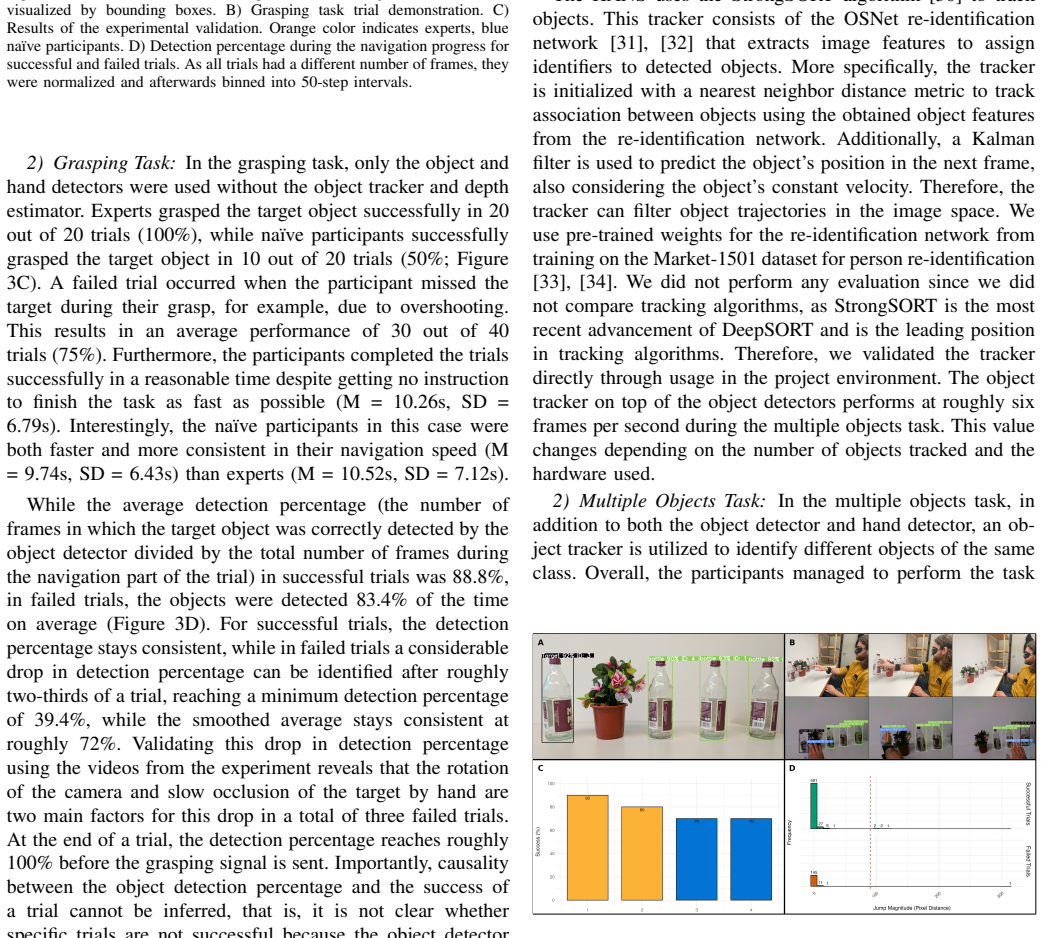
The paper's central discovery is that a closed-loop pipeline—parallel object and hand detectors, a multi-frame object tracker, an optional monocular depth estimator, and a guiding script—can turn a glasses-mounted camera feed into a small set of directional vibration commands that let users reach a specified target. In the grasping task, participants succeeded in 30 of 40 trials; in the multiple-objects task, where one instance had to be tracked among look-alikes, they succeeded in 31 of 40; in the depth-navigation task with an obstacle, they succeeded in 35 of 40. A blind participant in a less structured café environment succeeded in 9 of 10 grasping trials and 5 of 6 interaction trials. The authors interpret this as evidence that reducing AI-processed visual input to a low-data-rate tactile signal is enough to enable autonomous grasping behavior in everyday environments.
Load-bearing premise
The central autonomy claim rests on the premise that grasp success measured with targets manually entered by an experimenter, and with only four blindfolded sighted participants plus one blind participant, carries over to user-chosen targets in the broader, heterogeneous blind population.
Editorial extensions
If this is right
- Blind users would no longer need a sighted operator to steer their hand toward a chosen object, which addresses a gap left by earlier tactile scanning devices that only localize objects without navigating to them.
- The ability to track one specific instance among same-category distractors is a necessary step for cluttered real-world scenes, such as picking one bottle from a shelf of bottles.
- Incorporating depth estimates shows that the two-dimensional tactile command stream can carry enough information for three-dimensional routing, such as avoiding an obstacle on the way to the target.
- The blind participant's success in a café suggests the system can work outside a tightly controlled laboratory setup, which is the context that would matter for daily use.
- Because the system is modular—object detection alone is sufficient, with tracking and depth estimation as optional enhancements—simpler deployments could run on less powerful hardware.
- If the claimed reliability is confirmed, the tactile bracelet could be adapted to other assistive wearables that need to guide a user's limb or attention to a specific location.
Reading between the lines
- Beyond the paper, adding a voice-command target selector would turn the same pipeline into a hands-free device for tasks such as shopping-list picking; the paper identifies this as future work but does not test it.
- Because the paper itself notes that congenital versus late blindness changes tactile and spatial processing, a testable extension would compare those groups directly to see whether vibration dynamics need to be personalized per user.
- The modular architecture suggests the navigation logic could be ported to other form factors, such as a sleeve with more vibration motors, but the paper does not demonstrate such a port.
- The reported failure mode—users grasping next to the target when the grasp signal arrives—points toward a concrete design improvement: refining when and how the grasp cue is delivered, which could raise success rates without changing the perception pipeline.
Signed reviews
Editorial analysis
A structured set of objections, weighed in public.
Referee Report
Summary. The paper presents the automated hand navigation system (HANS), a closed-loop controller built around a previously developed tactile bracelet. The system uses two YOLOv5 detectors (objects and hands), a StrongSORT tracker, and a monocular depth estimator to convert camera input into four-motor vibration commands that guide a user's hand toward a target object. The authors validate HANS in three tabletop tasks with four blindfolded sighted participants (two experts with over five hours of HANS training, two naive) and in a cafe session with one blind participant. They report success rates of 75% (30/40) in the grasping task, 77.5% (31/40) in the multiple-objects task, 87.5% (35/40) in the depth-navigation task, and 90% (9/10) plus 83.3% (5/6) for the blind participant. The paper also reports system component metrics, questionnaire responses, and qualitative feedback. It concludes that the system enables autonomous grasping behavior in everyday environments. Data and code are openly available on OSF and GitHub.
Significance. If the system works as described, this is a useful engineering contribution to task-specific assistive technology: it removes the external operator from the navigation loop, compresses visual information into a low-rate tactile command stream, and preserves the auditory channel for the user. The open data and code are a concrete strength, as is the inclusion of a real-world cafe session with a blind participant. The paper is honest about several limitations, including the manual target-selection step and the heterogeneity of the blind population. However, the central claim in the abstract and conclusion that the system 'reliably guides the user's hand' and 'enables autonomous behavior in everyday environments' goes well beyond what the evidence supports. The sample is very small, the naive participants perform at a much lower level than the experts, and the single blind participant had prior contact with the system. These are not internal inconsistencies, but they are load-bearing gaps in the evidence for the population-level claim.
major comments (4)
- [II-B1, III-A2] The central reliability claim is not supported by the participant-level results in the grasping task. Section II-B1 states that the two expert participants had more than five hours of HANS training, while the two naive participants had never used HANS before. Section III-A2 reports that experts succeeded in 20/20 trials (100%) while naive participants succeeded in only 10/20 trials (50%); the pooled 75% is therefore driven by the trained users. No confidence intervals, individual trial breakdowns, or inferential statistics are reported for any task; for the naive participants alone, a binomial 95% CI for 10/20 spans roughly 27-73%. Since the abstract claims that HANS 'reliably guides the user's hand' without qualification, this claim needs to be either restricted to trained users or supported by additional data and uncertainty analysis. This is load-bearing because the paper's stated goal is to enable independent use by blind users, most of whom would start untrained.
- [III-E, IV] The blind-participant evidence is a single case study, not a population-level validation. Section III-E describes one blind participant who had already taken part in an earlier cafe testing session, used a simplified horizontal-then-vertical navigation mode, and completed only 10 grasping trials and 6 interaction trials. The paper itself acknowledges in Section IV that the blind population is heterogeneous and that usability should be assessed per user, but the abstract and the concluding paragraph generalize to 'visually impaired people' and 'the blind community.' The results should be framed as a promising case study with prior contact and simplified navigation, not as evidence that the system reliably serves the target population. This is load-bearing for the abstract's 'everyday environments' claim.
- [II-A, IV] The autonomy claim in the abstract overstates the system's current capabilities because target selection is manual. Section II-A states: 'the experimenter manually enters the target object into the system for each trial, or a list of objects is iterated automatically.' The hand navigation itself is automated, but the decision of what to grasp is not part of the closed loop. The Discussion acknowledges this limitation ('the current version of the system is limited by the use of text input'), yet the abstract and conclusion describe 'autonomous behavior in everyday environments.' This inconsistency between the central framing and the acknowledged limitation should be resolved by rewording the claim to specify that the system automates hand guidance after a target has been selected.
- [III-C2] In the depth navigation task, the paper reports no analysis of the depth-estimator outputs themselves, and the target-object detection percentage is 100% in failed trials and 89.4% in successful trials. Since the obstacle-avoidance behavior is attributed to the depth module, the task-level success rate alone does not establish that depth estimation, rather than the participants' own head or hand movements, produced the successful obstacle avoidance. Reporting depth-based trajectory metrics or a failure analysis of the five failed trials would make the depth-navigation claim more specific. This is a moderate load-bearing point for the 'depth navigation task' contribution.
minor comments (5)
- [II-A] There is a typo in Section II-A: 'blinfolded' should be 'blindfolded.'
- [III-A2, III-B2, III-C2] The expert/naive distinction is indicated only by color in Figures 3C, 4C, and 5D. Adding distinct markers or hatching would make the figures readable in grayscale and accessible to color-blind readers.
- [III-A1] For the object detector, the paper reports precision, recall, mAP, and inference time for the chosen model, but it does not specify the validation set or the number of epochs used for the final pre-trained model returned to after fine-tuning. Please clarify in the text or in Table S2.
- [III-B1] The sentence 'We did not perform any evaluation since we did not compare tracking algorithms' could be read as dismissing component-level evaluation. Please clarify that the tracker was validated indirectly through task performance and the jump analysis, and state whether any additional tracker-specific metrics were computed.
- [III-C1] The depth estimator comparison reports only median errors (e.g., median symmetric mean absolute percentage error of 0.073 for MiDaS V2.1 and median absolute relative error of 0.174 m for UniDepth). Reporting the spread or confidence intervals of these errors, and the definition of the composite performance score, would strengthen reproducibility.
Circularity Check
No significant circularity: success rates are empirical outcomes, and cited prior work is used only as hardware source and external benchmark ranking.
full rationale
The paper makes no formal derivation whose conclusion reduces to its inputs. Its central claims are empirical success rates in closed-loop physical trials (75% grasping, 77.5% multiple objects, 87.5% depth navigation, and 90%/83.3% in the blind-participant sessions), and these rates are measured outcomes of the system rather than parameters fitted to predict them. The HANS components (YOLOv5 detectors, StrongSORT tracker, MiDaS and UniDepth depth estimators) are externally published models, and the reported benchmark numbers come from external datasets (COCO, EgoHands, Market-1501, HaND); no component's output is defined in terms of the success metric. The two self-citations are not circular: reference [26] supplies the previously developed bracelet hardware and an earlier feasibility study, while reference [35] is a co-author's Master's thesis containing an external comparison of depth estimators on the HaND dataset. Both are used as sources of components or benchmarks, not as proof of the current navigation success rates, and the present validation data were collected independently. The acknowledged limitations—manual text entry of the target object, small and expert-heavy samples, and heterogeneity of the blind population—narrow the generality of the claims but do not make any result equivalent to its input by construction. No circular step is identifiable under the stated criteria.
Assumptions & free parameters
free parameters (4)
- Vibration intensity calibration baseline (50%, adjustable in 5% steps) =
Per-participant intensities, no reported values
- Tracking-jump threshold (90 pixels) =
90 px, stated as 'relatively arbitrary'
- Object spacing, camera field of view 88 degrees, target distance 40 cm =
15 cm separation, 40 cm distance, 88 degrees
- COCO subset training choices (20 categories, 5000 instances per class, 130 epochs, batch 32, resolution 1280) =
Reported mAP 0.70, precision 0.76, recall 0.65
assumptions (5)
- domain assumption YOLOv5 object detector trained on COCO (and EgoHands for hands) generalizes to the tabletop environments used in the experiments.
- domain assumption StrongSORT with OSNet re-identification features from Market-1501 (person re-ID) transfers to tracking objects of the same category (bottles) in egocentric video.
- domain assumption Monocular depth estimates from MiDaS and UniDepth are accurate enough to plan obstacle-avoiding trajectories in peripersonal tabletop scenes.
- domain assumption Participants can be trained within an unrestricted number of self-paced training trials to interpret the vibration signals such that the measured performance reflects the system rather than training time.
- domain assumption The four blindfolded sighted participants plus one blind participant represent the target blind population sufficiently for the stated reliability claims.
Cite this review
Pith. "Pith review of Helping Blind People Grasp: Enhancing a Tactile Bracelet with an Automated Hand Navigation System." pith.science (2026). https://pith.science/paper/RVMNYTMS
@misc{pith2026250416502,
  author       = {Pith},
  title        = {Pith review of: Helping Blind People Grasp: Enhancing a Tactile Bracelet with an Automated Hand Navigation System},
  year         = {2026},
  howpublished = {\url{https://pith.science/paper/RVMNYTMS}},
  note         = {Machine review of arXiv:2504.16502}
}
read the original abstract
Grasping constitutes a critical challenge for visually impaired people. To address this problem, we developed a tactile bracelet that assists in grasping by guiding the user's hand to a target object using vibration commands. Here we demonstrate the fully automated system around the bracelet, which can confidently detect and track target and distractor objects and reliably guide the user's hand. We validate our approach in three tasks that resemble complex, everyday use cases. In a grasping task, the participants grasp varying target objects on a table, guided via the automated hand navigation system. In the multiple objects task, participants grasp objects from the same class, demonstrating our system's ability to track one specific object without targeting surrounding distractor objects. Finally, the participants grasp one specific target object by avoiding an obstacle along the way in the depth navigation task, showcasing the potential to utilize our system's depth estimations to navigate even complex scenarios. Additionally, we demonstrate that the system can aid users in the real world by testing it in a less structured environment with a blind participant. Overall, our results demonstrate that the system, by translating the AI-processed visual inputs into a reduced data rate of actionable signals, enables autonomous behavior in everyday environments, thus potentially increasing the quality of life of visually impaired people.
Figures


Figures from the paper (4 more)


Reference graph
Works this paper leans on
-
[1]
The GRASP Taxonomy of Human Grasp Types,
T. Feix, J. Romero, H. B. Schmiedmayer, A. M. Dollar, and D. Kragic, “The GRASP Taxonomy of Human Grasp Types,” IEEE Transactions on Human-Machine Systems , vol. 46, no. 1, pp. 66–77, 2016. [Online]. Available: https://doi.org/10.1109/THMS.2015.2470657
arXiv 2016
-
[2]
The complexities of grasping in the wild,
Y . C. Nakamura, D. M. Troniak, A. Rodriguez, M. T. Mason, and N. S. Pollard, “The complexities of grasping in the wild,” IEEE- RAS International Conference on Humanoid Robots , pp. 233–240,
-
[3]
The contributions of vision and haptics to reaching and grasping,
K. D. Stone and C. L. R. Gonzalez, “The contributions of vision and haptics to reaching and grasping,” Frontiers in Psychology , vol. 6, no. September, pp. 1–18, sep 2015. [Online]. Available: https://doi.org/10.3389/fpsyg.2015.01403
-
[4]
Visuomotor channels: Their integration in goal-directed prehension,
M. Jeannerod, “Visuomotor channels: Their integration in goal-directed prehension,” Human Movement Science , vol. 18, no. 2-3, pp. 201–218, jun 1999. [Online]. Available: https://doi.org/10.1016/S0167-9457(99) 00008-1
-
[5]
G. Maiello, M. Schepko, L. K. Klein, V . C. Paulun, and R. W. Fleming, “Humans Can Visually Judge Grasp Quality and Refine Their Judgments Through Visual and Haptic Feedback,” Frontiers in Neuroscience, vol. 14, no. January, pp. 1–11, 2021. [Online]. Available: https://doi.org/10.3389/fnins.2020.591898
-
[6]
A review of grasping as the movements of digits in space,
J. B. Smeets, K. van der Kooij, and E. Brenner, “A review of grasping as the movements of digits in space,” Journal of Neurophysiology, vol. 122, no. 4, pp. 1578–1597, 2019. [Online]. Available: https://doi.org/10.1152/jn.00123.2019
-
[7]
Effects of object shape and visual feedback on hand configuration during grasping,
L. F. Schettino, S. V . Adamovich, and H. Poizner, “Effects of object shape and visual feedback on hand configuration during grasping,” Experimental Brain Research , vol. 151, no. 2, pp. 158–166, 2003. [Online]. Available: https://doi.org/10.1007/s00221-003-1435-3
-
[8]
S. Pardhan, C. Gonzalez-Alvarez, and A. Subramanian, “How does the presence and duration of central visual impairment affect reaching and grasping movements?” Ophthalmic and Physiological Optics, vol. 31, no. 3, pp. 233–239, 2011. [Online]. Available: https://doi.org/10.1111/j.1475-1313.2010.00819.x
Show all 64 references
-
[9]
Blindness and vision im- pairment,
World Health Organization, “Blindness and vision im- pairment,” https://www.who.int/news-room/fact-sheets/detail/ blindness-and-visual-impairment, accessed: 2025-04-07
2025
-
[10]
Global Prevalence of Presbyopia and Vision Impairment from Uncorrected Presbyopia: Systematic Review, Meta-analysis, and Modelling,
T. R. Fricke, N. Tahhan, S. Resnikoff, E. Papas, A. Burnett, S. M. Ho, T. Naduvilath, and K. S. Naidoo, “Global Prevalence of Presbyopia and Vision Impairment from Uncorrected Presbyopia: Systematic Review, Meta-analysis, and Modelling,” Ophthalmology, vol. 125, no. 10, pp. 14...
2018 doi
-
[11]
The Evolution of Assistive Technology: A Literature Review of Technology Developments and Applications,
M. Zallio and T. Ohashi, “The Evolution of Assistive Technology: A Literature Review of Technology Developments and Applications,” Human Factors in Accessibility and Assistive Technology , vol. 37,
-
[12]
Sensory substitution and the human-machine interface,
P. Bach-y Rita and S. W. Kercel, “Sensory substitution and the human-machine interface,” Trends in Cognitive Sciences, vol. 7, no. 12, pp. 541–546, 2003. [Online]. Available: https://doi.org/10.1016/j.tics. 2003.10.013
2003 doi
-
[13]
The future of sensory substitution, addition, and expansion via haptic devices,
D. M. Eagleman and M. V . Perrotta, “The future of sensory substitution, addition, and expansion via haptic devices,” Frontiers in Human Neuroscience , vol. 16, 2023. [Online]. Available: https: //doi.org/10.3389/fnhum.2022.1055546
2023
-
[14]
Stereo Vision Based Sensory Substitution for the Visually Impaired,
S. Caraiman, O. Zvoristeanu, A. Burlacu, and P. Herghelegiu, “Stereo Vision Based Sensory Substitution for the Visually Impaired,” Sensors, vol. 19, no. 12, p. 2771, jun 2019. [Online]. Available: https://doi.org/10.3390/s19122771
2019 doi
-
[15]
See ColOr: An extended sensory substitution device for the visually impaired,
J. D. Gomez, G. Bologna, and T. Pun, “See ColOr: An extended sensory substitution device for the visually impaired,” Journal of Assistive Technologies , vol. 8, no. 2, pp. 77–94, 2014. [Online]. Available: https://doi.org/10.1108/JAT-08-2013-0025
2014 doi
-
[16]
The Vibe: A versatile vision-to-audition sensory substitution device,
S. Hanneton, M. Auvray, and B. Durette, “The Vibe: A versatile vision-to-audition sensory substitution device,” Applied Bionics and Biomechanics, vol. 7, no. 4, pp. 269–276, 2010. [Online]. Available: https://doi.org/10.1080/11762322.2010.512734
2010
-
[17]
Sensory Substitution and Augmentation: An Introduc- tion,
F. Macpherson, “Sensory Substitution and Augmentation: An Introduc- tion,” Sensory Substitution and Augmentation, pp. 1–42, 2018. [Online]. Available: https://doi.org/10.5871/bacad/9780197266441.003.0001
2018
-
[18]
A sensorimotor account of vision and visual consciousness,
J. K. O’Regan and A. No ¨e, “A sensorimotor account of vision and visual consciousness,” Behavioral and Brain Sciences , vol. 24, no. 5, pp. 939–973, oct 2001. [Online]. Available: https://doi.org/10.1017/ S0140525X01000115
2001
-
[19]
The experience of new sensorimotor contingencies by sensory augmentation,
K. Kaspar, S. K ¨onig, J. Schwandt, and P. K¨onig, “The experience of new sensorimotor contingencies by sensory augmentation,” Consciousness and Cognition , vol. 28, no. 1, pp. 47–63, 2014. [Online]. Available: https://doi.org/10.1016/j.concog.2014.06.006
2014 doi
-
[20]
Impact of a vibrotactile belt on emotionally challenging everyday situations of the blind,
C. Brandebusemeyer, A. R. Luther, S. U. K ¨onig, P. K ¨onig, and S. M. K¨archer, “Impact of a vibrotactile belt on emotionally challenging everyday situations of the blind,” Sensors, vol. 21, no. 21, 2021. [Online]. Available: https://doi.org/10.3390/s21217384
2021 doi
-
[21]
World Health Organization, 2022
World Health Organization and United Nations Children’s Fund, Global report on assistive technology . World Health Organization, 2022. 11
2022
-
[22]
Assistive technology,
World Health Organization, “Assistive technology,” https://www.who. int/news-room/fact-sheets/detail/assistive-technology, accessed: 2025- 04-07
2025
-
[23]
PalmSight: an assistive technology helping the blind to locate and grasp objects,
Z. Yu, S. Horvath, A. Delazio, J. Wang, R. Almasi, R. Klatzky, J. Ga- leotti, and G. D. Stetten, “PalmSight: an assistive technology helping the blind to locate and grasp objects,” Carnegie Mellon University, Pittsburgh, Tech. Rep., 2016
2016
-
[24]
FingerSight: A Vibrotactile Wearable Ring for Assistance With Locating and Reaching Objects in Peripersonal Space,
S. A. Satpute, J. R. Canady, R. L. Klatzky, and G. D. Stetten, “FingerSight: A Vibrotactile Wearable Ring for Assistance With Locating and Reaching Objects in Peripersonal Space,” IEEE Transactions on Haptics , vol. 13, no. 2, pp. 325–333, apr 2020. [Online]. Available: https:...
2020
-
[25]
Grasping objects with a sensory substitution glove,
C. de Paz, J. Ib ´a˜nez-Gij´on, D. Travieso, and D. M. Jacobs, “Grasping objects with a sensory substitution glove,” International Journal of Human-Computer Studies , vol. 170, no. October 2022, p. 102963, feb
2022
-
[26]
Helping Blind People Grasp: Evaluating a Tactile Bracelet for Remotely Guiding Grasping Movements,
P. Powell, F. P ¨atzold, M. Rouygari, M. Furtak, S. M. K ¨archer, and P. K ¨onig, “Helping Blind People Grasp: Evaluating a Tactile Bracelet for Remotely Guiding Grasping Movements,” Sensors, vol. 24, no. 9, pp. 1–20, 2024. [Online]. Available: https://doi.org/10.3390/s24092949
2024 doi
-
[27]
You Only Look Once: Unified, Real-Time Object Detection,
J. Redmon, S. Divvala, R. Girshick, and A. Farhadi, “You Only Look Once: Unified, Real-Time Object Detection,” in 2016 IEEE Conference on Computer Vision and Pattern Recognition (CVPR) , vol. 2016-Decem. IEEE, jun 2016, pp. 779–788. [Online]. Available: https://doi.org/10.1109...
2016 doi
-
[28]
Microsoft coco: Common objects in context,
T.-Y . Lin, M. Maire, S. Belongie, J. Hays, P. Perona, D. Ramanan, P. Doll ´ar, and C. L. Zitnick, “Microsoft coco: Common objects in context,” in Computer Vision – ECCV 2014 . Springer International Publishing, 2014
2014
-
[29]
Lending a hand: Detecting hands and recognizing activities in complex egocentric in- teractions,
S. Bambach, S. Lee, D. J. Crandall, and C. Yu, “Lending a hand: Detecting hands and recognizing activities in complex egocentric in- teractions,” in The IEEE International Conference on Computer Vision (ICCV), December 2015
2015
-
[30]
Strong- sort: Make deepsort great again,
Y . Du, Z. Zhao, Y . Song, Y . Zhao, F. Su, T. Gong, and H. Meng, “Strong- sort: Make deepsort great again,” IEEE Transactions on Multimedia , 2023
2023
-
[31]
Omni-Scale Feature Learning for Person Re-Identification,
K. Zhou, Y . Yang, A. Cavallaro, and T. Xiang, “Omni-Scale Feature Learning for Person Re-Identification,” in 2019 IEEE/CVF International Conference on Computer Vision (ICCV) , vol. 2019- Octob. IEEE, oct 2019, pp. 3701–3711. [Online]. Available: https://doi.org/10.1109/ICCV ....
2019
-
[32]
Learning Generalisable Omni-Scale Representations for Person Re-Identification,
——, “Learning Generalisable Omni-Scale Representations for Person Re-Identification,” IEEE Transactions on Pattern Analysis and Machine Intelligence, vol. 44, no. 9, pp. 1–1, 2021. [Online]. Available: https://doi.org/10.1109/TPAMI.2021.3069237
2021
-
[33]
Scalable person re-identification: A benchmark,
L. Zheng, L. Shen, L. Tian, S. Wang, J. Wang, and Q. Tian, “Scalable person re-identification: A benchmark,” in Proceedings of the 2015 IEEE International Conference on Computer Vision (ICCV) , ser. ICCV ’15. USA: IEEE Computer Society, 2015, p. 1116–1124
2015
-
[34]
Improving person re-identification by attribute and identity learning,
Y . Lin, L. Zheng, Z. Zheng, Y . Wu, Z. Hu, C. Yan, and Y . Yang, “Improving person re-identification by attribute and identity learning,” Pattern Recognition , vol. 95, pp. 151–161, nov 2019. [Online]. Available: https://doi.org/10.1016/j.patcog.2019.06.006
2019 doi
-
[35]
Guiding in Three Dimensions: Integrating Depth Estimation into a Tactile Bracelet for the Blind,
F. P ¨atzold, “Guiding in Three Dimensions: Integrating Depth Estimation into a Tactile Bracelet for the Blind,” Master’s thesis, University of Osnabr¨uck, 2025
2025
-
[36]
Hand dataset,
OptiVisT, “Hand dataset,” https://universe.roboflow.com/optivist/ hand-rmcj2, jul 2024, accessed: 2025-04-07. [Online]. Available: https://universe.roboflow.com/optivist/hand-rmcj2
2024
-
[37]
Towards Robust Monocular Depth Estimation: Mixing Datasets for Zero-Shot Cross-Dataset Transfer,
R. Ranftl, K. Lasinger, D. Hafner, K. Schindler, and V . Koltun, “Towards Robust Monocular Depth Estimation: Mixing Datasets for Zero-Shot Cross-Dataset Transfer,” IEEE Transactions on Pattern Analysis and Machine Intelligence , vol. 44, no. 3, pp. 1623–1637, mar
-
[38]
UniDepth: Universal Monocular Metric Depth Estimation,
L. Piccinelli, Y .-H. Yang, C. Sakaridis, M. Segu, S. Li, L. Van Gool, and F. Yu, “UniDepth: Universal Monocular Metric Depth Estimation,” mar
-
[39]
An insight into smartphone-based assistive solutions for visually impaired and blind people: issues, challenges and opportunities,
A. Khan and S. Khusro, “An insight into smartphone-based assistive solutions for visually impaired and blind people: issues, challenges and opportunities,” Universal Access in the Information Society , vol. 20, no. 2, pp. 265–298, jun 2021. [Online]. Available: https://doi.org...
2021 doi
-
[40]
Impact of Apps as Assistive Devices for Visually Impaired Persons,
S. Pundlik, P. Shivshanker, and G. Luo, “Impact of Apps as Assistive Devices for Visually Impaired Persons,” Annual Review of Vision Science, vol. 9, no. 1, pp. 111–130, sep 2023. [Online]. Available: https://doi.org/10.1146/annurev-vision-111022-123837
2023 doi
-
[41]
Available: https://doi.org/10.1109/TPAMI.2020.3019967
[Online]. Available: https://doi.org/10.1109/TPAMI.2020.3019967
2020
-
[42]
Internet-of-Things Devices and Assistive Technologies for Health Care: Applications, Challenges, and Opportunities,
M. J. Baucas, P. Spachos, and S. Gregori, “Internet-of-Things Devices and Assistive Technologies for Health Care: Applications, Challenges, and Opportunities,” IEEE Signal Processing Magazine , vol. 38, no. 4, pp. 65–77, jul 2021. [Online]. Available: https: //doi.org/10.1109/...
2021
-
[43]
Artificial Intelligence of Things Applied to Assistive Technology: A Systematic Literature Review,
M. P. de Freitas, V . A. Piai, R. H. Farias, A. M. R. Fernandes, A. G. de Moraes Rossetto, and V . R. Q. Leithardt, “Artificial Intelligence of Things Applied to Assistive Technology: A Systematic Literature Review,” Sensors, vol. 22, no. 21, p. 8531, nov 2022. [Online]. Avail...
2022 doi
-
[44]
IoT in Brain-Computer Interfaces for Enabling Communication and Control for the Disabled,
S. Rajarajan, T. Kowsalya, N. S. Gupta, P. M. Suresh, P. Ilampiray, and S. Murugan, “IoT in Brain-Computer Interfaces for Enabling Communication and Control for the Disabled,” in 2024 10th International Conference on Communication and Signal Processing (ICCSP). IEEE, apr 2024,...
2024
-
[45]
Enhancing Tactile Bracelet: A Comparative Study of Alpha and Beta Prototype Bracelets for Guiding Movements in Visually Impaired Individuals,
F. E. Christiadi, “Enhancing Tactile Bracelet: A Comparative Study of Alpha and Beta Prototype Bracelets for Guiding Movements in Visually Impaired Individuals,” Master’s thesis, University of M ¨unster, 2025
2025
-
[46]
Smartphones-Based Assistive Technology: Accessibility Features and Apps for People with Visual Impairment, and Its Usage, Challenges, and Usability Testing [Corrigendum],
S. S. Senjam, S. Manna, and C. Bascaran, “Smartphones-Based Assistive Technology: Accessibility Features and Apps for People with Visual Impairment, and Its Usage, Challenges, and Usability Testing [Corrigendum],” Clinical Optometry , vol. V olume 13, no. November, pp. 333–334...
2021 doi
- [47]
-
[48]
Translating Natural Language to Planning Goals with Large-Language Models,
Y . Xie, C. Yu, T. Zhu, J. Bai, Z. Gong, and H. Soh, “Translating Natural Language to Planning Goals with Large-Language Models,” feb
-
[49]
Improved auditory spatial tuning in blind humans,
B. R ¨oder, W. Teder-S ¨alej¨arvi, A. Sterr, F. R ¨osler, S. A. Hillyard, and H. J. Neville, “Improved auditory spatial tuning in blind humans,” Nature, vol. 400, no. 6740, pp. 162–166, 1999. [Online]. Available: https://doi.org/10.1038/22106
1999 doi
-
[50]
A sensitive period for language in the visual cortex: Distinct patterns of plasticity in congenitally versus late blind adults,
M. Bedny, A. Pascual-Leone, S. Dravida, and R. Saxe, “A sensitive period for language in the visual cortex: Distinct patterns of plasticity in congenitally versus late blind adults,” Brain and Language , vol. 122, no. 3, pp. 162–170, sep 2012. [Online]. Available: https://doi....
2012 doi
- [51]
-
[52]
Congenital blindness leads to enhanced vibrotactile perception,
C. Y . Wan, A. G. Wood, D. C. Reutens, and S. J. Wilson, “Congenital blindness leads to enhanced vibrotactile perception,” Neuropsychologia, vol. 48, no. 2, pp. 631–635, jan 2010. [Online]. Available: https://doi.org/10.1016/j.neuropsychologia.2009.10.001
2010 doi
-
[53]
Auditory Spatial Perception without Vision,
P. V oss, “Auditory Spatial Perception without Vision,” Frontiers in Psychology, vol. 07, no. DEC, pp. 1–7, dec 2016. [Online]. Available: https://doi.org/10.3389/fpsyg.2016.01960
2016
- [54]
-
[55]
Embodied Space in Early Blind Individuals,
V . Crollen and O. Collignon, “Embodied Space in Early Blind Individuals,” Frontiers in Psychology, vol. 3, no. AUG, pp. 2008–2010,
2008
-
[56]
Spatial metric in blindness: behavioural and cortical processing,
M. Gori, M. B. Amadeo, and C. Campus, “Spatial metric in blindness: behavioural and cortical processing,” Neuroscience & Biobehavioral Reviews, vol. 109, no. November 2019, pp. 54–62, feb 2020. [Online]. Available: https://doi.org/10.1016/j.neubiorev.2019.12.031
2019 doi
-
[57]
Impact of blindness onset on the functional organization and the connectivity of the occipital cortex,
O. Collignon, G. Dormal, G. Albouy, G. Vandewalle, P. V oss, C. Phillips, and F. Lepore, “Impact of blindness onset on the functional organization and the connectivity of the occipital cortex,” Brain, vol. 136, no. 9, pp. 2769–2783, sep 2013. [Online]. Available: https://doi.o...
2013 doi
-
[60]
Imagery and spatial processes in blindness and visual impairment,
Z. Cattaneo, T. Vecchi, C. Cornoldi, I. Mammarella, D. Bonino, E. Ricciardi, and P. Pietrini, “Imagery and spatial processes in blindness and visual impairment,” Neuroscience & Biobehavioral Reviews, vol. 32, no. 8, pp. 1346–1360, oct 2008. [Online]. Available: https://doi.org...
2008 doi
-
[64]
Spatial navigation by congenitally blind individuals,
V . R. Schinazi, T. Thrash, and D. Chebat, “Spatial navigation by congenitally blind individuals,” WIREs Cognitive Science , vol. 7, no. 1, pp. 37–58, jan 2016. [Online]. Available: https://doi.org/10.1002/wcs. 1375
2016 doi
-
[2012]
Available: https://doi.org/10.3389/fpsyg.2012.00272
[Online]. Available: https://doi.org/10.3389/fpsyg.2012.00272
2012 arXiv
-
[2017]
Available: https://doi.org/10.1109/HUMANOIDS.2017
[Online]. Available: https://doi.org/10.1109/HUMANOIDS.2017. 8246880
2017 doi
-
[2022]
Available: https://doi.org/10.54941/ahfe1001646
[Online]. Available: https://doi.org/10.54941/ahfe1001646
-
[2023]
Available: https://doi.org/10.1016/j.ijhcs.2022.102963
[Online]. Available: https://doi.org/10.1016/j.ijhcs.2022.102963
2022
- [2024]
Reviewed August 16, 2026 · model on record in the stance chip above.
Discussion (0). Continue with ORCID to comment.