REVIEW 4 major objections 6 minor 37 references
Legendrian skein algebras and Hall algebras
T0 review · 4 major / 6 minor · reviewed 2026-08-14 · deepseek-v4-flash
Pith's one-line read This paper proves that the graded Legendrian skein algebra of a surface times a line maps homomorphically into the Hall algebra of the surface's Fukaya category, with the map an isomorphism for disks with marked points and injective for…
desk verdict Genuinely new bridge between Legendrian skein algebras and Hall algebras; the central geometric check is under-written but the argument looks correct and deserves a serious referee. read the letter →
The pith
A machine-rendered reading of the paper's core claim, the machinery that carries it, and where it could break.
The reading
What carries the argument
The load-bearing object is the map $\Phi$, defined by pushing forward a weighted counting measure along the functor from the augmentation category $\mathcal{C}(L)_1$ to the infinitesimally wrapped Fukaya category $\mathcal{F}^{\vee}$. The counting measure is computed explicitly as $(q-1)^{-|\pi_0(L)|} q^{-e(L)} \sum_E \sum_{\delta \in \mathrm{MC}(L,E)} [(L,E,\delta)]$, and the proof that $\Phi$ respects the product and the skein relations relies on curved $A_\infty$-categories with $\mathbb{R}$-filtered Hom-spaces. The key geometric input is Proposition 3.2, which gives a bijection between Maurer–Cartan elements on a smoothed curve $L_s$ with a fixed gluing isomorphism $g$ and Maurer–Cartan elements on the unresolved curve $L_-$ whose component at the crossing is $g$; this bijection is what turns skein relation (S1) into an identity in the Hall algebra. The disk and annulus results also use a slicing of the Fukaya category to decompose the Hall algebra into tensor products, and for the annulus the classical basis of the Iwahori–Hecke algebra quotient transfers to the Legendrian skein.
What would settle it
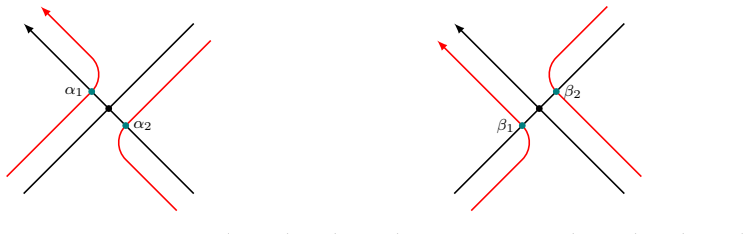
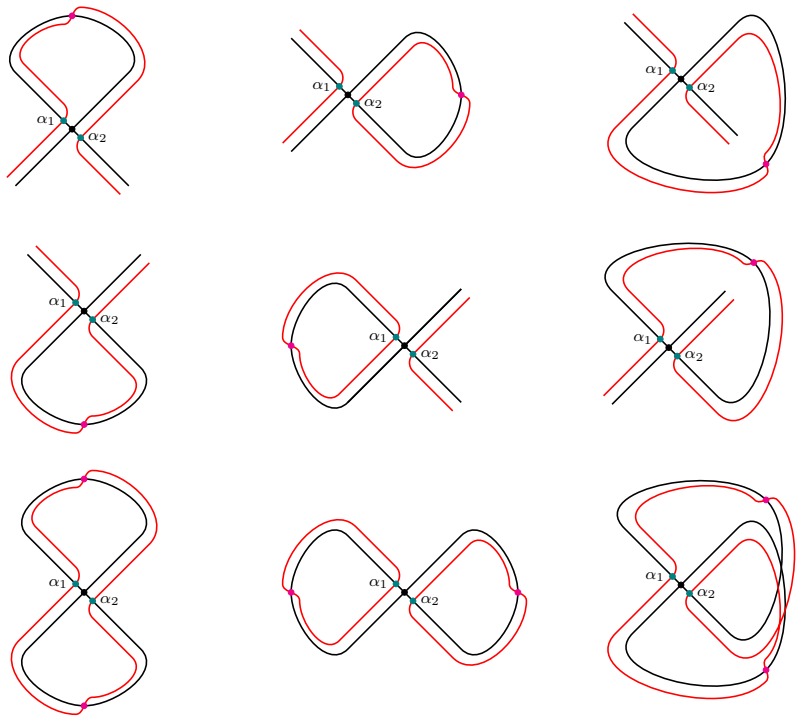
Directly verify Proposition 3.2 in the nine configurations of Figure 10 over a small finite field: compute the sets $\mathrm{MC}(L_s,E_g)$ and $\{\delta \in \mathrm{MC}(L_-,E): \delta_p = g\}$ for each case. A single configuration where the counts differ would be a counterexample, since then $\Phi$ would not satisfy (S1); equivalently, one can look for a configuration where the claimed inverse morphisms $\alpha_1+\alpha_2$ and $\beta_1-\beta_2$ fail to be closed to zeroth order.
Extended reading notes
Core claim
The central claim is Theorem 4.3: for a compact surface $S$ with boundary, a finite set $N \subset \partial S$, a Liouville form $\theta$, a grading structure $\eta$, and a finite field $K$, the assignment sending a graded Legendrian link $L$ to the pushforward of the weighted counting measure on the category $\mathcal{C}(L)_1$ (rank-one local systems with Maurer–Cartan elements on $L$) along the functor $\mathcal{C}(L)_1 \to \mathcal{F}^{\vee}(S,N,\theta,\eta,K)$ induces a well-defined $\mathbb{Q}$-algebra homomorphism $\Phi: \mathrm{Skein}(S,N,\theta,\eta) \otimes_{\mathbb{Z}[t^{\pm},(1-t)^{-1}]} \mathbb{Q} \to \mathrm{Hall}(\mathcal{F}^{\vee})$, with $t \mapsto |K|$. Theorem 4.6 states that for a disk with $n+1$ marked boundary points $\Phi$ is an isomorphism, so the Legendrian skein algebra at a prime power $q$ is the Hall algebra of the bounded derived category of $\mathbb{F}_q$-representations of an $A_n$ quiver; Theorem 4.9 states that for the annulus with no marked points $\Phi$ is injective, embedding the skein algebra into the Hall algebra of $D^b(\mathrm{Mod}_{fd}(K[x^{\pm}]))$. The paper thus claims that Legendrian skein relations are not ad hoc: they are exactly the identities satisfied by counts of Maurer–Cartan elements in a Fukaya category.
Load-bearing premise
The weakest load-bearing premise is Proposition 3.2: the assertion, verified only by a case-by-case check of nine drawn configurations, that smoothing a self-intersection gives a bijection between the formal deformations on the smoothed link and those on the unresolved link with a prescribed crossing component; if any of the nine cases fails, skein relation (S1) need not hold in the Hall algebra and the homomorphism $\Phi$ collapses.
Editorial extensions
If this is right
- For a disk with $n+1$ marked boundary points, the graded Legendrian skein algebra specialized at $q$ is isomorphic to the Hall algebra of $D^b(\mathrm{Rep}(A_n,\mathbb{F}_q))$, so its structure constants are those of quiver representations over finite fields.
- For the annulus, the Legendrian skein algebra embeds into the Hall algebra of $D^b(\mathrm{Mod}_{fd}(K[x^{\pm}]))$, and the curves $C_k$ map to objects given by companion matrices, giving an explicit algebraic model of the skein algebra.
- Because $\Phi$ is a homomorphism, the skein relations (S1), (S2), (S3) and their boundary versions hold as identities after counting Maurer–Cartan elements; the skein algebra is therefore a quotient-like subobject of the Hall algebra rather than a separate construction.
- The injectivity result for the annulus connects the skein algebra of the annulus to counts of representations of the Chekanov–Eliashberg differential graded algebra, putting Legendrian satellite invariants into the Hall-algebra framework.
Reading between the lines
- One testable extension the author leaves open: if injectivity holds for all surfaces as conjectured, then the Legendrian skein algebra is a canonically embedded subalgebra of the Hall algebra, and computing $\Phi$ on a low-degree link in a higher-genus surface would give a concrete test.
- The counting version of the Hall algebra depends on the finite field size $q$, while the skein algebra is defined over $\mathbb{Z}[q^{\pm},(q-1)^{-1}]$; a motivic or cohomological Hall algebra with a formal parameter would likely recover the skein algebra integrally, making the specialization to finite fields a genuine specialization rather than a lossy one.
- The same mechanism suggests that 'skein = Hall' could be taken as a definition in higher dimensions: for Legendrian submanifolds in higher-dimensional contact manifolds, the relations among Hall-algebra images may be the right replacement for local skein relations, and a test would be whether those relations are generated locally.
Signed reviews
Editorial analysis
A structured set of objections, weighed in public.
Referee Report
Summary. The paper compares the graded Legendrian skein algebra of a product threefold S×R with the Hall algebra of the derived Fukaya category of S. For a graded Legendrian link L, the author defines Φ(L) as the pushforward of the weighted counting measure on the augmentation category C(L)_1 to the Fukaya category; Lemma 4.2 rewrites this as a sum over rank-one local systems and Maurer–Cartan elements. Theorem 4.3 asserts that this assignment descends to a Q-algebra homomorphism from the skein algebra, after specializing t to the cardinality q of a finite field. Theorems 4.6 and 4.9 state that for a disk with marked points the map is an isomorphism onto the Hall algebra of the bounded derived category of an An quiver, and for the annulus it is injective. The proof of the homomorphism property reduces the skein relation (S1) to a comparison of Maurer–Cartan elements under smoothing, Proposition 3.2, whose proof is the central technical point.
Significance. If the main theorem is correct, it gives a conceptual bridge between Legendrian skein algebras and categorical Hall algebras: the skein relations are interpreted as identities among counts of Maurer–Cartan elements, and the skein algebra acquires a categorical meaning. The disk and annulus results are concrete and provide the first such identifications, with explicit bases and statements in terms of well-known representation categories. The paper is careful in its algebraic formalism: Section 2 gives a self-contained treatment of curved A∞-categories, homotopy cardinality, and the Hall algebra, with explicit formulas and a proof of associativity; Section 4 contains constructive proofs of generation and bases in the disk and annulus cases. The conjectural extension to general surfaces is clearly stated and gives the paper a falsifiable direction. The main reservations are technical: the proof of the central smoothing proposition is not written out, and some foundational Fukaya-category issues are deferred.
major comments (4)
- [Section 3.3.1, Proposition 3.2] The proof of Proposition 3.2 is not written out at the point where it is load-bearing. The zeroth-order statement that α1+α2 and β1−β2 are inverse isomorphisms is justified only by a 'tedious but straightforward' check of nine cases, with Figure 10 in place of explicit formulas for the relevant A∞-products and for the small-disk contributions to ~m1. A sign or framing error in any of the nine configurations would invalidate the identification of MC sets used in the proof of the skein relation (S1), and hence the main theorem. The manuscript needs an explicit verification of the nine cases, or a systematic reduction to one computation that includes all signs and orientations. In addition, the final assertion that Hom(X,X)>0 = Hom(Y,Y)>0 for X=(L−,E,δ) and Y=(Ls,Eg) is not justified; this equality is needed to conclude that the map constructed via Proposition 2.2 is an isomorphism rather than merely a homotopy equivalence. The analogous gap also propagates to the boundary version Proposition 3.3, whose proof is delegated by analogy.
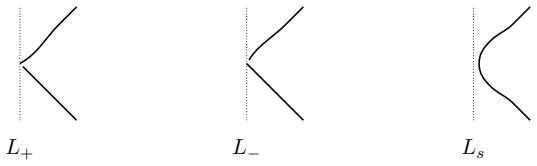
- [Section 4.2.1, proof of (S1)] Proposition 3.2 is stated for the resolution L−, but the proof of (S1) applies it to L+, where the roles of the two branches t0 and t1 are reversed. The implicit relabelling is never spelled out: the paper does not explain the effect of this relabelling on the condition i(L,t0,L,t1)=1, on the sign −g in the construction of the local system Eg, or on the bijection between MC(Ls,Eg) and {δ∈MC(L+,E):δp=g}. Since the author explicitly notes that the proof of (S1) is the only nontrivial local relation, this is a central presentation gap. The paper should either state an L+ version of Proposition 3.2 or give a precise symmetry argument reducing L+ to L−.
- [Section 3.1, setup and conventions] The manuscript states that 'certain foundational issues in defining Fukaya categories of surfaces will not be addressed in detail' and refers to external sources. This is a gap because the main theorem depends on the A∞-structure of the category F∨ on objects (L,E,δ) whose underlying curves are immersed with transverse self-intersections, and on the finiteness of the disk counts used to define the structure maps. The paper should specify which of the cited frameworks supplies the needed facts, or prove those facts in the restricted setting actually used. Without this, the definition of Φ is not fully rigorous as written.
- [Section 4.2, Theorems 4.3 and 4.9] There is a systematic notational inconsistency in the target category. Theorem 4.3 and the beginning of Section 4.2 write the target as Hall(F(S,N,θ,η,K)), but the objects introduced by the skein link L have endpoints in N×R and therefore belong to F∨, not F. The introduction and the annulus theorem correctly use F∨ (or the finite-dimensional module category), while Theorem 4.9 in Section 4.5 again writes 'F' where F∨ is meant. Since F and F∨ are isomorphic only under additional hypotheses on N, the theorem statements should consistently specify F∨ (or explicitly state the isomorphism hypothesis).
minor comments (6)
- [Section 2.4, Proposition 2.7 proof] In the associativity proof, the summation conditions are written with 'm1(f)=0' where they should refer to m1(a12)=0, and a similar typo occurs in the second product; these should be corrected for readability.
- [Lemma 4.8 and proof of Theorem 4.6] The chain of inequalities in both places reads 'i1+j1 ≥ i2+j1 ≥ ...' but the second term should be i2+j2.
- [Section 4.2.1, case m=n] The sentence 'The first summand is qΦ(L−)' states the conclusion without showing the cancellation of the factors (q−1)^{|π0|}, q^{−e}, and the cardinalities of the sets of local systems; displaying these four factors explicitly would make this step easier to verify.
- [Section 3.3.2, boundary resolution] After the list of the three resolutions L+, L−, Ls near the boundary, the text says 'See Figure 6', but the boundary resolution is shown in Figure 11; the reference should be corrected.
- [Section 1.4.1] The sentence 'One the other hand' should read 'On the other hand'; in the same paragraph, the statement that Z/(2n)-graded versions of the Fukaya category exist would benefit from a citation.
- [Section 4.1.1, front projection] The front-projection display of (S1) appears twice with different labels; this is redundant and the second display does not define the labels in the same way as the first, which may confuse the reader.
Circularity Check
No significant circularity: the skein-to-Hall homomorphism is constructed by counting Maurer–Cartan elements and the skein relations are verified in the Hall algebra, not assumed as inputs.
full rationale
The paper's central construction defines Phi(L) as the pushforward of the weighted counting measure on the augmentation category C(L)_1 to the Fukaya category, with the explicit formula Phi(L) = (q-1)^(-|pi_0(L)|) q^(-e(L)) sum over local systems E and Maurer-Cartan elements delta of [(L,E,delta)] (Lemma 4.2, Equation (4.2)). The main theorem 4.3 is then proved by checking, inside the Hall algebra, that the skein relations (S1), (S2), (S3), (S1b), and (S2b) hold for these images. Relation (S1) is verified by separating Maurer-Cartan elements according to the component delta_p at the crossing and invoking Proposition 3.2, which identifies Maurer-Cartan elements on the smoothed link L_s with those on L_- having fixed delta_p = g. Proposition 3.2 is proved from the curved A_infinity transport result Proposition 2.2, after a zeroth-order check of inverse isomorphisms in nine local configurations. No skein relation is inserted as an assumption in order to define Phi; instead the skein relations are derived in the Hall algebra. The compatibility with the product is also proved directly from the structure of Maurer-Cartan elements on stacked links and the Hall product formula (Subsection 4.2.2). The disk and annulus results (Theorems 4.6 and 4.9) are established by exhibiting explicit bases on the skein side and comparing with known Hall algebra bases; the use of prior work such as [HKK17] for the identification of the Fukaya category of the disk with Db(Rep(A_n)) and for the slicing is external, machine-independent support and is not equivalent to the target isomorphism. The author's self-citations (e.g., [HKK17], [Hai]) concern framework and standard structure, not the main theorem's conclusion. The reader-flagged fragility of the nine-case check in Proposition 3.2 is a presentation and verification-gap concern about correctness, not a circularity: no equation in that check is presupposed from the skein algebra being studied. Accordingly, no step reduces by construction to its inputs, and the appropriate circularity score is 0.
Assumptions & free parameters
assumptions (5)
- domain assumption The Fukaya categories F and F∨ of graded Legendrian curves over a finite field K are well-defined, locally left-finite, and closed under extensions, with A∞ structure maps counting immersed disks.
- domain assumption For a disk with n+1 marked points, F is equivalent to Db(Rep(A_n)) and the indecomposables and slicing used in Theorem 4.6 are as described.
- domain assumption For the annulus, F is equivalent to Db(Mod_fg(K[x±])) and F∨ to Db(Mod_fd(K[x±])), with the cyclic curves C_k corresponding to companion matrices.
- domain assumption The basis theorem for the quotient H_n/[H_n,H_n] of the Iwahori-Hecke algebra transfers to the Legendrian skein of the annulus.
- standard math Homotopy cardinality of ∞-groupoids and the derived Hall algebra of Toën give associative algebras as described in Section 2.4.
Cite this review
Pith. "Pith review of Legendrian skein algebras and Hall algebras." pith.science (2026). https://pith.science/paper/RVPAI7VI
@misc{pith2026190810358,
  author       = {Pith},
  title        = {Pith review of: Legendrian skein algebras and Hall algebras},
  year         = {2026},
  howpublished = {\url{https://pith.science/paper/RVPAI7VI}},
  note         = {Machine review of arXiv:1908.10358}
}
abstract
We compare two associative algebras which encode the "quantum topology" of Legendrian curves in contact threefolds of product type $S\times\mathbb R$. The first is the skein algebra of graded Legendrian links and the second is the Hall algebra of the Fukaya category of $S$. We construct a natural homomorphism from the former to the latter, which we show is an isomorphism if $S$ is a disk with marked points and injective if $S$ is the annulus.
Figures


Figures from the paper (11 more)






Reference graph
Works this paper leans on
-
[1]
Efimov , Ludmil Katzarkov , and Dmitri Orlov
Mohammed Abouzaid , Denis Auroux , Alexander I. Efimov , Ludmil Katzarkov , and Dmitri Orlov . Homological mirror symmetry for punctured spheres. J. Am. Math. Soc. , 26(4):1051--1083, 2013
work page 2013
-
[2]
On the Fukaya categories of higher genus surfaces
Mohammed Abouzaid . On the Fukaya categories of higher genus surfaces. Adv. Math. , 217(3):1192--1235, 2008
work page 2008
-
[3]
Bilinearized Legendrian contact homology and the augmentation category
Fr\'ed\'eric Bourgeois and Baptiste Chantraine . Bilinearized Legendrian contact homology and the augmentation category. J. Symplectic Geom. , 12(3):553--583, 2014
work page 2014
-
[4]
John C. Baez and James Dolan . From finite sets to Feynman diagrams. In Mathematics unlimited---2001 and beyond , pages 29--50. Berlin: Springer, 2001
work page 2001
-
[5]
Braid groups and Iwahori-Hecke algebras
Stephen Bigelow . Braid groups and Iwahori-Hecke algebras. In Problems on mapping class groups and related topics , pages 285--299. Providence, RI: American Mathematical Society (AMS), 2006
work page 2006
-
[6]
Stability conditions on triangulated categories
Tom Bridgeland. Stability conditions on triangulated categories. Ann. of Math. , 166:317--345, 2007
work page 2007
-
[7]
Quantum groups via Hall algebras of complexes
Tom Bridgeland . Quantum groups via Hall algebras of complexes. Ann. Math. (2) , 177(2):739--759, 2013
work page 2013
-
[8]
Differential algebra of Legendrian links
Yuri Chekanov . Differential algebra of Legendrian links. Invent. Math. , 150(3):441--483, 2002
work page 2002
Show all 37 references
-
[9]
The Hall Algebras of Surfaces I
Benjamin Cooper and Peter Samuelson. The Hall Algebras of Surfaces I . arXiv:1708.00889, to appear in Journal of the Institute of Mathematics of Jussieu
-
[10]
Higher Segal spaces I
Tobias Dyckerhoff and Mikhail Kapranov. Higher Segal spaces I . arXiv:1212.3563
-
[11]
Triangulated surfaces in triangulated categories
Tobias Dyckerhoff and Mikhail Kapranov . Triangulated surfaces in triangulated categories. J. Eur. Math. Soc. (JEMS) , 20(6):1473--1524, 2018
2018
-
[12]
Orientations in Legendrian contact homology and exact Lagrangian immersions
Tobias Ekholm , John Etnyre , and Michael Sullivan . Orientations in Legendrian contact homology and exact Lagrangian immersions. Int. J. Math. , 16(5):453--532, 2005
2005
-
[13]
Fukaya, Y.-G
K. Fukaya, Y.-G. Oh, H. Ohta, and K. Ono. Lagrangian Intersection Floer Theory, Anomaly and Obstruction, Parts I, II , volume 46.1 of AMS/IP Studies in Adv. Math. 2009
2009
-
[14]
The algebra of partitions
Philip Hall . The algebra of partitions. Proc. 4th Canad. Math. Congr. Banff, 1957, 147-159 (1959). , 1959
1959
-
[15]
Flat surfaces and stability structures
Fabian Haiden, Ludmil Katzarkov, and Maxim Kontsevich. Flat surfaces and stability structures. Publ. Math. Inst. Hautes \'Etudes Sci. , 126:247--318, 2017
2017
-
[16]
A-infinity algebras, modules and functor categories
Bernhard Keller . A-infinity algebras, modules and functor categories. In Trends in representation theory of algebras and related topics. Workshop on representations of algebras and related topics, Quer\'etaro, M\'exico, August 11--14, 2004. , pages 67--93. Providence, RI: Ame...
2004
-
[17]
private communication, 2018
Maxim Kontsevich. private communication, 2018
2018
-
[18]
Stability structures, motivic Donaldson-Thomas invariants and cluster transformations
Maxim Kontsevich and Yan Soibelman. Stability structures, motivic Donaldson-Thomas invariants and cluster transformations. arXiv:0811.2435
-
[19]
Sur les A-infinity cat\'egories
Kenji Lef\`evre-Hasegawa. Sur les A-infinity cat\'egories . PhD thesis, Paris Diderot University, 2003
2003
-
[20]
Satellite ruling polynomials, dga representations, and the colored homfly-pt polynomial
Caitlin Leverson and Dan Rutherford. Satellite ruling polynomials, dga representations, and the colored homfly-pt polynomial. arXiv:1802.10531
-
[21]
The HOMFLYPT skein algebra of the torus and the elliptic Hall algebra
Hugh Morton and Peter Samuelson . The HOMFLYPT skein algebra of the torus and the elliptic Hall algebra. Duke Math. J. , 166(5):801--854, 2017
2017
-
[22]
Satellites of Legendrian knots and representations of the Chekanov-Eliashberg algebra
Lenhard Ng and Daniel Rutherford . Satellites of Legendrian knots and representations of the Chekanov-Eliashberg algebra. Algebr. Geom. Topol. , 13(5):3047--3097, 2013
2013
-
[23]
Augmentations are Sheaves
Lenhard Ng, Dan Rutherford, Vivek Shende, Steven Sivek, and Eric Zaslow. Augmentations are Sheaves . arXiv:1502.04939
-
[24]
The cardinality of the augmentation category of a Legendrian link
Lenhard Ng , Dan Rutherford , Vivek Shende , and Steven Sivek . The cardinality of the augmentation category of a Legendrian link. Math. Res. Lett. , 24(6):1845--1874, 2017
2017
-
[25]
P. E. Pushkar and Yu. V. Chekanov . Combinatorics of fronts of Legendrian links, and Arnol'd's 4-conjectures. Russ. Math. Surv. , 60(1):95--149, 2005
2005
-
[26]
The Thurston-Bennequin number, Kauffman polynomial, and ruling invariants of a Legendrian link: the Fuchs conjecture and beyond
Dan Rutherford . The Thurston-Bennequin number, Kauffman polynomial, and ruling invariants of a Legendrian link: the Fuchs conjecture and beyond. Int. Math. Res. Not. , 2006(9):15, 2006
2006
-
[27]
A biased view of symplectic cohomology
Paul Seidel . A biased view of symplectic cohomology. In Current developments in mathematics, 2006 , pages 211--253. Somerville, MA: International Press, 2008
2006
-
[28]
Fukaya categories and P icard- L efschetz theory
Paul Seidel. Fukaya categories and P icard- L efschetz theory . Zurich Lectures in Advanced Mathematics. European Mathematical Society (EMS), Z\"urich, 2008
2008
-
[29]
Steinitz
E. Steinitz . Zur Theorie der Abelschen Gruppen. Jahresber. Dtsch. Math.-Ver. , 9(1):80--85, 1901
1901
-
[30]
Ribbon graphs and mirror symmetry
Nicol\`o Sibilla , David Treumann , and Eric Zaslow . Ribbon graphs and mirror symmetry. Sel. Math., New Ser. , 20(4):979--1002, 2014
2014
-
[31]
Legendrian knots and constructible sheaves
Vivek Shende , David Treumann , and Eric Zaslow . Legendrian knots and constructible sheaves. Invent. Math. , 207(3):1031--1133, 2017
2017
-
[32]
Representations of quivers over \( F_ 1 \) and Hall algebras
Matt Szczesny . Representations of quivers over \( F_ 1 \) and Hall algebras. Int. Math. Res. Not. , 2012(10):2377--2404, 2012
2012
-
[33]
Derived Hall algebras
Bertrand Toen . Derived Hall algebras. Duke Math. J. , 135(3):587--615, 2006
2006
-
[34]
V. G. Turaev . The Conway and Kauffman modules of the solid torus. Zap. Nauchn. Semin. Leningr. Otd. Mat. Inst. Steklova , 167:79--89, 1988
1988
-
[35]
Vladimir G. Turaev . Skein quantization of Poisson algebras of loops on surfaces. Ann. Sci. \'Ec. Norm. Sup\'er. (4) , 24(6):635--704, 1991
1991
-
[36]
Moduli of objects in dg-categories
Bertrand Toen and Michel Vaqui\'e . Moduli of objects in dg-categories. Ann. Sci. \'Ec. Norm. Sup\'er. (4) , 40(3):387--444, 2007
2007
-
[37]
Hall algebras associated to triangulated categories
Jie Xiao and Fan Xu . Hall algebras associated to triangulated categories. Duke Math. J. , 143(2):357--373, 2008
2008
Reviewed August 14, 2026 · model on record in the stance chip above.
Discussion (0). Continue with ORCID to comment.