REVIEW 3 major objections 6 minor 38 references
Stellar flares cannot explain the Galactic 511 keV emission
T0 review · 3 major / 6 minor · reviewed 2026-08-02 · deepseek-v4-flash
Pith's one-line read Stellar flares cannot be the dominant source of the Milky Way's 511 keV positron emission, according to a new analysis combining solar-flare calibration with 20 years of INTEGRAL/SPI observations.
desk verdict Careful, honest population-synthesis analysis that very likely rules out normal stellar flares as the 511 keV source, though the escape-fraction caveat keeps the headline one notch stronger than strictly proven. read the letter →
The pith
A machine-rendered reading of the paper's core claim, the machinery that carries it, and where it could break.
The reading
What carries the argument
The central object is the solar-calibrated flare-energy-to-511 keV luminosity relation, L^⊙_511(E_F) = D (E_F/E_A)^δ, derived from a chain of three power-law correlations (flare energy → peak soft X-ray flux → 2.223 MeV line flux → 511 keV flux) and fitted simultaneously with a hierarchical Bayesian model (using Stan) that estimates unknown measurement uncertainties and intrinsic scatter. This relation is then combined with flare frequency–energy distributions (FFDs) of different stellar types and a flare-duration scaling Δt ∝ E^0.3 to compute the quasi-persistent 511 keV luminosity per star, L^*_511,QP, via an integral over flare energy. The Galactic total is obtained by integrating over a
What would settle it
A direct measurement that would settle the claim: detect a diffuse 2.223 MeV line from the Milky Way at a flux of order 10^−5 ph cm^−2 s^−1 (the companion line expected from the flare relation), or observe a stellar flare on a nearby star with a 511 keV luminosity several orders of magnitude above the solar-calibrated L^⊙_511(E_F) relation; either would contradict the paper's central exclusion.
Extended reading notes
Core claim
The paper's central claim is that stellar flares fall short by several orders of magnitude in explaining the Galactic positron annihilation rate, and that stellar flare scenarios cannot reproduce the observed 511 keV morphology. The authors construct a solar-calibrated relation L^⊙_511(E_F) = 8.0 × 10^23 (E_F/10^30 erg)^0.68 ph/s by chaining three empirical power-law sub-correlations: flare energy to peak soft X-ray flux, peak soft X-ray flux to 2.223 MeV line flux, and 2.223 MeV to 511 keV flux, fitted jointly in a hierarchical Bayesian model that treats unknown uncertainties. Combining this with flare frequency–energy distributions for M, K, G, F, and A stars, and a flare-duration scaling
Load-bearing premise
The load-bearing premise is that the solar-calibrated relation between flare energy and 511 keV luminosity, based on positrons that annihilate locally in the flare atmosphere, correctly measures the total positron yield for all flaring stellar types in the Milky Way; if most flare-produced positrons escape before annihilating, the predicted Galactic signal could rise by orders of magnitude.
Editorial extensions
If this is right
- If correct, stellar flares contribute at most a few percent of the Galactic positron budget, so the dominant source must lie elsewhere among old-stellar-population candidates such as compact binaries, millisecond pulsars, or type Ia supernovae.
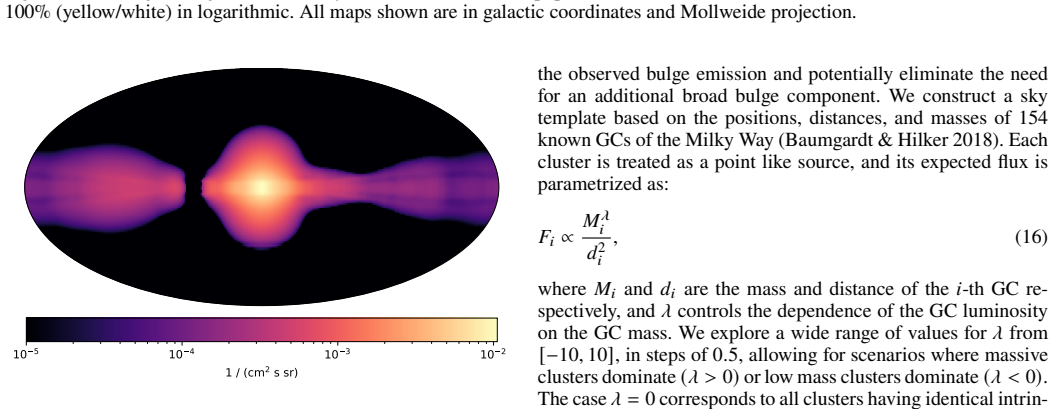
- Globular clusters are constrained as 511 keV sources: the paper provides 2σ upper limits for 154 clusters, with Terzan 5 at <2.7 × 10^−5 ph cm^−2 s^−1, marginally excluding a specific X-ray binary scenario.
- A diffuse 2.223 MeV line from neutron-capture in flare sites is predicted at a similar level (Galactic-wide flux ~10^−5 ph cm^−2 s^−1), and a future search with INTEGRAL/SPI or COSI could test the flare scenario directly.
- The bulge morphology fitted from random point-source distributions suggests the 511 keV emission is not smooth, favoring a discrete-source interpretation rather than a diffuse stellar-flare template.
- The conclusion applies to 'normal' flaring activity; extreme superflares or flare positrons escaping into the interstellar medium remain outside the paper's central exclusion.
Reading between the lines
- The paper's strongest lever is the assumption that flare-produced positrons annihilate locally; if even a few percent escape into the wind or ISM, the predicted 511 keV output could rise by an order of magnitude or more, so measuring escape fractions in solar or stellar flares is a direct test of the conclusion.
- The hierarchical calibration chain could be re-derived using other stellar activity proxies (e.g., X-ray or radio flare energies) to check whether the solar baseline is representative of more active stars, which would either harden or weaken the paper's exclusion.
- A future detection of a diffuse 2.223 MeV line at fluxes above ~10^−5 ph cm^−2 s^−1 would contradict the paper's calibration baseline and would force a revision of the solar-derived relation, whereas a nondetection would independently support the conclusion.
- The random-point-source bulge fits hint that the source of the 511 keV emission may be a population of unresolved old compact objects; if COSI resolves such point sources, the stellar-flare hypothesis could be fully retired.
Editorial analysis
A structured set of objections, weighed in public.
Referee Report
Summary. The paper estimates the quasi-persistent 511 keV luminosity produced by stellar flares in the Milky Way, using a hierarchical Bayesian model calibrated on solar-flare correlations (flare energy → GOES flux → 2.223 MeV line → 511 keV line) and flare frequency–energy distributions per stellar type. The predicted Galactic luminosity is 10^37–10^40 ph/s, three to four orders of magnitude below the positron injection rate inferred from INTEGRAL/SPI. The paper also constructs stellar-population and globular-cluster templates and finds they do not reproduce the 511 keV morphology. The conclusion is that normal stellar flaring activity cannot be the dominant source of Galactic positrons.
Significance. If correct, this is an important negative result: it would close a proposed old-stellar-population channel for the 511 keV bulge, complementing morphological and population studies. The paper combines a physically motivated solar calibration, an independent energy-budget argument, and direct 20-year SPI data analysis, including new GC flux limits. The hierarchical treatment of unknown solar-flare uncertainties is a useful methodological contribution. However, the strength of the conclusion depends on two load-bearing assumptions: the internal consistency of the solar correlation chain and the assertion that only a small fraction of flare-produced positrons escape the stellar atmosphere before annihilating.
major comments (3)
- [Sect. 3.4, Eqs. (6)–(9)] The reported sub-correlation indices are internally inconsistent. With α=0.51, β=3.02, γ=1.22, the product αβγ equals 0.51×3.02×1.22 ≈ 1.88, not the claimed δ=0.68. Moreover, inserting A=8.5×10^-3, B=1.35, C=0.65, d=1.5×10^13 cm into Eq. (9) gives D ≈ 6×10^19 ph/s, not 8×10^23 ph/s. The two methods (indirect chain and direct SMM fit) therefore differ by orders of magnitude at a given energy, contrary to the statement that they bracket a systematic uncertainty. Since L_sun_511(E_F) is the central calibration, the predicted luminosities in Tables 1 and 2 may change substantially if the chain is corrected; this must be re-derived and re-reported.
- [Sect. 7] The escape fraction f_esc is not bounded physically. The paper's own text states the calculation is calibrated to positrons that annihilate locally, and then assumes 'plausible escape fractions at the level f_esc=0.2' without support. If the true escape fraction for K/M dwarfs were ≥0.99, the positron yield could be orders of magnitude larger, closing the energy gap. The authors dismiss the Bisnovatyi-Kogan & Pozanenko (2017) extreme as 'highly optimistic' because their near-total escape would produce 10^46 ph/s, but intermediate values are not excluded. The GC upper limits derived in this paper could in principle constrain f_esc; this should be done explicitly before claiming that stellar flares 'cannot' explain the signal.
- [Sects. 6.3–7] The morphology argument also relies on the local-annihilation assumption. If a large fraction of flare positrons escape into the stellar wind or ISM, the 511 keV distribution would not trace the stellar density directly, and the failure of stellar-population templates would not be decisive. The paper acknowledges this only indirectly. The authors should either model or bound the propagation effect, or explicitly restrict the conclusion to the case of local annihilation, which would weaken the abstract's categorical claim.
minor comments (6)
- [Sect. 5.2 / Eq. (2)] Equation (2) cites the Chabrier (2003) PDMF, but Sect. 5.2 uses a Kroupa IMF approximated as a PDMF. Please reconcile which stellar-mass distribution is used.
- [Sect. 3.3.3] The text says Shih et al. (2009) correlates the 2.223 MeV line with bremsstrahlung above 300 keV, but Eq. (7) relates it to GOES soft X-ray flux. Clarify whether the GOES flux is used as a direct proxy or an intermediate step.
- [Fig. 5 / Eq. (11)] The figure axis labels 'Flare frequency [erg^-1 year^-1]' while Eq. (11) uses units of s^-1. Make the unit convention consistent.
- [Table 1] The L*_511,QP columns have no explicit units in the table header; add ph/s. Also, the FFD normalizations A_ν are not reported, which prevents the reader from reproducing the single-star luminosities in Table 1.
- [Sect. 3.2] Typo: 'utilises stan1' should be separated; the software is Stan.
- [Eq. (12)] The formula has a denominator (1+ε); for ε≈-1 (which occurs for some parameter combinations, e.g., G-type with the indirect calibration), the integral should be logarithmic. State how this case is handled.
Circularity Check
No significant circularity: the flare-to-511 keV calibration uses external solar flare data and independent stellar FFD catalogs; the Galactic 511 keV signal enters only as the comparison target.
full rationale
The derivation chain is self-contained against external benchmarks. Eq. (9) calibrates the solar flare relation L_sun_511(E_F) = D(E_F/E_A)^δ jointly from three independent solar datasets (Aschwanden et al. 2015; Shih et al. 2009; Vestrand et al. 1999), with an alternative direct SMM fit in Sect. 3.5 providing a stated systematic range (δ'=1.41 vs δ=0.68). The flare frequency-energy distributions are taken from external catalogs (Yang & Liu 2019; Maehara et al. 2012), the duration scaling τ≈0.3 from Pettersen (1989), and the stellar population normalization from Chabrier/Kroupa IMFs. No Galactic 511 keV flux is used to set D, δ, α_ν, τ, or T; the INTEGRAL/SPI signal (~10^43–10^44 e+/s) is used only as the comparison target for the predicted ~10^37–10^40 ph/s. The morphology test builds templates from independent stellar-density maps (Robitaille 2017; Porter et al. 2017) and compares against 20 years of SPI data; the self-citations (Siegert et al. 2016; Yoneda et al. 2025) supply the observational dataset and baseline morphological model, which are measurements rather than fitted inputs to the flare model, so they are not load-bearing in a circular sense. The main caveat is the paper's own flagged limitation (Sect. 7): the calculation 'is calibrated to the 511keV luminosity from positrons that annihilate locally in the flare,' and a large escape fraction (e.g., the Bisnovatyi-Kogan & Pozanenko 2017 extreme) could change the budget by orders of magnitude. This is an unvalidated physical assumption — a correctness/robustness risk, not a circular reduction — because f_esc is neither fit to nor defined by the Galactic 511 keV signal. The central claim therefore has independent content and does not reduce to its inputs.
Assumptions & free parameters
free parameters (8)
- Solar 511 keV luminosity normalization D (combined chain) =
8.0e23 ph/s at 10^30 erg
- 511 keV luminosity power-law index δ =
0.68 ± 0.08 (direct SMM: 1.41 ± 0.10)
- Intermediate solar correlation slopes/normalizations A, B, C, α, β, γ =
A=8.5e-3, α=0.51; B=1.35, β=3.02; C=0.65, γ=1.22
- FFD slope α_ν per stellar type =
M -2.09, K -1.78, G -1.96, F -2.11, A -1.12
- FFD normalization A_ν per stellar type =
not tabulated; taken from Yang & Liu (2019), 3-6 dex above solar at 10^32 erg
- Flare energy range E_min/E_max per type =
M 1e31-1e35; K 1e32-1e35; G 1e32-1e37; F 1e34-1e36; A 1e34-1e36 erg
- Flare duration normalization T and index τ =
T from Pettersen (1989) relation; τ≈0.3
- Positron escape fraction f_esc =
0 (main model); 0.2 explored
assumptions (6)
- domain assumption The solar E_F → F_SXR → F_2223 → F_511 calibration chain applies to all flaring stellar types
- domain assumption Positrons annihilate locally in the flare atmosphere, so observed solar 511 keV luminosity equals total positron yield
- domain assumption FFDs from Kepler/TESS/Yang & Liu are power laws over E_min-E_max for each spectral type
- domain assumption Stellar number densities follow blackbody decomposition of Galactic SED maps (Robitaille 2017; Porter et al. 2017)
- domain assumption Annihilation morphology traces flare injection morphology (no significant positron transport)
- domain assumption Kroupa IMF as PDMF over 0.08-2.1 M_sun with total N=10^11 stars
Cite this review
Pith. "Pith review of Stellar flares cannot explain the Galactic 511 keV emission." pith.science (2026). https://pith.science/paper/RVSA7FQ5
@misc{pith2026260711716,
  author       = {Pith},
  title        = {Pith review of: Stellar flares cannot explain the Galactic 511 keV emission},
  year         = {2026},
  howpublished = {\url{https://pith.science/paper/RVSA7FQ5}},
  note         = {Machine review of arXiv:2607.11716}
}
abstract
The origin of the 511 keV line signal in the Milky Way remains unresolved despite decades of observations. The measured flux of $\sim 3 \times 10^{-3}\,\mathrm{ph\,cm^{-2}\,s^{-1}}$ suggests a steady-state positron injection rate of $\sim 10^{43}$-$10^{44}\,\mathrm{e^+\,s^{-1}}$. One proposed contributor to this signal is stellar flaring activity since high energy Solar flares are known to produce positrons and associated annihilation radiation. We estimate the quasi-persistent 511 keV luminosity expected from flaring stellar populations and estimate the Galactic contribution. We constrain the 511 keV fluxes for different sources in the Galaxy, and in particular globular clusters. Using Solar flare observations as a calibration baseline, we construct a hierarchical Bayesian model to link flare energy to 511 keV luminosity. We further use flare frequency-energy distributions to estimate the time-averaged positron output of stellar populations. The resulting predictions are compared with INTEGRAL/SPI observations using spatial and population-based models. We find that stellar flares fall short by several orders of magnitude in explaining the Galactic positron annihilation rate. Reproducing $\sim10\%$ of the observed luminosity in the Galactic bulge would require unphysically large maximum flare energies per star reaching up to $E_\mathrm{{max}} \gtrsim 10^{37-39}\,\mathrm{erg}$. Spatial modeling further shows that stellar flare scenarios cannot reproduce the observed 511 keV morphology. Stellar flares cannot be the dominant source of Galactic positrons. Although previous studies have shown that the measured 511 keV morphology is broadly consistent with old stellar populations, our results exclude normal stellar flaring activity as the underlying source for this emission.
Figures


Figures from the paper (7 more)



Reference graph
Works this paper leans on
-
[1]
Aegerter,T.R.W.,Emmons,D.J.,&Loper,R.D.2020,JournalofAtmospheric and Solar-Terrestrial Physics, 208, 105375 Aschwanden,M.J.,Boerner,P.,Ryan,D.,etal.2015,TheAstrophysicalJournal, 802, 53
2020
-
[2]
J., Tarbell, T
Aschwanden, M. J., Tarbell, T. D., Nightingale, R. W., et al. 2000, The Astro- physical Journal, 535, 1047 Aulanier,G.,Démoulin,P.,Schrijver,C.,etal.2013,Astronomy&Astrophysics, 549, A66
2000
-
[3]
& Hilker, M
Baumgardt, H. & Hilker, M. 2018, Monthly Notices of the Royal Astronomical Society, 478, 1520
2018
-
[4]
Bisnovatyi-Kogan, G. S. & Pozanenko, A. S. 2017, Astrophysics, 60, 223
2017
-
[5]
P., & Jourdain, E
Bouchet, L., Roques, J. P., & Jourdain, E. 2010, The Astrophysical Journal, 720, 1772 Carnero Rosell, A., Santiago, B., Dal Ponte, M., et al. 2019, Monthly Notices of the Royal Astronomical Society, 489, 5301
2010
-
[6]
Chabrier, G. 2003, Publications of the Astronomical Society of the Pacific, 115, 763 Churazov,E.,Sunyaev,R.,Sazonov,S.,Revnivtsev,M.,&Varshalovich,D.2005, Monthly Notices of the Royal Astronomical Society, 357, 1377 Crosby,N.B.,Aschwanden,M.J.,&Dennis,B.R.1993,SolarPhysics,143,275
2003
-
[7]
Das, S., Krumholz, M. R., Crocker, R. M., Siegert, T., & Eisenberger, L. 2025, arXiv preprint arXiv:2506.00847
arXiv 2025
-
[8]
Diehl, R., Siegert, T., Greiner, J., et al. 2018, Astronomy & Astrophysics, 611, A12 Gao,D.-Y.,Liu,H.-G.,Yang,M.,&Zhou,J.-L.2022,TheAstronomicalJournal, 164, 213 Günther,M.N.,Zhan,Z.,Seager,S.,etal.2020,TheAstronomicalJournal,159, 60
2018
Show all 38 references
-
[9]
A., Wheatley, P
Jackman, J. A., Wheatley, P. J., Acton, J. S., et al. 2021, Monthly Notices of the Royal Astronomical Society, 504, 3246
2021
-
[10]
2006, Astronomy & Astrophysics, 445, 579 Knödlseder, J., Sabri, K., Jean, P., et al
Jean, P., Knoedlseder, J., Gillard, W., et al. 2006, Astronomy & Astrophysics, 445, 579 Knödlseder, J., Sabri, K., Jean, P., et al. 2025, A&A, 700, A257 Knoedlseder,J.,Jean,P.,Lonjou,V.,etal.2005,Astronomy&Astrophysics,441, 513
2006
-
[11]
2011, Astronomy & Astrophysics, 530, A84
Kretzschmar, M. 2011, Astronomy & Astrophysics, 530, A84
2011
-
[12]
2001, Monthly Notices of the Royal Astronomical Society, 322, 231
Kroupa, P. 2001, Monthly Notices of the Royal Astronomical Society, 322, 231
2001
-
[13]
Licquia, T. C. & Newman, J. A. 2015, The Astrophysical Journal, 806, 96
2015
-
[14]
2012, Nature, 485, 478
Maehara, H., Shibayama, T., Notsu, S., et al. 2012, Nature, 485, 478
2012
-
[15]
1997a, in AIP Conference Pro- ceedings, Vol
McConnell, M., Fletcher, S., Bennett, K., et al. 1997a, in AIP Conference Pro- ceedings, Vol. 410, American Institute of Physics, 1099–1103 McConnell,M.,Ryan,J.,Diehl,R.,etal.1997b,AmericanAstronomicalSociety, 191, 1370 Murphy,R.J.,Share,G.H.,Skibo,J.G.,&Kozlovsky,B.2005,TheAs...
2005
-
[16]
1989, in International Astronomical Union Colloquium, Vol
Pettersen, B. 1989, in International Astronomical Union Colloquium, Vol. 104, Cambridge University Press, 299–312
1989
-
[17]
Pleintinger, M. M. M., Diehl, R., Siegert, T., Greiner, J., & Krause, M. G. H. 2023, Astronomy & Astrophysics, 672, A53
2023
-
[18]
A., Johannesson, G., & Moskalenko, I
Porter, T. A., Johannesson, G., & Moskalenko, I. V. 2017, The Astrophysical Journal, 846, 67
2017
-
[19]
2011, ArXiv e-prints, astro-ph.HE
Prantzos, N. 2011, ArXiv e-prints, astro-ph.HE
2011
-
[20]
Robitaille, T. P. 2017, Astronomy & Astrophysics, 600, A11
2017
-
[21]
J., Beer, J., Baltensperger, U., et al
Schrijver, C. J., Beer, J., Baltensperger, U., et al. 2012, Journal of Geophysical Research: Space Physics, 117
2012
-
[22]
Share, G. H. & Murphy, R. J. 2004, in Stars as Suns : Activity, Evolution and Planets, ed. A. K. Dupree & A. O. Benz, 133
2004
-
[23]
2009, The Astrophysical Journal, 698, L152
Shih, A., Lin, R., & Smith, D. 2009, The Astrophysical Journal, 698, L152
2009
-
[24]
1995, Publications of the Astronomical Society of Japan, v
Shimizu, T. 1995, Publications of the Astronomical Society of Japan, v. 47, p. 251-263., 47, 251
1995
-
[25]
2023, Astrophysics and Space Science, 368
Siegert, T. 2023, Astrophysics and Space Science, 368
2023
-
[26]
D., & Weinberger, C
Siegert, T., Berteaud, J., Calore, F., Serpico, P. D., & Weinberger, C. 2022a, arXiv.org, arXiv:2202.04574
-
[27]
2016, Astronomy & Astrophysics, 586, A84
Siegert, T., Diehl, R., Khachatryan, G., et al. 2016, Astronomy & Astrophysics, 586, A84
2016
- [28]
-
[29]
Skinner, G., Diehl, R., Zhang, X., Bouchet, L., & Jean, P. 2014, in Proceedings of the 10th INTEGRAL Workshop: ”A Synergistic View of the High-Energy Sky”(INTEGRAL2014).15-19September2014.Annapolis,MD,USA.Pub- lished online at http://pos.sissa.it/cgi-bin/reader/conf.cgi?confid...
2014
-
[30]
2022, PASA, 39, e026
Staveley-Smith, L., Bond, E., Bekki, K., & Westmeier, T. 2022, PASA, 39, e026
2022
-
[31]
2024, in 2024 8th International Conference on Robotics, Control and Automation (ICRCA) (IEEE), 745 Tomsick,J.A.,Zoglauer,A.,Sleator,C.,etal.2019,arXiv.org,arXiv:1908.04334
Tomsick, J., Boggs, S., Zoglauer, A., et al. 2024, in 2024 8th International Conference on Robotics, Control and Automation (ICRCA) (IEEE), 745 Tomsick,J.A.,Zoglauer,A.,Sleator,C.,etal.2019,arXiv.org,arXiv:1908.04334
2024 arXiv
-
[32]
P., Schönfelder, V., et al
Vedrenne, G., Roques, J. P., Schönfelder, V., et al. 2003, Astronomy & Astro- physics, 411, L63
2003
-
[33]
T., Share, G
Vestrand, W. T., Share, G. H., Murphy, R. J., et al. 1999, The Astrophysical Journal Supplement Series, 120, 409 Walkowicz,L. M.,Basri,G., Batalha,N., etal.2011, TheAstronomicalJournal, 141, 50
1999
-
[34]
2008, Nature, 451, 159
Weidenspointner, G., Skinner, G., Jean, P., et al. 2008, Nature, 451, 159
2008
-
[35]
2021, PhD thesis, Technische Universität München
Weinberger, C. 2021, PhD thesis, Technische Universität München
2021
-
[36]
Winkler, C., Courvoisier, T. J. L., Di Cocco, G., et al. 2003, Astronomy & Astrophysics, 411, L1
2003
-
[37]
2024, Monthly Notices of the Royal Astro- nomical Society, 527, 2232
Xin, L.-P., Li, H.-l., Wang, J., et al. 2024, Monthly Notices of the Royal Astro- nomical Society, 527, 2232
2024
-
[38]
& Liu, J
Yang, H. & Liu, J. 2019, The Astrophysical Journal Supplement Series, 241, 29 Yoneda,H.,Siegert,T.,&Mittal,S.2025,Astronomy&Astrophysics,702,A220 Article number, page 11 of 13 A&A proofs:manuscript no. aanda Appendix A: Appendix A.1: bulge region: random point source distribut...
2019
Reviewed August 2, 2026 · model on record in the stance chip above.
Discussion (0). Sign in to comment.