REVIEW 3 major objections 6 minor 62 references
On VR Spatial Query for Dual Entangled Worlds
T0 review · 3 major / 6 minor · reviewed 2026-08-14 · deepseek-v4-flash
Pith's one-line read The paper introduces DROP, proves it NP-hard, and gives a polynomial-time (1+epsilon)-approximation algorithm for shortest VR paths under redirected-walking cost.
desk verdict New problem and solid reduction, but the FPTAS time bound has a real gap; deserves refereeing with a required fix. read the letter →
The pith
A machine-rendered reading of the paper's core claim, the machinery that carries it, and where it could break.
The reading
What carries the argument
Minimum Immersion Loss Range (MIL Range): for each possible virtual edge length $l$, $\alpha(l)$ is the smallest RW cost over all loco-state pairs at distance $l$, and $\beta(l)$ is the largest over starting states of the minimal cost to realize a step of length $l$. The paper uses these two numbers as per-edge weights in two simplified single-world graphs (COS-DROP and CPS-DROP), then solves each with Lagrangian relaxation on the visibility graph to obtain a reference path. The reference path feeds three pruning rules (ILSP, SLSP, ULSL) that discard loco-states that cannot be feasible or cannot beat the current best, and the surviving states go into a round-and-scale dynamic program with scale $S = \epsilon L/|X|$.
What would settle it
Take two physical paths with the same sum of per-step MIL values but different orderings or densities of operations (for example, one long Reset versus many small rotations), measure SSQ dizziness or detection rates in a user study, and check whether the experienced immersion loss is equal. If the two totals differ systematically, the additive MIL model that DEWN optimizes does not match real user cost, and the approximation guarantee holds for the model rather than for actual experience.
Extended reading notes
Core claim
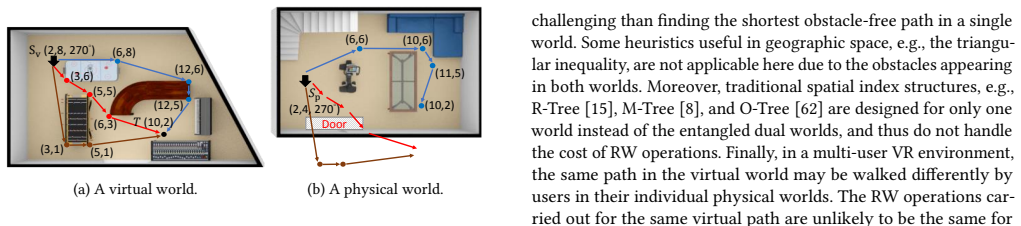
The paper establishes that the Dual-world Redirected-walking Obstacle-free Path (DROP) problem — finding a minimum-length virtual path whose corresponding physical walk is obstacle-free and has redirected-walking cost within a budget $C$ — is NP-hard, via a reduction from 0-1 Knapsack. It then proves Theorem 5.1: for any virtual path, the true RW cost lies between the sum of per-edge MIL lower bounds $\alpha(l)$ and the sum of per-edge upper bounds $\beta(l)$. Using these bounds, DEWN simplifies DROP into two single-world constrained shortest path problems, finds a feasible reference path by Lagrangian relaxation, prunes the loco-state space, and applies rounding-and-scaling dynamic programming. Theorem 5.2 states the result is within $(1+\epsilon)$ of optimal and runs in $O(N^2 + N^3/\epsilon)$ time, i.e., DEWN is a fully polynomial-time approximation scheme.
Load-bearing premise
The whole construction assumes that the total redirected-walking cost of a path is exactly the sum of the costs of its individual steps, so per-step losses can be added up without considering how operations interact across consecutive steps.
Editorial extensions
If this is right
- DROP can be answered approximately in polynomial time, so dual-world shortest-path queries scale to maps with hundreds of thousands of virtual locations, where the exponential Basic DP is unusable.
- Existing kNN and range query algorithms can be reused for VR by invoking DEWN as a building block, turning a single-world spatial index into a dual-world one.
- The MIL Range is query-independent and precomputable offline, so online query time is spent on routing rather than on recomputing redirected-walking costs from scratch.
- When user orientations are dropped (the COS simplification), DEWN remains an FPTAS on path length, and the RW cost is only inflated by at most $C_\theta$ times the virtual-graph diameter.
- Among the compared methods, only DEWN and Basic DP carry formal guarantees on both feasibility and solution quality; the others sacrifice at least one of the two.
Reading between the lines
- Beyond the paper: the additive MIL model is the main risk; if redirected-walking operations interact across consecutive steps, the FPTAS guarantee holds relative to the model rather than to true user immersion. A testable extension would replace MIL with a measured state-dependent transition cost and check whether DEWN's pruning and approximation arguments still go through.
- Beyond the paper: the MIL Range trick — bounding a cross-world cost per segment and then solving two one-world relaxations — is a general recipe for constrained path problems with a secondary cost that is expensive to compute exactly, and could transfer to robot navigation or assisted mobility.
- Beyond the paper: the theoretical running time $O(N^2 + N^3/\epsilon)$ relies on the ratio between the reference path length and a lower bound being constant; the paper notes this ratio is usually below 2 in experiments but is not bounded in the worst case, so there may be instances where the true running time is worse than the headline bound.
Signed reviews
Editorial analysis
A structured set of objections, weighed in public.
Referee Report
Summary. The paper introduces DROP, a shortest-path query for VR users whose movement in a virtual world must be realizable by an obstacle-free physical walk under a redirected-walking (RW) cost budget. The authors prove DROP is NP-hard by reduction from 0-1 Knapsack, present an exponential-time Basic DP algorithm, and then propose DEWN, which uses precomputed Minimum Immersion Loss Ranges, Lagrangian relaxation on simplified single-world problems, heuristic reference-path generation, pruning strategies, and a rounding-and-scaling DP. They claim DEWN is a fully polynomial-time approximation scheme for DROP, and they extend it as a building block for dual-world kNN and range queries. The paper closes with experiments on real and synthetic maps and a user study with an HTC Vive implementation.
Significance. If the central FPTAS claim were fully established, the paper would make a useful contribution: it formalizes a new spatial-query problem in VR, proves NP-hardness, introduces the MIL Range idea to decouple the virtual and physical worlds, and shows how existing spatial-query machinery can be reused for the dual-world setting. The experimental evaluation is extensive, includes a user study, and gives evidence that the proposed reference-path and pruning heuristics behave well in practice. The NP-hardness reduction is sound, and the overall algorithmic architecture is plausible and well-motivated. However, as written, the FPTAS claim is not proven: the complexity analysis contains an admitted unbounded factor, and there are smaller correctness gaps in the supporting lemmas and in the multiplier-search algorithm. These issues are local and likely repairable, but they are load-bearing for the paper's main theoretical contribution.
major comments (3)
- [Section 5.4, Theorem 5.2 and footnote 22] The time-complexity derivation ends with a DP phase cost of O(|X|^3/epsilon * L/L), and the following sentence concludes that the total complexity is O(N^2 + N^3/epsilon) 'since |Gamma_v|, |E_v|, and |X| are all smaller than N.' This step is invalid: the factor L/L is not bounded by any of |Gamma_v|, |E_v|, or |X|, and footnote 22 explicitly concedes that L/L is not guaranteed to be O(1). Consequently the sentence 'Therefore, DEWN is an FPTAS of DROP' does not follow from the preceding analysis. This is the central theoretical claim of the paper, so the gap must be closed, for example by proving a polynomial bound on L/L or by invoking and costing the polynomial-time parameter-testing technique cited as [13], or the theorem must be restated with the ratio included in the bound and without the FPTAS label.
- [Section 5.1, Algorithm 3 (CSMS)] In line 10, r_i is computed as (l(q_i)-l(p_i))/(i(p_i)-i(q_i)). Since alpha(l) and beta(l) can both be zero (Table 4 lists alpha(l)=0 for several edge lengths), the denominator i(p_i)-i(q_i) can vanish even when p_i and q_i are distinct; the loop then divides by zero and the algorithm does not terminate. Please add an explicit tie-handling rule, for example stopping and returning a fixed multiplier when the denominator is zero, and state what the return value should be in that case.
- [Section 5.3, Lemma 1 proof (SLSP branch)] The contradiction chain in the SLSP case is written as l(p*) > lmin(...) + lmin(...) > L > l(p*). Both strict inequalities are not guaranteed: l(p*) >= lmin(...) + lmin(...) because the lmin quantities are lower bounds, and L >= l(p*) because the reference path is feasible and p* is optimal. The argument can be repaired by using non-strict inequalities and by referring to the current value of L at the time of pruning, but as written the proof is not valid.
minor comments (6)
- [Section 6.1, Theorem 6.1] The proof states that the modifications invoke 'at most D(G_v) separated Reset operations,' where D(G_v) is the diameter of the v-graph. A diameter is a distance, not a count of turning points; the argument should bound the number of separate Reset operations by the number of edges in the simplified v-path, for example |Gamma_v|-1, or should define D(G_v) as the maximum number of edges in a simple path.
- [Section 7.2, experimental comparison] The text says that 'S-DEWN and DP share similar results with DEWN and are not shown here,' but no exact values are reported for those algorithms in the comparison figures or tables; please provide the numbers in a table or appendix so the claim is checkable.
- [Section 3.1, Definition 1] Definition 1 says the physical location set Gamma_p includes locations representing 'either an unoccupied location or an obstacle'; an obstacle cell should not be a valid p-state for an obstacle-free p-path, so the definition should state explicitly that only unoccupied cells are candidate p-states and that obstacle cells are excluded.
- [Section 5.4, notation] The lower bound L and the reference-path length L are typographically almost identical in the text of the complexity paragraph; please use distinct symbols (e.g., L_lb and L_ref) to avoid ambiguity.
- [Section 6, Algorithm 6] The loop bound 'for l/S = 1 to ceil(L/S)+|X|' implicitly assumes that L/S is an integer; please clarify the rounding convention or use an explicit ceiling on the upper limit.
- [Section 1, typo] The phrase 'Head Mound Displays' should be 'Head-Mounted Displays.'
Circularity Check
No significant circularity: DEWN's approximation proof is self-contained, though the FPTAS time bound has an acknowledged unsupported factor that is a correctness gap, not a circular reduction.
full rationale
The central derivation chain is not circular. DROP is defined in terms of the precomputed Minimum Immersion Loss (MIL) between neighboring loco-states (Definition 5), and the RW-path cost is defined as the sum of these MIL values (Definition 6). DEWN's approximation argument (Lemma 1 and Theorem 5.2) relies on lower bounds computed by Dijkstra on the v-graph (c_alpha_min, lmin) and on a rounding-error bound S|X| = epsilon*L; none of these quantities is fitted to the target solution or defined in terms of the output. The pruning proof shows by contradiction that an optimal path cannot leave the trimmed state space, using only feasibility and length lower bounds, so the guarantee is not imported from a self-citation. Self-citations such as ROAD [28] and O-Tree [62] are used for extensions and background, not to justify the main FPTAS claim. The experiments compare against external baselines and include a user study with human feedback, so there is no fitted-input-called-prediction pattern. The real weakness is in the time-complexity analysis: the DP phase is O(|X|^3/epsilon * L/L), and footnote 22 explicitly states that L/L is not guaranteed to be O(1); the sentence 'Therefore, DEWN is an FPTAS of DROP' therefore does not follow from the stated bound. This is a rigor gap in proving the FPTAS property, not a circular derivation: the paper exposes the problematic factor in its own equation instead of defining it away. Consistent with the reviewing rule, this concern is noted as a correctness risk rather than treated as circularity.
Assumptions & free parameters
assumptions (4)
- domain assumption MIL costs are additive along path segments and independent of path history.
- standard math Visibility graphs preserve shortest obstacle-free paths in both worlds.
- domain assumption Detectability thresholds from prior literature determine RW cost.
- domain assumption The physical world can be represented as a coarse grid graph.
Cite this review
Pith. "Pith review of On VR Spatial Query for Dual Entangled Worlds." pith.science (2026). https://pith.science/paper/RVX56KUR
@misc{pith2026190808691,
  author       = {Pith},
  title        = {Pith review of: On VR Spatial Query for Dual Entangled Worlds},
  year         = {2026},
  howpublished = {\url{https://pith.science/paper/RVX56KUR}},
  note         = {Machine review of arXiv:1908.08691}
}
read the original abstract
With the rapid advent of Virtual Reality (VR) technology and virtual tour applications, there is a research need on spatial queries tailored for simultaneous movements in both the physical and virtual worlds. Traditional spatial queries, designed mainly for one world, do not consider the entangled dual worlds in VR. In this paper, we first investigate the fundamental shortest-path query in VR as the building block for spatial queries, aiming to avoid hitting boundaries and obstacles in the physical environment by leveraging Redirected Walking (RW) in Computer Graphics. Specifically, we first formulate Dual-world Redirected-walking Obstacle-free Path (DROP) to find the minimum-distance path in the virtual world, which is constrained by the RW cost in the physical world to ensure immersive experience in VR. We prove DROP is NP-hard and design a fully polynomial-time approximation scheme, Dual Entangled World Navigation (DEWN), by finding Minimum Immersion Loss Range (MIL Range). Afterward, we show that the existing spatial query algorithms and index structures can leverage DEWN as a building block to support kNN and range queries in the dual worlds of VR. Experimental results and a user study with implementation in HTC VIVE manifest that DEWN outperforms the baselines with smoother RW operations in various VR scenarios.
Figures


Figures from the paper (9 more)




Reference graph
Works this paper leans on
-
[13]
Funda Ergün, Rakesh K. Sinha, and Lisa Zhang. An improved FPTAS for restricted shortest path. Inf. Process. Lett., 83(5):287–291, 2002
work page 2002
-
[1]
k- nearest neighbors on road networks: A journey in experimentation and in- memory implementation
Tenindra Abeywickrama, Muhammad Aamir Cheema, and David Taniar. k- nearest neighbors on road networks: A journey in experimentation and in- memory implementation. PVLDB, 9(6):492–503, 2016
work page 2016
-
[2]
Efficient top-k shortest-path distance queries on large networks by pruned land- mark labeling
Takuya Akiba, Takanori Hayashi, Nozomi Nori, Yoichi Iwata, and Yuichi Yoshida. Efficient top-k shortest-path distance queries on large networks by pruned land- mark labeling. In AAAI, pages 2–8, 2015
work page 2015
-
[3]
Fast exact shortest-path distance queries on large networks by pruned landmark labeling
Takuya Akiba, Yoichi Iwata, and Yuichi Yoshida. Fast exact shortest-path distance queries on large networks by pruned landmark labeling. In ACM SIGMOD, pages 349–360, 2013
work page 2013
-
[4]
Optimal obstructed sequenced route queries in spatial databases
Anika Anwar and Tanzima Hashem. Optimal obstructed sequenced route queries in spatial databases. In EDBT, pages 522–525. OpenProceedings.org, 2017
work page 2017
-
[5]
Mahdi Azmandian, Mark Hancock, Hrvoje Benko, Eyal Ofek, and Andrew D. Wilson. Haptic retargeting: Dynamic repurposing of passive haptics for enhanced virtual reality experiences. In CHI, pages 1968–1979. ACM, 2016
work page 1968
-
[6]
Evren Bozgeyikli, Andrew Raij, Srinivas Katkoori, and Rajiv V. Dubey. Point & teleport locomotion technique for virtual reality. In CHI PLAY, pages 205–216. ACM, 2016
work page 2016
-
[7]
Haiwei Chen and Henry Fuchs. Supporting free walking in a large virtual environment: imperceptible redirected walking with an immersive distractor. In CGI, pages 22:1–22:6. ACM, 2017
work page 2017
Show all 62 references
-
[8]
M-tree: An efficient access method for similarity search in metric spaces
Paolo Ciaccia, Marco Patella, and Pavel Zezula. M-tree: An efficient access method for similarity search in metric spaces. In VLDB, pages 426–435. Morgan Kaufmann, 1997
1997
-
[9]
Daniel Clarke, Graham McGregor, Brianna Rubin, Jonathan Stanford, and T. C. Nicholas Graham. Arcaid: Addressing situation awareness and simula- tor sickness in a virtual reality pac-man game. In CHI PLAY (Companion), pages 39–45. ACM, 2016
2016
-
[10]
Cliburn, Stacy Rilea, David Parsons, Prakash Surya, and Jessica Semler
Daniel C. Cliburn, Stacy Rilea, David Parsons, Prakash Surya, and Jessica Semler. The effects of teleportation on recollection of the structure of a virtual world. In EGVE/ICAT/EuroVR, pages 117–120. Eurographics Association, 2009
2009
-
[11]
van Kreveld, and Mark H
Mark de Berg, Otfried Cheong, Marc J. van Kreveld, and Mark H. Overmars. Computational geometry: algorithms and applications, 3rd Edition . Springer, 2008
2008
-
[12]
Generalized best-first search strategies and the optimality of A*
Rina Dechter and Judea Pearl. Generalized best-first search strategies and the optimality of A*. J. ACM, 32(3):505–536, 1985
1985
-
[14]
Formal definition of a user-adaptive and length-optimal routing graph for complex indoor environments
Marcus Goetz and Alexander Zipf. Formal definition of a user-adaptive and length-optimal routing graph for complex indoor environments. Geo-spatial Information Science, pages 119–128, 2011
2011
-
[15]
R-trees: A dynamic index structure for spatial searching
Antonin Guttman. R-trees: A dynamic index structure for spatial searching. In SIGMOD Conference, pages 47–57. ACM Press, 1984
1984
-
[16]
Hassan, Walid G
Mohamed S. Hassan, Walid G. Aref, and Ahmed M. Aly. Graph indexing for shortest-path finding over dynamic sub-graphs. In SIGMOD Conference, pages 1183–1197. ACM, 2016
2016
-
[17]
Bachmann, and Tyler Thrash
Eric Hodgson, Eric R. Bachmann, and Tyler Thrash. Performance of redirected walking algorithms in a constrained virtual world. IEEE Trans. Vis. Comput. Graph., 20(4):579–587, 2014
2014
-
[18]
Dynamic visibility graph for path planning
Han-Pang Huang and Shu Yun Chung. Dynamic visibility graph for path planning. In IROS, pages 2813–2818. IEEE, 2004
2004
-
[19]
Lagrange relax- ation based method for the QoS routing problem
Alpár Jüttner, Balázs Szviatovszki, Ildikó Mécs, and Zsolt Rajkó. Lagrange relax- ation based method for the QoS routing problem. In INFOCOM, pages 859–868. IEEE, 2001
2001
-
[20]
Shortest paths with arbitrary clearance from navigation meshes
Marcelo Kallmann. Shortest paths with arbitrary clearance from navigation meshes. In Symposium on Computer Animation , pages 159–168. Eurographics Association, 2010
2010
-
[21]
Exploration of large image corpuses in virtual reality
Sanket Khanwalkar, Shonali Balakrishna, and Ramesh Jain. Exploration of large image corpuses in virtual reality. In ACM Multimedia, pages 596–600. ACM, 2016
2016
-
[22]
Interactive and adaptive data-driven crowd simulation
Sujeong Kim, Aniket Bera, Andrew Best, Rohan Chabra, and Dinesh Manocha. Interactive and adaptive data-driven crowd simulation. In VR, pages 29–38. IEEE Computer Society, 2016
2016
-
[23]
Position tracking for virtual reality using commodity wifi
Manikanta Kotaru and Sachin Katti. Position tracking for virtual reality using commodity wifi. In CVPR, pages 2671–2681. IEEE Computer Society, 2017
2017
-
[24]
Real walking in virtual environments for factory planning and evaluation
Andreas Kunz, Markus Zank, Morten Fjeld, and Thomas Nescher. Real walking in virtual environments for factory planning and evaluation. Procedia Cirp , 44:257–262, 2016
2016
-
[25]
Application of redirected walking in room-scale VR
Eike Langbehn, Paul Lubos, Gerd Bruder, and Frank Steinicke. Application of redirected walking in room-scale VR. In VR, pages 449–450. IEEE Computer Society, 2017
2017
-
[26]
Bending the curve: Sensitivity to bending of curved paths and application in room-scale VR
Eike Langbehn, Paul Lubos, Gerd Bruder, and Frank Steinicke. Bending the curve: Sensitivity to bending of curved paths and application in room-scale VR. IEEE Trans. Vis. Comput. Graph. , 23(4):1389–1398, 2017
2017
-
[27]
Evaluation of locomotion techniques for room-scale VR: joystick, teleportation, and redirected walking
Eike Langbehn, Paul Lubos, and Frank Steinicke. Evaluation of locomotion techniques for room-scale VR: joystick, teleportation, and redirected walking. In VRIC, pages 4:1–4:9. ACM, 2018
2018
-
[28]
Ken C. K. Lee, Wang-Chien Lee, Baihua Zheng, and Yuan Tian. ROAD: A new spatial object search framework for road networks. IEEE Trans. Knowl. Data Eng., 24(3):547–560, 2012
2012
-
[29]
Efficient algorithms and cost models for reverse spatial-keyword k-nearest neighbor search
Ying Lu, Jiaheng Lu, Gao Cong, Wei Wu, and Cyrus Shahabi. Efficient algorithms and cost models for reverse spatial-keyword k-nearest neighbor search. ACM Trans. Database Syst., 39(2):13:1–13:46, 2014
2014
-
[30]
Gaze-aware streaming solutions for the next generation of mobile VR experiences
Pietro Lungaro, Rickard Sjöberg, Alfredo Fanghella Valero, Ashutosh Mittal, and Konrad Tollmar. Gaze-aware streaming solutions for the next generation of mobile VR experiences. IEEE Trans. Vis. Comput. Graph. , 24(4):1535–1544, 2018
2018
-
[31]
Knapsack problems: algorithms and computer implementations
Silvano Martello. Knapsack problems: algorithms and computer implementations . John Wiley & Sons Ltd., 1990
1990
-
[32]
Virtualspace - overloading physical space with multiple virtual reality users
Sebastian Marwecki, Maximilian Brehm, Lukas Wagner, Lung-Pan Cheng, Flo- rian ’Floyd’ Mueller, and Patrick Baudisch. Virtualspace - overloading physical space with multiple virtual reality users. In CHI, page 241. ACM, 2018
2018
-
[33]
Ellips Masehian and M. R. Amin-Naseri. A voronoi diagram-visibility graph- potential field compound algorithm for robot path planning. J. Field Robotics , 21(6):275–300, 2004
2004
-
[34]
Lee, and Maren Bennewitz
Marcell Missura, Daniel D. Lee, and Maren Bennewitz. Minimal construct: Effi- cient shortest path finding for mobile robots in polygonal maps. In IROS, pages 7918–7923. IEEE, 2018
2018
-
[35]
Neth, Jan L
Christian T. Neth, Jan L. Souman, David Engel, Uwe Kloos, Heinrich H. Bülthoff, and Betty J. Mohler. Velocity-dependent dynamic curvature gain for redirected walking. IEEE Trans. Vis. Comput. Graph. , 18(7):1041–1052, 2012
2012
-
[36]
Peck, Gerd Bruder, Eri Hodgson, Stefania Serafin, Mary C
Niels Christian Nilsson, Tabitha C. Peck, Gerd Bruder, Eri Hodgson, Stefania Serafin, Mary C. Whitton, Frank Steinicke, and Evan Suma Rosenberg. 15 years of research on redirected walking in immersive virtual environments. IEEE Computer Graphics and Applications, 38(2):44–56, 2018
2018
-
[37]
Suma, Rolf Nordahl, Mark T
Niels Christian Nilsson, Evan A. Suma, Rolf Nordahl, Mark T. Bolas, and Stefania Serafin. Estimation of detection thresholds for audiovisual rotation gains. In VR, pages 241–242. IEEE Computer Society, 2016
2016
-
[38]
Bdd- constrained search: A unified approach to constrained shortest path problems
Masaaki Nishino, Norihito Yasuda, Shin-ichi Minato, and Masaaki Nagata. Bdd- constrained search: A unified approach to constrained shortest path problems. In AAAI, pages 1219–1225. AAAI Press, 2015
2015
-
[39]
Query processing in spatial network databases
Dimitris Papadias, Jun Zhang, Nikos Mamoulis, and Yufei Tao. Query processing in spatial network databases. In VLDB, pages 802–813. Morgan Kaufmann, 2003
2003
-
[40]
Fast shortest path distance estimation in large networks
Michalis Potamias, Francesco Bonchi, Carlos Castillo, and Aristides Gionis. Fast shortest path distance estimation in large networks. In CIKM, pages 867–876. ACM, 2009
2009
-
[41]
Mores Prachyabrued and Christoph W. Borst. Design and evaluation of vi- sual interpenetration cues in virtual grasping. IEEE Trans. Vis. Comput. Graph. , 22(6):1718–1731, 2016
2016
-
[42]
Approximate shortest distance computing: A query-dependent local landmark scheme
Miao Qiao, Hong Cheng, Lijun Chang, and Jeffrey Xu Yu. Approximate shortest distance computing: A query-dependent local landmark scheme. IEEE Trans. Knowl. Data Eng., 26(1):55–68, 2014
2014
-
[43]
Whitton, and Anthony Steed
Sharif Razzaque, David Swapp, Mel Slater, Mary C. Whitton, and Anthony Steed. Redirected walking in place. In EGVE, pages 123–130. Eurographics Association, 2002
2002
-
[44]
Rethinking redirected walking: On the use of curvature gains beyond perceptual limitations and revisiting bending gains
Michael Rietzler, Jan Gugenheimer, Teresa Hirzle, Martin Deubzer, Eike Langbehn, and Enrico Rukzio. Rethinking redirected walking: On the use of curvature gains beyond perceptual limitations and revisiting bending gains. In ISMAR, pages 115–122. IEEE, 2018
2018
-
[45]
Spatial databases: with application to GIS
Philippe Rigaux, Michel Scholl, and Agnes Voisard. Spatial databases: with application to GIS. Elsevier, 2001
2001
-
[46]
Ruddle, Ekaterina P
Roy A. Ruddle, Ekaterina P. Volkova, and Heinrich H. Bülthoff. Walking improves your cognitive map in environments that are large-scale and large in extent.ACM Trans. Comput.-Hum. Interact., 18(2):10:1–10:20, 2011
2011
-
[47]
You spin my head right round: Threshold of limited immersion for rotation gains in redirected walking
Patric Schmitz, Julian Hildebrandt, André Calero Valdez, Leif Kobbelt, and Mar- tina Ziefle. You spin my head right round: Threshold of limited immersion for rotation gains in redirected walking. IEEE Trans. Vis. Comput. Graph., 24(4):1623– 1632, 2018
2018
-
[48]
Nilsson, Erik Sikström, Amalia de Götzen, and Rolf Nordahl
Stefania Serafin, Niels C. Nilsson, Erik Sikström, Amalia de Götzen, and Rolf Nordahl. Estimation of detection thresholds for acoustic based redirected walking techniques. In VR, pages 161–162. IEEE Computer Society, 2013
2013
-
[49]
Application of precise indoor position tracking to immersive virtual reality with translational movement support
Jongkyu Shin, Gwangseok An, Joon-Sang Park, Seung Jun Baek, and Kyogu Lee. Application of precise indoor position tracking to immersive virtual reality with translational movement support. Multimedia Tools Appl., 75(20):12331–12350, 2016
2016
-
[50]
Asymmetric design approach and collision avoidance techniques for room-scale multiplayer virtual reality
Misha Sra. Asymmetric design approach and collision avoidance techniques for room-scale multiplayer virtual reality. In UIST (Adjunct Volume), pages 29–32. ACM, 2016
2016
-
[51]
Estimation of detection thresholds for redirected walking techniques
Frank Steinicke, Gerd Bruder, Jason Jerald, Harald Frenz, and Markus Lappe. Estimation of detection thresholds for redirected walking techniques. IEEE Trans. Vis. Comput. Graph., 16(1):17–27, 2010
2010
-
[52]
Group nearest neighbor queries in the presence of obstacles
Nusrat Sultana, Tanzima Hashem, and Lars Kulik. Group nearest neighbor queries in the presence of obstacles. In SIGSPATIAL/GIS, pages 481–484. ACM, 2014
2014
-
[53]
Qi Sun, Anjul Patney, Li-Yi Wei, Omer Shapira, Jingwan Lu, Paul Asente, Suwen Zhu, Morgan McGuire, David Luebke, and Arie E. Kaufman. Towards virtual real- ity infinite walking: dynamic saccadic redirection. ACM Trans. Graph., 37(4):67:1– 67:13, 2018
2018
-
[54]
Communication, computing and caching for mobile VR delivery: Modeling and trade-off
Yaping Sun, Zhiyong Chen, Meixia Tao, and Hui Liu. Communication, computing and caching for mobile VR delivery: Modeling and trade-off. In ICC, pages 1–6. IEEE, 2018
2018
-
[55]
Handsfree omnidirectional VR navigation using head tilt
Sam Tregillus, Majed Al Zayer, and Eelke Folmer. Handsfree omnidirectional VR navigation using head tilt. In CHI, pages 4063–4068. ACM, 2017
2017
-
[56]
Whitton, Rui Bastos, Anthony Steed, Mel Slater, and Frederick P
Martin Usoh, Kevin Arthur, Mary C. Whitton, Rui Bastos, Anthony Steed, Mel Slater, and Frederick P. Brooks Jr. Walking > walking-in-place > flying, in virtual environments. In SIGGRAPH, pages 359–364. ACM, 1999
1999
-
[57]
Effective indexing for approximate constrained shortest path queries on large road networks
Sibo Wang, Xiaokui Xiao, Yin Yang, and Wenqing Lin. Effective indexing for approximate constrained shortest path queries on large road networks. PVLDB, 10(2):61–72, 2016
2016
-
[58]
McNamara, Thomas H
Betsy Williams, Gayathri Narasimham, Björn Rump, Timothy P. McNamara, Thomas H. Carr, John J. Rieser, and Bobby Bodenheimer. Exploring large virtual environments with an HMD when physical space is limited. In APGV, volume 253 of ACM International Conference Proceeding Series ,...
2007
-
[59]
Wilson, Mark McGill, Matthew Jamieson, Julie R
Graham A. Wilson, Mark McGill, Matthew Jamieson, Julie R. Williamson, and Stephen A. Brewster. Object manipulation in virtual reality under increasing levels of translational gain. In CHI, page 99. ACM, 2018
2018
-
[60]
Spatial queries in the presence of obstacles
Jun Zhang, Dimitris Papadias, Kyriakos Mouratidis, and Manli Zhu. Spatial queries in the presence of obstacles. In EDBT, volume 2992 of Lecture Notes in Computer Science, pages 366–384. Springer, 2004
2004
-
[61]
Hudson, Chris Harrison, and Alanson P
Yang Zhang, Chouchang (Jack) Yang, Scott E. Hudson, Chris Harrison, and Alanson P. Sample. Wall++: Room-scale interactive and context-aware sensing. In CHI, page 273. ACM, 2018
2018
-
[62]
Range-based obstructed nearest neighbor queries
Huaijie Zhu, Xiaochun Yang, Bin Wang, and Wang-Chien Lee. Range-based obstructed nearest neighbor queries. In SIGMOD Conference, pages 2053–2068. ACM, 2016. A DEFINITIONS OF RW OPERATIONS Without loss of generality, when a user moves in the virtual world, it is assumed that th...
2016
Reviewed August 14, 2026 · model on record in the stance chip above.
Discussion (0). Continue with ORCID to comment.