Laser-intensity-spike-dominated hot electron generation from two-plasmon decay instability driven by moderate-bandwidth pulses
Pith reviewed 2026-06-25 19:02 UTC · model grok-4.3
The pith
Broadband laser pulses enhance two-plasmon decay and hot electron production through stochastic intensity spikes.
A machine-rendered reading of the paper's core claim, the machinery that carries it, and where it could break.
Core claim
Our direct-drive-relevant experiments identify two-plasmon decay as the primary source of hot electrons and demonstrate that broadband laser pulses enhance TPD and the consequent hot electron production; particle-in-cell simulations attribute the enhancement to stochastic intensity spikes inherent in broadband laser fields, robust in both weakly- and strongly-driven regimes.
What carries the argument
Stochastic intensity spikes inherent in broadband laser fields that drive enhanced two-plasmon decay instability.
If this is right
- Broadband pulses produce more hot electrons than narrowband pulses at comparable average intensity.
- The spike-driven enhancement persists across both weakly and strongly driven TPD regimes.
- Mitigation of hot-electron generation requires suppression of the intensity spikes rather than bandwidth reduction alone.
Where Pith is reading between the lines
- Laser designs for inertial confinement fusion may need to optimize temporal coherence to minimize spikes even when bandwidth is retained for other reasons.
- Similar spike effects could appear in other laser-plasma instabilities where local intensity controls the threshold.
- Diagnostic campaigns that resolve instantaneous intensity statistics rather than time-averaged profiles would test the mechanism directly.
Load-bearing premise
The observed rise in TPD and hot electrons is produced by the stochastic intensity spikes rather than by other unmeasured differences in pulse shape, facility conditions, or diagnostic response.
What would settle it
A side-by-side measurement of TPD growth rates and hot-electron spectra using two broadband pulses that differ only in the presence or absence of engineered intensity spikes.
Figures
read the original abstract
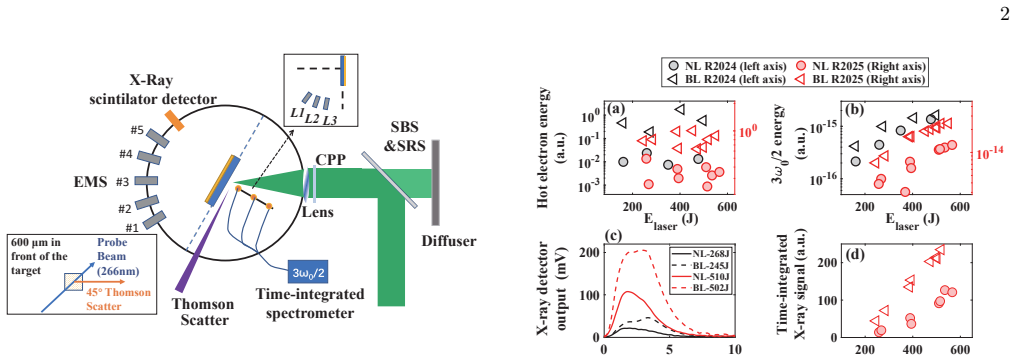
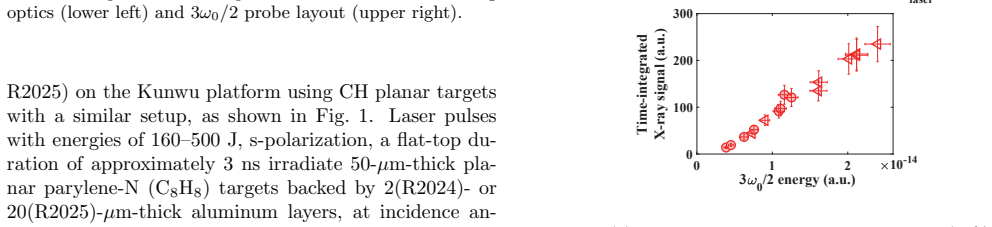
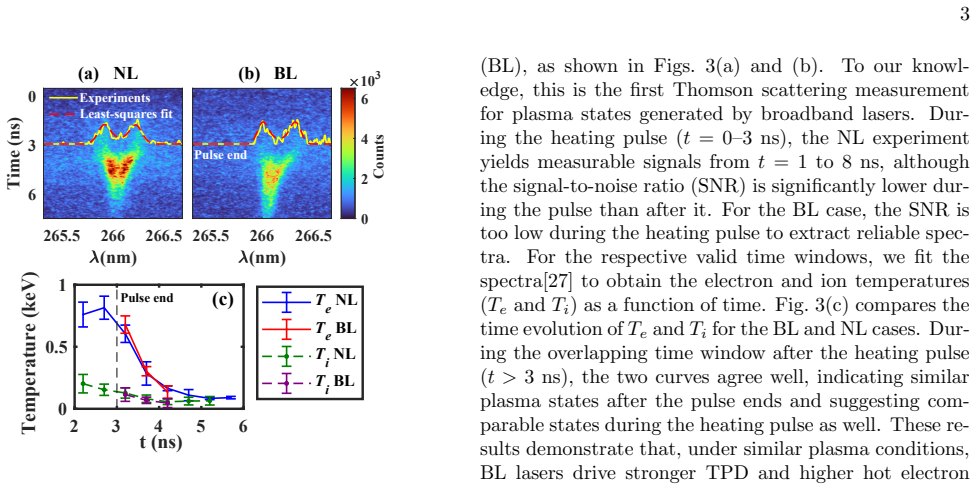
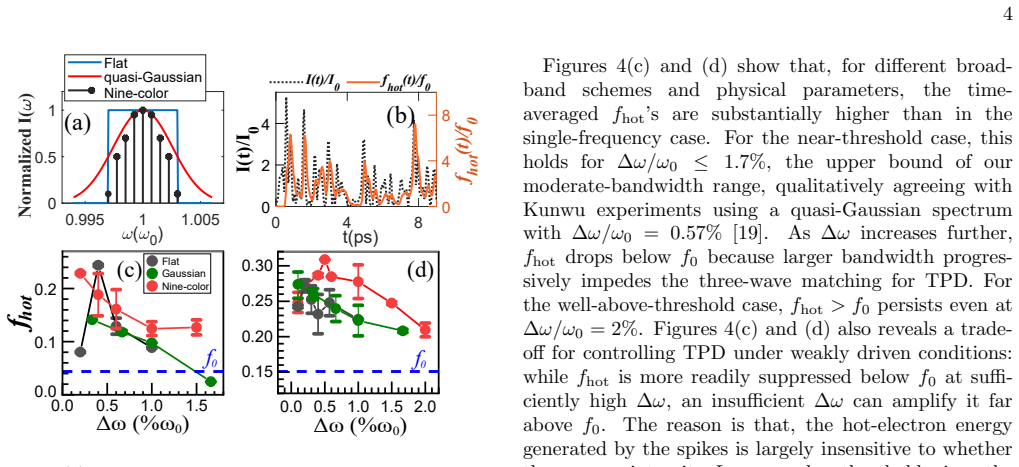
Our direct-drive-relevant experiments on the low-coherence Kunwu laser facility identify two-plasmon decay (TPD) as the primary source of hot electrons, and demonstrate for the first time that broadband laser pulses enhance TPD. Using particle-in-cell simulations, we attribute this TPD enhancement and the consequent hot electron production to stochastic intensity spikes inherent in broadband laser fields, robust in both weakly- and strongly-driven regimes. These findings suggest that mitigating hot electron generation requires suppressing these intensity spikes.
Editorial analysis
A structured set of objections, weighed in public.
Referee Report
Summary. The paper reports direct-drive-relevant experiments on the Kunwu laser facility identifying two-plasmon decay (TPD) as the primary hot-electron source and demonstrating that moderate-bandwidth (broadband) pulses enhance TPD and hot-electron production relative to narrowband pulses. PIC simulations are used to attribute the enhancement to stochastic intensity spikes inherent in the broadband fields, with the conclusion that suppressing these spikes is required to mitigate hot electrons; the effect is stated to be robust across weakly- and strongly-driven regimes.
Significance. If the attribution to stochastic spikes is confirmed by isolating that mechanism, the result would be significant for inertial confinement fusion, as it identifies a concrete pulse-design consideration for controlling hot-electron preheat in broadband laser systems. The combination of facility experiments with PIC modeling is a strength, as is the claim of robustness across drive regimes.
major comments (2)
- [PIC simulations section (attribution paragraph)] The central claim that broadband enhancement of TPD and hot electrons is caused specifically by stochastic intensity spikes requires a controlled contrast that holds spectral shape, temporal envelope, and coherence properties fixed while varying only the stochastic spike statistics. The experimental comparison (broadband vs. narrowband on Kunwu) and the PIC runs described in the simulations section do not isolate this variable; multiple pulse characteristics differ simultaneously, leaving the causal attribution load-bearing but unverified.
- [§3] §3 (experimental results): quantitative comparison between measured hot-electron spectra and simulated spectra is needed to confirm that the observed increase is not due to differences in diagnostic response, facility conditions, or unaccounted pulse parameters; the abstract states the attribution but the manuscript must show error bars, data exclusion criteria, and direct experiment-simulation metrics to support the claim.
minor comments (2)
- Figure captions should explicitly label which curves correspond to broadband versus narrowband cases and state the bandwidth values used.
- Ensure consistent use of TPD growth-rate notation between the text and any equations in the theory or simulation sections.
Simulated Author's Rebuttal
We thank the referee for their careful and constructive review. We address each major comment below and indicate where revisions will be made to the manuscript.
read point-by-point responses
-
Referee: [PIC simulations section (attribution paragraph)] The central claim that broadband enhancement of TPD and hot electrons is caused specifically by stochastic intensity spikes requires a controlled contrast that holds spectral shape, temporal envelope, and coherence properties fixed while varying only the stochastic spike statistics. The experimental comparison (broadband vs. narrowband on Kunwu) and the PIC runs described in the simulations section do not isolate this variable; multiple pulse characteristics differ simultaneously, leaving the causal attribution load-bearing but unverified.
Authors: We acknowledge that a fully isolated contrast varying only spike statistics would provide stronger causal evidence. Our existing PIC runs model the measured experimental pulses (including their differing coherence properties), which produce the observed spike statistics as a direct consequence of bandwidth. To strengthen the attribution, we will add new simulations employing synthetic fields with matched spectra and envelopes but controlled phase randomization to isolate spike statistics; these will be described in a revised simulations section with explicit discussion of remaining limitations. revision: partial
-
Referee: [§3] §3 (experimental results): quantitative comparison between measured hot-electron spectra and simulated spectra is needed to confirm that the observed increase is not due to differences in diagnostic response, facility conditions, or unaccounted pulse parameters; the abstract states the attribution but the manuscript must show error bars, data exclusion criteria, and direct experiment-simulation metrics to support the claim.
Authors: We agree that quantitative metrics are required. The revised §3 will include error bars on all hot-electron spectra, explicit data exclusion criteria, and direct experiment-simulation comparisons (e.g., integrated hot-electron energy ratios and spectral slope differences) to rule out diagnostic or facility artifacts. revision: yes
Circularity Check
No circularity; derivation rests on independent experiment and simulation
full rationale
The paper reports direct-drive experiments on the Kunwu facility comparing broadband vs. narrowband pulses, identifies TPD as the hot-electron source, and uses separate PIC simulations to attribute the observed enhancement to stochastic intensity spikes. No quoted step reduces a claimed prediction or first-principles result to a fitted parameter, self-definition, or self-citation chain by construction. The attribution is presented as an interpretive conclusion from simulation comparison rather than an input that is renamed or forced. This is the normal case of a self-contained empirical-plus-numerical argument with no load-bearing circularity.
Axiom & Free-Parameter Ledger
Reference graph
Works this paper leans on
-
[1]
A. B. Zylstra, O. A. Hurricane, D. A. Callahan, A. L. Kritcher, J. E. Ralph, H. F. Robey, J. S. Ross, C. V. Young, K. L. Baker, D. T. Casey, T. D¨ oppner, L. Di- vol, M. Hohenberger, S. Le Pape, A. Pak, P. K. Patel, R. Tommasini, S. J. Ali, P. A. Amendt, L. J. Atherton, B. Bachmann, D. Bailey, L. R. Benedetti, L. Berzak Hop- kins, R. Betti, S. D. Bhandark...
2022
-
[2]
Abu-shawareb, Achievement of Target Gain Larger than Unity in an Inertial Fusion Experiment, Physical Review Letters132, 65102 (2024)
H. Abu-shawareb, Achievement of Target Gain Larger than Unity in an Inertial Fusion Experiment, Physical Review Letters132, 65102 (2024)
2024
-
[3]
A. L. Kritcher, C. V. Young, H. F. Robey, C. R. We- ber, A. B. Zylstra, O. A. Hurricane, D. A. Callahan, J. E. Ralph, J. S. Ross, K. L. Baker, D. T. Casey, D. S. Clark, T. D¨ oppner, L. Divol, M. Hohenberger, L. B. Hop- kins, S. Le Pape, N. B. Meezan, A. Pak, P. K. Patel, R. Tommasini, S. J. Ali, P. A. Amendt, L. J. Atherton, B. Bachmann, D. Bailey, L. R....
2022
-
[4]
J. A. Marozas, M. Hohenberger, M. J. Rosenberg, D. Turnbull, T. J. B. Collins, P. B. Radha, P. W. Mckenty, J. D. Zuegel, F. J. Marshall, S. P. Regan, T. C. Sangster, W. Seka, E. M. Campbell, V. N. Gon- charov, M. W. Bowers, J.-M. G. Di Nicola, G. Erbert, B. J. Macgowan, L. J. Pelz, and S. T. Yang, First Observation of Cross-Beam Energy Transfer Mitigation...
-
[5]
A. R. Christopherson, R. Betti, C. J. Forrest, J. Howard, W. Theobald, J. A. Delettrez, M. J. Rosenberg, A. A. Solodov, C. Stoeckl, D. Patel, V. Gopalaswamy, D. Cao, J. L. Peebles, D. H. Edgell, W. Seka, R. Epstein, M. S. Wei, M. Gatu Johnson, R. Simpson, S. P. Regan, and E. M. Campbell, Direct Measurements of DT Fuel Pre- heat from Hot Electrons in Direc...
2021
-
[6]
A. R. Christopherson, R. Betti, and C. J. Forrest, Infer- ences of hot electron preheat and its spatial distribution in OMEGA direct drive implosions, Physics of Plasmas (2022)
2022
-
[7]
D. H. Froula, C. Dorrer, A. Cola¨ ıtis, D. H. Edgell, R. K. Follett, E. M. Hill, I. V. Igumenshchev, A. L. Milder, J. P. Palastro, R. C. Shah, A. A. Solodov, D. Turn- bull, V. N. Goncharov, S. P. Regan, C. Sorce, J. Zuegel, and C. Deeney, A future of inertial confinement fusion without laser-plasma instabilities, Physics of Plasmas32, 052713 (2025)
2025
-
[8]
J. J. Thomson and J. I. Karush, Effects of finite- bandwidth driver on the parametric instability, The Physics of Fluids17, 1608 (1974)
1974
-
[9]
J.J.Thomson, Finite-bandwidth effects on the parametric 6 instability in an inhomogeneous plasma, Nuclear Fusion 15, 237 (1975)
1975
-
[10]
Y. Zhao, S. Weng, M. Chen, J. Zheng, H. Zhuo, C. Ren, Z. Sheng, and J. Zhang, Effective suppression of para- metric instabilities with decoupled broadband lasers in plasma, Physics of Plasmas24, 112102 (2017)
2017
-
[11]
R. K. Follett, J. G. Shaw, J. F. Myatt, C. Dorrer, D. H. Froula, and J. P. Palastro, Thresholds of absolute insta- bilities driven by a broadband laser, Physics of Plasmas 26, 62111 (2019)
2019
-
[12]
R. K. Follett, J. G. Shaw, J. F. Myatt, H. Wen, D. H. Froula, and J. P. Palastro, Thresholds of absolute two- plasmon-decay and stimulated Raman scattering insta- bilities driven by multiple broadband lasers, Physics of Plasmas28, 32103 (2021)
2021
-
[13]
Y. Gao, L. Ji, X. Zhao, Y. Cui, D. Rao, W. Feng, L. Xia, D. Liu, T. Wang, H. Shi, F. Li, J. Liu, D. Pengyuan, X. Li, J. Liu, T. Zhang, C. Shan, Y. Hua, W. Ma, Z. Sui, J. Zhu, W. Pei, S. Fu, X. Sun, and X. Chen, High- power, low-coherence laser driver facility, Optics Letters 45, 6839 (2020)
2020
-
[14]
Dorrer, E
C. Dorrer, E. M. Hill, and J. D. Zuegel, High-energy para- metric amplification of spectrally incoherent broadband pulses, Optics Express28, 451 (2020)
2020
-
[15]
Kanstein, F
C. Kanstein, F. Wasser, S. Z¨ ahter, S. Atzeni, G. Benin- casa, G. Cristoforetti, G. Erdogdu, M. Fischer, L. A. Gizzi, K. Glize, S. J. Grimm, J. Hornung, E. Hume, P. K¨ oster, S. Kuschel, T. Meffert, F. Neufeld, P. Neu- mayer, K. L. Nguyen, W. Theobald, V. Winter, N. Woolsey, K. Zarrouk, X. Zhao, V. Bagnoud, and M. Roth, Experimental study of laser plasma...
2025
-
[16]
Y. Gao, Y. Cui, L. Ji, D. Rao, X. Zhao, F. Li, D. Liu, W. Feng, L. Xia, J. Liu, H. Shi, P. Du, J. Liu, X. Li, T. Wang, T. Zhang, C. Shan, Y. Hua, W. Ma, X. Sun, X. Chen, X. Huang, J. Zhu, W. Pei, Z. Sui, and S. Fu, Development of low-coherence high-power laser drivers for inertial confinement fusion, Matter and Radiation at Extremes5, 065201 (2020)
2020
-
[17]
A. Lei, N. Kang, Y. Zhao, H. Liu, H. An, J. Xiong, R. Wang, Z. Xie, Y. Tu, G. Xu, X. Zhou, Z. Fang, W. Wang, L. Xia, W. Feng, X. Zhao, L. Ji, Y. Cui, S. Zhou, Z. Liu, C. Zheng, L. Wang, Y. Gao, X. Huang, and S. Fu, Reduction of backward scatterings at the low- coherence kunwu laser facility, Phys. Rev. Lett.132, 035102 (2024)
2024
-
[18]
L. Yang, X. Wang, J. Zhang, A. H. Hai, Z. Liu, X. Z. Yong, J. Dong, P. Wang, Z. Fang, C. Wang, W. Wang, J. Sun, Y. Gu, X. Huang, and P. Wang, Broadband laser absorption study based on radiochromic film combined with fiber-optic probes at the low-coherence Kunwu laser facility, High Power Laser Science and Engineering14, e22 (2026)
2026
-
[19]
P. Wang, H. An, Z. Fang, J. Xiong, Z. Xie, C. Wang, Z. He, G. Jia, R. Wang, S. Zheng, L. Xia, W. Feng, H. Shi, W. Wang, J. Sun, Y. Gao, and S. Fu, Backward scattering of laser plasma interactions from hundreds-of- joules broadband laser on thick target, Matter and Ra- diation at Extremes9, 015602 (2024)
2024
-
[20]
Rosenberg, A
M. Rosenberg, A. Solodov, J. Myatt, W. Seka, P. Michel, M. Hohenberger, R. Short, R. Epstein, S. Regan, E. Campbell, T. Chapman, C. Goyon, J. Ralph, M. Bar- rios, J. Moody, and J. Bates, Origins and Scaling of Hot- Electron Preheat in Ignition-Scale Direct-Drive Inertial Confinement Fusion Experiments, Physical Review Let- ters120, 055001 (2018)
2018
-
[21]
D. T. Michel, A. V. Maximov, R. W. Short, J. A. Delet- trez, D. Edgell, S. X. Hu, I. V. Igumenshchev, J. F. My- att, A. A. Solodov, C. Stoeckl, B. Yaakobi, and D. H. Froula, Measured hot-electron intensity thresholds quan- tified by a two-plasmon-decay resonant common-wave gain in various experimental configurations, Physics of Plasmas20, 55703 (2013)
2013
-
[22]
Hohenberger, P
M. Hohenberger, P. B. Radha, J. F. Myatt, S. Lepape, J. A. Marozas, F. J. Marshall, D. T. Michel, S. P. Re- gan, W. Seka, A. Shvydky, T. C. Sangster, J. W. Bates, R. Betti, T. R. Boehly, M. J. Bonino, D. T. Casey, T. J. Collins, R. S. Craxton, J. A. Delettrez, D. H. Edgell, R. Epstein, G. Fiksel, P. Fitzsimmons, J. A. Frenje, D. H. Froula, V. N. Goncharov...
2015
-
[23]
M. J. Rosenberg, A. A. Solodov, J. F. Myatt, S. Hironaka, J. Sivajeyan, R. K. Follett, T. Filkins, A. V. Maximov, C. Ren, S. Cao, P. Michel, M. S. Wei, J. P. Palastro, R. H. Scott, K. Glize, and S. P. Regan, Effect of overlap- ping laser beams and density scale length in laser-plasma instability experiments on OMEGA EP, Physics of Plas- mas30, 42710 (2023)
2023
-
[24]
R. P. Drake, R. E. Turner, B. F. Lasinski, K. G. Es- tabrook, E. M. Campbell, C. L. Wang, D. W. Phillion, E. A. Williams, and W. L. Kruer, Efficient Raman sidescatter and hot-electron production in laser-plasma interaction experiments, Physical Review Letters53, 1739 (1984)
1984
-
[25]
W. Seka, D. H. Edgell, J. F. Myatt, A. V. Maximov, R. W. Short, V. N. Goncharov, and H. A. Baldis, Two- plasmon-decay instability in direct-drive inertial confine- ment fusion experiments, Physics of Plasmas16, 052701 (2009)
2009
-
[26]
J. Xu, J. Zheng, X. Li, J. Zhang, M. Deng, C. Peng, S. Sun, Y. Du, Y. Shi, F. Yang, and J. Chen, Influence of Yttrium Concentration on Scintillation Performance of Heavily Y-Doped Barium Fluoride Crystals, IEEE Trans- actions on Nuclear Science72, 2000 (2025)
2000
-
[27]
D. H. Froula, S. Glenzer, N. Luhmann, and J. Sheffield, Plasma Scattering of Electromagnetic Radiation: The- ory and Measurement Techniques, 2nd ed. (Academic Press/Elsevier, Burlington, MA, 2011) pp. xiv, 497, first edition published 1975
2011
-
[28]
R. A. Fonseca, L. O. Silva, F. S. Tsung, V. K. Decyk, W. Lu, C. Ren, W. B. Mori, S. Deng, S. Lee, T. Kat- souleas, and J. C. Adam, OSIRIS: A three-dimensional, fully relativistic particle in cell code for modeling plasma based accelerators, Lecture Notes in Computer Science (including subseries Lecture Notes in Artificial Intelli- gence and Lecture Notes ...
2002
-
[29]
Simon, R
A. Simon, R. W. Short, E. A. Williams, and T. De- wandre, On the inhomogeneous two-plasmon instability, Physics of Fluids26(1983)
1983
-
[30]
Turnbull, A
D. Turnbull, A. V. Maximov, D. Cao, A. R. Christopher- son, D. H. Edgell, R. K. Follett, V. Gopalaswamy, J. P. Knauer, J. P. Palastro, A. Shvydky, C. Stoeckl, H. Wen, and D. H. Froula, Impact of spatiotemporal smoothing on the two-plasmon-decay instability, Physics of Plasmas 27, 102710 (2020)
2020
-
[31]
X. Wang, X. Chai, P. Li, B. Zhang, Q. Zhu, X. Tian, J. Wang, Z. Zong, S. Zhou, K. Yao, S. Li, J. Zhao, and Z. Peng, Ultraviolet spectral broadening by stimulated rotational Raman scattering on nitrogen pumped with signal laser injection, Matter and Radiation at Extremes 10, 017401 (2024)
2024
-
[32]
C. Yao, J. Li, L. Hao, R. Yan, C. Wang, A. Lei, Y.-K. Ding, and J. Zheng, Anomalous hot electron generation from two-plasmon decay instability driven by broadband laser pulses with intensity modulations, Nuclear Fusion 64, 106013 (2024)
2024
-
[33]
C. Yao, J. Li, L. Hao, R. Yan, Q. Jia, Y.-K. Ding, and J. Zheng, Resonance density range of absolute two- plasmon decay instability, Plasma Physics and Con- trolled Fusion68, 015003 (2026), arXiv:2509.06021
arXiv 2026
-
[34]
Q. K. Liu, L. Deng, Q. Wang, X. Zhang, F. Q. Meng, Y. P. Wang, Y. Q. Gao, H. B. Cai, and S. P. Zhu, Elec- tron kinetic effects in back-stimulated Raman scattering bursts driven by broadband laser pulses, Matter and Ra- diation at Extremes9, 047402 (2024)
2024
-
[35]
Tikhonchuk, D
V. Tikhonchuk, D. Blackman, P. Loiseau, and C. Ruyer, Effect of spectral bandwidth on the stimulated scattering of laser beams in plasma, Physics of Plasmas33, 012107 (2026)
2026
-
[36]
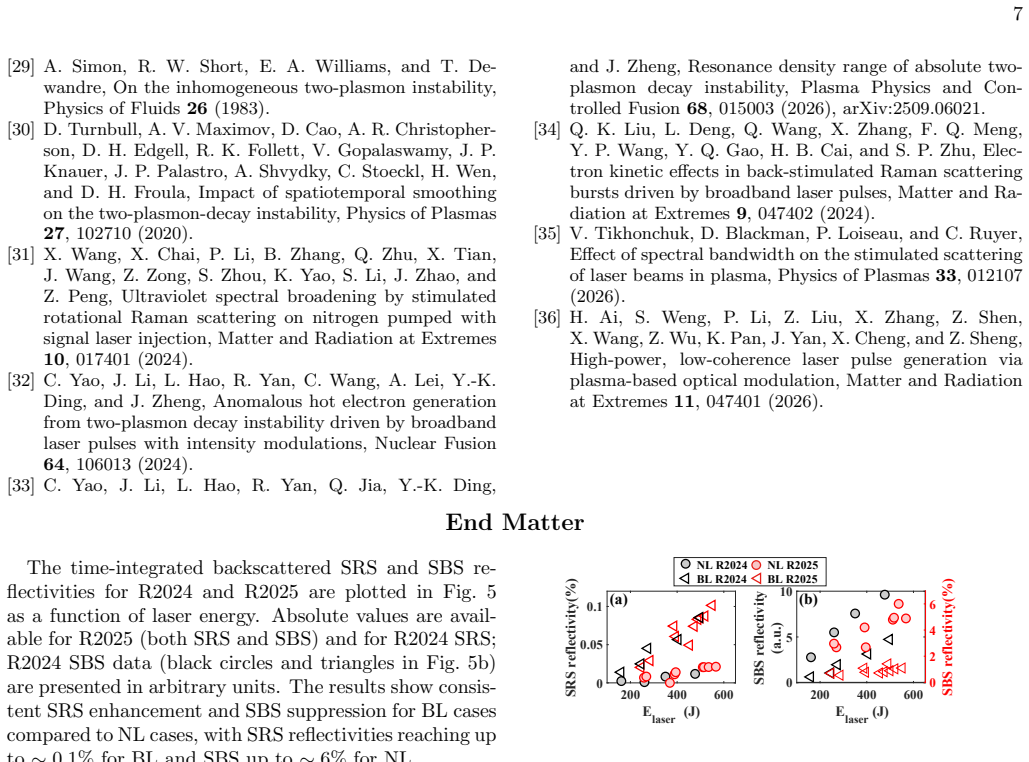
H. Ai, S. Weng, P. Li, Z. Liu, X. Zhang, Z. Shen, X. Wang, Z. Wu, K. Pan, J. Yan, X. Cheng, and Z. Sheng, High-power, low-coherence laser pulse generation via plasma-based optical modulation, Matter and Radiation at Extremes11, 047401 (2026). End Matter The time-integrated backscattered SRS and SBS re- flectivities for R2024 and R2025 are plotted in Fig. ...
2026
discussion (0)
Sign in with ORCID, Apple, or X to comment. Anyone can read and Pith papers without signing in.