REVIEW 4 major objections 5 minor 68 references
Asymptotically exact solution of the non-Hermitian disordered interacting Hatano-Nelson chain
T0 review · 4 major / 5 minor · reviewed 2026-08-15 · deepseek-v4-flash
Pith's one-line read The paper establishes an asymptotically exact low-energy solution of the disordered interacting Hatano-Nelson spin chain, showing that non-Hermitian couplings grow under renormalization and turn the ground state into classicalized…
desk verdict The paper's central claim of a non-Hermitian relevant perturbation collapses under the model's exact similarity to the Hermitian XXZ chain; the headline signatures are basis-dependent. read the letter →
The pith
A machine-rendered reading of the paper's core claim, the machinery that carries it, and where it could break.
The reading
What carries the argument
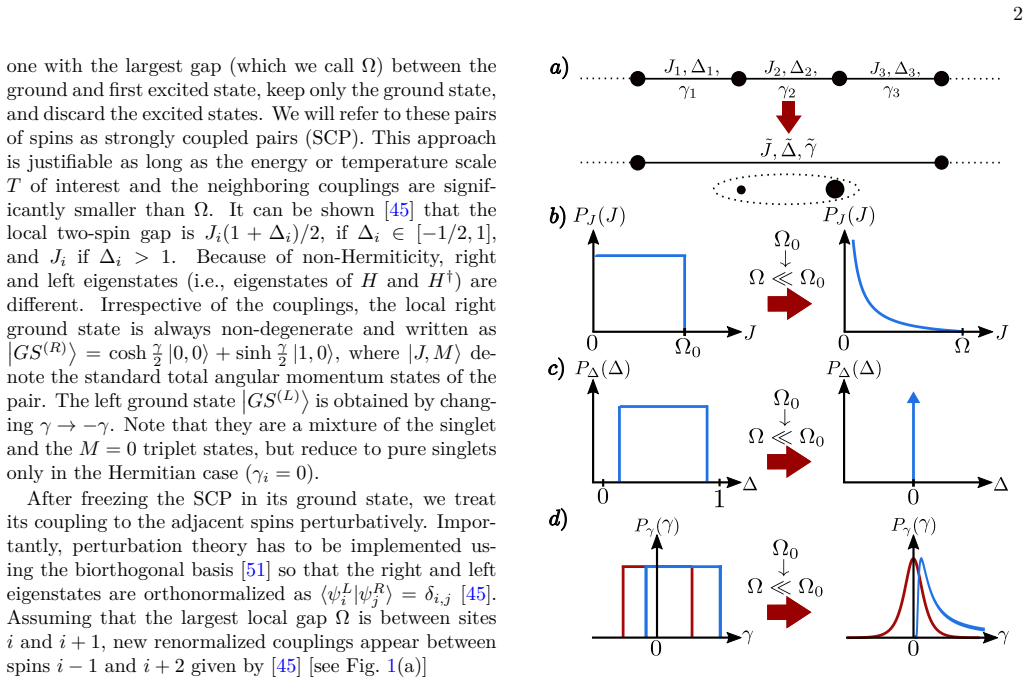
The engine is the strong-disorder renormalization group, a real-space scheme that repeatedly finds the two neighboring spins with the largest local excitation gap, freezes them in their biorthogonal ground state, and replaces them by one effective bond between the outer neighbors. The load-bearing identity is the decimation rule $\tilde{\gamma}_{i-1} = \gamma_{i-1}+\gamma_i+\gamma_{i+1}$, identical in form to the rule for bond length $\tilde{\ell}_{i-1} = \ell_{i-1}+\ell_i+\ell_{i+1}$ and independent of the flows of $J$ and $\Delta$. This decoupling lets the authors transfer known fixed-point distributions for bond lengths to $\gamma$, and gives the joint fixed-point distribution $Q_n(\eta=0,x,y)$ of scaled couplings, lengths, and $\gamma$ (subscript $n=1$ for symmetric, $n=2$ for asymmetric initial distributions) from which the susceptibility and the entropy follow.
What would settle it
Run the SDRG on chains of millions of sites over many disorder realizations—the same numerical experiment the paper uses for its histograms—and compare the measured joint distribution of scaled couplings, lengths, and gamma at the cutoff with Eqs. (38)-(39); failure to collapse onto those forms would remove the basis for the predicted entropy saturation. A complementary check is to compute the right-right pair entropy of a two-site problem at large gamma and compare with Eq. (11).
Extended reading notes
Core claim
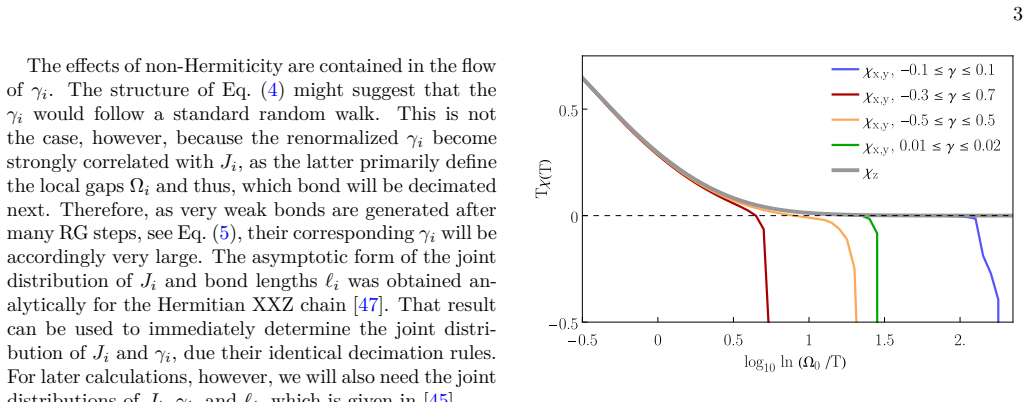
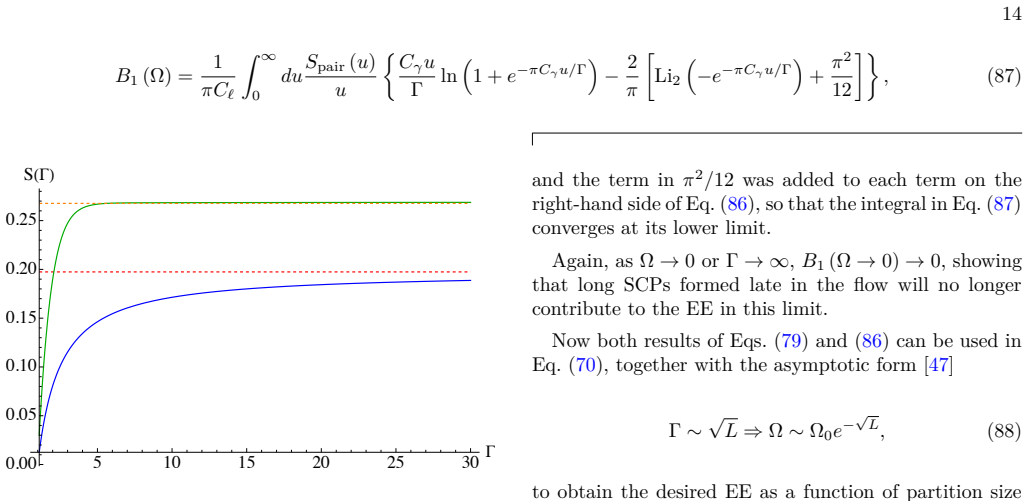
The paper claims that at low energies the disordered non-Hermitian XXZ chain flows to an infinite-disorder fixed point whose ground state is a random strongly coupled pair phase. In each decimated pair, the right ground state is $|GS^{(R)}\rangle = \cosh(\gamma/2)|0,0\rangle + \sinh(\gamma/2)|1,0\rangle$ (and the left one has $\gamma\to -\gamma$), so pairs are coherent mixtures of singlet and $M=0$ triplet; in the Hermitian limit $\gamma=0$ they reduce to singlets. Because the decimation rule for $\gamma_i$ is additive and decoupled from $J_i$ and $\Delta_i$, the $\gamma$ distribution broadens without bound, in an even universal form for symmetric initial distributions and a one-sided universal form for asymmetric ones. The broadening makes low-energy pairs nearly classical, which produces two concrete predictions: $T\chi_{x,y}$ from already decimated pairs is negative, proportional to $-\sinh^2(\gamma/2)$, and diverges at a finite temperature $T=\Omega_0 e^{-\pi C_\gamma}$ in the symmetric case; and, using the right-right reduced density matrix, the entanglement entropy of a partition saturates for large $L$, in sharp contrast to the $\ln L$ growth of the Hermitian random-singlet chain.
Load-bearing premise
The analysis depends on an unproven joint fixed-point distribution of couplings, bond lengths, and non-Hermitian parameters, which the paper says will be derived elsewhere; the entanglement-entropy saturation is computed from it, so an error there would invalidate that central prediction.
Editorial extensions
If this is right
- The ground state is a random strongly coupled pair phase, not a random singlet phase: pairs of arbitrary length at random positions are singlet-triplet mixtures, so spin-spin correlations and response functions differ from the Hermitian chain.
- The $xy$ magnetic susceptibility turns negative at low temperature and diverges at a finite temperature set by the initial distribution ($T=\Omega_0 e^{-\pi C_\gamma}$ in the symmetric case), while the $z$ susceptibility keeps the Hermitian quasi-Curie form.
- The entanglement entropy of a partition saturates at large $L$ instead of growing as $\ln L$; the saturated value is nonuniversal and controlled by the same constants $C_\gamma$ and $C_\ell$ that set the flow.
- The one-sided growth of the $\gamma$ distribution at low energies gives a many-body, interacting explanation of the non-Hermitian skin effect: long bonds have strongly one-sided hopping, while symmetric initial $\gamma$ distributions show no skin effect.
- The same SDRG framework can be applied to other disordered non-Hermitian models, such as a non-Hermitian random transverse-field Ising chain, where a similar quantum-to-classical crossover is expected.
Reading between the lines
- If the claimed fixed-point distribution is right, the saturation of entanglement entropy should be visible in numerical simulations of finite chains with modest disorder: the crossover scale in $L$ should be controlled by $C_\gamma$, so systems with broader initial $\gamma$ distributions should saturate earlier.
- The negative, diverging susceptibility is an equilibrium thermodynamic signature of non-Hermiticity; because the paper shows it is not self-averaging, any experiment or numerical estimate would need many disorder realizations before claiming a finite-temperature divergence.
- The RR versus RL density-matrix ambiguity suggests a sharper test: measuring entanglement with different state-vector normalizations should give either maximal pair entropy (RL) or $\gamma$-dependent suppression (RR); the paper's saturation picture only holds for RR.
Signed reviews
Editorial analysis
A structured set of objections, weighed in public.
Referee Report
Summary. This paper presents a strong-disorder renormalization-group (SDRG) study of the disordered non-Hermitian spin-1/2 XXZ chain, Eq. (1), which is equivalent to the interacting fermionic Hatano-Nelson model. The authors derive decimation rules for the couplings J, Δ, and the non-Hermitian parameter γ, show that J and Δ flow as in the Hermitian case, and find that the distribution of γ broadens without limit. They interpret this broadening as non-Hermiticity being a relevant perturbation, leading to a 'quantum-to-classical crossover' and a random strongly coupled pair phase. The paper predicts a negative transverse magnetic susceptibility that diverges at a finite temperature and an entanglement entropy that saturates with subsystem size, and it supports these predictions with numerical SDRG simulations of chains up to 5 million sites.
Significance. The model is well chosen and the SDRG machinery is applied with care: the decimation rules are derived in biorthogonal perturbation theory, and the fixed-point distributions of γ are checked numerically on very large chains. If the central physical interpretation were correct, the paper would be a significant analytical advance in disordered non-Hermitian many-body physics. However, the main claim—that non-Hermiticity is an RG-relevant perturbation—is not supported because the γ couplings can be removed by an exact similarity transformation, and the two headline observables (susceptibility and entanglement entropy) depend, as the paper itself shows, on the chosen biorthogonal/RR convention. The significance is therefore conditional on resolving these foundational issues.
major comments (4)
- [Main text, around Eq. (4) and SM Section II] The Hamiltonian in Eq. (1) is exactly similar to the Hermitian disordered XXZ chain. With U = ∏_i exp(θ_i S^z_i) and θ_{i+1} – θ_i = γ_i/2, one has U H U^{-1} = ∑_i J_i[(S^+_i S^-_{i+1} + S^-_i S^+_{i+1})/2 + Δ_i S^z_i S^z_{i+1}], so the full spectrum and the SDRG decimation order are those of the Hermitian model. This is consistent with SM Eq. (16), which shows the two-site eigenvalues are γ-independent, and with the sentence after SM Eq. (25) stating that the decimation 'follows the same hierarchy of decimations as the Hermitian one would.' The additive rule for γ in Eq. (4) therefore accumulates the gauge phase in the same way that the bond length ℓ does. The broadening of P(γ) is a kinematic consequence of cluster formation, not the flow of a coupling that controls any spectral scale or similarity-invariant physical property. The central claim in the abstract and Conclusions that non-Hermiticity is 'relevant in the RG sense' is thus not established. The paper should either identify a similarity-invariant observable that distinguishes the non-Hermitian model from the Hermitian one or substantially revise the interpretation.
- [Eq. (8) and SM Section IV; Eq. (11) and SM Section V] Both headline predictions are convention-dependent. The negative transverse susceptibility of a single pair, Eq. (8) and SM Eq. (46), is obtained as the biorthogonal matrix element ⟨ψ_L|(S^α)^2|ψ_R⟩ of a positive operator; this quantity can be negative because the right and left eigenstates of a non-Hermitian Hamiltonian are not orthogonal. The paper does not justify why this matrix element is the physical magnetic response of a non-Hermitian thermodynamic system. Similarly, the entanglement-entropy saturation in Fig. 3 is based on the RR reduced density matrix, whereas SM Eq. (69) shows that the RL scheme gives S_pair = 1 for all γ and hence no saturation. Since the claimed quantum-to-classical crossover is identified through these two quantities, the main physical conclusions are not robust to the choice of convention. A physical argument for the RR/biorthogonal choice is required before these results can be interpreted as evidence of a crossover.
- [SM Eqs. (38)–(39)] The joint fixed-point distribution Q_n(η, x, y) is stated without derivation; the text says the derivation is lengthy and details will be provided elsewhere. This distribution is essential for the entanglement-entropy calculation, since the EE in SM Eq. (72) and the analytical curves in Fig. 3 are computed from it. The 'asymptotically exact' claim for the EE therefore rests on an unverified input. The derivation should be included in the paper, or the EE result should be labeled as a numerical observation.
- [SM Fig. 4 and main-text Figs. 2–3] The quantitative comparison between the analytical expressions and the numerics is not parameter-free. The constants C_γ and C_ℓ are determined by fitting the numerical SDRG flow to the universal fixed-point distributions (SM Fig. 4), and the same constants enter the analytical curves for χ and S that are overlaid on the numerical data in Figs. 2 and 3. Because the fitted parameters come from the same simulations that are being compared, the agreement demonstrates consistency but does not independently validate the theory. Please separate the fitting step from the test, for example by extracting C_γ and C_ℓ from one quantity and using them to predict another.
minor comments (5)
- [Fig. 2 caption and text] The text refers to red, yellow, green, and blue curves, but the color scheme in the figure as rendered is not consistent; please verify the labels against the published figure.
- [Main text, after Eq. (9)] The quantity Γ_T is used in Eq. (9) but only defined in the following sentence; please define it before first use.
- [SM Eqs. (26)–(28)] Please clarify the dimensions and definitions of C_γ and C_ℓ explicitly, and state whether they are dimensionless constants depending on the initial distributions.
- [Main text, paragraph after Eq. (5)] The phrase 'infrared stable fixed points of the Δ distribution are Δ_i = 0 ... and Δ_i → ∞' is imprecise; the Δ → ∞ fixed point is the Ising fixed point, and the flow to Δ = 0 occurs for 0 < Δ_i < 1, while Δ_i > 1 flows to the Ising fixed point. Please rephrase for clarity.
- [Introduction and references] Several references are recent preprints; please update citation data where journal versions are available, and define 'biorthogonal basis' on first use in the main text.
Circularity Check
The γ-flow is the Hermitian bond-length flow relabeled, and the quantitative susceptibility/EE curves use constants fitted to the same SDRG flow they are compared with.
-
renaming known result
[Main text, 'SDRG flows' section (after Eq. (5)); SM Sec. II A, Eq. (16)]
"The asymptotic form of the joint distribution of Ji and bond lengths ℓi was obtained analytically for the Hermitian XXZ chain [47]. That result can be used to immediately determine the joint distribution of Ji and γi, due their identical decimation rules. ... Note that the eigenvalues are independent of γi and, therefore, the same as those of the Hermitian XXZ model."
The paper's own two-site spectrum is γ-independent, so the SDRG decimation hierarchy is exactly the Hermitian one. The γ distribution is then taken, by the paper's admission, directly from Fisher's known Hermitian bond-length distribution because γ and ℓ obey identical additive rules. Moreover, γ enters Eq. (1) only through an exact non-unitary gauge transformation U=∏_i exp(θ_i S^z_i) with θ_{i+1}-θ_i=γ_i, which conjugates the Hamiltonian to the Hermitian XXZ chain. Hence the claimed 'growth' of γ is the accumulation of a removable gauge phase/cluster size, not the flow of a physical coupling that affects any spectral scale.
-
fitted input called prediction
[Supplemental Material, Sec. III and Fig. 4; main text Fig. 3 caption]
"We could then fit the numerical histograms at late flow stages to the fixed-point distributions of Eqs. (32) and (33), and thus determine the constant Cγ ... By fitting to the distributions from the late stages of the SDRG flow [(c) and (f)], we determined the non-universal constants for (c) Cγ = 20.5 and (f) Cγ = 4.8. ... The lines correspond to fits to the analytical expressions derived in the asymptotic large-L regime."
The non-universal constants Cγ and Cℓ enter the analytical susceptibility (SM Eq. (55), including the divergence at T=Ω0 e^{-πCγ}) and the analytical entanglement-entropy curves (SM Eqs. (79) and (86)). These constants are fitted to the same numerical SDRG flow whose late-stage distributions the analytical expressions are then compared with; the main-text Fig. 3 caption explicitly labels the curves as fits. Thus the agreement in Figs. 2 and 3 is a fit to the same flow, not an external check. The qualitative broadening of P(γ) follows directly from the additive rule Eq. (4) without fitting, which limits the circularity, but the quantitative predictions are not independent.
full rationale
The SDRG decimation rules themselves are derived self-consistently in the biorthogonal basis, and the J and Δ flows genuinely reproduce the Hermitian XXZ structure, so the paper is not wholly circular. However, two load-bearing reductions weaken the central claims. First, because the two-site spectrum is γ-independent and γ obeys the same additive decimation rule as the bond length, the paper imports the Hermitian bond-length distribution as the γ distribution; together with the exact non-unitary gauge removal of γ, the 'relevance of non-Hermiticity' is a relabeling of the known growth of cluster sizes rather than an independent physical result. Second, the quantitative curves for the susceptibility divergence and the entanglement-entropy saturation use Cγ and Cℓ fitted from the same numerical SDRG flow with which they are compared, so the agreement in Figs. 2 and 3 is partly a fit. The joint fixed-point distribution Q_n in SM Eqs. (38)-(39) is also assumed without derivation ('details will be provided elsewhere'), adding fragility, though this is not itself circularity. On balance the qualitative additive growth is derived rather than fitted, so the score is not maximal; but the central interpretation and the quantitative predictions are substantially built from the Hermitian flow and fitted constants, giving a score of 6.
Assumptions & free parameters
free parameters (3)
- C_gamma (symmetric case) =
20.5 (for uniform gamma in [-0.1, 0.1])
- C_gamma (asymmetric case) =
4.8 (for uniform gamma in [0.1, 0.2])
- C_ell =
Not explicitly reported; set to 1 in Fig. 6, fitted for Fig. 3 lines
assumptions (6)
- domain assumption The SDRG decimation rules derived from second-order perturbation theory in the biorthogonal basis are asymptotically exact at low energies.
- domain assumption The fixed-point distributions for J and Delta are the same as in the Hermitian random XXZ chain (Fisher 1994).
- ad hoc to paper The joint fixed-point distribution Q_n(eta,x,y) in SM Eqs. (38)-(39) is correct; its derivation is deferred.
- domain assumption For non-Hermitian thermodynamics, the trace is evaluated in the biorthogonal (left-right) basis, which is complete.
- domain assumption The RR density matrix is the appropriate one for the entanglement entropy of the ground state.
- domain assumption Delta_i > -1/2 and J_i > 0 to avoid ferromagnetic phases and keep a real spectrum.
Cite this review
Pith. "Pith review of Asymptotically exact solution of the non-Hermitian disordered interacting Hatano-Nelson chain." pith.science (2026). https://pith.science/paper/RW27UTCJ
@misc{pith2026250916309,
  author       = {Pith},
  title        = {Pith review of: Asymptotically exact solution of the non-Hermitian disordered interacting Hatano-Nelson chain},
  year         = {2026},
  howpublished = {\url{https://pith.science/paper/RW27UTCJ}},
  note         = {Machine review of arXiv:2509.16309}
}
abstract
We present an asymptotically exact solution of a paradigmatic non-Hermitian model: the disordered interacting fermionic Hatano-Nelson model, or equivalently, the non-Hermitian spin-1/2 XXZ model. We use a renormalization group method suited for disordered systems and show that non-Hermitian couplings are relevant perturbations to the Hermitian model, which ultimately leads to a quantum-to-classical crossover. The ground state of the model consists of a collection of strongly coupled pairs of spins of arbitrary size at random positions which, unlike the Hermitian case, do not form singlets, but a mixture of the singlet and the $M=0$ triplet state. As a result, the magnetic susceptibility in the $x,y$-directions becomes negative and diverges at a finite small temperature. Additionally, in sharp contrast to the $\ln(L)$ increase observed in disordered Hermitian chains, the entanglement entropy of a partition of size $L$ saturates for large $L$, as the strongly coupled pairs become classical and stop contributing at large length scales.
Figures

Figures from the paper (3 more)


Reference graph
Works this paper leans on
-
[1]
This is a consequence of an emergent symmetry of the model [47, 54]. The contribution of a single SCP, χα sscp(T), is given by [45] Tχα sscp(T) = { −sinh 2(γ 2 ) ,ifα=x,y 0,ifα=z. (8) Note how this contribution only exists in thex,y- directions and in the nH case. This is because the ground state of a SCP is a superposition of the two-spin singlet andM= 0...
-
[2]
I. Rotter and J. P. Bird, A review of progress in the physics of open quantum systems: theory and experi- ment, Rep. Progr. Phys.78, 114001 (2015)
work page 2015
-
[3]
Z. Gu, H. Gao, P.-C. Cao, T. Liu, X.-F. Zhu, and J. Zhu, Controlling sound in non-hermitian acoustic systems, Phys. Rev. Appl.16, 057001 (2021)
2021
- [4]
-
[5]
L. Feng, R. El-Ganainy, and L. Ge, Non-hermitian pho- tonics based on parity–time symmetry, Nat. Photonics 11, 752 (2017)
2017
-
[6]
H. M. Wiseman and G. J. Milburn,Quantum Measure- ment and Control(Cambridge University Press, 2009)
2009
-
[7]
A. J. Daley, Quantum trajectories and open many-body quantum systems, Adv. Phys.63, 77 (2014)
2014
-
[8]
Minganti, A
F. Minganti, A. Miranowicz, R. W. Chhajlany, and F. Nori, Quantum exceptional points of non-hermitian hamiltonians and liouvillians: The effects of quantum jumps, Phys. Rev. A100, 062131 (2019)
2019
Show all 68 references
-
[9]
Ashida, Z
Y. Ashida, Z. Gong, and M. Ueda, Non-hermitian physics, Adv. Phys.69, 249 (2020)
2020
-
[10]
Hébert, M
F. Hébert, M. Schram, R. Scalettar, W. Chen, and Z. Bai, Hatano-nelson model with a periodic potential, Eur. Phys. J. B79, 465 (2011)
2011
-
[11]
Hamazaki, K
R. Hamazaki, K. Kawabata, N. Kura, and M. Ueda, Uni- versalityclassesofnon-hermitianrandommatrices,Phys. Rev. Research2, 023286 (2020)
2020
-
[12]
Longhi, Stochastic non-hermitian skin effect, Opt
S. Longhi, Stochastic non-hermitian skin effect, Opt. Lett.45, 5250 (2020)
2020
-
[13]
Claes and T
J. Claes and T. L. Hughes, Skin effect and winding num- ber in disordered non-hermitian systems, Phys. Rev. B 103, L140201 (2021)
2021
-
[14]
Zhang, H
Z.-Q. Zhang, H. Liu, H. Liu, H. Jiang, and X. Xie, Bulk- boundary correspondence in disordered non-hermitian systems, Sci. Bull.68, 157 (2023)
2023
-
[15]
E. T. Kokkinakis, K. G. Makris, and E. N. Economou, Andersonlocalizationversushoppingasymmetryinadis- ordered lattice, Phys. Rev. A110, 053517 (2024)
2024
-
[16]
Midya, Topological phase transition in fluctuating imaginary gauge fields, Phys
B. Midya, Topological phase transition in fluctuating imaginary gauge fields, Phys. Rev. A109, l061502 (2024)
2024
-
[17]
W. Wang, X. Wang, and G. Ma, Anderson transi- tion at complex energies in one-dimensional parity-time- symmetric disordered systems, Phys. Rev. Lett.134, 066301 (2025)
2025
-
[18]
C. Wang, W. He, X. R. Wang, and H. Ren, Unified one- parameterscalingfunctionforandersonlocalizationtran- sitions in nonreciprocal non-hermitian systems, Phys. Rev. Lett.134, 176301 (2025)
2025
-
[19]
Shang and H
J. Shang and H. Hu, Spreading dynamics in the hatano- nelson model with disorder (2025), arXiv:2504.04370 [cond-mat.dis-nn]
2025 arXiv
-
[20]
Sun and H
K. Sun and H. Hu, Lyapunov formulation of band theory for disordered non-hermitian systems (2025), arXiv:2507.09447 [cond-mat.dis-nn]
2025 arXiv
-
[21]
Longhi, Erratic non-hermitian skin localization, Phys
S. Longhi, Erratic non-hermitian skin localization, Phys. Rev. Lett.134, 196302 (2025)
2025
-
[22]
B. Li, C. Chen, and Z. Wang, Universal non-hermitian transport in disordered systems, Phys. Rev. Lett.135, 033802 (2025)
2025
-
[23]
Albertini, S
G. Albertini, S. R. Dahmen, and B. Wehefritz, Phase diagram of the non-hermitian asymmetric xxz spin chain, J. Phys. A29, L369 (1996)
1996
-
[24]
Bilstein and B
U. Bilstein and B. Wehefritz, Spectra of non-hermitian quantum spin chains describing boundary induced phase transitions, J. Phys. A30, 4925 (1997)
1997
-
[25]
Fukui and N
T. Fukui and N. Kawakami, Breakdown of the mott insu- lator: Exact solution of an asymmetric hubbard model, Phys. Rev. B58, 16051 (1998)
1998
-
[26]
Couvreur, J
R. Couvreur, J. L. Jacobsen, and H. Saleur, Entan- glement in Nonunitary Quantum Critical Spin Chains, Phys. Rev. Lett.119, 040601 (2017)
2017
-
[27]
X. Z. Zhang and Z. Song,η-pairing ground states in the non-hermitian hubbard model, Phys. Rev. B103, 235153 (2021)
2021
-
[28]
G. Chen, F. Song, and J. L. Lado, Topological spin ex- citations in non-hermitian spin chains with a general- ized kernel polynomial algorithm, Phys. Rev. Lett.130, 100401 (2023)
2023
-
[29]
Sayyad and J
S. Sayyad and J. L. Lado, Topological phase diagrams of exactly solvable non-hermitian interacting kitaev chains, Phys. Rev. Research5, l022046 (2023)
2023
-
[30]
Li, X.-H
H. Li, X.-H. Yu, M. Nakagawa, and M. Ueda, Yang-lee zeros, semicircle theorem, and nonunitary criticality in bardeen-cooper-schrieffer superconductivity, Phys. Rev. Lett.131, 216001 (2023)
2023
-
[31]
Yang and Y.-C
P.-Y. Yang and Y.-C. Tzeng, Entanglement hamiltonian and effective temperature of non-hermitian quantum spin ladders, SciPost Physics Core7, 074 (2024)
2024
-
[32]
F. C. Alcaraz and L. M. Ramos, Conformally invariant free-parafermionic quantum chains with multispin inter- actions, Phys. Rev. E109, 044138 (2024)
2024
-
[33]
L. Mao, X. Yang, M.-J. Tao, H. Hu, and L. Pan, Liou- villian skin effect in a one-dimensional open many-body quantum system with generalized boundary conditions, Phys. Rev. B110, 045440 (2024)
2024
-
[34]
Akemann, F
G. Akemann, F. Balducci, A. Chenu, P. Päßler, F. Roc- cati, and R. Shir, Two transitions in complex eigenvalue statistics: Hermiticity and integrability breaking, Phys. Rev. Res.7, 013098 (2025)
2025
-
[35]
Liu and Z
J. Liu and Z. Xu, From ergodicity to many-body localiza- tion in a one-dimensional interacting non-hermitian stark system, Phys. Rev. B108, 184205 (2023)
2023
-
[36]
C.-Z. Lu, X. Deng, S.-P. Kou, and G. Sun, Many-body phase transitions in a non-hermitian ising chain, Phys. Rev. B110, 014441 (2024)
2024
-
[37]
Suthar, Boundary-driven many-body phase transi- tions in a non-hermitian disordered fermionic chain, Phys
K. Suthar, Boundary-driven many-body phase transi- tions in a non-hermitian disordered fermionic chain, Phys. Rev. B111, 064202 (2025)
2025
-
[38]
Brighi, M
P. Brighi, M. Ljubotina, F. Roccati, and F. Bal- ducci, Finite steady-state current defies non-hermitian many-body localization (2025), arXiv:2504.02460 [cond- mat.dis-nn]
2025
-
[39]
Tiwary and J
S. Tiwary and J. E. Moore, Measurement-induced phase transition in a disordered xx spin chain: A real-space renormalization group study (2025), arXiv:2507.11957 [quant-ph]
2025 arXiv
-
[40]
Hatano and D
N. Hatano and D. R. Nelson, Localization transitions in non-hermitian quantum mechanics, Phys. Rev. Lett.77, 570 (1996)
1996
-
[41]
Hatano and D
N. Hatano and D. R. Nelson, Vortex pinning and non- hermitian quantum mechanics, Phys. Rev. B56, 8651 (1997)
1997
-
[42]
Hatano and D
N. Hatano and D. R. Nelson, Non-hermitian delocaliza- 6 tion and eigenfunctions, Phys. Rev. B58, 8384 (1998)
1998
-
[43]
Dóra and C
B. Dóra and C. P. Moca, Full counting statistics in the many-body hatano-nelson model, Phys. Rev. B106, 235125 (2022)
2022
-
[44]
Orito and K.-I
T. Orito and K.-I. Imura, Entanglement dynamics in the many-body hatano-nelson model, Phys. Rev. B108, 214308 (2023)
2023
-
[45]
D. S. Fisher, Critical behavior of random transverse-field ising spin chains, Phys. Rev. B51, 6411 (1995)
1995
-
[46]
Mattiello, V
V. Mattiello, V. L. Quito, and E. Miranda, Supplemental Material (2024)
2024
-
[47]
C. M. Bender and S. Boettcher, Real spectra in non- hermitian hamiltonians having pt symmetry, Phys. Rev. Lett.80, 5243 (1998)
1998
-
[48]
D. S. Fisher, Random antiferromagnetic quantum spin chains, Phys. Rev. B50, 3799 (1994)
1994
-
[49]
Dasgupta and S
C. Dasgupta and S. k. Ma, Low-temperature properties of the random heisenberg antiferromagnetic chain, Phys. Rev. B22, 1305 (1980)
1980
-
[50]
S. k. Ma, C. Dasgupta, and C. k. Hu, Random Antifer- romagnetic Chain, Phys. Rev. Lett.43, 1434 (1979)
1979
-
[51]
Iglói and C
F. Iglói and C. Monthus, Strong disorder rg approach - a short review of recent developments, Eur. Phys. J. B91, 290 (2018)
2018
-
[52]
D. C. Brody, Biorthogonal quantum mechanics, J. Phys. A47, 035305 (2013)
2013
-
[53]
J. C. Getelina and J. A. Hoyos, The correlation func- tions of certain random antiferromagnetic spin-1/2 criti- cal chains, Eur. Phys. J. B93, 2 (2020)
2020
-
[54]
M.Inui, S.A.Trugman,andE.Abrahams,Unusualprop- erties of midband states in systems with off-diagonal dis- order, Phys. Rev. B49, 3190 (1994)
1994
-
[55]
V. L. Quito, J. A. Hoyos, and E. Miranda, Emergent su(3) symmetry in random spin-1 chains, Phys. Rev. Lett.115, 167201 (2015)
2015
-
[56]
Herviou, N
L. Herviou, N. Regnault, and J. H. Bardarson, En- tanglement spectrum and symmetries in non-Hermitian fermionic non-interacting models, SciPost Phys.7, 069 (2019)
2019
-
[57]
L.-M. Chen, Y. Zhou, S. A. Chen, and P. Ye, Quan- tum entanglement and non-hermiticity in free-fermion systems, Chin. Phys. Lett.41, 127302 (2024)
2024
-
[58]
Refael and J
G. Refael and J. E. Moore, Entanglement entropy of random quantum critical points in one dimension, Phys. Rev. Lett.93, 260602 (2004)
2004
-
[59]
J. A. Hoyos, A. P. Vieira, N. Laflorencie, and E. Mi- randa, Correlation amplitude and entanglement entropy in random spin chains, Phys. Rev. B76, 174425 (2007)
2007
-
[60]
Refael and J
G. Refael and J. E. Moore, Criticality and entangle- ment in random quantum systems, J. Phys. A42, 504010 (2009)
2009
-
[61]
M.Fossati, F.Ares,andP.Calabrese,Symmetry-resolved entanglement in critical non-Hermitian systems, Phys. Rev. B107, 205153 (2023)
2023
-
[62]
Cipolloni and J
G. Cipolloni and J. Kudler-Flam, Entanglement entropy of non-hermitian eigenstates and the ginibre ensemble, Phys. Rev. Lett.130, 010401 (2023)
2023
-
[63]
Guo, Y.-C
Y.-B. Guo, Y.-C. Yu, R.-Z. Huang, L.-P. Yang, R.-Z. Chi, H.-J. Liao, and T. Xiang, Entanglement entropy of non- Hermitian free fermions, J. Phys.: Condens. Matter33, 475502 (2021)
2021
-
[64]
Hsieh and P.-Y
C.-T. Hsieh and P.-Y. Chang, Relating non-Hermitian and Hermitian quantum systems at criticality, SciPost Phys. Core6, 062 (2023)
2023
-
[65]
Modak and B
R. Modak and B. P. Mandal, Eigenstate entanglement entropy in a $\mathcal{PT}$-invariant non-Hermitian system, Phys. Rev. A103, 062416 (2021)
2021
-
[66]
Kawabata, T
K. Kawabata, T. Numasawa, and S. Ryu, Entanglement Phase Transition Induced by the Non-Hermitian Skin Ef- fect, Phys. Rev. X13, 021007 (2023)
2023
-
[67]
M. M. Sternheim and J. F. Walker, Non-hermitian hamil- tonians, decaying states, and perturbation theory, Phys. Rev. C6, 114 (1972)
1972
-
[68]
Abramowitz and I
M. Abramowitz and I. A. Stegun, eds.,Handbook of Mathematical Functions with Formulas, Graphs, and Mathematical Tables, 9th ed. (Dover, New York, 1972). 7 SUPPLEMENT AL MA TERIAL This Supplemental Material is organized as follows. In Section I, we present other possible parame...
1972
Reviewed August 15, 2026 · model on record in the stance chip above.
Discussion (0). Continue with ORCID to comment.