Simultaneous Reconstruction of Multiple Unknowns in Stokes-Darcy System from Partial Boundary Data
Pith reviewed 2026-07-02 09:48 UTC · model grok-4.3
The pith
All three unknowns in a Stokes-Darcy system are uniquely determined by localized boundary Cauchy data.
A machine-rendered reading of the paper's core claim, the machinery that carries it, and where it could break.
Core claim
The paper establishes a global uniqueness theorem showing that the viscosity coefficient μ, the interface Γ, and the internal object D are all uniquely determined by the boundary measurements. A novel method based on the construction of an interior transmission problem is introduced, which amplifies the singularity of solutions to distinguish the three unknowns from the localized Cauchy data.
What carries the argument
An interior transmission problem constructed to amplify the singularity of solutions sufficiently to distinguish the viscosity coefficient, interface, and internal object from localized Cauchy data.
If this is right
- The three unknowns can be recovered simultaneously rather than sequentially.
- Only partial boundary measurements suffice for the global uniqueness result.
- The construction applies directly to the coupled Stokes-Darcy model with an embedded object.
- The amplified-singularity approach yields a theorem that holds without additional regularity assumptions on the unknowns.
Where Pith is reading between the lines
- Numerical reconstruction schemes could be built that iterate over candidate interior transmission problems to match observed data.
- The same singularity-amplification idea might transfer to other coupled interface problems such as fluid-structure interactions.
- Synthetic experiments that deliberately vary the strength of the constructed singularities could test how robust the separation of unknowns remains under noise.
Load-bearing premise
The interior transmission problem can be constructed so that it amplifies the singularity of solutions sufficiently to distinguish the three unknowns from the localized Cauchy data.
What would settle it
Two different combinations of viscosity coefficient, interface location, and embedded object that produce identical localized Cauchy data on the boundary would disprove the uniqueness result.
Figures
read the original abstract
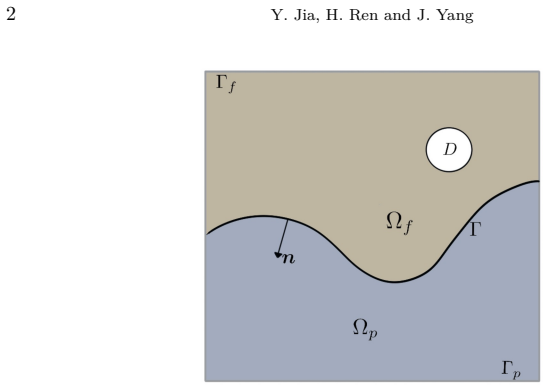
This paper studies an inverse boundary value problem for a coupled Stokes-Darcy system modeling fluid-porous medium interaction, with an unknown solid object embedded in the free-flow region. We simultaneously recover the viscosity coefficient $\mu$, the interface $\Gamma$, and the internal object $D$ from localized boundary Cauchy data. A novel method based on the construction of an interior transmission problem is introduced, which can amplify the singularity of solutions. We establish a global uniqueness theorem, showing that all three unknowns are uniquely determined by the boundary measurements.
Editorial analysis
A structured set of objections, weighed in public.
Referee Report
Summary. The paper studies an inverse boundary value problem for a coupled Stokes-Darcy system modeling fluid-porous medium interaction with an unknown solid object embedded in the free-flow region. It claims to simultaneously recover the viscosity coefficient μ, the interface Γ, and the internal object D from localized boundary Cauchy data by introducing a novel method based on the construction of an interior transmission problem that amplifies the singularity of solutions, and establishes a global uniqueness theorem showing that all three unknowns are uniquely determined by the boundary measurements.
Significance. If the result holds, this would constitute a notable contribution to inverse problems for coupled PDE systems, as the simultaneous recovery of a coefficient, an interface, and a subdomain from partial (localized) Cauchy data is technically demanding. The approach of using an interior transmission problem to generate solutions with controllable singularities offers a potentially reusable technique for other transmission or interface inverse problems in fluid mechanics.
Simulated Author's Rebuttal
We thank the referee for the careful reading and positive evaluation of the significance of our result on simultaneous recovery of μ, Γ, and D in the Stokes-Darcy system from localized Cauchy data. The referee notes that the interior transmission problem construction is potentially reusable; we agree this is a key technical feature. No specific major comments were provided in the report, so we address the overall assessment below.
Circularity Check
No significant circularity; uniqueness theorem is self-contained PDE analysis
full rationale
The paper claims a global uniqueness result for the triple (μ, Γ, D) recovered from localized Cauchy data on a Stokes-Darcy system. The method relies on constructing an interior transmission problem to produce controllable singularities that distinguish the unknowns. No parameter fitting occurs, no predictions are made from fitted inputs, and no load-bearing steps reduce to self-citations or self-definitional loops. The derivation is a standard inverse-problem uniqueness argument via special solutions and density arguments; it does not rename known results or smuggle ansatzes via prior self-work. The central claim therefore stands as independent mathematical content rather than a tautology.
Axiom & Free-Parameter Ledger
axioms (1)
- domain assumption The coupled Stokes-Darcy system admits well-posed solutions in appropriate Sobolev spaces under standard interface conditions.
Reference graph
Works this paper leans on
-
[1]
Alvarez, C
C. Alvarez, C. Conca, L. Friz, O. Kavian, and J. H. Ortega , Identification of immersed obstacles via boundary measurements , Inverse Problems, 21 (2005), pp. 1531–1552
2005
-
[2]
Astala and L
K. Astala and L. Päivärinta , Calderón inverse conductivity problem in the plane , Annals of Mathematics, 163 (2006), pp. 265–299
2006
-
[3]
Badia, N
A. Badia, N. Moulin, R. Ferrier, C. Descamps, and S. Drapier , A level-set/fem approach for particle bed growth in stokes–darcy suspension filtration , Applied Mathematical Mod- elling, (2024)
2024
-
[4]
A. P. Calderón , On an inverse boundary value problem , in Seminars on Numerical Analysis and its Application to Continuum Physics, Rio de Janeiro, 1980, Sociedade Brasileira de Matemática, pp. 65–73
1980
-
[5]
Caro and T
P. Caro and T. Zhou , Global uniqueness for an ibvp for the time-harmonic maxwell equations , Analysis & PDE, 2 (2014), pp. 375–405
2014
-
[6]
D’Angelo and P
C. D’Angelo and P. Zunino , Robust numerical approximation of coupled stokes’and darcy’s flows applied to vascular hemodynamicsand biochemical transport , ESAIM: Mathematical Modelling and Numerical Analysis, 45 (2011), p. 447–476
2011
-
[7]
H. Heck, X. Li, and J. N. W ang , Identification of viscosity in an incompressible fluid , Indiana University Mathematics Journal, 56 (2006), pp. 2489–2510
2006
-
[8]
O. Y. Imanuvilov and M. Yamamoto , Global uniqueness in inverse boundary value problems for the navier-stokes equations and lame system in two dimensions , Inverse Problems, 31 (2015), p. 035004
2015
-
[9]
Isakov, Inverse Problems for Partial Differential Equations (2nd ed.) , Springer, New York, 2006
V. Isakov, Inverse Problems for Partial Differential Equations (2nd ed.) , Springer, New York, 2006
2006
-
[10]
Y. Jia, C. Wu, H. Wu, and J. Yang , Recovering discontinuous viscosity coefficients for inverse stokes problems by boundary measurements , submitted, (2025)
2025
-
[11]
Jiang and Y
N. Jiang and Y. Li , An efficient scalar auxiliary variable partitioned projection ensemble method for simulating surface-groundwater flows , Mathematics and Computers in Simula- tion, 221 (2024), pp. 39–54
2024
-
[12]
Kohn and M
R. Kohn and M. Vogelius , Determining conductivity by boundary measurements , Communi- cations on Pure and Applied Mathematics, 37 (1984), pp. 289–298
1984
-
[13]
M. Kohr, G. P. Sekhar, and W. L. Wendland , Boundary integral equations for a three- dimensional stokes–brinkman cell model , Mathematical Models and Methods in Applied Sciences, 18 (2008), pp. 2055–2085
2008
-
[14]
R. Y. Lai, G. Uhlmann, and J. N. W ang , Inverse boundary value problem for the stokes and the navier-stokes equations in the plane , Archive for Rational Mechanics and Analysis, 215 (2015), pp. 811–829
2015
-
[15]
Li and J
X. Li and J. N. W ang , Determination of viscosity in the stationary navier-stokes equations , Journal of Differential Equations, 242 (2007), pp. 24–39
2007
-
[16]
Moraiti , On the quasistatic approximation in the stokes–darcy model of groundwater– surface water flows , Journal of Mathematical Analysis and Applications, 394 (2012), pp
M. Moraiti , On the quasistatic approximation in the stokes–darcy model of groundwater– surface water flows , Journal of Mathematical Analysis and Applications, 394 (2012), pp. 796–808
2012
-
[17]
Nakamura and G
G. Nakamura and G. Uhlmann , Global uniqueness for an inverse boundary problem arising in elasticity , Inventiones Mathematicae, 118 (1994), pp. 457–474
1994
-
[18]
Pichler , An inverse problem for maxwell’s equations with lipschitz parameters , Inverse Problems, 34 (2018), pp
M. Pichler , An inverse problem for maxwell’s equations with lipschitz parameters , Inverse Problems, 34 (2018), pp. 1–21
2018
-
[19]
Sylvester and G
J. Sylvester and G. Uhlmann , A global uniqueness theorem for an inverse boundary value problem, Annals of Mathematics, 125 (1987), pp. 153–169
1987
-
[20]
Wilbrandt , Stokes-Darcy equations, Birkhäuser/Springer, Cham, 2019
U. Wilbrandt , Stokes-Darcy equations, Birkhäuser/Springer, Cham, 2019
2019
-
[21]
J. Yang, H. Zhang, and B. Zhang , Uniqueness in inverse acoustic and electromagnetic scattering by penetrable obstacles with embedded objects , Journal of Differential Equations, 265 (2018), pp. 6352–6383
2018
discussion (0)
Sign in with ORCID, Apple, or X to comment. Anyone can read and Pith papers without signing in.